It Doesn't Have To Be Right…

… it just has to sound plausible


3 Comments

Undersea habitats, full stops and low humour – a little more on Fantasycon 2010

It occurred to me reading my last post on Fantasycon 2010 that the convention was more than just the hotel and the books I purchased. I spent the weekend in the company of a couple of hundred people, all of whom are interested enough in genre fiction to spend a weekend dedicated to it in a hotel. So I really should mention a few of those people. Unfortunately, my memory is not what it once was – well, obviously, it’s still a memory, but it’s no longer as effective as it once was. Or at least, no longer as effective as memory insists it once was…

I arrived at the con around mid-afternoon – it’s an easy journey for me to Nottingham. There weren’t many people about but after about an hour sat in the bar I spotted my first friendly face: Mark Harding. He admitted he’d been in the hotel since the night before. Over the course of the evening, the bar began to fill with con-goers. I spoke with: Mark about projects we were each working on; Gavin Smith, author of Veteran, about role-playing games, underwater holidays and technical diving; Allen Ashley about Catastrophia and collaborations; Neil Williamson and Andrew Hook and Jasper Kent, author of Twelve and Thirteen Years Later, about writing… and no doubt other subjects, and with other people. See above re memory.

Most of Saturday I spent in the bar and in the dealers’ room. When I wasn’t browsing through the stocks of the various dealers, I was chatting to Roy Gray on the Interzone table. Andy Remic turned up for the day, as did Mark Charan Newton. Andy finally saw my review of Ian Whates’ anthology Conflicts in Interzone. In response to my comment on his story, he asked, “What’s wrong with low humour?” Nothing, Andy. The review of Conflicts generated a couple of conversations over the weekend (that might even be ironic…) – it was interesting seeing how different people preferred different stories. But that’s the nature of anthologies. I also chatted to Colin Harvey, author of Winter Song and Damage Time (which was launched by Angry Robot at Fantasycon; as was Andy’s Soul Stealers), some of the Angry Robot people, Chris Teague of Pendragon Press, Gary Couzens (who’d attended the Worldcon in Melbourne), and a few members of The T-Party, a writing group in London.

After we got back from the Thai restaurant, we waited for the banquet to finish so we could attend the awards ceremony. But we discovered that would mean standing up for the duration as all the seats were taken by those who’d attended the banquet. So we went back to the mostly-deserted bar. Which soon filled up, once the awards ceremony was over. I remember an interesting conversation with Terry Edge about writing workshops and the way in which rules of punctuation are often broken by successful writers. I lasted until about midnight before calling it a day.

The Sunday was a much quieter day and, like the day before, was spent mostly in the bar or dealers’ room. I forget how I spoke to and about what, although I do remember discussing poetry with Gaie Sebold. I’d planned to leave about three p.m., but the raffle took longer than I’d expected, so I didn’t actually catch a train until 4:40 p.m.

That was Fantasycon (redux): a series of conversations on a variety of topics (most were writing-related), some of which were lubricated by beer, some not. I don’t generally attend programme items – I keep promising myself I’ll go to more of them, but I usually fail. Because I enjoy sitting in the bar, chatting to friends and meeting new people.

And buying books, of course…


9 Comments

Space frogmen, magnetic shower-curtains and jugs – Fantasycon 2010

So that was Fantasycon. It was my first. Sort of. I turned up for just the Saturday of Fantasycon 2008, but this year I stayed in the hotel for the entire weekend. For a couple of reasons: first, I didn’t go to the Eastercon, so this was my first, and probably only, con of the year; and second, they were launching Catastrophia, which contains one of my stories, at Fantasycon.

For a number of years, Fantasycon has taken place in the Britannia Hotel in Nottingham, which is actually where the first con I ever attended took place. Back then it was called the Albany. The convention was Mexicon 3 in 1989. At the time, I was living in Mansfield, “that once-romantic, now utterly disheartening colliery town” as DH Lawrence puts it. (It’s actually my home town.) I’d seen mention of Mexicon in Matrix, the BSFA newsletter, and since I’d never been to a convention before, I decided to give it a go. I bought a membership, and drove into Nottingham each day. It wasn’t the best way to attend a science fiction convention, but I haven’t looked back since.

Next year, however, Fantasycon won’t be in Nottingham, but in Brighton. Which is a bit of a shame, as Nottingham is much more convenient for me. Having said that, the Britannia is a bit of a dump. It’s a 1970s Brutalist tower block, so it looks great from the outside but the interior is showing its age; and it appears as though it was last refurbished about twenty years ago. There is, for example, a room off the main Forum Bar, used to access the function rooms at the rear of the hotel, which looks as though it once was a posh restaurant. Bizarrely, it has no windows. There are just tables and these strange niches containing banquette seats with colourful upholstery. It’s a wide corridor with tables lining it. During one conversation during Fantasycon, Neil Williamson and I decided that the hotel should put all the interior décor back as it was when the place opened in 1969, and make it into a 1970s experience. (But not with nylon sheets, I could never sleep in a bed with nylon sheets.)

While the building itself might not be up to much, the staff were friendly, the breakfast was plentiful, and the bottled Coronation Street real ale was very drinkable, so I’ve no real complaints. Having said that, every time I stay in hotels, I’m always surprised by the dwarf showers. I’m not especially tall, but the showerheads in hotel showers are always fixed to the wall at about the level of my chin. I remarked on this as I was heading down in the lift to breakfast on the Saturday. To which the diminutive Ian Watson replied, “For you, perhaps.”

The other thing about hotel showers I always forget is the magnetic shower-curtain. As soon as you step into the tub, it attaches itself to you and tries to envelop your body. Having a shower is a constant battle with a sheet of thin plasticised material. You daren’t turn to face it in case it glues itself to your face and asphyxiates you. Who needs knife-wielding psychos in the bathroom when you can be attacked by a magnetic shower-curtain? If Hitchcock were still alive, he’d make a film about it. I’m sure of it.

I also had the usual problem with the keycard for my hotel room, which required five trips down to the reception over the Friday and Saturday. It wasn’t as bad as the Hilton during the 2009 Eastercon in Bradford. My door lock there broke so often I ended up on first-name terms with the maintenance man.

I spent most of Fantasycon, as is usual at conventions, in the bar chatting to people. The various conversations I had seemed to revolve around writing more than is usually the case at an Eastercon. Most of the people I met were writers, so perhaps that’s why. I only made a single programme item, which was about short stories. A group of us ventured out of the hotel on both the Friday night and the Saturday night for food – Indian the first night, and Thai the next. The Indian wasn’t up to much. We walked into the restaurant and saw it was deserted. When we remarked on this, the waiter said, “Wait until 4 a.m.” That didn’t bode well, but we stayed. The food was nothing special. The Thai, however, was very good. The restaurant’s toilets were marked “Gent” and “Lady”, which amused us more than it should have done.

Highlight of the weekend for me was the Catastrophia launch on the Saturday afternoon. Because I have a story in it. PS Publishing were actually launching seven books that afternoon, Catastrophia being only one of them. There were about half a dozen of us Catastrophia contributors there for the launch. We sat at a long table, people bought the book and then moved down the table collecting our signatures. It took me a few goes to get my signature right – in fact, I ended up writing an exemplar on the back of the little piece of card giving my name so I knew how my book-signing signature was supposed to look. Obviously, I didn’t want to sign books with the same signature I use on cheques. One of the other PS books being launched was Cinema Futura, an essay collection on sf films. The contributors to that book – again not all of those in the book – sat at another long table on the opposite side of the bar. When it look liked our line had died down, I bought a copy and dashed across the room to get it signed. I can’t show you Catastrophia because I’ve not received my contributor copy yet. But you can be sure I’ll be sticking photos of it up here when I do.

The only other programme item I made was the raffle, compered entertainingly by Guy Adams. I was only there because I’d been given five tickets. Happily, I won two items, both of which I was quite pleased about and shall be keeping. (Sorry, Roy.)

Those two weren’t the only books I got at Fantasycon, of course. I bought a number. I actually purchased less than I usually do at cons, perhaps because I’m more of a sf fan than a fantasy/horror fan, and so there were less books which were likely to appeal to me. But there were some I wanted; others just caught my eye. You can probably guess which are which.

Three small press books: Terry Grimwood, Andrew Hook and Mark Harding were all at Fantasycon. I’m not sure what The Places Between and Ponthe Oldenguine are about, or even how the latter’s title is pronounced; but they looked interesting. Music for Another World is an anthology which doesn’t contain a death metal hard sf story by Yours Truly, but I got a copy anyway.

Another three small press books: Silversands is Gareth L Powell’s first novel, and is a handsomely-produced signed hardback from Pendragon Press. Ultrameta by Douglas Thompson sounded really interesting; and Cinema Futura I’ve already mentioned – it contains a sixty entries on science fiction films by science fiction writers.

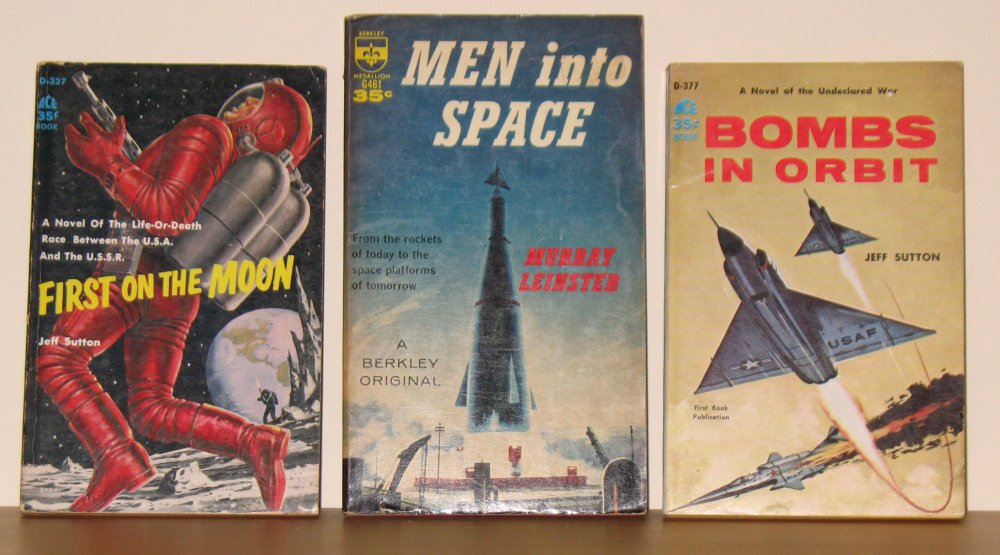
I couldn’t resist these three. First On The Moon is Jeff Sutton’s debut novel from 1958, and Bombs in Orbit is his second from 1959. They’re Cold War sf novels. Those jets on the cover of Bombs in Orbit are clearly Convair F-102 Delta Daggers. Men into Space is apparently based on a television series of the same name.

It wasn’t just the F-102s on the cover which inspired me to buy this book. As soon as I saw “SPACE FROGMEN!”, I knew I had to have it. So I did.

Another three 1950s sf novels. The Worlds of Eclos is by Rex Gordon, a British sf author of the 1950s and 1960s who seems to be mostly forgotten now. A review of his No Man Friday will be appearing on this blog soon-ish. Time to Live is one half of an Ace double, back-to-back with Lin Carter’s The Man Without A Planet. Rackham is another forgotten British sf author of last century. The White Widows by Sam Merwin Jr is the book which Beacon Books “spiced up” and published as The Sex War (see here). I plan to read both, and perhaps write about the differences.

I won this in the raffle. It’s a nice sturdy box which contains eight issues of the magazine Murky Depths – which, among other things, has published a graphic novel version of Richard Calder’s Dead Girls. I’m looking forward to reading the issues.

So that’s the Fantasycon book haul. And that was Fantasycon. I had a good time, and I might well go next year. We shall see…

Ah yes, the “jugs” in the title of this blog post… That’s from a conversation about music which took place on the Saturday. I wanted Neil Williamson to listen to something on my iPod, but he said he didn’t have his headphones with him. I suggested getting mine, pointing out they weren’t earbuds, just normal headphones. Nor were they those big ones, jugs, that sit over the entire ear. I actually meant “cans”. But after that slip, headphones became known as jugs for the duration of the weekend.


Leave a comment

I am not a book blogger…

… but I am a book lover, and I have on occasion reviewed books on this here blog over the past four years. So I thought it might be a useful exercise to list those book reviews which can be found here. Alphabetically by author. And then chronologically by title within author. Of course. Because that’s how book collections should always be organised.

Since the books I’ve written about are a somewhat varied collection – no fascination for the shiny new here, you know – I’ve included the original year of publication of the books in brackets after the title.

Click on the titles to see the reviews.

Abercrombie, Joe: The Blade Itself (2006)
Attanasio, AA: Radix (1981)

Banks, Iain (M): Against A Dark Background (1993)
Banks, Iain (M): Matter (2008)
Banks, Iain (M): Transition (2009)
Blish, James: Jack of Eagles (1952)

Chabon, Michael: The Yiddish Policemen’s Union (2007)
Clarke, Arthur C: Rendezvous with Rama (1972)
Cobley, Michael: Humanity’s Fire 1: The Seeds of Earth (2009)
Cobley, Michael: Humanity’s Fire 2: The Orphaned Worlds (2010)
Compton, DG: Chronocules (1970)
Compton, DG: The Continuous Katherine Mortenhoe (1974)

Delany, Samuel R: Dhalgren (1975)
Dickson, Gordon R: the Dorsai trilogy (1959 – 1971)
Durrell, Gerald: My Family and Other Animals (1956)
Durrell, Lawrence: Pied Piper of Lovers (1935)

Eddings, David: Belgariad 1: Pawn of Prophecy (1982)
Ellis, Warren & Gianluca Pagliarani: Aetheric Mechanics (2008)

Farmer, Philip José: To Your Scattered Bodies Go (1971)
Ford, Ford Madox: The Good Soldier (1915)
Foster, Alan Dean: The Tar-Aiym Krang (1972)

Gibson, Gary: Shoal Sequence 3: Empire of Light (2010)
Greenland, Colin: Take Back Plenty (1990)

Harrison, Harry: The Stainless Steel Rat (1961)
Heinlein, Robert: Starship Troopers (1959)
Heinlein, Robert: Stranger in a Strange Land (1961)
Herbert, Frank: Dune (1965)
Highsmith, Patricia: The Talented Mr Ripley (1955)
Hobb, Robin: The Assassin’s Apprentice (1995)
Holdstock, Robert: Where Time Winds Blow (1981)

Jarmain, John: Priddy Barrows (1944)
Jones, Gwyneth: Escape Plans (1986)
Jones, Gwyneth: Kairos (1988)
Jones, Gwyneth: Spirit (2008)

Kadrey, Richard: Metrophage (1988)
Kerouac, Jack: On the Road (1957)
Kipling, Rudyard: Kim (1901)

Le Guin, Ursula K: The Left Hand of Darkness (1969)

MacLeod, Ken: The Night Sessions (2008)
McCarthy, Cormac: The Road (2006)
Martin, George RR: A Song of Ice and Fire 1: A Game of Thrones (1996)
Mercurio, Jed: Ascent (2007)
Morgan, Richard: Black Man (2007)

Niven, Larry: Ringworld (1970)

Park, Paul: Coelestis (1993)
Parker, KJ: Fencer trilogy 1: Colours in the Steel (1998)
Powell, Anthony: A Dance to the Music of Time 1: A Question of Upbringing (1951)

Rand, Ayn: The Fountainhead (1943)
Russell, Sean: Swans’ War 1: The One Kingdom (2001)

Scott, Paul: Raj Quartet 1: The Jewel in the Crown (1966)
Silverberg, Robert: Lord Valentine’s Castle (1980)
Simak, Clifford D: Time and Again (1951)
Smith, EE ‘Doc’: Second Stage Lensman (1941 – 1942)
Stephenson, Andrew M: Nightwatch (1977)
Swanwick, Michael: Stations of the Tide (1991)

van Vogt, AE: The Mating Cry (1950, AKA The Undercover Aliens / The House That Stood Still)
Vance, Jack: Demon Princes 1: Star King (1964)
Varley, John: The Ophiuchi Hotline (1977)

Wolfe, Gene: The Book of the New Sun (1980 – 1983)
Woolf, Virginia: Orlando (1928)

I also review books for Interzone – but you’ll have to buy the magazine to see those; and for the last few months I’ve been posting book reviews to the reviews section of SFF Chronicles here.

I have a few books lined up about which I intend to write on this blog over the next few weeks – a trio of old British sf novels; Gwyneth Jones’ Bold as Love Cycle and the rest of my summer reading project; and – well, why not? after all, it’s not really suitable for my Space Books blog – I might even write about Seven Miles Down, the book about the Trieste’s descent into Challenger Deep… And I really must write more about my favourite authors, too.


3 Comments

Look what the postie brought

Book haul time again. It’s been a month since the last one, so once more you get to see what new items I’ve added to my already-groaning bookshelves. Instead of a single photo, I’ve broken it down this time into several pictures.

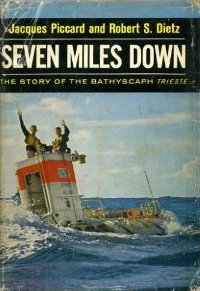
First up is a trio of non-fiction books: Personal Landscapes by Jonathan Bolton, a study of British poets in Egypt during the Second World War (poets such as Lawrence Durrell, Keith Douglas, John Jarmain, Terence Tiller, Bernard Spencer, and others); a signed copy of A Short History of Lyme Regis by John Fowles, for the collection (see here); and Seven Miles Down by Jacques Piccard & Robert S Dietz, the only book written about the bathyscaphe Trieste‘s descent to the floor of Challenger Deep fifty years ago (see here).

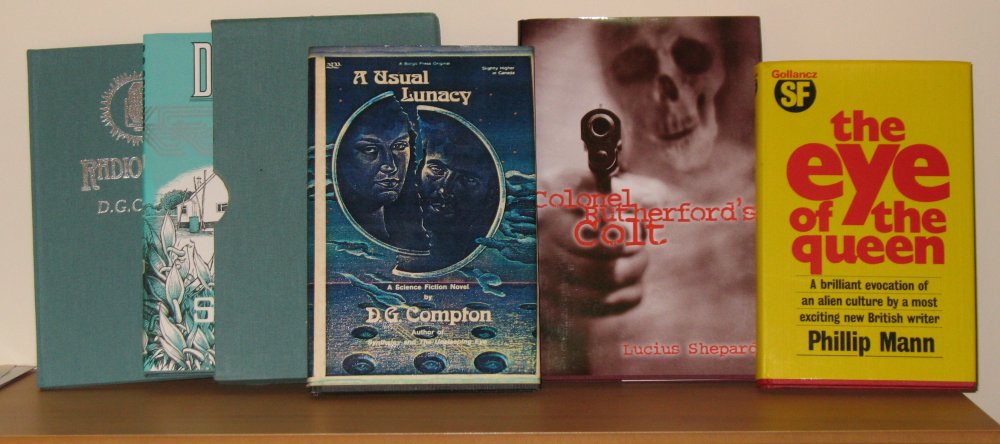
Next up is four first edition genre novels. On the right is a signed and numbered slipcased edition from Kerosina Books of DG Compton’s Scudder’s Game, which also includes Radio Plays. In front of it is A Usual Lunacy, also by DG Compton and signed, and published by Borgo Press. Next is Colonel Rutherfords’ Colt by Lucius Shepard, for the Shepard collection (see here). Finally, Phillip Mann’s The Eye of the Queen, which completes my Mann collection (expect a book porn post on his novels soon).

Here are a couple of old British sf novels which were listed on my British SF Masterworks list (see here). No Man Friday by Rex Gordon I’ve had for a couple of months, but A Man of Double Deed by Leonard Daventry is a recent purchase. Expect reviews of both to appear on this blog soon. In fact, I intend to review most of the books on my British SF Masterworks list, the hard-to-find old and obscure ones almost certainly.

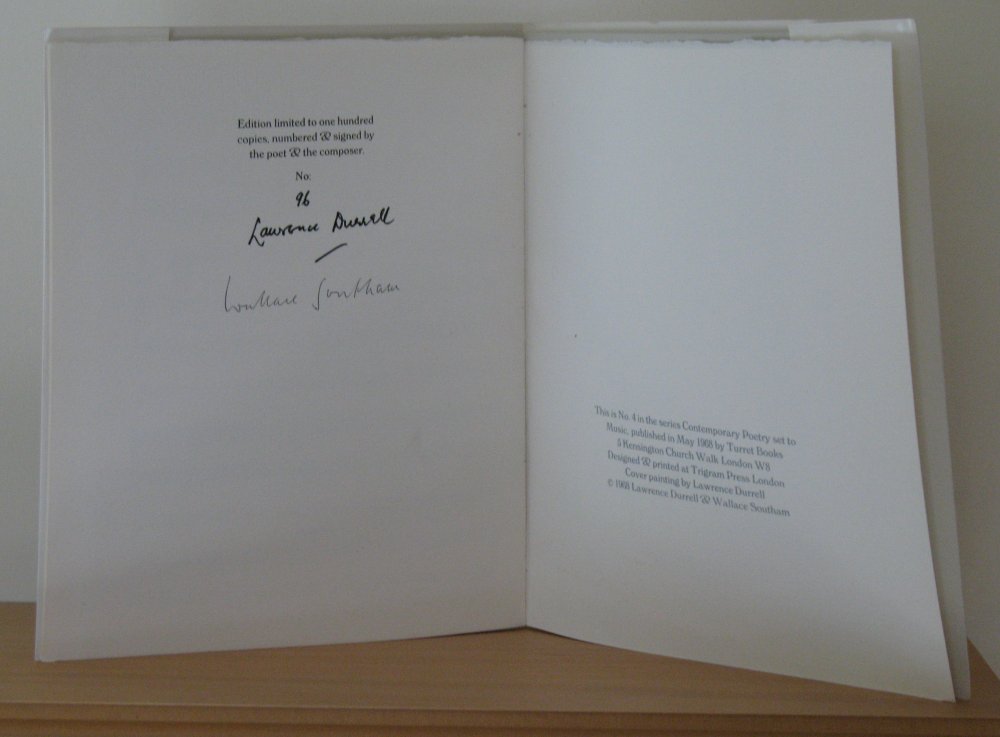
This is In Arcadia, a signed and numbered chapbook published in 1968 by Turret Books. It contains the eponymous poem by Lawrence Durrell, and music by Wallace Southam. The pair did two such chapbooks – I’ve had the other one, Nothing is Lost, Sweet Self, for a while (see this Lawrence Durrell collection post here).

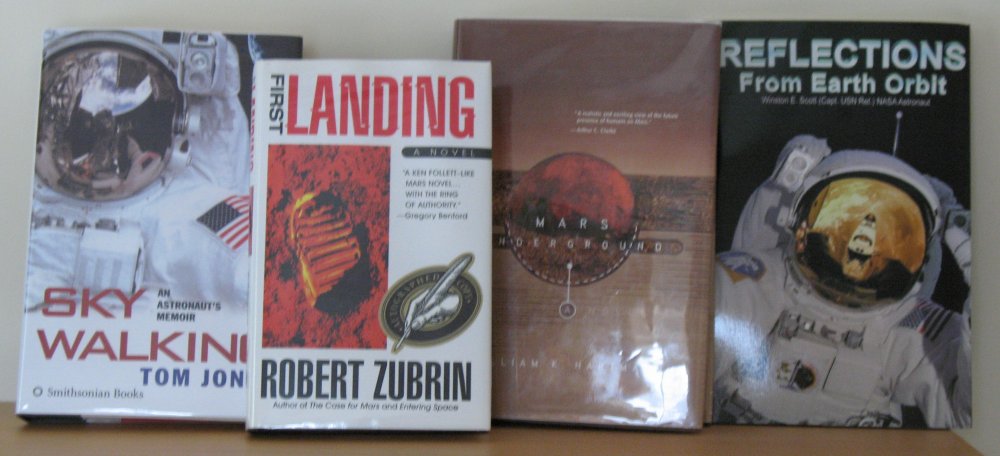
And finally, here are four books for the Space Books collection. Sky Walking is astronaut’s Tom Jones’ memoir (no, not that Tom Jones, another one; the name, well, it’s not unusual). First Landing is a sf novel about the, er, first landing on Mars, by Robert Zubrin, an expert on the topic. Mars Underground by William K Hartmann is also about settling the Red Planet but is non-fiction. And last of all, Reflections from Earth Orbit by Winston E Scott is another astronaut autobiography. All four books are signed.


2 Comments

Let’s hope it pays off…

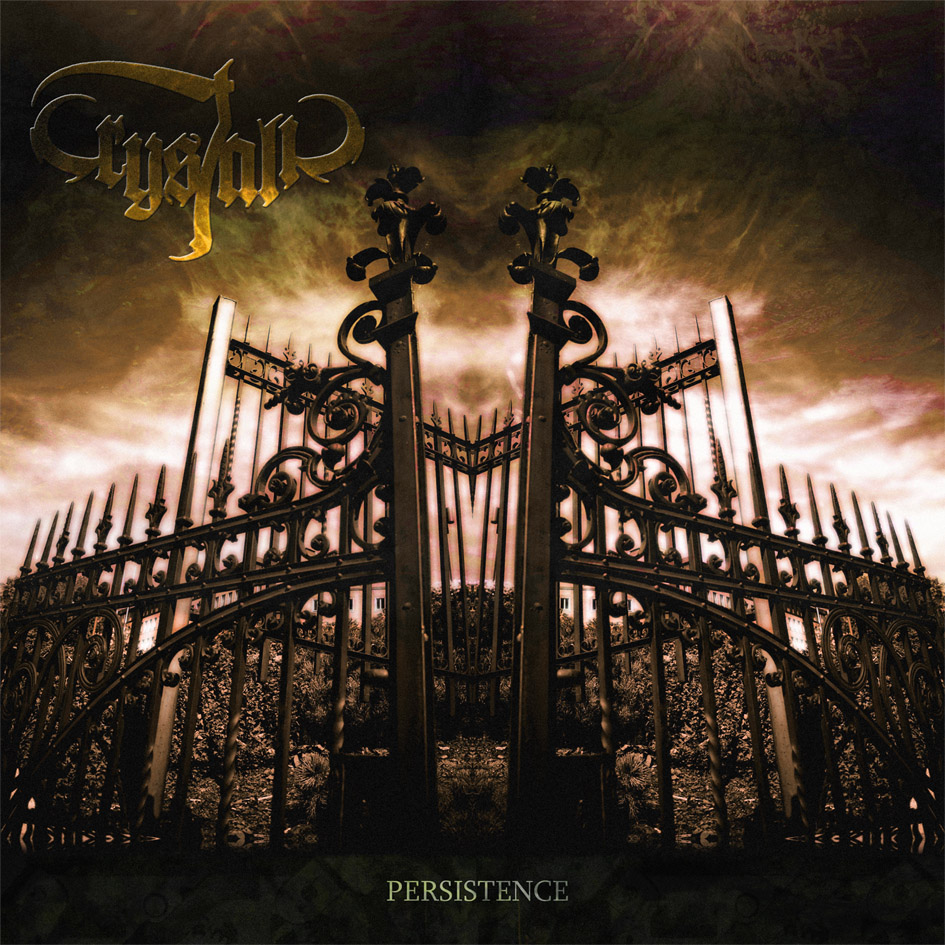
Crystalic is melodic death metal band from Tampere in Finland. I’ve liked their music since stumbling across one of their demos a few years ago. In 2007, they released an album, Watch Us Deteriorate, on a small label. I bought it. Apparently, things have not been good since then and they no longer have a record deal. So they’re giving away their new album, Persistence, on their website here. It’s very good. Download it, listen to it, and spread the word.

The band are also going to self-release the album as a limited edition CD, which you can pre-order here. I’ve put my order in already.


4 Comments

I’ve suffered for my research, now it’s your turn

I promised myself that during August I’d have a go at writing a space opera – you know, a proper one, with giant spaceships, aliens, awesome weaponry… that sort of thing. Not just because I enjoy reading such stories and would like to write one of my own, but also because I could make it all up. I mean, what would I need to research? The laws of physics? Most space opera stories ignore those pretty much, anyway. I could just take the story, and fly with it.

Sadly, I didn’t manage it. Instead, I wrote the first drafts of two stories – one set at the bottom of the Pacific Ocean, and the other about the exploration of Mars. (This was on top of ongoing work on a novelette and a novel.)

Both stories required a lot of research.

The Mars one was the easier of the two. There’s plenty of material online – there’s even a Google map of Mars. Plus, I have several books on the exploration of the Red Planet: Mission to Mars, Michael Collins (I reviewed it here); The Case for Mars, Robert Zubrin; Mars 1999, Brian O’Leary; and Mars Underground, William K Hartmann. So I had lots to read in order to make my fictional trip to Mars, and subsequent surface exploration, as accurate and authentic as possible.

The story set on the floor the Mariana Trench, which I’ve been referring to as my “bathypunk” story, was much harder to research. It seems bizarre that more information is available about Mars than about the bottom of the Pacific, but that does seem to be the case.

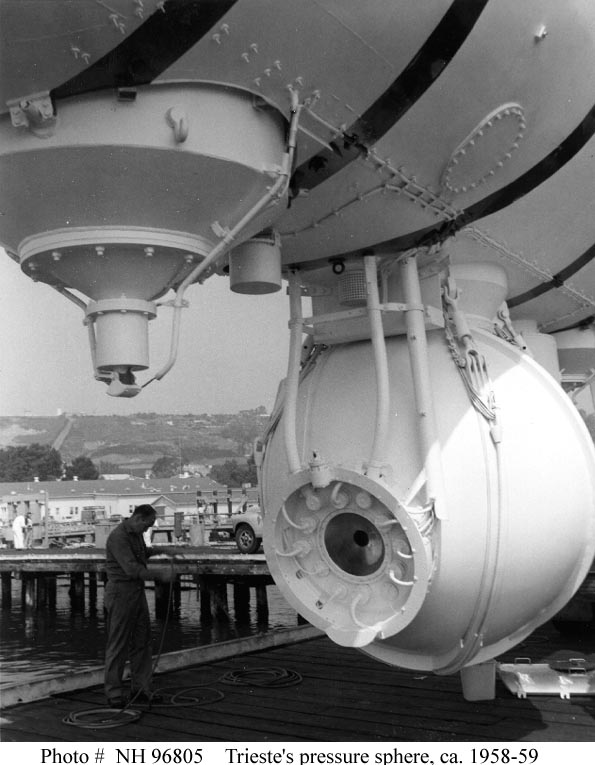
I forget where I first stumbled across mention of the bathyscaphe Trieste, which dived 35,767 feet to the floor of  Challenger Deep, the deepest part of the ocean on the planet, in January 1960. But the whole thing struck me as fascinating. Perhaps it was due in part to that recent, and terrible, BBC series, The Deep. However, what’s most astonishing about the Trieste‘s achievement is that it’s never been repeated. As one book says: hundreds of people have reached the summit of Everest, twelve men have walked on the Moon, but only two men have ever visited the deepest part of the ocean.

This January was the fiftieth anniversary of the Trieste‘s descent, but it’s been a curiously low-key celebration. There’s a very nice website here. But, while the fortieth anniversary of the Apollo 11 resulted in the publication of a number of books (see here), there’s been nothing about Jacques Piccard and Don Walsh’s trip 36,000 feet down, where the pressure is close to seven tons per square inch, on the floor of Challenger Deep. The best account I’ve found online is this, the Google Books scan of a contemporaneous article in Life Magazine, dated 15 February 1960 and written by Don Walsh himself.

This made researching my story a great deal harder than I’d expected. Yes, writing most varieties of science fiction requires research. Getting the details right in, for example, spacecore – I invented the term, so I’m going to damn well use it – is important. Happily, there’s plenty of information available online – the Apollo Lunar Surface Journals, for example – and I also have loads of books on the topic. But for my bathypunk story, I wanted to know the answer to a simple question: what are the actual physical dimensions of Challenger Deep? It’s described as a “bathtub-shaped slot” in the floor of the Mariana Trench; but I can’t find how deep that slot is, how long it is, or how wide. There’s even doubt as to whether it’s the deepest part of the Mariana Trench – the Wikipedia articles on it, Challenger Deep, and the Trieste all appear somewhat contradictory.

In the end, I had to resort to ordering a copy of Seven Miles Down, by Jacques Piccard and Robert S Dietz. It was published in 1961, and appears to never have been republished since – not even for the fiftieth anniversary of the Trieste‘s descent. There was a Scientific Book Club edition in 1963, but that apparently doesn’t include the photographs in the original. Seven Miles Down is pretty damn rare. And expensive. Admittedly, I really do want to read the book, even if my bathypunk story, er, sinks without trace (although I’d sooner it didn’t, of course).

They say you should write about what you know. But, let’s face it, that would make for pretty boring fiction. And not just by me. It also makes little sense if you’re writing science fiction. Unless “what you know” can be read as “shit you make up that no one else has ever made up before”. Which is much harder than it sounds, and not always effective. Because how do you know that something you’ve just made up isn’t, well, wrong? You’ve just dreamt up this great idea: it’s sort of like a planet, but it’s actually a humungous ribbon which goes all the way around a star and people live on the inside surface of it… It’s a ringworld. And then someone reads your book featuring this ringworld and works out that it’s inherently unstable as described… Oops. Should have researched it.

Admittedly, it’s easy to get bogged down in the research for a story. And I actually enjoy reading about the stuff around which I base my stories. Sometimes, I’m already interested in a subject when an idea for a story comes to me – all those books I collect for my Space Books blog have inspired a few ideas, not all of which have become stories. Other times, something I read sparks an idea, which in turn requires research before I can make a story of it – like my bathypunk story, or ‘The Amber Room’ (see here). Then there are the ones where the idea comes out of nowhere, sometimes fully-formed, but usually vague and incomplete…

When I started this post, I’d intended to write about my experience in researching two different short stories, but I seem to have drifted from the point. Nonetheless, having read back over what I’ve written here, I’m now more determined then ever to see if I can write that space opera story, one where I can just make it all up, one that requires no research at all. Wish me luck.


4 Comments

There’s something moving in sf

There’s an interesting Mind Meld this week on SFSignal about “The Next Big Trend/Movement in SF/F Literature”. You can find it here. I noticed that my jetpunk (see here) doesn’t get a mention – although it has here in a post by Dr Nader Elhefnawy, which I suppose means it’s sort of arrived…

To be honest, jetpunk wasn’t an entirely serious suggestion, and I wrote the post chiefly because I liked the title “Vulcan Bombers in Space” and I wanted to post some pictures of cool aeroplanes. But I do think there’s room for some interesting fiction to be written in there – especially given that retro sf usually either means visions of the future from the 1930s – 1940s, or, well, steampunk and dieselpunk. The 1950s and 1960s were, I think, more interesting technologically, and some of the futurism from those decades would make for excellent science fiction.

(Source: Douglas Holland's Aerospace Site)

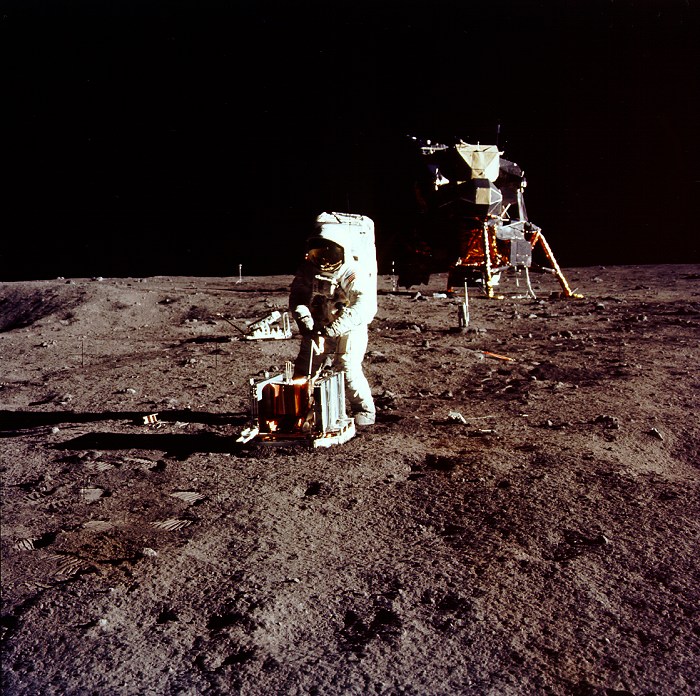
All of which got me thinking about other “movements” and what inspires me to write science fiction and what I try to put into my stories. I like the hardware, I freely admit it – I have all those books about the Apollo programme because I find the spacecraft, and the way they work, fascinating – the technology, the engineering, the science… and how that does what it does for those who use it. The hardware I find inspirational, but it’s the people using it I try to write about it.

And all those books about Apollo I’ve read persuaded me to try writing sf which was as realistic as I could possibly make it. Not Mundane sf – because I want to still use some of the genre’s tropes, like faster-than-light travel or aliens. But I wanted to show that space is a hostile environment, that getting out of gravity wells is difficult, that human beings can only operate in space because of the science and technology and engineering. And since I’d been thinking about trends and movements, I decided this should be called… spacecore.

(Source: NASA)

Then I had an idea for another story, but this time set in the depths of the ocean – which again is as much about technology as it is about people since the ocean depths are as inimical an environment as space. I was going to title the story ‘Base Under Pressure’, but that really is the worst short story title ever. Anyway, I thought, stories set at the bottom of the sea need a name too. How about bathypunk?

(Source: SEVEN MILES DOWN, Jacques Piccard & Robert S Dietz)

At which point, I decided – and had pointed out to me by friends – it was all getting a bit silly. To tell the truth, my sf stories are hardly written down a single line in the genre anyway: the Euripidean Space stories are near-future hard sf; ‘Killing the Dead’ is set in a generation starship; ‘The Amber Room’ features alternate universes; ‘Through the Eye of the Needle’ is near-future post-catastrophe… And the novels I’ve delivered to my agent are steampunk-ish space opera.

Also, movements and labels tend to be applied after the fact by commentators and critics. They point to a group of writings and decide they are enough alike to deserve a common term to describe them. Dreaming up a “-punk” or “-core” and then writing to it is apparently the wrong way to do it. Well, it is if you tell everyone that’s what you’ve done.

So I won’t. I’ll be thinking about jetpunk and spacecore and bathypunk and whatever other ones I dream up as I’m bashing out my stories. I’ll be thinking about the hardware and the people who use it. And if others do the same, if that means there’s a little less magic in sf and a bit more, well, science and technology, then I’ll consider that a good thing. But it’s not like a movement or a bandwagon or anything.

Unless you want it to be.


3 Comments

Readings & watchings 8

July felt like a month of molasses – everything seemed a bit of a struggle. I thought I hadn’t read as much as usual, nor written as much. And yet, looking back, I seem to have read as many books as I typically do in a month. Perhaps I wasn’t exactly prolific on the writing-front during the same period – not that I ever am – but I did manage to start and finish a couple of new pieces. Happily, August felt a little better. Although, having said that, I’ve only just started on my Summer Reading Project (see here); and I’d planned to read the first book in July…

Anyway, you know how it goes: books wot I read and films wot I watched since the last post on this wot I wrote.

Books
The Continuous Katherine Mortenhoe, DG Compton (1975), I wrote about here.

Conflicts, edited by Ian Whates (2010), I reviewed for Interzone. A mixed bag: some good ones, but not so good – as I hope my review makes clear.

Hello Summer, Goodbye, Michael G Coney (1975), is Eric Brown’s favourite sf novel – he even managed to sneak it onto the Grauniad’s 1000 novels everyone must read last year. I’m surprised I’d not read this sooner. Coney’s name is not unknown to me, but I seem to have managed to avoid his novels over the years. Yet I vaguely recall having his books recommended to me at cons as much as twenty years ago. I should have read them then, because Hello Summer, Goodbye is good. The world-building is excellent, it’s well-plotted, and the characters are drawn well. It’s set on a world with extreme seasons and human-like people. Drove, a young teenager, and his parents have moved to Pallahaxi, a seaside town, because of the war with a neighbouring nation. The previous year Drove had fallen in love with a town resident, Browneyes, and he’s keen to renew his friendship with her. Which he does. He also learns more about the war, and about his world. Drove is admittedly a bit of a prat, and he matures surprisingly quickly about halfway through the book. But the ending is cleverly done. There’s a sequel, I Remember Pallahaxi, which I wouldn’t mind reading.

The Possibility of an Island, Michel Houellebecq (2005), is the second Houellebecq novel I’ve read and, while the story is different, it’s very much like Atomised. The same concerns – immortality and sex – are there, the same misanthropic and nihilistic tone is there. In this one, Daniel is a French comedian, fêted for his edginess. As he grows older, he finds his libido waning and his ennui waxing. By accident, he gets involved with the Elohimites, your typical nutjob alien-saviours/creators cult/religion. Except the Elohimits are serious about genetically-engineering humanity to be immortal, and have the scientific chops to make a proper job of it. Daniel takes on the role of documenting the Elohimites’ quest for immortality, an important aspect of the stopgap measure they introduce – as indicated by short interspersed chapters by Daniel26 (i.e., the 26th incarnation of Daniel). There’s something about Houellebecq’s writing which carries you through his novels – despite the misery; the unhealthy, and often misogynistic, focus on sex; and the weak sfnal ideas around which he builds his plots, and the unconvincing way he often deploys those ideas. I have Platform on the TBR.

Anna Mercury Volume 1: The Cutter, Warren Ellis & Facundo Percio (2009), and Ignition City Volume 1, Warren Ellis & Gianluca Pagliarani (2010), are a pair of mini-series collected as trade paperbacks. Both are sf. In Anna Mercury Volume 1: The Cutter, the title character is an agent of a secret organisation who travels to alternate Earths. There are apparently nine of these alternate Earths, and they were discovered when the USS Eldridge disappeared in 1943 during the Philadelphia Experiment. The means of travel used by Mercury means she has, effectively, superpowers. In this story, she’s attempting to prevent a war between two powers. The aggressors are the nation where the USS Eldridge arrived, and they’ve reverse-engineered the technology they glimpsed and built a cargo-cult around the ship’s appearance. Ignition City Volume 1 is, I think, the better of the two, although its premise isn’t as interesting, or off-the-wall, as the other one. It’s set in a post-Flash Gordon 1970s, after the Earth has fared badly since defeating Kharg (Ming, in other words). Flash Gordon is named Lightning Bowman, and he’s not heroic anymore. Mary Raven, daughter of another such space hero, has come to Ignition City to learn how her father died. He was murdered in his sleep, probably by Lightning Bowman. But why? There’s a brilliant exchange in this: when Mary meets the Professor Zarkov character and is invited into his house, she says, “… your house smells weird.” He replies, “It smells of SCIENCE.” I hope they do another series of this one. The art in both, by the way, is uniformly very good.

The Alteration, Kingsley Amis (1976). Ten-year-old Hubert Anvil is a chorister, with perhaps the best voice in Christendom, and so the abbot of his school decides he should have a glittering career as a singer. There’s only one thing that needs to be done first: castrate him. In the world of The Alteration, there was no Protestantism and so the Roman Catholic Church “rules” all of Europe. Technology has reached about mid-Victorian levels, although the book is set in 1976. Anvil’s impending “alteration” sets off a chain of events: he meets the pope, runs away from school, is abducted by a Jewish kidnapper who uses ransom money to finance Aliyah, and tries to escape to North America. Amis’ alternate world is cleverly done, there are some excellent sf in-jokes in the story, and the plot canters along at a comfortable pace. The writing’s a bit clumsy in one or two places, and the fact it’s a “satire” is plainly meant to justify the frankly disappointing ending. Still a fun read, though.

The Chimpanzee Complex Vol 3: Civilisation, Richard Marazano & Jean-Michel Ponzio (2010), is the final part of this French graphic novel trilogy, and… Something doesn’t quite add up. Parts one and two both had really cool ideas, but this one feels like it belongs to another story. It’s also a little odd reading a comic which doesn’t use decompression. I think I need to reread all three parts of The Chimpanzee Complex… and then I will write about it here. Maybe.

Starswarm, Brian W Aldiss (1964), is another attempt by Aldiss to do Last and First Men, much like he tried in Galaxies Like Grains of Sand. I like Aldiss’s fiction, and I have a high regard for it, but a month after reading this collection I can remember almost nothing of it.

Veteran, Gavin G Smith (2010). I met Gavin at alt.fiction (see here), and he arranged for me to be sent a review copy of this, his debut novel. My review is up on SFF Chronicles here. It’s not a book I enjoyed reading a great deal – I didn’t like the world, and I’m not a fan of military sf. It’s a polished debut, there’s no doubt about that; but it’s not for me.

The Inward Animal, Terence Tiller (1943), is a collection of Tiller’s poetry. There’s a faint stamp on the cover of this first edition which reads, ‘Burma Educational Bookshop, 549 Merchant Street, Rangoon’, so it’s not only come a long way in time but also in space to reach my bookshelves. The poems are war poems, inasmuch as they attempt what Tiller describes in a foreword as the three parts of a pattern of experience: “a shocked and defensive rebellion; reconciliation must follow; the birth of some mutual thing in which the old and the new, the self and the alien, are combined after war”. Tiller I find a very technical poet, a skilled practitioner of form and imagery, and The Inward Animal shows this more than his other collections. Several of the poems were composed in Cairo, where Tiller taught during World War II and was a member of both the Personal Landscape and Salamander groups.

Smiley’s People, John Le Carré (1980), I read because it was on one of those 1001 Books You Must Read Before You Die lists (but not the Grauniad one). I’ve read a number of Le Carré’s novels over the years but not, apparently, this one. I don’t think I even saw the BBC dramatisation, starring Alec Guinness as Smiley; although I wouldn’t mind doing so (in fact, I think I’ll stick it on the DVD rental list; and Tinker, Tailor, Soldier, Spy too). Anyway, as a novel, Smiley’s People was slow, and seemed to veer strangely from narrative to reportage and back. Le Carré also appeared more interested in Smiley-as-enigma than he did in the actual story. But it had a good sense of place, and the way the plot was slowly revealed was cleverly done.

Roads Not Taken, edited by Gardner Dozois & Stanley Schmidt (1998), is one of those anthologies cobbled together from recycled stories from Asimov’s. This one is themed and the theme is, er, alternate history. The usual suspects are all present and correct: Harry Turtledove, Mike Resnick and, um, Gene Wolfe. I got this book free from readitswapit.co.uk, which is just as well as it’s crap. It takes real skill as an editor to put together an anthology that contains not one single decent story, but they managed it with this one.

The Restoration Game, Ken MacLeod (2010), I enjoyed a lot more than I’d expected to. My review of it can be found at SFF Chronicles here.

Films
Moon, dir. Duncan Jones (2009), is the best film on the Hugo ballot for “Dramatic Presentation, Long Form” (what a horrible mouthful). I wrote about it here.

Surrogates, dir. Jonathan Mostow (2009), is your usual Hollywood tosh masquerading as science fiction. It embodies a couple of perversions which seem to be part of the so-called American Dream – a) true success for a company means dominating 100% of the market (which requires corrupting the legislature in order to make that legal); and b) any idealistic leader who opposes the successful company must be corrupt. I don’t think this is what neocons mean when they complain about “Hollywood liberals”. The surrogates of the title are near-indestructible robot bodies which people use every day – while they stay at home, safe and sound, operating their robot bodies through VR. Of course, the surrogates are prettified versions of the real people – except for star Bruce Willis’s surrogate, which actually looks quite creepy. Which is weirdly fitting, because the entire concept is creepy. Willis is a FBI agent tasked with investigating the bizarre murders of some surrogates – murders which also kill the surrogates’ operators. Definitely a film to avoid. But you knew that already because Bruce Willis has hair in it.

Battlestar Galactica: The Plan, dir. James Edward Olmos (2009), was, well, odd. I like Battlestar Galactica, I even like the hiccup ending they put in because of the writers’ strike; and I like the actual real ending which had so many people annoyed. Which is why I bought Battlestar Galactica: The Plan. It’s a feature-length television movie which tells the story of all four seasons of the television series from the point of view of the Cylons. And chiefly from the point of view of a pair of them played by Dean Stockwell. If you’ve not watched the TV series, you won’t understand this. If you have, you’ll wonder why they thought they needed to make it.

Humanoid Woman, dir. Richard Victorov (1981), was a rewatch, but I decided to write about it here as I hadn’t done so before. It’s an English-dubbed and much-mangled version of a Russian film, Через тернии к звездам (To The Stars By Hard Ways). There’s an official site here in Russian. A starship comes across the wreck of an alien ship. The crew explore the wreck, and find a number of dead humanoid bodies and a single survivor. This section was filmed underwater to simulate zero gravity – which works quite well, but does look weirdly murky. The survivor, Niya, is taken to Earth and invited to stay with a scientist, his family and crap-looking robot. She has lost her memory, but appears to have weird supernatural abilities such as teleportation. She recovers her memory, and remembers that she is from the planet of Dessa, which has suffered a catastrophic ecological collapse due to over-industrialisation. Earth puts together a rescue mission, with Niya, and heads for Dessa. But the Dessans are split into two warring factions, and one manages to control Niya telepathically. She breaks their control, and releases some sort of intelligent foam, which seems to clean up the planet. This is a very strange film, and I’m not entirely sure whether it makes sense. That may be an artefact of being mangled and dubbed for the English-language market, but I suspect the original Russian version was also very odd. A director’s cut with new special effects was apparently released a couple of years ago on DVD by the director’s son. If it was available with English subtitles, I’d seriously consider buying a copy.

Cargo, dir. Ivan Engler & Ralph Etter (2009), I reviewed for The Zone here. It is also the best sf film I have seen for several years, and should have been on the Hugo shortlist.

Gentlemen Broncos, dir. Jared Hess (2009), is by the director of Napoleon Dynamite. It’s about a sf fan and a sf writer. It is also stupid and rubbish. I reviewed it for VideoVista here.

Romeo & Juliet, dir. Alvin Rakoff (1978), is another one of the BBC’s Complete Works of Shakespeare adaptations. Like many of Shakespeare’s plays, the story is known by pretty much everyone. Likewise, almost everyone forgets a few details – as I had. Such as the fact that Juliet is only thirteen when she secretly marries Romeo. In this adaptation, the actress playing Juliet, Rebecca Saire, is close to that age – she’s fourteen. And Romeo, who is almost twice her age, snogs her repeatedly. Otherwise… John Gielgud’s plummy tones bookend the story as the chorus, Michael Hordern plays the head of the Capulets well, but both Romeo and Juliet are a bit bland, and Anthony Andrews hams it up shamelessly as Mercutio. Not one of the BBC’s better adaptations.

The Damned United, dir. Tom Hooper (2009), I watched because I’d read the book and I wanted to see how it differed. Not much. Although they did tone down the swearing quite a lot. The film also missed out some of the story, especially some of Clough’s early life. But that’s not unexpected. Not being a fan of football, the subject of the film was hardly going to appeal, but I liked the book and that carried over into the film. Michael Sheen managed to turn Clough into a likable bloke, which might have been doing Clough a great disservice but certainly made for an entertaining film.

Timecrimes, dir. Nacho Vigalondo (2007), is one of those twisty-turny time-travel films like Primer but, well, is nowhere near as fiendishly twisty-turny as Primer. Héctor and his wife have just moved into their new house. While the wife heads off to the shops, Héctor relaxes in the garden. But he spots something in the woods up the hill from his house. It’s a young woman undressing. He investigates, finds the young woman seemingly out cold, is attacked by a mysterious figure with its head wrapped in bandages… and runs away to find himself in a laboratory with a strange machine. The scientist present urges him to hide in the machine, which proves to be a time machine, so he travels back in time… and sort of recreates the plot of Heinlein’s ‘By His Bootstraps’… A clever and entertaining film.

Up, dir. Peter Docter and Bob Peterson (2009), is the last of the “long forms” (ugh) from the Hugo awards shortlist. As everyone has said, the opening section showing Carl Fredricksen meeting his wife-to-be Ellie, the two of them growing up together, marrying, living to a ripe old age, her death… is superb. That’s not to say the remainder of the film is rubbish – it’s not as strong, but it’s still very good. And if I were voting on the Hugo, I think I’d place Moon first, followed by Up, Avatar, and then No Award – as I disliked District 9 and thought Star Trek XI so monumentally stupid it should never have been shortlisted. But Up… The whole balloon thing is a bit too whimsical, but sort of works. The bird is annoying – as is the fat kid, but only initially as he soon grows on you. The dogs are excellent – the best things in the film, in fact. It’s a fun movie, worth seeing. And it may well win the Hugo, although I suspect not.

Out Of The Past, dir. Jacques Tourneur (1947), is film noir starring Robert Mitchum, and is generally considered one of the greatest of all film noir. I like film noir, but strangely this one didn’t appeal. It wasn’t Mitchum, who I find perfectly watchable; nor Jane Greer, who was good in her role. Perhaps it’s just one of those films you simply don’t connect with. I may have to watch it again some day.

Homecoming, dir. Morgan J Freeman (2009), I reviewed for VideoVista here. No, it’s not that Morgan Freeman. Also, it stars Mischa Barton.

Body Of Lies, dir. Ridley Scott (2008). Once upon a time, I was big fan of Scott’s films. Well, yes, he directed Alien and Blade Runner. But then he did Legend. And after that he only managed the occasional film which seemed to rise above their story. Plus many that didn’t – I mean, G.I. Jane? Anyway, I hadn’t even recognised Body Of Lies as one of his when I sat down to watch it… and discovered it was in the opening credits. It is, essentially, Syriana with more guns. Sort of. A perfectly respectable thriller, in other words, and happily not one of the gung-ho Republican thrillers which attempts to justify US foreign policy, torture, rendition or Gitmo. Leonardo DiCaprio plays a CIA Arabist (who speaks Arabic with a terrible accent) in Iraq. His handler, played by Philip Seymour Hoffman, is a fascist prick… and it’s DiCaprio’s attempt to do the job right, as he’s the man on the ground, against Hoffman’s neocon steamroller tactics which drives the plot. The action starts in post-invasion Iraq, but soon moves to Jordan and the hunt for an Al-Qa’eda terrorist cell. Better than I expected.

Mesrine 1: Killer Instinct and Mesrine 2: Public Enemy No. 1, dir. Jean-François Richet (2008), were an odd pair of films. They’re about the eponymous gangster, played extremely well by Vincent Cassel, from his beginnings as a soldier in Algeria to his ignominious end as public enemy number one. The films present his life without moralising, which made for a nice change, but about halfway through they started to turn increasingly less realistic. After fleeing to Canada, Mesrine is arrested and jailed in a high security prison which makes Gitmo look like Disney World. This was during the 1970s. He escapes, and returns to shoot the place up – ostensibly to free the other prisoners, but he fails. He returns to France, continues to rob banks, and is eventually killed in a shoot-out with the police. Mesrine was, apparently, a real person, and the events of the two films are mostly based on true events – despite seeming in places like something out of a Hollywood thriller. These are good films, well-made thrillers, and definitely worth seeing.

The Day The Earth Stood Still, dir. Scott Derrickson (2008). Well, I’d been warned. This film is bad, they said. I’d seen the trailer and, despite starring Keanu Reeves, it didn’t look like it could be as dreadful as described. But I was wrong and they were right. The Day The Earth Stood Still is terrible. Reeves is even more wooden than usual, the plot is stupid, the story doesn’t make much sense, and even the message of the original has been garbled. Avoid.