It Doesn't Have To Be Right…

… it just has to sound plausible


Leave a comment

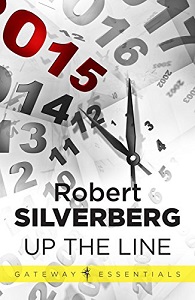
Up the Line, Robert Silverberg

I’ve never been a fan of Silverberg’s work. I liked the original Majipoor trilogy but, to be honest, it felt like he was ripping off something else. His other books I’ve read – perhaps twenty or so in total, out of over one hundred – I thought mostly unremarkable. Up the Line (1969, USA), however, is not unremarkable: it was nominated for both the Hugo and Nebula Awards, and it is remarkably horrible.
Jud Elliott is a disaffected young man in 2059. On the recommendation of a friend, he joins the Time Service as a Time Courier. Historians and tourists routinely visit the past, and are accompanied by a tour guide, or courier. Elliott specialises in Byzantium, from the ninth to fifteenth centuries. He takes people on tours, he learns his trade… and the reader learns all about the history of Byzantium..

There are no women in this novel, there are only objects of varying degrees of beauty and/or desire. Silverberg tries desperately hard to be hip, a beatnik, but it’s too studied, and repeated mentions of gay men, or coloured men, does not make this novel either liberal or progressive. What truly makes the book nasty, however, is the tacit approval given to paedophilia. Not only does Elliott at one point lust over a prepubescent girl – or rather, prepubescent girls in general – but the actual plot centres on an unapologetic paedophile who absconds from his time tour, rapes a twelve-year-old girl, subsequently marries her, and so causes Elliott never to have existed.

As a bonus, Elliott meets one of his ancestors and has an affair with her. She’s seventeen.

Silverberg has clearly put a lot of effort into his Byzantium research – I seem to recall him using the city in other works; in fact, I think it’s an interest of his. But I’m not sure why he’s trying to be so hip – and failing, this is no Delany – given sf fans were hardly counterculture. I’m tempted to think he was influenced by John Brunner’s Stand on Zanzibar (1968, UK) or The Jagged Orbit (1969, UK), but while Silverberg was notoriously prolific, even he wasn’t that fast.

On the other hand, it’s not worth putting too much effort into untangling all of Elliott’s back-and-forths in time. Silverberg introduces a series of Paradoxes in order to make sense of it, but it doesn’t really add up, and I suspect it isn’t really supposed to – Silverberg was clearly more interested in Byzantium than in plot logic.

Up the Line really should not have made the Hugo or Nebula shortlists. The Breendoggle was five years earlier, so you’d think paedophilia might be a sensitive subject in US science fiction fandom. Apparently not. Although given Operation Yew Tree in the UK, and now the Epstein Files in the US, perhaps there’s nothing unusual about that after all…

4 Comments

The voters have spoken

Back on 22 June, I posted a poll to see which six allegedly classic science fiction novels you would like me to read as my summer reading project. I promised to read the books and then write a blog post on each one. In hindsight, it was clearly a foolish thing to promise, although perhaps there were one or two books in the seventeen I chose for the poll that I sort of wanted to read/reread. Sadly, only one of those made it to the final six. Which are, for the record:

rah_themooni The Moon is a Harsh Mistress, Robert A Heinlein 35 votes
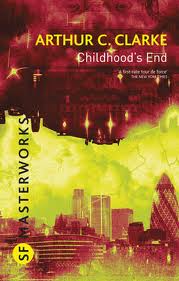
childhoodsend Childhood’s End, Arthur C Clarke 32 votes
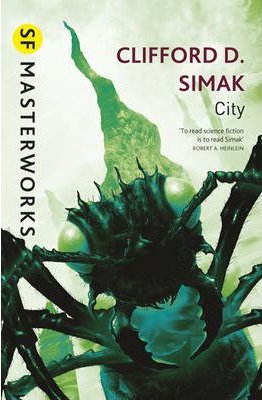
city City, Clifford D Simak 23 votes
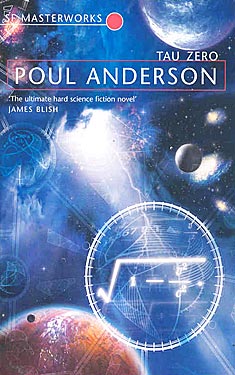
TauZero Tau Zero, Poul Anderson 22 votes
Panther-1080-n Asimov Foundation Foundation, Isaac Asimov 22 votes
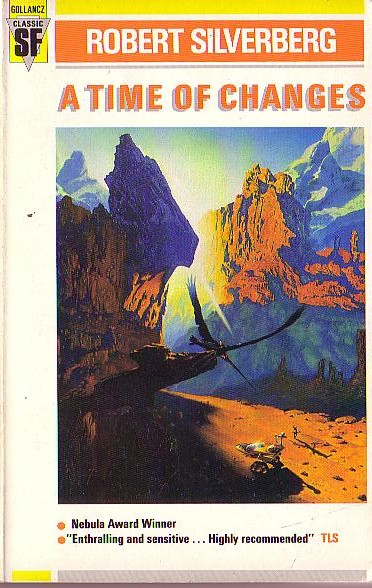
timeofchanges A Time of Changes, Robert Silverberg 20 votes

You lot must really hate me – The Moon is a Harsh Mistress and Foundation. Still, a promise is a promise. Foundation is one of three rereads of the six books. I last reread it in 2006, thugh for some reason I don’t appear to have written about it then. Childhood’s End I read some time back in the early to mid-1980s, I think. I’ve not reread it since. A Time of Changes I’ll have read around the time my Gollancz Classic SF edition was published, which was 1986. The remaining three books I’ve never read before. They’re also in the SF Masterworks series, and those are the editions I own – in fact, Foundation and A Time of Changes are the only books in the six that aren’t SF Masterworks.

Anyway, some time in July I will start my summer project, and after I have finished each book I will write a review here on the blog. I am not expecting my reviews to be positive, but you never know, I might be pleasantly surprised…


7 Comments

Reading Challenge #9 – Lord Valentine’s Castle, Robert Silverberg

I can’t say I’m a huge Silverberg fan. I’ve read many of his books and short stories, and I’ve enjoyed them. But I’ve never made an effort to seek out those of his works I’ve not read – as I have done with some other writers. To be fair, Silverberg is one of the stalwarts of the genre. He’s had – and still has, of course – a fifty-four year writing career, and has mostly produced good books and stories. During that more-than-half-a-century, he has won four Hugo Awards and five Nebula Awards.

Silverberg’s most well-known creation is, arguably, the world of Majipoor, on which he has set seven novels, two novellas and a short story. The first of these is Lord Valentine’s Castle, published in 1980.

Majipoor is a big planet – in fact, it was inspired by Jack Vance’s novel, Big Planet – with four enormous continents. The world has been settled for thousands of years and has a population of some sixty billion; but it is now something of a backwater, and rarely visited by people from other planets. It is home to several races – humans, Skandars, Ghayrogs, Vroons, Su-Suheris, Liimen, and Hjorts. There are also the native Metamorphs, from whom the humans took the world, and they now live in a reservation. Majipoor is ruled by four potentates – the Coronal, who is the executive arm of government and rules from his castle atop the thirty-mile-high Castle Mount; the Pontifex, the legislative arm, who lives in the Labyrinth; the Lady of the Isle of Sleep, who through dreams provides the world’s moral framework; and the King of Dreams, who punishes wrongdoers, also through dreams.

Lord Valentine’s Castle opens with a man called Valentine on a ridge looking down upon the city of Pidruid, on the western shore of the continent Zimroel. He doesn’t know who he is, or how he got there. A passing boy, taking cattle to market in Pidruid, approaches him and the two enter the city together. Within a couple of chapters, Valentine has shown an uncanny natural ability at juggling, and joined a juggling troupe. The Coronal – also called Valentine – is due to appear shortly in Pidruid on the Grand Processional all coronals take shortly after ascending to power.

The name is not a coincidence. Valentine the juggler soon learns that he was Coronal Valentine but, by some art or science never explained, his mind has been swapped into another body and someone else has taken his place as coronal. The more of his memory Valentine recovers, the more he determines to take back his throne. So he travels across Zimroel to its east coast, and there takes ship to the Isle of Sleep, in order to persuade the Lady (who is always the mother of the coronal) of his true identity. And after succeeding in doing that, he continues on to the eastern continent, Alhanroel, to first gain the Pontifex’s support, and then march on Castle Mount and throw down the usurper.

And that’s pretty much the plot. Silverberg intended that “the book must be fun”“all light, delightful, raffish…” And in that respect he succeeds. Valentine encounters obstacles on his way, but he overcomes them. He has exciting adventures – some of which seem a little too much, such as being swallowed by a legendarily giant sea-dragon while en route to the Isle of Sleep.

But then, Lord Valentine’s Castle is not a book to take seriously. It has a simple plot and a hero who prevails. It is, above all, colourful – Valentine’s journey east is very descriptive. And everything he sees and meets is exotic. And we know it is exotic because Silverberg has given it a made-up name. Although not all names, it has to be said, actually work all that well. “Niyk-tree” isn’t too bad, nor is “blave”; but “stajja” and “dhiim” just look like typographical accidents.

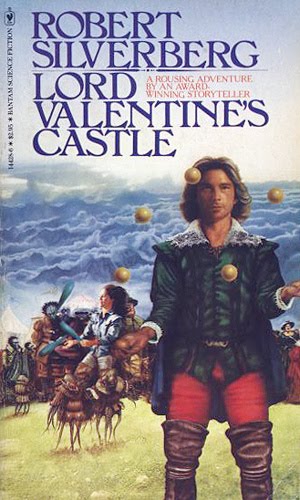
What strikes me most about this book is not the acknowledged debt it owes to Big Planet, but the debt it owes to Vance. Silverberg is channelling Vance. He does it well, because Silverberg is nothing if not a master craftsman. But, all the same, Lord Valentine’s Castle often feels a little like there’s too much Vance in it, as if Silverberg has crammed several novels by Vance into one book – which at 506 pages (in my 1982 Pan paperback; not the cover shown above) probably is equivalent to several novels by Vance…

Unlike some of the other books I’ve read in this year’s reading challenge, I didn’t regret rereading Lord Valentine’s Castle. I quite enjoyed it. It’s mind candy, but the sort of mind candy a friend might bring back from a trip to a foreign country – still fluffy, but with an exotic flavour to it. It’s a good book to read on a dull journey. And, like many books of its type, its general shape will linger – that the world of Majipoor is so big, Castle Mount and the Fifty Cities on its slopes, the overall story of the book but not Valentine’s individual adventures… and that it all ends happily. It had been a good twenty years or more since I last read Lord Valentine’s Castle, and still it felt comfortably familiar. Which is no bad thing sometimes.