It Doesn't Have To Be Right…

… it just has to sound plausible


Leave a comment

A Heritage of Stars, Clifford D Simak

Simak was one of my go-to sf authors in my early teens, and his Time and Again (1951, USA) was a very early favourite novel. But I reread it about twenty years ago, and was not impressed. A Heritage of Stars (1977, USA) I must also have read back in the late 1970s – I used to own a copy, but sold it when I moved north. I had no memory of its plot. I picked up a copy from my local secondhand sf bookshop, mistakenly thinking it was another Simak novel, one which had been nominated for the Hugo. It wasn’t. But I reread it anyway.

It’s 1 500 years after civilisation collapsed – in the US, at least, although like all American science fiction up until the late years of the twentieth century, the USA is assumed to be the whole of the world. Cushing is a young man who works at a university where knowledge is preserved in ancient books. But not knowledge about technology – all of that has been completely removed. He stumbles across some notes from the author of a “history” written some 1 000 earlier (although it’s not explained how the paper lasted so long). The notes mention a legend about the Place of Going to the Stars, so Cushing decides to go looking for it. Along the way, he picks up various strange companions: an old woman with telepathic powers, the last operating robot, an old man who can talk to plants and his weird granddaughter, some shadow-like creatures, and a pattern of lights called the Shivering Snake. They head west into Dakota, searching for Thunder Butte, which they believe is the location of the starport.

They find it, of course – but it is not a starport. They learn it’s the ground station, in effect, for centuries of robotic missions out into the galaxy. But somehow the sole remaining robot (one apparently fell “victim to a strange disease”!) in the facility, called the Ancient and Revered, can no longer access the data collected. Cushing and his companions come up with a plan to fix this – for reasons.

There’s a lot that doesn’t really add up in A Heritage of Stars. Some of it is Simak just churning out the stuff he was good at, but the plot is cobbled together from a handful of dated sf tropes thrown together with little thought. The same is true of the prose – some of the descriptive prose, especially of the landscape, is quite effective, but the rest is sloppy (to be fair, he was 73, when the book was published):

“… He talks obliquely about what he calls a phoenix rising from its ashes, an allusion that escapes us in its entirety.”

“There is no need to beat about the bushes,” said #2. (p167/168)

The aliens don’t understand the first expression but do the second? 

Simak was known for writing bucolic science fiction, and here he has his cake and eats it too: a central science-fictional idea, but he also gets to write about a USA slowly returning to nature. Except. The story is set fifteen centuries after a period when humanity had interstellar travel… yet the abandoned cities and towns Cushing travels through resemble towns and cities of the 1950s and 1970s. He mentions a collapsed water tower. If humanity can go to the stars, surely they’d have a better solution than sticking a tank of water on a high pole? Not to mention the wreckage of the water tower still being recognisable after 1 500 years of decay… by someone who had probably never come across the concept before…

Further, the tribes of barbarians which inhabit the plains and try to prevent Cushing and his companions from reaching Thunder Butte, and then refuse his plan to gain access to the data, are all based on racist depictions of Native Americans.

A Heritage of Stars is typical of a lot of science fiction produced in the US between the Second World War and the New Wave, almost exclusively by white males (although not always, and Arslan (1976, USA) by MJ Engh is a good female example). A handful of science-fictional tropes, mostly so well-known they require little scaffolding, and a complete absence of imagination in world-building. Mostly, the setting is just the US of the writers’ early adulthood with a handful of sf buzzwords, or, in this case, a few years of neglect. This is poor stuff.

4 Comments

The voters have spoken

Back on 22 June, I posted a poll to see which six allegedly classic science fiction novels you would like me to read as my summer reading project. I promised to read the books and then write a blog post on each one. In hindsight, it was clearly a foolish thing to promise, although perhaps there were one or two books in the seventeen I chose for the poll that I sort of wanted to read/reread. Sadly, only one of those made it to the final six. Which are, for the record:

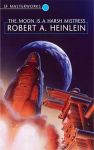
rah_themooni The Moon is a Harsh Mistress, Robert A Heinlein 35 votes
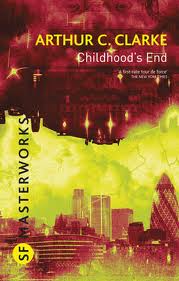
childhoodsend Childhood’s End, Arthur C Clarke 32 votes
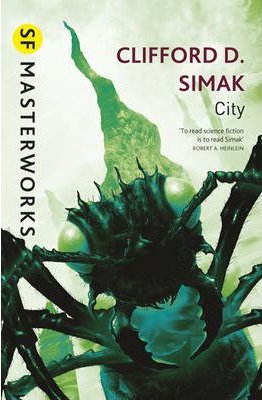
city City, Clifford D Simak 23 votes
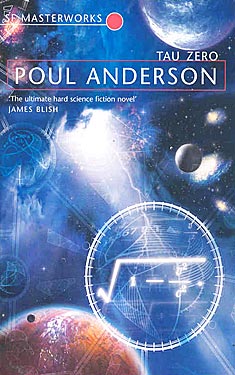
TauZero Tau Zero, Poul Anderson 22 votes
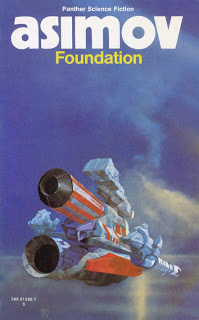
Panther-1080-n Asimov Foundation Foundation, Isaac Asimov 22 votes
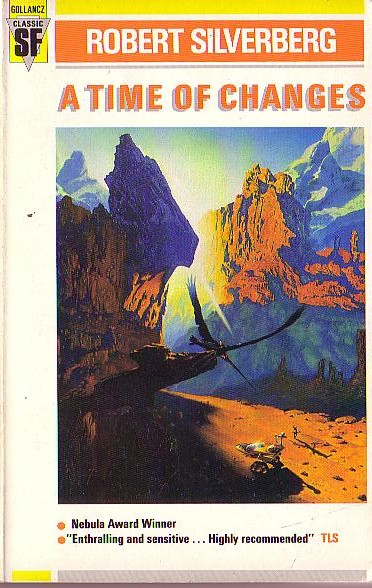
timeofchanges A Time of Changes, Robert Silverberg 20 votes

You lot must really hate me – The Moon is a Harsh Mistress and Foundation. Still, a promise is a promise. Foundation is one of three rereads of the six books. I last reread it in 2006, thugh for some reason I don’t appear to have written about it then. Childhood’s End I read some time back in the early to mid-1980s, I think. I’ve not reread it since. A Time of Changes I’ll have read around the time my Gollancz Classic SF edition was published, which was 1986. The remaining three books I’ve never read before. They’re also in the SF Masterworks series, and those are the editions I own – in fact, Foundation and A Time of Changes are the only books in the six that aren’t SF Masterworks.

Anyway, some time in July I will start my summer project, and after I have finished each book I will write a review here on the blog. I am not expecting my reviews to be positive, but you never know, I might be pleasantly surprised…


1 Comment

Rereading Favourites – June Update, Part 1

After Soldier, Ask Not, I decided to expand the challenge to include an “also-ran” each month… just in case the favourite failed to make the grade. For June, the favourite was Gwyneth Jones’ Kairos, and the also-ran was Time and Again by Clifford Simak.

Time and Again was first published in 1951 under the title First He Died. It’s also one of the earliest sf novels I ever read. I can distinctly remember reading it when I lived in Dubai – likely borrowed from Dubai Country Club‘s subscription library. That would be sometime between 1976 and 1979. Thirty years ago! And yet I could recall some of the details of the plot – there was a time war; and a man who landed a wrecked spaceship despite it having no drives, nor even being airtight. One image from the novel which had stayed with me was of a car that had crashed into a tree, and which contained a book from the future.

I suppose disappointment was inevitable – I certainly hope I’m a more discerning reader now than I was when I was eleven years old. The novel opens with a typically Simakian scene: a man is sitting on his porch, the crickets are chirping, the brook is burbling, night is falling… Another man walks up, tells the seated man he is from the future, and that Asher Sutton is returning to Earth tomorrow and must be killed. It’s a great set-up for a story. And it gets better. Twenty years ago, Sutton was sent to 61 Cygni in an attempt to break through the mysterious barrier guarding the system’s seventh planet. He is the first and only person to have done so. And now he is back – travelling in a spaceship that has no spacedrive and isn’t even airtight. Sutton will write a book about something he learned on 61 Cygni. This book will be used as a rallying cry for a movement to emancipate androids (vat-grown humans, slaves in all but name). Others, however, will interpret Sutton’s revelations to refer to humans only. And so there will be a war.

Time and Again is set some 6,000 years from now, in a future when humanity has a galactic empire – which appears to be ruled by a bureacracy. Time travel has only just been discovered when Sutton returns to Earth, but factions from the future representing both sides have travelled back in time in an effort to influence events.

The great ideas promised by the novel’s opening, however, never really appear. Simak is more concerned with the character of Sutton, and the nature of his revelation, than he is with the ramifications of the situation Sutton creates. The world-building is poor – the Earth of the 81st Century comes across as no different to 1950s America, but with silly clothes and a code duello. The time travel, and any paradoxes it might create, never really kicks into gear. Early in the story, Sutton finds a letter written by an ancestor in 1987, and which has remained unopened since then. Ignoring the fact that paper would never last 6,000 years, the letter itself is written in a style of English which seems more 1900s than 1980s. It all adds up to a novel which is a great deal less than the sum of its parts. Perhaps it’s for good reason it’s not as well-known as some of Simak’s other works, like Way Station or City.

So, cross off one also-ran. It drops off that list, never mind being promoted to the favourites list. And on we go with the rereads…

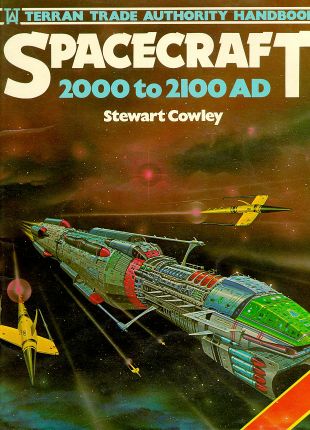
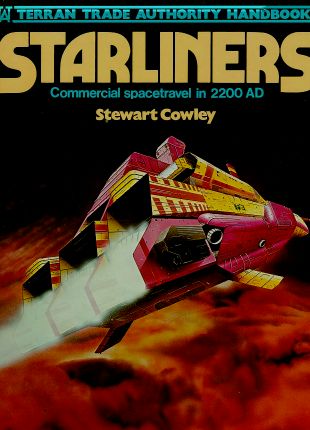
Incidentally, you’ll notice that my editions of Time and Again and the Dorsai trilogy – see here – all feature cover art by Tony Roberts (who was recently famous for being “sampled” by Glenn Brown in his Turner Prize nominee, The Love of Shepherds 2000). I wonder if it’s the art that made me believe the books were favourites – because I really do like those covers. Perhaps it’s because I began to identify myself as a sf fan around that time, but I find the cover art of the late 1970s more appealing than that of sf books today. Tony Roberts, Angus McKie, Tim White, Bruce Pennington and, of course, Chris Foss… Stewart Cowley’s Terran Trade Authority books: Spacecraft 2000 – 2100 AD and Starliners… Spaceships. Cool spaceships. Book covers then always seemed to exude an air of mystery – something sadly lacking from today’s cover art. It seems almost irrelevant that those wonderful covers rarely had any link to the contents of the book. But they made you pick it up.