
It Doesn't Have To Be Right…

… it just has to sound plausible


Leave a comment

The Last Song of Penelope, Claire North

The Last Song of Penelope (2024, UK) is the final book in the Songs of Penelope, preceded by Ithaca (2022) and House of Odysseus (2023). This is the story of Penelope, who was left behind to rule Ithaca – for twenty years! – after Odysseus left to fight in the Trojan War. Each book is narrated by a goddess. In The Last Song of Penelope, it is Athena.
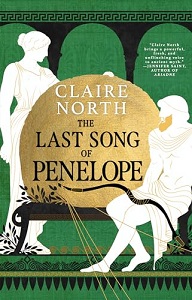
Odysseus has finally returned, but in the guise of an old beggar. Penelope is not fooled, although she pretends to be because she understands why he is in disguise. It’s the one hundred suitors – for twenty years, they have feasted in the palace, each one hoping to marry Penelope and so become king of Ithaca. Odysseus cannot defeat them all alone, and even with his son Telemachus he still has too few warriors surviving from his long voyage home. So he murders them in the night, catching them unaware and slaughtering them. What he does not realise is that Penelope and her maids have drugged all the suitors to make it easier.

Then Odysseus, believing the lies of his old nursemaid, executes some of the maids for consorting with the suitors. (They didn’t.) There’s nothing Penelope can do. She’s aware of the importance of the story – that Odysseus is the hero, and she’s merely an adjunct to his tale.

The fathers of two of the dead suitors raise an army and attack the palace. Odysseus, his men, Penelope and her surviving maids, flee, and take up refuge in Odysseus’s father’s farm, which they fortify. The fathers’ army, bolstered by mercenaries, besieges the farm. Penelope is forced to call on her army of women.

Throughout all this, Athena is watching, and influencing events where she can. She muses on her own life, her treatment by her father and siblings, by the fact she is female but has more in common with her brothers. Like Penelope, she knows this is Odysseus’s story, and she wants that story to survive because she is part of it, and that means knowledge of her will also survive.

Retelling Greek myths seems to have been bizarrely popular these last few years. I’ve no idea why – and I don’t recall any similar novels about Roman mythology. I read North’s Song of Penelope because it was by North, not because of its story or setting. Similarly, I’m reading Pat Barker’s Women of Troy trilogy because it’s by Barker. North’s is the more fantastical of the two, but one of the things I like about these stories is how embedded in daily lives are their gods. It impacts everything the Greeks do and think. North adds an extra layer by making her cast aware of story, that their lives are merely part of what will become The Odyssey, centred on Odysseus, a man, and in which the women are merely part of the background – but knowing that, they still impact, and even direct, the narrative.

Read Ithaca, House of Odysseus and The Last Song of Penelope because they are a smart genre-adjacent trilogy about an untold part of The Odyssey, the part about the women who are mentioned only in passing. But also read it because it is by Claire North, who is currently one of the best genre writers currently writing in the UK.

2 Comments

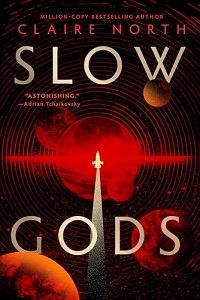
Slow Gods, Claire North

I’ve been following the career of Claire North, a pseudonym of Catherine Webb, since her debut under that name, The Fifteen Lives of Harry August (2014, UK). I thought it good-ish, but things started picking up with The Sudden Appearance of Hope (2016, UK) – which, if I remember correctly, managed an impressively accurate description of Dubai – and by The Pursuit of William Abbey (2019, UK) she was on my must-buy list.

Which brings me to her latest, Slow Gods (2025, UK). Which is, well, a Banksian space opera. Iain M Banks’s space opera novels have been copied a lot over the past thirty five years, but Slow Gods comes closer than many. Which is not to say there’s nothing original in Slow Gods, because there’s plenty.

Interstellar travel in the universe of Slow Gods is accomplished via arcspace, but journeys through it are extremely unsettling to humans (there were definite vibes of the movie Event Horizon here). Ships require a human Pilot, who is plugged into the ship, but they can only Pilot for two or three trips before suffering a psychotic break. Or worse.

The Shine, properly the United Social Venture, is the complete antithesis of Banks’s Culture. A rich and powerful elite enjoy lives of untrammelled luxury supported by the labour of an indentured population kept permanently in debt. The Shine “Management” are cruel, sadistic and sociopathic. Any resemblance to twenty-first century USA is undoubtedly intended.

The Shine uses criminals and debtors as Pilots, and surgically destroys their higher brain functions so they last longer. It gives the Shine an advantage in interstellar travel. Mawukana na-Vdnaze was arrested during a Corpsec sweep, and promptly condemned to be a Pilot, but the surgery did not happen. Maw’s ship was then lost in arcspace, but somehow he managed to bring it home – but he was changed in the process. He is now effectively immortal, and he can Pilot through arcspace without being affected and with pinpoint accuracy.

The Slow, a huge and enigmatic AI with a very successful record of predicting the future, declares a binary star system will go nova, and the resulting wavefront will wipe out all worlds within an eighty light year radius. Which includes the Shine. But Management declares this “fake news” and does nothing to protect their worlds from the resulting wavefront.

Maw escapes the Shine, and goes to work for the Accord, a loose alliance of other interstellar polities. He runs various errands, including helping rescue historical artefacts from a world among the first to be destroyed by the wavefront. The Shine continues to refuse to evacuate its worlds, and instead seems bent on conquering other planets for Management to rule. The Accord can do nothing because the Shine has blackships, stealth warships with planet-killing weaponry, hidden in the systems of the Shine’s enemies. It’s the ultimate deterrent.

All this takes place over decades. The Shine are really horrible – although, to be honest, they’re not much worse than some of the polities in other twenty-first century sf novels, although here the novelty is they’re the villains. Maw is a curiously passive protagonist, someone who is so afraid of his abilities he rarely uses them. The Accord keeps him on a small island, since other people find him just as unsettling as arcspace. There’s even a hint of Special Circumstances to Maw’s role and the missions he undertakes. The world-building is also especially good. 

I don’t think the comparison with Banks is unfair, although Slow Gods is very much a twenty-first century take on the material, with thoroughly modern sensibilities (something many writers forget to do when aping Banks). I’ll be disappointed if Slow Gods does not appear on a few award shortlists this year.