It Doesn't Have To Be Right…

… it just has to sound plausible


Leave a comment

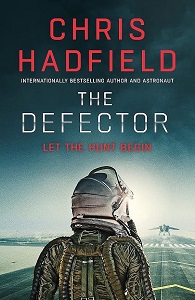
The Defector, Chris Hadfield

(A review from Facebook)

Yes, that Chris Hadfield, astronaut, recorded a video of himself playing ‘Space Oddity’ on the ISS and it went viral. That Chris Hadfield. The Defector (2023, Canada) is his second work of fiction, after The Apollo Murders (2021, Canada), and also features one-eyed ex-test pilot Kaz Zemeckis in the lead role.

A Soviet pilot defects with a MiG-25, landing in Israel the day before the Yom Kippur War. He and his aircraft are shipped to the US, to Groom Lake, AKA Area 51, where USAF plans to learn as much as possible about the MiG-25. Complicating matters are the three cosmonauts assigned to the Apollo-Soyuz Project, two real historical figures and the invented female cosmonaut who was the first Russian on the Moon in The Apollo Murders. I enjoyed the first book in what is now plainly a series because of the hardware – I mean, just look at the fiction I’ve written – and this one is centred around a topic also of interest to me: Cold War supersonic military aircraft. But not, unfortunately, to the same degree.

I must admit, Zemeckis is starting to smack a little of Dirk Pitt. I was a fan of Clive Cussler’s novels when I first read them back in the early 1980s, but the writing grew too bad to be forgivable and I eventually gave up on them over 20 years ago. Sadly, recent rereads of those early Dirk Pitt novels have shown they were always bad – as is evident from the reviews I’ve posted her – and I’m somewhat surprised I ever bothered reading past the first one. (I didn’t read them in order, so I’ve no idea which of the first half-dozen or so I read first.) Hadfield is a marginally better writer than Cussler at his best, although this is not a field in which writing chops count for much – in fact, it’s possibly the reverse. But when Zemeckis dogfights in a F-15 after one leg has been shredded below the knee by a shotgun blast, some of Dirk Pitt’s more incredible physical exploits spring to mind.

If Hadfield sticks to areas that interest me, my “enthusiasms” as I call them – deep sea exploration next? – then I’ll probably continue to pick up cheap copies of his books.


Leave a comment

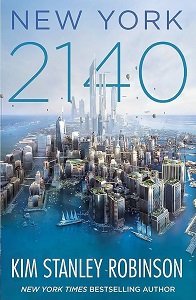
New York 2140, Kim Stanley Robinson

I’ve read pretty much every book Kim Stanley Robinson has published, except perhaps a couple of collections, and I’ve probably read most of their contents anyway. I buy his books in hardback as soon as they are published. This probably makes him a favourite writer.

He’s a good choice to have as a favourite author – his novels cover a wide range of subjects, and they’re never less than interesting. And I mean that in a good sense. True, he clearly has an agenda in each one – people who don’t understand how fiction works would call it “message fiction”. It makes his work a damn sight more appealing than the warmed-over middle America of the 1950s plus spaceships that far too much science fiction of last century was, even if, yes, he does tend a little to US-defaultism… although, to be fair, this particular novel is about New York.

The title of New York 2140 (2017, USA) tells you where and when the novel is set, but not what it’s about. Which is two things: climate change and late-stage capitalism. Most of Manhattan is flooded – fifteen metres in the book, which most experts agree is unlikely, and by 2140 would probably be no more than a third that high – and people use boats and skybridges between buildings to get about. The novel centres on a handful of residents of the MetLife Tower, which was originally constructed in 1909. These include: the building’s maintenance engineer, a broker, a senior NYPD police officer, the head of the residents’ board, an influencer who travels about in her own airship, and a pair of orphaned homeless boys who are eventually “adopted” by the building.

There are two major plot-threads: equity funds have decided to force ownership of the flooded buildings, currently not subject to property laws, and are trying to buy the MetLife Tower, improving their chances with some sabotage; and a huge storm hits New York, throwing everything into chaos, and forcing a new social and economic order. The novel opens when two unemployed “quants”, programmers for a brokerage, who are staying in the building go missing. Their disappearance ties into the sabotage, and the movement of capital between a number of shell companies, all of which seems to be targeting the MetroLife Tower.

Then the storm hits, destroying parts of the city and in the aftermath Central Park becomes a giant refugee camp. A move to occupy vacant buildings in a safer part of Manhattan – buildings owned by one-percenters – leads to a violent clash. Which in turn prompts a plot by the central characters to safeguard ownership of their building, which involves deliberately crashing the economy and then forcing the US government into taking over the banks, thus curtailing their power.

There’s also a hunt for some lost British gold, a bit about the life on Herman Melville, an attempt to prevent the extinction of polar bears by migrating half a dozen to Antarctica, and a new way to colonise intertidal land. Robinson once said exposition is just another form of narrative, and there’s certainly a lot of lecturing in New York 2140, either between characters or directly to the reader. It’s mostly fascinating stuff – the bits about capitalism, however, are mostly enraging. Having said, the characters are all! a bit! excitable! With liberal use of exclamation marks in dialogue! It makes most of the cast come across like those super-perky Americans they have in bad US sitcoms.

I’ve heard New York 2140 described as Robinson’s best novel to date. I’m not sure I agree, although it’s certainly one of his better ones. It feels more didactic, and less modernist, than his other works, and its perkiness does give its prose a weird flippancy that seems at odds with the seriousness of the topics it covers. Nonetheless, definitely worth reading.


Leave a comment

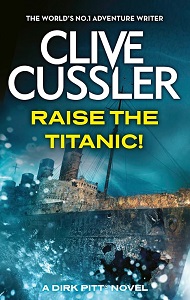
Raise the Titanic!, Clive Cussler

(Another Facebook review.)

For reasons I have yet to question, I started rereading Cussler’s novels, which I last read back in the 1980s and 1990s. And even then I thought they were bad. Raise the Titanic! (1976, USA) is probably his most famous novel – it’s certainly the one that made him a bestselling author. It was his third novel, the first two had sold poorly, and this one was expected to do the same. But an editor visiting from the UK saw the manuscript at Cussler’s US publisher, and took a copy back home with him. This kicked off a bidding war on both sides of the Atlantic, resulting in Cussler pulling in a huge advance. The novel then went on to become a bestseller. (Soon after, Cussler bought back the rights to his earlier novels, and resold them to his then-current publisher for considerably more than he’d sold them originally.)

The plot of Raise the Titanic! sees Dirk Pitt, special operations director of the US National Underwater and Marine Agency, and all-round lady killer and Competent Man, tapped to head a US project to raise the RMS Titanic from its seabed grave, 3800 metres below the surface (where the pressure is around 400 atmospheres). Because there’s a presidential black project to build an anti-missile screen around the US and it needs a supply of “byzanium” in order to work. The only known quantity of byzanium was secretly mined under the noses of the Soviets on Novaya Zemlya by US miners in 1912, but was shipped home on the RMS Titanic. Oops. The USSR learns of this plan and decides to hijack the Titanic once she is on the surface.

Perhaps because of the amount spent to buy the novel, Raise the Titanic! seems to have been closely edited, and the prose is far better than in the earlier novels (although still not, well, good). The plot and setting is also much more science-fictional. The book was written before the wreck was found, and most people believed the ship had come to rest in one piece (she actually split in two). Pitt’s plan is to plug the many holes in the Titanic’s hull with “wetsteel” and then pump the ship full of air.

The novel was adapted for the screen in 1980 by UK TV production company ITC, but was a massive flop. ITC’s owner, Lew Grade, later said “it would have been cheaper to lower the Atlantic”, but he did like the film. Cussler didn’t. He refused to allow anyone to adapt his other books, and later sued the makers of Sahara, adapted from his 1992 Dirk Pitt novel of the same name. That film was a huge flop too.

Cussler died in 2020, but some time around the millennium he’d created an atelier, which has since produced a huge quantity of Dirk Pitt and NUMA novels by diverse hands (with Cussler’s name the most prominent on the cover, of course). His son, called Dirk, natch, now writes the Pitt novels.


Leave a comment

City of Desire, Anton Gill

Back in the 1990s, Gill wrote a trilogy of historical crime novels set in Ancient Egypt. The protagonist was a minor scribe, who discovered he had a talent for solving “puzzles”, specifically who committed a murder. The novels were set during the Eighteenth Dynasty, when Akhenaten became pharaoh and tried to make Egypt monotheistic. He was overthrown and replaced by Tutankhamun.

In 2015, he returned to the world of Huy, scribe turned occasional detective, and published a further three novels in the series. City of Desire (2015, UK) is the middle book of this second trilogy. The stories of these novels are very much predicated on the world in which they’re set. These are not English murder-mysteries in pharaonic drag.

In City of Desire, the dwarf in charge of pharaoh’s harem is murdered. A perpetrator is eventually identified and punished, but Huy remains unsatisfied. It’s mostly politics – an old friend turned rival, their career is partly dependent on events in the harem. Pharaoh is also trying to hang onto his throne, but no one is entirely sure what prompted the murder of the dwarf. Or the subsequent murders in the harem.

City of Desire is not your typical crime novel, with a, er, crime, and someone solving it. There are indeed crimes, but Huy fails to solve them, and only later works out what happened once the political dust has settled. Where the book succeeds, however, is in presenting life in Eighteenth Dynasty Egypt. I’ve no way of knowing how close it is to the reality, but it’s definitely convincing. Gill discusses what is known in an author’s note:

“we know a comparatively large amount about life in Ancient Egypt … since the science of Egyptology began, scarcely more than twenty-five percent of what might be known has been revealed.”

Worth reading.


Leave a comment

A Heritage of Stars, Clifford D Simak

Simak was one of my go-to sf authors in my early teens, and his Time and Again (1951, USA) was a very early favourite novel. But I reread it about twenty years ago, and was not impressed. A Heritage of Stars (1977, USA) I must also have read back in the late 1970s – I used to own a copy, but sold it when I moved north. I had no memory of its plot. I picked up a copy from my local secondhand sf bookshop, mistakenly thinking it was another Simak novel, one which had been nominated for the Hugo. It wasn’t. But I reread it anyway.

It’s 1 500 years after civilisation collapsed – in the US, at least, although like all American science fiction up until the late years of the twentieth century, the USA is assumed to be the whole of the world. Cushing is a young man who works at a university where knowledge is preserved in ancient books. But not knowledge about technology – all of that has been completely removed. He stumbles across some notes from the author of a “history” written some 1 000 earlier (although it’s not explained how the paper lasted so long). The notes mention a legend about the Place of Going to the Stars, so Cushing decides to go looking for it. Along the way, he picks up various strange companions: an old woman with telepathic powers, the last operating robot, an old man who can talk to plants and his weird granddaughter, some shadow-like creatures, and a pattern of lights called the Shivering Snake. They head west into Dakota, searching for Thunder Butte, which they believe is the location of the starport.

They find it, of course – but it is not a starport. They learn it’s the ground station, in effect, for centuries of robotic missions out into the galaxy. But somehow the sole remaining robot (one apparently fell “victim to a strange disease”!) in the facility, called the Ancient and Revered, can no longer access the data collected. Cushing and his companions come up with a plan to fix this – for reasons.

There’s a lot that doesn’t really add up in A Heritage of Stars. Some of it is Simak just churning out the stuff he was good at, but the plot is cobbled together from a handful of dated sf tropes thrown together with little thought. The same is true of the prose – some of the descriptive prose, especially of the landscape, is quite effective, but the rest is sloppy (to be fair, he was 73, when the book was published):

“… He talks obliquely about what he calls a phoenix rising from its ashes, an allusion that escapes us in its entirety.”

“There is no need to beat about the bushes,” said #2. (p167/168)

The aliens don’t understand the first expression but do the second? 

Simak was known for writing bucolic science fiction, and here he has his cake and eats it too: a central science-fictional idea, but he also gets to write about a USA slowly returning to nature. Except. The story is set fifteen centuries after a period when humanity had interstellar travel… yet the abandoned cities and towns Cushing travels through resemble towns and cities of the 1950s and 1970s. He mentions a collapsed water tower. If humanity can go to the stars, surely they’d have a better solution than sticking a tank of water on a high pole? Not to mention the wreckage of the water tower still being recognisable after 1 500 years of decay… by someone who had probably never come across the concept before…

Further, the tribes of barbarians which inhabit the plains and try to prevent Cushing and his companions from reaching Thunder Butte, and then refuse his plan to gain access to the data, are all based on racist depictions of Native Americans.

A Heritage of Stars is typical of a lot of science fiction produced in the US between the Second World War and the New Wave, almost exclusively by white males (although not always, and Arslan (1976, USA) by MJ Engh is a good female example). A handful of science-fictional tropes, mostly so well-known they require little scaffolding, and a complete absence of imagination in world-building. Mostly, the setting is just the US of the writers’ early adulthood with a handful of sf buzzwords, or, in this case, a few years of neglect. This is poor stuff.


Leave a comment

Schismatrix Plus, Bruce Sterling

(Another review from Facebook.)

I’m pretty sure I read Schismatrix (1985, USA) back in the very early 1990s… but I also have a vague memory of borrowing the novel when staying with a friend on a trip to the UK a couple of years after I’d moved to the Middle East in the mid-1990s. Schismatrix Plus (1996, USA), published a decade after the original novel, includes it and five short stories set in the same universe. I suspect I’d read a couple of the short stories first, and then read the novel when staying with that friend. Whatever the truth of the matter, I’d pretty much no memory of the novel’s actual story when coming to this recent reread.

Certainly, the one big thing I’d forgotten about Schismatrix was that it featured aliens. In the future of the novel, a couple of centuries hence, humanity has colonised the Solar system and those based off Earth have split into two factions – the Shapers, who improve themselves through genetic engineering, and the Mechanists, who use technology and cybernetics. The two factions are in an almost constant state of political and commercial rivalry slash war.

Lindsay is born in an O’Neill cylinder orbiting the moon. Despite being a Mechanist, he’s sent to the Shapers for diplomatic training (and some genetic engineering). Later, he’s exiled from his cislunar republic, and embarks on a career bouncing around the outer Solar system, growing more and more politically powerful, although typically as an eminence grise. He has a rival, Constantine, and the two are at constant, if often hidden, loggerheads. Aliens, the Investors, large dinosaur-like interstellar merchants, arrive, and there is a peace of sorts between Shapers and Mechanists. But it doesn’t last.

Sterling’s future solar system is pretty neat, if a little dated in places, such as the frequent mentions of “tape”, but Lindsay’s and Constantine’s political genius, even the reasons they’re so admired, is never explained and never really convinces. They are what they are because Sterling tells us so. The most interesting character in the book, Kitsune, who later becomes an actual space station, doesn’t appear often enough.

The aliens are dull, and not very original. Although the Swarm in the story titled, er, ‘Swarm’, originally published in F&SF in 1982, is based around a neat idea – indeed, something similar to it was used by Paul McAuley in his debut novel, Four Hundred Billion Stars (1988, UK). Sterling went on to write much better novels than Schismatrix, although it remains popular to this day. It was ahead of its time back in 1985, but sf has moved on a great deal since then. Schismatrix Plus is worth a read, the original novel on its own not so much. 


Leave a comment

The Map and the Territory, Michel Houellebecq

I’m a fan of Houellebecq’s fiction, and have been ever since reading Atomised (1998, France) back in 2009. He’s a miserable writer, but I like his commitment to factuality, to the extent he often includes exposition as much as in any science fiction text. But Houellebecq is not above using other literary techniques, and in The Map and the Territory (2010, France) it’s metafiction. Of a sort – Houellebecq himself appears as a character in the novel.

Jed Martin is a struggling artist in Paris. He has the idea of taking tilt-shift photographs of Michelin maps, which brings him fame and a girlfriend, the beautiful Olga, who works for Michelin. When she is transferred to Russia (her homeland), Martin turns to painting portraits of professional people, including his father, and most famously the painting ‘Bill Gates and Steve Jobs Discussing the Future of Information Technology’. Martin approaches Houellebecq and asks him to write an accompanying text for an exhibition of the paintings – a real thing which has led to published novels, Paul Park’s All Those Vanished Engines (2014, USA) and Olga Ravn’s The Employees (2018, Denmark), come to mind. This text is not The Map and the Territory, even if the novel documents Martin’s career and works as reportage.

As payment for the text, Martin paints a portrait of Houellebecq. Martin’s career skyrockets, and his professional portraits all sell for six-figure sums. Some time later, Houellebecq is found murdered in his country cottage. More: his head has been removed and placed on a sofa, and his skin cut into strips and scattered around the living-room. The remaining parts of his body are never found. The police investigation founders. The detective in charge retires. The police learn Houellebecq’s portrait is missing, and is now worth nine million euros. The crime is eventually solved by accident.

The Map and the Territory is more than the above, of course. The plot is just an excuse for Houellebecq to pontificate on a number of different subjects. I actually read this immediately after finishing Kim Stanley Robinson’s New York 2140 (2017, USA), and despite the differences in plot and setting, the two books are remarkably similar. They are both didactic, although Robinson discusses history and economics whereas Houellebecq writes about art and commerce. Robinson’s novel is annoyingly chatty, with overly excitable characters; The Map and the Territory’s characters are almost automatons, although extremely self-reflective ones, and Houellebecq has an irritating habit of randomly italicising phrases. Nonetheless, both are excellent books.

Houellebecq is one of those authors whose books I’ll happily read when I come across them, and while I keep up with his career, I don’t buy each new book as it appears – I’m reading The Map and the Territory 16 years after it was published, after all. He’s never less than thought-provoking, although often more in the sense of being deliberately provocative. But he’s always worth reading – whether you agree or not with the premise of the novel you’re reading.

(I should probably mention I welcome comments on my reviews. You don’t have to agree with me – in fact, I know many people don’t.)


4 Comments

The People of the Wind, Poul Anderson

(Another review which originally appeared only on FB.)

Anderson was not one of those authors I read much back when I was a teenager. Perhaps half a dozen of his best-known works. There were other science fiction authors whose books and stories I much preferred. But he was a popular and well-regarded author in his day and, to be honest, his Terran Empire / Ensign Flandry / Nicholas van Rijn novels always struck me as featuring the sort of world-building I sort of liked… And yet I never made any effort to explore it.

Anyway, The People of the Wind (1973, USA) was nominated for the Hugo in 1974 (but lost out to Arthur C Clarke’s Rendezvous with Rama (1973, Sri Lanka)). It’s set on a world called Avalon, shared by humans and Ythrians, who are winged bird-like humanoid aliens, and which is nominally part of the Ythrian Domain. The Terran Empire decides it wants a nice and less ragged border with the Domain, which makes no sense, and so decides to launch a full-scale attack on the Domain, which makes no sense, in order to take over those Ythrian worlds it feels will make the border look neat and tidy on a map, which makes no sense. Which makes no sense.

Anyway, Avalon is happy being a mixed human/Ythrian world, and has created a culture all its own. It has no intention of being subsumed into the Terran Empire. And it has a plan to defend itself. And when that works, but not enough, it has a last-ditch plan to defeat the forces of the Terran Empire. Which also works. Oops. Spoiler.

Anyway, reading The People of the Wind I think I understand why Anderson’s novels never appealed to me. The descriptive prose is actually not bad, and its presence not all that common in sf novels of the time, but Anderson’s decision to make use of archaic, and often completely made-up English, works against him – “blent”? “fleered”? WTF? Has either been used since Chaucer’s day? It also doesn’t help that Anderson drops lumps of exposition, which read like encyclopaedia passages, into his narrative. There are many ways to deal with exposition, assuming you even believe it’s necessary, but this is surely the most inelegant. No, wait– “As you know…” dialogue is definitely less elegant.

Anyway, I think even the most cynical would agree that exposition, in whatever form, should at least advance the story. Anderson’s doesn’t. It’s thinly-disguised gazetteer information, and might possibly be of relevance should they ever produce a RPG of the universe (which was not a consideration back in 1973).

Anyway, The People of the Wind. The usual bullshit “underdog defeats vastly superior enemy” narrative – which is, when you think about it, somewhat ironic coming from a US author – written in a combination of clumsy infodumps and pseudo-archaic English, and which presents absolutely nothing interesting in terms of insight… was apparently considered notable enough to be shortlisted for the genre’s premier award in the US in 1974.

Anyway, not a reason, I would think, to start reading Poul Anderson. But perhaps a good reason not to read him.