
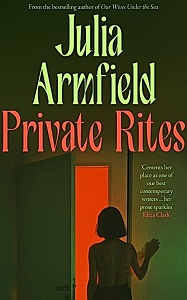
Private Rites (2024, UK) was nominated for the Clarke Award last year, which is why I read it. I generally follow the Clarke, although recent shortlists have been mixed at best: some nominations have been actually quite bad, and this year the award has nominated a book first published six years ago. Armfield was not a name with which I was familiar, but when I looked her up, her previous novel, Our Wives Under the Sea (2022, UK), rang a dim and distant bell. Perhaps someone recommended it or something. Having now read Private Rites, I’m unlikely to seek it out.
Private Rites is, Armfield has said, basically King Lear’s three daughters in a post climate-crash UK. And, er, that’s it. There’s no plot, as such. Irene, Isla and Agnes have as little to with each other as they can, and when they do meet, they bicker. Then their father, a renowned architect dies, and they bicker some more. And argue.
Meanwhile, it rains all the time, and the unnamed English city in which the three live is completely flooded. That’s the extent of the science fiction in Private Rites. It is neither explained, nor solved – the ending might be interpreted as a solution, but if so, it’s pure fantasy, not science fiction.
Readers are going to come to this book because of the writing, not the lack of plot, poorly-grounded setting or well-drawn characters. I value good writing. But I also think less is more, when it comes to literary fiction writing. Armfield shows some nice insights and turns of phrases, but all too often it veers into creative writing degree prose. She’s not a genre writer, but I feel it’s a problem in both literary and genre fiction. Creative writing degrees and MFAs on the one hand, genre residential writers’ workshops on the other – neither claim to be prescriptive, but they’re slowly imposing a prose style on authors. It’s the singular voices which are often the most memorable, and are certainly the most innovative. That may be why translated non-Anglophone fiction is becoming increasingly popular in both mainstream and genre circles – it doesn’t follow the same “rules” as graduates of MFAs and writing workshops.
Private Rites was a slog in places, and the ending was not really worth the investment in reading it. The Clarke that year was won by Annie Bot (2024, USA), which I felt laboured its point to the extent it undercut its argument. The Ministry of Time (2024, UK; my review here) and Extremophile (2024, UK; my review here) were enjoyable enough, but I wasn’t blown away (Service Model (2024, UK) and Thirteen Ways to Kill Lulabelle Rock (2024, UK) I have yet to read). It felt like there were better books they could have chosen. So too this year (mostly). No Slow Gods (2025, UK; my review here)? One of the best UK writers currently writing in genre, and she’s ignored by both the BSFA and Clarke Awards. The Clarke, a juried award, is supposed to be an antidote to the popular vote BSFA, which is like all other genre awards of its type, increasingly dominated by tribalism. In recent years, however, it sometimes seems like the Clarke is nominating books based on how many copies it’s sold, and not its science-fictional or literary credentials…

