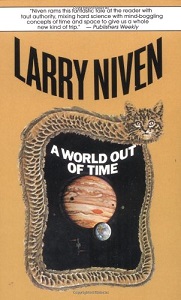
I’m still not entirely sure why I’m continuing to read, or reread, Niven’s novels. He was never a favourite of mine when I was reading science fiction back in the early 1980s, although Ringworld (1970, USA) does continue to hold some fascination. A World Out of Time (1976, USA), which is not part of Niven’s Known Space universe, was a reread – at least, I used to own a copy of the book (the 1982 Futura edition with the Peter Andrew Jones cover art) and I’m pretty sure I read it… But reading the book this year, none of it was familiar. And I’m usually pretty good at remembering books I’ve read, no matter how long ago.
Anyway, A World Out of Time is a Larry Niven novel. Corbell is dying of cancer, so he has himself frozen. And wakes in 2190, in the body of another man. Criminals in the worldwide State of 2190 have their personalities wiped. And the personalities of people who had themselves frozen in earlier centuries are then decanted into the criminals’ bodies (the process destroys the frozen body). The State which runs the world is mostly fascist, although Niven wants to present it as near-utopian. But people such as Corbell are considered less than human, and are employed in the sort of professions that would otherwise be occupied by slaves and, well, inmates in present-day US corporate-run prisons.
Corbell seems best-suited to become the pilot of a “rammer”, which is a single-person Bussard ramjet-powered spaceship which carries “biological package probes” used to terraform planets that are almost Earth-like. He is trained in his new role by being injected with RNA (not how it works, but never mind). Eventually, he is launched in his ship on a mission planned to take some 200 years at near lightspeed, returning him to Earth 300 years later. He’d spend most of the trip in cold sleep. But Corbell rebels, and aims his spaceship at the galactic core, intending to return to Earth 70,000 years later (not how it works, but never mind).
He judges it likely the State will still exist 70,000 years in the future, because it is a “water empire” but has no external enemies to bring it down (not how it works, but never mind; in fact, the concept of water empires has long since been debunked). Unfortunately, his watchdog back on Earth manages to upload his personality into the spaceship’s computer and it sabotages Corbell’s plan. So Corbell actually returns to Earth three millions years after he left.
Unsurprisingly, a lot has changed since 2190. Not least of which is that the Sun is now a red giant (which it won’t be three million years from now), and Earth has been moved into orbit about Jupiter. The State has long since vanished – eventually brought low by its own colonies. The secret of immortality was discovered, but only a select few, the Dictator class, were privy to it. But then an alternative process arrested development at the age of eleven, resulting in warring civilisations of immortal Boys and Girls.
On landing on Earth, which is now mostly inhospitable desert, Corbell is taken prisoner by the pilot of a Bussard ramjet spaceship who left centuries after him, and returned millennia before him. She had been kept in a “zero-time prison”, but later escaped. She is now old, but repeatedly mentions how beautiful she used to be (you can probably guess where that leads). She wants the secret of immortality for herself. Corbell escapes, and flees to Antarctica, which is temperate, and where some surviving Boys live in the ruins of one of their cities.
Nothing in A World Out of Time is even remotely believable, even for a science fiction novel. The trip through the galactic core manages to make a hash of everything from cosmology to physics. The Earth of three million years hence is just far too familiar – cars might fly, but cities have subways (and matter transmission booths, huh) and hospitals and police stations. The characterisation of the female antagonist is mostly offensive; Niven struggles to show the Boys are as super-intelligent as he tells us they are. The politics are everything you would expect of a white American male author who lives a life of unearned wealth and privilege.
A World Out of Time is actually a fix-up of three earlier stories, and the State apparently makes an appearance in two later novels, The Integral Trees (1984, USA) and The Smoke Ring (1987, USA).