It Doesn't Have To Be Right…

… it just has to sound plausible


1 Comment

Who?, Algis Budrys

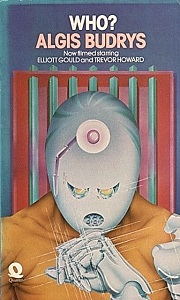
I think this was a reread but I couldn’t swear to it. I think I’ve seen the film adaptation (some stills from which are on the back cover of the paperback edition I read) but I couldn’t swear to it. I certainly know the basics of the story – and if I didn’t get them from the book or the film, then… who, er, knows?

The basics of Who? (1958, USA) are: an important US scientist is blown up in his laboratory in Europe, the Russians get there first and spirit away the heavily-injured scientist and rebuild him, so to speak – robotic arm, new head which is a featureless ovoid with electronic eyes and mechanical mouth. The US (or rather, the Allied Nations Government) demands him back, the Soviets oblige. But is the scientist they returned really the one who was nearly killed in the explosion? This is important because he was working on “K-Eighty-eight”, some sort of vitally important defence project which is never explained (but, to be honest, never really needs to be, and I suppose we should be grateful Budrys chose not to).

Is robot-head Martino the real Martino? The ANG needs to know before putting him back to work on K-Eighty-eight, which is annoyingly never written as K-88. They somewhat reluctantly decide they cannot confirm his identity, so they let him go home to New York and keep a careful eye on him to see if he behaves as the real Martino would have done.

It occurred to me as I read the novel that it would be relatively straightforward to confirm Martino’s identity, especially in a sf novel set in the 1990s (I think; Martino attends university in the late 1960s), even though written in the 1950s. After all, DNA had been discovered decades before Budrys wrote Who?. Surprisingly, it wasn’t known it could be used to uniquely identify an individual until 1984. It’s so ubiquitous now that feels wrong. But there you go.

So, no face. Fingerprints can be faked. (So can faces, for that matter.) Is metalhead Martino a ringer? Once loose in New York, he behaves exactly as the real Martino would do – which the reader knows thanks to alternating flashback chapters covering Martino’s life. Of course, a well-trained replacement would also behave exactly as the real Martino would do. A real puzzler.

Budrys dangles “he’s a fake!” before the reader, then sets up a plausible fake, but soon lets the cat out of the bag. According to my paperback copy, Who? is “one of the classic giants among science-fiction novels – and among spy thrillers too”, and it was nominated for the Hugo Award. But I think it fails as both. It’s no le Carré, and even when it tries for ambiguity, it bottles it. The world-building is perfunctory and unconvincing – the West has formed the Allied Nations Government (hello! the Treaty of Rome was 1957!); the Russians and Chinese and all those other countries in between are now Soviet. Technology has apparently stagnated, other than the tech required to rebuild Martino. The New York of is-it-really-Martino is pretty much the same as that of the real Martino in his twenties.

I think they call novels like this “high concept” – ie, a neat idea you can encapsulate in a handful of words, but everything else is either slapdash or badly done. Who? is neither good nor interesting- Its conceit is interesting, but nothing else between the covers of the book is.

(At one point, Martino takes his girlfriend to the cinema to see a film. They leave when they reach the point in the movie when they entered. That was how people used to go to the cinema: they’d enter the auditorium, no matter when the film had started, sit down and watch it through to the end, then stay to see the part they’d missed. It was Hitchcock’s Psycho (1960, USA) which changed that. He didn’t want to spoil the surprise of Janet Leigh’s murder, so he insisted people were only allowed to watch the film from the start, and cinemas would lock the auditorium doors to prevent people from entering after the movie had begun. It changed the way people visited the cinema.)


Leave a comment

Up the Line, Robert Silverberg

I’ve never been a fan of Silverberg’s work. I liked the original Majipoor trilogy but, to be honest, it felt like he was ripping off something else. His other books I’ve read – perhaps twenty or so in total, out of over one hundred – I thought mostly unremarkable. Up the Line (1969, USA), however, is not unremarkable: it was nominated for both the Hugo and Nebula Awards, and it is remarkably horrible.

Jud Elliott is a disaffected young man in 2059. On the recommendation of a friend, he joins the Time Service as a Time Courier. Historians and tourists routinely visit the past, and are accompanied by a tour guide, or courier. Elliott specialises in Byzantium, from the ninth to fifteenth centuries. He takes people on tours, he learns his trade… and the reader learns all about the history of Byzantium..

There are no women in this novel, there are only objects of varying degrees of beauty and/or desire. Silverberg tries desperately hard to be hip, a beatnik, but it’s too studied, and repeated mentions of gay men, or coloured men, does not make this novel either liberal or progressive. What truly makes the book nasty, however, is the tacit approval given to paedophilia. Not only does Elliott at one point lust over a prepubescent girl – or rather, prepubescent girls in general – but the actual plot centres on an unapologetic paedophile who absconds from his time tour, rapes a twelve-year-old girl, subsequently marries her, and so causes Elliott never to have existed.

As a bonus, Elliott meets one of his ancestors and has an affair with her. She’s seventeen.

Silverberg has clearly put a lot of effort into his Byzantium research – I seem to recall him using the city in other works; in fact, I think it’s an interest of his. But I’m not sure why he’s trying to be so hip – and failing, this is no Delany – given sf fans were hardly counterculture. I’m tempted to think he was influenced by John Brunner’s Stand on Zanzibar (1968, UK) or The Jagged Orbit (1969, UK), but while Silverberg was notoriously prolific, even he wasn’t that fast.

On the other hand, it’s not worth putting too much effort into untangling all of Elliott’s back-and-forths in time. Silverberg introduces a series of Paradoxes in order to make sense of it, but it doesn’t really add up, and I suspect it isn’t really supposed to – Silverberg was clearly more interested in Byzantium than in plot logic.

Up the Line really should not have made the Hugo or Nebula shortlists. The Breendoggle was five years earlier, so you’d think paedophilia might be a sensitive subject in US science fiction fandom. Apparently not. Although given Operation Yew Tree in the UK, and now the Epstein Files in the US, perhaps there’s nothing unusual about that after all…


Leave a comment

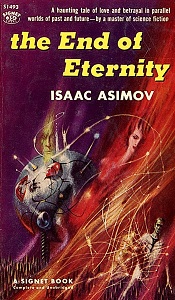
The End of Eternity, Isaac Asimov

(Another review from Facebook, posted before I unshuttered this blog.)

I read The End of Eternity (1955, USA) because it was nominated for the Hugo Award in 1956, and I’ve been trying a few of the old Hugo nominees. It’s also one of the few Asimov novels I managed to miss reading back in my very early teens.

Normally, of course, I avoid his books like the plague – I think he was a terrible writer, who managed a couple of ideas per book but everything else was just 1950s USA with a thin wash of paint. He’s the exemplar of Men in Hats sf. Asimov was 35 when The End of Eternity was published, but much of it reads like it was written by a much younger man – even though he didn’t even start it until 1953.

The invention of time travel has led to the creation of Eternity, a series of stations outside of time, with access to every year from their creation to the distant future, which are staffed by an all-male (for reasons that probably were unexceptional in the 1950s) corps who make carefully calculated changes to history in order to prevent future rough patches.

One such staff member, a Technician, Andrew Harlan, born in the 95th Century, despite the resolutely 20th Century US name, falls in love with a young woman from the 575th Century, and jeopardises his career, and Eternity, in order to have a relationship with her. This also includes jeopardising the plan in which he is unwittingly instrumental – sending a technician back to the 24th Century to invent time travel. No time travel, no Eternity, no Andrew Harlan, no nookie.

Everything goes entirely as expected, even the plot twists. The prose is anodyne and the level of invention low – one mission involves sabotaging a clutch on a vehicle in the 223rd century because of course they would still have cars with gearboxes 20,000 years from now; although I was… bemused by “her long legs shimmered in faintly luminescent foamite”, which is a really tone-deaf neologism and likely doesn’t evoke the image Asimov intended.

The End of Eternity lost the Hugo to Heinlein’s Double Star (1955, USA), although Leigh Brackett’s The Long Tomorrow (1955, USA) would have been a better winner.


Leave a comment

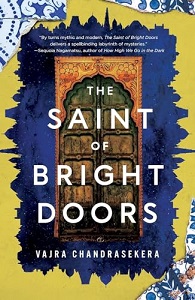
The Saint of Bright Doors, Vajra Chandrasekera

I wouldn’t say this was recommended by a friend so much as it was a friend asking me several times if I’d read the book and what I thought to it. Since I tend to have strong opinions on books, and if someone wants to know what that opinion is, then the book in question is either good enough, or bad enough, for me to invest an opinion in it. And what I knew about The Saint of Bright Doors (2023, Sri Lanka) wasn’t really in its favour: nominated for the Hugo and won the Nebula, two awards whose shortlists rarely align with my taste in genre fiction, and a modern fantasy in which magic sits alongside mobile phones, television, and so on…

And yet…:The Saint of Bright Doors is very good indeed. 

Mixing fantasy and mimetic fiction, as this novel does, is difficult and usually done badly (unless it’s a portal fantasy, which this isn’t). Chandrasekera pulls it off. That alone makes it a notable twenty-first century fantasy novel.

Fetter is the son of a god, the Perfect and Kind, but he lives with his mother, Mother-of-Glory, who raises him as an assassin, with the eventual plan of killing his father. By the time he hits his early twenties, Fetter is no longer an assassin and has moved to Luriat. The city is known for its “bright doors”. Doors which remain closed for a period of time become one-sided: door on one side, blank wall on the other. They cannot be opened and are painted in bright colours. To prevent this occurring, most doors have a glass or see-through panel.

Fetter masquerades as a student studying the bright doors, and gets involved with some revolutionary groups. He provides help to recent immigrants. But then his mother gets back in touch with him, and tells him of her past. How his father turned their island home into a peninsula, and then recreated the past so he had existed for thousands of years. Unfortunately, his followers have schismed, and one has become a brutal cult used by the authorities in Luriat.

Fetter is arrested and sent to an internment camp which seems to be much bigger on the inside than the outside (this reminded me of another novel, but I couldn’t think which). His father visits Luriat, and Fetter is brought out of the camp to see him. He refuses to bow to his father’s will. There is a pogrom, then a plague. Fetter fights against his father.

There’s a lot more crammed in there than just the above. There are books in which the author isn’t really sure where their story lies and so fills their story with far too many things. In parts, The Saint of Bright Doors feels a little like that, but somehow or other it all hangs together. Like the mix of magic and present-day technology, which shouldn’t work, but does.


Leave a comment

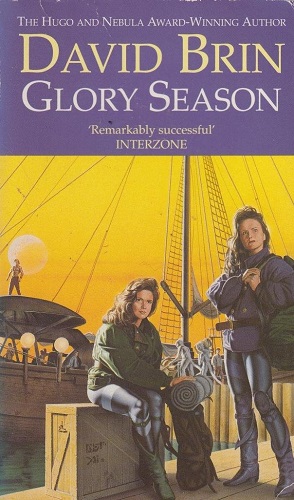
Glory Season, David Brin

I remember reading Brin’s Uplift novels many years ago and quite enjoying them, although something about them never sat quite well with me. I no longer remember what that was, although I’ve never made an effort to seek out his novels since. But Glory Season (1993, USA) was nominated for the Hugo Award, and is set on a world of cloned women, so it sounded like it might be worth a go.

So I was surprised to discover Brin is actually a pretty bad writer – sloppy, a tendency to stretch his story long past what the narrative can bear, with a handful of good ideas buried under a mass of banal detail. Characters change hair colour between paragraphs, a woman described as Chuychin (one of the cloned women clans) becomes half-Chuchyin a couple of sentences later. The writing is mostly clumsy, but occasionally manages an easy readability.

The world of Stratos was settled millennia before by a group who wanted to create a society that was safe for women. They needed men to “spark” their parthagenetic clones, but they limited the male libido to a single season of each year, and allowed them to also produce non-clone children (needed to replace the men, of course, but also daughters). The clones live in clans, each of which fulfils some sort of “niche”, or specialisation, in Stratoin society. Non-clone daughters, known as vars, hope to find niches and so get permission to start their own clans of clones.

Maia and Leie are twin vars, who leave their clan on their majority to seek their fortune. They sign aboard a pair of coal hauliers travelling down the coast. Maia stumbles across a conspiracy to supply a drug to men which triggers their libido out of season. From there, it spirals into a plot between two hardline factions, at the centre of which is a recently-arrived scout from the interstellar society the founders of Stratos left millennia before. Maia learns more about her world’s history, about the Game of Life, which is important to the men of the world, and about humanity on worlds other than Stratos.

In the best of hands, that’s a lot to cover, but Brin still manages to make it drag over 600 pages. At one point, Maia and her companions are trapped in a room with a hidden exit, and Brin spends over twenty pages explaining how they eventually discover the exit. For huge chunks of the book, Maia has no agency, and is little more than a witness to elements of the world-building Brin wants to show off. It makes for an aggravating read.

There are also many similarities between Glory Season and Mary Gentle’s Golden Witchbreed (1983, UK). The plots are vaguely similar, although Brin’s novel is told from the perspective of a native of the world, not a visitor – but the same lost past, a high tech war fought thousands of years earlier, and an ancient high tech citadel… Coincidence, or did Glory Season simply “borrow” elements of Golden Witchbreed‘s plot? Glory Season may have been nominated for the Hugo, but Golden Witchbreed is greatly superior (it was nominated for the BSFA, but lost to Tik-Tok (1983, UK)).

Discovering Brin was a worse writer than I’d remember was not a surprise. Spotting the resemblances between Glory Season and Golden Witchbreed was. I’ve no idea if Brin had knowledge of Gentle’s novel. I would like to think not, but it was definitely published in the US. Even so, on its own merits alone, Glory Season is not very good: overly long, and its poor writing works against its few good ideas.


Leave a comment

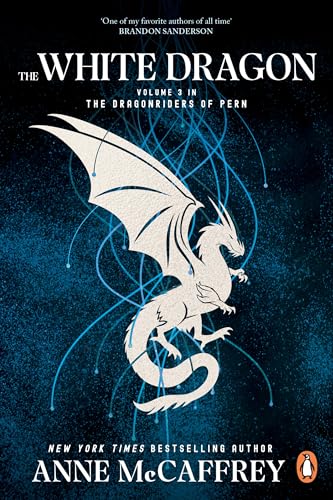
The White Dragon, Anne McCaffrey

The White Dragon (1978, Ireland) is the concluding volume to the original Dragonrider of Pern trilogy, but having now read the book it doesn’t much feel like the conclusion to anything. So I suppose it’s fortunate McCaffrey continued to churn out Pern novels for a few more decades…

The White Dragon follows directly on from Dragonquest (1971, Ireland). It focuses on Jaxom and Ruth, the teenage heir to Ruatha Hold and his undersized dragon, which is white if you hadn’t guessed. Ruth, the dragon, proves to be better at some things than the other dragons, despite being undersized and not sexually developed. He is faster and more manoeuvrable in the air, he has an excellent memory which is useful when travelling between (which is always italicised), and fire-lizards love him. Fire-lizards were introduced in the previous book and are sort of ferret-sized (I think) pocket dragons, about as smart as cats, and have been adopted by many on Pern as pets. They also seem to remember events that happened in the distant past.

The dragonriders, hold lords and master craftsmen have determined that humans first settled Pern on the southern continent, but they can find no record of why they fled north. The oldtimers – dragonriders from 400 years previously who helped save the day in the first book of the trilogy, Dragonflight (1968, Ireland) – were given land on the southern continent because they were causing problems with the present-day dragonriders and holds. But it looks like there’s lots more, and more desirable, land available on the continent.

And The White Dragon is more or less about that – exploring the southern continent, uncovering the ruins of the first human settlement on Pern, some political wrangling between an ambitious hold lord on the southern continent and the established holds on the northern continent, and Jaxom’s romance with the sister of said ambitious hold lord… There’s no plot per se, just a series of events which develop the characters and the background, and hint at the actual history of the planet.

Which doesn’t mean it’s not an entertaining read. Jaxom is an engaging character, as are the immediate supporting cast, more so at least than in the earlier two books, and Ruth can be amusing at times. Things happen… but there’s no real plot, no climax, no closure, no suggestion the story has concluded. Looking at the Pern books, it doesn’t seem so much a series as a collection of linked trilogies, and I’ve no idea which novel actually continues the story from The White Dragon.

I’ve enjoyed reading the trilogy, far more than I expected to, but I’ve no plans to read any more. If there is a book that follows on directly from The White Dragon, perhaps I might give it a go. But Wikipedia is no help, and I don’t intend to read umpteen books on the off-chance I find it… So, for now, I shall bail – but I will no longer malign the Dragonriders of Pern series as it’s actually not that bad.


Leave a comment

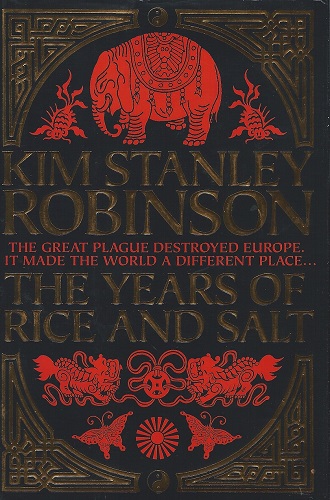
The Years of Rice and Salt, Kim Stanley Robinson

I’m a big fan of KSR’s fiction, because of the subjects he tackles and his treatment of them just as much as the stories he tells. He doesn’t just make use of common sf tropes, he interrogates them. A lot more sf authors should do that.

The Years of Rice and Salt (2002, USA) may be an alternate history, but it’s not a story set in a world which differs from ours due to some change in the past; it is in fact several stories – ten of them. Nor is it the book promised by its back-cover blurb, which posits a story set in a present-day world in which the Black Death in the fourteenth century killed 99% of the population of Europe instead of one-third. As a result, other civilisations flourished. Obviously, they flourished in real history – but in KSR’s novel they ended up dominating the world. The Years of Rice and Salt is not that either. It’s not a history of the world following on from the jonbar point. Which I suppose would be almost impossible – and huge! – to write. Like Laurent Binet’s Civilizations (2019, France), it is a series of vignettes which skip forward through the centuries, and around the world, from the Black Death to the present day. 

The linking conceit is that there is a group of people, connected eternally as a “jati”, who are repeatedly reincarnated. They die, spend time in the bardo, and are then reincarnated – as humans, or as animals. Allowing KSR to provide a focus point from which to hang to ten different stories taking place over the centuries in his alternate history. Sometimes the members of the jati remember their earlier lives, but usually they don’t.

The Black Death wipes out Europe. The Islamic Empire is never dislodged from the Iberian Peninsula. The Chinese continue to war on their western border, but also explore east and eventually settle the western coast of North America. A progressive empire develops in southern India. A league of Native American nations in central North America form a federation and keep their independence. There is a decades-long war which involves all three of the major world powers – the Indian empire, the Islamic empire, and the Chinese empire. Once the dust has settled, a new world order prevails. The various members of the jati are present, or pivotal, in some of the more important events in this 700 year history. Which also take place all over the world – Samarkand, Beijing, the Great Lakes, an Islamic city in western France, a Chinese San Francisco, and so on…

It’s fascinating stuff. The linking text is, to be honest, a not especially interesting mechanism to give the novel structure, and the ten “books” in The Years of Rice and Salt would be equally engrossing without them. KSR’s research is impressive – but not perfect: at one point, he states the Islamic punishment of cutting off the right hand of criminals is worsened because it forces criminals to use their left “unclean” hand when eating. That’s the whole point of the punishment. But the invented history KSR has created is astonishing. It feels all too real, which I guess is the point of the novel. Recommended.


Leave a comment

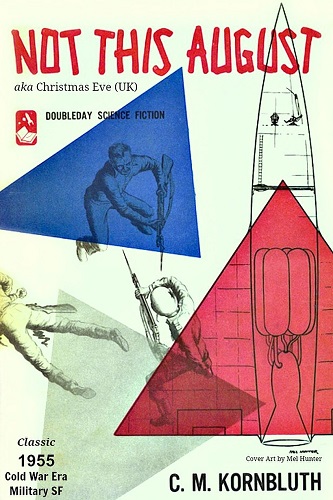
Not This August, Cyril M Kornbluth

Nominated for the Hugo in 1956, which was won that year by Robert Heinlein’s Double Star (1955, USA). Not This August (1955, USA) takes place in 1965 in a US that has been fighting USSR and Chinese forces for three years. The war has not been going well, and life in the US is grim, deprived and increasingly restrictive.

Billy Justin is a veteran and a small milk farmer barely scraping by. He hires a local itinerant who doesn’t appear to have all his marbles, only for the man to reveal he headed a secret project to build a crewed orbital bomb platform to end the war. The project was in danger of being discovered so he sealed the secret bunker and fatally gassed everyone inside.

The Soviets conquer the US and a political troop take over the county where Justin lives. He hooks up with a US resistance, and they restart the orbital bomb platform project, which was nearly finished anyway. Then the Soviet occupying troops are replaced with more hardline troops, but the Americans manage to stage an uprising, which serves as a successful ploy to prevent the Soviets from stopping the launch of the bomb platform.

Not This August reminded me a little of MJ Engh’s Arslan (1976, USA), a novel I didn’t like. One of the problems I had with that novel was the US at the time of writing, 1976, threw off fifty years of progress seemingly overnight, going from cars to carts and horses in a matter of days. In Not This August, the US has at least been at war for three years, and while it has taken most of the nation’s resources, it has not at the start of the novel managed to take US territory. Except the life lived by Justin is not the 1965 we remember, but closer to 1935. True, there were still farms and rural communities in the US without electricity until the mid-1960s in the real world, but even so… 

There’s a lot of American sf written and set in the early latter half of last century that feels like it’s set between the wars. Because that’s when the writers were teenagers, or young men (they’re almost always men; except for, well, Engh), and their imagination doesn’t stretch much further than that. Either that, or the US was a lot more backward, and perhaps still is, than it liked, or likes, to insist. Not This August is an entertaining if dated and not especially plausible sf novel. I remember living under the threat of Mutually Assured Destruction, and Kornbluth obviously was when he wrote this novel, but there’s nothing here to evoke that – or, I suspect, to remind those who lived during rationing what it was like (the US had rationing during WWII, but it was nowhere near as severe as in the UK). Nice try, but no Blue Peter badge, I’m afraid.


2 Comments

Venus Plus X, Theodore Sturgeon

This was a reread, although I couldn’t tell you when I last read the book. The late seventies or early eighties, at a guess. I’d remembered the novel’s basic set-up, but nothing else. Venus Plus X (1960, USA) is set in the distant future, in a utopian community of hermaphroditic humans (not really an acceptable term these days, but these have the organs of both sexes and can procreate). 

A man from the mid-twentieth-century is pulled forward in time to the community of Ledom. Yes, it’s “model” backwards, but Sturgeon admits in a postscript he reversed the name of a can of his favourite tobacco. The time-traveller, Charlie Johns, is asked to give his opinion on Ledom and its society. Various guides show him around and explain things. Everything in Ledom is a consequence of the “A-field”, a sort of force-field, and the “cerebrostyle”, which can write knowledge directly onto people’s brains. There is also a chapter on biology – the Ledoms have both sex organs, and two uteruses, and always give birth to twins.

Alternating with this guidebook-style narrative is some sort of sitcom featuring two families who live next door to each other. These sections are almost entirely dialogue.

(The cover shown above, which I think is the edition I have in storage, badly misrepresents the actual story)

There are long sections on gender, which I suspect only gammons and terfs will disagree with, and religions, which manages to erase almost all of them except Christianity and misrepresents those it does mention. Sturgeon’s thesis is that both of these – the elimination of gender through the creation of hermaphroditic humans, and a charitic religion – were necessary to create the utopian Ledom. Except, while Sturgeon rightly points out gender roles are social constructs, he still defines them using biological sex; and, as others have pointed out, the gender politics Sturgeon presents were not universal even back in 1960 – and his model society only exists more because of its two magical inventions than anything else.

Charlie learns Ledom exists inside an A-field bubble on an Earth devastated by nuclear war. He also discovers – against the wishes of the Ledom senior members – that the Ledoms give birth to normal humans, which are then (surgically?) altered to be Ledoms. For some reason, this sends Charlie completely off the rails and he tells them he, and all humans, would kill them if they could. When Charlie tries to escape to the past, he discovers the truth about the time-travel machine. Meanwhile, nuclear bombs explode outside Ledom’s A-field – is this implying humans still live? Or that Ledom is actually in the present? It’s unclear.

Sturgeon writes that he wanted to write a novel about sex. The novel credited with introducing the topic of sex into science fiction is Philip José Farmer’s novella, ‘The Lovers’ (1952, USA). The earliest sf novel I can find centred around a hermaphroditic character is Katherine Burdekin’s Proud Man (1934, UK), but in that novel the hermaphrodite travels back in time from the future to 1930. Burdekin’s novel, according to Wikipedia, criticises gender roles. Venus Plus X doesn’t do that – it posits a near-utopia, which despite its arguments only survives because it hides a horrible secret, which, to be fair, is a common science fiction trope, sort of like soylent green. I wasn’t convinced.

The title, incidentally, comes from the phrase “men are from Mars, women are from Venus”, and Charlie speculates the hermaphroditic Ledoms are women with a bit extra, “x”. Ugh.


Leave a comment

Witch World, Andre Norton

I remember reading some novels by Norton back in the 1970s, but I don’t remember if Witch World (1963, USA) was one of them. Probably not. Nothing in it seemed remotely familiar. Or particularly good. Although it was on the Hugo Award shortlist in 1964. The only memory I have of the novels by Norton I read back then is that they were science fiction adventure stories, on a par with something like the Hardy Boys. And with, I seem to recall, mostly teenage or young adult protagonists. Enjoyable, but not memorable. To a teenager, at least.

And I think you’d have to be a teenager to put up with the awful cod-mediaeval dialogue Norton uses in Witch World. The plot is simple: Simon Tregarth – who is not a teenage or young adult protagonist – is on the run after a life of adventure post-war, not always on the right side of the law. He meets a man who promises him a new life, where he will never be caught. Tregarth goes with him, and learns the man is the guardian of the Siege Perilous, a magical stone which can send people to other worlds. Tregarth gets sent to one. Cue adventure.

The world is vaguely mediaeval, with the odd bit of high tech, which even Tregarth thinks is weird in inconsistent. There’s also magic, but he doesn’t blink an eye at that. Nor the fact it’s only women who can perform magic, and they lose the ability if they’ve had sex (which is a bit annoying for Tregarth, as he fancies one of the witches big time). But then it turns out he has magical abilities – a man! inconceivable! – and he’s definitely not a virgin.

Anyway, Tregarth joins the Guards of Estcarp, and plays a pivotal role in a war against the Kolder, human invaders from another world – Norton comes within an inch of describing them as “Yellow Peril” – who turn those they capture into robot zombies. Despite proving unstoppable for much of the novel, Tregarth manages to stop them. There are, of course, a few diversions along the way – failing to defend the trader city of Sulcarkeep, meeting the misogynist Falconers of the mountains, a pogrom against those of the “old blood” in Karsten, a forced marriage in Verlaine, and even discovering the tomb of one of the ancient race who occupied the planet before the humans arrived. It’s all very thrilling…

Witch World went on to spawn a series of more than twenty books over four decades, not all by Norton alone. I have the second book of the series, Web of the Witch World (1964, USA), but I very much doubt I’ll be reading any further.