It Doesn't Have To Be Right…

… it just has to sound plausible


Leave a comment

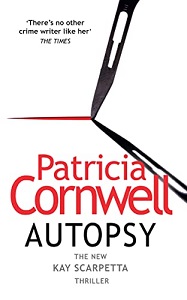
Scarpetta 25: Autopsy, Patricia Cornwell

I’ve been reading the Scarpetta books for a number of years. I read the first seven back in the 1990s, but started the series again a few years ago – and have been working my way through them ever since. I was looking forward to the television adaptation, which had been promised for many years, and when it was finally made, and broadcast this year, I watched it… Despite the stellar cast, there were changes I’d not expected. It was also based on the plot of this book, Autopsy (2021, USA), the series’ twenty-fifth novel, which I hadn’t read at the time.

Now I have. The most obvious changes in the TV series were: Pete Marino is married to Scarpetta’s sister, Dorothy, and niece Lucy’s wife and adopted son are both dead. None of which was the case in the preceding book, Chaos (2016, USA; see my review here).

However, Marino is indeed married to Dorothy in Autopsy, which appeared five years after Chaos and, more pertinently, after the pandemic. Lucy’s family apparently died of covid while living in London (Cornwell outright lies here and implies the UK fatalities were much greater than those of the US; in fact, far more people, and more people per capita, died in the US). The romance between Marino and Dorothy was hinted at in Chaos, and before that in Flesh and Blood (2014, USA) and Depraved Heart (2015, USA), but there is no good reason I could discern why Janet and Desi should be killed off. (Or for Janet’s change of nationality to British, when in the books she is ex-FBI and first met Lucy at Quantico.)

So, it seems the TV adaptation is mostly quite faithful (and yes, an AI Janet does feature in the novel). In terms of plot… Autopsy opens with Scarpetta back in Virginia and once again the Commonwealth Chief Medical Examiner, taking over from the incompetent and manipulative Elvin Reddy, who is apparently an old adversary of Scarpetta’s, although he wasn’t mentioned in earlier novels (as far as I remember). She is called to the house of a young woman who has disappeared, and who might be the victim in an ongoing murder investigation. A body was discovered beside some railway tracks in a park, and its hands had been removed. They quickly confirm the missing woman is the murder victim. She worked for a laboratory researching 3D-printed organs, and they discover she was a spy – corporate espionage, or for the Russians, they don’t know. She has an accomplice, who is aboard an orbiting laboratory operated by the same company. Except he’s gone rogue, murdered the other two astronauts, and fled in the Soyuz spacecraft.

Scarpetta is asked to help understand what happened in the orbital laboratory (it doesn’t crash on Earth, as it does in the TV series, because, well, things falling from orbit rarely reach the ground). She doesn’t think the woman’s murder is related to the spying, but she does think an earlier death in the same park, ruled accidental by Reddy, was murder – and by the same killer. Meanwhile, she has to contend with Reddy’s cronies making her job difficult, her sister and Marino staying with her (although they don’t bicker as much as they do in the TV adaptation), and Lucy’s grief. 

Then Reddy fires her. And a man tries to break into her house…

Everything is wrapped up in a couple of pages of epilogue. Scarpetta gets her job back. Lucy kills the intruder, who turns out to be an odd-job man Scarpetta had used several times. He also murdered the two women, and had been a serial rapist for years. WTF. “By the way, here’s how the story ended” is a piss-poor way to finish a novel.

Given the changes to Scarpetta’s situation, I have to wonder if the novel was written with the TV series in mind – ie, Marino’s marriage, Lucy’s loss, were added to the book because the TV adaptation needed them to create home drama. Scarpetta’s move back to her old job as Chief Medical Examiner in Virginia was because in the narrative set in the past, and based on the first Scarpetta novel, Postmortem (1990, USA), she held that position – and so was dictated by the structure of the TV series. The book was published in 2021, and the series was greenlit that same year, so it’s certainly possible.

Despite all of the above, the strangest thing about the book is that it appears to have been written by AI. Things were different back in 2021, but GPT-3 had been around for a year, and while less sophisticated than current LLMs, it’s not inconceivable Cornwell could have used it. It would certainly explain the bizarre writing. Cornwell is hardly a prose stylist, but in Autopsy the writing is actually terrible. Sentences have weird hanging adverbial clauses. Dependent clauses lack verbs. The relative pronoun “which” is conspicuous by its absence, especially in sentences which would be grammatically correct if it had been used. The same bizarre syntax also appears occasionally in dialogue, in actual speech spoken by characters. And, most bafflingly, the swearwords have all been bowdlerised – eg, “effing”, “cluster-eff”, “flipping”. The bowdlerisation is even annotated:

“They can screw themselves.” Only Marino doesn’t say screw. (p 272)

WTAF. 

The last few Scarpetta novels have been frustrating reads, chiefly because plot reasons require Scarpetta, and hence the reader, be kept in dark for much of the book. But I quite liked the microscopic focus on the lead character in Chaos. Autopsy, on the other hand, is easily one of the worst books in the series so far, if not the actual worst. Appallingly written, poorly plotted, and with changes to Scarpetta’s family life that make no sense, unless introduced with the TV series in mind (and even then baffling). I hope the remaining four novels in the series are not the same.


1 Comment

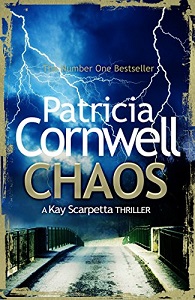
Scarpetta 24: Chaos, Patricia D Cornwell

This follows directly on from the previous book, Depraved Heart (2015, USA), and I have to wonder if the books in this series can be read independently anymore. Certainly I didn’t read the first few books of the Scarpetta series in order originally, much as I didn’t for both Sue Grafton’s Alphabet series (despite the titles; yes, I know) or Sara Paretsky’s VI Warsawski novels – both of which, incidentally, I recommend more than I do Cornwell’s Scarpetta series. My point being the early Scarpetta novels were pretty much self-contained, but now they form trilogies and short series within the larger series, and Chaos (2016, USA) is definitely a sequel to Depraved Heart, which itself continues on from Flesh and Blood (2014, USA). Chaos at least seems to be the end of it as psycho-genius Carrie Grethen is captured and committed to a secure psychiatric hospital by the end of the novel. And if that constitutes a spoiler, you’ve not been reading this series very long…

The road from chapter one to the end in Chaos is not all that different to the preceding books in this series within a series. There were, however, a couple of changes I hadn’t seen coming (and which may have been spoiled by the recent TV adaptation). Once again, the novel is structured around a murder which presents contradictory evidence. A young woman, whom Scarpetta had spoken to earlier that day, is found dead on a path in a park by the Harvard campus. She was on her bike, but has been thrown from it, and the cause of death is almost impossible to determine.

Meanwhile, Benson and Lucy are aware of events happening elsewhere in Boston, but keep Scarpetta in the dark. Scarpetta’s sister, Dorothy, the flaky children’s author, is flying up for a visit, and it seems she and Marino became “very good friends” in Miami during the events of Flesh and Blood. Most of Chaos takes place at the murder crime scene – the location, and the heat wave affecting Boston, have complicated the investigation.

Of course, Grethen is the murderer, and Scarpetta spends much of Chaos speculating how she might be involved, despite being entirely off-stage for the entire narrative. Benson’s and Lucy’s secretiveness seems less justified here than in earlier novels, and in places it feels like Cornwell was more interested in describing how uncomfortable Scarpetta finds the heatwave than in actually solving a murder.

Chaos is a quick read, and feels somewhat unsatisfying. The murder is solved, and further horrors are avoided, but it all seems weirdly secondhand, given that Grethen never makes an actual appearance. On the one hand, I like that Cornwell is focusing on Scarpetta much more intensely; on the other, keeping her in the dark for much of the novel is getting a little wearying. There’s third-person omniscient POV, and there’s tightly-coupled first-person POV, but having other members of the cast expressly not reveal information to the narrator for plot reasons…

Five books to go – assuming Cornwell doesn’t publish another before I reach the end, and she probably will. The next book in the series is Autopsy (2021, USA), which was adapted for the contemporary narrative strand in the recent TV series. It will be interesting to see what changed with the move to the screen.


Leave a comment

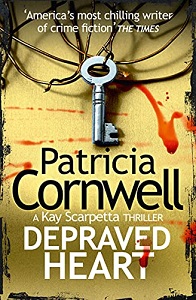
Scarpetta 23: Depraved Heart, Patricia Cornwell

Depraved Heart (2015, USA) continues on directly from Flesh and Blood (2014, USA) – which ended with a major cliffhanger: Scarpetta shot with a speargun and possibly dead… But of course she isn’t: there are at present six more books in the series. 

Depraved Heart opens some months later. Scarpetta is still recovering, and while she has no doubt she was shot by returned-from-the-dead psycho killer Carrie Grethen, the FBI is not so convinced. In fact, they seem to think Lucy is the killer. From the reader’s point of view, it’s all nonsense. And whatever is happening to defend Lucy is being kept from Scarpetta – by Benton, by Lucy, by pretty much everyone.

All of which manifests itself as a raid on Lucy’s well-defended mansion by the FBI. There’s also a young woman who seems to have fallen to her death while drunkenly adjusting a chandelier in her mother’s palatial home… but Scarpetta is not convinced it’s accidental. And there’s plenty that’s a bit weird about the murder and the victim. Not the least of which is that she knew Lucy.

All this is going on and Scarpetta is deliberately left in the dark, which means there’s lots of interiority about Grethen shooting her, and Scarpetta doubting her own memories, and suspecting some sort of conspiracy aimed at her and her loved ones…

It’s all resolved, of course, although Grethen spends the novel entirely off-stage. Given she’s the fulcrum around which the plot revolves – the title, a legal term in US justice, seemingly applies to her, although Scarpetta does worry at one point whether it could also apply to Lucy. I’m assuming everything comes to a head in the next novel in the series, Chaos (2016, USA), as Scarpetta discusses Grethen’s career of “causing chaos” several times in Depraved Heart

Most of the Scarpetta novels stand alone, but I’m not convinced this one does. It reads like the middle novel of a trilogy. On the other hand, Cornwell does like to make full use of her psycho killers over several novels, even if she has to bring them back from the dead a few times.