It Doesn't Have To Be Right…

… it just has to sound plausible


Leave a comment

White King, Juan Gómez-Jurado

This is the third book of the Antonia Scott trilogy. I watched a TV adaptation of the first book, Red Queen (2018, Spain), and enjoyed it. So when the books popped up as cheap ebooks, I didn’t hesitate to buy them. Unfortunately, like another famous European thriller trilogy featuring a genius protagonist, the first book is way better than the sequels. In Red Queen, gay Basque detective Jon Gutiérrez is assigned to assist genius criminologist Antonia Scott while she investigates the kidnapping of a billionaire’s daughter. Scott is part of the Red Queen project, a pan-European agency which uses drugs and neural programming to enhance selected geniuses to make them super-effective solvers of crimes.

Red Queen was followed by Black Wolf (2019, Spain), which had Scott and Gutiérrez involved with Russian gangsters on the Costa del Sol. The title refers to a hired assassin. The events of both novels, however, had all been part of a plot organised by a genius psychopath known as the White King. And that’s what White King (2020, Spain) is about.

Mt White, the genius psychopath, has been hired to steal something. He needs Scott’s help, but of course she would refuse. So he set up the kidnappings in Red Queen, and the murders in Black Wolf, to manipulate her, and the Red Queen project, into a position where he has access to the thing he has been contracted to steal. None of this is especially convincing. Especially since the manipulation seems to depend on minor details from the first two books. 

White King is structured as three murders, one from several years before, one that occurs that very day, and one that is about to happen. All three are linked. Scott is given only hours to solve the murders. In order to motivate Scott, White kidnaps Gutiérrez and implants a bomb against his spine. If Scott fails to solve each crime by the deadline… Gutiérrez loses his head.

I mentioned another popular European trilogy, but unlike those three books, the Red Queen trilogy pits one genius against another, and genius is always difficult to present in fiction. White’s speciality is blackmailing people into performing tasks for him, even tasks completely against their nature – such as murdering all their colleagues. It’s not credible, and like most fiction of this type, book, television or film, relies on people abandoning whatever morals they may possess at the slightest provocation for plot reasons. The other aspect of genius as presented in fiction is vast knowledge. In past works, this manifested as erudite and well-educated, often self-educated, criminal masterminds. But these days, with computers so ubiquitous and intertwined in daily life, and the internet, there’s no need for the villain to have that knowledge, only have access to it. Which means Magical Hackers. And so it is here.

White King’s denouement is cleverly done, however, and Scott is an interesting character. Goméz-Jurado’s prose is choppy, and perhaps a little journalistic, but also plainly written with film or TV adaptation in mind. And the TV series was indeed good. There’s been no mention of adapting Black Wolf or White King. Which is a shame.


Leave a comment

Scarpetta 23: Depraved Heart, Patricia Cornwell

Depraved Heart (2015, USA) continues on directly from Flesh and Blood (2014, USA) – which ended with a major cliffhanger: Scarpetta shot with a speargun and possibly dead… But of course she isn’t: there are at present six more books in the series. 

Depraved Heart opens some months later. Scarpetta is still recovering, and while she has no doubt she was shot by returned-from-the-dead psycho killer Carrie Grethen, the FBI is not so convinced. In fact, they seem to think Lucy is the killer. From the reader’s point of view, it’s all nonsense. And whatever is happening to defend Lucy is being kept from Scarpetta – by Benton, by Lucy, by pretty much everyone.

All of which manifests itself as a raid on Lucy’s well-defended mansion by the FBI. There’s also a young woman who seems to have fallen to her death while drunkenly adjusting a chandelier in her mother’s palatial home… but Scarpetta is not convinced it’s accidental. And there’s plenty that’s a bit weird about the murder and the victim. Not the least of which is that she knew Lucy.

All this is going on and Scarpetta is deliberately left in the dark, which means there’s lots of interiority about Grethen shooting her, and Scarpetta doubting her own memories, and suspecting some sort of conspiracy aimed at her and her loved ones…

It’s all resolved, of course, although Grethen spends the novel entirely off-stage. Given she’s the fulcrum around which the plot revolves – the title, a legal term in US justice, seemingly applies to her, although Scarpetta does worry at one point whether it could also apply to Lucy. I’m assuming everything comes to a head in the next novel in the series, Chaos (2016, USA), as Scarpetta discusses Grethen’s career of “causing chaos” several times in Depraved Heart

Most of the Scarpetta novels stand alone, but I’m not convinced this one does. It reads like the middle novel of a trilogy. On the other hand, Cornwell does like to make full use of her psycho killers over several novels, even if she has to bring them back from the dead a few times.


Leave a comment

Scarpetta 22: Flesh and Blood, Patricia Cornwell

One of the problems with formulas, particularly when it comes to book series, and especially series that have been going for longer than the author likely originally expected… I mean, I don’t know how many Scarpetta novels Cornwell set out to write, but twenty-two must be more than she ever envisaged – and the series is currently up to twenty-nine books. She’s maintained an impressive inventiveness in the murders, and the solving of them, over the books I’ve read so far…

But because of the formula, the books demand a villain against whom Scarpetta can pit her expertise and wits, and they’re usually genius-level psychopaths who enjoy planning and executing complicated murders. And good villains are hard to give up, so they have a tendency to come back from the dead. Cornwell has already done this once. And she does it here again.

It’s Scarpetta’s birthday and she’s due to go on vacation in Florida with her husband, FBI profiler Benton Wesley. But then, a college music teacher is shot in his driveway by a sniper. Scarpetta has history with the victim. Whose death has similarities to two other murders. Then more deaths – accidental, homicide mistaken for accidental, and actual homicide – seem to be connected… and somewhere in the centre of all this is Scarpetta. So once again, the death and mayhem is all intended to destroy her or her reputation.

Lucy is also involved, and she seems to have a good idea who the killer is. As does Benton. Scarpetta does not figure it out until near the end (long-time readers of the series will probably work it out before Scarpetta). The killer has been hired as a fixer by a corrupt congressman with a sociopathic son, but the fixer seems to have jumped the rails. Americans like their corrupt public officials – they even put one in the White House. Twice.

The ending hews close to the formula – Scarpetta becomes the killer’s target, although not this time because she sets things up so that’s the case: the killer wants her dead for reasons of their own. Of course, the killer fails – there are another seven books in the series to go, after all. But Flesh and Blood (2014, USA) does end with one of the most ambiguous cliff-hangers I have ever read.

On the whole, one of the better of the recent Scarpetta novels, so it seems the series is improving. And I’m really looking forward to the television adaptation, starring Nicole Kidman, I believe, in the title role.


Leave a comment

Millennium 8: The Girl with Ice in her Veins, Karin Smirnoff

The second book of the third trilogy featuring Lisbeth Salander, genius sociopath hacker. The problem with novels which centre sociopaths as the hero is the villains have to be complete psychopaths in order to present some spectrum of good to bad. So, here, for example, a bad guy who infiltrates a group of eco-activists turns out to be a paedophile, because being on the bad guy’s side is not enough on its own. And when every villain is grotesque beyond plausibility, suspension of disbelief even, then you have to wonder what point the story is trying to make.

On the other hand, this is a deckare, a thriller, so I guess making a point is not, well, the point of the book. The Girl with Ice in her Veins (2025, Sweden) is not a translation of the book’s original Swedish title, Lokattens klor, which means “the lynx’s claws”, but neither of the titles is especially relevant to the plot – although there is a a newly-introduced character nicknamed Lo, lynx. She’s a baddy, of course.

Like the preceding novel, The Girl in the Eagle’s Talons (2022, Sweden), The Girl with Ice in her Veins is set mostly in the invented north Swedish town of Gasskas. It also features the same cast – not just Salander and Blomkvist from the original trilogy, but also Blomkist’s daughter and family, Salander’s niece, and the trilogy’s main villain, disabled white supremacist millionaire Branco. The ecological theme also continues, although this time it’s opencast mining rather than windfarms.

Salander’s niece, Svala, is interning at the local newspaper and has joined a local group of eco-activists. After discovering a local abandoned sanatorium is secretly in use, Svala’s mentor at the newspaper is murdered. A bomb explodes near a disused mine, which appears to be in the process of being re-opened. There is also a consortium interested in opening a new mine in the area.

It’s all connected, of course, although the novel seems more interested in the depredations of the secondary cast, especially the villains. The Cleaner is hired to murder someone in Copenhagen, who turns out to have connections to the new mine in Gasskas, but instead he decides to help Svala. A visiting Greek/Chinese millionaire, who is interested in investing in re-opening the old mine (which is actually owned by Gaskass kommune), turns out to be the father of Blomkvist’s grandson. But because he’s a baddy, he’s also a domestic abuser and made his fortune through people trafficking. Branco pops up every now and again. He’s after the harddisk containing billions in cryptocurrency which Svala was given by her mother and which she has hidden. He’s also less interested in business and more in his white supremacist political organisation.

The Girl with Ice in her Veins resolves its main plot-threads, but Branco once again escapes. So that’s the plot of book three – as yet untitled – sorted. The prose is present-tense again, and often choppy. It mostly works, but occasionally gets perilously close to the fourth wall. I did spot a couple of weird choices in translating Swedish words/culture, but fewer than in the previous book. The Girl with Ice in her Veins is not a great book, but then the series could hardly be called a great series. The first book, The Girl with the Dragon Tattoo/Män som hatar kvinnor (2005, Sweden), was a solid serial killer hunt thriller, but it’s been downhill since then. I must admit, I do wonder how far they plan to take the series. Blomkvist is now in his sixties, Salander is slowing down too… The Girl in the Eagle’s Talons and The Girl with Ice in her Veins do feel a little like they’re moving Svala to centre-stage, so who knows…


Leave a comment

Scarpetta 21: Dust, Patricia Cornwell

Benton, Scarpetta’s husband, a FBI profiler, is away working on three linked murders of women in Washington DC, but his expertise is being ignored, disparaged even. And then the body of a murdered woman appears in Cambridge (Massachusetts, that is), Scarpetta’s jurisdiction, and it’s clear it’s connected to the three in Washington, even if it seems to contradict the prevailing theory held by the FBI about the crimes.

Scarpetta, Benton, Lucy and Marino find themselves trying to identify a serial killer who, it seems, is being protected by someone powerful, at least to the extent the FBI agent in charge of the investigation is ignoring evidence and focusing instead on a teenager who disappeared seventeen years before.

Once again, Scarpetta’s reputation is under attack, as are her family and relationships, but this time she sets out to methodically prove every point of her – and Benton’s – theory of the crimes, and so bring down the FBI agent deliberately misleading everyone. As in other books in the series, the murderer is more than human, almost as if the nearest the US can get to real-life superheroes are serial killers, which is pretty damn sick no matter which way you look at it. It might even be said crime novels which focus on serial killer stories – as so many of the Scarpetta series have – have much in common with fantasy or science fiction. True, one of the reasons I like the Scarpetta series is because Cornwell details the forensic science used – which does occasionally read like science fiction (much like the many CSI TV series).

Another draw is Cornwell’s focus on characterisation. Her cast are not enigmatic, phlegmatic, whimsical or just sketched-in, as is usually the case in crime fiction. She started out using first-person narratives, then switched to third-person omniscient before moving back again to first-person, except now there’s far more interiority and Scarpetta’s every thought is worked through implacably.

Dust (2013, USA) is one of the better books in the series, even though the plot centres around an implausible serial killer, and a defining event occurs off-stage and is far too easy to be credible. There’s also a fascinating article about Cornwell after the novel in the ebook edition, highlighting the many parallels between Cornwell herself and her characters, especially Scarpetta and Lucy..


Leave a comment

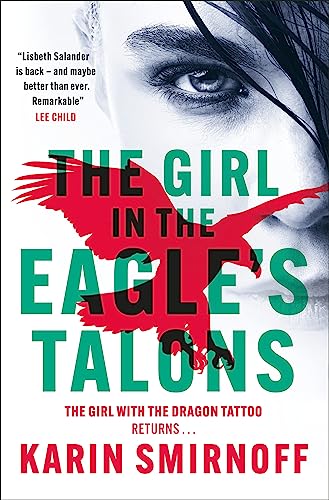
The Girl in the Eagle’s Talons, Karin Smirnoff

The start of the third trilogy featuring Lisbeth Salander and Mikael Blomkvist, and a new author. As indicated by the title, I read it in English – and… a new translator too. This time it’s a professional translator from Swedish to English. The English version keeps up The Girl… book titles, which are not of course direct translations of the original Swedish titles. In this case, it’s Havsörnens skrik, The Sea Eagle’s Cry – but weirdly, it’s a boy who finds himself in the titular, er, appendages.

Blomkvist is in the invented town of Gasskas in Norrbotten, a county in the most northerly part of Sweden. He’s there for his daughter’s wedding. To the head of the Gasskas kommune (district council/municipality). Who Blomkvist doesn’t like from the moment he meets him as he seems to be a bit of a chancer. Honest – but not the most transparent of politicians. Especially when it comes to a deal to build Europe’s biggest windfarm on land in the district. There are three companies in line to take a third each of the contract, but one wants 100% of it, a shadowy Swedish company run by a disabled psychopath who lives in a refurbished military bunker near Gasskas.

Lisbet Salander is in Gasskas because her half-brother’s daughter – previously unmentioned in the series, unsurprisingly – is about to go into care, and Salander is the only surviving relative. The daughter, Svala, is a genius like Salander, and also has the same genetic condition as her father which means she doesn’t feel pain.

The two narratives are connected. Svala’s mother is missing because she’s been kidnapped by the psycho millionaire. Blomkvist’s soon-to-be son-in-law is being threatened by the same psycho to give him the entire contract. The two stories intersect when Blomkvist’s grandson is kidnapped at the wedding.

There’s little that’s new here, except perhaps the setting: the Swedish north. Blomkvist is a bit more of a fogey than in earlier novels, and Svala fills more of Salander’s typical role than Salander does. The villains are almost caricatures – they even have a secret underground lair!

The writing is better than the Lagercrantz trilogy, although that’s hardly a high bar to clear. Everything is in present tense, which gives it more urgency, and often drops into choppy sentence fragments. It works, to an extent – although I don’t think the material is really strong enough for it, given everything is so clichéd. 

This is the English prose, of course, so it seems the translator is much better. There were a couple of questionable choices: Systembolaget is referred to throughout as “the off-licence”, which may well be a UK term for a shop that sells booze, but Systemet is the state liquor monopoly chain, which is not quite the same thing. The word “Lapp” is used interchangeably with “Sámi”, even though it’s considered offensive, and it’s not always in dialogue or in the POV of characters who are prejudiced. And someone orders “a pizza salad”, but “pizza salad” is the name of a side-dish in pizza restaurants here (the indefinite article looks odd – like, you order a pizza and say “and garlic bread”, not “and a garlic bread”).

So, slightly better than the preceding three books, and makes good use of the series mythology. They are at least better than Dan Brown’s “weapons-grade bollocks” – and English is his first language! – but even for a commercial thriller this is near the bottom of the barrel.

And yes, I really should try reading the books in Swedish.


Leave a comment

Scarpetta 20: The Bone Bed, Patricia Cornwell

The twentieth book in the Kay Scarpetta series. Only nine more to go – including the one due this October. The title refers to a palaeontological dig in Alberta, Canada. A female paleontologist disappeared and several months later Scarpetta is sent an anonymous email containing a short video of the missing woman and a photo of a severed ear. Despite Scarpetta having no connection to palaeontologist, the place in Canada, or even dinosaurs.

Then the body of a woman turns up in Boston Bay, tied to a buoy. Scarpetta manages to recover the body intact. Shortly afterwards she is in court being cross-examined by the lawyer of a billionaire industrialist who has been charged with hiring the murder of his missing wife. But the body in the bay is not her.

And when they do identify the body, it turns out she was someone Marino was flirting with on Twitter, so he comes under suspicion…

Initially, it all seems like yet another plot to destroy Scarpetta’s career and reputation, a feeling only reinforced by the grilling she gets in court and the FBI investigating Marino. But it actually isn’t. It’s just your common or garden psychopath serial killer, of which the US has plenty, and Scarpetta’s involvement is more by accident than by design, or at the very least a happy and contrived coincidence on the part of the killer.

It also starts to look like Scarpetta is going to dangle herself as a victim, only to turn the tables – as in many other books in the series. But again, the killer abducts her only because of, er, happy coincidence, and for other reasons she’s rescued by the usual gang – Lucy, Marino, etc.

I’ve no idea if Cornwell was deliberately teasing the reader with hints of her more formulaic books, but I did like the fact The Bone Bed (2012, USA) didn’t hew closely to the formula. The title came from an actual bone bed visited by Cornwell, which inspired the novel – but it’s actually more or less peripheral to the story. She could have dropped the murder of the palaeontologist and it wouldn’t have substantially changed the plot.

A middling Scarpetta novel, I think. Slight above average, but not one of the more memorable ones. In its defence, it focuses more on crimes, and a killer, who has absolutely nothing to do with Scarpetta.


Leave a comment

Black Wolf, Juan Gómez-Jurado

The second book in a trilogy featuring Antonia Scott, a neurodivergent super-genius who works for a secret European agency dedicated to solving high-profile crimes. She’s assisted by Jon Gutiérrez, a gay Basque police detective. The two first appeared in Red Queen (2018, Spain), which was adapted for television in 2024.

In Black Wolf (2019, Spain) The pair are asked to assist in investigating the attempted murder of a Russian mobster’s girlfriend in Málaga. The girlfriend escaped, and is now on the run, but the mobster did not – and it turns out she was the financial genius behind all his shell companies and money laundering schemes. And because of that, the head of the Russian mob in the area wants her dead. So he asks his superiors back in Russia to send him some help, and they send the Black Wolf, a renowned assassin.

But when Scott and Gutiérrez stumble across a shipping container containing dead women who’d been trafficked to Spain, and the container is linked to the dead mobster, Scott is determined to take down the Russian mob in Málaga. But things aren’t as simple as they seem. Someone is attacking the organisation Scott works for, the police in Málaga are not as honest as they should be, and even the Black Wolf has her own agenda.

It all comes to a head in a villa in the woods near Madrid during a snowstorm. The Russians attack, and the handful of good guys – Scott, Gutiérrez et al – in the house have to hold out until the police arrive. Black Wolf is a more straightforward narrative than Red Queen, and its focus on the Russian bratva in Spain leaves less room for social commentary. There are still plentiful hooks to the third book, White King (2020, Spain), however. This is a good series, with a pair of engaging leads, and is already being compared to Larsson’s Millennium trilogy, although I’d argue it’s probably better, and I can understand why the first book was adapted for TV. It would be nice to see the other two adapted as well.


Leave a comment

Scarpetta 19: Red Mist, Patricia Cornwell

The nineteenth book in the Kay Scarpetta series, and following straight on from the previous one, Port Mortuary (2010, USA). Scarpetta has been invited to the Georgia Prison for Women to speak to the woman who sexually abused Jack Fielding (Scarpetta’s deputy, who was murdered in Port Mortuary) when he was twelve, and whose daughter is the psycho genius responsible for his death (and several others). Scarpetta is then contacted by Jaime Berger, no longer DA responsible for sex crimes in New York, but now based in Savannah – and it turns out she manipulated Scarpetta into visiting Georgia. Because she thinks a young woman on death row who brutally murdered a respected doctor and his family ten years prior is innocent.

Scarpetta resents being manipulated, but then Berger is murdered… and the hunt is on for a poisoner, who may be linked to the prison and responsible for the deaths of several inmates who died of “natural causes” just hours before they were due to be executed. The whole gang is in Savannah – Marino, Lucy, Benton – and it seems the poisoner was actually responsible for the doctor’s murder ten years ago.

The plot is, to be honest, a bit weak. Once again, Scarpetta’s reputation is attacked (the murderer from the previous book is claiming Scarpetta tried to kill her). There’s another psycho genius hiding in the background, and whose identity is pretty easy to guess. Everyone seems particularly slow to spot things, including Scarpetta, and the killer is found more or less by accident. But there’s some good autopsy scenes and some good deductive science in identifying the poison.

Red Mist (2011, USA) seems to close off a two-book story arc, so I expect the next one, The Bone Bed (2012), will introduce yet another psycho genius who will murder a few people, then twist the facts of the case to make Scarpetta look like the villain, before being shot and killed while trying to murder Scarpetta… But we shall see.


Leave a comment

Scarpetta 18: Port Mortuary, Patricia Cornwell

I read Port Mortuary (2010, USA) while travelling back home from Copenhagen by train. These books are becoming increasingly easier to polish off in a single sitting, even if they seem to be getting longer. Mostly, I suspect, that’s because I know the character of the protagonist, Dr Kay Scarpetta, pretty well now after 18 novels, and also probably because the plots are beginning to settle into something of a rut. Again, a puzzling murder is the springboard to a conspiracy to attack Scarpetta’s profile, credibility and relationships.

Scarpetta has spent six months at Dover Air Force Base, where US casualties from the invasion of Iraq are shipped. Shortly before this, she had set up a new forensic centre in Cambridge (Massachusetts), and left it under the command of Dr Jack Fielding, a character familiar from earlier books. But when a body appears to have bled out while in the freezer in this new centre, and Fielding has gone AWOL, Scarpetta is helicoptered in to fix things.

Unfortunately, nothing looks good. The centre is falling apart, things cannot, er, hold. The dead man in the fridge was murdered using some strange weapon which left pockets of air in his chest cavity. Benton is meanwhile treating a young man on the spectrum, a near-genius working in the R&D department of  a nearby defence contractor, who has confessed to murdering a small boy by hammering nails into his head. Benton is convinced the man has been manipulated into confessing – but by whom?

Scarpetta is also having flashbacks to the autopsy of two young women she performed for the US military in South Africa, back at the beginning of her career. She knows their murders were staged, likely by government agents to foment hatred – Cornwell seems to think Afrikaaners were black South Africans, which is, well, the exact opposite – but has always regretted following the party-line.

The murder of the boy and the man who bled in the fridge turn out to be linked, and clues point back to the defence contractor’s R&D lab. Fielding is also involved somehow. It all slots together neatly – Cornwell has been doing this for a while – but it does, unfortunately, fall back on Cornwell’s favourite solution: the super-intelligent psychopath who manipulates everyone around them. And Cornwell throws in an ending she over-used in the first few books of the series, where the villain of the piece attacks Scarpetta at home and is defeated.

Port Mortuary has moved back to first person, and is far more introspective than earlier books. There are a lot of words on the process, and means, of discovering the facts surrounding the two murders. Plus, everyone seems to know what’s going on, but is deliberately keeping Scarpetta in the dark. It makes for a frustrating read at points.

I’m not sure where to rank Port Mortuary among the Scarpetta books I’ve read. Too much in it feels like retcon, and Cornwell’s changes in narrative style – we’re eighteen books into the series here! – make it hard to get a real purchase on the series arc. Lucy’s inconsistent aging notwithstanding – cf Sue Grafton’s Kinsey Millhone books, which stuck so rigorously to their internal chronology her last book, Y is for Yesterday (2017, USA), was set in 1989. I do like the Scarpetta novels, I like their focus on the science and, increasingly, technology of forensic pathology. But they’re nowhere near as rigorous – perversely – than other series in the same space I like.