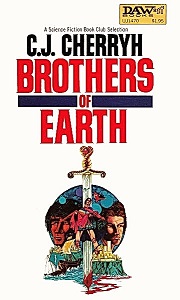
Brothers of Earth (1976, USA) was Cherryh’s first novel (published a few months after Gates of Ivrel (1976, USA), but actually submitted and accepted first). It’s based on a premise Cherryh has used many times throughout her career – a human man crashlands on an alien, but humanoid, world and tries to integrate, inadvertently kicking off a war between various nations/factions (cf the Compact Space books, Cuckoo’s Egg (1985, USA), Faded Sun trilogy, Foreigner series, etc). The story takes place over a thousand years after Cherryh’s Alliance/Union history, although the Alliance still exists. But it’s at war with another human polity, the Hanan.
Kurt Morgan, sole survivor of an Alliance warship, crashes and is discovered by a party of locals, the nemet. They take him aboard their sailing ship to the city of Nephane, where he meets the methi, the ruler of the city, who is Hanan, and the sole survivor of an earlier Hanan mission. She allows him to enter the household of Kta, the captain of the ship. Kta’s family is the Elas, and they’re descended from the Indras, inhabitants of a powerful theocratic state across the sea. Nephane is split between Indras-descended and the original locals, the Sufaki, with the former forming a wealthy and powerful elite. The Sufaki rebel, Morgan and Kta are caught up in it, and flee because the methi supports the Sufaki…
The world is at a roughly late Bronze Age level – Cherryh used to teach ancient history – so it’s all swords and sandals and triremes, with the theocratic Indras versus the more liberal Indras-descended of Nephane versus the pantheistic Sufaki. This is stuff Cherryh has done many times since, and better. For a first novel, in the 1970s, it’s sort of impressive, and it’s interesting seeing how much of Cherryh’s style was pretty much there from the beginning. But the story does drag in places, and while there are plenty of strong female characters, the main protagonists are male – and there’s also an instance of fridging.
The gauntlet has been laid down, and I’m up for the challenge.
What do I think are the best science fiction series?
For this list, I’ve defined a series as more than a trilogy, or a series of standalone novels set in the same universe and sharing a linked chronology. I actually put together a list of twenty series I like a great deal – not all of which I will happily admit are good – so choosing a top ten was harder than I’d expected. But after much soul-searching, I managed to pick ten I not only like a great deal, but also have a high regard for. And which, I believe, show a reasonable spread across the many different types and styles of heartland science fiction.
So, in time-honoured reverse order:-
10Dumarest Saga, EC Tubb
Over the course of thirty-three novels, Earl Dumarest travelled the galaxy, trying to find his home world, the mythical planet Earth. In each novel in this series, he landed on a new planet, had an adventure of some sort – which usually involved a) a beautiful woman, and b) a fight to the death – and discovered some clue which moved him one step closer to his home. He eventually reached it in book 32: The Return, which was originally published in French and later republished in English by a small press. The Dumarest saga was never intended as great literature – Tubb himself has said he was happy to churn them out as long as Donald Wollheim was happy to buy them for DAW – but that doesn’t mean they’re badly-written. There are no hamsters in wheels in this series. The Dumarest novels were formative books for me, and helped shape my view of science fiction. See here for the full list of books in the series.
9Alliance-Union, CJ Cherryh
These books aren’t so much a series as a tapestry. In around thirty books, Cherryh has created a huge future history, stretching across thousands of years. Not every book is especially good, and Cherryh’s brusque prose can be an acquired taste. But there’s no denying the achievement such a future history represents, nor the rigorous internal consistency Cherryh has maintained throughout the books. This is truly immersive stuff, peopled by characters who aren’t cardboard cut-outs, and comprising stories which are not afraid to explore a variety of weighty topics. See here for the full list of books in the series.
7The Book of the New Sun, Gene Wolfe
I reread this last year, and wasn’t as impressed with it as I’d expected to be. But it belongs on this list because it shows that science fiction can be clever and cleverly-written, without having to pretend not to be genre. The five books of this series are not easy reads – you need your wits about you – and there has probably been more words written about it than the Book of the New Sun itself contains. But this is a work likely to remain a classic for a long time. Books in the series: The Shadow of the Torturer, The Claw of the Conciliator, The Sword of the Lictor, The Citadel of the Autarch (my review of these four here), The Urth of the New Sun.
6Eight Worlds, John Varley
The Invaders came and destroyed human civilisation to save the whales. The only survivors were those living off-planet at the time – on the Moon, Mars, the Saturnian and Jovian systems… Over the course of a number of stories and three novels, Varley fleshed out a future history in which humanity struggles to survive – using gifted alien technology – on the various inhospitable worlds of the Solar system. Most of the novels and short stories set in the Eight Worlds were written during the 1970s and 1980s, but they’ve held up pretty well. They were always, first and foremost, about people – yet Varley still managed to build a mostly convincing universe in which to place his characters. Books in the series: The Ophiuchi Hotline (my review here), Steel Beach, The Golden Globe, plus many of the stories collected in The Persistence of Vision, The Barbie Murders and Blue Champagne.
5Revelation Space, Alastair Reynolds
Last year, Gollancz paid Reynolds £1,000,000, and with good reason. Few writers have managed the consistently high level of invention Reynolds has so far in his nine novels (five in the Revelation Space universe) and many short stories. He is, perhaps, the poster boy for New Space Opera, although his works are actually not all that much like New Space Opera as it’s now commonly understood. But the mix of Big Ideas and hard sf – something Stephen Baxter also does very well – is certainly representative of twenty-first science fiction. It’s the sort of sf which shows what the genre is capable of. Books in the series: Revelation Space, Chasm City, Redemption Ark, Absolution Gap, The Prefect, plus the novellas Diamond Dogs and Turquoise Days, and the stories collected in Galactic North.
4Dune, Frank Herbert
Well, you knew it was going to appear on this list somewhere… Of the six books – we won’t mention the execrable seventh and eighth books by Kevin J Anderson and Brian Herbert – I actually think Dune contains the poorest writing. It has the most immediately-immersive story, but I consider the last two that Frank Herbert wrote the better books. God-Emperor of Dune is a bit of an obstacle, a massive tome plonked in the middle of the series, which seems to lecture more than it entertains, but it’s definitely worth reading. Herbert wasn’t the best sf writer of his generation, but he was certainly the most thoughtful. Books on the series: Dune (my review here), Dune Messiah, Children of Dune, God-Emperor of Dune, Heretics of Dune, Chapterhouse Dune, and some of the stories collected in Eye and The Road to Dune.
3Hainish Cycle, Ursula K Le Guin
Some of the genre’s best novels belong to this informal series but, even so, together they form something that is greater than the sum of its parts. The early novels might be a little wobbly, but the later ones more than make up for it. Few sf writers can document cultures as convincingly as Le Guin, and she does it to great effect in each of these novels. These books, and those at #1 and #2 in this list, are very political books – and that’s proper politics: not good interstellar empire battling nasty evil aliens. Sf is as much about the real world as it is the invented world of the story. The best sf writers know this. Books in the series: Rocannon’s World, Planet of Exile, City of Illusions, The Left Hand of Darkness (my review here), The Dispossessed, The Word for World is Forest, Four Ways to Forgiveness, The Telling, plus a number of short stories.
2RGB Mars, Kim Stanley Robinson
This one is only a little bit of a cheat. Yes, it’s a trilogy… but there’s also the coda volume, The Martians. Besides, it’s simply the best series of books ever written about colonising Mars. But it’s not all hardware and the Right Stuff – the story expands to include the early centuries of the colony, discusses politics, utopianism, history and the future, among many other topics. Few sf novels can make you feel like you’ve been to the real Red Planet – Red Mars does that, and then continues on from there. Books in the series: Red Mars, Green Mars, Blue Mars, The Martians.
1The Culture, Iain M Banks
If Banks’ Culture novels occasionally disappoint, it’s only because he has set so high a standard he sometimes fails to meet it himself. But as a body of work the seven Culture novels know no equal. They are the space operas of space operas. They re-invigorated both space opera and sf, and they continue to show how it should be done. They have invention, wit, giant spaceships, shit that gets blown up, and excellent writing. Happily, Banks has not yet finished playing in his Culture universe – a new Culture novel will apparently be published next year. I can’t wait. Books in the series: Consider Phlebas, The Player of Games, Use of Weapons, Excession, Inversions, Look to Windward, Matter (my review here).