It Doesn't Have To Be Right…

… it just has to sound plausible


Leave a comment

The Cold Between, Elizabeth Bonesteel

The Cold Between (2016, USA) is the first in a four-book series, originally published between 2016 and 2025. There may be more to follow. There probably is. The series is called Central Corps, because the main characters belong to that organisation. It’s a sort of Bujold/Cherryh/Moon light space opera, of a sort that was plentiful during the 1980s and 1990s. I read a lot of it in the 1990s, and I still have fond memories of many of them.

Which makes The Cold Between feel a bit old-fashioned, although it has updated the template in some parts. One of which is an actual sex scene, which takes place in the first ten pages.
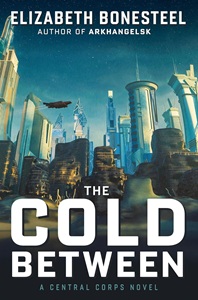
Elena Shaw is the chief of engineering aboard the Central Corps ship Galileo, which has been sent to the world of Volhynia to deliver a cargo that should have been delivered by another Central Corps ship. But that ship had been attacked by a ship of the PSI, sort of spaceship Romany who are generally on good terms with Central Corps.

On Volhynia, Shaw leaves a bar with a retired PSI captain (the aforementioned sex scene), and that ex-captain later finds the body of a murdered Galileo crew-member, who incidentally Shaw had split with only a few weeks earlier. The Volhynia authorities arrest the ex-captain, Zajec, and seem keen on pinning the murder on him, despite Shaw providing an alibi.

Back aboard Galileo, executive officer Valentis has been involved in some secret mission with Shadow Ops, with Captain Foster completely out of the loop. It’s all to do with a nearby wormhole and the mysterious loss of Central Corps ship Phoenix decades earlier, and on which Foster’s mother was serving. Shadow Ops, and some dirty dealers in Central Corps, plus a major corporation, have a secret on the other side of the wormhole. And they’re happy to start off a war with the PSI to keep it secret.

Of course, Shaw and Zajec, and Foster once he’s figured things out, manage to foil the plot, and everything ends neatly. But then these sort of sf novels are generally good on the plotting, even if never entirely convincing when it comes to the world-building. Okay yes, it’s basically the US in spaaaace, a nicer and kinder than the present-day version, it’s true, but it still continues to astonish me how US science fiction writers seem incapable of imagining any type of future human society that is not based on the US, incorporating all the things wrong with it and that other nations on Earth, of which there are nearly 200, do not have or do (and yes, I’ve been watching The Expanse; don’t get me started).

The other major element of these books is the characters, and Bonesteel has a likeable, although not particularly varied or diverse, cast list. But at least none of the good guys are sociopaths, which is unusual enough these days to be notable. Having said all that, The Cold Between feels a bit, well, meh. It’s put together well enough, but there’s nothing remarkable, no “eyeball kicks” or ideas that jump out. It’s an action-adventure set in a made-up future, and everything in it is all too recognisable. I doubt I’ll bother with the sequels.
Leave a comment

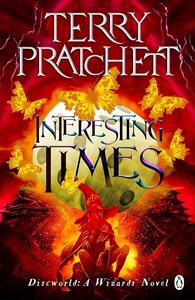
Interesting Times, Terry Pratchett

There’s something refreshing about the consistency of the Discworld novels. Yes, some are better than others, but the humour remains constant, as does the sideways look at social issues. Many cite Interesting Times (1994, UK) as their favourite Discworld novel – I’ve not read them all yet, so I wouldn’t like to choose, but… It’s all a bit orientalist to begin with, although it soon pulls back from that. On the other hand, its targets are orientalist clichés, so perhaps that initial orientalism is justified…

The Agatean Empire on the Counterclockwise Continent has asked for the help of the “Great Wizzard”, but the only person who spells the word with a double z is Rincewind, who is anything but great. It’s all due to the journal written by Twoflower from the first book in the series, The Colour of Magic (1983, UK), who was a tourist from the Agatean Empire.

Using Hex, a sort of magical AI – and Pratchett’s description maps quite neatly onto present-day so-called AI – the Unseen University sends Rincewind to the Counterclockwise Continent. Where he stumbles across Cohen the Barbarian, and his team of equally-aged barbarians, who are planning to take over the empire.

The end result is a collision between the well-meaning incompetence of the Red Army, a group of slogan-spouting Agatean rebels, the somewhat puzzled but violent competence of Cohen and his barbarians, the machinations of the super-competent Lord Hung, and the extremely lucky total lack of any competence whatsoever of Rincewind. The combination of which manages to both destroy the Agatean Empire and build something fair and equitable from its wreckage. Interesting Times, unusually, not only has a happy ending but also leaves the reader feeling happier. Which, to be fair, is one of the strengths of the series, that it leaves the reader feeling as if shit is solvable. Which is not to say it’s not, but this is not Discworld.

I can understand why Interesting Times is a favourite for many. It’s certainly one of the better Discworld novels. But I think I’ll wait until I’ve read more of them before I call it.


Leave a comment

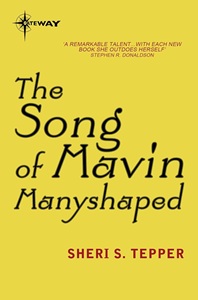
The Song of Mavin Manyshaped, Sheri S Tepper

(Another review originally posted on Facebook)

I read a lot of Tepper back in the late 1990s, and I’m not entirely sure why I stopped, because her books were generally good. She’s notable for starting her career late – she was in her fifties when her first novel was published. So never give up.

The Song of Mavin Manyshaped (1985, USA) is an early work, her fourth or fifth book, I think, and the first of a trilogy set on a fantasy world populated by numerous different races, which later proves to be a trilogy of trilogies and, in fact, is science fiction of a sort. Mavin is a Shifter, although she has yet to come into her Talent. She’s one of only two female Shifters in Panderbat, and it’s clearly implied the women are there to provide sexual services for the male Shifters, and to bear children too, of course. But Mavin is not yet old enough, and her older sister is apparently infertile.

After developing her Shifting ability in secret, Mavin escapes Panderbat and flees to a friendly relative’s castle. En route, her young brother – who develops a different Talent – is taken ill with “ghoul plague”, so Mavin must help the shadowpeople and defeat the ghoul king in order to cure her brother and set everything to rights.

There’s numerous references to games and such, as if the world itself were a game board, which makes everything seem especially unreal – and reminds me a little of Jack Chalker’s Wellworld series, and… I’m sure there’s another one but it escapes me. Vance, probably. Anyway. It’s all very light and inconsequential, but the feminist ire burns through, and I’m surprised these early works aren’t as well known as Tepper’s later novels. An oeuvre definitely worth exploring. And I definitely must read the other two books in the trilogy some time.


Leave a comment

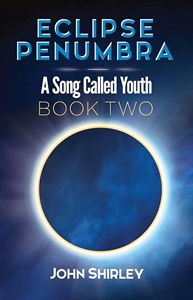
Eclipse Penumbra, John Shirley

The first book of A Song Called Youth, Eclipse (1985, USA), set up the situation, but I’m not entirely convinced the sequels were originally intended. They’ve been subsequently rewritten at least twice, so they’re certainly a thing now. There’s also a shift in tone between book one and book two. Having said that, these books have in some respects proved scarily prescient.

Europe has been invaded by the New-Soviets, but the Americans defeated them – well, that version of Nato which exists in the minds of most Americans that is 99% American and apparently also funds all of Europe’s healthcare, education, etc. The Second Alliance, a Christian far right security company, has taken over policing Europe, but they’re actually working to turn Europe into a white supremacist state under their leadership. They’re being fought by the New Resistance, now based in Malta after escaping France. There’s also a space colony, which has been taken over by SA after an internal revolt; it’s also being blockaded by the New-Soviets.

Eclipse had a 1980s cyberpunk feel. One character was a famous guitarist, and died jamming on top of the Arc de Triomphe as it was attacked by giant steampunk-ish wheel tanks. Eclipse Penumbra (1988, USA) dials all this back and goes for straight-up future war. We have a handful of viewpoint characters in the NR, and through them we see several military actions against the SA. In the space colony, the SA administration takes one step too far when it packs a maintenance shuttle with dissidents and non-whites and blows it up in an “accident”. This prompts the head of security to flip sides – although he’d already seen the writing on the wall, and it didn’t bode well for him.

Meanwhile, the NR leadership has managed to get hold of some incriminating footage of a SA bigwig and the US president. Smoke, the jaded writer with the pet crow from Eclipse (another cyberpunk-ish touch), is making a name for himself back in the US as a pundit. The NR campaign finally swings US public opinion against SA, and the president. It helps that one of the other SA bigwigs has infiltrated an assassin into the SA headquarters – and he successfully takes out the organisation’s messianic leader…

So, a hopeful ending. Of sorts. SA seems to be on its way out. The space colony is free once again. The NR has beaten the SA in southern Europe. The New-Soviets are retreating, but Europe is still in a mess – and the stateside SA are still planning on turning it into a white supremacist superstate.

In many respects, Shirley has stayed ahead of the current global situation, even given the last update of this trilogy was 26 years ago. The US in the book is just as big a bin fire as the US is today (arguably it’s been one throughout its history, it just has excellent PR), but Shirley’s version of Europe owes more to American ignorance of, and misinformation about, Europe than the reality. It’s the US that’s collapsing IRL, not the EU. I suppose it’s hardly surprising Shirley is closer with his future US.

The end of Eclipse Penumbra doesn’t give much of a clue where the third book, Eclipse Corona (1990, USA) is likely to go. The “corona” in the title, incidentally, is extremely unlikely to have anything to do with a virus. But we shall see. So far the trilogy is proving solid Shirley without really standing out. I’ve a feeling Eclipse’s time has passed and, despite updates and rewrites, it will never recapture that. Which leaves A Song Called Youth in a strange place.


Leave a comment

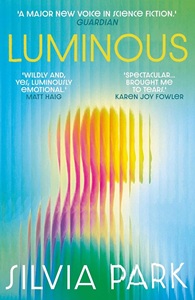
Luminous, Silvia Park

Luminous (2025, USA) was nominated for the Clarke Award this year (won by EJ Swift’s When There Are Wolves Again (2025, UK)), which is not necessarily an indicator of quality (see Chilling Effect, Sea of Rust, The Last Astronaut, etc.). But Luminous did get some good reviews – some very effusively positive reviews, in fact. So it goes without saying I was not especially impressed…

The novel is set in Seoul, some time after a war unified the two Koreas. Jun is a detective in the Robot Crimes squad (of two) and a war veteran. He is in fact half bionic as he was seriously wounded by a robot suicide bomber, called a HALO, during the war. And he’s a trans man.

Ruijie is a young disabled girl at a summer school. There’s a scrapyard next to the school, where she sneaks off to explore. She finds a damaged boy robot who calls himself Yoyo. Ruijie and her friends work together to protect Yoyo from the scrappers. He’s also clearly more sophisticated than other robots.

When Eli, a robot girl, goes missing, Jun investigates. Eli was an early model of the Sakura robot, made by Imagine Friends. Which is where Jun’s sister works. Imagine Friends specialises in robot children. These robots are mostly indistinguishable from real children.

In this future unified Korea, which seems pretty much like South Korea now, robots are common. Except they’re only robots because the novel tells us they are. They might as well be human from their actions and dialogue. And the fact most of them are children is, well, a bit skeevy. It’s a crime in this future Korea to assault robot children. But not robot adults. There’s a scene where a group of men get together and attack a group of robot women using baseball bats and clubs.

Imagine Friends are about to release a new boy robot. It turns out it’s based on Yoyo from the scrapyard – or rather, the original Yoyo was a prototype created by Jun’s father and brought home for his son and daughter. But that Yoyo disappeared years ago. In fact, he was used as the model for a series of HALO robots – boy robot suicide bombers. As was the Sakura girl robot. Is it just me, or is selling boy and girl robots that are the same models as ones used as suicide bombers during a war a really bad idea? And why was Jun blown up by one – North Korea didn’t have the technology to build them.

The whole robot thing in Luminous just doesn’t work. We’re asked to believe in children suicide bombers, that children identical to those suicide bombers are not triggering, that assaulting female robots who resemble real women is acceptable. And we’re supposed to believe the robots are indeed robots when they act and feel and speak like humans.

Then there’s the writing. I don’t know whether it’s just US science fiction or US literature in general, but some of the prose held up in recent years as good writing is just meaningless drivel. It seems to have no idea how to use metaphors. For example;

He had a smooth, high voice, but he had so many more he could slip into like a chest full of shoes. (p 163)

What does this even mean? Or,

Sometimes the heart can fail without war. This phrase would live in her heart until the end. (p 181)

Complete nonsense. And this is not how you use the verb cobble:

He could barely cobble sense of the title. (p 197)

This is just plain wrong:

Why isn’t there a male equivalent for the word maid? … The Brits have their skivvies… (p 204)

A skivvy is a slang term for a domestic servant. The nearest male equivalent to a maid is probably a footman. And finally,

… but children are still ships that have yet to be built, and now this boy was forced to float in his own wreckage. (p 272)

This is just garbage prose. There are sentences like these on pretty much every page.

In its defence, Luminous was not a chore to read – but an unconvincing premise, and prose that tries too hard and too often falls flat on its face, do not for me make an award-worthy novel.