It Doesn't Have To Be Right…

… it just has to sound plausible


Leave a comment

The Deviates, Raymond F Smith

(A review posted on FB back in 2024)

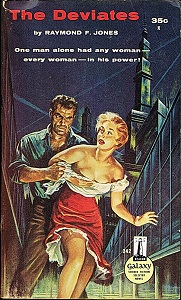
Back in the 1950s, Galaxy Science Fiction began a series of reprint paperback novels which they gave away with issues of the magazine. After 35 issues, the novel series was sold to Beacon Books, who were known for publishing mildly pornographic romance paperbacks. As a result, the Galaxy novels issued by Beacon were “edited” to add sexual content. I actually wrote a blog post about these back in 2009; you can find it here.

The Deviates (1959, USA) was the second of this series – what’s the opposite of bowdlerised? there needs to be a word for this; maybe we should adopt “beaconised” – and was originally published by Avalon Books as The Secret People (1956, USA). Jones was best known for his novel This Island Earth (1952, USA), adapted into a film of the same name in 1955. He was last published in 1978, and died in 1994. He’s more or less forgotten now.

In a US recovering from a nuclear war, the genetic viability of all people is tracked and only those who won’t sire mutants are certified as “breeders”. It’s an old, and discredited, trope, but it was popular in the 1950s and produced some notable works, such as The Long Tomorrow (1955, USA) by Leigh Brackett, ‘Created He Them’, Alice Eleanor Jones, and ‘That Only a Mother’, Judith Merrill. The head of the Central Genetic Institute is Robert Wellton, who is secretly a “deviate”, but he has used his position to hide that fact.

Wellton’s deviation is beneficial – he is a telepath. So he has doctored the records such that his sperm has been used to father hundreds of children, all of whom exhibit telepathy. He has helped these “Children” to escape to a hidden village in forests in the north. (Wasn’t there an actual news story about a sperm bank doctor who used his own sperm to fertilise ova? There might have even been more than one.) Wellton comes under suspicion and so flees to the Children. But they’re no longer onboard with his mission to gradually improve humanity. They’ve built an atomic-powered spaceship – from knowing only first principles! – and want to go to Mars.

I’ve read Jones before. I don’t remember him sermonising so much. I know early US sf writers had a tendency to do so – hello, RAH! – and some of the crap they spouted barely flew in the 1950s and is now thoroughly discredited or debunked, or just plain offensive in the 21st century. Jones’s plot is based on eugenics, and a poor understanding of genetics, which is bad – but his moral arguments are more misguided than offensive.

And yet, The Deviates is supposed to be the “spiced up” version of The Secret People, and I could find nothing in it which wouldn’t have seen print in a 1956 sf novel from a major imprint. A later novel in the Beacon series, The Mating Cry (1960, Canada) by AE van Vogt, was based on van Vogt’s The House That Stood Still (1950, Canada), AKA The Undercover Aliens (1950, Canada), which happens to be a favourite sf novel, and at least I spotted the content that had been added by Beacon (reader, it did not improve the book). I haven’t read The Secret People, but I couldn’t see anything in The Deviates that might have been added by Beacon.

Oh, and the cover is a complete – and unsurprising – misrepresentation. There are no ripped blouses in the novel, and Wellton’s only “power” over women is a result of his position at the Central Genetic Institute (he can legally prevent them from having babies – see?).

Maybe the cover is the spiced up bit of the story?


Leave a comment

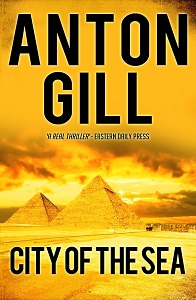
City of the Sea, Anton Gill

This is the sixth and final book in Gill’s series set in Eighteenth Dynasty Egypt featuring the scribe/detective Huy. As far as I know, the first three books – City of the Horizon (1991, UK), City of Dreams (1993, UK) and City of the Dead ( 1994, UK) – were published by Bloomsbury in the early 1990s, and Gill later revisited the character and setting for a further three books in 2015, perhaps initially self-published, but later picked up by an ebook-only publisher. Except someone on the Storygraph site thinks this book was published 1999, as does AI and a lot of online sites; and the book itself claims it was first published in 1993 by Boomsbury, which I think means they used the colophon from one of the original trilogy. So, a bit of a mess. Gill’s Wikipedia page is no help either.

Anyway. Huy’s son by his first marriage has vanished, and Huy has been given permission, and a few side-tasks, to visit the City of the Sea in the Nile delta. His ex-wife and her new family live there, and the son, Heby, a soldier, had disappeared while en route across the Mediterranean to the northern part of the Egyptian empire (roughly where Lebanon is, or looks increasingly like it might be was, now). But all is not as it seems. The local high priest has been murdered and the governor asks Huy to investigate.

The great and good of the City of the Sea are, it transpires, all deeply corrupt. Plus ça change, and all that. Heby has deserted in order to sort them out, because he loves the daughter of one of them, and she was raped numerous times as a five- and six-yer-old by the now-dead high priest.

Huy is not a great detective. He uncovers the facts but often seems reluctant to act on them. Fatalism is not a good driver of justice. In fact, the villains only get their come-uppance because they over-played their hand, and General Horemhep, who has returned victorious from the wars in the north, and will later head south and become the last pharaoh of the Eighteenth Dynasty, is in a rush to clean things up.

Even after six books, the setting remains interesting, but Huy is also a somewhat passive protagonist for a crime novel. Gill has yet to revisit them both, which is perhaps a good thing. But I did enjoy reading them.


Leave a comment

Cyclops, Clive Cussler

Rereading these books, I’ve been surprised which stories I’ve remembered and which ones I’ve forgotten. Raise the Titanic! (1976, USA), Vixen 03 (1978, USA) and Night Probe! (1981, USA) had stuck in memory. But not Deep Six (1984, USA), or this one, Cyclops (1986, USA). I’d completely forgotten, for example, that Cyclops is chiefly about a secret base on the Moon the US has been operating for over a decade. You’d think you’d remember something like that in a novel.

The formula for the Dirk Pitt novels was beginning to settle by Cyclops, the eighth in the series. Open with an historical mystery, typically a ship that vanished without trace. Hint at a great treasure, or a great threat. Add a present-day geopolitical threat to the US which requires the president to get involved. Pitt is dragged in by accident, or bad luck. Tie the mystery and the present-day threat together, and resolve both.

The title refers to a US Navy Auxiliary ship which disappeared in the Bermuda Triangle in 1912 (Cussler never mentions the Bermuda Triangle, however). In 1989, a US millionaire goes searching for the wreck from an airship. He and his crew vanish. A full-scale search fails to find him or the airship. A few weeks later, while Dirk Pitt is working in Florida, the airship reappears. Pitt manages to stop it before it crashes into a hotel and burns. Onboard are three dead bodies – strangers, not the missing three men.

Meanwhile, the US has been running a secret Moon base programme for years. It’s so secret not even the president knows about it. Also meanwhile, Castro is making secret overtures to the Americans – because the USSR wants to take over Cuba, and he’s not happy about that.

Pitt, Giordino, Gunn, and the wife of the missing millionaire re-enact the airship’s hunt for the Cyclops, to discover what happened to the missing men. The Cuban military shoots them down, but they still find the wreck, But then they’re washed ashore on an uninhabited island. Which isn’t uninhabited. There’s a secret Soviet base on it, with a hidden radio dish that allows it to eavesdrop, and interfere, with all radio traffic in the US.

All three plots collide as Pitt blunders about, somehow managing to defy the odds – and physics, and human strength and endurance – and scupper the villains. The Soviet leadership are all nasty horrible venal people, much like the present-day US leadership, and Putin, of course. The Moon base colonists are all engineers and scientists, but they manage to defeat a squad of Soviet special forces. Pitt discovers the secret of the Cyclops – a mysterious and incalculably valuable statue it was carrying, but which isn’t in the wreck.

It all comes to an explosive head when the USSR triggers its plan to oust Castro by detonating a nuclear bomb in Havana. Except it’s not an atom bomb, although just as devastating. Pitt prevents the worst of it happening, but doesn’t entirely stop it. The results drive Castro straight into the arms of the US.

And then Pitt finds the missing statue.

The writing is bad, of course; but the formula actually works quite well in this one. And Cussler has now added Cuba to the US, after adding Canada in an earlier book. And there’s a US base on the Moon too, currently unoccupied, as the astronauts have returned home– oh wait, I forgot to mention the Soviets seized remote control of the Space Shuttle bringing the astronauts back to Earth and tried to crash it, but Pitt managed to destroy the secret Soviet base with the radio dish in time…

I’ve known from the start these books follow a downward path after Raise the Titanic!, but one or two have surprised me by not actually being as bad as I’d expected. To be fair, my expectations were really low. We shall have to see how the next book in the series fares.


Leave a comment

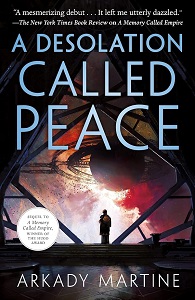
A Desolation Called Peace, Arkady Martine

(Originally posted on FB two years ago)

A Desolation Called Peace (2021, USA) is the second book of a duology and, I think, more lauded than the first, with nominations for the Hugo, Nebula, Clarke and BSFA Awards; and winning the Hugo, which the first book in the duology, A Memory Called Empire (2019, USA), also did. So you would expect high-quality science fiction from the two books, and more so from the second. But, of course, awards are not about quality, and never have been, despite the use of the word “best” in their names.

A Desolation Called Peace follows on directly from A Memory Called Empire. Mahit Dzmare has returned home to Lsel Station, but is unwilling to be debriefed as she knows it will destroy what she is: herself, and two corrupted imagos, or memory imprints, both of her predecessor in the ambassador’s role. (His murder kicked off the plot of the first book.) Meanwhile, the Teixcalaani empire has encountered an alien species and their failure to communicate with it has triggered a war. This was what Lsel Station wanted, of course – the ambassador before Dzmare had traded imago-technology for Lsel Station’s independence, but his superiors had always planned to keep the Teixcalaani empire at bay by embroiling them in a war with the mysterious aliens.

Dzmare’s lover, Three Seagrass, gets herself assigned as a language specialist to the fleet fighting the aliens, dragoons Dzmare into assisting her, and the two actually manage to open communications. Meanwhile, there are factions in the war ministry who think the only solution is ending the war by bombing the shit out of the (an?) alien home world. This does not sit well with the commander of the fleet sent to resolve the alien menace.

So, lots of politics, lots of gooey eyes between Three Seasick and Dzmare, lots of interiority and info dumps, but not, sadly, much description. There’s a lot here that reminds me of Susan R Matthews’s Jurisdiction novels, although given A Desolation Called Peace reads more like a love-letter to Three Seagrass than anything else that’s perhaps less than expected, given the set-up. The big reveal behind the aliens’ inability to communicate with humans, despite communication and language being a major feature of the two novels, and even numerous mentions of an earlier alien race contacted by the Teixcalaani empire, and several embarrassingly bad passages from the aliens’ POV… Despite all that, the big reveal is something that cropped up in a recent sf trilogy – and no doubt we’ll see it again over the next few years.

I thought A Memory Called Empire had its moments – some nice world-building, an interesting plot – but A Desolation Called Peace dials back on both. While it introduces a couple of interesting new characters, they’re not enough to overcome a dawning sense of familiarity, or the way Three Seasick begins to take over the narrative. The first book was an interesting spin on space opera, at a time when interesting spins on space opera were du jour. The second… well, either the moment has passed (it has), or it reads too much like the two books were a single novel padded out to a duology and the second book got the worst of the deal. Disappointing.


Leave a comment

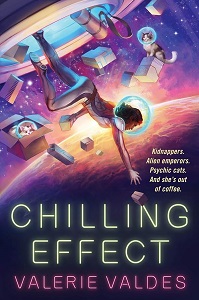
Chilling Effect, Valerie Valdes

Chilling Effect (2019, USA) is the first book of the Captain Eva Innocente series, followed by Prime Deceptions (2020, USA) and Fault Tolerance (2022, USA). It was nominated for the Clarke Award in 2020. Which is why I read it. I will not be reading the sequels. Chilling Effect is one of several baffling choices – a less polite way of putting it would be, actually shit books – the Clarke has shortlisted in the past decade. It reads like fan fiction, cobbled together from every space opera trope used in television or movies, and given a Latinx spin for added flavour.

Innocente is the captain of an independent trader spaceship (check), with a crew of misfits (check), including a qualified medic (check), although with a crew of only five why would you waste a berth on a doctor?, an alien engineer (check), who is also a love-interest (check), a dim-witted ex-military general crewmember (check), and a pilot who plugs into the ship (check). Within the first three pages, we have slavery and indentured labour, a mysterious galactic criminal organisation, more alien races than you can count (check; very few of which are described), and an adventure on every planet the ship visits (check). The ship’s engineer later turns out to be a member of an alien elite combat unit, apparently AWOL (check). Innocente has a murky past (check), including some sort of atrocity which is mentioned frequently but never explained (check), and comes from a family that is one half criminal and one half naively innocent (check). 

The number of clichés, and they’re all TV and movie sf clichés, the book rolls out is relentless.

Nuvesta, the capital station of the BOFA (the interstellar good guy polity) is a straight rip-off of Alpha (ie, Point Central) from the movie Valerian and the City of a Thousand Planets. The concert given by an alien opera singer on a cruise liner is from The Fifth Element. At one point, Innocente spends a year involuntarily “on ice”. The word “carbonite” is not used, but it’s there hovering over the text like a storm cloud. There’s also this:

“I didn’t realize I was a sweet young moisture farmer with dreams of space travel” (p 318)

It doesn’t help that the love interest, ship’s engineer Vakar, has mouth palps and claws and is basically, well, Dr Zoidberg. How can any reader take a book seriously that presents Dr Zoidberg as a romantic lead? One of the other crew-members, Sue, is accompanied by a swarm of small yellow bots. One carries a teddy bear, another wears goggles and a hat. Clearly, they’re Minions. Sue is obviously not Gru, but perhaps one of his daughters.

During the raid on the cruise liner mentioned above – and during which a pirate crew actually talk like comedy pirates – the ship “lists twenty degrees”, causing people to fall across the room (p 232). That’s straight from Attack of the Clones and made zero sense then. If the ship has gravity plates on its decks, then the actual attitude of the ship is completely fucking irrelevant to those inside.

And not to forget the short ugly alien who demands Innocente join his harem, and turns out to be a powerful alien emperor, who stalks her throughout the book with his alien armada, destroying worlds when they don’t hand her over to him. It’s not even remotely funny.

The thing with references, or Easter eggs, is that the satisfaction for the reader lies in spotting them. But when they’re so fucking obvious, there’s no thrill to be had in recognising them. It doesn’t help that Chilling Effect‘s universe is so thinly sketched-in, and so lacking in rigour, it’s hard to tell where the story is actually set. There’s a mention of the “tail-end” in Innocente’s ship, which is not a term often used in sf for spaceships. And the ship takes 47 minutes to travel from one world to another (p 323). 

The author is Cuban-American and her protagonist, Captain Eva Innocente, is Latina. So the text is littered with Spanish, none of which is translated. The use of Spanish is possibly the only thing in Chilling Effect’s favour, although it would have made sense to translate the Spanish, directly or indirectly, given the book is aimed at an English-language audience. We may not all be monoglots, but not all of us have Spanish as our second or third or fourth language.

2021 was not a good year for the Clarke Award. The award was won by The Animals in that Country (2019, Australia) by Laura Jean McKay, which I’ve not read. Also on the shortlist were Edge of Heaven, RB Kelly (2019, UK), The Infinite, Patience Agbabi (2019, UK), aimed at 9 to 11 year olds (the Clarke is not an award for children’s books), Vagabonds, Hao Jingfang (2019, China), and The Vanished Birds, Simon Jimenez (2019, USA), which I’ve read and thought very much over-rated. 

I find it hard to believe anyone thought Chilling Effect was one of the best half-dozen books published in the UK that year. It’s a string of sf movie tropes set in a universe which is so light on detail and rigour it might as well not exist. A book to avoid.