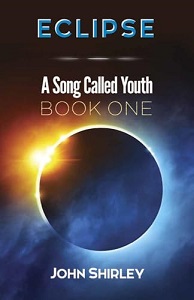
The first book of A Song Called Youth, Eclipse (1985, USA), set up the situation, but I’m not entirely convinced the sequels were originally intended. They’ve been subsequently rewritten at least twice, so they’re certainly a thing now. There’s also a shift in tone between book one and book two. Having said that, these books have in some respects proved scarily prescient.
Europe has been invaded by the New-Soviets, but the Americans defeated them – well, that version of Nato which exists in the minds of most Americans that is 99% American and apparently also funds all of Europe’s healthcare, education, etc. The Second Alliance, a Christian far right security company, has taken over policing Europe, but they’re actually working to turn Europe into a white supremacist state under their leadership. They’re being fought by the New Resistance, now based in Malta after escaping France. There’s also a space colony, which has been taken over by SA after an internal revolt; it’s also being blockaded by the New-Soviets.
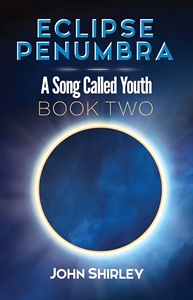
Eclipse had a 1980s cyberpunk feel. One character was a famous guitarist, and died jamming on top of the Arc de Triomphe as it was attacked by giant steampunk-ish wheel tanks. Eclipse Penumbra (1988, USA) dials all this back and goes for straight-up future war. We have a handful of viewpoint characters in the NR, and through them we see several military actions against the SA. In the space colony, the SA administration takes one step too far when it packs a maintenance shuttle with dissidents and non-whites and blows it up in an “accident”. This prompts the head of security to flip sides – although he’d already seen the writing on the wall, and it didn’t bode well for him.
Meanwhile, the NR leadership has managed to get hold of some incriminating footage of a SA bigwig and the US president. Smoke, the jaded writer with the pet crow from Eclipse (another cyberpunk-ish touch), is making a name for himself back in the US as a pundit. The NR campaign finally swings US public opinion against SA, and the president. It helps that one of the other SA bigwigs has infiltrated an assassin into the SA headquarters – and he successfully takes out the organisation’s messianic leader…
So, a hopeful ending. Of sorts. SA seems to be on its way out. The space colony is free once again. The NR has beaten the SA in southern Europe. The New-Soviets are retreating, but Europe is still in a mess – and the stateside SA are still planning on turning it into a white supremacist superstate.
In many respects, Shirley has stayed ahead of the current global situation, even given the last update of this trilogy was 26 years ago. The US in the book is just as big a bin fire as the US is today (arguably it’s been one throughout its history, it just has excellent PR), but Shirley’s version of Europe owes more to American ignorance of, and misinformation about, Europe than the reality. It’s the US that’s collapsing IRL, not the EU. I suppose it’s hardly surprising Shirley is closer with his future US.
The end of Eclipse Penumbra doesn’t give much of a clue where the third book, Eclipse Corona (1990, USA) is likely to go. The “corona” in the title, incidentally, is extremely unlikely to have anything to do with a virus. But we shall see. So far the trilogy is proving solid Shirley without really standing out. I’ve a feeling Eclipse’s time has passed and, despite updates and rewrites, it will never recapture that. Which leaves A Song Called Youth in a strange place.