It Doesn't Have To Be Right…

… it just has to sound plausible


Leave a comment

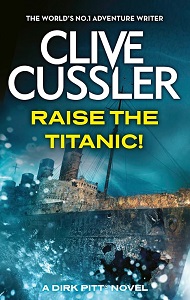
Raise the Titanic!, Clive Cussler

(Another Facebook review.)

For reasons I have yet to question, I started rereading Cussler’s novels, which I last read back in the 1980s and 1990s. And even then I thought they were bad. Raise the Titanic! (1976, USA) is probably his most famous novel – it’s certainly the one that made him a bestselling author. It was his third novel, the first two had sold poorly, and this one was expected to do the same. But an editor visiting from the UK saw the manuscript at Cussler’s US publisher, and took a copy back home with him. This kicked off a bidding war on both sides of the Atlantic, resulting in Cussler pulling in a huge advance. The novel then went on to become a bestseller. (Soon after, Cussler bought back the rights to his earlier novels, and resold them to his then-current publisher for considerably more than he’d sold them originally.)

The plot of Raise the Titanic! sees Dirk Pitt, special operations director of the US National Underwater and Marine Agency, and all-round lady killer and Competent Man, tapped to head a US project to raise the RMS Titanic from its seabed grave, 3800 metres below the surface (where the pressure is around 400 atmospheres). Because there’s a presidential black project to build an anti-missile screen around the US and it needs a supply of “byzanium” in order to work. The only known quantity of byzanium was secretly mined under the noses of the Soviets on Novaya Zemlya by US miners in 1912, but was shipped home on the RMS Titanic. Oops. The USSR learns of this plan and decides to hijack the Titanic once she is on the surface.

Perhaps because of the amount spent to buy the novel, Raise the Titanic! seems to have been closely edited, and the prose is far better than in the earlier novels (although still not, well, good). The plot and setting is also much more science-fictional. The book was written before the wreck was found, and most people believed the ship had come to rest in one piece (she actually split in two). Pitt’s plan is to plug the many holes in the Titanic’s hull with “wetsteel” and then pump the ship full of air.

The novel was adapted for the screen in 1980 by UK TV production company ITC, but was a massive flop. ITC’s owner, Lew Grade, later said “it would have been cheaper to lower the Atlantic”, but he did like the film. Cussler didn’t. He refused to allow anyone to adapt his other books, and later sued the makers of Sahara, adapted from his 1992 Dirk Pitt novel of the same name. That film was a huge flop too.

Cussler died in 2020, but some time around the millennium he’d created an atelier, which has since produced a huge quantity of Dirk Pitt and NUMA novels by diverse hands (with Cussler’s name the most prominent on the cover, of course). His son, called Dirk, natch, now writes the Pitt novels.


Leave a comment

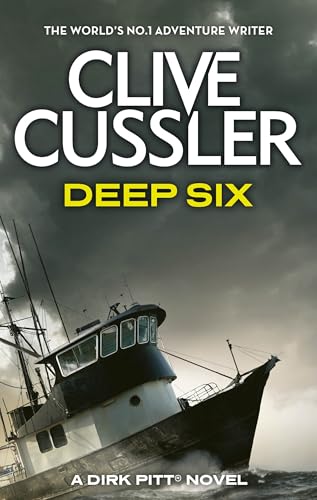
Deep Six, Clive Cussler

The seventh book featuring Dirk Pitt, NUMA Special Projects Director and all-round man’s man and action hero, but actually the sixth book as Cussler managed to sell a trunk novel, set and written before his debut novel, having now become a best-selling author. Trunk novels should generally stay trunk novels, and Cussler’s is no exception. I should point out that Deep Six (1984, USA) may have been Cussler’s seventh actual novel, but in 2025 Cussler, who died in 2020, has 27 Dirk Pitt novels in print (the last two written by his son), 21 NUMA Files novels written by assorted hands from his atelier, 18 Oregon Files novels, 15 Isaac Bell Adventures novels, and 12 Fargo Adventures novels. I make that 93 novels. That’s a fucking large, or a fucking productive, hacktelier atelier. 

Deep Six is set in 1989, five years after it was published. A tramp freighter disappears in the 1970s with a bank robber aboard. It is discovered ten years later because it was carrying a cargo of barrels of stolen US Army nerve gas, one of which has leaked and killed hundreds of people off the coast of Alaska. Pitt amazes everyone by quickly finding the ship. The barrels of nerve gas are taken away to be buried, but Pitt is intrigued by the ship itself, a Liberty ship from World War 2 from which all identification has been removed. He investigates further, and learns it was operated by a shady Korean shipping company, now based in New York.

Meanwhile, the president of the US, vice-president, speaker of the house, and a senator are off on a weekend trip on the presidential yacht, the USS Eagle (the last presidential yacht was actually the USS Sequoia, which was sold off by Carter in 1977). Overnight, a heavy fog drops, and when it lifts everyone aboard the yacht has vanished. The Administration desperately tries to cover up the fact the president is missing…

… and who has actually been kidnapped by the aforementioned Koreans, who have been paid by the Soviets, and a Soviet neuroscientist plans to brainwash the president and insert a controlling microchip into his head…

It’s action all the way as Pitt ends up involved in the hunt for the missing politicians. A Soviet liner in the Caribbean is blown up and sunk – and Pitt’s latest lover is aboard, so he’s involved in that too. But the Koreans have her, so he’s after them in a desperate race to find their secret laboratory before they kill everyone. The climax involves a battle on the Mississippi delta between the machine-gun-armed Koreans on a tug and a company of ACW re-enactors with muskets on a paddle-wheel steamer. Exciting stuff, even if not in the slightest bit credible. And the only reason Pitt found them is because the Korean shipping company named all their ships after towns on the Mississippi delta – er, what?

I’m beginning to wonder if Cussler had a time-machine and visited 2025. In Night Probe! (1981, USA), the US and Canada merged – which didn’t happen in the real world, obviously, although Trump clearly thought he could make it happen. In Deep Six, the president is controlled by the Soviets (although a microchip in Trump’s brain would be ineffective as his brain is clearly ineffective, but he’s still Putin’s puppet), he wants to pull the US out of Nato, there are troops on the streets of Washington, and the US is no longer a democracy. Hmmm. I don’t recall a tech billionaire who believes the laws of physics don’t apply to him in Raise the Titanic! (1976, USA), however. And while Iceland featured in Iceberg (1975 USA), Greenland wasn’t mentioned.

Still, another twenty Dirk Pitt novels to go…


1 Comment

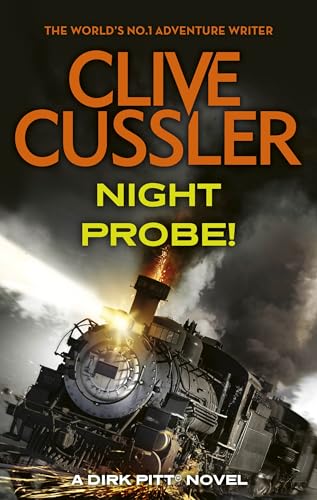
Night Probe!, Cliver Cussler

Well, this book was a timely reread. The entire plot is about Canada joining the US – although Cussler calls the conjoined nations the United States of Canada, which would undoubtedly cause President Chump’s remaining brain cell to combust.

Cussler’s formula has always been explicit – an historical mystery is the key to a present-day conspiracy, and Dirk Pitt is dragged into an investigation regarding one or the other, and so ends up resolving both. The novels are also set a decade or two ahead of when they were written, and often feature some sort of advanced tech.

Night Probe! (1981, USA) opens with a provincial railway station robbery in 1914, which nets little and prevents the two station staff from halting an express train heading for a bridge brought down in a storm. On the train were millions of dollars of gold bullion, and a Canadian official with important documents. Coincidentally, around the same time, a passenger ship heading for Britain is sunk in the St Lawrence River. On board is a British official with important documents.

Commander Heidi Milligan, introduced in the previous book, is studying for a PhD in American History, and she stumbles across a reference to a treaty between the US and Great Britain signed in 1914. But she can find nothing else about the treaty. Meanwhile, the head of a Quebecois separatist organisation tries to assassinate the prime minister of Canada. Somehow, news of the treaty, copies of which were carried on the crashed train and sunken ship, reaches the ears of the UK government, and they send a retired MI6 agent to the US to ensure the documents are never found.

Pitt uses NUMA equipment to dive on the wreck in the St Lawrence and, despite attempted sabotage by the British and Quebecois, manages to retrieve a copy of the treaty. Unfortunately, it’s unreadable. So Pitt goes looking for the crashed train, but there’s no sign of the wreck in the river below the destroyed bridge. Pitt eventually figures out the location of the train, and finds the treaty.

Night Probe! was published in 1981. While Cussler got a lot wrong (in it the USSR still exists, for example; not that he was actually trying to predict the future), I’m amused the plot is structured around the abortive sale of Canada to the US by Britain in 1914. And the desire by both the Canadians and USians to merge in the year the novel is set. Recent events have shown the Canadians are more than happy not being part of the US – as indeed is Greenland, and, in fact, every other fucking nation on the fucking planet – and I suspect the same attitude pretty much held true back in 1981. 

I’d remembered Night Probe! as one of the better Dirk Pitt novels, and it’s proven the best so far. Which doesn’t actually make it a good novel, just a good Cussler novel, which is not exactly a high bar. Trump’s deranged pronouncements since taking office, however, added a little extra to the reading. If only that were the only impact of his lunacy…