
Luminous (2025, USA) was nominated for the Clarke Award this year (won by EJ Swift’s When There Are Wolves Again (2025, UK)), which is not necessarily an indicator of quality (see Chilling Effect, Sea of Rust, The Last Astronaut, etc.). But Luminous did get some good reviews – some very effusively positive reviews, in fact. So it goes without saying I was not especially impressed…
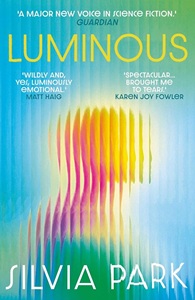
The novel is set in Seoul, some time after a war unified the two Koreas. Jun is a detective in the Robot Crimes squad (of two) and a war veteran. He is in fact half bionic as he was seriously wounded by a robot suicide bomber, called a HALO, during the war. And he’s a trans man.
Ruijie is a young disabled girl at a summer school. There’s a scrapyard next to the school, where she sneaks off to explore. She finds a damaged boy robot who calls himself Yoyo. Ruijie and her friends work together to protect Yoyo from the scrappers. He’s also clearly more sophisticated than other robots.
When Eli, a robot girl, goes missing, Jun investigates. Eli was an early model of the Sakura robot, made by Imagine Friends. Which is where Jun’s sister works. Imagine Friends specialises in robot children. These robots are mostly indistinguishable from real children.
In this future unified Korea, which seems pretty much like South Korea now, robots are common. Except they’re only robots because the novel tells us they are. They might as well be human from their actions and dialogue. And the fact most of them are children is, well, a bit skeevy. It’s a crime in this future Korea to assault robot children. But not robot adults. There’s a scene where a group of men get together and attack a group of robot women using baseball bats and clubs.
Imagine Friends are about to release a new boy robot. It turns out it’s based on Yoyo from the scrapyard – or rather, the original Yoyo was a prototype created by Jun’s father and brought home for his son and daughter. But that Yoyo disappeared years ago. In fact, he was used as the model for a series of HALO robots – boy robot suicide bombers. As was the Sakura girl robot. Is it just me, or is selling boy and girl robots that are the same models as ones used as suicide bombers during a war a really bad idea? And why was Jun blown up by one – North Korea didn’t have the technology to build them.
The whole robot thing in Luminous just doesn’t work. We’re asked to believe in children suicide bombers, that children identical to those suicide bombers are not triggering, that assaulting female robots who resemble real women is acceptable. And we’re supposed to believe the robots are indeed robots when they act and feel and speak like humans.
Then there’s the writing. I don’t know whether it’s just US science fiction or US literature in general, but some of the prose held up in recent years as good writing is just meaningless drivel. It seems to have no idea how to use metaphors. For example;
He had a smooth, high voice, but he had so many more he could slip into like a chest full of shoes. (p 163)
What does this even mean? Or,
Sometimes the heart can fail without war. This phrase would live in her heart until the end. (p 181)
Complete nonsense. And this is not how you use the verb cobble:
He could barely cobble sense of the title. (p 197)
This is just plain wrong:
Why isn’t there a male equivalent for the word maid? … The Brits have their skivvies… (p 204)
A skivvy is a slang term for a domestic servant. The nearest male equivalent to a maid is probably a footman. And finally,
… but children are still ships that have yet to be built, and now this boy was forced to float in his own wreckage. (p 272)
This is just garbage prose. There are sentences like these on pretty much every page.
In its defence, Luminous was not a chore to read – but an unconvincing premise, and prose that tries too hard and too often falls flat on its face, do not for me make an award-worthy novel.

