It Doesn't Have To Be Right…

… it just has to sound plausible


1 Comment

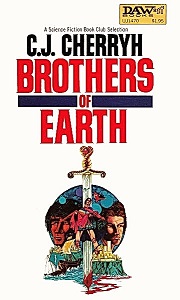
Brothers of Earth, CJ Cherryh

(A review first posted only on Facebook in 2024)

Brothers of Earth (1976, USA) was Cherryh’s first novel (published a few months after Gates of Ivrel (1976, USA), but actually submitted and accepted first). It’s based on a premise Cherryh has used many times throughout her career – a human man crashlands on an alien, but humanoid, world and tries to integrate, inadvertently kicking off a war between various nations/factions (cf the Compact Space books, Cuckoo’s Egg (1985, USA), Faded Sun trilogy, Foreigner series, etc). The story takes place over a thousand years after Cherryh’s Alliance/Union history, although the Alliance still exists. But it’s at war with another human polity, the Hanan.
Kurt Morgan, sole survivor of an Alliance warship, crashes and is discovered by a party of locals, the nemet. They take him aboard their sailing ship to the city of Nephane, where he meets the methi, the ruler of the city, who is Hanan, and the sole survivor of an earlier Hanan mission. She allows him to enter the household of Kta, the captain of the ship. Kta’s family is the Elas, and they’re descended from the Indras, inhabitants of a powerful theocratic state across the sea. Nephane is split between Indras-descended and the original locals, the Sufaki, with the former forming a wealthy and powerful elite. The Sufaki rebel, Morgan and Kta are caught up in it, and flee because the methi supports the Sufaki…

The world is at a roughly late Bronze Age level – Cherryh used to teach ancient history – so it’s all swords and sandals and triremes, with the theocratic Indras versus the more liberal Indras-descended of Nephane versus the pantheistic Sufaki. This is stuff Cherryh has done many times since, and better. For a first novel, in the 1970s, it’s sort of impressive, and it’s interesting seeing how much of Cherryh’s style was pretty much there from the beginning. But the story does drag in places, and while there are plenty of strong female characters, the main protagonists are male – and there’s also an instance of fridging.

One for Cherryh fans.

Leave a comment

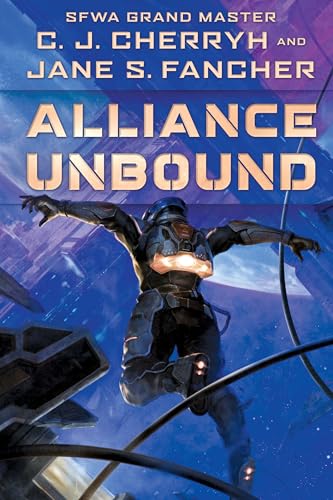
Alliance Unbound, CJ Cherryh & Jane S Fancher

Alliance Unbound (2024, USA) is the second book of the latest Union-Alliance series, the Hinder Stars trilogy, co-written with Cherryh’s long-term partner Fancher. Cherryh has a whole timeline worked out for her novels, which even includes the stuff that doesn’t, at first glance, seem to fit into her Union-Alliance universe, like the Faded Sun trilogy. But this new trilogy definitely does fit in.

There’s Earth, and Earth Company (EC), and it set up a series of stations orbiting nearby stars. Initially kept supplied by near-speed-of-light pusher ships, but then one station discovers FTL, and two breakaway polities form, one based around Cyteen and the other around Pell. The EC was unhappy with this, and this kicked off the Company Wars. All of this is covered in earlier novels by Cherryh.

The Hinder Stars are those stations closest to Sol. In the book preceding this one, Alliance Rising, the EC wants to reassert control, takes over Alpha (Barnard’s Star) and builds its own massive FTL troop carrier. Meanwhile, a FTL route was discovered between Alpha and Sol, meaning pusher ships will no longer be the sole link between Earth and the expanding number of stations, which by now are carrying on very happily by themselves.

Alliance Unbound is set after those events. While visiting Pell Station, the crew of Finity’s End, a FTL megaship, which is on a mission to sign up all the merchant ships and stations to its Alliance, becomes suspicious of some luxury items it finds on the station. Which leads them to a supposedly mothballed station. And it turns out the EC is secretly supplying it with pusher ships, in the hope of… taking over the stations in the name of the EC.

At times, the prose felt almost like distilled Cherryh. It’s always been brusque and direct, but here more so; and yet there’s a lot of interiority, a lot of guessing and second-guessing. But the plot rolls on relentlessly, which makes for a fast read. I’ve read a lot of Cherryh’s novels, some of them so long ago the details are a little hazy… But even so, it felt like there was some retconning going on here. It’s intriguing stuff, and gives more of an insight into Cherryh’s universe, even if some of the details didn’t quite line up with what I remembered from other Union-Alliance novels.

It’s not like this has never happened before in fictional universes – cf John Varley’s Eight Worlds and Steel Beach (1992, USA) – and it’s more or less inevitable as authors dig deeper into previously unexplored areas of their own universes. Having said that, the pusher ships as described in Alliance Unbound struck me as a fascinating concept to explore – cut off for years, while in the outside universe decades pass. And yet I don’t believe Cherryh has written a novel about the pushers. The first explicitly Union-Alliance novel she wrote was Downbelow Station (1981 USA), which won the Hugo, and that’s set during the Company Wars.

I think I’ve said before that I enjoy exploring science fictional universes, and will often forgive most, but not egregious, deficiencies in the writing while doing that. Happily, there’s nothing here by Cherryh to forgive. She’s an excellent writer, and still going strong, if Alliance Unbound is any indication. She has a huge back-catalogue to explore, and that’s not including the 20+ Foreigner novels, and it’s definitely worth doing so.


2 Comments

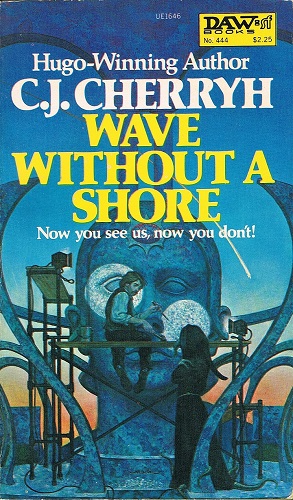
Wave Without a Shore, CJ Cherryh

The back cover blurb of Wave Without a Shore (1981, USA) describes it as “a different sort of interplanetary novel by the author of Downbelow Station (1981, USA) and The Faded Sun” trilogy (1978-1979, USA). Which is almost true. It certainly doesn’t resemble the two titles mentioned – for one thing, it’s set entirely on the surface of a single planet. So, not really “interplanetary” either, I guess.

The world of Freedom was settled by humans, even though it already had a native population, the ahnit. The humans built a city, Kierkegaard, and settled down to develop a way of life that resulted them in not seeing things which do not fit their worldview or “reality”. Such as the ahnit. Who more or less become invisible to them. As do humans who drop out.

Herrin Law considers himself the cleverest person on the planet. He becomes a sculptor at the university in Kierkegaard, where he meets Waden Jenks, son of the world’s First Citizen, and almost as clever as Herrin, if not equal in intelligence. Jenks’s cleverness, however, lies in politics. There’s also a third super-smart student, Keye Lynn, who starts out as Law’s girlfriend, then after Jenks has seized power from his father, moves in with Jenks.

Jenks commissions a statue of himself from Law, which Law turns into a series of carved domes, within which is the statue, in Kierkegaard’s only square. Meanwhile, Freedom’s sole contact with other worlds, a freebooter merchant, threatens Jenks and Kierkegaard, and Jenks responds by shopping him to the military… who then start building a station in Freedom orbit.

Much of the first half of the novel is taken up with philosophical discussions between Law and Jenks. Everyone on Freedom is solipsistic to the degree they can choose what and what not to see in their surroundings. But when Jenks, encouraged by the visiting military, tells Law to never sculpt again, and then has his goons break Law’s hands to make sure… Law is driven into a crisis and begins to “see” the ahnit.

It’s a neat concept – and reminds me a little of Miéville’s The City & the City (2009, UK) – but Cherryh spends so long setting up the characters of Law and Jenks, and describing the underpinnings to the Freedom humans’ solipsism, the story drags badly for much of its length. Nor is it helped by both Law and Jenks being so arrogant and self-centred and unlikeable. It also reminds me a little of other novels by Cherryh, such as Voyager in Night (1984), and while it’s set in her Alliance-Union universe, it’s on the fringes of it, like The Faded Sun trilogy and Angel with the Sword (1985, USA). So, probably one for completists.