It Doesn't Have To Be Right…

… it just has to sound plausible


Leave a comment

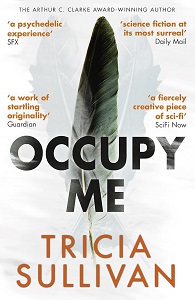
Occupy Me, Tricia Sullivan

Sullivan has long been a writer I wanted to read. I tried one of her novels, Maul (2003, UK), which was shortlisted for the Clarke, BSFA and Tiptree Awards, several years ago, but I remember finding it hard-going. In fact, I’d chosen it as one of twelve books for a reading challenge that year. I reviewed ten of the books, failed to review Maul, and never even read the final book, Octavia Butler’s Kindred (1979, USA). (For the record, the other books in the challenge were: Winterstrike (2008, UK), Liz Williams; Zoo City (2010, South Africa), Lauren Beukes; Dark Space (2007, Australia), Marianne de Pierres; City of Pearl (2004, UK), Karen Traviss; The Year of Our War (2004, UK), Steph Swainston; Spin State (2003, USA), Chris Moriarty; Shadow Man (1996, USA), Melissa Scott; China Mountain Zhang (1992, USA), Maureen F McHugh; The Steerswoman (1989, USA), Rosemary Kirstein; and Winterlong (1988, USA), Elizabeth Hand.)

Which brings me to Occupy Me (2016, UK), which was nominated for both the Clarke and BSFA Awards. In it, Sullivan pulls no punches. For the first third of the novel, you’re struggling to figure out what’s going on. The narrator is called Pearl, she is not entirely human, if human at all. She arrived on Earth in an abandoned fridge in a junkyard in New York. She is sort of an angel – at least, she has wings, but they are usually kept hidden in Higher Dimensions (HD). There are other things hidden in HD, including parts of Pearl’s organism? metabolism?, her powers, and her origin. 
She is tricked into flying past a helicopter carrying a billionaire called Austen Stevens, who was responsible for a series of atrocities in an invented African nation while controlling an oil company. He then left the oil company, having embezzled millions, and set up an investment company. Now, he is dying. He has hired a native of that invented nation, the sole survivor of a family who died in the atrocities, who was then educated in the US and qualified as a doctor, to manage his palliative care in his last few months. Because Stevens believes the doctor has a briefcase which contains a spaceship or time-machine or some other science-fictional device which can make the billionaire immortal.

In fact, the briefcase is part of Pearl’s body, stolen from HD. And she wants it back.

To be honest, that plot summary doesn’t do Occupy Me much justice. There are three narratives: Pearl’s, told in the first person; the doctor’s, told in the second person; and one told in the third person, which describes the events leading up to all the main characters meeting on an oil platform in the North Sea, where certain truths about Pearl, the briefcase, the billionaire and the doctor are revealed. The novel is relentless – the narrative’s sheer momentum carries you through passages that you simply don’t have enough information to parse (but those explanations do come later), and sentences that tip from sense to a sort of nonsense that seems entirely in keeping with the narrative voice.

I didn’t think I’d like Occupy Me when I started reading it – to paraphrase a remark I made to a friend a few months ago, I may have a catholic taste in fiction, but I have a protestant ethic to reading. I will finish a book, even if I think I don’t like it or think it’s shit (and yes, that probably explains a lot of the reviews on this blog). But the further I got into Occupy Me, the more fascinating I found it, the more the shape of it became apparent, and the more its arguments began to make a strange kind of sense.

There are novels you’re not sure you like, but you can’t stop thinking about them. Tiptree’s Brightness Falls from the Air (1985, USA; my review here) is one such novel I read in the last twelve months. Occupy Me is another. I’ve come to the conclusion both novels are much much better than I initially thought, but I’m not sure why and I’ve not really convinced myself I’m right. But now I want to read more of Tricia Sullivan’s novels, and perhaps even revisit her Maul

Who knows, perhaps I’ll think it’s really good on my second read…

Leave a comment

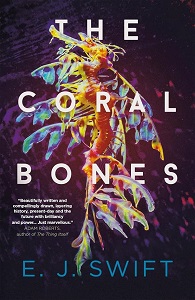
The Coral Bones, EJ Swift

This is the first book I’ve read by EJ Swift, although her name was not unknown to me. Mostly because of her appearances on the BSFA and Clarke Award shortlists – in fact, The Coral Bones (2022, UK) was nominated for both (it lost the Clarke to Ned Beauman’s Venomous Lumpsucker (2022, UK) and the BSFA to Adrian Tchaikovsky’s City of Last Chances (2022, UK)).

The Coral Bones is structured as three narratives set in three different times. The first is in the present day, or perhaps a few years hence. Hana is a marine biologist, helping map the slow death of the coral of the Great Barrier Reef. She and a colleague discovered a dead man floating in an inflatable dinghy. He has been painted white, and the words “This is what it looks like when coral dies” painted on the side of the dinghy. Later, the man is found to have drowned, so it wasn’t murder, just someone trying to make a political point with his corpse. Hana has split from her partner, after the two had decided to have a child and the partner is now pregnant. Hana also begins to obsess about the dead man, who was also helping document the reef.

Judith is a precocious seventeen-year-old in Sydney in 1839. Her father is a celebrated captain, who has been mapping the coast of Australia. She is also a naturalist. After her mother returns alone to England, Judith persuades her father to let her accompany him on his next voyage. She documents the creatures she encounters along the way, and eventually marries the naturalist on the voyage, despite initially hating him.

Telma works for the Restoration Committee in 22nd Century Australia. The climate is now too hot for humans during the day, and most animal species are extinct. The Restoration Committee tracks down animals thought to be extinct in order to preserve them. An informant tells the Committee he has spotted a leafy seadragon near the northern end of the Great Barrier Reef (which has long since died). Telma heads north to meet him. It takes him weeks before he finally reveals his secret, and the secret behind the seadragon’s survival.

The narrative flips between the three, which eventually prove to be connected – Hana learns about Judith’s career, and fate; and the secret Telma uncovers also links back to Judith’s career. Of the three stories, Judith’s is the most interesting, perhaps because she’s an adventurous and headstrong young woman, where the other two have so much personal baggage it almost overwhelms the role they play in the plot. The future narrative thread, however, is cleverly done. The present day one – well, the mystery behind the man’s death is pretty easy to figure out, although Swift drags it out to the end. The prose is good, the research deep but worn lightly, and I don’t recall any road-humps during my read.

On the strength of The Coral Bones, I certainly plan to read more Swift – which is fortunate, as I have her BSFA-Award-winning When There Are Wolves Again (2025, UK) on the TBR (it has also been nominated for the Clarke, and may well win it). Recommended.


Leave a comment

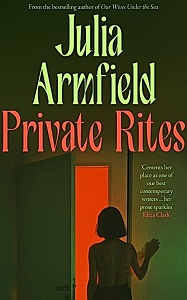
Private Rites, Julia Armfield

Private Rites (2024, UK) was nominated for the Clarke Award last year, which is why I read it. I generally follow the Clarke, although recent shortlists have been mixed at best: some nominations have been actually quite bad, and this year the award has nominated a book first published six years ago. Armfield was not a name with which I was familiar, but when I looked her up, her previous novel, Our Wives Under the Sea (2022, UK), rang a dim and distant bell. Perhaps someone recommended it or something. Having now read Private Rites, I’m unlikely to seek it out.

Private Rites is, Armfield has said, basically King Lear’s three daughters in a post climate-crash UK. And, er, that’s it. There’s no plot, as such. Irene, Isla and Agnes have as little to with each other as they can, and when they do meet, they bicker. Then their father, a renowned architect dies, and they bicker some more. And argue.

Meanwhile, it rains all the time, and the unnamed English city in which the three live is completely flooded. That’s the extent of the science fiction in Private Rites. It is neither explained, nor solved – the ending might be interpreted as a solution, but if so, it’s pure fantasy, not science fiction.

Readers are going to come to this book because of the writing, not the lack of plot, poorly-grounded setting or well-drawn characters. I value good writing. But I also think less is more, when it comes to literary fiction writing. Armfield shows some nice insights and turns of phrases, but all too often it veers into creative writing degree prose. She’s not a genre writer, but I feel it’s a problem in both literary and genre fiction. Creative writing degrees and MFAs on the one hand, genre residential writers’ workshops on the other – neither claim to be prescriptive, but they’re slowly imposing a prose style on authors. It’s the singular voices which are often the most memorable, and are certainly the most innovative. That may be why translated non-Anglophone fiction is becoming increasingly popular in both mainstream and genre circles – it doesn’t follow the same “rules” as graduates of MFAs and writing workshops.

Private Rites was a slog in places, and the ending was not really worth the investment in reading it. The Clarke that year was won by Annie Bot (2024, USA), which I felt laboured its point to the extent it undercut its argument. The Ministry of Time (2024, UK; my review here) and Extremophile (2024, UK; my review here) were enjoyable enough, but I wasn’t blown away (Service Model (2024, UK) and Thirteen Ways to Kill Lulabelle Rock (2024, UK) I have yet to read). It felt like there were better books they could have chosen. So too this year (mostly). No Slow Gods (2025, UK; my review here)? One of the best UK writers currently writing in genre, and she’s ignored by both the BSFA and Clarke Awards. The Clarke, a juried award, is supposed to be an antidote to the popular vote BSFA, which is like all other genre awards of its type, increasingly dominated by tribalism. In recent years, however, it sometimes seems like the Clarke is nominating books based on how many copies it’s sold, and not its science-fictional or literary credentials…