
I’ve read pretty much every book Kim Stanley Robinson has published, except perhaps a couple of collections, and I’ve probably read most of their contents anyway. I buy his books in hardback as soon as they are published. This probably makes him a favourite writer.
He’s a good choice to have as a favourite author – his novels cover a wide range of subjects, and they’re never less than interesting. And I mean that in a good sense. True, he clearly has an agenda in each one – people who don’t understand how fiction works would call it “message fiction”. It makes his work a damn sight more appealing than the warmed-over middle America of the 1950s plus spaceships that far too much science fiction of last century was, even if, yes, he does tend a little to US-defaultism… although, to be fair, this particular novel is about New York.
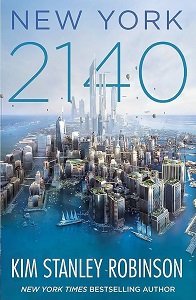
The title of New York 2140 (2017, USA) tells you where and when the novel is set, but not what it’s about. Which is two things: climate change and late-stage capitalism. Most of Manhattan is flooded – fifteen metres in the book, which most experts agree is unlikely, and by 2140 would probably be no more than a third that high – and people use boats and skybridges between buildings to get about. The novel centres on a handful of residents of the MetLife Tower, which was originally constructed in 1909. These include: the building’s maintenance engineer, a broker, a senior NYPD police officer, the head of the residents’ board, an influencer who travels about in her own airship, and a pair of orphaned homeless boys who are eventually “adopted” by the building.
There are two major plot-threads: equity funds have decided to force ownership of the flooded buildings, currently not subject to property laws, and are trying to buy the MetLife Tower, improving their chances with some sabotage; and a huge storm hits New York, throwing everything into chaos, and forcing a new social and economic order. The novel opens when two unemployed “quants”, programmers for a brokerage, who are staying in the building go missing. Their disappearance ties into the sabotage, and the movement of capital between a number of shell companies, all of which seems to be targeting the MetroLife Tower.
Then the storm hits, destroying parts of the city and in the aftermath Central Park becomes a giant refugee camp. A move to occupy vacant buildings in a safer part of Manhattan – buildings owned by one-percenters – leads to a violent clash. Which in turn prompts a plot by the central characters to safeguard ownership of their building, which involves deliberately crashing the economy and then forcing the US government into taking over the banks, thus curtailing their power.
There’s also a hunt for some lost British gold, a bit about the life on Herman Melville, an attempt to prevent the extinction of polar bears by migrating half a dozen to Antarctica, and a new way to colonise intertidal land. Robinson once said exposition is just another form of narrative, and there’s certainly a lot of lecturing in New York 2140, either between characters or directly to the reader. It’s mostly fascinating stuff – the bits about capitalism, however, are mostly enraging. Having said, the characters are all! a bit! excitable! With liberal use of exclamation marks in dialogue! It makes most of the cast come across like those super-perky Americans they have in bad US sitcoms.
I’ve heard New York 2140 described as Robinson’s best novel to date. I’m not sure I agree, although it’s certainly one of his better ones. It feels more didactic, and less modernist, than his other works, and its perkiness does give its prose a weird flippancy that seems at odds with the seriousness of the topics it covers. Nonetheless, definitely worth reading.

