
It Doesn't Have To Be Right…

… it just has to sound plausible


Leave a comment

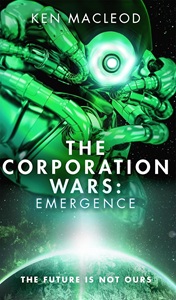
Emergence, Ken MacLeod

In the previous book of the Corporation Wars trilogy, Insurgence (2016, UK), the various factions all began to advance their own agendas. This was somewhat complicated by the assorted groups including sleeper agents from both the Rax and the Axle (capitalist and anti-capitalist factions from the war back on Earth), and even sleeper agents within each faction for the opposite faction.

In Emergence (2017, UK), the Axle defectors are now with the freebots on SH-17, a moon of the super-habitable world, SH-0. And the Locke Proviso sim populated by Axle has crash-landed on SH-0 in an effort to kickstart a colony, even though the Direction (the government on far distant Earth) has decreed SH-0 off-limits.
Rax white supremacist Mackenzie Dunt and his cronies have occupied SH-119 but the freebots there are resisting occupation – one even sends a call for help to the freebots on SH-17, the ones whose bootstrapping to sentience kicked off the story of the trilogy.

The station that crash-landed on SH-0 has discovered the local fauna is more dangerous, and much more clever, than they’d expected, and it begins to meld somehow with the mechanoids used by the downloaded humans in the sim.

And on SH-17, Carlos the Jackal, one of the core characters, has realised that by incorporating himself he gains far more legal rights and protections than he had as a downloaded human and, because he’s a downloaded human, his corporation has the legal right to manufacture and sell weaponry. Making Carlos Ltd, so to speak, in short order the richest and most powerful corporate entity in the planetary system.

A final section, set thousands of years later as Carlos is re-awakened on a terraformed H-0, the system’s sole habitable planet (but needs terraforming), adds a new spin on the story preceding it as it provides closure for the various narratives.

MacLeod plays all this out with an impressive degree of rigour and logic. Despite that, he keeps the story focused on human, and robot, characters with whom readers can sympathise. It’s a cleverly-done juggling act: so many agendas in play, and yet MacLeod keeps the narratives clear and distinct.

I originally bought these books as they were released in hardback, and only purchased the omnibus paperback after moving to Sweden because the hardbacks were in storage. I don’t actually like reading omnibuses in one go – I feel that if its constituent parts were published separately then that’s the best way to read them. Except that’s often not the case – some trilogies and series are conceived as a whole but split on publication for a variety of reasons. The Corporation Wars, I think, actually works better as an omnibus, because its plot is complex, the factions its characters represent evolve quickly as the trilogy progresses, and because its victories and reversals have strategic implications.

This is an excellent trilogy, superior science fiction, but I suspect it’s best consumed in the omnibus paperback as a single novel rather than the three original novels.
Leave a comment

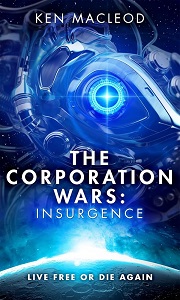
The Corporation Wars 2: Insurgence, Ken MacLeod

So, they sent robots to another planetary system, and some humans whose consciousnesses had been uploaded when they died, and the robots started mining an exo-moon and then accidentally developed self-awareness. Meanwhile the uploaded humans were living in a very realistic virtual reality, and fighting while piloting small humanoid robot bodies, called “frames”, against… Which is where it gets a bit complicated…

There were two political factions on Earth, the Reaction (Rax) and the Acceleration (Axe), both of whom were fighting against late-stage capitalism through various acts of terror, the former wanting a return to earlier political systems, the latter trying to power through capitalism to something better. Out of this war arose the Direction, a global government. It’s the Direction which is trying to colonise another planetary system, which features a super-habitable exoplanet. But a legal dispute has come up in the exo-system and two law firms (both subsidiaries of another firm), each controlled by an AI, are now settling their dispute. With war.

Meanwhile, the Axe uploaded humans have settled in a VR based on a popular fantasy MMRPG while they plot to prevent the Rax in the other VR (where much of the first book, Dissidence (2016, UK) was set) from actually physically settling on the exoplanet. Except the Rax are no longer in charge of that other law firm, and some of the Axe have defected to the self-aware robots, who have decided they’re neutral.

Despite the complexity of the background, and the politics which drives the plot, Insurgence (2016, UK) is a fast-paced read. The narrative focuses on a handful of characters, each representing different factions, so giving the reader a pretty good overview of what’s happening. The level of invention is light, but clever, and MacLeod manages to keep the reader guessing as to who are the actual good guys (although pretty much everyone has something really bad in their past). Like most middle books of trilogies, there’s a lot of movement, as characters move around and events are set in motion for the final volume. If you’re going to read one book about self-aware robots and uploaded humans fighting a complicated political war over an exoplanet, make it these three. If that makes sense.


1 Comment

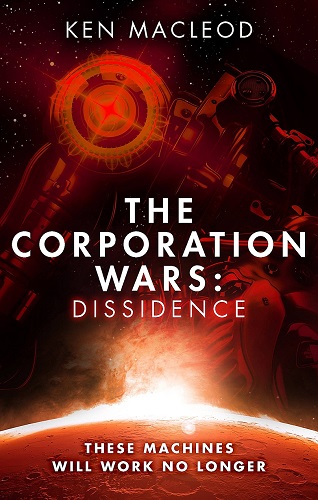
The Corporation Wars 1: Dissidence, Ken MacLeod

This was a reread – I read it back in 2017 – but never got the chance to read the two sequels before I put the books in storage when I moved. Earlier this year I bought an omnibus edition of the trilogy, intending to finally finish all three. 

I actually wrote a review of Dissidence (2016, UK) on my blog back then. For some reason, I wrote that it took place on a moon of Jupiter, which was complete rubbish – the author even called me out on my mistake. I’ve no idea why I wrote that. The terms exoplanet and exomoon are used throughout the novel, and it states several times that it takes place in a planetary system 25 light years from Earth. So sorry, Ken: I’ve no idea why I wrote that and I’d like to make it clear the novel is set in another planetary system.

Anyway. Two companies are exploring the mineral wealth of an exomoon using robots. One of the robots, through a sequence of events, becomes self-aware. And so causes other robots, in both mining companies, to become self-aware. They rebel. So the AIs which run the mining companies unöeash their legal AIs on the “freebots”. Everything in the planetary system is run by AIs, based on a mission profile originally sent from Earth at sublight speeds.

Carlos the Terrorist was responsible for killing thousands in London during the undeclared war between the Acceleration (left-wing, basically) and the Reaction (right-wing, basically). He finds himself reincarnated in a simulation running on an AI in the same system as the aforementioned freebots. He, and several other resurrected and uploaded war criminals from the Acceleration, is there to fight those freebots on behalf of the legal AI that represents the mining company to which the robots belonged.

Except, it’s slightly more complicated than that. Is the simulation Carlos and his team experience really a simulation? Why does the legal AI representing one of the mining companies break off relations and start a war?

The story is surprisingly fast-paced, given all the ontological discussions, but MacLeod keeps the focus tight on Seba, the first robot to gain self-awareness, and Carlos. There’s a few bait-and-switches before the novel finally reveals its plot, but it’s the first of a trilogy. There are few authors I’d trust with political science fiction, but MacLeod is definitely one of them. True, I have more in common with him politically than most sf authors (especially US ones, past and present), but also because he writes sf to his politics, not despite them.

I’d happily recommend any novel by Ken MacLeod. Some are better than others. If you read them all, there may be a few disappointments, but on the whole you’ll be impressed. The Corporation Wars trilogy, based on just this first novel, seems to be somewhere near the middle, so definitely worth reading.