It Doesn't Have To Be Right…

… it just has to sound plausible


Leave a comment

Schismatrix Plus, Bruce Sterling

(Another review from Facebook.)

I’m pretty sure I read Schismatrix (1985, USA) back in the very early 1990s… but I also have a vague memory of borrowing the novel when staying with a friend on a trip to the UK a couple of years after I’d moved to the Middle East in the mid-1990s. Schismatrix Plus (1996, USA), published a decade after the original novel, includes it and five short stories set in the same universe. I suspect I’d read a couple of the short stories first, and then read the novel when staying with that friend. Whatever the truth of the matter, I’d pretty much no memory of the novel’s actual story when coming to this recent reread.
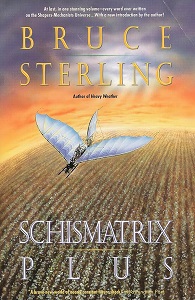
Certainly, the one big thing I’d forgotten about Schismatrix was that it featured aliens. In the future of the novel, a couple of centuries hence, humanity has colonised the Solar system and those based off Earth have split into two factions – the Shapers, who improve themselves through genetic engineering, and the Mechanists, who use technology and cybernetics. The two factions are in an almost constant state of political and commercial rivalry slash war.

Lindsay is born in an O’Neill cylinder orbiting the moon. Despite being a Mechanist, he’s sent to the Shapers for diplomatic training (and some genetic engineering). Later, he’s exiled from his cislunar republic, and embarks on a career bouncing around the outer Solar system, growing more and more politically powerful, although typically as an eminence grise. He has a rival, Constantine, and the two are at constant, if often hidden, loggerheads. Aliens, the Investors, large dinosaur-like interstellar merchants, arrive, and there is a peace of sorts between Shapers and Mechanists. But it doesn’t last.

Sterling’s future solar system is pretty neat, if a little dated in places, such as the frequent mentions of “tape”, but Lindsay’s and Constantine’s political genius, even the reasons they’re so admired, is never explained and never really convinces. They are what they are because Sterling tells us so. The most interesting character in the book, Kitsune, who later becomes an actual space station, doesn’t appear often enough.

The aliens are dull, and not very original. Although the Swarm in the story titled, er, ‘Swarm’, originally published in F&SF in 1982, is based around a neat idea – indeed, something similar to it was used by Paul McAuley in his debut novel, Four Hundred Billion Stars (1988, UK). Sterling went on to write much better novels than Schismatrix, although it remains popular to this day. It was ahead of its time back in 1985, but sf has moved on a great deal since then. Schismatrix Plus is worth a read, the original novel on its own not so much. 

Leave a comment

The Map and the Territory, Michel Houellebecq

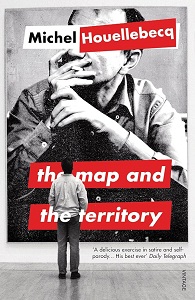
I’m a fan of Houellebecq’s fiction, and have been ever since reading Atomised (1998, France) back in 2009. He’s a miserable writer, but I like his commitment to factuality, to the extent he often includes exposition as much as in any science fiction text. But Houellebecq is not above using other literary techniques, and in The Map and the Territory (2010, France) it’s metafiction. Of a sort – Houellebecq himself appears as a character in the novel.

Jed Martin is a struggling artist in Paris. He has the idea of taking tilt-shift photographs of Michelin maps, which brings him fame and a girlfriend, the beautiful Olga, who works for Michelin. When she is transferred to Russia (her homeland), Martin turns to painting portraits of professional people, including his father, and most famously the painting ‘Bill Gates and Steve Jobs Discussing the Future of Information Technology’. Martin approaches Houellebecq and asks him to write an accompanying text for an exhibition of the paintings – a real thing which has led to published novels, Paul Park’s All Those Vanished Engines (2014, USA) and Olga Ravn’s The Employees (2018, Denmark), come to mind. This text is not The Map and the Territory, even if the novel documents Martin’s career and works as reportage.

As payment for the text, Martin paints a portrait of Houellebecq. Martin’s career skyrockets, and his professional portraits all sell for six-figure sums. Some time later, Houellebecq is found murdered in his country cottage. More: his head has been removed and placed on a sofa, and his skin cut into strips and scattered around the living-room. The remaining parts of his body are never found. The police investigation founders. The detective in charge retires. The police learn Houellebecq’s portrait is missing, and is now worth nine million euros. The crime is eventually solved by accident.

The Map and the Territory is more than the above, of course. The plot is just an excuse for Houellebecq to pontificate on a number of different subjects. I actually read this immediately after finishing Kim Stanley Robinson’s New York 2140 (2017, USA), and despite the differences in plot and setting, the two books are remarkably similar. They are both didactic, although Robinson discusses history and economics whereas Houellebecq writes about art and commerce. Robinson’s novel is annoyingly chatty, with overly excitable characters; The Map and the Territory’s characters are almost automatons, although extremely self-reflective ones, and Houellebecq has an irritating habit of randomly italicising phrases. Nonetheless, both are excellent books.

Houellebecq is one of those authors whose books I’ll happily read when I come across them, and while I keep up with his career, I don’t buy each new book as it appears – I’m reading The Map and the Territory 16 years after it was published, after all. He’s never less than thought-provoking, although often more in the sense of being deliberately provocative. But he’s always worth reading – whether you agree or not with the premise of the novel you’re reading.

(I should probably mention I welcome comments on my reviews. You don’t have to agree with me – in fact, I know many people don’t.)


4 Comments

The People of the Wind, Poul Anderson

(Another review which originally appeared only on FB.)

Anderson was not one of those authors I read much back when I was a teenager. Perhaps half a dozen of his best-known works. There were other science fiction authors whose books and stories I much preferred. But he was a popular and well-regarded author in his day and, to be honest, his Terran Empire / Ensign Flandry / Nicholas van Rijn novels always struck me as featuring the sort of world-building I sort of liked… And yet I never made any effort to explore it.

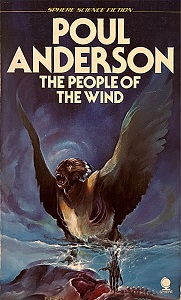
Anyway, The People of the Wind (1973, USA) was nominated for the Hugo in 1974 (but lost out to Arthur C Clarke’s Rendezvous with Rama (1973, Sri Lanka)). It’s set on a world called Avalon, shared by humans and Ythrians, who are winged bird-like humanoid aliens, and which is nominally part of the Ythrian Domain. The Terran Empire decides it wants a nice and less ragged border with the Domain, which makes no sense, and so decides to launch a full-scale attack on the Domain, which makes no sense, in order to take over those Ythrian worlds it feels will make the border look neat and tidy on a map, which makes no sense. Which makes no sense.

Anyway, Avalon is happy being a mixed human/Ythrian world, and has created a culture all its own. It has no intention of being subsumed into the Terran Empire. And it has a plan to defend itself. And when that works, but not enough, it has a last-ditch plan to defeat the forces of the Terran Empire. Which also works. Oops. Spoiler.

Anyway, reading The People of the Wind I think I understand why Anderson’s novels never appealed to me. The descriptive prose is actually not bad, and its presence not all that common in sf novels of the time, but Anderson’s decision to make use of archaic, and often completely made-up English, works against him – “blent”? “fleered”? WTF? Has either been used since Chaucer’s day? It also doesn’t help that Anderson drops lumps of exposition, which read like encyclopaedia passages, into his narrative. There are many ways to deal with exposition, assuming you even believe it’s necessary, but this is surely the most inelegant. No, wait– “As you know…” dialogue is definitely less elegant.

Anyway, I think even the most cynical would agree that exposition, in whatever form, should at least advance the story. Anderson’s doesn’t. It’s thinly-disguised gazetteer information, and might possibly be of relevance should they ever produce a RPG of the universe (which was not a consideration back in 1973).

Anyway, The People of the Wind. The usual bullshit “underdog defeats vastly superior enemy” narrative – which is, when you think about it, somewhat ironic coming from a US author – written in a combination of clumsy infodumps and pseudo-archaic English, and which presents absolutely nothing interesting in terms of insight… was apparently considered notable enough to be shortlisted for the genre’s premier award in the US in 1974.

Anyway, not a reason, I would think, to start reading Poul Anderson. But perhaps a good reason not to read him.