
(Another review from Facebook.)
I’m pretty sure I read Schismatrix (1985, USA) back in the very early 1990s… but I also have a vague memory of borrowing the novel when staying with a friend on a trip to the UK a couple of years after I’d moved to the Middle East in the mid-1990s. Schismatrix Plus (1996, USA), published a decade after the original novel, includes it and five short stories set in the same universe. I suspect I’d read a couple of the short stories first, and then read the novel when staying with that friend. Whatever the truth of the matter, I’d pretty much no memory of the novel’s actual story when coming to this recent reread.
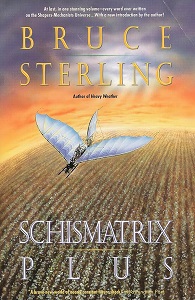
Certainly, the one big thing I’d forgotten about Schismatrix was that it featured aliens. In the future of the novel, a couple of centuries hence, humanity has colonised the Solar system and those based off Earth have split into two factions – the Shapers, who improve themselves through genetic engineering, and the Mechanists, who use technology and cybernetics. The two factions are in an almost constant state of political and commercial rivalry slash war.
Lindsay is born in an O’Neill cylinder orbiting the moon. Despite being a Mechanist, he’s sent to the Shapers for diplomatic training (and some genetic engineering). Later, he’s exiled from his cislunar republic, and embarks on a career bouncing around the outer Solar system, growing more and more politically powerful, although typically as an eminence grise. He has a rival, Constantine, and the two are at constant, if often hidden, loggerheads. Aliens, the Investors, large dinosaur-like interstellar merchants, arrive, and there is a peace of sorts between Shapers and Mechanists. But it doesn’t last.
Sterling’s future solar system is pretty neat, if a little dated in places, such as the frequent mentions of “tape”, but Lindsay’s and Constantine’s political genius, even the reasons they’re so admired, is never explained and never really convinces. They are what they are because Sterling tells us so. The most interesting character in the book, Kitsune, who later becomes an actual space station, doesn’t appear often enough.
The aliens are dull, and not very original. Although the Swarm in the story titled, er, ‘Swarm’, originally published in F&SF in 1982, is based around a neat idea – indeed, something similar to it was used by Paul McAuley in his debut novel, Four Hundred Billion Stars (1988, UK). Sterling went on to write much better novels than Schismatrix, although it remains popular to this day. It was ahead of its time back in 1985, but sf has moved on a great deal since then. Schismatrix Plus is worth a read, the original novel on its own not so much.

