
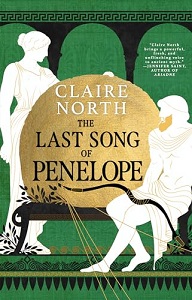
The Last Song of Penelope (2024, UK) is the final book in the Songs of Penelope, preceded by Ithaca (2022) and House of Odysseus (2023). This is the story of Penelope, who was left behind to rule Ithaca – for twenty years! – after Odysseus left to fight in the Trojan War. Each book is narrated by a goddess. In The Last Song of Penelope, it is Athena.
Odysseus has finally returned, but in the guise of an old beggar. Penelope is not fooled, although she pretends to be because she understands why he is in disguise. It’s the one hundred suitors – for twenty years, they have feasted in the palace, each one hoping to marry Penelope and so become king of Ithaca. Odysseus cannot defeat them all alone, and even with his son Telemachus he still has too few warriors surviving from his long voyage home. So he murders them in the night, catching them unaware and slaughtering them. What he does not realise is that Penelope and her maids have drugged all the suitors to make it easier.
Then Odysseus, believing the lies of his old nursemaid, executes some of the maids for consorting with the suitors. (They didn’t.) There’s nothing Penelope can do. She’s aware of the importance of the story – that Odysseus is the hero, and she’s merely an adjunct to his tale.
The fathers of two of the dead suitors raise an army and attack the palace. Odysseus, his men, Penelope and her surviving maids, flee, and take up refuge in Odysseus’s father’s farm, which they fortify. The fathers’ army, bolstered by mercenaries, besieges the farm. Penelope is forced to call on her army of women.
Throughout all this, Athena is watching, and influencing events where she can. She muses on her own life, her treatment by her father and siblings, by the fact she is female but has more in common with her brothers. Like Penelope, she knows this is Odysseus’s story, and she wants that story to survive because she is part of it, and that means knowledge of her will also survive.
Retelling Greek myths seems to have been bizarrely popular these last few years. I’ve no idea why – and I don’t recall any similar novels about Roman mythology. I read North’s Song of Penelope because it was by North, not because of its story or setting. Similarly, I’m reading Pat Barker’s Women of Troy trilogy because it’s by Barker. North’s is the more fantastical of the two, but one of the things I like about these stories is how embedded in daily lives are their gods. It impacts everything the Greeks do and think. North adds an extra layer by making her cast aware of story, that their lives are merely part of what will become The Odyssey, centred on Odysseus, a man, and in which the women are merely part of the background – but knowing that, they still impact, and even direct, the narrative.
Read Ithaca, House of Odysseus and The Last Song of Penelope because they are a smart genre-adjacent trilogy about an untold part of The Odyssey, the part about the women who are mentioned only in passing. But also read it because it is by Claire North, who is currently one of the best genre writers currently writing in the UK.

