It Doesn't Have To Be Right…

… it just has to sound plausible


5 Comments

Anatomy of a Story: Through the Eye of a Needle

It’s been nearly a year since I dissected one of my stories and the creative process which led to it. I’ve had several stories published since my last ‘Anatomy of Story’ back in October 2009 (see here) – six in this year alone, in fact. But I’d sooner not write about one of my stories if people can’t read it, and though I may only have sold first serial rights to the magazines which published those stories, I feel it’s better to wait a suitable period before sticking the story up here on my blog.

Unless, of course, the story was published online. In which case I can just link to it.

Which brings us to ‘Through the Eye of a Needle’, which was published in M-Brane SF #19, and is available on the website as #19 is the sample issue for the magazine.

‘Through the Eye of a Needle’ is, I think, the first story I’ve ever written to a specific market. I wrote it to submit to Catastrophia, an anthology of post-catastrophe stories edited by Allen Ashley and published by PS Publishing. Usually, I have an idea – sometimes it includes a plot, other times not even that – I work on it until it’s a story, then I submit it to whichever venue I feel it best suits… and then the next best… and then the next… and so on.

The central idea of ‘Through the Eye of a Needle’ came from a couple of New Scientist articles. (I subscribe to their feed, rather than to the magazine itself. I especially like the Zoologger column – some of the creatures it describes are even more bizarre than any alien race invented by sf writers). Anyway, there were a couple of articles about creating an artificial sunshade high in the atmosphere using particulates which, it was hoped, would help alleviate global warming. Both articles were strongly against the idea, suggesting that the effects on the climate could be catastrophic. I filed the idea away for a possible story.

Around the same time, I’d read an article by Jonathan McCalmont on his blog about the fascism inherent in secondary-world fantasies, in particular George RR Martin’s A Game of Thrones. McCalmont mentions specifically the public execution by Lord Eddard Stark of an “oathbreaker”. That got me thinking – not so much about public executions, but the practice of displaying the body after an execution; and of a world in which doing something like that wouldn’t be fascist.

Then there was the current recession, caused by scumbag bankers, who continue to pocket ridiculous bonuses. Plus the likes of Fred Goodwin, ex-CEO of RBS, whose criminal mismanagement – a loss of £24.1 billion – was rewarded with a £700,000 a year pension. Clearly, the ever-increasing equity gap is grossly unfair and is only going to result in yet more financial disasters.

I put all the above together with the planetary sunshade idea from New Scientist. I’d have a billionaire put up a planetary sunshade on his own initiative, and it would all go horribly wrong. Which would lead to a backlash against wealth and the hoarding of riches… But I wouldn’t actually tell that story. I’d tell a story about a young couple living in this new post-wealth ice age world, and how they fell foul of these new laws.

I’d originally planned to call the central couple Peter and Pauline – as in “robbing Peter to pay Paul” – but decided that was a bit naff. So instead I called the husband Robin (robbing? geddit?), and the wife Petra. I wanted to describe a world which was only a few years ahead of our own, so I decided to keep the technological extrapolation light. People would use their phones for pretty much everything – as I think will probably become the case anyway. Robin reads books on his phone, listens to music on it, does his banking, and uses an app to follow his route on the bus. The roads are also heated, and the bus electric-powered.

There was a fuss in the news at the time I was writing ‘Through the Eye of a Needle’ about Muslim women wearing veils and the hijab (the wearing of veils in public has now been made illegal in France). Having grown up in the Arabian Gulf, and spent ten years working there after graduating from university, I’m used to the sight of women in veils, or even full abeya. Given that climate collapse could badly affect the ozone layer, greatly increasing UV to dangerous levels, it made sense to me for people in my invented post-wealth world to cover up completely when outside. Perhaps even wearing veils; which could then lead to them becoming fashion accessories. The scene in the kitchen at Robin’s work thus serves double-duty – laying out some of the story’s politics, but also commenting on the wearing of veils.

I think at one point I toyed with the idea of people wearing masks – not necessarily decorative masks, but ones that aped their actual features… or how they wanted their features to appear. But that struck me as a bit too fetishistic, so I stuck with veils.

In the event, Allen didn’t take ‘Through the Eye of a Needle’. He liked it, even described it as “beautifully written”, but he bounced it all the same. He had enough stories, he said, set in post-catastrophe worlds. He was now looking for stories set at the point of catastrophe. So I wrote another story, ‘In the Face of Disaster’, which describes the beginnings of a global epidemic of prosopagnosia, and he took that one.

‘Through the Eye of a Needle’, which is, I think, a little too literary for most sf venues, was subsequently bounced by a couple of magazines, spent several months each at a couple of literary magazines who never bothered to respond, before finding a home at M-Brane SF.

Chris Fletcher of M-Brane SF admitted when he took the story that he was a little unsure of its politics. To me, it’s quite clearly left-wing. But Chris was afraid some readers, especially US ones, might think the story was anti-socialist, that it painted a deliberately harsh portrait of a socialist society as a way of showing how “inimical” that political system is. Except, well, I don’t think ‘Through the Eye of a Needle’ actually depicts a dystopia. To my mind, there’s nothing Nineteen Eighty-four about it. A well-developed public infrastructure, free public transport, free public leisure facilities, no equity gap… Okay, so no one gets to save the money they earn. But why would they? If they lived to their means, what’s the point in wealth? It only leads to conspicuous consumption, which contains a multitude of traps for the careless.

‘Through the Eye of a Needle’ was a deliberate attempt by myself to write a sf story with a more literate feel than is common in the genre. I tried to keep the world-building to a minimum and avoid info-dumps. I told a story about a marriage which disintegrates, with a cause that is specific to the world of the story – and that’s why ‘Through the Eye of a Needle’ is definitely science fiction.

I hope you enjoyed it.


Leave a comment

Readings & watchings 9

Apologies for the delay since the last one of these. I’ve posted a number of reviews of individual books to this blog over the past few weeks, but they haven’t been all I’ve read during that time. Here’s all of them – with the links to the aforementioned reviews where appropriate, of course. And there’s also all those DVDs I’ve watched since my last readings & watchings post…

Books
Terminal World, Alastair Reynolds (2010). I’m working on a review of this for SFF Chronicles. I promise to post it up there soon. Suffice it to say, my feelings about this novel probably echo those of most of Reynolds’ fans.

Corpsing, Toby Litt (2000), is, as you can no doubt tell from the title, Litt’s third book. (Each of his books is titled alphabetically, although they are not a series or linked in any way.) I first came across Litt’s name when his tenth book, Journey into Space, a science fiction novel set aboard a generation starship, was reviewed in Interzone. I found a copy of that book (see here), enjoyed it, and so decided to read more by the author. Corpsing is a mystery novel, of sorts. The first-person narrator, Conrad, meets his ex-girlfriend, an up-and-coming actress, for a meal in a posh restaurant. During the main course, a hitman enters, kills the ex-girlfriend and mortally wounds Conrad. When he comes out of the resulting coma, he determines to discover who ordered the hit on his ex-girlfriend, and why. The solution to the mystery is not entirely what he expected. While the resolution is a little disappointing, the journey to it is very good. Conrad is an engaging narrator, there’s some perceptive writing in the book, and it’s also funny in parts and clever in others. I shall certainly be reading more by Litt.

Thousandth Night / Minla’s Flowers, Alastair Reynolds (2009), is a signed limited back-to-back double of a pair of Reynolds’ novellas from Subterranean Press. I’d read ‘Minla’s Flowers’ in The New Space Opera, but ‘Thousandth Night’ was new to me as it first appeared in a SF Book Club anthology One Million A.D. I have, however, read House of Suns, which is a novel-length sequel-of-sorts to ‘Thousandth Night’. The title refers to a year-long reunion of the Gentian Line, immortal clones descended from a single woman, albeit engineered to be individual, who travel the galaxy alone for 10,000 years doing touristy-type things. At the reunion, each member of the line creates a dream of what they have experienced during their travels, each of which is played to the clones each night. The narrator, Campion, however, notices some discrepancies in the dream, or “threading”, of one the other clones. With the help of Purslane, a female clone, he investigates… and uncovers a dastardly plot which could impact both the Gentian Line and the entire galaxy. The central conceit is pretty cool, and there is some impressive sf imagery in the story – the flying whales surely could have been inspired by the album art from Gojiro’s From Mars to Sirius (but then Reynolds has written a story name-checking Elton John, so perhaps not…). The characters in ‘Thousandth Night’ are better differentiated than they are in House of Suns, where they did tend to blur together. However, I was amused by the line: “It’s like trying to play chequers on a chess board” (p 33). For a start, we call it “draughts” in the UK; it’s called “checkers”, and spelled that way, in the US. And you do play it on a chessboard. I couldn’t actually work out if Reynolds was having a joke, or a brainfart.

Bold as Love (2001), Castles Made of Sand (2002), Midnight Lamp (2003), Band of Gypsys (2005) and Rainbow Bridge (2006), Gwyneth Jones. The Bold as Love Cycle was the first quintet of my summer reading project (see here). I’m working on a piece about the five books, which I’ll post here when it’s finished. I hope to have it done before the end of the month.

The Stainless Steel Rat, Kelvin Gosnell and Carols Ezquerra (1979 – 1985). This is an omnibus edition of the comic adaptation of Harry Harrison’s Stainless Steel Rat novels which first appeared in 2000AD. I may no longer be a big fan of the books (see here), but I do have fond memories of the comic strip and didn’t think it could be any worse than the novels. And, well, I’m not so sure… Ezquerra’s art is always distinctive, and mostly very good; although it does seem a bit slapdash in some of the later stories. However, important chunks of the plots seem to be missing. In the first strip, an adaptation of The Stainless Steel Rat, Jim DiGriz refers to the villain as Pepe Nero, despite him never having been named previously. The same thing happens in ‘The Stainless Steel Rat Saves the World’ – there’s a leap from “someone messing about with the distant past” to “plot by Him to destroy the universe”. We know DiGriz and family, but the villains need to be introduced too. As does the plot. Ah well. Now, if 2000AD will only publish an omnibus of their take on Dan Dare…

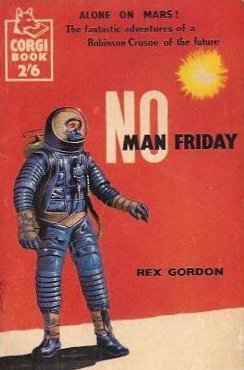
No Man Friday, Rex Gordon (1956), is one of my British SF Masterworks, and I reviewed it here.

Empress of Eternity, LE Modesitt Jr (2010), I read for review for Interzone. I’d never read Modesitt before, although I was aware of the name. I won’t be reading him again. Ever.

A Man of Double Deed, Leonard Daventry (1965), is another of my British SF Masterworks, and I reviewed it here.

Disgrace, JM Coetzee (1999), won the Booker Prize in 1999 and is the first book by Coetzee I’ve read. A university professor in Cape Town has an affair with a student which sours. A complaint is raised against him. Rather than defend himself, the professor stands on principle and is subsequently fired. So he goes to visit his daughter, a lesbian farmer in the East Cape region. But several weeks after his arrival, the farm is attacked by three bandits, who rape the daughter. She refuses to acknowledge this, and he finds himself helpless in the face of her refusal. It’s easy to cast the relationship as a metaphor for South Africa, but I’m not sure Coetzee’s unadorned prose works in the story’s favour – it’s good, but feels a bit too stark to really appeal. I may try more by the author, but I shan’t make a point of seeking out his books.

Seven Miles Down, Jacques Piccard & Robert S Dietz (1962), I wrote about here.

Gherman Titov’s Flight into Space, Wilfred Burchett & Anthony Purdy (1962), I will be reviewing on my Space Books blog soon.

The Guardians 1: The Krilov Continuum, JMH (James) Lovegrove (1998), was , the author freely admits, work-for-hire. Orbit came up with the concept, and did a cross-promotional deal with the Sci-Fi Channel. Lovegrove was interested in the topic, so was keen to work on the project. It’s alt history UFO mythology type stuff, with the Tunguska explosion caused by the crash of a craft powered by anti-gravity. It was invented by a Russian scientist, Krilov, although he unknowingly had help from an extra-dimensional race… because it seems there is a war being fought on Earth between two groups from that race, and the chief weapon is Progress. One side – the good guys – want to keep progress at a level where the human race neither destroys itself, nor attacks the extra-dimensional race – as happened in Atlantis eons before. The bad guys, however, like to mess things up by introducing alien technology here and there. A bit of a potboiler, to tell the truth. Lovegrove has written much better. The Sci-Fi Channel apparently failed to keep up their end of the deal and sales were so poor the series was cancelled after two books. I’m not sure I can be bothered to track down the sequel.

Little Birds, Anaïs Nin (1979). I suspect I came across mention of Nin through her link with Lawrence Durrell, and so when I stumbled across this thin collection of her short fiction – well, erotica – in a charity shop, I bought it. And… Sorry, not impressed. Some of the stories skated dangerously close to paedophilia and rape, and very few of them actually struck me as erotic. They were apparently written in the 1940s – although Nin did not allow them to be published until the late 1970s – so clearly they did things very differently back in those days…

The Dream of Scipio, Iain Pears (2002), was another one I picked up in a charity shop. But I did so because I’d read and enjoyed Pears’ An Instance of the Fingerpost back in 1998. A fifth-century bishop, a fifteenth-century poet, and a WWII academic, all in Provence, each studying the earlier person, and each in some sort of relationship with a Jewish woman, in interlinked stories which are part history lesson, part discussions of philosophy and religion, and part love story. Admittedly, much of the philosophy was lost on me – the title is shared with a treatise by Cicero, and it’s referenced many times during the story. But the historical periods were handled well, the characters were interesting, and although the book was slow to start, I did like it a lot. It not as good as An Instance of the Fingerpost, but I’ll certainly be reading more by Pears.

Films
Under The Sand, dir. François Ozon (2000). I like Ozon’s films, but this one dragged a bit. Charlotte Rampling and her husband go on holiday to their seaside chalet. They head down to the beach, she settles down with a book, and he goes for a swim. And doesn’t come back. She calls the life guards, but there’s no sign of him. Eventually, they decide he must have drowned. She heads back to Paris and tries to get on with her life. But she refuses to admit that her husband is dead. Even when the police ask her to identify a body washed up on the beach, she claims it is not her husband’s though it plainly is. Meanwhile, her friends try to match-make, and she enters into a relationship with another man. Throughout this time, at home she hallucinates that her husband is alive and well. She tells him what she’s been up to, including the man she is seeing… I like the idea at the core of the story, but I suspect it’s not strong enough for a 94-minute film.

The Merry Wives of Windsor, dir. David Hugh Jones (1982), is another of the BBC’s adaptations of Shakespeare’s plays, this one starring Richard Griffiths as Falstaff, and Prunella Scales as one of the eponymous wives. Not one of the Bard’s better ones, I thought; more like an Elizabethan Carry On film than anything else. Some of the jokes I’m sure I’ve seen in other plays, and the characters were just broad stereotypes. Griffiths didn’t seem quite big enough a presence as Falstaff, and the ending was completely bonkers. Falstaff tries to get it on with two of the wives, but they reject his advances. One of the husbands mistakenly believes Falstaff has succeeded and so pretends to be a secret admirer of his own wife needing Falstaff’s help to enter into an affair with her. It’s the usual mistaken/hidden identity Shakespearean thing. Oh, and there’s a daughter who loves one person, but her father wants her to marry someone else, and her mother wants her to marry yet another man. Once everything is sorted out, the good burghers of Windsor decide to have their revenge on the fat letcher, and trick him into meeting in a nearby wood at midnight. Where they’ve arranged for the local kids to dress up as fairies and sing and dance about him. And, of course, Falstaff thinks they’re real fairies…

The 7th Dimension, dir. Brad Watson (2009), I reviewed for VideoVista here. Some interesting ideas, but the director threw too much into the pot and it all turned into a bit of mess.

All That Heaven Allows, dir. Douglas Sirk (1955), was a rewatch, and remains a favourite film. It is almost note-perfect throughout. Jane Wyman plays an upper-middle class widow with two grown-up children. Rock Hudson is the man who comes round to trim her trees. They get talking, and subsequently fall in love. But all Wyman’s friends, and her two kids, frown on her relationship with the bohemian gardener. All That Heaven Allows is a very autumnal film, and is beautifully photographed. Like all of Sirk’s films, there’s much more going on that the melodramatic story suggests – here, it’s a biting critique of US society of the time. A film I will certainly watch again and again.

Hierro, dir. Gabe Ibáñez (2009), I reviewed for VideoVista here. It is excellent.

Planet 51, dir. Jorge Blanco, Javier and Marcos Martínez (2009), is one of a spate of recent genre-ish animated films, aimed at kids, but including something for adults. This one is a reverse of all those 1950s alien invasion B-movies – it’s the humans who invade. Well, human. A lone astronaut lands on the eponymous world, whose alien inhabitants bizarrely resemble those of a 1950s USA. There are some amusing little jokes – a pet which resembles an alien from the Alien franchise, for example – but like all films of this ilk, the clever visuals can’t disguise a story straight from the pro-family values conservative school of Hollywood script-writing.

While the City Sleeps, dir. Fritz Lang (1956), I reviewed for VideoVista here. A good noir-ish film, although Dana Andrews appears a bit too louche to convince as the sharp investigate reporter protagonist.

Pandorum, dir. Christian Alvart (2009), I’d been meaning to get hold of for a while, but after seeing a few ambivalent reviews I decided not to shell out for the DVD. So I rented it instead. And I’m glad I did. Because it’s rubbish. Man wakes on giant spaceship. He’s all alone. Except for the zombie-like creatures. And the few survivors of, well, of something, who have managed to eke out a living. Nothing in this story made any sense whatsoever. Cargo did it so much better. Avoid.

Fish Tank, dir. Andrea Arnold (2009), is the second feature-length film by the director of Red Road, which I saw on DVD back in 2007. Teenage Mia lives on a sink estate but dreams of making it as a dancer. She practices daily in an abandoned flat. Her drunken young mother is in a relationship with a security guard at the local DIY superstore (played by Michael Fassbender). This is not one of those films with a well-defined beginning, middle and end, but it’s all the better for it. The cast are mostly excellent, particularly Fassbender and Katie Jarvis as Mia. Not an easy film to watch, but definitely worth seeing.

Blood Diamond, dir. Edward Zwick (2006), I liked more than I thought I would. Hollywood takes on the blood diamond trade, starring Leonardo DiCaprio – nothing there to signal it would be a good film, I’d have thought. But it proved to be a reasonably even-handed take on its subject, and DiCaprio, who seems to be getting better as he gets older, was good in the main role. The obligatory female role, played by Jennifer Connolly, struck me as a bit unnecessary, but Djimon Hounsou, as the man kidnapped by rebels to work in the diamond mine, played a good part.

Tinker, Tailor, Soldier, Spy: The Complete BBC Series (1979). I recently watched an episode of Spooks. I’d never bothered watching it before. Now I understand why. Spooks is the direct opposite of Tinker, Tailor, Soldier, Spy, the BBC’s adaptation of John Le Carré’s novel. Tinker, Tailor, Soldier, Spy is slow and requires much thought to follow; Spooks is fast-paced and completely stupid. Admittedly, Tinker, Tailor, Soldier, Spy does take a couple of episodes to get going, and you might initially wonder why you’re bothering as nothing actually appears to be happening. It doesn’t help that the characters seem to have been written by a public schoolboy. But having recently read Smiley’s People (see here), I think I’m happy to have seen the television series of Tinker, Tailor, Soldier, Spy rather than read the book. I intend, of course, to rent Smiley’s People too. That should prove a more interesting viewing experience as I’ll be able to compare it to the book.

Cloudy With A Chance Of Meatballs, dir. Phil Lord and Chris Miller (2009). Another quirky genre-ish animated family film. This time it’s about male bonding and family ties and, like Planet 51, the inventive visuals can’t disguise that humdrum story and its middle-class moralising. It is, apparently, based on a series of children’s books, which probably explains why it exists as a movie. I can’t see Hollywood ever coming up with something as plain weird as Cloudy With A Chance Of Meatballs‘s central premise – food raining from the sky – unless the concept had proven itself in another media and there was perceived ready market for it.

Hunter Prey, dir. Sandy Collora (2010), I reviewed for VideoVista here. Star Wars fanfic stretched out to feature-length. Disappointing.

The Big Clock, dir. John Farrow (1948), I reviewed for VideoVista here. For some reason, this film reminded me of Ayn Rand’s The Fountainhead, but I’m not entirely sure why. Rand’s book is risible, but this film is quite watchable.

The Sword With No Name, dir. Yong-gyun Kim (2009), I reviewed for VideoVista here. It was a lot better than I expected it to be. In fact, it was pretty good.

Nausicaä of the Valley of the Wind, dir. Hayao Miyazaki (1984), was Studio Ghibli’s first feature-length film, although it was apparently released before the studio was founded. However, it certainly looks like a Ghibli film. It’s set on a post-apocalyptic Earth, which a voiceover by the title character tries to explain, but the explanation doesn’t really make sense, But that’s okay, because it’s the Ghibli visuals which are the film’s main draw. Sometimes the animation seemed a bit jerky, and the story didn’t always add up, but the film was better-paced than many anime films I’ve seen and it had a distinct story-arc from start to finish. Not a bad film – I enjoyed it, although I’ll not be dashing out to buy my own copy.

The Hurt Locker, dir. Kathryn Bigelow. (2008). Cor, guess what. US soldiers are trigger-happy idiots. But that’s okay, because war is dehumanising. Hollywood films about war seem to either cast American soldiers as noble heroes or murdering incompetent dolts. The Hurt Locker falls into the second category. A member of a US Army bomb disposal squad in Baghdad takes insane risks because war has made him that way. What this is meant to illustrate is anybody’s guess. Certainly the film does demonstrate that the Iraqi people are considered to be little more than an amorphous faceless enemy, that the US shouldn’t go round invading sovereign nations, and that the reputation of the US armed forces for effectiveness is ill-deserved. I’m surprised this film won so many awards – six Oscars, six BAFTAs, and a host of others. Perhaps that’s because it’s a war film that doesn’t glorify war – which is nothing knew, I admit – but it does it in reference to the invasion of Iraq (rather than Vietnam). I’m not overly fond of morons-with-guns films, military or otherwise, and even less fond of ones that don’t even bother to treat the victims of said morons as human beings.


13 Comments

In the deepest water

At 8:15 on the morning of 23 January 1960, Jacques Piccard and Lieutenant Don Walsh, US Navy, climbed into the pressure sphere of the bathyscaphe Trieste, and sealed the hatch. Less than ten minutes later, they were descending towards the floor of the Pacific Ocean, towards the floor of the deepest part of the Pacific Ocean: Challenger Deep.

Challenger Deep is 35,994 feet (10,971 metres) deep. If you put Mount Everest in it, there would still be a mile of water above the mountain’s peak. It is a slot-shaped depression, about one mile wide by four miles long, in the floor of the Mariana Trench. There have been only three descents to Challenger Deep. The Trieste‘s was the first, and the only one to carry human beings. Two remotely operated vehicles have also been there: Kaikō in 1995 and Nereus in 2009. Given conditions on the floor of the Mariana Trench, this is hardly surprising. Down there in the hadal zone, the pressure is close to seven tons per square inch, the temperature is around two degrees Centigrade, and light itself cannot reach. Yet there are creatures living there.

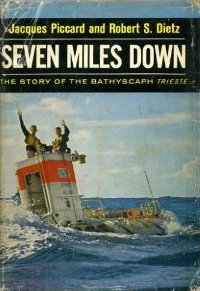
Seven Miles Down by Jacques Piccard and Robert S Dietz is the only book written specifically about the Trieste and its descent into Challenger Deep. The Trieste was invented by Piccard’s father, Swiss professor Auguste Piccard, who was apparently the inspiration for Hergé’s Professor Calculus. Piccard senior was one of those scientist-inventors who no longer seem to exist. In the 1930s, he built a balloon with a pressurised gondola, and ascended into the stratosphere, the first person to ever do so. A decade later, he turned his attention in the opposite direction, and invented the bathyscaphe, or “deep boat”, in order to study the depths of the ocean. It operates much as a balloon does, although using gasoline, which is lighter than water, rather than air. His first such vessel was the FNRS-2, named for the Belgian Fonds National de la Recherche Scientifique, which financed its construction and early operations. It was later sold to the French Navy, who upgraded it to the FNRS-3. The Trieste, however, was privately funded.

I forget where I stumbled across mention of the Trieste‘s descent to Challenger Deep. I was aware of it, of course; but knew little beyond the fact that it had happened. I certainly didn’t know that this year was its fiftieth anniversary. I remember watching the BBC submersible drama series The Deep, which featured a drilling rig on the floor of an ocean trench some 20,000 feet below the sea-surface. While The Deep wasn’t very good (nuclear reactors do not explode), I thought a crewed facility on the floor of the deepest part of the ocean might make a good location for a short story. So it might well have been that which inspired me to look up the Trieste…

… at which point I discovered that there’d been very little written about the descent. Last year was the fortieth anniversary of the Apollo 11 Moon landings and a number of books were published to celebrate it. This year was the fiftieth anniversary of the Trieste‘s descent and there’s been… nothing. In fact, the only things I could find proved to be contemporary with it: an article from Life magazine written by Walsh (see here), and Seven Miles Down by Jacques Piccard and Robert S Dietz. And the latter has apparently never been reprinted since.

source: Wikipedia

The book is actually more a history of the Trieste, and Piccard’s involvement with it, than it is a blow-by-blow account of the descent to Challenger Deep. The opening chapters cover the FNRS-2 and -3, the difficult time Piccard senior making his dream of a bathyscaphe reality, and the early dives. There is mention of Otis Barton and William Beebe, who invented the bathysphere and pioneered direct study of the deep ocean using a submersible. About halfway through the book, Dietz joins the story. An oceanographer attached to the US Navy’s Office of Navy Research and based in London, he helped persuade the US Navy to buy the Trieste and put Jacques Piccard under contract. During the second half of the 1950s, the Trieste made some thirty-five descents, piloted by Piccard and carrying scientists as observers. These were initially in the Mediterranean, and later off the coast of California. It was not until 1959 that a request was made of the Chief of Naval Operations to authorise “bathyscaphe (Trieste) operations (Project NEKTON) in the Mariana Trench, between November 1959 and February 1960”. Permission was given, a new and stronger pressure sphere was ordered from Krupps of Germany, and once that was fitted the Trieste was shipped from her base of operations in San Diego to Guam. She made six descents to various depths in the South Pacific before Piccard and Walsh made their record-breaking dive to Challenger Deep.

source: US Navy

Much of Seven Miles Down is written from Jacques Piccard’s point of view, although he does hand over the narrative at various points to Dietz. The prose is workmanlike but readable. Piccard maintains a nice balance between technical detail and his own impressions and experiences. It makes for an interesting read, although the prose doesn’t really come alive until the chapter on the descent to Challenger Deep. The technology involved is perhaps not as fascinating, and nowhere near as complex, as that in the Apollo programme, but the descents were every bit as dangerous – in Challenger Deep, there were 200,000 tons of water pressing on the Trieste‘s pressure sphere, for example. If Piccard had miscalculated the amount of gasoline needed in the float, or iron shot used as ballast, the bathyscaphe might never have returned to the surface. In fact, they were very lucky: during the descent, Piccard and Walsh heard something explode but could not work out what it was (on previous dives lights, a camera, and stanchions had all imploded). It was only during the ascent that Walsh spotted that the window at the rear of the antechamber had cracked. If it gave way, they could not clear the water from the antechamber and entrance tunnel and so would be unable to exit the sphere. They’d have to remain inside it for the five-day journey back to Guam and dry dock. Fortunately, the window didn’t break.

An appendix gives the technical specifications of the Trieste, and lists all sixty-five dives made by the bathyscaphe between 1953 and 1960. After the descent to Challenger Deep, the Trieste returned to San Diego but did not dive again. In 1963, she was modified and then used to search for the missing submarine, USS Thresher. She underwent numerous modifications and upgrades over the years before eventually being retired in 1980. She now resides at the National Museum of the US Navy in Washington DC.

Here’s an excellent video by Rolex about the Challenger Deep dive:

Finally, this year the X Prize Foundation announced a $10 million prize for the first privately-funded submersible to make two crewed descents to Challenger Deep. And yes, I did write a science fiction story set in a crewed base in Challenger Deep. It just needs a little more work before I start submitting it…


8 Comments

Another obscure British sf masterwork

Among the books recommended to me by others for inclusion on my list of British sf masterworks (see here) was A Man of Double Deed, Leonard Daventry’s debut novel, and the first book of the Keyman trilogy. Daventry is forgotten now. He wrote seven science fiction novels between 1965 and 1980 – the last one somewhat ironically titled You Must Remember Us…? – but his books are neither in print nor especially easy to find. Which is a shame, as there are worse authors from that period still in print, whose deathless prose continues to clog the bookshelves of Waterstone’s and other book shops.
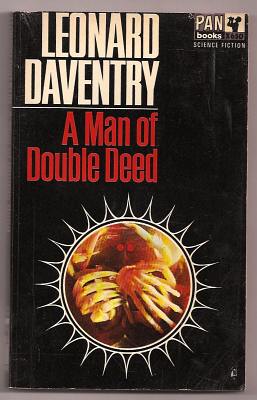
The title character of A Man of Double Deed is Claus Coman. He is a keyman. This means he is a telepath, and one of a handful of such people, who operate something like secret agents and something like Special Branch, on an Earth a century after an all-out nuclear war, the “Atomic Disaster of 1990”. Coman is something of a throwback – he lives in a house in Old Peckham, not in a giant apartment block, and he smokes like a chimney, even though the habit is illegal. He is also, we are told on the first page, “old-fashioned in other ways also, being content with two women only”. These two women are Jonl and Sein, and Coman is bonded to them – again, something considered old-fashioned and slightly dubious.

Coman returns to Earth after adventures on Venus – several of his previous escapades are mentioned in the novel – to find something strange going on. The youth of 2090 have taken to murder and suicide. It’s almost an epidemic. The only solution the World Council can conceive is a “War Section”. This is an area, preferably on another planet, in which the murderous teenagers and young adults can be left to their own violent devices. The Council is meeting shortly to consider implementing such a War Section, but the leader of the Council, Marst, is being influenced to vote against the proposal by a conspiracy. Coman’s boss, Karns, asks him to travel to the Fifteenth City, a holiday destination built above a line of islands in the Pacific, to persuade Marst to change his vote. Marst is apparently under the influence of a pair of “jokers”, telepaths who oppose the keymen but fortunately possess much weaker abilities. Coman and his two wives travel from the Twelfth City (London) to the Fifteenth City. Shortly after their arrival, while at a swimming-pool, Coman identifies one of the jokers, a woman called Linnel. He seduces her – Jonl and Sein are not happy about it, but they trust him. With Linnel’s help, Coman manages to prevent the conspiracy.

The plot summary above probably doesn’t quite illustrate how odd this novel is. Superficially, it resembles an ordinary piece of science fiction tosh from the 1950s or 1960s, with a superman hero, a supporting bevy of beautiful subservient women, and a future Earth which in no way resembles the Earth of the time of writing but still feels horribly dated. But that would be doing A Man of Double Deed a disservice. It’s a much better book than that.

Coman is such a strange hero, for one thing. He is a dour intellectual, but not a misanthrope. He is not a man of action, but is often called upon to behave like one. There’s something of the World War II RAF officer in him, a combination of education, arrogance, pragmatism, and a grudging respect for others. He is his own biggest critic, but extremely private with his criticisms. He is very British.

Nor are the women of the story, Jonl, Sein and Linnel, characterless females. On the contrary, Jonl could become a keyman herself, but does not wish to do so on principle. Sein is more stereotypical a female character. She loves Coman, and longs for a baby. She gets her wish in the end, and it’s a result all are happy with. Linnel is a femme fatale, but an insecure one who falls for Coman’s singular charms, but refuses to bend entirely to his will. These three are not, I hasten to add, brilliantly-drawn female characters, or even especially realistically-drawn ones, but they are a good deal better-realised than is common for genre fiction of the time.

A Man of Double Deed is a novel in which principles play a large part. At several points in the story, Coman, Karns, Marst, or Coman’s cyborg friend Deenan talk about moral and legal principles, and these are well-written and well-argued pieces of dialogue. They are not the usual political or moralistic crap you’d find in most genre novels, and which doesn’t stand up to scrutiny, this is solid, well-presented, intelligent argument. It makes for a refreshing change.

Perhaps the invention on display in the novel is not especially high, but the writing is solid, and even occasionally good, the characters are drawn well, and the plot comes to a satisfactory end… even if not everything is explained. What, for example, was the conspiracy which had hired the two jokers? Why did they not want a War Section? Nevertheless, A Man of Double Deed is an interesting sf novel and doesn’t deserve to be forgotten. In fact, I think I’ll hunt down the other two books in the trilogy, Reflections in a Mirage and The Ticking is in Your Head, and read them.


4 Comments

Books from my collection: Phillip Mann

Phillip Mann was born in the UK but has been resident in New Zealand since 1969. Between 1982 and 1996, he wrote nine well-regarded science fiction novels. He’s had nothing published since, although Wikipedia claims he is working on a new novel. I hope so.

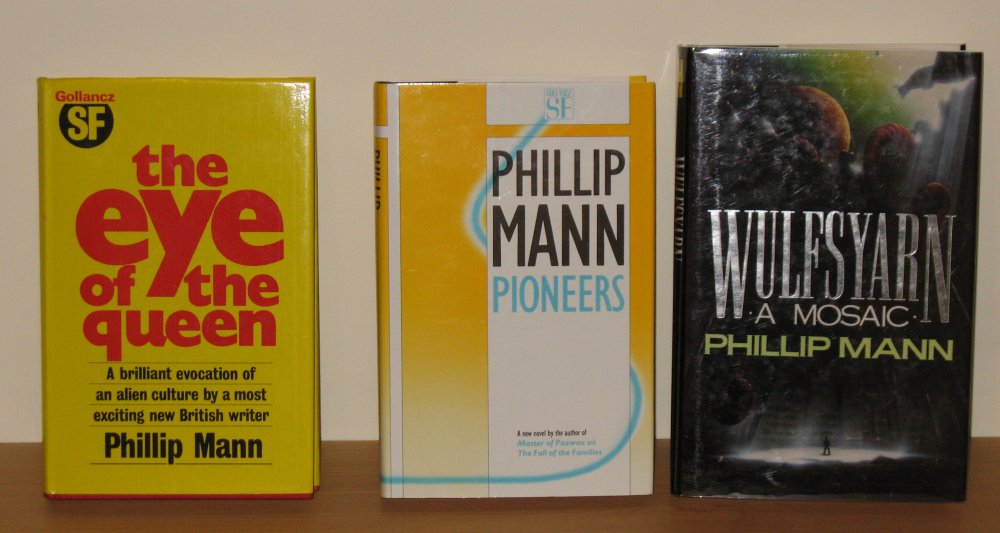
His first, fourth and fifth novels. The Clute and Nicholls Encyclopedia of Science Fiction calls The Eye of the Queen, Mann’s debut novel, “an accomplished novel of First Contact”. I remember picking up a paperback copy of it in Birmingham in the mid-1980s. First edition hardback copies of it are hard to find, and correspondingly expensive. Fortunately, I recently found one being sold on eBay for a reasonable price. Pioneers, “his best novel to date” according to the Encyclopedia, is about a team of two genetically-engineered humans exploring the galaxy who return to a much-changed Earth. Wulfsyarn tells the story of the captain of the Nightgale, a starship in the Mercy fleet which vanished on its maiden voyage, and returned a year later with only its captain aboard.


Mann’s second and third novels were the diptych, The Story of the Gardener: Master of Paxwax and The Fall of the Families. It’s a space opera, of sorts. There are no giant spaceships, or huge space battles, but it’s set in a galaxy populated by a multitude of alien races, all of which are dominated by humanity. And just waiting to rebel…

His last four books were the alternate history quartet, A Land Fit for Heroes: Escape to the Wild Wood, Stand Alone Stan, The Dragon Wakes and The Burning Forest. In these, the Roman Empire remained in Britain, there were no Saxon invaders, and the British Isles now consists of Roman garrison towns scattered across a countryside of primordial forests containing communities of Celts. I reviewed the first two books for Vector, the critical journal of the British Science Fiction Association, and thought they were excellent.

Damn. Now I want to reread all his books…


15 Comments

British SF Masterworks redux

After all the comments on my list of 50 British science fiction masterworks, I decided to revisit it. There were several authors I’d inadvertently left off – and no, I’ve no idea how I managed to miss Paul J McAuley (sorry); but he’s on there now. There were also a couple of books I listed which, on reflection, were either too peripheral to the genre, or not really masterworks. The Durrell stays on, however, because a) he’s my favourite writer, and b) it features a number of sf tropes.

Brian W Aldiss claims in Trillion Year Spree that Mary Shelley’s Frankenstein is the first science fiction novel, but I prefer to date the genre to the appearance of Amazing Stories in 1926. So Shelley goes. But it would be criminal to produce a list of British sf masterworks without including one by HG Wells, whose “scientific romances” were certainly an ancestor of sf (and many were reprinted in Amazing Stories, anyway).

I’ve also changed Lessing’s entry from The Memoirs of a Survivor to the Canopus in Argos: Archives quintet, as each of the five books in it are more substantial than my original choice. I’ve added Christopher Evans, Geoff Ryman, Ted Tubb, Mark Adlard, Eric Frank Russell, James White, Colin Kapp and Douglas Adams (bowing to public pressure there). Some of the books may not be masterworks per se – the Kapp series, for example, is more notable for its eponymous Big Dumb Object than it is its prose, characterisation or plot. Tubb, of course, was best known for his 33-book Dumarest series, but I’ve seen several positive mentions of The Space-Born, a generation starship story. James White probably wrote better books than the one I’ve chosen, but it’s the only one of his Sector General novels to appear on a any kind of shortlist – the Locus SF Novel Award for 1988 (which was, admittedly, a shortlist of thirty-three…).

So I have made some changes. And somehow the list has grown to fifty-five books.

1 – The Time Machine, HG Wells (1895)
2 – Last And First Men, Olaf Stapledon (1930)
3 – Brave New World, Aldous Huxley (1932)
4 – Nineteen Eighty-four, George Orwell (1949)
5 – The Day of the Triffids, John Wyndham (1951)
6 – The Death of Grass, John Christopher (1956)
7 – No Man Friday, Rex Gordon (1956) – my review here.
8 – The Space-Born, EC Tubb (1956)
9 – On The Beach, Nevil Shute (1957)
10 – WASP, Eric Frank Russell (1958)
11 – A Clockwork Orange, Anthony Burgess (1962)
12 – The Drowned World, JG Ballard (1962)
13 – Memoirs of a Spacewoman, Naomi Mitchison (1962)
14 – A Man of Double Deed, Leonard Daventry (1965)
15 – A Far Sunset, Edmund Cooper (1967)
16 – The Revolt of Aphrodite [Tunc, Nunquam], Lawrence Durrell (1968 – 1970)
17 – Pavane, Keith Roberts (1968)
18 – Stand On Zanzibar, John Brunner (1968)
19 – Behold The Man, Michael Moorcock (1969)
20 – Ninety-eight Point Four, Christopher Hodder-Williams (1969)
21 – Junk Day, Arthur Sellings (1970)
22 – T-City trilogy [Interface, Volteface, Multiface] Mark Adlard (1971 – 1975)
23 – The Continuous Katherine Mortenhoe, DG Compton (1973) – my review here.
24 – Rendezvous with Rama, Arthur C Clarke (1973) – my review here.
25 – Collision with Chronos, Barrington Bayley (1973)
26 – Inverted World, Christopher Priest (1974)
27 – The Centauri Device, M John Harrison (1974)
28 – Hello Summer, Goodbye, Michael G Coney (1975) – my review here.
29 – Orbitsville [Orbitsville, Orbitsville Departure, Orbitsville Judgement], Bob Shaw (1975 – 1990)
30 – The Alteration, Kingsley Amis (1976)
31 – The White Bird of Kinship [The Road to Corlay, A Dream of Kinship, A Tapestry of Time], Richard Cowper (1978 – 1982) – my review here.
32 – SS-GB, Len Deighton (1978)
33 – Canopus in Argos: Archives [Shikasta, The Marriages Between Zones 3, 4 and 5, The Sirian Experiments, The Making of the Representative for Planet 8, The Sentimental Agents in the Volyen Empire], Doris Lessing (1979 – 1983)
34 – The Hitch-hiker’s Guide to the Galaxy [The Hitch-hiker’s Guide to the Galaxy, The Restaurant at the End of the Universe, Life, the Universe and Everything, So Long, and Thanks for All the Fish, Mostly Harmless], Douglas Adams (1979 – 1992)
35 – Where Time Winds Blow, Robert Holdstock (1981) – my review here.
36 – The Silver Metal Lover, Tanith Lee (1981)
37 – Cageworld [Search for the Sun!, The Lost Worlds of Cronus, The Tyrant of Hades, Star-Search], Colin Kapp (1982 – 1984)
38 – Helliconia, Brian W Aldiss (1982 – 1985)
39 – Orthe, Mary Gentle (1983 – 1987)
40 – Chekhov’s Journey, Ian Watson (1983)
41 – In Limbo, Christopher Evans (1985)
42 – Queen of the States, Josephine Saxton (1986)
43 – Wraeththu Chronicles [The Enchantments of Flesh and Spirit, The Bewitchments of Love and Hate, The Fulfilments of Fate and Desire], Storm Constantine (1987 – 1989)
44 – Code Blue – Emergency!, James White (1987)
45 – Kairos, Gwyneth Jones (1988) – my review here.
46 – The Empire of Fear, Brian Stableford (1988)
47 – Desolation Road, Ian McDonald (1988)
48 – The Child Garden, Geoff Ryman (1989)
49 – Take Back Plenty, Colin Greenland (1990) – my review here.
50 – Wulfsyarn, Phillip Mann (1990)
51 – Use of Weapons, Iain M Banks (1990)
52 – Vurt, Jeff Noon (1993)
53 – The Time Ships, Stephen Baxter (1995)
55 – Fairyland, Paul J Mcauley (1995)

So that’s the new list. I still intend to read and review some of the more obscure books – and have already done the Rex Gordon (see here). Those books I’ve written about on this blog now have links beside them – some are full-blown reviews, some are just a paragraph or two in one of my Readings & Watchings catch-up posts.

Now let the discussion begin.

Again.


6 Comments

An obscure British sf masterwork?

Several of the authors I included in my fifty British SF Masterworks list (see here), I’d not actually read. And with good reason – they’re more or less forgotten. One such author was Rex Gordon, the pen-name of Stanley Bennett Hough, born in 1917, who wrote nine science fiction novels between 1953 and 1969. Of those novels, the best-known is perhaps No Man Friday (or so I was reliably informed). Second-hand copies of the book are relatively easy to find – both under that title and under its US title, First on Mars – so I bought one. And read it. (Incidentally, Gordon’s The Worlds of Eclos was published in the US as First to the Stars, and his The Time Factor as First Through Time; there seems to be a pattern there…)

Gordon Holder is the narrator of No Man Friday. He is an engineer at Woomera, Australia, where Britain carried out its rocket and missile programme during the 1950s and 1960s. Determined to beat the Americans into space, the British engineers secretly build a rocket to take them to Mars. They sneak orders for the parts they need onto the account lines of officially-approved projects, and build the rocket inside a disused water tower. It’s a peculiarly British way to do it, working within the system, hiding in the bureaucracy – rather than fighting against it, one man versus the overbearing government, as would happen in an American novel.

No Man Friday is not an especially scientifically accurate novel, although Gordon is careful to maintain a plausible tone. The rocket, for example, carries a crew of seven, and clearly owes more to the pointy rockets of the science fiction of the period than it does to the contemporary Redstone launch vehicle of NASA (one of which would put the first American, Alan Shepard, into space six years later).

En route to Mars, Holder has to leave the confines of the rocket to fix a deflector-plate which is causing the craft to spin. On his return, something goes wrong and the outer and inner airlock doors are both opened. Everyone inside dies. Only Holder survives, because he’s still wearing his spacesuit. Gordon has clearly thought about what it would be like to wear an inflated spacesuit in a vacuum, and describes the difficulty of performing tasks in such a suit – although he didn’t anticipate the damage to fingernails that modern-day astronauts apparently experience on EVA (see here).

The rocket crashes on Mars, but again Holder survives. Given that Gordon had no knowledge of the surface conditions of Mars – the first Mars lander would not be until 1971, when the Soviet Mars 3 managed to transmit data and pictures for 22 seconds; and the first successful landers were the US’s Viking 1 and Viking 2 in 1976 – nonetheless, he manages a reasonably believable Martian surface, not unlike, say, the Atacama Desert.

Holder manages to use the wreckage of the rocket, and its surviving equipment, to manufacture both water and oxygen. He builds himself a sand scooter, and goes exploring. But wherever he goes, it’s all the same: an endless red desert, populated only by strange Martian cacti and the over-sized termites which feed on them. He even experiments with the plants, trying to find some method of preparation which will make them edible and nutritious.

Then he discovers evidence of some larger animal – he has already guessed that the low gravity and air pressure would result in creatures larger in size than earthly ones. This creature proves to be humanoid in shape, but its behaviour demonstrates it is clearly not intelligent. But the giant centipede creatures, the size of buses, which feed on the corpses of the humanoids and communicate via biological light-organs, definitely appear to be.

Holder sets out to follow the giant centipedes, and eventually discovers their nesting area. He attempts to communicate with them…

Fifteen years later, a US rocket lands on Mars, and its crew are astonished to see a human approaching their craft on foot. Holder has survived as a favoured pet of the giant centipedes. He explains this to the Americans, telling them that the Martians will only allow one rocket per year to land on the Red Planet. The Americans reply that the system is unworkable, not least because the Soviets are planning their own mission. Holder tries to return to the Martians, but is unable to do so – some strange barrier prevents him.

No Man Friday clearly owes a lot to Daniel Defoe’s Robinson Crusoe and, in fact, references that book a number of times. Not having read Defoe, I can’t say how close the parallels are. No Man Friday is also a very explanatory book, as Holder takes an interest in his strange surroundings and in discovering how to survive in them. He explains what he does, and why. The prose is strong throughout, and Holder is an engaging and thoughtful narrator. The flora and fauna on Mars Gordon invents sounds mostly believable, and the giant centipede Martians are otherworldly enough to feel alien – especially given the hands-on engineering tone of the rest of the novel.

No Man Friday is quick, fun and interesting, without being glib or ridiculously fanciful. It’s very much a “hard” science fiction novel of its time, but also very characteristically British. There’s no mistaking No Man Friday for an American sf novel. That’s where much of its charm lies. And, yes, it does belong on the British SF Masterwork list.