It Doesn't Have To Be Right…

… it just has to sound plausible


Leave a comment

Lucky Jim, Kingsley Amis

This was the debut novel of Kingsley Amis, father of Martin Amis, author of science fiction study New Maps of Hell (1960, UK) and the sf-adjacent The Alteration (1976, UK), and a writer I don’t normally read, even though I do read several post-war British writers… And it turns out I’ve actually read a few novels by Amis previously, including the aforementioned The Alteration, plus The Old Devils (1986, UK) and Jake’s Thing (1978, UK). Lucky Jim (1954, UK) is a novel that has been on my radar for a long time, although I’ve never actively sought it out to read – although I did watch the movie adaptation once.

Anyway, it popped up for 99p on a certain near-monopolistic seller of ebooks, so I clicked on the buy button, and here we are. It is, like many debut novels by British authors from the first half of last century, partly inspired by the author’s own life. And that of Philip Larkin, a friend and mentor, who I always think wrote The Darling Buds of May (1958, UK), turned into an execrable TV series in the early 1990s, but that was by HE Bates, and the name of the family in it was Larkin. Philip Larkin is perhaps best-known these days for the poem ‘This Be the Verse’, which memorably opens with the line, “They fuck you up, your mum and dad”… 

Jim Dixon has just started as a junior lecturer in history at a provincial university. He is fairly sure his department head, Professor Welch, doesn’t like him; and he’s worried his job is not secure. He’s been seeing a fellow lecturer, Margaret, who is a sort of 1950s male-stereotype “neurotic” woman. Things go from bad to worse when Welch’s artist son turns up for a weekend stay, with nubile girlfriend Christine in tow. Dixon is attracted to Christine; Betrand is unhappy about this. Betrand is also an ass (and even an arse). Christine, incidentally, is only eighteen (or perhaps nineteen), and Dixon in his mid-twenties; but her youth is more or less ignored.

There are several comic set-pieces, most of which are amusing. Dixon manages to poison his own prospects, but in the process becomes closer to Christine. The final showdown, so to speak, is a lecture on “Merrie England” given by Dixon to the university and town’s great and good. Unfortunately, for various reasons, Dixon is very drunk. Unfortunately, because Amis put a lot of effort into the run-up to this lecture, it’s not a very funny piece of writing. Amis tries to avoid the specific, but that’s where humour lies.

Happily, Dixon lives up to the book’s title, and gets both a new career and the girl. Neither feel deserved, but that may be the point. After painting academia as populated chiefly by incompetents and martinets, Dixon, who is allegedly neither, eventually has his escape handed to him. There’s a hint of criticism of the snobbery against “provincial” universities – in my day, there was Oxbridge, the red brick universities, and way way down the pecking order, the polytechnics (I went to a polytechnic, although it was a university when I graduated). But expecting a British novel (especially of the first half of the twentieth century) not to feature class and snobbery is like expecting an American novel not to feature chattel slavery.

Lucky Jim was a fun read and, yes, better than the film adaptation. I will not be dashing out to buy more novels by Kingsley Amis, however. I know which post-war British writers I like, and he is not on that list.
Leave a comment

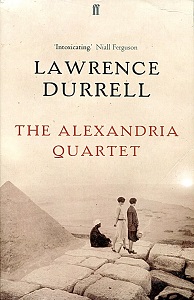
Mountolive, Lawrence Durrell

Back in the 1990s, I borrowed the omnibus edition of The Alexandria Quartet (1957-1960, UK) by Lawrence Durrell from the Daly Community Library, the subscription library I’d joined within six months of arriving in Abu Dhabi. I was aware of the quartet, although I forget where I first came across mention of it. However, for some reason I never got around to starting it, and took it back unread. A few months later, I was in Dubai and I came across the Penguin US boxed paperback editions of all four books in, I think, a book shop in the Dubai Mall. I bought it. I read the books. And was so impressed, I began hunting down everything by Durrell I could find. I now have an extensive collection of first editions and limited edition chapbooks by Durrell, including first editions of his first two novels, Pied Piper of Lovers (1935, UK) and Panic Spring (1937, UK; as by Charles Norden).

I’ve been meaning to reread the Alexandria Quartet for years, but never got around to it until recently. I read Justine (1957, UK) and Balthazar (1958, UK) last year, but was not reviewing the books I read at the time. I was, however, just as taken with the two books as I had been all those years ago – more so, perhaps. It had not struck me before how cleverly plotted the Alexandria Quartet is. Everyone remembers the lush prose, the setting, the cast of expatriates, and the various relationships, especially that of the opening novel between Darley and Justine… but there’s much more to the quartet than initially seems, and it’s in Mountolive (1958, UK) that it comes into focus.

The title character is a member of the Foreign Office, assigned to Egypt, where he makes friends with the Hosnani family. He has an affair with Leila Hosnani, the mother of Nessim and Narouz (Nessim is the husband of Justine). Mountolive is moved on to other postings, gradually rising up the ranks, until he finally returns to Egypt as ambassador, shortly before the events described in Justine and annotated in Balthazar. In the years since, Leila has survived a bout of smallpox and is now disfigured and a complete recluse. 

Meanwhile, Pursewarden has had a disagreement with Maskelyne, the head of intelligence at the embassy, particularly over the role of the Hosnanis in Egyptian, and Middle Eastern, politics. Maskelyne is sent to Palestine. Later, Pursewarden discovers Maskelyne was right, and commits suicide.

Mountolive is the pivot around which the story of the Alexandria Quartet revolves. It is the actions of the Hosnani family, and their secret project, and the clues regarding it uncovered by Darley, Clea and others, which explains the actions of the characters in the preceding two books. It all slots together like a piece of precision engineering. The lush writing is still there, and there are some eye-opening sequences in Mountolive. The commentary on Egyptian politics is all you would expect of a Brit who lived in the country during WWII. There is an invented figure who reads like a parody of the venal, corrupt Middle Eastern politician.

The last time I read the quartet, I seem to remember Mountolive being something of a disappointment after Justine and Balthazar. It’s written in the third-person, unlike the other two, and Mountolive is far more reserved than the rest of the cast. But this time I liked it more, more even than Justine and Balthazar, perhaps because its wider view made Egypt, and especially Alexandria, more of a character than in the earlier novels. They were filtered through Darley’s point-of-view, and here Durrell is writing about Egypt.

One more book to go, Clea (1960, UK), which is set six years after the events of the first three novels. I’m looking forward to rereading it.


Leave a comment

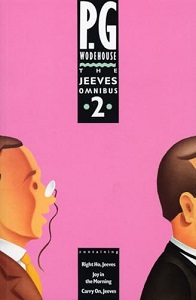
Carry On, Jeeves, PG Wodehouse

The collection Carry On, Jeeves (1925, UK) is the third book in the second volume of the Jeeves Omnibuses, and contains stories published between 1916 and 1925. Some of the plots were later used in novels. I say “plots”, but there’s pretty much just the one Wodehouse uses.

Interestingly, the opening story, ‘Jeeves Takes Charge’, describes Bertie hiring Jeeves. Around half of the stories take place in New York. They all follow the usual pattern: a friend approaches Bertie, or sometimes Jeeves directly, for help with a small problem, usually involving a fiancée or a relative, it all goes horribly wrong, but Jeeves has not only foreseen this, he has carefully engineered events to produce the desired ending. It’s all very clever, but it does wear a bit thin over the course of ten stories. There are some characters familiar from other stories, or novels, some here introduced for the first time.

The stories were mostly originally published in Strand in the UK and the Saturday Evening Post in the US. Some of the contents are rewritten versions of stories that appeared in an earlier collection, My Man Jeeves (1919, UK). So it’s not just plots Wodehouse re-uses, sometimes it’s the stories themselves. Still, they are amusing, and Wodehouse can throw a neat turn of phrase, even if it gets a little formulaic in places. The names here are not as absurd as in later stories, although I expect they would still seem absurd to any reader who is not, well, English. I should probably rephrase that: it’s not that the names do not seem absurd to English readers, they do; it’s just that they also seem entirely plausible for the upper classes.

Wodehouse’s depiction of the upper classes endures for the English. He’s not the only chronicler of the aristocracy’s inbred idiosyncrasies and depredations, and his stories only really hold true for a relatively short period in recent UK history; but then all the stories written about the English aristocracy only really hold true for the time during which the stories take place. In the twenty-first century, they’re an anachronism. Like, well, royalty.


1 Comment

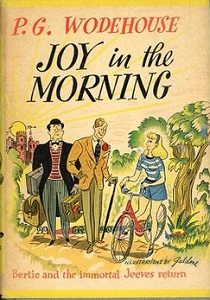
Joy in the Morning, PG Wodehouse

Wodehouse’s first novel was published in 1902, and I had always thought his Jeeves and Wooster stories and novels were published in the decade in which they were set, the 1920s. In fact, he continued writing Jeeves and Wooster novels right up until his death in 1975, although all were set during Edwardian times. As Wodehouse himself explains, Edwardian England was one of the few periods when a character like Bertie Wooster could exist, or indeed an entire community or subculture like him, second sons living on the largesse of their families. In later decades, they would have been forced to find work to fund their lifestyles, but in the 1920s their families were still unencumbered enough to fund them.

Joy in the Morning (1946, UK) was written two decades later, just after the Second World War, while Wodehouse was in Germany after being released from internment by the Nazis. He then moved to the US and never returned to the UK. Its story, however, follows pretty much the same plot as other Jeeves and Wooster novels. Jeeves, or occasionally Wooster, is asked to help a friend in a matter, romantic or business, and somewhere involved in this is either one or two romantic couples. Who promptly split up. And Wooster ends up, against his wishes, affianced to one of the women involved.

In Joy in the Morning, Wooster is asked to help his uncle arrange a secret meeting with an American shipping magnate called J Chichester Clam (the names in these books are excellent). Meanwhile, Wooster also has to help his friend Boko Fittleworth persuade the same uncle he is a fit husband, despite being a successful writer, for Nobby Hopwood, the ward of the uncle, and against whom the uncle is set after several botched meetings. Wooster further manages to break up the engagement of Florence Craye, the uncle’s daughter, and Stilton Cheeseworth, an old schoolfriend of Wooster’s, who is both large and somewhat dim, and has chosen to join the police rather than become a MP (although, to be fair, both qualities are useful in either career). Florence, who was once affianced to Wooster, promptly re-institutes their old engagement.

The usual hijinks ensue. There’s also a young boy, the uncle’s son, whose efforts to perform good deeds generally result in hurt and chaos – such as accidentally burning down the cottage where Wooster was intending to stay.

Given Wodehouse had by this point been writing these stories and novels for three decades, it comes as no surprise the plot ticks along like well-engineered clockwork, every remark and incident falling inexorably into place to keep plot momentum at a steady pace. Unlike other Jeeves and Wooster novels I’ve read, it’s the two of them who resolve the various situations, rather than Wooster worsening matters and Jeeves resolving it all. In fact, at several points Jeeves declares himself unable to think of a solution (although on one occasion this is a deliberate ploy). Good stuff.


Leave a comment

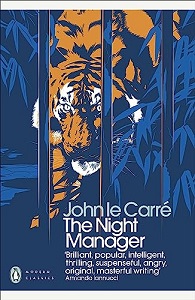
The Night Manager, John le Carré

I recently watched the second series of The Night Manager and was dissatisfied with it. It didn’t feel like something le Carré might have written, and I didn’t like the ending. So I decided to read The Night Manager (1993, UK), the actual novel by le Carré, on which the first series, broadcast in 2016, was based.

I was, it turned out, both right and wrong. For the right and wrong reasons.

The first series of the television adaptation follows the basic beats of the novel’s story. Ex-Army officer now hotelier Jonathan Pine is given reason to hate international arms dealer Richard Onslow Roper, and is recruited by a UK government agency to infiltrate Roper’s inner circle. For obvious budgetary reasons, the setting for the TV series was moved from the Caribbean and Central America to the Mediterranean. Likewise the change, but perhaps more due to the number of years since publication than budget, from South American cartel villains to Middle Eastern ones. Pine’s handler, Burr, was also gender-swapped from man to woman – which was a good call (especially as she was played by Olivia Coleman). Other changes were less understandable. Roper’s girlfriend Jed is, in the novel, a vacuous upper-class English deb, but in the TV series she was re-imagined as American, and with a secret kid. Some of the characters names were also changed.

Events from the plot of the novel are there in the TV series – the murder of Sophie in Cairo, the fake murder in Cornwall, the staged kidnapping of Roper’s young boy, the incident with lobster salad… Sections were also cut-out in order to streamline the story. Pine’s adventures in Canada. His time in Cornwall is also shortened, and its nature changed – in the book, he’s well-liked and the “murder” he commits comes as a shock; in the TV series, he’s a not very convincing villain from the day of his arrival.

And then there’s the ending. In the novel, Burr’s operation to bring down Roper is being derailed by corrupt officials in the UK and US intelligence communities. They out Pine to Roper, but Burr manages to stage a monumental bluff which saves both Pine and Jed. In the TV series, Roper is brought down by Burr and Pine. To be honest, I prefer the TV ending. It’s also telling that in the book Pine is tortured and beaten before being released, but in the TV series it’s Jed who is beaten.

But then I don’t think The Night Manager is an especially good le Carré novel. He was a bloody good writer and his chosen genre has likely obscured how important he was. He was always anti-establishment, much more so in later years, but the cast of The Night Manager are, well, establishment caricatures. They’re ineptly corrupt, they talk like Harry Enfield lampooning 1950s Whitehall mandarins, and le Carré layers on the contempt so heavily it’s hard to take them seriously. In real life, members of the British establishment are corrupt or paedophiles or both, and have always been seen as such by the working class. And they have always been untouchable.

Which is why Roper remains untouched at the end of the novel.

All of which, ironically, are reasons why I didn’t like the second series of The Night Manager and accused it of not feeling like le Carré… When it’s set in South America, much like part of the original novel, and Roper escapes unscathed as he did in the book. Which actually makes it closer to le Carré’s novel than the first series…

The ebook edition I read includes an essay by le Carré on the various adaptations of his novels. He thought his work better served by TV than film, and in general agreed with the changes made to The Night Manager. Having now read the novel, I suspect he would have been happy with series two, even though strictly speaking it’s not an adaptation.


2 Comments

Uncommon Danger, Eric Ambler

I first saw mention of Eric Ambler on Paul Kincaid’s blog. He praised him as a superior writer of thrillers. For some reason, I had the impression he was a 1960s and 1970s writer like, say, Hammond Innes. In fact, Ambler is from an earlier generation, published chiefly in the 1930s and 1940s. And the plots of his novels reflect that period. At least, Uncommon Danger (1937, UK), his second novel, certainly does so.

Kenton is a freelance journalist in Europe, based mainly in Germany. After losing money in a game of poker-dice, he catches the train to Vienna to borrow money from a friend. Enroute, he’s asked to carry suspicious documents across the Austrian border, which he does for money. But then the owner of the documents is murdered and Kenton is the chief suspect.

The documents are copies of a Soviet plan to invade Bessarabia (now part of Moldova) and take over its oil fields. (History fans will already know Stalin led the Soviet annexation of Azerbaijan, which was famous at the time for its oil fields.) The Soviet plan is actually speculative, rather than intended, but a UK oil company plans to use it to hoist a right-wing government into power in Romania, which will then give them majority rights to Romanian oil.

None of which helps Kenton, who is wanted for murder in Austria. He’s helped by Zamenhoff, a Soviet agent, and Zamenhoff’s sister, and the three team up to retrieve the stolen documents and scupper the oil company’s plan, as managed by “political saboteur” Colonel Robinson and his sadistic sidekick Captain Mailler.

The end result is a solid thriller, like early Graham Greene, and very much of its time. There are telephones, but they’re not ubiquitous (no mobiles, of course). Long distance travel is chiefly by train. Kenton eludes capture by the police simply by eluding individual police officers. There’s no way the plot could be transposed to the present day – Kenton wouldn’t last a minute.

Which is not a complaint. The book was published in 1937 and that’s what the 1930s were like. The politics may not have changed much, but technology and infrastructure certainly have. Ambler’s prose is good, with an interesting tendency to delve into detail. The story is surprisingly violent for its time – more so than Greene, from what I remember of his books. Perhaps the characters are a little broad brush-stroke, and the story a little predictable – although explaining the underlying plot in a prologue is unusual.

Nonetheless, a good read. And for what it is, a between-the-wars political thriller, a good example of its type. I’ve another Ambler on the TBR, which I’ll read – but I’m not sure I’d describe him as a must-read author.


Leave a comment

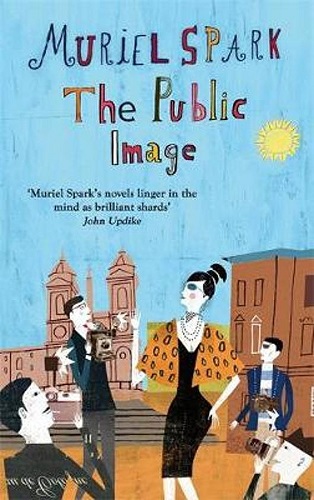
The Public Image, Muriel Spark

I read Spark’s The Girls of Slender Means (1953, UK) back in 2010, and judging by the review I wrote on my blog at the time, I didn’t like it very much. I can now add The Public Image (1968, UK) to the list of novels by Muriel Spark I don’t like very much.

It was nominated for the first ever Booker Award in 1969, which is why I read it. The story is relatively straightforward: Annabel Christopher stars in a film by an Italian director and becomes an international star – or perhaps European, given she never makes it to Hollywood. Annabel moves to Rome, with her semi-successful screenwriter husband. She has a baby. Shortly afterwards, her husband commits suicide and in his suicide notes (he wrote several) he accuses Annabel of promiscuity and throwing orgiastic parties. None of which is true. Annabel tries to control the narrative around her husband’s death before the Italian press destroys her career.

And, er, that’s it.

I have watched many 1960s Italian films, not just giallo or poliziotteschi, but also movies by Antonioni, Fellini, Pasolini, de Sica, Rossellini and so on. I’m a fan of the first three directors. So Spark’s depiction of Annabel’s career in Italian cinema never really convinced me. Neither did her husband’s suicide – there was nothing in the narrative to suggest he might take his life. There were clues he resented his wife’s success – but it’s a leap from there to suicide.

Then there’s the writing. Spark was nominated twice for the Booker Prize, and was much lauded critically – she was made an OBE in 1967 and a dame in 1993, for services to literature, and ranked number eight in the fifty greatest British writers since 1945 by the Times in 2008. But The Public Image reads more like reportage than fiction, and over-uses one of my pet hates in writing – the construction “was to be”. There are several auxiliary verbs which can be used in English, there are even grammatical moods available. So many different ways to add nuance and meaning instead of “was to be”. It’s no different to using “get” as a catch-all verb.

So, a lack of authenticity and too much passive voice using weak constructions, especially “was to be”. Not impressed. Annabel may have been reasonably well characterised, but the rest of the cast were ciphers. The Public Image is not a book I can recommend.


Leave a comment

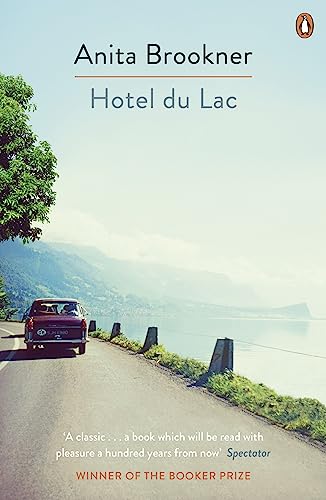
Hotel du Lac, Anita Brookner

Apparently a surprise winner of the Booker Prize back in 1984. Ballard’s Empire of the Sun (1984, UK) was the favourite, although Lodge’s Small World (1984, UK) or Barnes’s Flaubert’s Parrot (1984, UK), the only other books on the shortlist I’ve read, would have been a better winner than Hotel du Lac (1984, UK). It’s not that Brookner’s novel is bad – it’s nicely written, with some sharp insights. But. It’s set at the time of writing but reads like it takes place in the 1950s or 1960s. It’s horribly old-fashioned.

Edith Hope is a single woman in her late thirties, who writes “women’s fiction” under a pseudonym, reasonably successfully. She has a lover, a married man, and lives alone. She accepts an offer of marriage from a man, but jilts him at the altar (well, outside the registry office). Her friends, upset with her, arrange for her to spend a week or two at the titular hotel in Switzerland. It’s the end of the season, and there are only a handful of other guests: Mrs Pusey and her daughter, Jennifer; La Comtesse de Bonneuil, a caricature of a early twentieth-century European grandmother, and Monica, an anorexic (although this is never said) and beautiful minor aristocrat. A group of men stay at the hotel, among them Mr Neville, the well-off owner of an electronics company, in his fifties, smug and successful. He later proposes to Edith – marriage, but a partnership predicated on comfort and position, not love.

Throughout her stay, Edith writes long letters to her lover back in London, but does not send them. Various little scenes are enacted, Edith learns more about her fellow guests, their back-stories and their personalities. Mrs Pusey is quickly revealed as selfish and mistaken in her level of consequence. Her daughter, who is the same age as Edith, is little more than an accessory. Monica is a snob and dismissive, but surprisingly friendly. Madam de Bonneuil is deaf and a figure of (gentle) fun.

It’s all very smooth, and Edith is an engaging, if overly introspective, protagonist. But it’s all so horribly outdated. Neville takes Edith on a boat-trip across the lake, and wears a deerstalker hat. In 1984? Seriously? Edith wears gloves to her aborted wedding. Women rarely wore gloves to church – or registry offices – in the 1970s, never mind the 1980s. The women are dismissive of feminism, and define themselves in relation to the men in their lives, or who were once in their lives, or all men in general. This is not the early 1980s I remember.

If Hotel du Lac had been written and presented as historical fiction, it might have read better. Having said that, even then it wouldn’t have deserved to win the Booker.