
The collection Carry On, Jeeves (1925, UK) is the third book in the second volume of the Jeeves Omnibuses, and contains stories published between 1916 and 1925. Some of the plots were later used in novels. I say “plots”, but there’s pretty much just the one Wodehouse uses.
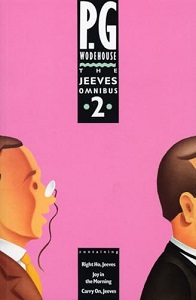
Interestingly, the opening story, ‘Jeeves Takes Charge’, describes Bertie hiring Jeeves. Around half of the stories take place in New York. They all follow the usual pattern: a friend approaches Bertie, or sometimes Jeeves directly, for help with a small problem, usually involving a fiancée or a relative, it all goes horribly wrong, but Jeeves has not only foreseen this, he has carefully engineered events to produce the desired ending. It’s all very clever, but it does wear a bit thin over the course of ten stories. There are some characters familiar from other stories, or novels, some here introduced for the first time.
The stories were mostly originally published in Strand in the UK and the Saturday Evening Post in the US. Some of the contents are rewritten versions of stories that appeared in an earlier collection, My Man Jeeves (1919, UK). So it’s not just plots Wodehouse re-uses, sometimes it’s the stories themselves. Still, they are amusing, and Wodehouse can throw a neat turn of phrase, even if it gets a little formulaic in places. The names here are not as absurd as in later stories, although I expect they would still seem absurd to any reader who is not, well, English. I should probably rephrase that: it’s not that the names do not seem absurd to English readers, they do; it’s just that they also seem entirely plausible for the upper classes.
Wodehouse’s depiction of the upper classes endures for the English. He’s not the only chronicler of the aristocracy’s inbred idiosyncrasies and depredations, and his stories only really hold true for a relatively short period in recent UK history; but then all the stories written about the English aristocracy only really hold true for the time during which the stories take place. In the twenty-first century, they’re an anachronism. Like, well, royalty.

