Been a while since the last one of these. I have been reading, of course, and I’ve even managed to get into the habit of polishing off a few pages when I get home from work. And now that Dayjob Horrible Project has moved into a slightly less frantic phase (but only slightly less), I can start getting some writing done… including those reviews I owe people… Meanwhile, here are some short paragraphs, that aren’t really reviews, about books I’ve read…
 If on a winter’s night a traveller*, Italo Calvino (1979). You are reading a book which opens with the line, “You are about to begin reading Italo Calvino’s new novel, If on a winter’s night a traveller,” and you think, sigh, metafiction. But this is Italo Calvino, and so you take the advice Calvino offers: “Relax. Concentrate. Dispel every other thought”– Hang on, every other? How will you know which ones to dispel and which ones to keep? And yet, it is perhaps sound advice as you read about a reader who reads a book only for his reading to be cut short, and when he goes looking for a complete copy of the novel he was reading he discovers he had been reading an entirely different book altogether… And at the book shop he meets a young woman who is also interested in this literary mystery he has uncovered, and together they discover yet a third novel mixed in with the previous two. But then he meets the young woman’s sister and becomes involved in her schemes… and at some point both young women end up in one of the narratives you are reading about him reading… And yet despite this literary shell game, where the narrative peas seem to proliferate out of sight under the cups, the whole is intensely readable and not in the slightest bit confusing. In parts it reminded me of Nabokov’s Pale Fire, although without the prissiness. It certainly convinced me I should read more Calvino – If on a winter’s night a traveller may be one long literary trick, but it’s gloriously done. Bravo.
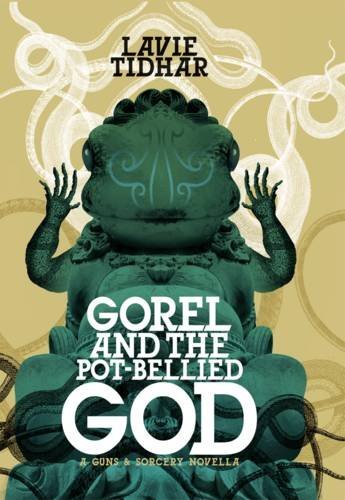
 Gorel and the Pot-Bellied God, Lavie Tidhar (2011). And from the sublime to, er, Tidhar. This is the first of his “gunpowder fantasies”, which I take to mean generic heroic fantasies but with firearms. (Obviously the guns and bullets and gunpowder are all made by magic, as fantasy worlds rarely have an industrial base.) Gorel travels to Falang-Et, the home of a frog-like race, in order to steal their most sacred magical object (not that he knows exactly what it is). En route, he meets up with a bird-like man and a fish-like woman, and the three join together for the theft. Which doesn’t go quite as planned. Of course. That’s the nature of these sort of story. The setting hovers on the edge of strangeness and familiarity. I’m not that widely read in this type of fantasy, or New Weird, but I think there’s a bit of Lovecraft in there somewhere; and probably some Clark Ashton Smith and William Hope Hodgson, for all I know. Whatever it is, the combination is pretty effective. The book’s novella-length works in its favour too, although the prose is occasionally a little too light on detail. It’s still not my thing, but I did enjoy it.
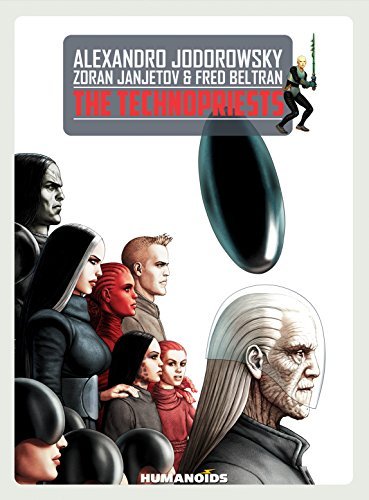
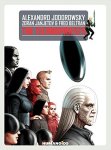 The Technopriests Supreme Collection, Alexandro Jodorowsky, Zoran Janjetov & Fred Beltran (2013). Originally published between 1998 and 2006, the eight-book bande dessinée series collected in this omnibus follow the fortunes of Supreme Technopriest Albino, and his two siblings, as he rises through the technopriest hierarchy while the other two track down the three pirates who raped their mother and so fathered them. The story is framed as Albino’s reminiscences during a journey to lead 50,000 technopriests to a new home in a distant galaxy. When the three were born, the mother rejected Albino and his four-armed red-skinned sister Onyx, and lavished all her affection on grey-skinned Almagro. She started up a business making “kamenvert” cheese, which became a galactic monopoly. But Albino wanted to be a videogame creator for the technopriests, only he proved to have much greater talent in that area than anyone had expected… This is not Moebius – the art is gorgeous, but all the characters are somewhat pumped up, so to speak. Happily, Jodorowsky’s off-kilter inventiveness is abundant. Although it takes a few twists and turns, it’s a more straightforward morality tale than The Incal or The Metabarons, and in parts it does feel a little like it’s retreading ground already covered in those earlier series. But if you like Jodorowsky’s bandes dessinées, you’ll like this one.
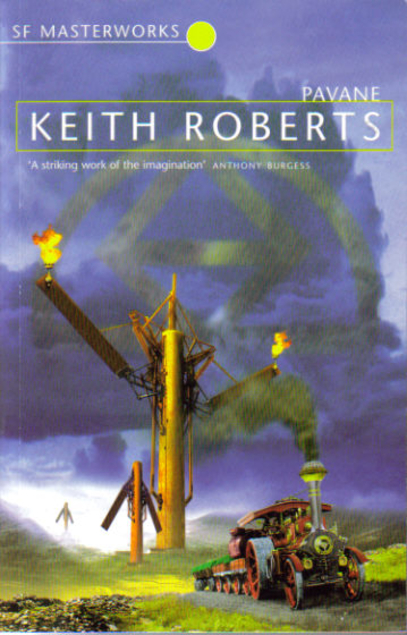
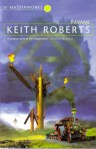 Pavane, Keith Roberts (1968). I’ve had this book for years – I collected the original SF Masterworks series as they were published – and was fairly sure I’d read it many years before. But having now read it (again?) I’m not so sure. I think I may have read a part of it as a short story – it’s a fix-up, after all. The central conceit has made it a touchstone work for an entire genre – alternate history or counterfactual stories. In Pavane, Queen Elizabeth I was assassinated and the Duke of Medina Sidonia successfully invaded England. The book is set at the time of writing in a Catholic Britain which is technologically far behind the real 1968 – obviously because of the Roman Catholic Church. It’s handled well – society seems to be stuck in the late 1600s, and some areas of science and technology not much past then. The first chapter, for example, is about a steam-powered road train. There is also a chain of great semaphore stations stretching the length and breadth of the country, as electricity has not been discovered nor radio invented. I’ve certainly heard it said that the Catholic Church set back science in Europe by about a thousand years, but I’ve never seen it argued with any degree of intellectual rigour. True, Hero of Alexandria had his aeolipile in the first century CE, and all the work done by Islamic medics, mathematicians and astronomers was completely ignored by the Church… But Roberts’s premise needs to be taken with a pinch of salt, since quite a few places – like the Holy Roman Empire – remained under Roman Catholic influence for a long period and progressed pretty much at the same pace as everywhere else. Still, Roberts was one of British sf’s better writers, and if Pavane isn’t his best book, it’s still a good one. ‘The White Boat’ is worth the price of entry alone. Worth reading.
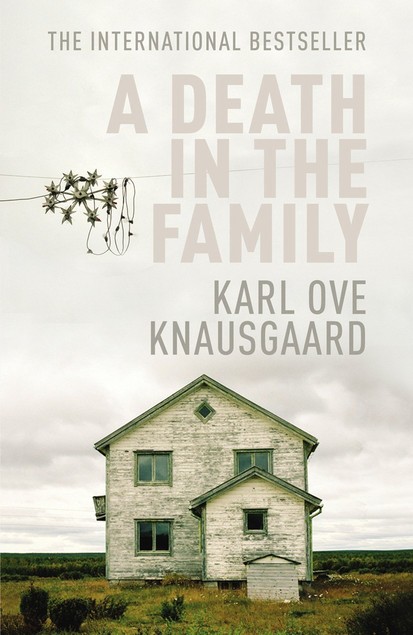
 My Struggle 1: A Death in the Family, Karl Ove Knausgård (2009). Yes, I know the cover the book spells it Knausgaard, but the proper Norwegian is Knausgård; and no, I don’t know why the publisher felt a need to “Anglicise” it, as it’s not exactly hard to write. But anyway. This is the first book in a six-volume autobiography – as I write this five volumes are currently available in English – although for some reason the series has been published as fiction. Knausgård, it seems, prefers the term “novel” because he wrote the books as if they were fiction, although they were based closely on his own life. Certainly it’s true the level of detail for something set thirty years ago suggests fiction more than reminiscence. A Death in the Family covers Knausgård’s teen years in Tromøya in southern Norway, his friends, the girls he fancies, his introduction to alcohol, and his difficult relationship with his parents. In the second half of the novel, Knausgård tries to come to terms with the death of his father, and the state his grandparents have fallen into since their son’s death. I’ll admit I found the level of detail fascinating, even though the story itself is mostly banal. And the weird distancing effect between adult Knausgård presenting his memories and the lack of self-awareness by the teen narrator made for an interesting juxtaposition. I think I’ll give the second one, A Man in Love, a go…
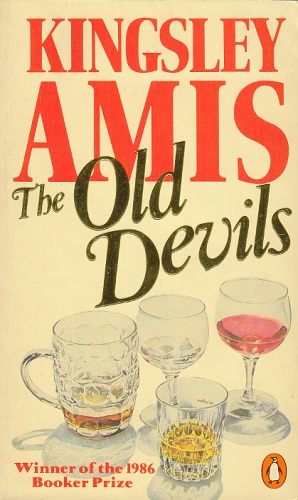
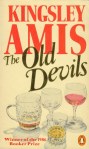 The Old Devils*, Kingsley Amis (1986). “Professional Welshman” Alun Weaver returns to his South Wales hometown after a career in London as a writer and poet and TV pundit. His old friends are in two minds about his re-appearance. And that of his wife, Rhiannon. Yet they welcome the pair pretty much with open arms, and some private bickering. And a lot of drinking. One of the good things about The Old Devils is that, on the one hand, the various characters are conflicted about the Weavers’ return; on the other, things quickly settle into what is clearly a well-established routine. A number of past events resurface and cause a few problems, but they seem to be resolved with a surprising lack of drama – in fact, the most dramatic scene is prompted by the pettiest of disagreements. There’s often some nastiness on display – and of all the characters, it’s the wives who are treated worst. One might almost suspect Amis was a misogynist – one wife is cruelly mocked by her friends, another has her character assassinated, and a third heartlessly abandons her husband. The men are old codgers and drunkards, and amusing at times, but The Old Devils‘ one-sidedness does get wearying as the novel progresses. I’ve no idea why The Old Devils is on the 1001 Books You Must Read Before You Die list.
1001 Books You Must Read Before You Die count: 126