
Back in the 1990s, I borrowed the omnibus edition of The Alexandria Quartet (1957-1960, UK) by Lawrence Durrell from the Daly Community Library, the subscription library I’d joined within six months of arriving in Abu Dhabi. I was aware of the quartet, although I forget where I first came across mention of it. However, for some reason I never got around to starting it, and took it back unread. A few months later, I was in Dubai and I came across the Penguin US boxed paperback editions of all four books in, I think, a book shop in the Dubai Mall. I bought it. I read the books. And was so impressed, I began hunting down everything by Durrell I could find. I now have an extensive collection of first editions and limited edition chapbooks by Durrell, including first editions of his first two novels, Pied Piper of Lovers (1935, UK) and Panic Spring (1937, UK; as by Charles Norden).
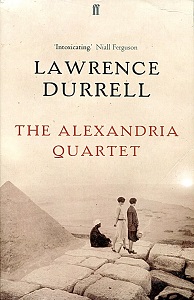
I’ve been meaning to reread the Alexandria Quartet for years, but never got around to it until recently. I read Justine (1957, UK) and Balthazar (1958, UK) last year, but was not reviewing the books I read at the time. I was, however, just as taken with the two books as I had been all those years ago – more so, perhaps. It had not struck me before how cleverly plotted the Alexandria Quartet is. Everyone remembers the lush prose, the setting, the cast of expatriates, and the various relationships, especially that of the opening novel between Darley and Justine… but there’s much more to the quartet than initially seems, and it’s in Mountolive (1958, UK) that it comes into focus.
The title character is a member of the Foreign Office, assigned to Egypt, where he makes friends with the Hosnani family. He has an affair with Leila Hosnani, the mother of Nessim and Narouz (Nessim is the husband of Justine). Mountolive is moved on to other postings, gradually rising up the ranks, until he finally returns to Egypt as ambassador, shortly before the events described in Justine and annotated in Balthazar. In the years since, Leila has survived a bout of smallpox and is now disfigured and a complete recluse.
Meanwhile, Pursewarden has had a disagreement with Maskelyne, the head of intelligence at the embassy, particularly over the role of the Hosnanis in Egyptian, and Middle Eastern, politics. Maskelyne is sent to Palestine. Later, Pursewarden discovers Maskelyne was right, and commits suicide.
Mountolive is the pivot around which the story of the Alexandria Quartet revolves. It is the actions of the Hosnani family, and their secret project, and the clues regarding it uncovered by Darley, Clea and others, which explains the actions of the characters in the preceding two books. It all slots together like a piece of precision engineering. The lush writing is still there, and there are some eye-opening sequences in Mountolive. The commentary on Egyptian politics is all you would expect of a Brit who lived in the country during WWII. There is an invented figure who reads like a parody of the venal, corrupt Middle Eastern politician.
The last time I read the quartet, I seem to remember Mountolive being something of a disappointment after Justine and Balthazar. It’s written in the third-person, unlike the other two, and Mountolive is far more reserved than the rest of the cast. But this time I liked it more, more even than Justine and Balthazar, perhaps because its wider view made Egypt, and especially Alexandria, more of a character than in the earlier novels. They were filtered through Darley’s point-of-view, and here Durrell is writing about Egypt.
One more book to go, Clea (1960, UK), which is set six years after the events of the first three novels. I’m looking forward to rereading it.
 It Doesn't Have To Be Right...