It Doesn't Have To Be Right…

… it just has to sound plausible


7 Comments

Memories of Maggie

Apparently I should not be disrespectful of Margaret Thatcher now that she has died, so I thought might instead share a few of my personal memories of her years in power and her immediate legacy:

  • the removal of the educational grants system and its replacement by student loans
  • three million unemployed, and the tories ever-changing definition of the word “unemployed”
  • the miners’ strike and communities split apart on NUM / UDM lines
  • the destruction of the British coal industry
  • the destruction of the British steel industry
  • the destruction of the British automotive industry
  • North Sea oil revenues squandered to prop up the balance of payments
  • Black Monday 1987
  • Poll Tax riots
  • my home town Mansfield becoming a ghost town after pit closures
  • Coventry becoming a ghost town after car factory closures
  • a Spitting Image sketch in which Thatcher berates Lawson, “I said phase out the Pound note, not the Pound Sterling!”
  • spending nine months on the dole after I graduated – they say 30% of graduates landed jobs within 6 months of graduation that year
  • living in a bedsit on £44.75 dole and £36 housing benefit a week, despite having just earned a BA (Hons)
  • having to leave the UK to get a job

Other people no doubt have other memories of her years in power. Mine are enough for me to see no good reason to respect her, alive or dead. I expect to be thoroughly sickened over the next few days by all the hagiographic crap that will be spouted via every media. Death does not make saints of sinners. When you see people praising Thatcher, take note of who they are – they’re the ones who benefited from her economic policies, and are still doing so. The rest of us, we just had to live with the damage she inflicted.


5 Comments

When I’m sixty-four

The Easter weekend in the UK traditionally sees around a thousand fans of science fiction, fantasy, horror and steampunk descend on a hotel somewhere in the country to discuss genre in all its forms, drink beer and generally socialise. They’ve been doing this since 1948 – but not the same group of people, obviously. This year, the Eastercon returned to the Cedar Court Hotel in Bradford, the site of 2009’s Eastercon LX. I remember Eastercon LX as a relaxed convention, and this year’s EightSquaredCon proved to be much the same. I had an excellent weekend, saw many old friends, met new ones, pretended to be erudite on a few programme items, bought a number of books, drank some beer, didn’t eat as much as I should have done, and, oh yes, I won a BSFA Award…

I’d planned to leave for Bradford around two pm on the Friday, but by lunchtime I was itching to go so I caught a train an hour earlier… which got me into Bradford around four pm. I had with me a suitcase full of copies of Adrift on the Sea of Rains and The Eye With Which The Universe Beholds Itself, which fortunately had wheels, so I dragged it across City Square to the hotel in which I was staying, Jurys Inn. It proved to be one of those modern minimalist places – restaurant/bar and reception on the ground floor, seven floors of rooms, all very comfortable. After checking in, I texted Mike Cobley, who I knew was staying in the same hotel and due to arrive around the same time as me. We agreed to meet in the lobby, which we did, and where we sat around for about thirty minutes catching up on each others’ news while we waited for the bus to the Cedar Court Hotel.

Because the con hotel is outside the city centre, but doesn’t have enough rooms for all the attendees, most of us were staying in either the Jurys Inn or Midland Hotel in the centre of town, or the Campanile a five-minute bus-ride from the Cedar Court Hotel. The con had organised two sets of buses running between the town-centre hotels and the Campanile every 15 to 20 minutes.

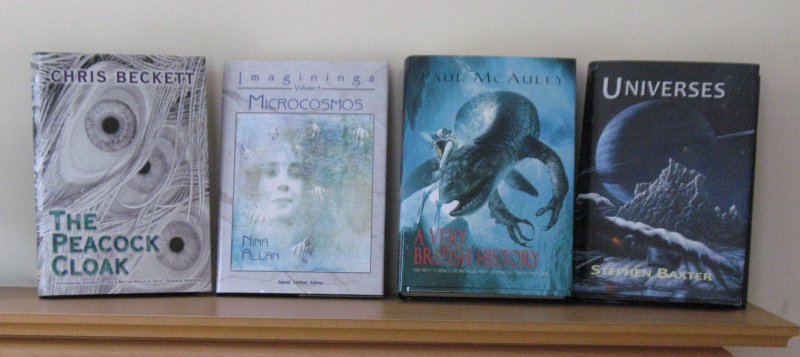
We arrived in time for the small press launch in the hotel’s Conservatory. Both PS Publishing and NewCon Press had new titles, and some of them I wanted. The hour that followed was my most expensive of the weekend – I bought four titles at £20 each. I also got them signed, though the NewCon Press ones were signed editions.

20130401a

The books are all collections – The Peacock Cloak, Chris Beckett, and Microcosmos, Nina Allan, from NewCon Press; and A Very British History, Paul McAuley, and Universes, Stephen Baxter, from PS Publishing.

After the launches, it was down to the bar… which is where I spent most of the con, a not unusual state of affairs for me.

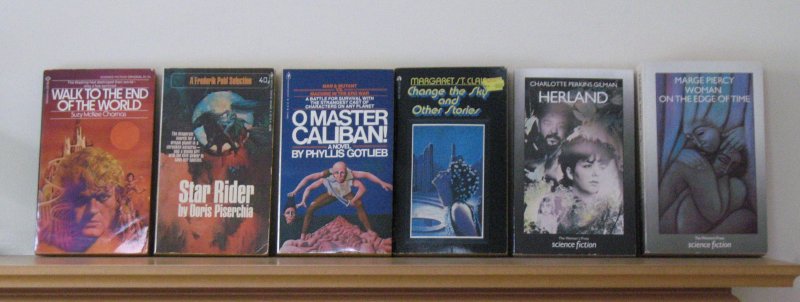
The following morning, I met up with Mike Cobley for breakfast, after which we went for a wander in a deserted Bradford city centre. We caught the bus to the Cedar Court Hotel, and I paid my first visit to the dealers’ room. I had a bunch of copies of Adrift on the Sea of Rains and The Eye With Which The Universe Beholds Itself to drop off at the Interzone table (thanks, Roy), but I also had a bimble about the room.. Aside from the Friday night launch titles, I only bought secondhand books all weekend, and they were all by women writers.

20130401d

A selection of sf by women writers – two from The Women’s Press: Herland (donated by Kev McVeigh, thanks) and Woman on the Edge of Time. Both Walk to the End of the World and Star Rider are in The Women’s Press sf series, but these editions will do for now. O Master Caliban! has the horriblest cover art I’ve seen for a long time. Change The Sky And Other Stories is a, er, collection.

20130401b

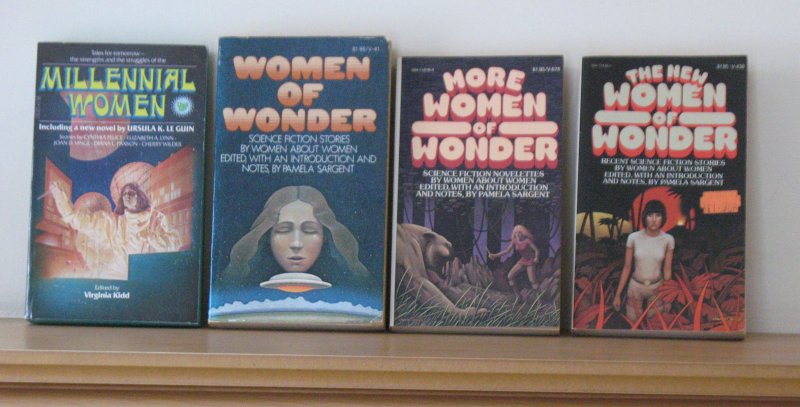
I’d have missed these if Mark Plummer hadn’t pointed them out to me, as they were squirrelled away in a box – the three female-only anthologies edited by Pamela Sargent from the 1970s, Women of Wonder, More Women Of Wonder and The New Women of Wonder. And Millennial Women, which was a new one to me.

20130401c

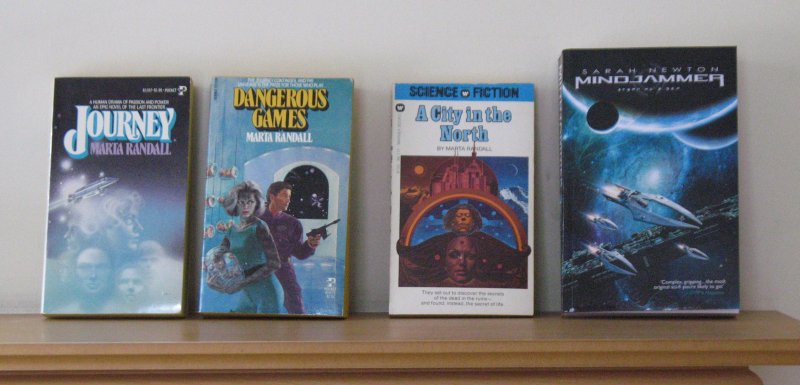
Three by Marta Randall, including the first two books of a trilogy – Journey and Dangerous Games – and her second novel, A City in the North. Plus Sarah Newton’s Mindjammer, which was self-published and is set in the RPG universe of the same name designed by Sarah.

That afternoon, Mike and I were moderating a programme item on designing a constitution for a Mars Colony. I’d agreed to co-chair in a fit of stupidity, as I had absolutely no idea what to say. I’d provide some technical background, but that was as much thought as I’d put into it. The item started, Mike went into his introduction, I spoke a little about the technical challenges, and then Mike started talking about politics… and I could see we were starting to lose the audience. So I mentioned something Mike and I had actually thought of as we were climbing the stairs to the room where the item was taking place. And that triggered off a discussion which lasted for over an hour. I don’t think we reached any specific conclusions, but people seemed to have had an interesting time.

That evening, my agent John Jarrold threw his now-traditional party for clients and publishers. That was fun. I had intended to avoid the wine and just stick to beer, but I ended up having a couple of glasses without any ill effect. I ate in the hotel that night. As they had done in 2009, the con hotel laid on a canteen-style eaterie all weekend. The food was basic and a bit bland, but it was also cheap and filling. I never actually managed to get out of the hotel to eat, which was a pity.

Sunday I was on two programme items, and the first one was at ten am. The subject was “Older women in genre fiction”, moderated by Caroline Mullan, and including GoH Freda Warrington, as well as Rochita Loenen-Ruiz, David Tallerman and myself. I thought the panel went reasonably well, though none of us could think of many genre novels with an older woman as the protagonist – but Freda did mention her Midsummer Night, which qualified.

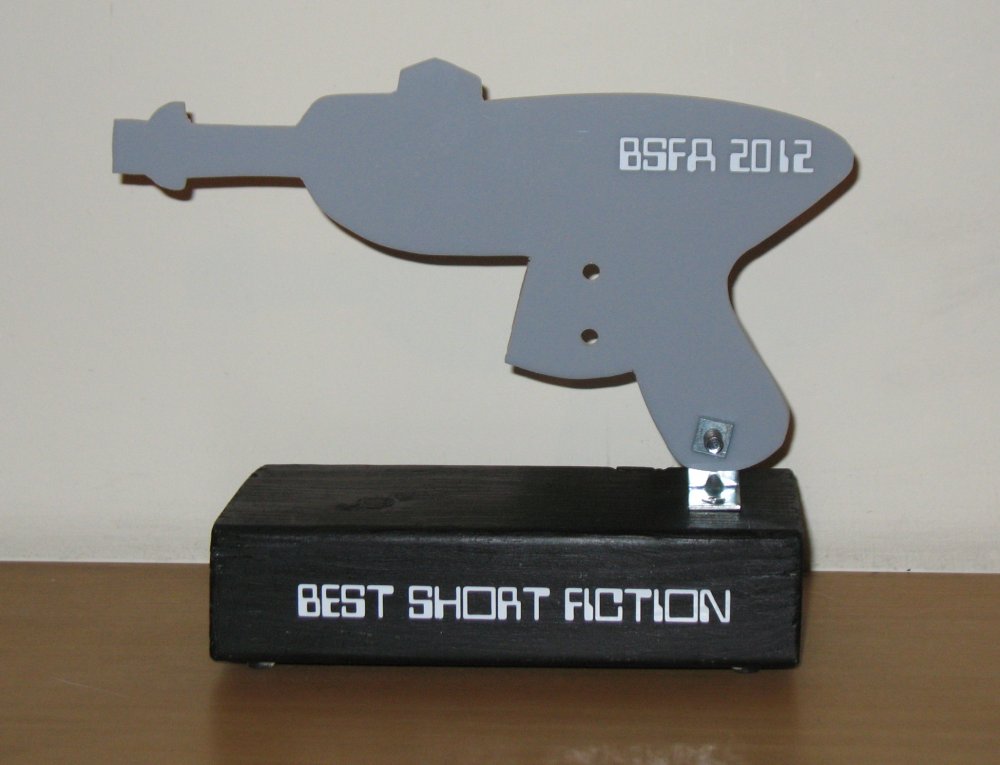
Before my second programme item of the day was the BSFA Awards ceremony. I sat on the front row, alongside fellow short fiction shortlistees Aliette de Bodard and Rochita. Paul Cornell emceed the ceremony entertainingly, but I don’t think he expected to get quite as much laughter as he did when he explained that, “BSFA… that’s what you get when you put BS together with FA”. GoH Anne Sudworth then presented the best artwork prize, which went to the cover for Jack Glass, and Freda presented best non-fiction, which was won by the World SF Blog. And then GoH Edward James took the stage to announce the winner of the short fiction category… I was so sure one of the others would win that it took a second or two to realise it was my name Edward had read out. And I hadn’t bothered to make any notes on what to say should I win. I did have a speech in my pocket, but it was by Karen Burnham, to be used in the event she won the non-fiction category. The best novel BSFA Award then went to Adam Roberts’ Jack Glass. Stephen Baxter was presenting this; he had also been asked by Adam to accept it on his behalf. Which led to a slightly surreal sketch in which Steve both presented and accepted the award.

bsfa2012

I then had to dash straight upstairs for a panel on Joanna Russ vs Anne McCaffery. Again, Caroline Mullan moderated, and the panel comprised Tanya Brown, Bob Neilsen and myself. When it came to doing our introductions, I said that for a week or two I’d be introducing myself as “the award-winning Ian Sales”… I have read a handful of books by both Russ and McCaffery, and I’d have preferred to have been better read in both… but given the way the discussion went it didn’t prove any handicap. There was plainly a lot of love for McCaffery in the room, and I was frequently Russ’s lone defender. I think the eventual conclusion was that Russ’s more cerebral work might have longer staying power than McCaffery’s more emotional oeuvre.

Then it was down to the bar, where I didn’t have to buy a drink all night. I caught the last bus back to my hotel at one am. It had been a good day…

… And I felt fine when I woke the next morning. Admittedly, the thermostat in my room had been misbehaving all weekend, and randomly resetting the temperature to 30 C. Which had led to some bizarrely hot nights. But I was the first in the hotel to make it down to breakfast, then I went for a walk, and then I caught the first bus to the Cedar Court Hotel… Colin Tate of Clarion Publishing had mentioned the day before there was a small press showcase in the Conservatory from 10 am to noon, and he was leaving early and so wouldn’t be able to use the table he’d booked. I was welcome to it. So I used it. I set out copies of my books alongside Sarah Newton and her sf novel Mindjammer. Also present were the Albedo One group, and Tony and Barbara Ballantyne and their new serial genre magazine Aethernet. It was freezing cold in the Conservatory, but I stuck it out and managed to sell some books.

By this point, the con was already winding down. I got a bite to eat and then just hung around in the foyer with friends until it was time to make a move.

I liked Bradford as a venue the last time the Eastercon was there, despite the split hotel thing; and I enjoyed this convention very much too. It was relaxed – somewhat colder than is usual, true; but very friendly and sociable. I saw many old friends and got to meet in person some people I knew only online. I’d need to take notes to recall all the conversations I had, the topics ranged from death metal to reviews of our own books to Chris Beckett’s fashion sense (sorry, Chris), and all points in between. Some names I remember speaking with at some length, in no particular order: John Jarrold, Neil Williamson, Gary Gibson, Mike Cobley, David Hebblethwaite, Leisel Schwartz, Cory Doctorow, Adrian Tchaikovsky, Cara Murphy, Kev McVeigh, Will and Jenny, the Ballantynes, Gillian Redfearn, Darren Nash, Roy Gray, Helen Jackson, Nina Allan, Donna Scott, Neil Bond, Alex Bardy, Johan Anglemark, Eric Brown, Paul Graham Raven, Paul Cockburn, David Tallerman, Jobeda Ali, Sarah Newton, Chris Beckett, Aliette de Bodard, Rochita Loenen-Ruiz, Simon Ings, Paul McAuley, Phil Palmer, Simon Morden, Ian Watson, Andy Stubbings, Chris Amies, Jim Burns, Colin Tate, Brian Turner, Steve Baxter… and no doubt I’ve forgotten some people. Sorry.

For all that, I think I came away from EightSquaredCon with a desire to do more at conventions. Sitting around in the bar all day is not as much fun as it once was. I could attend programme items, of course; and this time I sat through one panel I wasn’t on, which is almost a record for me. While cons are social events, and an excellent opportunity to hang out with friends you don’t otherwise see, we interact daily online anyway so no real catching up needs to be done. The internet has changed the nature of friendship in that respect. I spend every day with my friends on Twitter, Facebook, blogs, etc, etc, and while they’re no real substitute for meeting IRL, they do make something less special of the infrequent times you do meet in person. And that was what cons used to be for. (Perhaps if I lived in London, and regularly attended events there, the same effect would apply – and would have applied prior to the World Wide Web.)

Anyway, EightSquareCon. A good con. Now I have to wait twelve months for the next one. Which will be in Glasgow, a city I’ve always liked. Roll on Satellite 4…
7 Comments

To M or not to M

As no doubt most of you who read this blog are aware, Iain Banks today announced he has been diagnosed with terminal cancer and is unlikely to see the year out. It’s not unfair to say this comes as a blow to both British literary fiction and British science fiction.

I met Iain Banks several times. The first was in late 1989 at a small convention in Glasgow. I know I’d read The Wasp Factory by then, but I’m not sure if I’d read any of his science fiction. It was during the con that the infamous “massage lotion incident” took place. I witnessed it. During a room party, Banks pretended to sip from a small bottle of Body Shop massage lotion – provided, I think, by Kev McVeigh – but within a few weeks rumours were flying around that he’d actually drunk the entire contents. But mad stories like that seemed to accrete around Banks. Even before I’d met him, I’d heard of his alleged cat burgling at a con in Brighton. If his space operas were larger than the genre seemed capable of containing, then so the stories about him seemed to describe a person so much larger than he really was.

wassp1

The following year, at the Eastercon in Liverpool, Chris Reed of Back Brain Recluse had arranged to interview Banks for his magazine, but needed somewhere quiet to do so. I volunteered my hotel room. Around a dozen of us sat in on the interview. I remember Banks’ discussing his story ‘Piece’, which had just been published in The Observer Magazine. I also remember him talking about the structural engineering of corsets and bras and their similarity in that respect to bridges.

By that point, I was certainly reading his books – in fact, I bought Use Of Weapons and got it signed at that Liverpool Eastercon. I can still remember how shocked and impressed I was by the end of the book. In terms of the games writers can play with the chronologies of narratives, it has long been a touchstone work for me.

600full-use-of-weapons-cover

A year or two later at another convention, I remember a somewhat tipsy conversation with Banks on first lines. The opening line of his The Crow Road is famously, “It was the day my grandmother exploded.” John Varley’s Steel Beach, however, almost rivals it with, “‘In five years, the penis will be obsolete,’ said the salesman.” We conflated the two lines and came up with, “In five years, my grandmother’s penis will explode.”

Iain Banks was a fixture on the UK sf scene just as much as his books are a fixture on my book-shelves. After Use Of Weapons, I bought each book in hardback. And since starting up this blog, I have reviewed each new sf novel as it was published – which is not something I do routinely for other sf writers. If I often felt slightly disappointed by those novels, it was only because I expected them to be brilliant – is it my fault he’d himself set so high a standard?

I was hoping I’d be reading Banks’ fiction into my dotage. Sadly, I’ll only be able to reread it. A sad day.


9 Comments

A portrait of the author as a young man

For those who don’t believe in fate or whatever, here’s proof that from an early age I was destined to write hard science fiction about astronauts:

spacesuit

Taken in the early 1970s in Doha, Qatar. I will have been about four or five. The “spacesuit” was a Christmas present, I seem to remember. I suspect I would not have lasted long if I’d actually worn it in space.


1 Comment

The future we used to have, part 14

This time last year it was warm and sunny. This year, it is not. It’s the end of March, it’s freezing cold and there’s snow on the ground. It’s supposed to be spring, dammit. Let’s have some appropriate weather, please. Meanwhile, here’s some pictures to look at:

air

14_nx2_nuclear_plane

Proposed design for a nuclear plane – the detachable pod is the reactor

14_Jello-Kitty--f--0daed1_o

Nuclear bomb delivery mechanisms – an illustration from Life Magazine

14_x15delta

A proposed delta-winged version of the North American X-15

14_t4_2

The Sukhoi T-4 supersonic bomber – it never entered service

space

14_planeta bur 14

Spacesuits from Soviet sf classic, Планета Бур (Planeta Bur, 1962)

14_phantom_planet_u_02

Spacesuits from The Phantom Planet (1961)

14_moon_zero_two

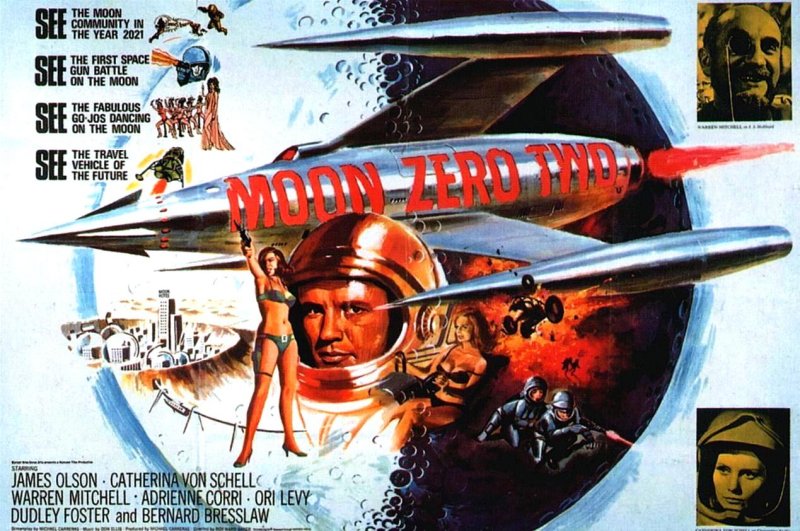
Brightly-coloured spacesuits from Moon Zero Two (1969)

14_machte_navstrechu

Spacesuits from Мечте навстречу (Mechte Navstrechu, 1963)

14_gordo_cooper

Gordon Cooper

14_Gagarin

Yuri Gagarin

land
(places I’ve known)

14_NCCW002672

Idlewells Precinct, Sutton in Ashfield (the pyramid in the background gives access to the underground car park)

14_kelvin_flats

Kelvin Flats, Sheffield (I worked on their refurbishment for the 1991 World Student Games; they were knocked down in 1993)

14_hyde_park

Park Hill Flats, Sheffield (they are currently being refurbished)

14_cov_uni

Coventry University (my alma mater)

14_Cov_Cathedral_Sep 1962

Coventry Cathedral in 1962

14_castle_market_4

Castle Market, Sheffield

14_castle_market_3

Castle Market, Sheffield (it’s now run-down and in sore need of refurbishment)


1 Comment

Films you must see: About Elly

about-elly-dvdLast year, two Iranian films made my top five best of the year, The Circle and No One Knows about Persian Cats, and a further two I gave honourable mentions, A Separation and The Wind Will Carry Us. About Elly (2009) is an earlier film by the director of A Separation, Asghar Farhadi. Three young middle-class couples from Tehran, with children, are spending the weekend on the shores of the Caspian Sea. Also along is Ahmad, visiting from Germany where he now lives, and recently divorced from his German wife; and Elly, the teacher of Sepideh’s young daughter, who Sepideh is hoping will make a good wife for Ahmad. Right from the start, it’s plain Sepideh is desperate for the weekend to work. When it turns out the villa they had originally booked is only available for one night – and Sepideh knew this – the group end up taking a near-derelict one on the beach. They clean it up and settle in, and so the weekend starts.

Elly, however, appears to be uncomfortable with being treated as a prospective wife for Ahmad. Though the two seem to like each other, Elly is stand-offish. When she tries to leave after the first night, Sepideh persuades her to stay, and even goes so far as to hide her bag.

The following day, the kids are playing on the beach. Nazy is making sure Arshad, the young son of Peyman and Shohreh, remains safe in the water. She goes inside to do some cleaning, and asks Elly to keep an eye out instead. But Sepideh’s daughter is having trouble with her kite, so Elly goes to help her…

Minutes later, Sepideh’s daughter runs up to the men, who are playing volleyball behind the house, screaming that Arshad is in the water. The men rush to rescue him. After some frantic searching they find the boy, floating face-down, but they manage to revive him. Then they notice that Elly is missing. Did she drown while trying to save Arshad? They hunt for her but find nothing. They call the police, but they too cannot find her. Or perhaps she left without saying anything? Was she the sort of woman who would do that?

It soon transpires that no one knows much about Elly, not even Sepideh. They contact her mother, but she didn’t even know Elly had gone to the seaside. From Elly’s mobile, they ring the number she last dialled, and get through to her brother. They tell him she has had an accident and is in hospital, and he immediately leaves Tehran for their villa.

But he’s not Elly’s brother, he’s her fiancé. As Sepideh reluctantly admits when she learns he is coming. For an affianced woman to go away to meet another prospective husband is not good. Elly’s honour is now at stake. If she did it without the knowledge of the party… While Sepideh’s husband, Amir, admits that he and his wife see nothing wrong with this behaviour, others in the party are less tolerant.

About Elly is not just a slow-burning thriller, it’s also a very clever character study of its cast. It begins innocently enough – a group of friends going away for the weekend, laughing and joking among themselves – then settles down to a friendly domestic drama… before taking an abrupt and horrifying turn. When Elly vanished, I will confess I was waiting for the other shoe to drop, for some additional twist to compound the tragedy. But About Elly is an Iranian film, and the turn it takes after Elly’s disappearance is entirely Iranian. It’s not about twisty turny plots, and how many times the director can wrongfoot the viewer, it’s about character and people and Iran. As a result, the ending is even more affecting.

The cast are uniformly excellent, with Golshifteh Farahani as Sepideh especially good. The direction throughout is also excellent, with Farhadi managing to evoke the mood of each section of the story without using any incidental music whatsoever.

On balance, I think About Elly is a better film than A Separation, even though the latter did win an Oscar; but Farhadi is certainly a director worth watching. I think I shall be tracking down some of his other films…


1 Comment

The future we used to have, part 13

I’ve not done one of these for a while, and since it looks miserable and grim outside – and I don’t just mean the weather – it must be about time I did another one. So here’s some retro-futurism:

buildings
(the following were taken from the excellent tumblr site Fuck Yeah Brutalism)

13_building_architect_house

House of the architect, Casablanca, Morocco, 1960s

13_building_hotel_ashkhabad

Hotel Ashkhabad, Ashgabat, Turkmenistan, 1969

13_building_mailman_center

Mailman Center for Child Development, University of Miami, Florida, 1972

13_building_pavilion_casablanca

Pavilion of the City of Casablanca, International Fair of Casablanca, Morocco, 1960

13_building_tech_college_busto_arsizio

Technical College, Busto Arsizio, Italy, 1963-64

air

13_air_tupolev_tu-114

Tupolev Tu-114 Rossiya (‘Cleat’)

13_air_first_class_lounge

1970s proposed first class lounge aboard an airliner

13_air_Seamonsters_of_the_Navy_03012012_3_GALL

Martin P6M SeaMaster

13_air_yak28pp-1

Yakovlev Yak-28PP ‘Brewer-E’

cinema
(a few posters from 1960s sf films, taken from Wrong Side of the Art)

13_cinema_12_to_the_moon_poster_02

I suspect those pressure suits wouldn’t keep the 12 alive for long

13_cinema_battle_in_outer_space_poster_02

NASA might be a bit upset their X-15s are being used to battle aliens in outer space

13_cinema_mission_stardust_poster_02

The hero is apparently using the female star as a human shield – that’s not very heroic behaviour

13_cinema_moon_zero_two_poster_02

Even on the Moon, women can wear bikinis

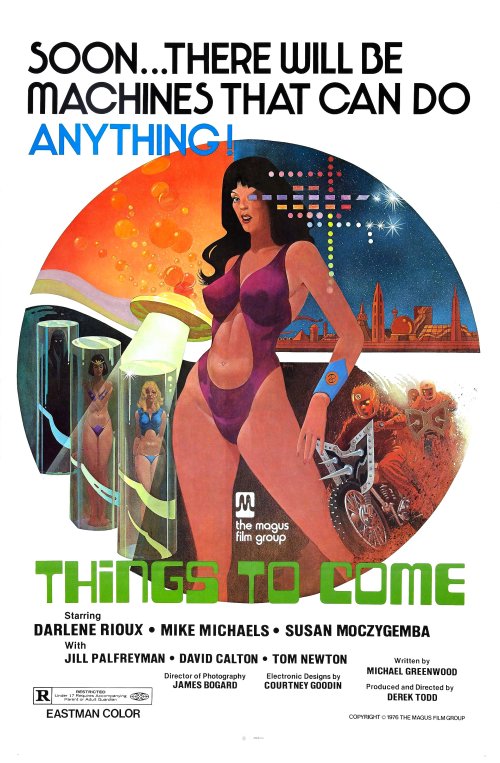
13_cinema_things_to_come_1976_poster_01

Although apparently not everything, such as ride motorbikes with big spikes on the front

fashion

13_fashion_tumblr_maxyfcDyPk1qzdzwdo1_500

It is important that some, if not all, of your outfit is colour-coordinated with the giant computer brain

13_fashion_1969 CLAIROL vintage ADVERTISEMENT women health and beauty NEW YORK CITY Central Park 1960s Bubble Photo

A 1969 Clairol advert, aparently – and no, I don’t understand why they’re in a giant transparent ball above a park, either

13_fashion_psa_flight_attendants

Pacific Southwest Airlines flight attendants – normally, they flew inside the aircraft with the passengers

13_fashion_steam_room

Back in the 1960s, the CIA was only just figuring out how to use waterboarding


3 Comments

The north face of Mount TBR

Owning books can be more fun than simply reading them. At least that’s what I tell myself when I eye the double-stacked book-shelves and piles of books on the floor of my house. Which is not to say that I plan to keep every one of the books mentioned in these book haul posts. Some of them will go to charity shops once I’ve read them, some of them will go elsewhere. But until I actually start reading more books each month than I buy, the piles are only going to get higher…

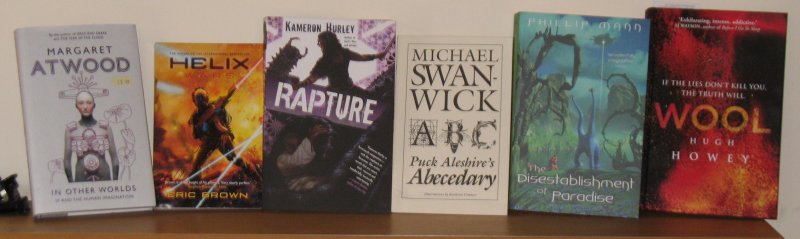
20130316a

New science fiction: Wool I’m reviewing for Interzone. It has come close to being hurled at the wall a couple of times. The Disestablishment of Paradise is a new book by a favourite author, who hasn’t had anything published for a good many years. I should probably have hung on for the UK edition of Rapture, but I do like my trilogies to all match and I already have the Night Shade editions of the first two books. Puck Aleshire’s Abecedary is a small press chapbook I bought on eBay. Helix Wars was sent me by Eric, and In Other Worlds I picked up for £3.99 in a discount bookshop in Wetherby.

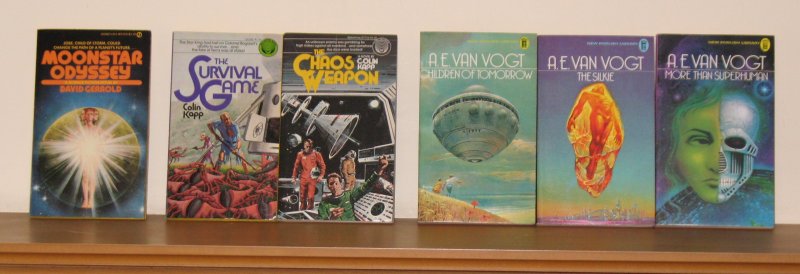
20130316b

These six paperbacks I bought from Cold Tonnage. I may slag off van Vogt a lot, but some of his books transcend their chaotic bonkersness and I find them weirdly appealling. I don’t know if More Than Superhuman, Children of Tomorrow or The Silkie fit that bill. I guess I’ll find out. Colin Kapp is forgotten and under-rated Brit sf author who, like many of his 1960s and 1970s contemporaries, was chiefly published in the US. The Chaos Weapon and The Survival Game are among the last few of his I didn’t own. And Moonstar Odyssey I’ve been looking for a decent copy of for ages, though I can’t remember exactly why…

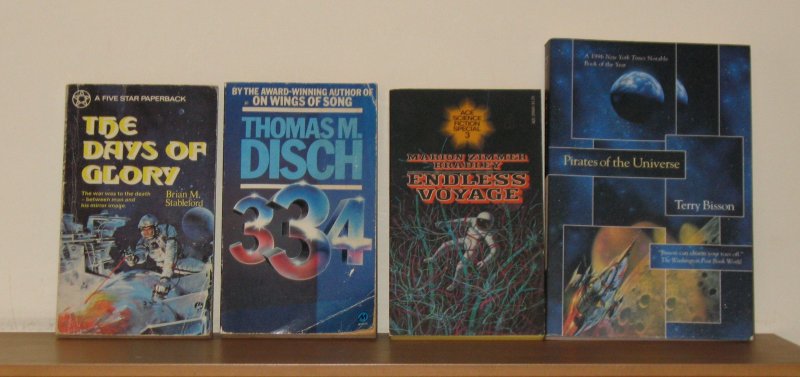
20130316c

Some secondhand sf. Pirates of the Universe I’ve been after for a while. The last time I bought a copy, I received a refund instead as the book had apparently suffered a “scissors accident” while the buyer was packing it to send. I know nothing about Endless Voyage, but the new Ace special series from the mid-1970s contains some odd books among its eleven titles. I’ve decided to collect them. 334 is a genre classic which I’ve never read, and The Days of Glory is the first book of Stableford’s Dies Irae trilogy. Both the last were charity shop finds.

20130316d

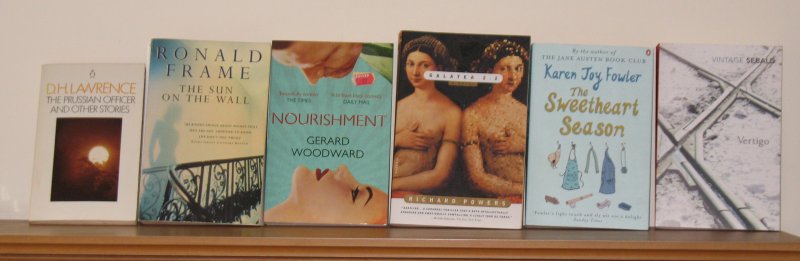
Vertigo was a birthday present, but all the rest were charity shop finds. I enjoyed the The Jane Austen Book Club, so I expect I’ll also enjoy The Sweetheart Season. Fowler’s genre work, of course, is excellent. Galatea 2.2 is literary-but-it’s-really-sf novel, which Powers has apparently done a couple of times. Nourishment is  Woodward’s latest; I enjoyed his first, August (see here). I’ve been meaning to try Ronald Frame’s fiction, but it’s taken me a while to find one of his books. And I’ve not checked The Prussian Officer and Other Stories yet, but I suspect I’ve already about half of its contents. But at least that’s half I’ve not read.

20130316e

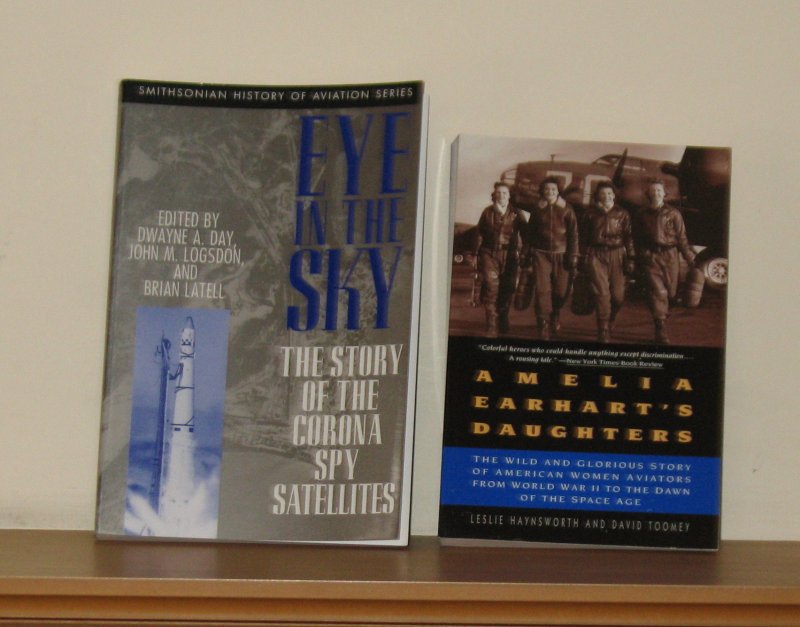
These are research books for the next book of the Apollo Quartet. They might give a clue as to its story.

20130316f

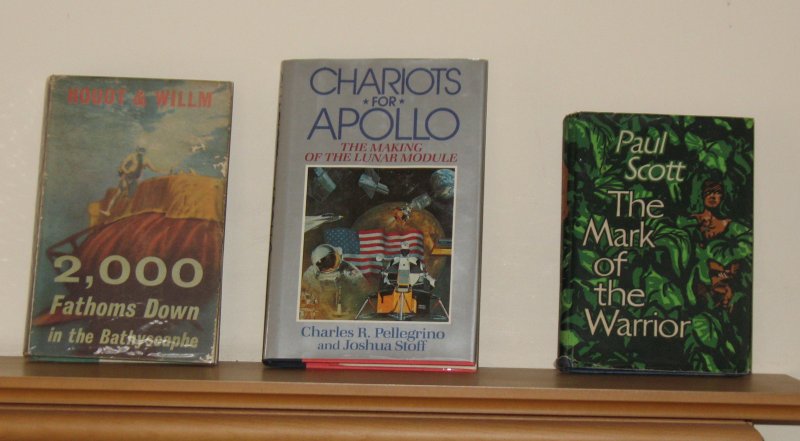
Three books for three collections: The Mark Of The Warrior is a first edition, to go with my other Paul Scott first editions; Chariots for Apollo is for the space books collection; and 2,000 Fathoms Down in the Bathyscape joins my (currently very small) collection of books on bathyscaphes and deep sea exploration.


4 Comments

Reading by numbers

After yet another argument on a science fiction forum, I decided to work out how many books I’ve reviewed – because in order to review a book, I have to read it critically. Which is not to say I don’t normally read critically, although sometimes the book simply isn’t worth doing so; but for a review, no matter how bad the book is, I have to.

I have a rough idea of how many books I’ve read. Since I started keeping records in 1991 I’ve read 3220 books, but I’ve no real idea how many I read before that. Probably a couple of thousand more. I have, after all, been reading books for about 40 years. And around two-thirds of those books have been science fiction. So I’ve been reading it a long time, and I’ve read a lot of it. This means that when I say Asimov is a bad writer, I’m not saying it having never read any of his books. In fact, I’ve read most of his novel-length oeuvre, and a good many of his short stories.

But, critical reading… I started out reviewing books in 1988 for Paperback Inferno, a review magazine for the British Science Fiction Association. In 1992, Paperback Inferno was folded into Vector, the critical journal of the BSFA, and I began reviewing for that magazine. I stopped a couple of years after I moved to the United Arab Emirates in 1994.

Between 1993 and 2003, I was in an APA called Acnestis, run by Maureen Kincaid Speller. Each month, we’d write a contribution – a combination of fan writing, criticism, reviews, commentary on previous months, etc – and produce thirty copies, which we’d post to Maureen. She would then sort those so each of us received an envelope containing a copy of each person’s contribution for that month. Acnestis helped keep me sane during my decade in the UAE. In my contributions, I usually mentioned the books I’d read that month. Sometimes it was just a capsule description, but occasionally I’d write a longer review. But only thirty people ever got to see those reviews.

In 2007, I started up this blog – originally on blogger.com, but now on WordPress – and among the many things I posted were several reviews of books I’d read. I also republished some of my Acnestis reviews. In 2008, I became a reviewer for Interzone. In 2010, I was asked to provide reviews for SFF Chronicles. In 2011, I set up SF Mistressworks. And in 2012, when Daughters of Prometheus started, I began contributing to that…

So that’s a lot of reviews. It is, in fact, 237 reviews. And here are a few tables breaking down that figure:

Reviews by year
(Note ten-year gap from 1997 to 2007.)

year Total
1988 4
1989 4
1990 14
1991 9
1992 5
1993 20
1994 5
1995 1
1996 1
1997 4
2007 10
2008 24
2009 20
2010 26
2011 38
2012 44
2013 8
Grand Total 237

Reviews by venue
(I have counted reviews only by their original appearance.)

venue Total
Daughters of Prometheus 5
Interzone 21
It doesn’t have to be right 88
Paperback Inferno 33
SF Mistressworks 36
SFF Chronicles 16
The Lyre* 6
Vector 32
Grand Total 237

The top ten by number of books reviewed of authors.
(Gwyneth Jones is no surprise, and I do have a habit of reviewing each new Iain Banks genre novel as it appears. Two of the Ian Whates books were anthologies he edited.)

author Total
Gwyneth Jones 6
CJ Cherryh 5
Iain M Banks 5
Ian Whates 5
DG Compton 4
Carolyn Ives Gilman 3
Ken MacLeod 3
Louise Cooper 3
Pamela Sargent 3
Roger Zelazny 3

I have reviewed books by 182 different authors, not all of them genre. I’ve not included the capsule reviews I’ve posted to my blog in these numbers, though that would likely bump the figure by about another 100 or so. I can’t claim the quality of my reviews has been consistent, either over the years or within a single year. I like to think they’re readable, honest, and occasionally make useful points.

I don’t usually have the luxury of time to spend months giving a book a really deep read with the intent of writing several thousand words on it. There are far too many books I want to read, and a year in which I read only a dozen or so books would feel like a complete waste of twelve months to me. Of course, I don’t write a review of every book I read. Nor do I choose every book I read for review – for Interzone, for example, I can only pick from among what’s available, and I don’t always get my first choice.

But I’ve been doing this for a few years now, and I’d like to think I’ve sort of got the hang of it. I don’t consider myself a critic – I don’t have the toolset for that. And, to be honest, I’d sooner focus on writing my own fiction than study to be a critic. I think it is important, however, that if you want to seriously discuss science fiction, or any fiction for that matter, then you need to read critically. Otherwise it’s just squee. It’s no good being knowledgeable about a novel’s universe or story, you also need to understand how that story works, where the author has succeeded and where they have failed, and why. That’s what reviewers try to do, that’s what I try to do when I write about other people’s fiction. That’s what I’ve been trying to do since 1988, over the course of 237 book reviews…

* The Lyre was a small press genre magazine I co-edited in the early 1990s. We published two issues, featuring original fiction by Eric Brown, Simon Clark, Stephen Baxter, Michael Cobley, Keith Brooke, Gwyneth Jones, Peter F Hamilton, Peter T Garratt, and a few other less familiar names.


5 Comments

Notable recent reads

I have been a bit rubbish at posting here over the past month or so, and I’m not entirely sure why. I could claim it’s because I’ve been busy writing short stories, novellas and novels, but that wouldn’t be entirely true. I have been busy – but it’s been other stuff: writing reviews, family stuff. And I’ve only managed to squeeze in a bit of fiction writing in here and there. I have been reading, however. Though not as many books as I’d have liked. Here are some of them – chiefly the ones I’ve not already reviewed, or plan to review, for SF Mistressworks or Daughters of Prometheus…

wintersboneWinter’s Bone, Daniel Woodrell (2006)
I was interested in reading this after seeing, and being much impressed by, the film adaptation. I was expecting a genre crime novel with a plot much like that of the movie. What I wasn’t expecting was a well-written literary novel, which actually has less plot than the film. Sixteen-year-old Ree’s father has gone missing, and he put up the house and land as collateral for bail. Which means if he doesn’t turn up in court, they lose the house. So Ree goes looking for him. The story is set in the Ozarks, where everyone is related to everyone else and most of the men are involved in brewing up or distributing drugs. Ree’s questions are not welcome – and it takes much of this short novel before she discovers why. If the film is brutal and the people in it scary, then the book is more so. The film adds a scene set at a cattle auction, but loses one where Ree and her best friend help to catch a pig loose on a bridge. There’s some lovely writing in this, Ree is extremely well-drawn, and the setting is, well, just plain frightening. I’m going to read more Woodrell. Recommended.

tyranopolisTyranopolis, AE van Vogt (1973)
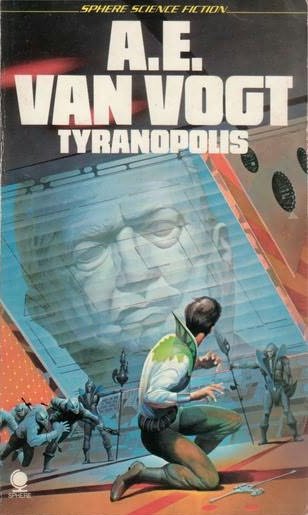
AE van Vogt really was a shit writer. He built his career on advice taken from a how-to-write book. And it shows. I still have a soft spot for his fiction because, every now and again, purely by accident, he manages to create something that’s almost mythic. But vast swathes of his oeuvre are unreadable meretricious tosh. He makes stuff up out of whole cloth, and it possesses neither plausibility nor rigour. Tyranopolis is a case in point. At some point in the future, a mysterious dictator rules the entire Earth with an iron fist. But an inventor, er, invents some sort of ray that allows him to see everywhere and be seen everywhere. Knowing the tyrant’s forces are closing in, he gifts the secret to his unborn son moments after the act of conception, by, er, putting it in his DNA or something. I don’t know. It makes no sense whatsoever. Whatever drugs van Vogt was on when he wrote, they were clearly more powerful than those used by Philip K Dick. The writing in Tyranopolis hovers on the cusp of sense, the plotting reads like he made it up as he went along, the central premise is complete nonsense, and yet… and yet… No, there is no “and yet”. Not for this one. It’s a rubbish book. Avoid it.

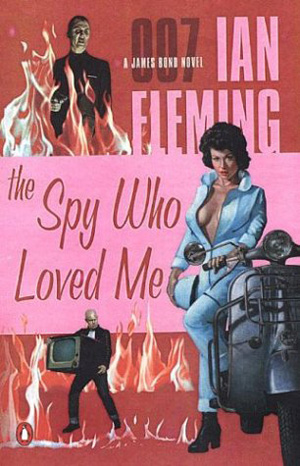
the-spy-who-loved-me-novelThe Spy Who Loved Me, Ian Fleming (1960)
Fleming was a real pioneer, you know. The Spy Who Loved Me is ground-breaking, you know. Because it’s a Bond novel, but Bond isn’t the protagonist! He doesn’t even appear until about a third of the way in! And, get this, the entire novel is narrated by a woman! I know, shocking. So the title doesn’t refer to some KGB temptress who falls for 007’s manly charms, as it does in the film. Bond is actually the spy of the title. But he doesn’t really fall in love with the narrator. And she knows it – indeed, she says as much. She’s making her way through the US from Canada on a moped and stops off at a remote motel. She stays on to work there, and is made responsible for closing the place down for the winter. Two employees of the owner turn up and it transpires they’re there to torch the place for insurance purposes. Fortunately, Bond suffers a flat tyre nearby, so he’s around to foil their plot and save the girl… You know when an author falls in love with their own creation, and this persuades them that writing a story about said creation from the point of view of a lovestruck young woman is a good idea? That. And they say this is the best of the Bond novels… Pfft.

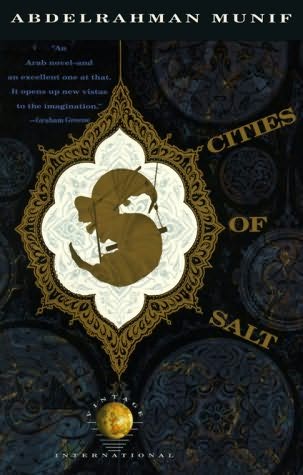
citiesofsaltCities of Salt, Abdelrahman Munif (1984, trans. 1987)
The lives of the Bedouin of Wadi al-Uyoun are disrupted by the discovery of oil. Eventually, they are moved and rehoused, but some instead move to the coastal village of Harran. Which then becomes the point of entry into the country for American oilworkers, and so the site of their camp and offices. The novel then charts the growth of Harran through the lives of some of its more notable inhabitants. The nation is meant to be an invented Gulf state, but Harran is clearly modelled on Dhahran. Munif is especially critical of the Americans and their interference and ignorance of Bedouin life, but he’s also critical of those Arabs who accepted US largesse and grew fat on the proceeds. I suspect Munif was not especially well served by his translator as some of the prose in Cities of Salt is clunky in places, but Munif certainly shows a sharp eye for characterisation. As far as I can determine, this book, and its two sequels, were never published in the UK – my copy is a US paperback – which is a shame as it’s definitely worth reading. I’ll have to get hold of the rest of the– Um, it’s apparently a quintet, but only the first three books were published in English. I guess I’ll have to start practicing my Arabic again, then…

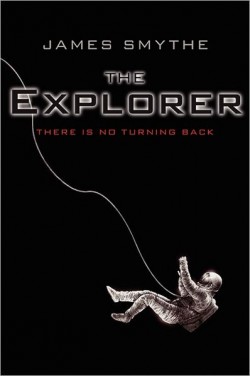
theexplorer-e1356978432870The Explorer, James Smythe (2013)
A handful of days into the first mission to send human beings as far from Earth as possible, and all of the crew have died except for the journalist, Cormac Easton. The first third of The Explorer explains how these deaths came about – and they’re senseless, mostly preventable deaths – and you start to wonder what the remaining two-thirds will be about… And then the second part starts, and the story kicks into a higher gear. James sent me a copy of this novel (a swap for a copy of Adrift on the Sea of Rains), and he did warn me I’d have to accept a certain lack of… scientific rigour in the set-up. And that’s certainly the case. In truth, the spacecraft seems more like something from a Hollywood film than genuine space fiction, with its mysterious engines, store rooms, and even room inside the walls in which Cormac hides like a rat. When the engines are running, there is no gravity. But when they stop, then there is gravity. Which is not something I can quite get my head round. Though I only saw a couple of episodes of it (but I was given the complete series on DVD for my birthday recently), I was reminded more of Defying Gravity than the Apollo programme, International Space Station or even one of my favourite fictional space television series, Space Odyssey: Voyage to the Planets. Happily, despite its creative use of space engineering, The Explorer very much worth reading. Cormac is well-drawn, and his descent in to madness is skilfully handled. Perhaps the rest of the crew tread a little close to stereotype, but that’s the nature of space fiction – astronauts are by definition stereotypes. Apparently, there will be a sequel, though I’m not entirely sure how that’s going to work…

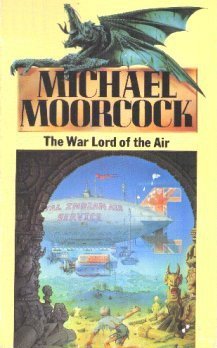
The_Warlord_of_the_Air-Michael_MoorcockThe Warlord of the Air, Michael Moorcock (1971)
If you’re a fan of all things steampunk, if you write steampunk, and you’ve not read this book, then you are doing it wrong. Though it starts inauspiciously, with a dirigible dropping ballast to descend, Moorcock’s airship opera is a clever commentary on imperialism framed in the language of pulp fiction. In 1902, Oswald Bastable visits the Shangri-la-like lair of an evil Indian high priest. An earthquake strikes, destroying the lair, and somehow throwing Bastable forward in time to 1973. He is rescued by an airship, and discovers that the Balance of Powers still holds good across the world, with most nations part of one or the other empire, all of which are ruled by means of vast fleets of airships. Bastable ends up inadvertently assisting Socialist terrorist Count Guevera escape the authorities, before being captured by Chinese warlord OT Shaw, who plans a future free of imperialism. This results in Shaw dropping a nuclear bomb, invented and built by his refugee scientists, on the airship yards of Hiroshima. Which throws Bastable back to 1903. The whole story is framed twice – once by Moorcock’s grandfather, who met Bastable and recorded his story, and by Moorcock himself, who found the manuscript in the attic. Bastable appears in another two novels – The Land Leviathan and The Steel Tsar. I’ll have to get hold of copies. Seems the trilogy is being reprinted this year, with nice new cover art.

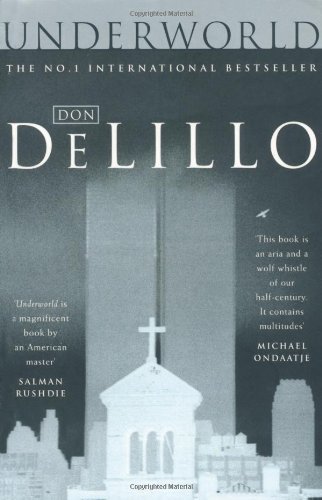
underworldUnderworld, Don DeLillo (1997)
Many many people had told me this is an excellent novel, so I was quite chuffed to find a copy in a charity shop last year. But its daunting size – 827 pages! – made me somewhat reluctant to give it a go. But at the beginning of this month, I found myself reaching for it and… Well, no one told me it opened at a baseball game. I hate baseball. And I hate fiction about baseball even more. Actually, I hate sport, and I hate fiction about sport. But. Underworld opens at the 1951 game between the New York Giants and the Brooklyn Dodgers, and describes the winning home-run apparently known as “the shot heard round the world”, which is a bit rich as only Americans actually give a shit about baseball. Underworld then introduces a number of characters, each of whom shares some link with the baseball from that winning home-run. The chronology bounces all over the place, describing events in various decades in no particular order. Some real world people make appearances – Frank Sinatra, J Edgar Hoover, Lenny Bruce, among others. The writing throughout is mostly lovely and sharp, and the dialogue is especially good – though its particular rhythm does have a tendency to blur some of the characters together. The Lenny Bruce sections I thought the least successful – they didn’t seem a sharp enough commentary on the zeitgeist to warrant inclusion. And it’s long novel, a very long novel. It’s a novel which will merit rereading. But it’s also a novel that’s too big and a bit too flabby to leap into my top ten novels of all time. Oh, and the premiere of the lost Eisenstein movie which gives the novel its title reminded me too much of Burroughs’ Casablanca Film Club and I found it hard to take that section seriously…