It Doesn't Have To Be Right…

… it just has to sound plausible


Leave a comment

Longer reviews

For the past few years, I’ve been writing longish reviews of books on Medium. I plan to keep that going, but I should probably post a link here when a new review goes up there. As happened last night, a review of John Scalzi’s Redshirts (2012, USA). You can find it here.

I’ve been posting reviews on Medium since May 2021, so there are quite a few. Feel free to check them out.


Leave a comment

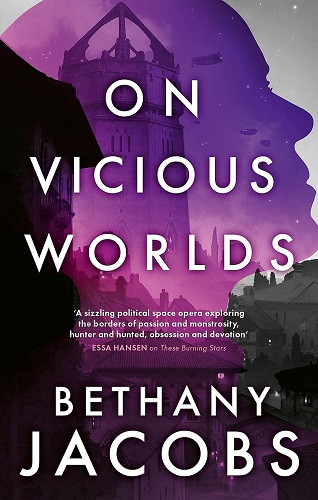
On Vicious Worlds, Bethany Jacobs

The second book of the Kindom trilogy, begun with These Burning Stars (2023, USA; see my review on Medium here). There’s a thing called Middle Book Syndrome which often affects trilogies. The first book does all the heavy-lifting for the world-building and kick-starts the plot; the final book is all about the climax for the story. So the middle one often consists of little more than re-arranging pieces on the board to set up the end-game. Jacobs makes a brave stab at avoiding the syndrome… and almost succeeds. 

Six and Chono are with the Jeveni in their ice-planet colony, reached by a stargate which has been locked against Kindom forces. But all is not well. Those non-Jeveni who were dragged along when the Jeveni escaped have been subject to, occasionally violent, prejudice. There has been a series of suspicious deaths – initially framed as suicides, but soon identified as murders – of Jeveni law enforcement officers. And there is another hacker, potentially better than Ironway, who’s been breaking important colony infrastructure. §

The identity of this hacker – called “the avatar”, but avatar of what? that’s not how you use the word – is one of the puzzles around which On Vicious Worlds (2024, USA) is structured, much as Six’s fate was in the first book. Unfortunately, it’s not as interesting; and the reveal is nowhere near as shocking, or indeed as credible.

Chono and Six return to the Kindom. Where they discover the Jeveni left behind have been forced to work in camps manufacturing vital fuel sevite – because apparently no one else in the Kindom can do it. There also seems to be some sort of power struggle going on between the three arms of the Kindom government – security, secretariat, and clergy. The secretaries seize power. They attempt to arrest Chono – who has become some sort of folk hero, although it never feels well-grounded – and Six. There’s a big fire-fight. Cue cliff-hanger ending.

They’re fun these books. Perhaps a little too Warhammer 40K, somewhat too brutal and heavy-handed; and in places it’s almost as if they’d looked to Banks’s Culture novels for inspiration and then borrowed the very things his novels were arguing against. The world-building is paper-thin in places, more so here than in The Burning Stars, and I’ve yet to be convinced some of the real-world inspirations were wise choices. The plotting is nicely convoluted, but still relentless, the action scenes well-choreographed, and there are more than enough intriguing hooks and callbacks.

If space opera had alignments, the Kindom trilogy would be chaotic evil – and Yoon Ha Lee’s Hexarchate trilogy possibly lawful evil. Given the choice, I’d sooner not read evil novels. Something lawful good, like Ann Leckie’s Radch novels, is more to my taste; or even chaotic good, such as the aforementioned Culture. But if I had to read a chaotic evil space opera trilogy, Jacobs’s trilogy would be the one.


Leave a comment

Project Hail Mary, Andy Weir

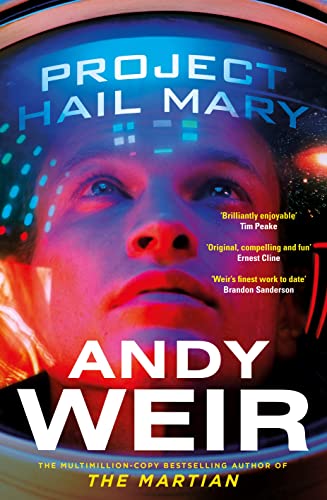
For a novel explicitly constructed as an old Analog-style puzzle story, there are four puzzles in Project Hail Mary (2021, USA) which the novel does not attempt to solve: why did I buy it, why did I read it, why was it published, and why has it been successful? I can possibly answer the first two – it was cheap, 99p in fact; and, I am an idiot. But the last two will forever remain a mystery.

Weir, of course, is best-known for The Martian (2014, USA), a surprise best-seller, originally self-published, which was then turned into a movie by Ridley Scott. The Martian is not a good book – a first-person narrative written by an unlikeable narrator, and written in the first-person for all the wrong reasons. It sold itself on its science, which is, unfortunately, not as accurate as it claimed.

Project Hail Mary is Weir’s third novel, following Artemis (2017, USA), which I have not read. In Project Hail Mary, a man wakes up aboard a spacecraft in another planetary system, with no memory of who he is or why he is there, or indeed where he is. Through chronological flashbacks, he learns he is one of three astronauts – the other two did not survive hibernation during the trip – sent to Tau Ceti. A microscopic creature has begun feeding on the Sun, and this threatens life on Earth. Tau Ceti is also infested with the microbes, called “astrophages”, but it is not losing luminance. An international project is put together to send a ship to Tau Ceti to discover why, and possibly send back a means to kill the microbes.

The microbes’ biology means they can convert mass to energy and back with no loss, making them a perfect fuel, allowing the ship to reach near light-speed. Soon after awakening, the narrator is hailed by an alien ship. It too has a single surviving crew. The alien is a rock-skinned spider-like creature which lives in a hyperbaric ammonia atmosphere. So, of course, the narrator names it Rocky. The two learn to communicate, and together discover why Tau Ceit’s astrophages have not destroyed the star.

The narrator is a high school science teacher. He was a physicist, but he published a paper on extraterrestrial life which saw him drummed out of the scientific community. Somehow or other, he ends up as an expert on the astrophage. Which is why he’s sent to Tau Ceti. He mentions repeatedly that he’s a good and well-loved teacher, which seems completely plausible as he thinks like a teenager.

Because he’s a high school science teacher, everything he encounters is solvable using high school maths. Which Weir explains in detail. All the technology, the sophisticated computers, aboard the spaceship, and yet every problem he encounters can be solved using schoolboy mathematics. It gets old very very quickly.

The astrophage is, I admit, quite ingenious, but it seems extremely unlikely to have evolved – in fact, I kept on expecting to read it was engineered. But no. Every other idea in the novel springs from the astrophage’s biology. The characters are drawn with the broadest of strokes; and while the cast is international, it’s only the handful of Russians and Chinese who don’t come across as Americans.

Many years ago, there was an international best-selling novel which taught its reader about the history of philosophy. Sophie’s World (1991, Norway) by Jostein Gaarder. I seem to remember reading it. Project Hail Mary reads like an attempt to do the same for high school maths, by showing how useful it is when, for example, trying to rendezvous with an alien spaceship, work out how not to poison yourself in an ammonia atmosphere, or even accidentally blow up the entire Earth while experimenting on microbes which are capable of total mass-energy conversion. Handy to know.

A novel that sets a low bar and all too often barks its shins on that bar. Avoid, unless you’re a masochist, or, like me, an idiot.


1 Comment

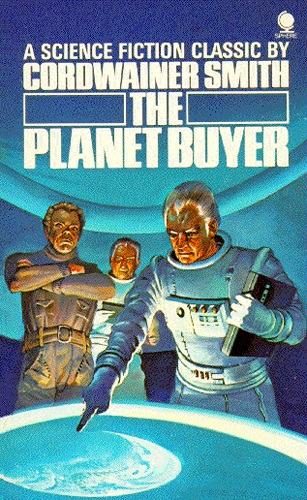
The Planet Buyer, Cordwainer Smith

Shortlisted for the Hugo Award in 1965. I suspect Smith is better-regarded these days than he was when he was writing. According to sfadb.com, he had only two Hugo nominations: a short story in 1956, and this novel (incorrectly given on the site as Norstrilia); and a Nebula nomination for a novella in 1966, the first year of the award. Norstrilia (1975, USA), by the way, is actually an expansion of The Planet Buyer (1964, USA) and its sequel, The Underpeople (1968, USA), and while I say “sequel”, it would not be entirely accurate to say The Planet Buyer is a complete novel – it even says as much in its Epilogue and Coda:

… the reason why this chronicle ends now is that the players have made the moves that will determine the outcome.

So, a somewhat baffling choice for an award for “best novel”.

Those familiar with Smith’s work will find everything they expect in The Planet Buyer. It opens on the world of Old North Australia – tellingly at one point given as Old North America, which makes more sense of the “north” – the richest planet in the galaxy, thanks to the immortality drug, stroon, which is harvested from giant mutated sheep. In order to maintain their simple dinkum cobber life-style, everything imported onto Norstrilia is charged 20,000,000% import duty. Even so, the Nortstrilians are stupidly wealthy, even more so than those moronic US-based techbros who seem determined to make humanity extinct. Rod McBan is one of the richest Norstrilians, although he has yet to come into his majority. A childhood enemy is out to get him, so he consults a secret AI he happens to have lying around, which tells him he should leave Norstrilia for Old Earth. But only after buying Old Earth. And can the AI please have permission to use Rod’s riches to manipulate the stroon futures market until he has enough money to buy Earth, please?

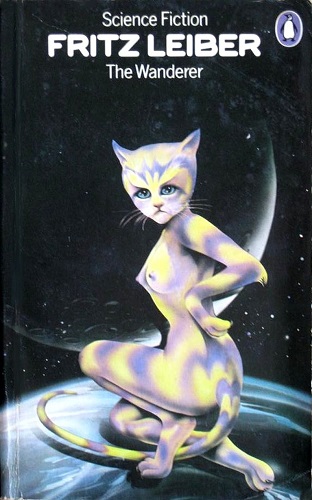
Rod is then smuggled to Old Earth by a Lord of the Instrumentality sympathetic to Rod’s problems (which, to be honest, seem somewhat weak sauce to drive such a momentous plot). He is disguised as a cat-man, one of the Underpeople, to keep him safe, and accompanied by C’Mell, a cat-woman who appears in other stories by Smith. There is discussion of the economic consequences for Old Earth of Rod’s ownership of the planet. There’s a reference to some prophecy or other. Rod arrives at Old Earth.

End of book.

I’ve enjoyed Smith’s stories when I’ve read them – and I read one of his collections only last November – and the Instrumentality, and Old Earth, make for an interesting setting. Smith’s prose style works more often than it doesn’t. But. Norstrilia is a somewhat dull place, and its inhabitants are not very engaging; and, unfortunately, The Planet Buyer spends much of its length on that world. I expect – I’m hoping – The Underpeople, which continues the story, is better (although it wasn’t nominated for the Hugo; go figure).

Not a book worth seeking out, given it’s only the first half of the later-published Norstrilia. Even then, I’d recommend Smith’s Instrumentality short stories, available in a number of collections, before Norstrilia or its two constituent novels.


1 Comment

Cat Karina, Michael G Coney

The late Eric Brown, a friend of many years, was a big fan of Coney’s fiction, but for some reason Coney was one of those authors I never seemed to pick up. The first was Hello Summer, Goodbye (1975, UK) about fifteen years ago, and I thought it quite good – and later I picked up and read Charisma (1975, UK). But stopped there. I’ve read more in the last few years, and found his Amorph trilogy of Mirror Image (1972, UK), Syzygy (1973, UK) and Brontomek! (1976, UK) good examples of a type of expatriate English science fiction of the 1970s which I find strangely appealing.

Cat Karina (1982, UK) is not that. It’s set in the far distant future, the Greataway, on an Earth populated by races that have been genetically melded with assorted animals, and in which technology is anathema – in fact, even fire is banned. The novel is explicitly framed as the telling of a legend, so much so it inserts commentary on later distortions and interpretations of the story. Also in the narrative are alternative timelines, happentracks, predicated on decisions made by Karina and others which might affect the future, or Ifalong.

There’s a prophecy, but it’s really a millennia-long plan to bring about the birth of someone who can free Starquin, “the greatest person the Earth has ever known”, who was imprisoned millennia earlier, and it involves the title character, who is a Specialist, a human with animal genes, and a felina, meaning the animal genes are from jaguars. Karina lives in a village on the sailway line, a wooden monorail with wind-powered sailcars. One section of the track is too steep for wind-power, so the sailcars must be hauled up to the summit. By teams of felinos. The chief cargo on the sailway is tortugas, a highly-prized fruit grown in the mountains on heavily-guarded farms.

A handmaiden of the Dedo, a part of the Starquin’s body “in human form”, whatever that is, tries to manipulate Karina so she follows the prophecy, but Karina has a mind of her own… The main story follows the preparations for an annual sailcar race to deliver the season’s first tortugas to the coast, and the plan to use a sailcar built using forbidden technology – ie, metal. Which could mean there will no longer be a need for gangs of felinos. Which prompts a revolution, with the Specialists overthrowing the True Humans.

There is little, to be honest, all that original about the plot of Cat Karina – it runs on rails as well-greased as those of the sailway. And, it must be said, the novel does a great deal of heavy-lifting when it comes to filling in the back-history of the universe (there’s a later trilogy set in the same universe), but it does so with some smart neologisms and an impressive economy. I don’t think Cat Karina privileges world-building over story, a common fault in science fiction and fantasy, but its world-building is certainly more original and accomplished than its story. Karina is an engaging hero and well-characterised, and it never feels like she’s being pushed and prodded by the plot, even though the narrative often details other happentracks. There’s some nice invention in parts, the secret of the tortugas, for example, an important plot-point, unlike the secret of the tumps (huge torpid meat animals), which is not.

Cat Karina is a well-crafted novel, and a good example of its particular type. To be honest, I much prefer Coney’s near-future sf, but for fans of sf set so far in the future it might as well be fantasy, Cat Karina (and, I expect, the trilogy which followed it) is a good read.


Leave a comment

Little Fuzzy, H Beam Piper

Another allegedly classic sf novel, which was nominated for the Hugo in 1963. Dick’s The Man in the High Castle (1962, USA) won that year, and was easily the best of the shortlisted novels. Little Fuzzy (1962, USA), on the other hand, is slight, not in the least bit plausible, and opens from a position of such comprehensive US hegemony its story is pretty much unrecoverable.

The title refers to the indigenous race on Zarathustra, waist-high cute-looking furry creatures with an average intelligence comparable to that of small children. Humans have been on the world for several decades before the first “Fuzzy” appears, and the corporation which owns the planet quickly realises that a native race invalidates their ownership of the world and all its resources. So they play dirty in an effort to prove the Fuzzies either non-existent or not intelligent. A situation which comes to a head when a company bigwig stamps on a Fuzzy, killing it, and a company bodyguard is shot and killed in self-defence.

Like a lot of American sf of the period, this is resolved by people coming together, homespun legal wizardry, a general distrust of the government (and governing corporation), and a handful of native backwoods cunning from several of the cast. While the local governor is corrupt, the local Navy base is packed to the gills with upright honest officers and personnel. The corrupt mayor is a cliché, but so too is the valorisation of military probity – at least in 1962, before the Vietnam War. There are entire Hollywood movies from the 1930s through to the 1950s which use any one of those tropes on which to hang a plot. And each one is as hokey as the next. 

If anything, Little Fuzzy multiplies the hokiness. It’s a novel with far more mouthpiece characters than it needs or the reader deserves. The Fuzzies may be intelligent enough to determine their own destiny, but the humans on their side seem to treat them chiefly as precocious pets. There are many arguments to be made about the European invasion of continental North America, but this novel doesn’t even come within spitting distance of them. It’s the colonisers defending the colonised against the colonisers’ own kind, for reasons that are best not examined too deeply.


2 Comments

How have the Hugos changed?

When you look at the Hugo Award fiction category nominees of the last few years, it seems like the same names keep on cropping up. Only an idiot would deny the Hugo nominees are more diverse than they were twenty years ago, but shouldn’t that mean the award now selects from a wider pool of authors? You’d assume so, given the existence of the internet. True, in recent years, the short fiction categories have been dominated by fiction published on tor.com or Clarkesworld; but in the 1980s and 1990s, the short fiction categories were dominated by fiction published in Analog, Asimov’s and F&SF.

Has anything really changed? I decided to have a look. (I was bored last weekend, obviously.)

There’s little point in comparing the representation of gender, race, nationality, etc, of nominees over the decades, as the awards are clearly far more inclusive. I was interested only in the number of writers considered by Hugo Award voters.

I split the Hugo Awards into three cohorts: early years (1953 to 1970), middle years (1971 to 2000), and present day (2001 to 2020). They’re unevenly-sized cohorts – the 1950s is not a full decade and we don’t have all the nominees for the early awards; in the 1970s, the novelette category was dropped for several years, and… 17 years (no award in 1954), 30 years and 20 years… But the split works when you consider the various cultural movements in sf and sf fandom.

big fish in a small pond

In total, over 67 years, 397 authors have been nominated for a Hugo fiction award – on average, five each in novel, novella, novelette and short story. For 1,256 nominations… 397 is a surprisingly low number. It gets even weirder when you look at how many times individual authors have been nominated. Almost half of those 397 have only a single nomination. Among the others…

The most-nominated author is Mike Resnick, with 30 nominations. The top ten looks like this:

1 Mike Resnick 30 1989 – 2012
2 Connie Willis 24 1980 – 2011
3 Robert Silverberg 23 1968 – 1990
4 Michael Swanwick 22 1986 – 2009
5 Ursula K Le Guin 20 1970 – 2003
6 Larry Niven 19 1967 – 1990
7 Harlan Ellison 18 1966 – 1994
8 George RR Martin 17 1980 – 2012
9= Poul Anderson 15 1959 – 1990
9= Orson Scott Card 15 1979 – 1992
9= Kim Stanley Robinson 15 1983 – 2018
9= Charles Stross 15 2002 – 2014

The years are first nomination to last nomination. The writers’ careers typically lasted much longer.

That’s a lot of old white men. Interestingly, the only author nominated in all three cohorts is Ursula K Le Guin, who had nominations dating from 1970 to 2003.

Among authors who have been nominated only since the turn of the century, the highest number of nominations is for Charles Stross, who managed 15 nominations in 12 years. Seanan McGuire, who has had 13 in just eight years, will likely end up beating his record.

Digging into the Hugo Award nominations for each year, it was surprising how often authors achieve multiple nominations in the same year. Seanan McGuire managed four in 2013, as did Michael Swanwick in 2003. (John C Wright also had four in 2015, but that was entirely due to Sad Puppy bloc voting.)

In early years, it was even more prevalent, with several authors appearing three times across all the fiction shortlists. John Varley even managed an unbroken six-year run, from 1977 to 1982, of two nominations per year.

The one thing the numbers do show clearly is that authors “have their day”. They will be nominated for half a dozen years on the trot, and then disappear. Some pop up a few years later, but most don’t. In some cases, it’s because their career has ended – either retirement or death – but others continue to be published but are never nominated, perhaps because they’re out of fashion or their fans no longer vote for the Hugo. Everything, as they say, shall pass.

But I set off down this rabbit hole to understand if the size of the pool of writers nominated for the Hugo Awards has changed. Overall, 49% of nominees are “one-hit wonders” (a statistic slightly thrown out by the Sad Puppy campaigns of 2014 and 2015), and 16% have had only two nominations.

And when you look at the one-hit wonders, it’s clear present-day voters read much wider: from 1953 to 1970, 51% of nominees appeared only once; from 1971 to 2000, 44% of nominees appeared only once; and from 2001 to 2020, fully 57% of nominees appeared only once (without the Sad Puppies, it would probably be a couple of percentage points lower, but still better than earlier cohorts). I had not expected that. The second cohort, 1971 to 2000, also shows more authors being repeatedly nominated. There were indeed some authors very popular among Hugo voters during this period, such as Connie Willis and Ursula Le Guin, but also Silverberg, Resnick, Varley, Niven and Card. (Lois McMaster Bujold’s success stretched across two cohorts, so she doesn’t score so highly here.)

debut or established?

One other question occurred to me. Present day Hugo voters, it seems to me, like debut novels. Certainly, the industry has changed and debut novels are pushed much harder than they used to be, sometimes even more so than new works by established authors. The whole concept of “building a career” has gone, killed by the need for a quick profit. Best-selling series of the past, like the Wheel of Time or Malazan Books of the Fallen, took several volumes to build up to best-seller levels. That wouldn’t happen now. Instead, we get instant best-sellers, like the Kingkiller Chronicles, followed by a decade-long wait for a sequel. If this is meant to be an improvement, it’s hard to understand how.

But, Hugo nominations can at least show – for best novel, specifically – which nominated novels over the years were debut novels. Popular perception – based on changes in the industry – suggest this is a recent phenomenon. So I went through every best novel shortlist, marking off those which were debuts – as in, the first book the author had published, also including collections. It’s a little difficult to be sure for the first cohort, since novels were often serialised in magazines, and it wasn’t always the serialised version that was nominated but a later hardcover/paperback release, and sometimes even both versions – ‘Dune World’, for example, was nominated two years before Dune, which was a joint-winner in 1966.

The results were… interesting.

I’d have expected a few more debuts in this cohort, given the genre was relatively young. But magazines had been serialising novels from the very beginning, so most well-known authors likely had plenty of novel-length works under their belts by 1953.

There’s considerable overlap between the earlier cohort and this one, and it takes a good fifteen years to fade away. (Perhaps I should have defined my cohorts differently – 1953 to 1965, 1966 to 1985, 1986 to 2015, and 2016 to 2020?) Aside from a blip in the early 1980s, debut novels were not that popular, appearing in only seven of the years. Interestingly, one of the two debuts on the 1985 shortlist was Neuromancer by William Gibson; the other was Emergence by David R Palmer, a fix-up of two novellas nominated for the Hugo in previous years. Palmer published one more novel and then vanished.

Again, there’s overlap from the preceding cohort, and it too takes around fifteen years to fade away. But debuts are also clearly more popular, appearing on the shortlists of eleven of the twenty years, and even making up half of the shortlist in 2020. On the other hand, the one debut novel on the 2004 shortlist was Charles Stross’s Singularity Sky – and he was then nominated each year for further five years. The debut novels nominated in 2011, 2012, 2013 and 2014 were by, respectively, NK Jemisin, James SA Corey (technically not a debut as one of the two authors who write under that name had been previously published), Saladin Ahmed (who has published no novels since), and Ann Leckie. At least two novels I’d thought were debuts – by Paolo Bacigalupi and Yoon Ha Lee – proved not to be, as both had published collections earlier.

in conclusion…

While recent years have seen several authors nominated multiple times, or for several years on the trot, it’s to a lesser degree than was the case in the decades before the turn of the millennium. So it may seem like the same names keep on appearing, but it was much worse in the past. On the other hand, it’s true debut novels are now more prevalent on the Best Novel shortlist than they were previously. I suspect this is a result of both social media and changes in the industry. Sf fandom has always been tribal – does anyone seriously believe Mike Resnick was the absolute best genre author of the 1990s and 2000s? – although I wouldn’t be surprised if a number of writers in twentieth-century Hugo Award shortlists owed their many nominations to logrolling…

Tribalism still plays a major role, of course, with lists of eligible works posted by influential authors, fans basically providing unpaid marketing for their favourites, and authors branding themselves as personalities separate from their novels (rather than “the death of the author”, it’s privileging the author over the work). But this is the world in which the Hugo Award now operates, and it too will likely change over the next decade or two.

additional findings

The most popular middle initial for Hugo nominees is apparently “M”.

The author with the most works published before their first Hugo nomination is Kevin J Anderson, with over one hundred novels or collections. A number of authors had published at least twenty books before their first nomination – Jim Butcher, Neil Gaiman, Frederik Pohl, Bob Shaw, Sheri S Tepper, Philip José Farmer, Michael Bishop, Robert Silverberg, Andre Norton and John Brunner.

The longest unbroken run for best novel nominations is Charles Stross, with six years. Orson Scott Card managed five years in a row.

Only Robert Silverberg has managed more than one novel on the shortlist – two in 1972 (A Time of Changes and The World Inside) and two in 1973 (The Book of Skulls and Dying Inside). He was obviously very popular then. Of course, there was also Blackout and All Clear by Connie Willis, which were published as two books, but the Hugo administrator decided to combine their votes, so giving Willis a win in 2011. As I remember, it was not a popular decision.

Only three people have been nominated for a Hugo posthumously for novel-length works. Both Edgar Rice Burroughs (died 1950) and EE Doc Smith (died 1965) were nominated for Best All-Time Series in 1966. Robert Jordan (died 2007) was, with Brandon Sanderson, nominated for Best Novel for The Wheel of Time series. And no, I can’t remember how they managed to swing that, either.


1 Comment

Fantasticon 2019

Fantasticon happens every year in Copenhagen, usually in September. It’s not the only con of that name, but it is the only Nordic con of that name. This year was my third Fantasticon. For the past few years, it’s been themed, and for 2019 the theme was Afrofuturism, and the guest of honour was US writer Nisi Shawl.

On previous visits – I’ve now visited the city over a dozen times – I flew from the UK, but now I’m resident in Sweden, and there’s a regular train service between Stockholm and, as we say here, Köpenhamn. Train travel is much superior to flying. And Swedish train are vastly superior to UK trains. In the company of Johan Anglemark, who had not attended Fantasticon since it moved to its current venue, I caught the train from Uppsala to Stockholm Central Station, and changed there onto the train to Copenhagen. The trip was unsurprisingly stress-free. We sat on the train for about five and a half hours, and though we crossed an international border we didn’t have to show any ID. This is not something I’m happy to give up just so a handful of very rich old white men won’t have to pay their fair portion of taxes. Fuck’ em. Better yet: lock them up.

Do you know how difficult it is to take a good photo of the Öresund while crossing the bridge on a fast-moving train?

We were joined on the train at Malmö by a Swedish fan from Göteborg, Patrik Centerwall. On arrival in Copenhagen, we trekked along Vesterbrogade from the main station to our hotel, where we bumped into a couple more familiar faces. After checking in and dumping our stuff in our rooms, we headed for the Serapions Order, where the con was taking place. It’s the lodge of a sort of Danish Masonic order, in Frederiksberg, a weird sort of enclave within Copenhagen. No sooner had we met up with various other fans, then around a dozen of us, led by Danish fan Sanna Bo Claumarch, caught a bus for the now-traditional Friday night oysters, at a French restaurant, L’Éducation Nationale. Some people also had snails. I played it safe and had entrecôte. We stayed until the restaurant closed, and a group of four of us – Johan, myself, Sanna and Sidsel Pedersen – set off to walk back to Frederiksberg, a distance of about 2 km. We stopped off en route at another bar. And closed that. And then Sidsel had to catch a taxi to Valby because Edmund Schluessel’s key wasn’t working on the entrance door to his hotel. The three of us left walked back via Sankt Jøgens Sø, and I was in bed by about 3 am.

The next day, I spent the morning briefly at the con, then headed into the centre of Copenhagen – basically a march the length of Vesterbrogade to Rådhuspladsen, where I met my sister. We went for a bite to eat, followed by a wander around the comics branch of Faraos Cigarer, and then the games branch. I returned to the con in time for a programme item celebrating Samuel R Delany and his work.

Saturday evenings at Fantasticon are typically taken up with a banquet, at which the guest of honour gives their speech. I’ve attended at all three of the Fantasticons I’ve, er, attended, and the food has been excellent. After the meal, there is filk. I am, I admit, not a fan of filk. I don’t get the appeal of rewriting the lyrics of folk songs so they refer to science fiction works or fannish traditions. Apparently, the Nordic filk tradition is very much a singalong style, unlike the UK and US traditions. Unfortunately, the person invited to lead the filking did not know this. So there wasn’t much of a singalong. Also unfortunately, the lyrics to the half-dozen songs performed, which were projected onto a screen, were hardly appropriate: one featured the term “nancy boys” and jocular references to rape. The most recent sfnal reference in them was Return of the Jedi (1982). Fortunately, I’d spotted a racial slur in the lyrics sheet as the projector was being tested, and asked for it to be removed. Which it was. Shit like that should not be happening in 2019.

After the banquet, and filk, had finished, a group of us headed to Vesterbro Torv. The bar we’d visited the year before had gone, replaced by some sort of posh pizzeria. So we ended up at a bar next door, which was not as good. At midnight, they packed up the outside tables, and only Sanna, Sidsel and myself moved inside. After we’d finished our drinks, we made our way to Mikkeller, probably my favourite bar in Copenhagen (in my defence, I have not visited that many). I was back in my hotel bed by about 2 am.

View of Tycho Brahe Planetarium across Sankt Jørgens Sø

Sunday morning demonstrated I really am getting too old for this shit. I had a bit of a lie-in – but still managed to catch hotel breakfast. I sat about and socialised for much of the day until my interview. 2019 is the fiftieth anniversary of the Apollo 11 moon landing, and I am allegedly knowledgeable on the subject – which no doubt explained why I was put on four panels about Apollo and the Moon at Worldcon this August, including two featuring an actual NASA astronaut (one of which I moderated). This likely explains why Flemming Rasch interviewing me about the Apollo programme, and my Apollo Quartet, was added to the Fantasticon programme. Amusingly, Johan had told me earlier that day about his experience at a con some years previously interviewing Iain Banks. He’d been asked to interview Banks for the programme booklet and had done so. On arrival at the con, he was then asked to interview Banks again as part of the programme. But, as he pointed out to Banks just before the programme item, he’d already asked the questions he wanted to ask. So he asked Banks if he would cooperate… and Johan admitted he asked only four questions and Banks gave 15 minute answers to each…

Which is sort of what happened in my interview. Flemming asked a question… and I was off. He managed to squeeze in another three questions. And even then he had to cut me short because the hour was up. I hadn’t actually prepared for the interview, so everything I said was completely off-the-cuff. I’m of the opinion that writers discussing how they write is boring, so instead I decided to focus on what I wrote – which I thought was interesting in its own right: the Apollo programme, Mercury 13, bathyscaphe Trieste, astronaut biographies… Plus, of course, how I came to write the Apollo Quartet, and the many non-genre inspirations I folded into it: the films of Douglas Sirk, Michael Haneke and James Benning; the fiction of Cormac McCarthy and WG Sebald… I enjoyed myself and it seemed the audience found it interesting. I was actually surprised at how much I’d managed to retain (although apparently not enough to turn straight to a page in All That Outer Space Allows to read an excerpt to demonstrate a point; oh well). Of course, as soon as the interview was over and I was back in the lounge area, I thought of loads things I could have mentioned…

View from Frederiksberg Have

Finally, there was the closing ceremony, in which con chairperson Knud Larn handed the baton over to Flemming. And then there was the dead dog party, which takes place in Cafe Asta, next to Hotel Fy og Bi, in Valby, a 2 km walk from the con venue. (Fantasticon used to be held around the corner from Cafe Asta. Fy and Bi were a Danish silent film comedy duo.) A group of us took a route there through Frederiksberg Gardens, which features one of Copenhagen’s few hills. After sushi, we joined the others at the Cafe Asta. Which closed at half past nine. Boo. Sanna, Johan and I walked back to Frederiksberg, this time detouring through the Carlsberg Brewery, which is in the process of being gentrified into posh offices and apartments. Johan and I looked for a bar that was still open in Vesterbrogade but without success. So it was an early night. Which was probably just as well as our train back to Stockholm departed at 8:23 the next morning.

Somewhere in the Carlsberg Brewery

So that was my third Fantasticon. Nisi Shawl was an excellent guest of honour, extremely approachable and friendly, and very knowledgeable. I purchased three books – well, four, as one was an Ace double – for 5 Danish crowns each (the con was selling off a late fan’s book collection of old sf paperbacks). That’s better than I did at Worldcon. Even if three of the books I already have in storage back in the UK. There’s definitely a Nordic fan group coming together, one that attends cons in all five Nordic countries, numbering between a dozen and two dozen people. You can always be sure of spotting a familiar face, whether the con is in Reykjavik or Helsinki. One of the excellent things about this group is its multilingualism, even if it often uses English as a lingua franca. At Fantasticon, I witnessed a Danish fan and a Swedish fan in conversation, and they were each speaking in their native tongue. Of course, the Scandinavian languages are to some extent mutually intelligible, although not to everyone; but I certainly found myself understanding more Danish than on previous visits after studying Swedish for four months.

Fantasticon is not a big convention – around sixty to seventy people – but it’s a friendly one. And Copenhagen is a lovely city. It’s definitely worth attending. I’ll certainly be keeping an eye open to learn what next year’s theme will be and the identity of the guest(s) of honour…

(Apologies for not name-checking everyone I met and spoke to during the weekend.)


2 Comments

A Tale of three cons

In the past four months I’ve attended three science fiction conventions in three different countries. Three con reports in one post would be a bit much, however, so I’ll keep these short.

The first was Åcon, in Mariehamn in the Åland Islands, a part of Finland. I hadn’t initially planned to attend a con so soon after my move north, but was persuaded to go by members of Uppsala fandom – well, one member: Johan Anglemark. And I’m glad I bowed to the pressure. The trip to Mariehamn was ridiculously easy – and the first time I’ve travelled to another country with liquids for many years. A group of fans from Malmö and Copenhagen came up to Uppsala by train the night before, and the following morning we all caught a coach to Grisslehamn on the coast. It takes about 45 minutes. Then it’s two hours on a ferry to Eckerö in the Åland Islands, followed by another 45-minutes coach-ride. It’s been many many years since I was last on a ferry, but they don’t appear to have changed much: a bar with a band murdering hits of the late twentieth century, a huge duty-free store (and, in fact, the chief reason why people take the ferry), and gently shifting motion that had me thinking I was a fraction of a degree away from falling over most of the time.

Åcon takes place in the Hotel Adlon, which may share its name with the Berlin hotel which appears in Philip Kerr’s excellent Bernie Gunther novels set in Nazi Germany, but is entirely the opposite. Sort of. It’s perhaps a bit tired these days, but it’s only a year or two past needing refurbishment and, to be honest, being a little behind the times seems entirely fitting in Mariehamn. While I was there, I actually saw someone delivering newspapers to people’s doors. I didn’t see a milk float, although I don’t think they’re a Finnish or Swedish thing, but if they were, they’d be still be using them in Mariehamn. It’s a bit like time travel. Which is, of course, entirely fitting for a science fiction convention.

Åcon is characterised as a relaxacon, with a single Guest of Honour. This year, the GoH was Amal El-Mohtar, a Canadian writer of Lebanese extraction who used to live in Glasgow, and who I last met in 2013 when she had a quite pronounced Scottish accent. To be honest, I’d thought then she was a Scottish writer. The Åcon way is to schedule 60-minute programme items 90 minutes apart. Everything is in English.

On the first night, I accompanied the GoH and several others to Dino’s, an upmarket burger/steak place. I like eating in Finland. Finns suffer from lactose intolerance, as I do, to such an extent that pretty much all eateries cater to both lactose- and gluten-intolerant diners to a massively better degree than any other country on the planet. The sports bar attached to the Hotel Adlon, for example, served only pizzas, but they were all made with lactose-free cheese… because it’s easier to do that than cater for those tolerant to it and those who aren’t. I love Finland for that.

I was put on two programme items at Åcon, one on how the genre treats the six senses, which I moderated. Yes, six. Because proprioreception is generally considered a sense now. That went so well, it overran its spot and I had trouble bringing it to a close. My second panel was about fairytales and I was probably the least-qualified person on the panel to discuss the topic. Oh well. I attended a couple of items I was not on. I do that at Nordic cons. I find their programmes more interesting because they scratch more itches as a science fiction fan. I was also chosen as a team captain for Jukka’s infamous quiz, but we lost by a single point.

On the Saturday, myself and a Finnish fan called Orjo visited the nearby Sjöfart Museum (Maritime Museum), which includes one of the last sailing ships used in trade by the Åland Islands. That was interesting. In the afternoon was a con-arranged trip to a craft brewery, Open Water Brewery on Lemland, one of the other Åland Islands. There we were given a quick lecture on brewing, and tried several of the breweries beers. Including its cider, new that year. And, I think, the first ever made in the Åland Islands (which actually provides 80% of Finland’s apples).

The final programme item – other than the “gripe session” – was a William Shatner karaoke. This turned out to be performing songs in the style of William Shatner. So, no actual singing. Which I cannot do. I have often said I could not carry a tune even if it came in a bucket. William Shatner karaoke sounds like something worth running from. In fact, it’s the exact opposite. It was definitely one of the funniest things I’ve seen at a con for years. Shout out to Regina from Shanghai, who not only travelled all the way from China to Åcon but also performed a jaw-dropping Mandarin song in William Shatner style.

My second convention was Replicon, the annual Swedish national con, Swecon, this year held in Västerås. Which is west of Stockholm and 80 minutes by coach from Uppsala. The con took place in the CuLTUREN, an old copper foundry (hence “Cu”) converted into function space. Replicon occupied the central foyer and made use of three function rooms – two for the programme, and one for the Fantikvariat, a charity that sells secondhand genre books, mostly UK or US. There were a couple of smaller rooms used for other programme items. The venue boasted a small coffee shop and a restaurant – which normally serves Lebanese food but for some bizarre reason decided for the con to become a pizzeria. I’d jokingly said the year before that eating Lebanese on the first night of Swecon had almost become a tradition (we did it in both 2017 and 2018). And this year, while I didn’t have Lebanese food on the Friday evening, I ate in what is normally a Lebanese restaurant. So I think that counts.

Anyway, I arrived at CuLTUREN and immediately bumped into the Anders. Who I’d not seen for over a year, and who was unaware I was now living in Uppsala. He took me to the Bishops Arms for a few beers. The Västerås Bishop Arms is the original one. There are now over 40 scattered around Sweden. After a couple of beers, we headed back to the venue for the Opening Ceremony. Which introduced the two Guests of Honour, Annalee Newitz and Charlie Jane Anders, both names known to me but I’ve not read anything by either. I didn’t attend that many programme items – there seemed to be more Swedish-language ones than in previous years; hopefully, by next year’s Swecon, that will make no difference to me. I spent both Friday and Saturday evenings in BierKeller with some Swedish and Finnish fans. This did entail the drinking of a couple of beers that cost 199 crowns each (in 500 ml bottles), although myself and Anders split both the cost and the beers.

While I may not have attended every programme item – although the ones I saw were good, particularly Anna Bark Persson’s talk on “Female masculinity in SF” – I did better in the Fantikvariat than I’ve done recently in dealers’ room: I bought eight books, two were in Swedish and four were books I already owned (but in storage in the UK). For the past couple of years, I’ve bought more second-hand books at Nordic cons than I have at UK cons. Go figure.

Replicon was a smaller affair than other Swecons I’ve attended, but it was well-organised, the venue worked, and Västerås is a pleasant town. In Swedish terms, I think Västerås fandom well and truly put themselves on the map in terms of con-running. Should they ever plan to run another Swecon, they’ll likely get more attendees.

The big con this year was, of course, the Worldcon, which took place at the Convention Centre in Dublin. I last visited the city when I was two years old so I remember nothing of the trip. And it’s undoubtedly changed a great deal since then. (I mentioned this to the cab driver taking me to the airport after the con. The area where my hotel was sited has been extensively redeveloped, and for all of the buildings we passed he pointed out what had been there before.) I’d booked rooms in the Grand Canal Hotel, a ten-minute walk from the Convention Centre, which no doubt contributed to my 10-km a day average for walking (when I normally average 8 km a day). But then there were a lot of floors in the Convention Centre and a lot of walking required between the various rooms. There were not, in fact, many chairs. Seriously, given the greying of fandom, cons need to provide more areas where people can sit down and relax.

The other notable aspect of this particular Worldcon was the queuing. I didn’t actually attend any programme items other than those I was on (more on them below), but I was told it was almost impossible to leave one panel and then get into the next because of the queues. Several people told me during the weekend that high levels of attendance for the programme seemed to be a new thing. Dublin2019 was only my third Worldcon, and while I remember lots of queues at Worldcon75 in Helsinki, I don’t remember any at Interaction in Glasgow in 2005. Fandom really has changed over the past decade; and for the better. There seems to be far more engagement, and it’s less of a private club.

But. My panels. The first was Apollo at 50, first thing on the Friday, with Dr Jeanette Epps, Mary Robinette Kowal, Dr David Stephens and Geoff Landis. When we arrived in the room – the 600-seat room – only two of the microphones were working, those in front of Epps and Kowal. So they suggested they talk while tech fixed the other mikes. And the subject they chose was… going to the toilet in space. It became a bit of theme during the panel. I thought the discussion went really well. The panellists were excellent, especially Dr Epps. Later that same day, I was on Artemis: Apollo’s Big Sister, again with Dr Epps and Geoff Landis, but also Becky Chambers and moderator Alan Smale. The panel went reasonably well, but I would have enjoyed it more if Becky Chambers had not sat with her back to me for its entire length.

My next panel was early afternoon on the Saturday. It was about Alternate Apollos. It came very close to becoming the Panel from Hell. It is my practice when moderating panels at cons to contact the panellists by email a week or so before. So we can introduce ourselves to each other and get some discussion going, and no one is ambushed during the actual panel. One member of the panel managed to offend another. The day before the panel. I demanded the person send out an apology. They objected, but sent the apology (which was, to be honest, pretty much a non-apology apology, you know the sort). The next morning I get an email asking me to visit Programme Ops. I’m told one member of the panel has dropped out (the offeendee, so to speak), and the offender has been removed from the panel. They’re looking for replacements, but not having much success. I spend half an hour running around the con, trying to find replacements of my own, before making my way up to the green room to break the news to the remaining panellist. Except, it turns out her partner is just as qualified for the panel and is downstairs queuing for it. “Get him up here,” I tell her. He joins us. And when we get to the room, it transpires Programme Ops has managed to get one of their alternates to volunteer – and my preferred choice, too. After all that, the panel went pretty well. I hadn’t wanted to get too space-geeky, but we had an audience of space geeks, and they seemed to enjoy the panel. But I didn’t enjoy running around trying to rescue the panel in the hour before it started.

Happily, my final panel, on the Monday morning, went reasonably smoothly. Admittedly, after four days of Worldcon, my ability to brain was badly impaired. The topic was lunar depictions in science fiction and fantasy, and I didn’t want it to turn into fifty minutes of recommendations of books, films or TV set on the Moon from popular and genre culture. Panellists Joey Yu, Hester J Rook, Jeffrey Reynolds and GoH Ian McDonald, however, managed to get some intelligent discussion going about depictions of the Moon in historical and mythological texts around the globe… and then we ended up recommending books, films or TV set on the Moon from popular and genre culture. Ah well.

The highlight of the con for me was being approached by Dr Jeanette Epps on the Sunday evening as I was heading out for a meal. she told me I was her favourite moderator. It’s not every day an actual astronaut says something like that to you. (To be fair, the  Apollo at 50 panel was good. It was informative and entertaining, and it stayed on topic. But I had excellent panellists and, even if I say so myself, it was probably one of the best jobs at moderation I’ve done in twenty years of appearing on panels at cons.)

I suppose I should mention the dealers room. It was big. But, unfortunately, the only books available were either brand new or self-published. No second-hand book dealers. I returned home with a single book purchased at the con:

My next convention this year will be held in a fourth country: Fantasticon in Copenhagen, Denmark. Maybe I’ll see you there.


Leave a comment

Me at Worldcon, with Apollo

So it’s the Worldcon in two and a bit weeks, and this year it’s in Dublin. And I’m going to be there. Last time I was in Ireland was around fifty years ago, so my memories of the trip are pretty much non-existent. Something else that happened fifty years is the Apollo 11 moon landing. And, somehow or other, I seem to have been put on a bunch of panels on that very subject…

My schedule looks like this:

Apollo at 50
16 Aug 2019, Friday 10:00 – 10:50, Second Stage (Liffey-B) (CCD)
Getting men on the Moon was certainly an achievement, but it is nearly 50 years since anyone was there and the Apollo launchers, unlike Soyuz, have been abandoned for years. Beyond the obvious spectacle, was Apollo all for nothing? Was the spectacle itself enough? Panellists consider the legacy of Apollo.
Jeanette Epps, Ian Sales (M), Dr David Stephenson, Geoffrey A Landis , Mary Robinette Kowal

Artemis: Apollo’s big sister
17 Aug 2019, Saturday 11:00 – 11:50, Second Stage (Liffey-B) (CCD)
Recently NASA selected three lunar landers for taking scientific instruments to the Moon. This is the start of many steps towards the goal of returning to the Moon in 2024. What needs to be done, what is planned, and how does this compare with initiatives from other countries?
Jeanette Epps, Becky Chambers, Alan Smale (M), Ian Sales, Geoffrey A Landis

Alternate Apollos
17 Aug 2019, Saturday 13:00 – 13:50, Wicklow Hall-1 (CCD)
We know how the Apollo landings turned out, but it could have gone quite differently. Armstrong and Aldrin could have crashed, or landed safely but been unable to take off again. What might have happened if Apollo 18 and the Apollo Applications programme hadn’t failed? If the Soviet N1 launcher had succeeded, could they have reached the Moon first? Panellists consider alternate histories of Apollo.
Henry Spencer, Ian Sales (M), Dr Laura Woodney, Gillian Clinton

Shoot for the moon: lunar depictions in SFF
19 Aug 2019, Monday 11:00 – 11:50, Liffey Hall-2 (CCD)
For as long as there has been science fiction there has been a fascination with the moon. What role does the moon play in cultures around the world and how do those cultures incorporate it into their speculative fiction? Our panel will discuss why the moon holds such a powerful allure as a subject for writers and whether the discovery of more distant heavenly bodies has had an impact on lunar fiction.
Ian Sales (M), Ian McDonald, Joey Yu, Hester J Rook, Jeffery Reynolds

The good news – sort of – is I’m moderating three of the panels, which means I don’t have to say anything intelligent, just keep the discussion moving. Which is just as well since most of the other panellists are actual rocket scientists. On the one hand, the above are good meaty topics, ones that interest me – one of the reasons, of course, why I wrote the Apollo Quartet. On the other, actual rocket scientists.

The more observant among you will have spotted the names of some successful sf authors above, including a Hugo Award finalist. And, er, also a Guest of Honour. Coincidentally, I’ve read some of their books, although not necessarily the ones appropriate to any of the panels.