It Doesn't Have To Be Right…

… it just has to sound plausible


17 Comments

Hi de bloody hi

So Liam P emails that he has some free tickets to SFX Weekender 3, and who fancies going? While some people seem to think the SFX Weekender is the future of cons, I’m not convinced – though, to be fair, everyone claims to have a good time. Since this year it’s in Prestatyn, North Wales, and a good deal closer than the previous two in Rye, Sussex (166 km by road compared to 413 km, according to Google Maps), I decide I might as well see what all the fuss is about. So I say yes. Then a whole bunch of people pile in and start organising chalets – because SFX Weekenders take place at Pontin’s holiday camps – and I don’t know any of these people and it starts to seem less likely I’ll be in one of the chalets they’re arranging. So perhaps I won’t be going after all.

Then Lavie Tidhar emails me: three of them are staying in a nearby hotel and they need a fourth to make up two twin rooms. I check out the hotel – it’s definitely close and it looks quite pleasant. I agree. So it seems I am going after all.

Beaches Hotel

Except the person I’m supposed to be sharing a room with pulls out two days before as he’s now staying in a chalet. I ring the hotel and get my booking changed to a single room. They agree too quickly, so I ring the next day to make sure… which is fortunate as it had all got garbled. But. Anyway. I have a hotel room.

I catch the train to Prestatyn via Manchester and it’s a painless journey. As I walk into Beaches Hotel, I see Lavie and David Tallerman, who have also just checked in. I dump my bags and together we head off to Pontin’s, a walk of about 800 metres. There’s a queue for tickets out the door at the main facility, so we blag our way in. Lavie and David’s tickets are with their publisher, Angry Robot, but I’d have to queue for mine – I’ve been told I just need to ask at reception, they’ll have my name on a list – but I’d sooner wait for a smaller queue.

After a pint, I head back outside to see if the queue is smaller. It’s not. It now stretches across the car park. But I have no choice so I join the end. Two hours later, I reach the front. And it occurs to me that perhaps I should ask at the Artists & Media window for the free ticket. So I do. They check but I’m not on any list. They give me a free ticket anyway. I’m in. And it only took two hours of unnecessary queuing. I go look for the others. They haven’t moved.

The Pontin’s venue consists of a foyer, which they’ve decked out with grey plastic panels and hazard tape to look science-fictiony; and a large main hall with banked seating at the back. Next to that is the dealers’ room, which is pretty large, though all the books on sale are new books. (I only buy one, Ken MacLeod’s Intrusion, so I can get it signed. I think that’s a con record for me.) There is also a lot of media stuff being sold. A passage leads alongside an amusement arcade and into another hall, which has no stage, but stepped levels to left and right with tables and chairs. There is a long bar running along the back of the room. And finally, there is the Queen Victoria pub. Everywhere looks a bit run-down and cheap and nasty. The function areas are painted black, like low-rent night-clubs. The beer is not especially cheap – £3 for a pint of lager, £1.90 during the 7pm – 9pm happy hour.

The main venue

I later heard about 6,000 people turned up, though the Saturday was about twice as busy as the other days. Most people seemed to be there for the media side of things, but I met a surprising number of people I knew through written sf – including, in no particular order, Stephen Baxter, Alastair Reynolds, Michael Cobley, Jaine Fenn, Jim Burns, Peter F Hamilton, Ken MacLeod, Ian Whates, the aforementioned Lavie and David, Sam Moffat and Paul Skevington, Donna Scott and Neil Benyon, Kim and Del Lakin-Smith, Sandy Auden, Andy Remic, editors from various publishers, Terry Martin from Murky Depths, Chris Teague from Pendragon Press, Roy Gray from TTA Press… I got to meet Jared and Ann from Pornokitsch for the first time, and also China Miéville and Joe Abercrombie. Others I spoke to include Niall Harrison, Nic Clarke, Liz Batty, Gareth L Powell, Paul J McAuley… and no doubt many more whose names I either didn’t catch or have criminally forgotten.

I managed to attend three programme items – well, two and a half. The Kitschies Awards ceremony, and then the pub quiz which followed. We came third, though this was chiefly due to Saxon Bullock, who knows far too much about sf films and television. And I sat through the first half of the space opera panel, before the heat drove me from the room.

People throughout the weekend seemed to flip between two states: drunk or hungover. I was back in my room by midnight every night, and up early for breakfast the next morning. Unfortunately, there was nowhere on the Pontin’s site to sit down and chill out. Everywhere was too noisy. I only managed to read a single book over the weekend, Betrayals by Charles Palliser. (It’s very good.) There was a canteen which sold food and coffee, but it too was large and loud. I seem to recall spending most of the time wandering from one bar to the other, walking to the hotel and back, going to chat to friends on dealers’ tables, and having snatched conversations in the pub. I ate lunch in the hotel bar on the Friday and Saturday – and it was very nice – but failed to eat in the evenings. The Gollancz party was fun, though somewhat compact. There were a lot of people wandering around in costumes, including some dance troupe in weird costumes on stilts. And there were Imperial Stormtroopers everywhere, often stopping the cars driving through the camp.

This is not the droid you're looking for

Having now survived an SFX Weekender, I’m not convinced it’s the future of cons as some claim. It’s a more commercial convention than a typical sf con like the Eastercon. There was no real time for reflection or quiet conversation – those were probably supposed to take place in the chalets. The cosplayers weren’t all that different to the masqueraders you used to see at Eastercon, though there were more of them – and, of course, the cosplayers’ costumes were (mostly) recognisable as media sf and fantasy characters.

The Thursday night was cold, but Friday was sunny and warm. I even went for a short walk on the beach by the hotel. It chucked it down all Saturday. And the heating was on full-blast that day in the venue, making it uncomfortably hot. How some of the cosplayers – especially the Wookie – put up with it is beyond me.

We’d known for weeks there was no rail service from Prestatyn on the Sunday. But someone clearly neglected to tell whoever had organised the replacement bus service there would be several thousands people heading home from SFX Weekender on that day. I got to the station at 10 am, and there were already several hundred there queuing for a coach. I’d been told a taxi to Chester would only cost about £40, so was cheap enough if split four ways. I mentioned this to the guys next to me in the queue. We decided to do that. I then saw Al Reynolds waiting in line for the replacement bus, so invited him on our plan. A couple overheard us, and they too joined in. We got a six-seater minibus, and it cost us £50 in total. Result.

At Chester station, I bumped into Mike Cobley, who was taking the same train as me, though not all the way to Manchester. He’d got a lift to Chester in a minibus laid on by Orbit for its authors. As the train moved out of Wales and into England, so snow began to appear on the ground. In Manchester there were several inches. It made the weekend I’d just spent in a holiday camp surrounded by Imperial Stormtroopers seem even more unreal and otherworldly.

Will I go next year? It’s going to be in Prestatyn again. I don’t know. Beaches Hotel is very pleasant and I recommend it. If I do go, I’d definitely stay there. But I suspect I need more of a reason than simply attending to do SFX Weekender 4. If I was selling or promoting something, perhaps it would be worth going. We shall see.


1 Comment

Yet more Durrelliana

As I was writing my post about the Durrell Centenary (see here), it occurred to me that I hadn’t posted photos of my more recent Durrell acquisitions. And since this is Larry’s year, I felt I should do so. Durrell’s books also, as someone put it, constitute high-class book porn, and that’s always welcome.

Three novels. I’ve no idea how I managed to miss The Black Book the last time I posted up some Durelliana, but never mind. My edition is signed. White Eagle Over Serbia was a recent purchase, though I’ve had a paperback edition for a number of years. The Revolt of Aphrodite is an omnibus of Tunc and Nunquam. And yes, I own the individual volumes as first editions too.

A trio of poetry collections titled, with a great deal of imagination, Selected Poems (1956), Collected Poems (1960) and, er, Selected Poems (1977). The 1977 collection is signed.

Three travel books: Sicilian Carousel is about Sicily, obviously. The Greek Islands is about… go on, have a guess. Caesar’s Vast Ghost, however, is about Provence (where Durrell lived from the late 1960s until his death in 1990). My copy of The Greek Islands is signed.

A pair of books about Durrell: Robin Rook’s Lawrence Durrell’s Double Concerto, signed by both Rook and Durrell, from 1990, and My Friend Lawrence Durrell from 1961.

Finally, three limited editions. The Red Limbo Lingo is slipcased and was published by Faber & Faber. My edition is unsigned, so obviously I plan to correct that at some point. The book with the marbled cover is Henri Michaux: The Poet of Supreme Solipsism. It is signed. And the big one with the colourful cover is a poem by Durrell set to music by Wallace Southam, In Arcadia. It is signed by both.

Here’s the title page of The Red Limbo Lingo.

Here’s Durrell’s signature in Henri Michaux, plus a prospectus for the book which was included inside when I bought it.

And here’s the signatures of Durrell and Southam in In Arcadia.


6 Comments

Films you must see: Red Desert, directed by Michelangelo Antonioni

Red Desert (1964), Michelangelo Antonioni’s first film in colour, forms a loose quartet with L’Avventura (1960), La Notte (1961) and L’Eclisse (1962). I have seen the first and third of those – though I do own a copy of the eureka! edition of La Notte. In fact, it was L’Avventura which introduced me to Antonioni’s films, and persuaded me to seek out more by him.

Like the earlier three films, Red Desert stars Monica Vitti. She plays Giuliana, the wife of a director of an industrial plant in Ravenna, Italy. She has just come out of hospital following a car accident which, it is later suggested, was actually an attempt at suicide. Certainly, Giuliana is… fragile. A friend of the husband – Zeller, played by Richard Harris, with his dialogue dubbed into Italian – arrives in Ravenna, looking for engineers for a project in South America. He finds himself drawn to Giuliana, and something in her responds to him more honestly than with her husband.

Film is a visual medium, and yet it often seems that few directors take true advantage of that fact. They use visuals as a short-hand for world-building, or by using special effects to overload the spectacle. Red Desert, however, is an extremely painterly film. Though it is set in an industrial area, it boasts rich colours – which are themselves commentary on the world of the story: in the final scene, Giuliana’s young son asks his mother why a nearby factory’s smoke is yellow. And so it is: a vivid yellow against a grey sky. “Because it’s poisonous,” Giuliana replies. In another scene, Giuliana, her husband, Zeller, and some of their friends spend an afternoon in a decrepit hut on a quay. The “bedroom” of the hut is a tiny space filled with a mattress and with walls painted a bright red. The horseplay inside the bedroom turns distinctly sexual before being defused by the appearance of a ship at the quay. It is so close that it looms over the hut, entirely blocking the view from the window. Later, when they leave the hut, a fog has drawn in, turning the entire world white and shapeless.

Other scenes notable for their use of shape and colour include Zeller’s visit to Giuliana’s “shop”, an empty building in a monotone street, in which Giuliana plans to start a business. She has yet to decide what her shop will sell, however. Outside, the two stop to talk beside a barrow of fruit – and all of the produce has been painted varying shades of gray. Later, Giuliana and Zeller visit an offshore wellhead platform – for reasons not entirely clear, though it’s something to do with Zeller’s project in South America – and the two act out their lines against the bright colours of the equipment on the platform.

In some respects, Red Desert resembles “poetical cinema” – it is not a film with a three-act structure, or any form of narrative closure. However, it does have readily-identifiable characters, and they interact in a way that apes the real world. Red Desert is, I think, a better film than L’Avventura and L’Eclisse – it is certainly a more beautiful film than those two. Recommended.


5 Comments

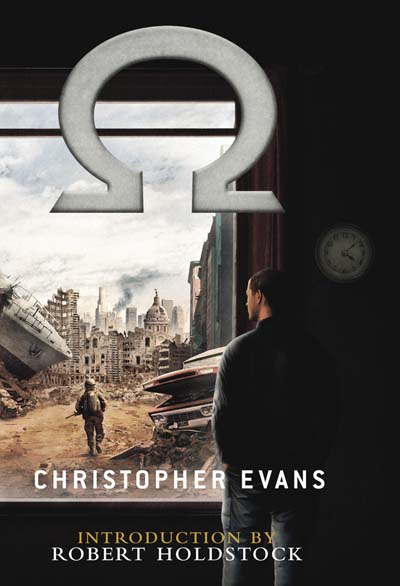
Books you must read: Omega, Christopher Evans

I’ve been a fan of Evans’ novels since reviewing his Aztec Century for Vector, the critical journal of the BSFA, back in 1993. His fiction is a literate, very British sort of sf, which doesn’t rely on flashy spectacle but on in-depth studies of their protagonists and their worlds. Omega, published in 2008 by PS Publishing and Evans’ first novel in more than a decade, is a case in point.

Owen Meredith is a maker of military history documentaries. One day while Christmas shopping with his wife and two daughters, a bomb explodes in Hamley’s. Meredith is outside and only injured in the blast, but his family are in the store and killed.

Major Owain Maredudd is an officer in an Allied army in a Britain that has been at war for over half a century. He had led a mission into enemy territory to test a new weapon, but something went wrong. Maredudd was the only survivor, and his memories of the mission are somewhat confused. As a result, he has been attached to his uncle’s staff. His uncle is the commander-in-chief of the allied forces in the UK and a member of the Joint Governing Council, the military junta that rules the Alliance. He is, in effect, the ruler of most of Europe.

When Meredith wakes in hospital after the bomb blast, he discovers first that at times he somehow inhabits Maredudd’s head, and so witnesses events in the major’s world. And secondly, Meredith’s memories of his life before the explosion don’t quite tally with the life he seems to now have. For a start, he is apparently in hospital because he was hit by a car while crossing the road. There was no bomb blast. And his wife left him several years before, taking the kids, and now lives in Australia.

As Meredith tries to figure out his life and pick up the pieces, so he comes to spend more time in Maredudd’s world. Maredudd himself is having his own problems as there seems to be something going on with his uncle to which he’s not privy but in which he is somehow involved. This is all to do with the secret weapon after which the book is titled. The Americans, once part of the Alliance, are apparently getting troublesome and the Omega weapon is intended to stop them.

Omega is not an easy book to do justice to. It’s an alternate history, inasmuch as part of the story is set in a world still embroiled in a world war. But it’s also much more than that. It’s a study of both Meredith and Maredudd, and their reactions to worlds they find it increasingly hard to fathom. While Meredith also has Maredudd’s world to explore, it’s implied that Maredudd is doing the same to Meredith. Certainly, there are periods when Meredith is strangely absent – though from others’ reactions it seems he continues to function as “normal”. The alternate UK is extremely well-drawn and very convincing, but it is the two protagonists who really carry the book. The writing is plain but elegant, the worlds of Meredith and Maredudd are portrayed with authority, and the novel is an engaging and surprisingly quick read.

I’m surprised Omega didn’t appear on any short-lists back in 2009. It’s certainly a better novel than the four that made it onto that year’s BSFA short-list – Aztec Century, incidentally, won the BSFA Award in 1994 – and it could have been a contender for the Clarke too. Recommended.


8 Comments

Larry’s Year

2012 is the centenary of Lawrence Durrell’s birth and there are apparently a number of things happening to celebrate it, including a conference in June. In bloody London, of course. But never mind. Lawrence Durrell is my favourite writer – see here and here – and on a purely sentence-by-sentence level I believe there has been no finer writer in the English language. Since pootling along to events in London is not that easy for me, I shall have to mark the centenary in my own way.

And the obvious way to do that is to read his books.

So, sometime during 2012, I am going to reread The Alexandria Quartet. And then The Avignon Quintet. And then The Revolt of Aphrodite. But first I need to get hold of the omnibus editions, as they were “improved” slightly from the original individual editions. I shall also read Durrell’s poetry. And whatever other bits and pieces of his writing that catch my eye.

And I shall blog about it all, of course.

Due to ongoing projects, none of this is likely to start until after Easter. In the meantime, here’s a link to my review of Durrell’s first novel, Pied Piper of Lovers, from 1935. The novel is from 1935, that is; not my review. Enjoy.


3 Comments

New Year, new books

It would have been nice if I could have made a New Year’s resolution to buy no books in 2012. But that was clearly impossible as there were a number of 2012 releases I wanted. I’ll just have to try and limit my purchases instead. Sadly, I’ve not been entirely successful in that regard – only one month into the year and look what’s been added to the bookshelves all ready…

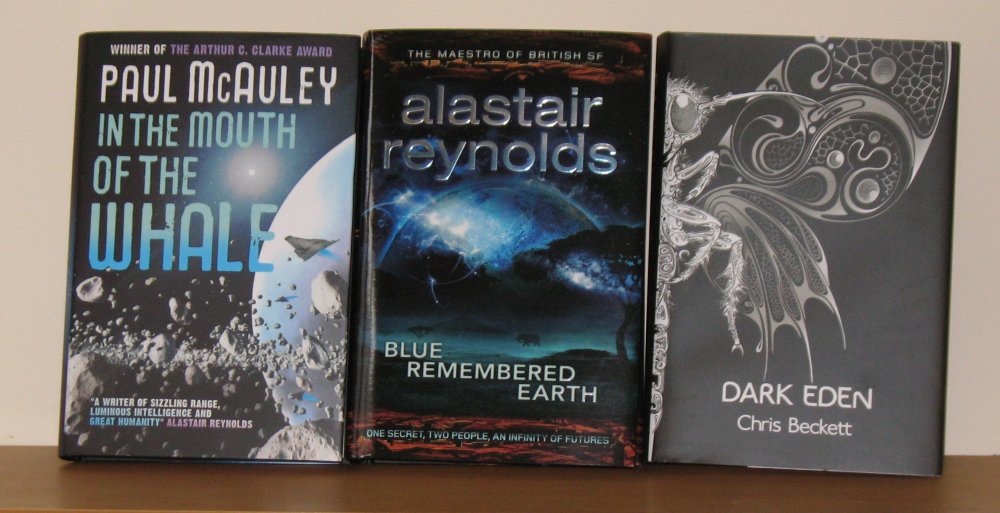
Three new releases: Blue Remembered Earth, Alastair Reynolds, In the Mouth of the Whale, Paul McAuley, and Dark Eden, Chris Beckett.

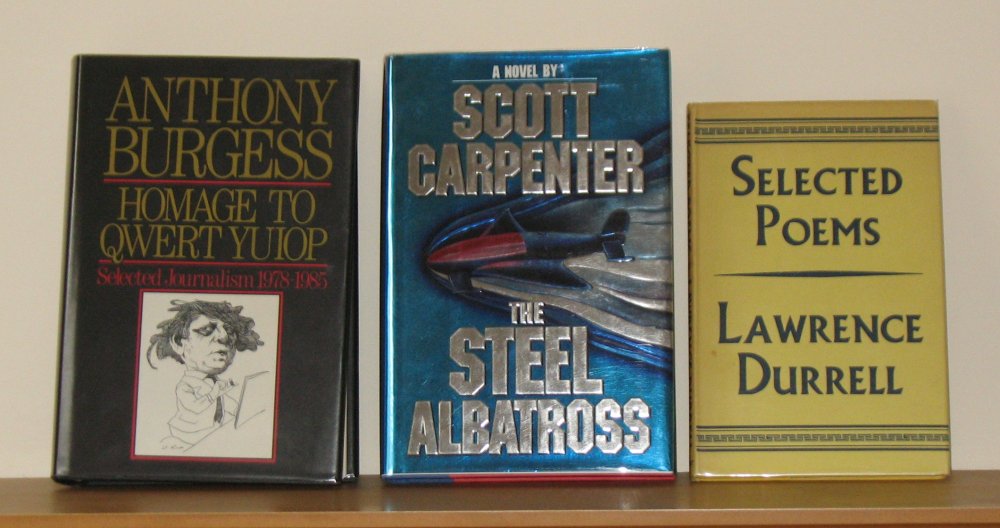
Three for the collections: Homage to QWERTYUIOP, Anthony Burgess, which is signed; The Steel Albatross, an underwater thriller by Mercury astronaut Scott Carpenter, which is also signed; and Selected Poems, Lawrence Durrell, from 1956, which is not signed.

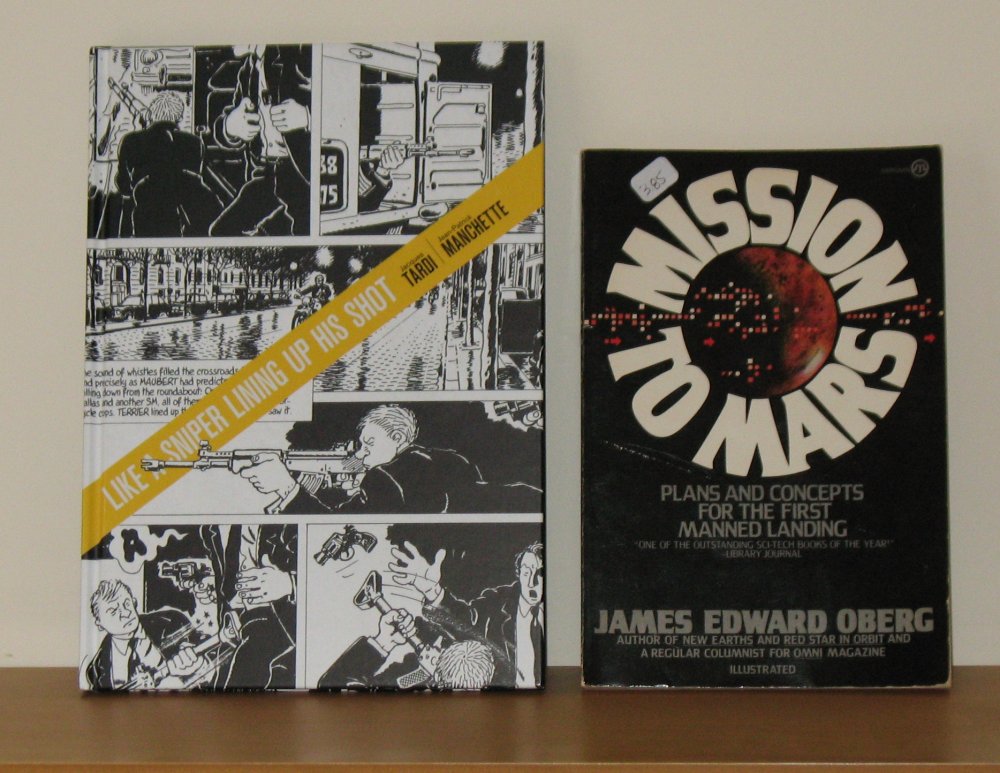
Another of Jacques Tardi’s bande desinée: Like A Sniper Lining Up His Shot is an adaptation of a French thriller novel and pretty good. Mission to Mars is for the Spacebooks collection, and also for research for a short story.

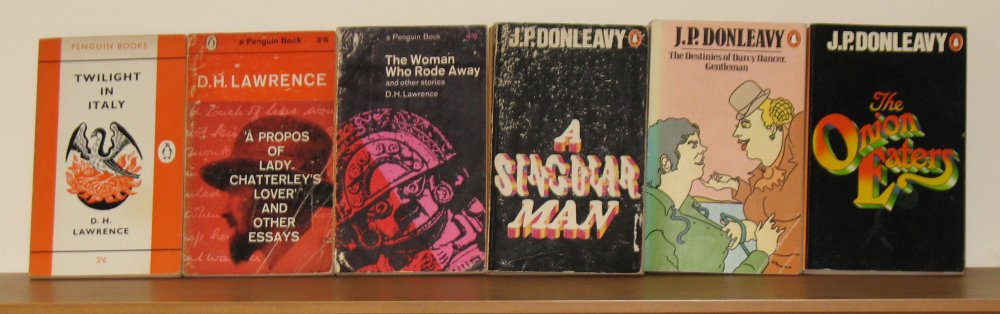
A bunch of paperbacks from my father’s Penguin collection… Twilight in Italy is travel-writing, ‘À Propose of Lady Chatterley’s Lover’ and Other Essays is, er, non-fiction, and The Woman Who Rode Away is a short-story collection. I think I have quite a lot of Lawrence on the TBR now. JP Donleavy, on the other hand, I have never read before and know very little about – so I’ll give A Singular Man, The Destinies of Darcy Dancer, Gentleman, and The Onion Eaters a go. He doesn’t appear to be in print in this country anymore.

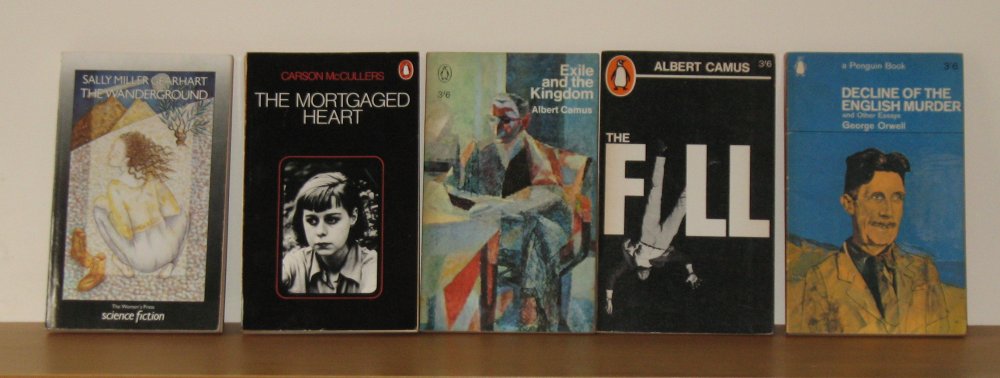
And more paperbacks from my father’s Penguin collection: another McCullers, The Mortgaged Heart, a collection, though I wasn’t that much taken with her The Member of the Wedding; a pair of Camuses (Cami? Camopodes?) Exile and the Kingdom and The Fall; and a collection of essays by Orwell, Decline of the English Murder. To the left is Sally Miller Gearhart’s The Wanderground, a Women’s Press sf paperback kindly donated to the SF Mistressworks collection by Una McCormack, for which much thanks.

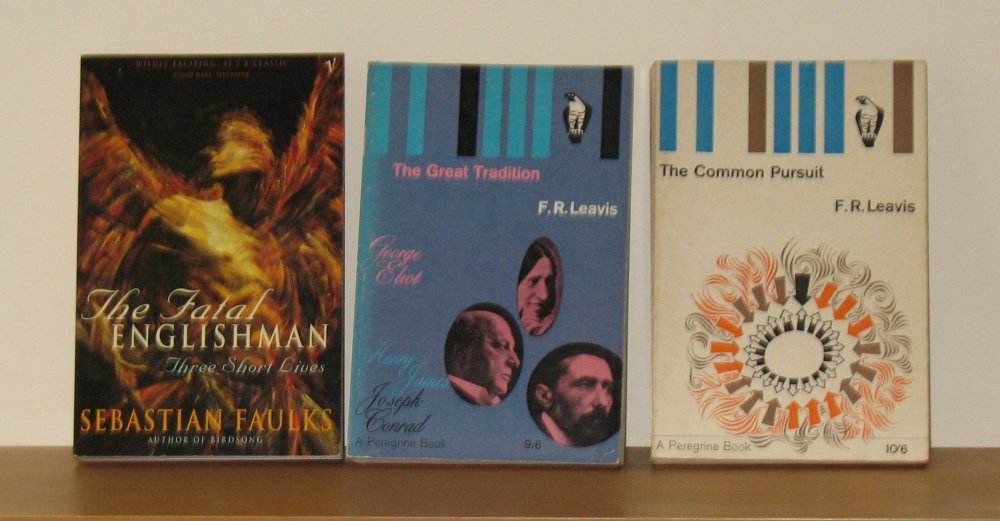
And three non-fiction works from my father’s collection: The Fatal Englishman by Sebastian Faulks is biography, of a sort; Leavis’s The Great Tradition and The Common Pursuit are both literary criticism.

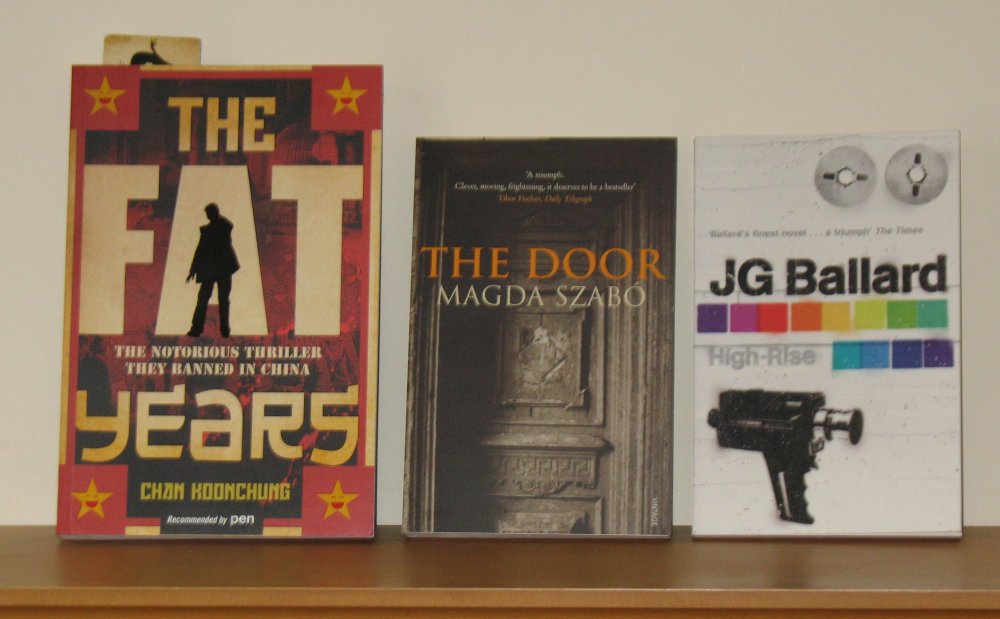
Two books for this year’s reading challenge – world fiction (see here): The Fat Years, Chan Koonchung, from China, and which you can see from the bookmark that I’m currently reading; and The Door, Magda Szabó, from Hungary. High-Rise joins the other nice 4th Estate paperback editions Ballards on my bookshelves.

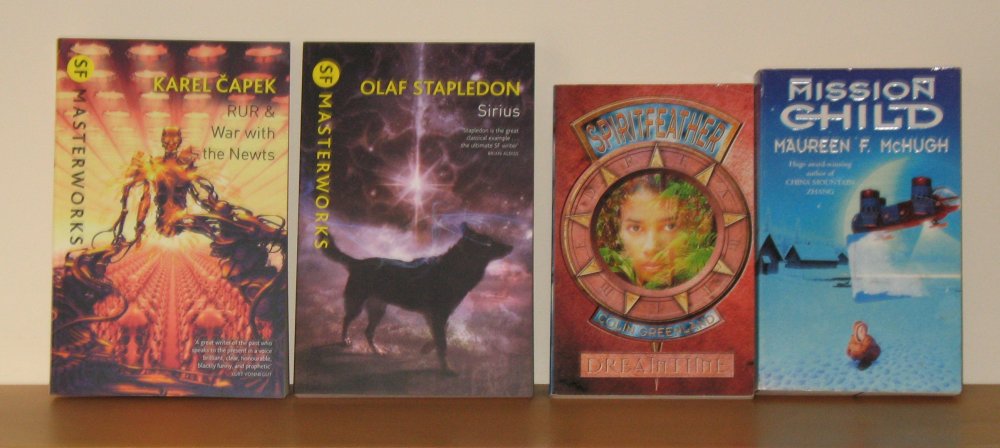
Some science fiction… A pair of SF Masterworks: RUR & War with the Newts, Karel Capek, and Sirius, Olaf Stapledon. Colin Greenland’s Spiritfeather, one of the volumes from the four-book Dreamtime YA series published in 2000. There was a bit of a fad for Brit sf authors contributing to YA series at that time – not just Dreamtime, but also The Web, which boasted books by Stephen Baxter, Ken MacLeod, Peter F Hamilton, Eric Brown and Pat Cadigan. And, finally, Mission Child, Maureen McHugh, a charity shop find I plan to review for SF Mistressworks.

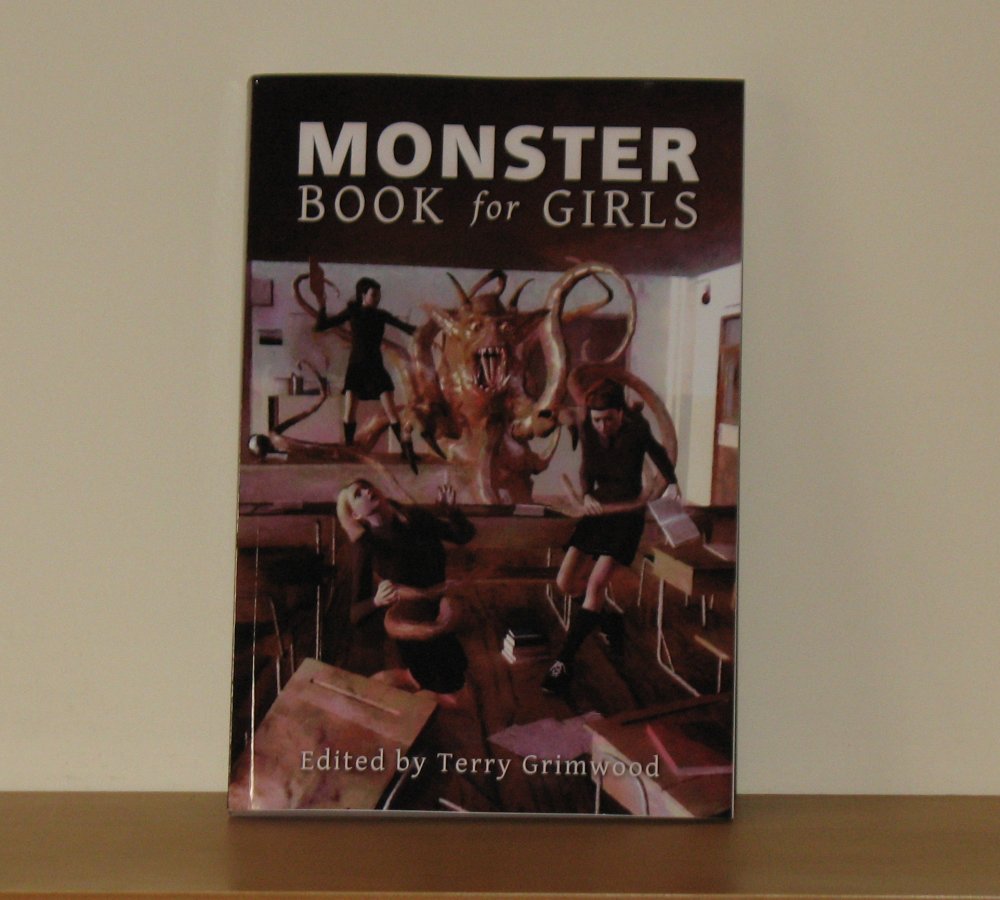
And here is The Monster Book for Girls, an anthology of dark fantasy and horror from theExaggeratedpress, which looks very nice indeed, but also…

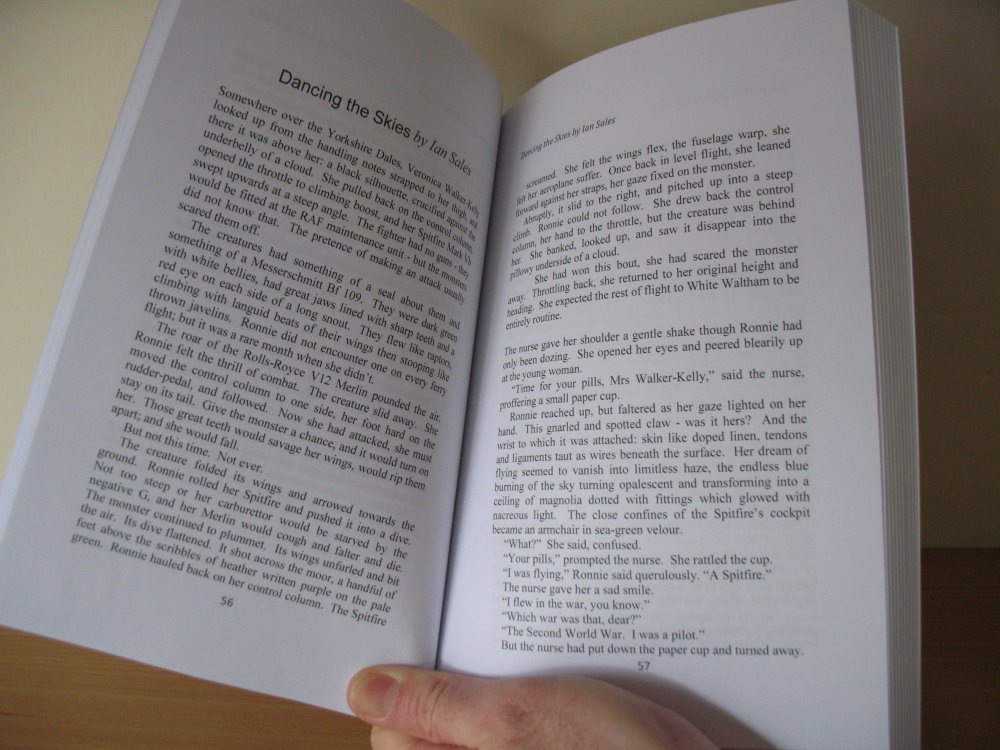
… contains my story ‘Dancing the Skies’, which is the ATA/Spitfire story, which required much research on the Air Transport Auxiliary and WWII fighters and bombers.


4 Comments

Films you must see: Red Psalm, directed by Miklós Janscó

I bunged Miklós Jancsó’s Red Psalm (1972) onto an order of Christmas presents at the beginning of December, though I can’t for the life of me remember why. I’d seen Janscó’s The Red And The White before – in June 2010, and wrote then that it was “definitely worth seeing” – but what possessed me to buy a Jancsó DVD is something of a mystery. Perhaps it was a review in Sight & Sound. No matter. I bought it. And now I’ve watched it.

I think I was expecting a paean to socialism when I put the DVD in the player. The title, and Jancsó’s politics, certainly suggest as much. Even the film’s original Hungarian title, Még kér a nép (The People Still Demand), fosters this impression. Except Red Psalm, while certainly a socialist film, is no paean. It is based upon a number of peasant uprisings in Hungary between 1890 and 1910, and melds these into a single extended dramatic piece – though it has no plot, no characters, and no dialogue per se.

There are the workers, represented by a group of young people in peasant costumes. And there are the authorities, represented variously by the rural police, a bailiff, the army, the local count, and a priest. Most of the cast have 1970s haircuts, which does make it look all a bit hippie. The film takes place at a rural farming community and the countryside surrounding it, though no effort is made to give the story any real sense of place.

The workers walk around, either singing folk songs (often with socialist lyrics) or making small speechlets about socialism. The soldiers and policemen also walk around (or ride around on horseback), trying to either intimidate or charm the workers. No one stands still, everyone moves. This “balletic” movement is a feature of Jancsó’s style. One soldier defects to the workers but is shot. Later, he reappears, as if resurrected. A worker is shot through the hand, but her wound becomes a red rosette. Later, all the workers wear such rosettes.

The local count attempts to explain the benefits of capitalism to the workers – though it is an unconvincing argument – but seems to die of a heart attack when his words fall on deaf ears. His wife subsequently attacks the workers with a whip. A priest exhorts the workers to obey the authorities, claiming it is the godly thing to do, but is forced back into his church, which is then set on fire.

Throughout Red Psalm, there is a sense of a story in continual evolution. Characters exchange roles, dialogue is declamatory or explanatory, but does not progress anything as bourgeois as a plot. At the end, the workers and soldiers come together to celebrate but, at a signal, the soldiers then separate, form a cordon about the workers… and massacre them. Tellingly, the cordon is in the shape of a heart.

But even that death is not final, as the workers later re-appear. And one takes a soldier’s gun, and then kills all the soldiers.

Red Psalm is an argument, framed in song, movement, political oratory and the interactions between opposing groups. If its young and good-looking cast make it appear more of a hippie film than a socialist one, it’s an illusion that is quickly dispelled. It’s perhaps not to everyone’s taste, but I thought it excellent and have even bought The Miklós Jancsó Collection box set. And I think more of Jancsó’s films should be released on DVD.


2 Comments

Books you must read: The Bender, Paul Scott

There are comic novels and there are novels of wit. Some novels evince humour by describing ridiculous characters in ridiculous situations; others prefer to amuse through their use of language. Paul Scott’s The Bender (1963) is a novel of wit and its characters, while amusingly drawn, are not comic caricatures. There is also much in the novel that points to Scott’s Raj Quartet, a use of language, voice and narrative that presages The Jewel In The Crown and its sequels.

George Lisle-Spruce is a wastrel. A relative left him a legacy of £10,000, which he cannot touch. But it does provide him with an annual income of £400. Initially, this was more than enough to live on, but by the beginning of the 1960s, George is finding it increasingly hard to make ends meet on his monthly allowance. And now his brother, a successful accountant, wants repaying the £200 he lent George years before. George spent the War in Cairo, and was never in combat. Since then he’s never held down a proper job. He has some charm, but never really made the most of it. And this is despite the best efforts of his Aunt Clara – who is not really his aunt, but whose husband it was who left George his legacy.

The Bender is told from the points of view of George, Aunt Clara, a real aunt who is on her death-bed, brother Tim, and youngest brother Guy (an Angry Young Man, with a play that has been broadcast on television to critical acclaim). The repayment of Tim’s loan precipitates a crisis in George’s life – though it is exacerbated by Clara’s renewed meddling, Tim’s impending change of career, and Guy’s success.

The writing in The Bender is a delight. It’s witty, the voices are handled superbly – though, one, Guy’s hippie chick girlfriend, feels somewhat forced – and a section two-thirds of the way through astonishes with its seamless post-modern blending of narratives and voices. The novel is also a pitch-perfect evocation of time and place, and feels throughout like a 1960s British black and white film starring Dirk Bogarde. Aunt Clara is perhaps the most amusing character – a forceful and opinionated dowager, with old school views about class and ability, views she has a habit of setting forth on tape:

…the Grundig’s microphone in one hand and, in the other, one of the Floris chocolates for which her lunchtime liquid slimming diet always gave her an appetite…

The Raj Quartet are novels of consequence. While The Bender may be somewhat inconsequential, it reaffirms my admiration of Scott’s writing. Fortunately, I have many more of his books to read. Recommended.


2 Comments

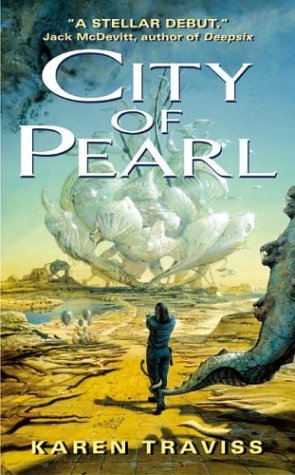
Women in sf reading challenge #10: City of Pearl, Karen Traviss

To be honest, I had not really expected to enjoy City of Pearl by Karen Traviss. From what I’d heard about the novel, it seemed the sort of science fiction I don’t especially like. And Traviss is known as an especially mercenary writer. No matter how talented she may be, such an attitude is unlikely to create works I would find appealing. Nonetheless, I picked the book as one of my dozen for my 2011 reading challenge, and though I may have slipped a little towards the end of last year, I had every intention of reading and blogging about the twelve listed novels.

And so I came to City of Pearl with, I admit, a few preconceptions. Some of them were indeed met, but I was surprised to find myself enjoying the novel more than I had expected.

Shan Frankland is a hard-as-nails police officer in a near-future in which corporations dominate ineffectual governments. All crops are genetically-engineered and trademark, such that no foodstuff can be grown without paying a license fee to a company. When Frankland is offered command of a mission to Earth’s only interstellar colony on Cavanagh’s Star’s second planet, she accepts the mission. But she doesn’t know exactly why, because whatever was told to her to persuade her to accept was part of a Suppressed Briefing, which only releases information into her memory in response to certain triggers.

The mission arrives at Cavanagh’s Star 2 and finds a situation it had not expected: a small low-tech human colony with an extremely small environmental footprint living under the aegis of an alien race, the wess’har. The aliens are actually native to Cavanagh’s Star 2’s twin planet, and are on Cavanagh’s Star 2 to protect that planet’s native squid-like aquatic race, the bezeri. Who had been almost polluted to extinction by a third alien race, the isenj, who had colonised the world. The wess’har wiped out the isenj colony, but now allow the humans to stay on sufferance. Aras is the wess’har responsible for the planet and its ecosystem, and he has been given this role because he has been infected by a native parasite, the c’naatat, which has made him immortal and almost impossible to kill.

Though Frankland tries to keep a tight leash on the scientific team she has brought to Cavanagh’s Star 2, they cavil at her restrictions and continually seek to subvert them. This makes tensions high within Frankland’s mission, a situation not helped by her high-handed and take-no-prisoners attitude. When a second starship from Earth turns up, having departed fifty years after the first, it seems Earth has formed an alliance with the idenj, who determined to take back Cavanagh’s Star 2. During a skirmish with the isenj, Frankland is mortally wounded, but Aras, who has come to value her, infects her with c’naatat. Now she can never return to Earth.

I liked Frankland, and the best parts of City of Pearl were the parts which focused on her. Unfortunately, the aliens are all single-note: the wess’har are literal and unbending, the bezeri are enigmatic, and the isenj are numerous. The scientists are all characterised as venal and selfish, and only the military characters appear to possess any redeeming virtues. The human colonists on Cavanagh’s Star 2 are treated like simple back-to-the-land peasants, and the novel makes little or no judgment on them or their way of life. A lot of City of Pearl is in Aras’ point of view, and he’s neither convincingly alien nor especially interesting.

There’s a fixity of views throughout City of Pearl which I found a little off-putting. The wess’har are very literal and do not compromise. Frankland is very much convinced her own opinion is always correct. The entire cast – with the exception of those Traviss villanises – are straight from the US mode of science fiction, with its Rational Competent Men. Though many in City of Pearl are actually women. Or alien. There’s no subtlety or complexity in the novel. The scientists are wrong, the isenj are wrong. And that’s it. I can see how such binary views might appeal to some readers, especially genre readers, since populist genre fiction seems incapable of psychological depth.

There are apparently a further five Wess’har books, but I’ll not be bothering to read them. While City of Pearl managed an interesting meld of near-future sf and space opera, it was too much like military sf in tone to really appeal to me. Traviss’s prose is readable and well-paced, though to be honest I kept reading more because I liked the character of Frankland than anything else.

Oh, and the titular city is the wess’har capital on their world, and it makes perhaps a half dozen appearances in the novel. Frankland visits it toward the end in order to seek permission from the wess’har elders to stay with Aras. It’s a somewhat peripheral element of the story with which to title it.


2 Comments

The Marching Morons

To all the people who read Liz Bourke’s review on Strange Horizons of Michael J Sullivan’s Theft Of Swords, and didn’t like the review because:

a) historians should not review epic fantasy
b) “intellectuals” should not review epic fantasy
c) women should not review epic fantasy
d) a negative review will upset the author
e) a negative review will negatively impact the author’s sales
f) popularity and quality are the same thing, as any fule kno
g) bad prose is better than good prose, as is demonstrated by any best-seller list
h) taking quotes from the novel “out of context” would make any author’s prose look bad
i) you read the book and enjoyed it so it can’t be bad
j) the book is meant to be “fun” and “light reading” so it can’t be bad
k) a negative review is obviously not objective since you disagree with it

Congratulations. You are officially stupid. If you want to know why genre fiction is not taken seriously, go and look in the mirror.