It Doesn't Have To Be Right…

… it just has to sound plausible


8 Comments

More Catching Up With The Challenge

October’s book for my 2008 Reading Challenge was Ford Madox Ford’s The Good Soldier. Like many of the books I chose for my challenge, I knew almost nothing about it. I knew it existed; I’d probably seen mention of it in various places, not to mention catching sight of it on the “classics” shelves in my local Waterstone’s. But I knew nothing about Ford – who he was, what part he played in English literature, or even what was the general reputation of The Good Soldier. And that’s one reason why I chose it. The other reason is that it’s a slim novel – I’d have liked to try a James Joyce novel, and I have a copy of Ulysses… but it’s huge (I also own Anthony Burgess’ Here Comes Everybody, his study of, although there’s little point in reading about, unless I’ve read Joyce, Joyce, Joyce*).
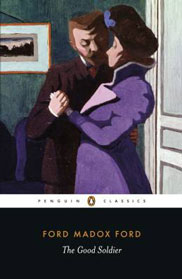
However, The Good Soldier

The novel is set just prior to World War I and is narrated by John Dowell, a wealthy American mostly resident in Europe. He and his wife, Florence, spend several months each year at Nauheim, a spa in Germany. While there they’re chiefly in the company of another couple, Edward and Leonora Ashburnham, who are English. Edward is the good soldier of the title. Dowell’s narrative skips about in time, describing incidents in no particular order from the decade or so during which the Dowells and Ashburnhams are friends. What Dowell does not initially reveal – although it’s later clear that he knows it at the time he is recounting the story – is that Edward is a philanderer and having an affair with Florence. And she has also had a succession of lovers – beginning with a blue-collar thing, Jimmy, whom she was sleeping with when she married Dowell.

As The Good Soldier progresses, Dowell reveals more and more of the peculiar dynamics between the two couples. When Florence learns that Edward has fallen in love with Nancy Rufford, the ward of Edward and Leonora, she commits suicide. Edward also commits suicide later, when Leonora sabotages Nancy’s burgeoning love for him.

Ford originally titled the novel The Saddest Story, and Dowell repeatedly describes the story as the saddest he knows. Perhaps too often. I can understand how a chronologically non-linear narrative might have been seen as something new and astonishing in 1915, when the book was first published, but it’s an unremarkable technique nowadays. The same is also true of using an unreliable narrator (if you’ve read anything by Gene Wolfe, you’ll be only too familiar with unreliable narrators). Which means that much of what’s interesting about The Good Soldier is no longer the case. The book does, however, give a good indication of what life was like for wealthy Edwardians – for example, Edward is almost sent to prison for kissing a maid on a train. That “consorting with the lower classes” was a crime then seems completely bizarre.

Ford’s maintenance of Dowell’s voice throughout The Good Soldier is impressive. Not once does he let his character slip. Unfortunately, far too much is told rather than shown. I suppose in part that’s the nature of a recounted narrative. It’s also perhaps the fashion of the time. But it reads somewhat distant to a modern reader.

In all, I find it hard to consider The Good Soldier as good as its reputation. I enjoyed reading it, and it’s a clever evocation of Edwardian England. But its two innovations – a non-linear narrative and an unreliable narrator – are neither as remarkable as they were in 1915. It’s by no means a difficult read, although it is difficult to care about the characters – which is hardly unsurprising, given that they’re hardly pleasant people. “Good people”, perhaps, but not pleasant. Having said that, I think I rate The Good Soldier higher than some of the books I’ve read during my challenge. But The Jewel in the Crown remains the highwater mark, and A Question of Upbringing a distant second.

* to spoof Burgess’ infamous: “He breathed baffingly on him, for no banquet would serve, because of the known redolence of onions, onions, onions” in Enderby Outside.


1 Comment

Walking the Same Road?

One of the things which really annoys science fiction fans is non-sf authors writing science fiction novels but refusing to admit they have done exactly that. There have been plenty of examples – PD James’ The Children of Men, Maggie Gee’s The Ice People (of which Jeremy Paxman said it couldn’t be science fiction because it was good), and pretty much anything by Margaret Atwood which doesn’t feature “squids in space”…

Of course, the reverse is also true to some extent. We fans of science fiction are happy to claim for the genre works which we feel fit the genre’s remit, even though they were not written by sf writers, or even identified as sf by their authors. Such as George Orwell’s Nineteen Eighty-Four or Anthony Burgess’ A Clockwork Orange. Admittedly, Burgess was not unfriendly to sf – albeit not as friendly as Kingsley Amis or Michael Chabon – but he preferred to think of it as “futfic”.

Which brings us to Cormac McCarthy’s The Road.

It’s a mainstream novel by a mainstream author. Literary fiction, if you will. It won the Pulitzer Prize for Fiction, and the James Tait Black Memorial Prize. And yet comparisons with sf novels are inevitable – George R Stewart’s Earth Abides and Walter M Miller’s A Canticle for Leibowitz, especially.

Incidentally, I dislike the term “literary fiction”. It’s mis-used too often as a genre tag, a handy way to label fiction some people don’t like. So rather than being descriptive, or perhaps even aspirational, it becomes a barrier, a shorthand for “I won’t read this book because I read a book once that wasn’t a simple escapist tale and I didn’t like it, so all books like it must be rubbish”.

I prefer to think of fiction as occupying a scale similar to food. At one end you have fast food – junk reading, intended to entertain but doesn’t require much thought. At the other end, you have gourmet reading – prose to savour, books to think about after you’ve finished them, products of great talent and skill. And, of course, there’s everything between those two extremes.

But The Road… Comparisons to sf are inevitable because of The Road‘s subject. It is a post-apocalypse novel. Something destroyed civilisation, and most of the life on Earth, years before. A man and his son walk from somewhere in the north of the United States towards warmer climes at the coast. En route they encounter other survivors – some have turned to cannibalism, others to violent tribalism. But there is no hardy community of back-to-nature survivors.

Few sf novels, even ones about the end of the world, are as bleak as The Road. Perhaps that’s because science fiction – despite much discussion of late claiming the contrary – is an inherently optimistic genre. It takes as axiomatic that problems can be solved, that phenomena are open to explanation. It’s pure optimism to assume – to operate on the assumption – that the universe is explicable. And malleable. And part of the bleakness of The Road stems from its refusal to explain the cause of the apocalypse.

In fact, there’s very little in the way of explanation in The Road. The man and the boy are not even named. The man also displays knowledge from a variety of fields – medicine, engineering, woodcraft – but his background is never described.

And then there’s the prose. Which is a great deal better than that you’d expect to find in a sf novel. There are indeed well-written (gourmet, so to speak) sf novels, but the genre is not known for the quality of its writing for good reason. McCarthy’s prose is spare, often stark – frequently forgoing even verbs – and is as responsible for the novel’s sense of bleakness as its dour premise. Some of it works really well:

The soft black talc blew through the streets like squid ink uncoiling along a sea floor and the cold crept down and the dark came early and the scavengers passing down the steep canyons with their torches trod silky holes in the drifted ash that closed behind them silently as eyes.

Some is less successful: the occasional odd verb, such as “… glassed the valley below them with the binoculars” or bizarre terms like “the snow lay in skifts all through the woods” and “the snow stood in razor kerfs atop the fencewires”. Skifts? Kerfs?

McCarthy’s punctuation is also… odd. Paragraphs are formatted as they would be on-line, with no indents and a line or two of space between them. But dialogue in a single paragraph is indented, and does not use inverted commas. This lack of quotation marks does somewhat distance the speech, which may have been the intent. McCarthy clearly doesn’t want the reader to get too close to the man or the boy. Or he would have named them.

I can think of no good reason, however, why he chose not to use apostrophes for certain constructions. The apostrophe is there in “there’s” and “they’re”; but not in “wont” or “cant” or “wouldnt”. I don’t understand the logic in not using it only for the elided “o” in “not”.

The Road is a very good novel indeed. But, despite its prizes, despite its acclaim, despite the film being made of it, The Road is not an important novel. It will not alter the way we think of post-apocalypse novels, it will not affect the relationship between sf and mainstream literature. At least, it will certainly not do that within the genre. Perhaps non-sf readers might think differently, but I suspect not.


7 Comments

2008 Reading Challenge: The One That Made It All Worthwhile

I’m still a bit behind with this year’s reading challenge, but I’m slowly catching up. For September’s book, which I didn’t actually start until this month, I picked The Jewel in the Crown by Paul Scott. Like most Brits my age, I have vague memories of the ITV adaptation from 1984. Other than that, I knew little about the book, or its author. And it’s unlikely that would have changed… if I hadn’t found all four books of The Raj Quartet going for £1.38 for the lot in a local charity shop, and thought they might be worth a go.

I should have come to Scott sooner. My favourite non-genre writers are Lawrence Durrell, John Fowles and Anthony Burgess, all British post-modern literary writers who came to prominence in the first two decades of the latter half of last century. As did Scott. There are other similarities – all four spent time abroad and later set fiction there: Burgess in Malaysia (The Long Day Wanes); Fowles in Greece (The Magus); Durrell… well, take your pick: he was a professional expat and set novels pretty much everywhere he lived; and Scott, of course, in India. Further, all four are known chiefly by the general public for only one of their works – The Raj Quartet for Scott, A Clockwork Orange for Burgess, The French Lieutenant’s Woman for Fowles, and The Alexandria Quartet for Durrell.


But on to the book itself.

Not having read anything by Scott before, I’d expected a relatively traditional narrative, something like EM Forster’s A Passage to India, perhaps. But the first page proved me wrong. Rather than pull the reader into the story of The Jewel in the Crown, Scott explains it: “This is a story of a rape, of the events that led up to it and followed it and of the place in which it happened.” The next forty pages then relate the life of Miss Crane, who moved to India as a governess in 1907 but stayed on when her employers were posted back to Britain. She became a teacher in the mission schools and, by the time the rape occurs in 1942, she is Superintendent of Schools in Mayapore, where The Jewel in the Crown is set. But she doesn’t actually have anything to do with the rape.

But then neither does Lady Lili Chatterjee. Or Sister Ludmilla. Or Mr Srinivasan. Or Brigadier Reid. Or Duleep Kumar. Yet these are all viewpoint characters in The Jewel in the Crown, and it is through them, and their stories, that Scott builds up a picture of the events sparked off by the rape of Daphne Manners by a group of Indian men. These viewpoints are written in a variety of narrative styles. Some are third person, some are first person. Some are presented as the spoken recollections of a character – and Scott’s handling of each character’s voice is impressive – to an unnamed listener. There are some lovely bits of prose, such as :

With all the chicks lowered the house is dark and cool even at midday. The ceilings are very high. In such rooms human thought is in the same danger as an escaped canary would be, wheeling up and up, round and round, fluttering in areas of shadow and crevices you can imagine untouched by a human hand since the house was rebuilt by MacGregor.

The Jewel in the Crown is by no means an easy read. Scott maintains voice so rigorously that the narrative rarely sticks to the story, and often detours into areas – such as the backgrounds and characters of his cast – which do not actually advance the plot. Duleep Kumar, for example, is Hari Kumar’s father, and Hari is one of the men accused of Daphne’s rape. Duleep’s story explains Hari – the Indian who is more English than the English – but it’s peripheral to the story.

Of course, India is as much a character in the book as Hari, Daphne and the others. It is represented by the invented city of Mayapore. Scott has not stinted on the details, nor on the thoughts and feelings of each of the various characters to the town and the country. The most damning is Hari, an Indian brought up in England and educated at the best schools, who does not feel Indian, but is treated as such. He thinks of himself as invisible: too Indian for the English, too English for the Indians. He’s the pivot about which the plot of The Jewel in the Crown revolves.

The Raj Quartet has been criticised for perpetuating prejudices and racial stereotypes. In a 1984 essay ‘Out of the Whale’, Rushdie pointed out that if Daphne Manners’ rape was a metaphor for the British exploitation of India, it should have been the rape of an Indian girl by white men. Which completely misses the point. The Jewel in the Crown is not about the exploitation of India. Scott is not writing about the Indian experience, about being Indian under the Brits. He is writing about two societies crashing together, each driven by an imposed agenda. The rape is merely the trigger for the reactions of the characters in the book, and those reactions are specific to those involved.

Nor is it surprising that The Jewel in the Crown perpetuates racial stereotypes. The story is told through its characters, and it is their sensibilities which are on display. Miss Crane, Brigadier Reid, Sister Ludmila, and Daphne Manners are all white. Brigadier Reid, for example, is offensively patronising because he epitomises the attitude of his generation of India hands. A reader who doesn’t understand that is missing the point. If Scott wanted to depict a balanced viewpoint, he would not have used Reid.

Now, obviously, my perspective on The Jewel in the Crown is going to differ from Rushdie’s. But I’m not reading it as a Brit, I’m reading it as a British expat – or rather, an ex-expat – who grew up in the Middle East as a “privileged white”. Of course, the parallels are not exact; the Gulf was not the Raj. Also, by the late 1960s / early 1970s, attitudes and sensibilities had changed a great deal. But I went to English speaking schools (I’m a founding pupil of two English speaking schools in the Gulf), I mixed with other European kids, and I rarely if ever socialised with Arabs or people from the Indian subcontinent. When I returned to the Gulf to work in the early 1990s, things were different. At one point, I was the only Brit in my employer’s Systems Development department (and I was also the only male). And yet in many respects, things had not changed: when I asked an Indian colleague why she was filling in a membership form for a bar, she told me it was so she wouldn’t be turned away at the door. I replied that I’d never been refused entry. “You’re white,” she said.

There is a particular British expat experience which The Jewel in the Crown (and Durrell’s The Alexandria Quartet) both make use of. Neither mirrors precisely my own experiences growing up in the Gulf, but there’s a… shape in the text, in the life and interaction of the characters which comes close to emulating it. It’s not as arrogant as:

In his heart he also shares with that old ruling-class of English he affects to despise a desire to be looked-up to abroad, and shares with them also the sense of deprivation because he has not been able to inherit the Empire he always saw as a purely ruling-class institution.

… But there is certainly a shadow of Empire colouring the experience, as well as an understanding of Britain which is filtered through the perceptions of those who were once ruled by it. It’s Britishness informed by the culture of its surroundings, a microcosm of Britishness – almost a siege-mentality in some respects – but one which has subsumed some aspects of its environs. It no longer maps directly onto the culture of Britain. It’s an experience I suspect is slowly vanishing as the world grows “smaller”. Since the alternative appears to be McDonald’s, Cocoa-Cola and Hollywood, then I’m not convinced its disappearance is a good thing.

Of the books I’ve read so far this year for my reading challenge, The Jewel in the Crown has easily been the best. I certainly plan to read the remaining books in The Raj QuartetThe Day of the Scorpion, The Towers of Silence and A Division of the Spoils. And I shall be adding Paul Scott’s other novels to my wants list. Oh, and I want to watch the television adaptation again.


10 Comments

Ahead of His Time?

Since one Stephenson has been reviewed and interviewed just about everywhere recently, I thought I’d be deliberately perverse and post an old review of a novel by an entirely different Stephenson.

In the late 1970s, Orbit published two novels by Andrew M Stephenson. The first of these was Nightwatch in 1977. While it initially seems very much a British science fiction novel of its time, it did promise a career to watch.

Dan Frome is a British engineer sent to Dvornik Moon-base in 2006 to oversee the installation in Jupiter probes of the artificial intelligences he’s invented, the Golems. But this, it transpires, is just a cover story. An alien spaceship has been detected en route to Earth. Frome’s Golems will actually be going into weapons platforms sent out to intercept the alien craft. And everyone on the Moon is stuck there for the duration. The inhabitants of Dvornik are not happy about this involuntary exile, especially since Earth itself is on the brink of war. By the time the weapons platforms are ready and in place, their homes could well have gone up in smoke.

Various secret factions within the Moon-base try to recruit Frome. Or kill him: he narrowly escapes one attempt on his life. Making matters more complicated is Frome’s belief that his Golems are not capable of the job for which they are being used. There is a fundamental flaw in their thought processes. Frome manages to persuade his superiors that someone has to accompany the weapons platforms, and be there with them to oversee the Golems. He is the only man for the job.

At which point, the narrative of Nightwatch abruptly shifts from its earlier first-person to third-person. Frome is sent out with the weapons platforms to Jupiter orbit. The alien craft draws near. One by one, the Golems malfunction. Frome brings them back on-line, and succeeds in returning enough functionality to them so they can attack the alien. But the weapons platforms seem to have no effect.

Up to this point, Nightwatch could best be described as 1970s hard science fiction. Perhaps more literate than others of its ilk – as testified by its first-person narrative, and the switch to third-person – there was little in Nightwatch‘s story which differentiated it from similar novels of its time. But the aftermath of the attack on the alien craft marks an abrupt change in science fiction mode. The alien, Frome learns, is a trader, and it carries a portal linking it to a vast galactic transport network. Frome passes through this portal… and discovers a galaxy rich in life, with a civilisation so old that its beginnings are long forgotten. No one, in fact, remembers who built the original transport network. There are echoes of 2001: A Space Odyssey in this, but there is also something about the concept which reminds me more of late 1980s and early 1990s science fiction by the likes of David Brin, or William Barton and Michael Capobianco.

Frome returns to Earth in the alien craft. The narrative returns to first-person. Earth has destroyed itself, but Dvornik Moon-base still survives. However, the planet can be rebuilt with the alien traders’ help.

I’ve no idea what reception Nightwatch received in its year of publication, but I would guess that it didn’t compete well with much of what was being published at that time. Compared to The Mote in God’s Eye, or Ringworld, it is too considered a novel, too British in tone, too dour, to have proven popular. Where US authors were writing shiny happy futures, infused with can-do optimism and an almost combat-engineering approach to problems and difficulties, Nightwatch is a story set in a decaying future, the end of Empire, where solutions are cobbled together from bits and pieces that used to be parts of something else that once upon a time worked…

Until that odd shift to space opera and pan-galactic civilisation.

While this shift fits within Stephenson’s story, it’s certainly not signalled by anything which has gone before. The mix of dour hard SF and optimistic space opera works well – and there’s a nice dichotomy at work, in the appearance of these galactic saviours as Earth bombs itself into oblivion – but only a persistent reader would get far enough to discover this.

Perversely, I think Nightwatch probably reads better now than it did thirty years ago. With a little updating, Nightwatch would not appear out of place on the science fiction shelves of today’s book shops. Which may be why Stephenson wrote only a pair of novels before falling silent. He was ahead of his time.

A shame.


10 Comments

Days of Future Past

A couple of weeks ago Niall Harrison wrote about Gwyneth Jones’ Kairos on Torque Control. Since I’ve long admired Jones’ fiction, I thought I’d do something similar and post a review of her 1986 novel Escape Plans. This review is actually a few years old, but never mind.

I consider Gwyneth Jones one of the best British science fiction writers currently being published. So it shouldn’t really surprise me to discover how good her novels are whenever I reread them. Escape Plans I first read in the late 1980s, probably soon after reading and falling in love with Kairos. When I came to this reread, I had not forgotten the story – a member of an orbital-based elite is trapped amongst the Nineteen Eighty-Four-ish drones of the “underworld” (Earth) – and I’d remembered the invented acronymic language which peppered the text. What I had forgotten was how well-written the novel was, how well-designed its background, and how… well, perhaps “clumsily-plotted” is too strong a term: but the story does seem to bounce from incident to incident, revelation to revelation, without actually come to anything more than a purely personal resolution.

ALIC (apparently a computer acronym, but it’s not in my OUP Dictionary of Computing) is a VENTURan, a member of a space-based society. VENTUR had originally been set up to colonise other star systems, but it never left the Solar System. And then the VENTURans ended up saving the Earth’s population from itself. ALIC (pronounced “Aeleysi”) is enjoying a holiday on Earth at SHACTI, Surface Habitat Area Command Threshold Installation, a planetary facility for the VENTURans. It is located on the Indian subcontinent. At a party, ALIC meets Millie Mohun, a bonded labourer jockey, who appears to be wearing a forged identification tag. The Earth’s population are, bar a minority of ruling “enableds”, all bonded labourers or “numbers”. Millie spins ALIC some story about being blackmailed into wearing the false tag; ALIC decides to help her. To this end, she infiltrates the numbers in SHACTI’s Sub Housing (the numbers’ underground hive-like city). Unfortunately, she soon finds herself trapped as a number, her VENTURan identity lost to her. And then a portion of the Sub number population rebels against their masters and the systems that maintain their habitats…

The plot of Escape Plans seems initially inspired by the story of Orpheus, who ventured into the underworld to rescue his wife Eurydice from Pluto. It is, after all, the vague feelings of desire for Millie which motivate ALIC to set out on her ill-considered journey. However, not content with this, or with Escape Plans‘ departure from the myth when ALIC (now Alice) finds herself trapped as a number, Jones adds a further twist to the plot. Millie Mohun, many of the numbers believe, is immortal. As the story progresses, yet another myth takes this one’s place: Millie Mohun is an alien, come to Earth to deliver the multitudes from servitude. The VENTURans had already discovered that Earth is trapped in a bubble-universe, and the only world in it with life. Millie, the numbers claim, is from outside, and part of her message is to lead humanity to the galactic confraternity which exists beyond the bubble-universe.

It is perhaps an unnecessary complication of a story which is not all together easy to parse in the first place. The setting, the use of an acronymic language, the mentions of the myriad systems, the deliberate confusion between the systems’ real and virtual locations, and the metaphors used by the Earth’s populace in explanation of this… all serve to richen and partly obscure the story. Happily, the prose is so well written, it pulls you along with the plot.

That Jones is familiar with India (I believe she’s visited the country several times) shines through Escape Plans. For one thing, the novel’s matriarchal society strikes me as a deliberate irony. In rural Indian society, females are considered a drain on family resources: girl children must be married off and dowries paid. Boy children, on the other hand, will grow up to become contributing members of the family. In Escape Plans, it is the men who are entirely useless. The Earth culture is based upon the use of humans as processors in the pervasive computer systems which run life support, law and order, communications, etc. But only women can perform this role. Men cannot do it. This is a motif Jones has used many times: the society of her Divine Endurance and Flowerdust is matriarchal; and she also turns the tables on gender roles in her Aleutian trilogy.

Having read Jones’s later works, it seems to me that her depiction of technology in Escape Plans also echoes her use of it in later novels. The acronymic language used in Escape Plans disguises this somewhat, but the systems of the book are based upon a computing model which is probably more familiar now than it would have been in the mid-1980s. Escape Plans‘ systems are distributed and pervasive. Their real location, as opposed to their virtual location, is an important plot-point. They interconnect in a fashion not unlike the Internet – which predates Escape Plans by a couple of decades, but did not really become ubiquitous until the early 1990s.

I opened this piece on Escape Plans by stating my high regard for Jones’s writing. It’s an opinion I’ve continued to hold with each book of hers I’ve read – or re-read. Escape Plans was certainly worth a second look.


5 Comments

Shiny Happy Science Fiction

Back in July I listed 20 British SF Novels You Should Read. One of the titles on that list was Chronicules by DG Compton. Here is a review of it, offered in part as an antidote to all those blog posts about science fiction being doomy and gloomy. If miserable sf gives us books such as this, and happy optimistic sf gives us the likes of, well, Asimov… then I know which one gets my vote. Read it and wince.

DG Compton’s Chronicules has one of the all-time great opening sentences:

About twenty years before this story begins – give or take a few years, the Simmons s.b. effect being untried and seriously (not that it mattered) inaccurate – the desolate silence on Penheniot Village, at the top of Penheniot Pill which is a creek off the small harbour of St. Kinnow in the county of Cornwall, was shattered by the practised farting of young Roses Varco.

But then the book was originally published under the title Hot Wireless Sets, Aspirin Tablets, the Sandpaper Sides of Used Matchboxes, and Something That Might Have Been Castor Oil, so this is not entirely unexpected. Neither title – the original unwieldy one, nor the later more science-fictional one – actually provides much clue to the story. If anything, both are somewhat misleading. (Weirdly, the later title was slightly altered for publication in the US to Chronocules.)

According to the blurb, Chronicules is a grand adventure through time. It isn’t. Nor is it a cutting-edge discussion of temporal research. The time travel bookends the actual story, which is more concerned with life in an artificial research village in a Britain slowly falling apart. Further, there’s a nastiness to Chronicules of which only the British seem capable. Americans don’t do it, don’t cut and belittle their own creations. Irony may be a high-minded alternative, but it doesn’t have sarcasm’s scalpel-like edge: wielded inexpertly, irony is at best blunt-force trauma.

A lack of sarcasm in a novel is not necessarily a bad thing: a writer being unnecessarily cruel to his or her own characters often seems like torturing defenceless children. And in Chronicules, Compton has loaded the odds in his favour: his chief protagonist is mentally retarded. Which only emphasises the novel’s intrinsic cruelty. Further honing the blade is the setting’s custom of public nudity: Compton dwells cuttingly on the physical unsuitability of various characters showing their sagging flesh and dangly bits. There are some quite disturbing images, certainly enough to turn you off nudism.

The characters are well-drawn, and wholly unlikeable. Varco, the central character, is entirely ineffective, and those characters which do have some impact on the plot have more hang-ups than positive qualities. Compton’s future UK is miserable and reads almost prophetically like the Britain of the Tories during the eighties. While some science fiction novels may attract through their settings – Banks’s Culture, or Varley’s Eight Worlds, for instance – Compton’s near-future UK only repels. In fact, the only thing to really like about Chronicules is its writing. The prose is a joy to read.

Finally, the last page of Chronicules, after the end of the story, in the Arrow paperback edition I read is headed “Other Arrow Books of interest:”. It is otherwise blank…


3 Comments

2008 Reading Challenge – August’s late entry

I didn’t read a classic book for 2008 reading challenge in August because I volunteered for a group read of Gene Wolfe’s The Book of the New Sun. I had a book picked out, but just didn’t get around to starting it. But now I’ve read it.

The book was My Family and Other Animals by Gerald Durrell.

I’m a big fan of Lawrence Durrell’s writing (see here), but I’ve never read anything by his brother Gerald. This is not so surprising – Gerald Durrell is a naturalist, and that’s a topic which has never interested me. But. My Family and Other Animals is generally considered a classic, and is even included in the Essential Penguins series.

After one too many miserable summers in the UK, the Durrell family – Larry, Leslie, Margo, Gerry, Mother and dog, Roger – decamp for sunnier shores. On the advice of a writer friend of Larry’s, they settle on the island of Corfu. My Family and Other Animals chiefly details ten-year-old Gerry’s explorations of the island and its fauna, but many family incidents are also recounted. When Larry freely offers invites to his friends and acquantainces, and several decide to accept, the family moves to another villa, large enough to accommodate guests. When Great Aunt Hermione declares an intention to visit, the family moves to a smaller villa in order not to have to put her up. In between, we have descriptions of the island, the insects and animals Gerry collects, and the people he meets.

The first thing to note about this book is that it’s funny. Durrell has an eye for idiosyncracies, and a nice turn of phrase when describing them; although he does have a tendency to characterise people as grotesques rather than as realistic people. The same is true of his family – there’s something a bit clichéd about them all: Larry, the sarcastic older brother; Leslie, monomaniacal about guns and hunting; Margo, the sister who mangles proverbs and aphorisms; Mother is harried, somewhat absent-minded, and very forgiving. But it’s these characterisations which lead into the humourous episodes, so it seems a bit churlish to complain.

One of the reasons I picked My Family and Other Animals was because it features Lawrence Durrell (I’ve yet to read Ian McNiven’s giant biography). Admittedly, Larry doesn’t come across too well in the book. In fact, he seems a bit of a self-important prat. He has a bad habit of insisting that other’s achievements are hardly remarkable as they’re no more than the result of applying intelligence and sense. So when Leslie tells how he shot two doves with a “left-and-right”, and Larry claims anyone could have done the same, he is argued into proving it. With entirely expected comic results.

However, there are things which are not so good about My Family and Other Animals. It was first published in 1956, but actually describes the years 1935 to 1939. Some of the attitudes and sensibilites seem odd, if not offensive, to a modern reader, although they were common at the time. There is, for example, a blithe casualness to disturbing wild animals in their habitat which is no longer acceptable. Having said that, Durrell’s treatment of the people he meets is never less than affectionate.

Also, Durrell’s prose is a bit like a child’s birthday cake – he has a tendency to over-ornament. He’s at his best when he keeps it simple – and that’s usually when he’s describing a family incident. Some of the writing about flora and fauna is so over-laden with colourful adjectives, it slows the narrative to a stumble. Again, the book is over fifty years old, and tastes change.

Of the eight books I’ve read to date for this year’s reading challenge, My Family and Other Animals is certainly one of the better ones. Perhaps Anthony Powell’s A Question of Upbringing was a better book, but I did enjoy My Family and Other Animals. I don’t expect to read more of Gerald Durrell’s books, however. I think I’ll stick to Lawrence Durrell.


7 Comments

New Sun – Old SF?

Over the past couple of weeks, I’ve been rereading Gene Wolfe’s The Book of the New Sun as part of a group read on LibraryThing. I first (and last) read the tetrology back in the mid-1980s.

It’s been an interesting experience.

The Book of the New Sun comprises four novels – The Shadow of the Torturer, The Claw of the Conciliator, The Sword of the Lictor and The Citadel of the Autarch – all published between 1981 and 1983; and a later sequel, The Urth of the New Sun, published in 1988. The Shadow of the Torturer won the World Fantasy Award in 1981, and The Claw of the Conciliator won the Nebula Award in 1981. All five books were nominated for the Nebula, and The Claw of the Conciliator, The Sword of the Lictor and The Urth of the New Sun were all shortlisted for the Hugo Award. There are also at least three critical analyses of The Book of the New Sun: Lexicon Urthus, Solar Labyrinth and Shadows of the New Sun. The first four books have also been published as two omnibus editions in the Fantasy Masterworks series.

In other words, this is a very highly regarded series of sf novels.

When I first read The Book of the New Sun, I think I was vaguely aware of its reputation. I didn’t, however, know that the story contained a large number of riddles and puzzles – such as the identity of protagonist Severian’s mother. I do now. In fact, I also own copies of Michael Andre-Druissi’s Lexicon Urthus and Robert Borski’s Solar Labyrinth. The first is a dictionary and compendium of characters, places, and unfamiliar terms from The Book of the New Sun; the second is an analysis of the story’s various puzzles. Neither are necessary to enjoy the five books – they’re for those interested in learning more about them.

Even though it had been a couple of decades since I’d last read The Book of the New Sun, I’d not forgotten its plot. I had forgotten many of the details, however. Severian is a torturer, a member of the Seekers for Truth and Penitence guild, and lives in the Citadel in the city of Nessus. When a noble lady from the Autarch’s palace, the House Absolute, is sent to the guild for “excruciation”, Severian is tasked with looking after her. He falls in love with her and, expressly against his training and the wishes of his guild, provides her with a knife which she uses to kill herself. The guild masters decide not to expel him from the guild, but instead send him to the northern city of Thrax to become that city’s lictor (i.e., prison warden and executioner). En route, he has several adventures and meets many people. In Thrax, he once again fails his guild – the archon asks him to kill a woman whose serial adultery has become an embarrassment to her husband, a prosperous noble; but Severian instead aids her escape. So he flees further north, experiencing further adventures… before becoming the Autarch himself. The Book of the New Sun is phrased as his memoirs, written years afterwards from his eidetic memory while he is Autarch.

The above is only a very brief outline of the plot. I’ve glossed over much of it – the “adventures”, his meetings with the rebellious Volidarus, his time with the Autarch’s army fighting the invading Ascians – all of which are important to Severian’s growth, his eventual assumption of the autarchy, and the many riddles in the story.

Regular readers of this blog will remember my recent post on “classic” science fiction, Don’t Look Back in Awe. While The Book of the New Sun is only twenty-seven years old, it’s still considered a classic of the genre. Some even consider it one of the best science fiction novels ever written. I was surprised, on this reread, to actually find that, well, to find that I didn’t like it very much. Perhaps I shouldn’t have been surprised, since I’ve always been conflicted about Wolfe – I have a high regard for his novels, but at the same time I hate his short fiction. And yes, that includes this year’s Hugo Award nominated novella, ‘Memorare’.

I should add that I didn’t like The Book of the New Sun because it’s a classic. I still think it’s a very good book. But. One of its defining characteristics is its use of archaic, obsolete and arcane words for various objects and concepts, the conceit being that Wolfe is “translating” the manuscript and uses such words because Severian does. So there are no swords mentioned in The Book of the New Sun, there are hangers and falchions and spadroons (among others). The fauna includes merychip, hesperorn and arctother. Ships are caiques or feluccas or xebecs. While this does give a feeling of exoticism and great antiquity to the story, it also felt in many places intrusive. But perhaps that was because some of the vocabulary was not obscure to me. I know what a dhow is (well, I did live in the Middle East). I know what cuir boli is (I spent my teen years playing Dungeons & Dragons). The words felt obfuscatory rather than clever.

There’s also an uncomfortable thread of misogyny running throughout the four books. Severian is a torturer, which immediately calls his morality into question. But almost all of his victims are women. When he eventually arrives at Baldander’s laboratory, he writes,

“… I saw what remained of a young woman who might have been a sister of Pia’s lying beneath a shimmering bell jat. Her abdomen had been opened with a sharp blade and certain of her viscera removed and positioned around her body… Her eyes opened as I passed…”

Later, he adds,

“I was acutely conscious, as I spoke, of the eviscerated woman mumbling beneath her glass somewhere behind me, a thing that would not have bothered the torturer Severian in the least.”

This, we are meant to realise, means Severian has grown, become a more moral person. Yes, Severian is a product of his (invented) world, and must be true to it if the fiction is to have any rigour. But that shouldn’t prevent a reader questioning the writer’s artistic decisions when creating that world.

The Book of the New Sun is a very clever book. It can’t, however, be read as an example of a less convoluted high fantasy narrative, which its outward appearance might initially suggest. This is not A Song of Ice and Fire or The Malazan Book of the Fallen by another name. It’s a book which requires full engagement by the reader – it’s all, or nothing. It’s not a book to be read lightly.

All of which is not, to me, a bad thing. But I came away from this reread not liking The Book of the New Sun for several reasons. The intrusive vocabulary. The misogyny. The seemingly random leaps in internal chronology. The fact that some of the plot elements seemed to exist only in order to present a puzzle.

Do I think The Book of the New Sun is a classic? Yes. But I suspect decades from now that Wolfe’s The Fifth Head of Cerberus is the one that will still be seen as a classic, but The Book of the New Sun won’t.


4 Comments

Catching Up With The Challenge

I’ve been a bit crap the last couple of months with my 2008 Reading Challenge. It seemed like a really good idea when I started it: each month, read a book by a classic author I’d never read before. Sadly, it’s proving a bit of a chore. I gave up on Hemingway. Woolf was definitely not to my taste. Five months in, and the best I could say was, I’d like to read more of Anthony Powell’s A Dance to the Music of Time.

And two months and two books later…

Well, June’s book was Joseph Conrad’s Nostromo. I wanted to like this. I know a lot of people who think it’s very good indeed. But I found it hard-going. I took it with me on a business trip to Stuttgart in early June. Plenty of opportunity for uninterrupted reading, I thought. I also took John Fowles’ The French Lieutenant’s Woman with me. I like Fowles’ writing a great deal, but I hadn’t expected to like The French Lieutenant’s Woman so much that I’d polish it off in three days.

And then I started Nostromo

Nostromo is set in the invented Central American country of Costaguana, and chiefly in the town of Sulaco in that country. The book’s title is the name of the town’s capataz de los cargadores, the leader of its gang of stevedores. Believed by all to be incorruptible, he is asked to hide the San Tomé mine’s silver from bandits and warlords taking advantage of a struggle for the presidency. Naturally, Nostromo proves less reliable than people had thought…

I didn’t actually finish Nostromo. I got bogged down somewhere in the middle and, after one too many looks of longing at the unread books on my shelves, put it down and turned to something new. It’s not that I didn’t appreciate what I’d read – Conrad clearly deserved his reputation. But after The French Lieutenant’s Woman, Nostromo‘s old-fashioned, more discursive and less focused prose failed to capture and keep my attention.

However, I plan to give Conrad a second chance – if not Nostromo, then perhaps one of his shorter novels.

July’s challenge book was The Garden Party & Other Stories by Katherine Mansfield. This was a much easier read than Nostromo, but ultimately just as disappointing. Mansfield, according to Wikipedia, is “widely considered one of the best short story writers of her period”. To me, the contents of the collection I read were more vignettes than stories. Well-written vignettes, I have to admit, but entirely plot-less. Perhaps it’s my genre background, but I expect a story to be more than a description of an incident, or series of incidents. It has to go somewhere. It has a plot. It has a resolution – or, at the very least, implies a resolution. None of Mansfield’s stories do this.

In the title story, a well-to-do family are planning a large garden party. A young working-class man who lives in a nearby cottage is run over and dies on the day of the party. One of the daughters of the family throwing the party wonders if it they should cancel it in sympathy. In ‘The Voyage’, Fennella and her grandmother take the ferry across Cook Strait. And, er, that’s it. ‘Marriage à la Mode’ describes a man returning to his wife for the weekend, and his dislike of her sycophantic friends and how they have changed her.

Mansfield had a nice turn of phrase, although some of descriptive imagery she used is no longer as fresh as it once was. Her characterisation was also sharp. And, I suppose, the fact that she wrote chiefly about life in New Zealand (despite living in England at the time) adds an interesting patina of strangeness to her fiction. But. She’s neither comic (cf PG Wodehouse or EF Benson) nor plot-driven (cf Agatha Christie) and, no matter how crass this is, I can’t help thinking that fiction from the 1920s ought to be one or the other.

I’m not so daft I really believe this, and I’d like to read something that proves me wrong. Anthony Powell’s A Question of Upbringing doesn’t count – it’s set in the 1920s but was published in 1951. But there are other writers I could try from the period. I might just do that.

For August, however, I’ve already picked out My Family & Other Animals by Gerald Durrell, brother of Lawrence Durrell, my favourite writer.


2 Comments

2008 Reading Challenge – May

I’ve had Virginia Woolf’s Orlando on my book-shelves for a number of years, but had never got around to reading it. I forget why I even bought it. It was cheap, I know that much: there’s a Dh 10/- sticker on the back (ten Dirhams, the currency of the UAE; at the time I was living there, that would be about £1.65).

I also have the DVD of Sally Potter’s film, starring Tilda Swinton. And it’s a good film – looks fantastic, although the story meanders a bit.

So the book immediately went on the list when I decided to read a classic author each month of 2008. And now I’ve read it…

Orlando is a young noble in Elizabethan England. He is a favourite of Queen Elizabeth, writes volumes of execrable poetry, and has an affair with a Muscovite princess. The affair ends badly, and so Orlando wangles a position as Ambassador Extraordinary to the Sultan’s Court in Istanbul. Several years later, he is promoted to Duke and made a member of the Order of Bath. Shortly afterwards, he falls into a sleep from which none can wake him for a week. While he sleeps, the Janissaries revolt. When Orlando wakes, he is now a woman.

After spending some time with Anatolian gypsies, Orlando returns to England. She then lives through the centuries following until the publication of the book: “Thursday, the eleventh of October, Nineteen hundred and Twenty Eight” (the last words of the novel).

Orlando is written as a biography, with frequent authorial interjections – at one point, even declaring the date on which a passage was written – “…for the poet has a butcher’s face and the butcher a poet’s; nature, who delights in muddle and mystery, so that even now (the first of November 1927) we know not why we go upstairs…”; or commenting on the prose itself: “…who has so much to answer for besides the perhaps unwieldy length of this sentence…” The words “biography” and “story” are used throughout, explaining that Orlando is as much a commentary on Orlando’s life as it is a telling of it.

Unfortunately, Orlando is a paragon – loved by all who meet him; his legs “the shapliest legs that any Nobleman has ever stood upright upon”; his house the greatest in England, with 365 rooms and 15 acres of parkland… We are told this repeatedly. Woolf makes no effort to make her protagonist or her story plausible. Orlando’s central change of sex is left completely unexplained – and barely remarked upon by those who knew him before.

Orlando reads like a paean to its subject. It tells a story, yes, but it’s not really a novel. Woolf’s close friend and lover Vita Sackville-West was the inspiration for Orlando, and the book reads like an open and frank love letter to her. In places, the author’s heart is far too visible on her sleeve.

In one respect, reading Orlando proved an interesting exercise. It’s a fantasy, and it was published ninety years ago. Given the current form of fantasy, especially high fantasy (or sword & sorcery, as it’s sometimes known), comparisons between such novels and Woolf’s were almost inevitable. The current trend is for immersion, a narrative that drags the reader into the world of the story and keeps them there. And the world must be internally consistent in order for that to occur. Whereas Orlando does no such thing. The story is told to the reader, no effort is made to entice the reader into living the story in their imagination. Woolf is quite clearly writing Orlando in 1928, and often makes reference to items and knowledge that would have been unknown to her protagonist – “The thought struck him like a bullet”, for example. It’s an entirely different reading experience to that of, say, Robert Jordan’s Wheel of Time (quality of writing aside).

Personally, I prefer rigour and internal consistency in my fiction. Especially in regard to an invented world, or a story which cannot rely on the real world to provide consistency. Woolf’s authorial interventions I found intrusive. This might have been acceptable if they were witty – like Jane Austen, for example – but in Orlando, they were just fawning. Orlando was too good, too improbable, a hero/heroine, and quickly became boring. Orlando is, well, fanciful tosh.

So, another classic fails to make the grade. While I admitted back in February that I might give Hemingway another go some time, I very much doubt I’ll be doing the same to Virginia Woolf. Orlando is, according to Wikipedia, “generally considered one of Woolf’s most accessible novels”. Not to mention its importance to English literature. But I just can’t see it.

I’ve all ready picked out Nostromo by Joseph Conrad for next month. Let’s hope I like that one better.

(Incidentally, for those who want to try Orlando for themselves, here’s an online copy.)