It Doesn't Have To Be Right…

… it just has to sound plausible


6 Comments

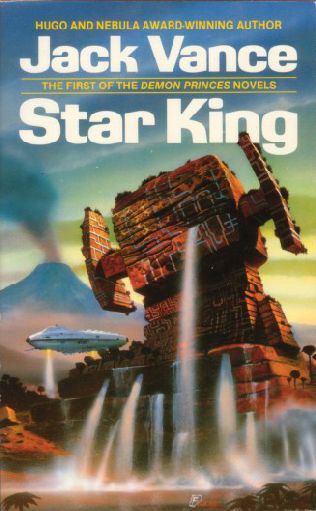
Reading Challenge #3 – Star King, Jack Vance

Ringworld and Rendezvous With Rama could certainly be considered classics of science fiction. And Jack Vance is certainly a classic sf author, and has written a couple of classic sf novels. But Star King is not one of them. However, Vance has always been a singular voice in sf, and I’ve always liked his books. So sticking one of his titles on the list for my 2009 Reading Challenge was a no-brainer. And I decided to choose one I’d not read for many years – for a couple of decades, even.

Star King is the first book of the Demon Princes quintet. The series’ story follows Kirth Gersen as he wreaks his revenge on five interstellar criminals who were responsible for enslaving his town when he was a child. Each novel details his revenge on one of the criminals. The first criminal is Attel Malagate the Woe, a member of an alien race known as Star Kings.

Star Kings are actually humanoid amphibians, but appear entirely human. They are also intensely competitive and driven to excel. The fact that Malagate is a member of this race does help Gersen eventually identify him…

Gersen has been brought to be an instrument of revenge by his grandfather. He has all the necessary skills, and is especially effective at unarmed combat. His grandfather dies and leaves him with a single name, a pirate captain he recognised who was present when the town was enslaved. In a flashback, Gersen visits the pirate, tortures him until he gives up the names of the five criminals – the demon princes of the series’ title – and then kills him.

While meditating on this information at Smade’s Tavern on Smade’s World, Gersen meets Lugo Teehalt, a locator who has discovered an Edenic world ripe for settlement. However, Teehalt has learnt that his sponsor is Malagate, and he doesn’t want to hand over the location of the world to the criminal. Teehalt is then murdered by three other guests of the tavern – who admit they work for Malagate. They take Gersen’s ship, assuming it is Teehalt’s.

Gersen finds Teehalt’s ship, and there are enough clues in it to indicate that Malagate is one of three administrators at Sea Province University on the world of Alphanor… But which one?

I read Star King in a day. There’s not much in it. My edition, the 1988 Grafton paperback, has only 208 pages. And even then, there’s not that much plot. Gersen fortuitously meets Teehalt. Gersen stumbles on a clue to Malagate’s real identity. Gersen puts into effect plan to identify Malagate. Plan works – albeit with one or two minor hurdles to overcome.

Vance has fleshed this out by having Gersen questioning everything he learns and everything he does. It makes the story somewhat… conditional. It’s bad enough that the plot starts with a coincidence, but the continual second-guessing only makes it seem as if Gersen is being driven by the plot rather than vice versa. Even the resolution relies on events Gersen could not have foreseen or planned for. He has his plan, yes; but the final clues which reveal which of the three administrators is Malagate are not part of it.

Still, this is a novel by Jack Vance. And you read his books as much for his voice as for the story. In that respect, Star King does not disappoint. It might be a thin work, but it could never be mistaken for another writer’s novel. Perhaps it’s more lightweight than I’d remembered, but it’s still a fun read. There are worse ways to kill a couple of hours, and certainly worse books available in any book shop.

I’m tempted to read the other four books of the Demon Princes series, but… the to-be-read pile is big enough already. Another day perhaps.


12 Comments

Beyond the Bounds of Vengeance – Spirit by Gwyneth Jones

To date, Gwyneth Jones has appeared on the Arthur C Clarke Award short list six times, and won it once – for Bold As Love in 2002. Only Stephen Baxter has been nominated more times, and he has yet to win the award. If Jones’ 2004 novel Life had been published in the UK, I suspect it too would have been short-listed – it did, after all, win the Philip K Dick Award for that year. As David Soyka wrote in his review of the book on on sfsite.com:

Simply, put, Life is one of the best things Jones has written. You can stop reading right now and go out and buy the book. Otherwise, you’ll have to endure yet another one of these diatribes about how science fiction doesn’t get any respect from the literary mainstream. Because you can’t read this book and not reflect on the fact that had this been written by, say, Margaret Atwood, Life would be receiving more of the widespread attention it deserves.

In other words, Gwyneth Jones is probably one of the best British science fiction writers currently being published. So a new novel by her is certain to be one worth reading. Spirit; or the Princess of Bois Dormant is her latest. It was published at the end of December 2008.

The plot of Spirit is based on that of The Count of Monte Cristo, but it shares its universe with the Aleutian trilogy of White Queen, North Wind and Phoenix Café. The universe has also featured in a number of Jones’ short stories, including ‘Saving Tiamaat’ in The New Space Opera (it can be read here); and ‘The Tomb Wife’, which has just been shortlisted for this year’s Nebula Award (it can be read here).

The shape of Dumas’ story is well-known: Dantès is falsely accused of treason, sentenced to life imprisonment in the Chateau d’If, befriended by a fellow prisoner who teaches him all manner of useful skills and knowledge, escapes, sets himself up in society using treasure whose location was given to him by his friend in prison… and subsequently has his revenge on those who conspired to send him to prison in the first place.

And Spirit does, in broad aspect, follow this. The novel’s protagonist is also unjustly imprisoned for twenty years, is educated while in prison, escapes and uses the “fortune” she was bequeathed by her mentor inside to… Not revenge, but neither is it justice. Call it a “balancing”.

Of course, Spirit is space opera – new space opera, in fact. The conspiracy which puts Dantès in prison was historical and reasonably well-known by readers. The conspiracy underlying Spirit is wholly invented; the world in which Spirit takes place is wholly invented. Which means the narrative of Jones’ protagonist – Gwibiwr; quickly shortened to Bibi – must begin much earlier than that of Dantès. It must give her origin, in fact. And the conspiracy which results in Bibi’s imprisonment must also be set up. It is not until halfway through Spirit that Bibi is actually sent to prison. This is not a criticism – Spirit is not about Bibi’s revenge, it is about Bibi. She is “the Princess of Bois Dormant”.

In the Aleutian trilogy, aliens arrived on Earth and precipitated a crisis. This led to the Gender Wars and, eventually, a World Republic. In Spirit, Jones has expanded this universe into an interstellar Hegemony of five worlds, ruled from a space station in the Kuiper Belt called Speranza. Each of the five worlds is the home of an “alien” race, although there is sufficient biological commonality between the various races to suggest Earth as a common home world in the ancient past. This is known as “having your cake and eating it”. A major theme of the Aleutian trilogy was colonialism, and Earth was the colonised; but in Spirit the humans – or “Blues”, as Earth is known as the Blue Planet – are the colonisers. The Hegemony also allows Jones to spread her commentary on gender and gender roles across societies that are very much other.

And there is plenty of cake to eat in Spirit. Not a Black Forest gateau or the like, not some fancy confection covered whipped cream and chocolate shavings. But a strong English fruitcake, steeped in brandy. Perhaps that’s too silly a conceit. Certainly Spirit contains plenty to chew on, not just the themes carried over from the Aleutian trilogy.

Admittedly, those themes strongly season the book, making Spirit very much a thematic sequel to Phoenix Café. But there are other ingredients: the opening section, in which Bibi grows up in semi-feudal Baykonur, has a flavour of Frank Herbert’s Dune. The sudden decamp to Speranza, and the explanation of the workings of the Hegemony’s interstellar transit network, contains pieces of Frederik Pohl’s Gateway. When Bibi is on Sigurt’s World as part of a diplomatic mission, and it all goes horribly wrong, Spirit tastes almost Banksian. And there’s a soupçon of Samuel Delany in the section set on Ki/An.

Also present are small nuggets of Jones’ earlier works: Escape Plans – the distributed systems of that book have become virtual, or 4-Space; and Kairos – travel via Buonarotti transit-pod mimics in some respects the effects of that novel’s eponymous drug.

All this is mixed in with The Count of Monte Cristo. And layered with new space opera as a mode of science fiction.

It makes for a rich and complex story; a story which, no matter how well stirred, can sometimes overwhelm the palate. As each new flavour or tang rises to the surface, so the focus of the story shifts. Bibi is not always there. At one point, for example, the story breaks away from her, simply so we can experience her ex-boyfriend laying another brick in the conspiracy which will condemn her. And in the final section of the book, the Princess of Bois Dormant has taken Bibi’s place entirely.

It is in fact that last section where Spirit becomes less the dish of its ingredients. Dumas serves this dish cold, but Jones is less focused on revenge. The Princess of Bois Dormant sets out to redress the wrongs done to her, but also to right the wrongs done to those who suffered because of her. Chief among the latter is her son, a prince of Sigurt’s World. This leads to an odd detour, following the prince’s holiday on Ki/An, his trip into the marshes, and his kidnap. Later on Speranza, the prince and his companion help rescue a pair of young women from the Traditionalist roles their family intend them to play. Both women are the daughters of Bibi’s enemies. Those enemies, of course, get their compeuppance, although Bibi seems to have little to do with it. One has a stroke, another is killed while trying to escape. It all seems a bit… incidental.

Not everything in Spirit works. I don’t understand Jones’ decision to pepper the names of the natives of Sigurt’s World with apostrophes, such as her alien prince D”ffyd. If it’s a joke, it soon wears thin. The many references to the French Revolution also seem to add little – despite the novel’s template, The Count of Monte Cristo; despite the novel’s title, Spirit, also referring to the Princess’s Aleutian transit-pod, Spirit of Eighty-Nine (1789, that is). And speaking of French… Sleeping Beauty in French is known as La Belle au Bois Dormant. Perhaps my French isn’t as good as it should be, but I thought the dormant (sleeping) referred to the belle (beauty) and not the bois (wood). La Princesse au Bois Dormant makes much more sense. And is especially ironic as the Interplanetary Prison Moon of Fenmu is a rocky inhospitable place, and Bibi spends twenty years there underground…

Spirit is an excellent novel. I’d have expected no less of Gwyneth Jones. I fully expect it to appear in my best novels of the year list for 2009. However, I suspect Spirit will not be on the short list for the Arthur C Clarke Award next year. It is too rich and complex a novel, and the Clarke seems to prefer works of a much stronger and more distinctive flavour. But I do think it will be on the BSFA Award short list – literate sf novels by British authors do well with the BSFA Award. And so they should.

Incidentally, 2009 should prove a good year for Jones. Spirit may have been published right at the end of 2008, but due during 2009 are a short-fiction collection from PS Publishing, Grazing the Long Acre; and a “Conversation Piece”, The Buonarotti Quartet, and a non-fiction collection, Imagination/Space, both from Aqueduct Press.

(Ah well. The cake-thing seemed like a good idea at the time. But never mind…)


Leave a comment

This Blog and Books…

When I started this blog back in November 2006, it was never intended to be a review blog. I still don’t plan for it to become one. I already review books for Interzone, and I’ve no desire to write a review of every book I read.

But. I have posted book reviews here. There are my annual reading challenges, of course. Others are of books I really like, or books I think are important. One or two have been reviews I wrote years ago, and I’ve posted them here because I thought people might like to read them. I might dig out some more of them.

And I’ll continue to do that. I’m currently working on a post on Gwyneth Jones’ latest novel, Spirit; or the Princess of Bois Dormant. Next month I’m going to work my way through L Timmel Duchamp’s Marq’ssan Cycle, and I’ll be writing about those – a single post on all five books, rather than one per book, I think. I’d like to do the same for Doris Lessing’s Canopus in Argos Archives, but that’ll have to wait until much later in the year.

Christopher Evans’ Omega will likely be worth a post, as will Lewis Shiner’s Black & White. Then there’s Lawrence Durrell’s second novel, Panic Spring, originally published under the name Charles Norden. And, from the sublime to the, er, slightly ridiculous, there’s Child of Earth by EC Tubb, the recently published 33rd and perhaps final book in the long-running Dumarest Saga.

I’d also like to write about the Beacon Books I’ve managed to collect – but I read during my commute to work and, given their cover art, I’d be too embarrassed to read them on the tram. But we’ll see.

And, of course, whatever other books I read which inspire to me write something about them.

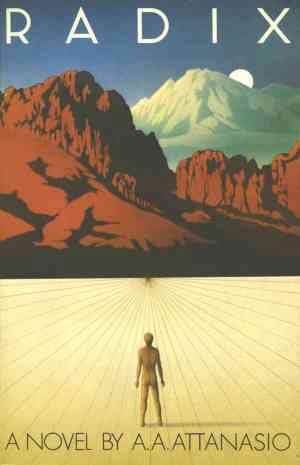
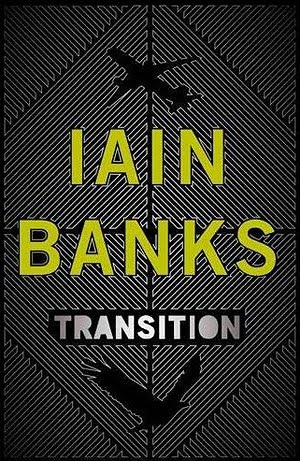
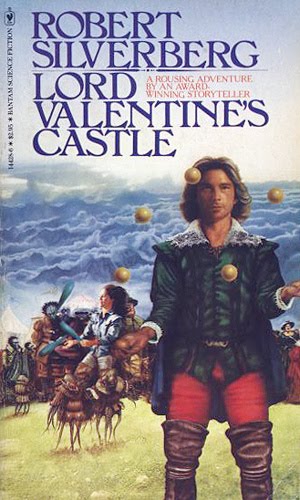
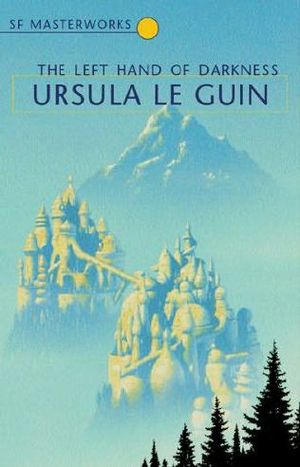
As a reminder, here are the books I’ve written about on this blog to date, in alphabetical order by author. It doesn’t include my annual reading challenge posts. Click on the title to go to the review.


10 Comments

2009 Reading Challenge #2 – Rendezvous with Rama, Arthur C Clarke

There’s a fitting synchronicity to my choice of Rendezvous With Rama by Arthur C Clarke as the second book of my 2009 Reading Challenge. Like Larry Niven’s Ringworld, it is a book that’s dominated by a Big Dumb Object. It also won both the Hugo and Nebula Awards for Best Novel, and is in the SF Masterworks series. So, another highly-regarded science fiction novel. In fact, it’s probably considered Clarke’s best novel, and he’s one of the “Big Three” of the genre, with Robert Heinlein and Isaac Asimov.

The plot of Rendezvous With Rama is not complicated. In 2131 AD, an object – named Rama by Spaceguard – is detected entering the Solar system. It is determined to be artificial, and the nearest spaceship is sent to investigate. The crew of Endeavour discover that Rama is an alien artefact, a cylinder fifty kilometres long and sixteen kilometres in diameter. Its interior is hollow, and it is roatating fast enough to provide gravity on its inside surface. Endeavour‘s crew explores Rama as it travels through the inner Solar system towards the Sun. They find no clues to its makers or origin. In fact, it is deserted but for a wide variety of “biots”, or biological machines. Eventually, the explorers abandon Rama, and the artefact uses the Sun to boost itself on a path out of the Solar system. End of story.

In other words, very little actually happens in the book. There is no explanation, no resolution. Rama is presented as a puzzle, but there is no solution. It is alien.

Rendezvous With Rama is a strange book in many ways. Not just the complete lack of narrative closure, or the way it resolutely fails to answer the questions it poses. It is also a book which has aged both gracefully and badly.

The framing narrative, which introduces the world of the future and then describes the deliberations of the committee overseeing the exploration of Rama, reads as though it’s taking place in the 1950s. Even in 1972, it must have seem dated. In 2009, of course, it reads even more out-of-date: for example, “when he was able to get computer time to process the results” (page 14). In 1972, perhaps, when mainframes were prevalent, this might have seemed plausible. But the novel is set in 2131. One hundred and fifty nine years later. One hundred and twenty-two years in our future.

The main narrative details the exploration by Commander Norton, captain of Endeavour, and his crew. The emphasis is on Rama itself, which helps distance the novel from its time of writing. The characters are also so bland they could be from any age. Admittedly, it’s also very Anglophonic Americo- and Euro-centric – far more so than any vision of the future written now would be. But their concerns are immediate, direct and almost entirely related to the story, so nothing especially jars.

However, like Ringworld, Rendezvous With Rama is over-shadowed by its eponymous BDO. It’s Rama that stays with you. There’s not much in the way of plot, anyway. And the characters aren’t remotely memorable.

But.

Should a science fiction novel be remembered for its furniture or for its story? Both Ringworld and Rendezvous With Rama have been lauded, and are held in high esteem, for the invented artefacts their casts discover and/or explore. Not for their story, or their writing, or indeed any of their characters. It’s little wonder the genre is held in low regard, when the fans themselves apply such reductive appreciation to the works they deem “classics”. After all, Dickens’ Great Expectations is not notable for Miss Havisham’s ruined mansion.

Rendezvous With Rama is an odd book. There’s a timelessness to its story, but its narrative firmly dates it. Its refusal to explain itself makes it more interesting than, by rights, it actually should be. If science fiction were only about “sense of wonder”, then Rendezvous With Rama succeeds as a science fiction novel. But it has not aged as gracefully as memory might insist it has. It’s the product of an imagined world, which in turn created imaginary worlds, which never really existed. And that tells against it.

In the final analysis, Rendezvous With Rama is, I suppose, another partial success. I’m glad I reread it. I may do so again one day. While it’s certainly not a very good novel, I’m beginning to wonder if it’s a good science fiction novel and if “good science fiction novel” means it doesn’t have to be a “good novel”…


2 Comments

Gods and Robots – The Night Sessions by Ken MacLeod

According to John Clute, every science fiction novel has three dates: the date it was written, the date it is set, and the date it is about. For all that it may be set in the future millennia hence, the best time to read a science fiction novel is in its year of publication. And if the novel is set in the near-future, this is even more true. After all, the near-future is seen as an extension of the present, with the present’s issues and concerns…

All of which may well have a sell-by date.

So, a decade or two from now, will we look back at the rise of creationism as some bizarre atavistic aberration? Will we look back in relief at our narrow escape from religious domination? Or will we, as Ken MacLeod posits in The Night Sessions, go to war and in the aftermath completely secularise society?

The Night Sessions is a near-future sf novel masquerading as a crime novel, much as The Execution Channel was a near-future sf novel masquerading as a thriller. It’s set in Edinburgh a decade or two in the future. The world differs from ours – and perhaps what ours might be – in several ways. There was a war, the “Faith War”, fought in Israel with tactical nuclear weapons, and the forces of the West lost. Society has turned its back on organised religion and everywhere is now entirely secular. By law. Churches and priests are no longer officially recognised. There are also robots, and some of them have developed artificial intelligence.

The novel opens with a fundamentalist Christian from New Zealand visiting Edinburgh to meet with the members of an underground Scottish Christian sect. The fundamentalist works in a “creationist science park” in New Zealand which has become a refuge for sentient robots. He has been preaching to the robots, and the Scots intend to broadcast his sermons to their own congregation. These are the night sessions of the title.

The story proper begins with the murder of a priest by a letter bomb. Detective Inspector Ferguson is in charge of the case. Clues suggest an underground Christian group, the Third Covenant, are responsible. Then a bishop is assassinated by a shot to the head. Ferguson’s investigation soon focuses on a robot called Hardcastle, who has been masquerading as a disfigured war veteran with extensive prostheses. And from there it cascades to take in a host of other Christian denominations, various youth subcultures in Edinburgh, more robots, and the Atlantic and Pacific Space Elevators…

Unfortunately, as a crime novel The Night Sessions mostly fails. Fortunately, as a science fiction novel it mostly succeeds. The problem is that the world of the book requires explanation – it’s neither the reader’s world, nor part of the reader’s history. The story requires its background – it cannot progress, nor be resolved, without those background details MacLeod has created. Which means that the crime novel is frequently interrupted by info-dumps. And because this is a crime novel, they seem horribly out of place. The Night Sessions asks to be read as a crime novel, but it cannot be because it is as exposition-heavy as the science fiction novel it really is.

As science fiction, however… The world MacLeod has created is both clever and interesting, but the requirements of the crime plot have led to a withholding of story information – something not normally found in science fiction. Science fiction novels are open – they lay bare their workings as they progress. The reader can see the rods and gears which drive the plot. And has to in order for the resolution to make sense (not doing so can result in the sin of deus ex machina). A crime novel, however, operates with a different mechanism, and part of the reading process involves the reader’s discovery of those rods, gears and linkages. The reader must build the mechanism in their mind in order to understand the book’s resolution.

Where The Night Sessions is especially good is in its depiction of life in this near-future Edinburgh, and in the tools used by the police of the time. As a near-future novel it convinces, and there’s an impressive inevitability, given MacLeod’s invented history, to the society depicted. Which makes it seem such a shame that Ferguson’s investigation seem to be mostly driven by authorial sleight of hand. Science fiction is essentially a logical genre – all sf stories follow an underlying logic. The same is true of crime stories. There’s a similar implacability to the end of a crime novel as there is to the end of sf novel. But in the crime genre there are no shortcuts on the route there. Ferguson seems to stumble upon the conspiracy at the heart of The Night Sessions more by serendipity than by methodical police-work (he has a number of neat tools, and they do help, however). This is not helped by the Columbo-style prologue. This names the villains of the piece, and means we must watch Ferguson and his team stumble through the clues to reach a destination we already know. Except that destination is a blind – because The Night Sessions is actually more of a whydunnit than a whodunnit, and the real why remains hidden for much of the narrative.

Because The Night Sessions is a crime novel, the resolution of the plot should be the identity of the murder and their motivation. Because The Night Sessions is a science fiction novel, that is not enough. The motivation for the crimes has to be science-fictional. And it is. But again not quite enough. Like The Execution Channel, the final plot-zinger in The Night Sessions happens off-screen – it is in fact recounted by one character to another.

The Night Sessions is one of the novels shortlisted for this year’s BSFA Award. It’s certainly one of the most interesting depictions of the near-future I’ve come across in science fiction. But I don’t think the engine of its plot is geared correctly to the wheels of its story. I also suspect it appears too prophetic to read well a decade from now. Its concerns are too specific – unlike, say, Nineteen Eighty-Four – and it’s not pure enough science fiction to weather the years. Read it now and it’s very good. Read it five years from now…?

Ken MacLeod writes bloody good science fiction novels, but we’ve yet to see his best.


5 Comments

2009 Reading Challenge #1 – Ringworld, Larry Niven

I forget when I last read this book. I seem to recall reading it several times during my early teens, but I’ve avoided it since. I’m not sure why – perhaps I was afraid it would disappoint. I’ve learnt to my cost that “nostalgia ain’t what it used to be”. Few books I loved as a teenager have survived a reread now that I’m just over halfway through my three score years and ten.

Having said that, I may well have not reread it simply because my To Be Read pile is big enough already. And continues to grow…

But Ringworld.

The novel won both the Hugo and Nebula Awards in 1971. It’s also No 60 in the SF Masterworks series. So it’s safe to say it’s highly regarded by sf fans. But I’m not convinced sf novels stand the test of time as well as most fans would have us believe, and Ringworld is now 39 years old.

Everyone knows that the first edition had Earth rotating the wrong way – but this was corrected in subsequent editions. But there are other mistakes (in my 1981 Sphere paperback). On page 22, there is a description of the Long Shot: “The ship would carry practically no cargo, though it was over a mile in diameter.” Yet when they finally see the ship: The Long Shot was a transparent bubble over a thousand feet in diameter” (pg 46). The last time I looked, a mile was 5,280 feet. There’s also a strange mix of metric and Imperial units: “The ring masses two times ten to the thirtieth power in grams, measures .95 times ten to the eighth power miles in radius, and something less than ten to the sixth power miles across.” (pg 70). These are minor complaints, however.

Louis Wu is a 200-year-old adventurer in the 29th Century. He is recruited by Nessus, a Pierson’s Puppeteer, for a mysterious mission. Also recruited are Speaker-to-Animals, a kzin, which is a large feline war-like alien; and Teela Brown, a young woman descended from five generations of winners of the Birthright Lotteries and so supposed to be very lucky. The mission requires a trip to an unspecified destination 200 light years from Earth. This would normally take several decades, but Nessus has use of a ship fitted with a secret “quantum II hyperdrive shunt”, which travels orders of magnitude faster. This ship, the Long Shot, and the secret of its drive, will be Louis Wu and his team-mates’ payment for the mission.

The team head for the home world of the Pierson Puppeteers… which proves to be a fleet of five worlds travelling through space at 80% of the speed of light. The puppeteers are a cowardly race and are fleeing the explosion of the galactic core, whose wavefront won’t reach Known Space for another 20,000 years. Recently, they had discovered an artefact a couple of light years from their present position. A ringworld – a single band of material approximately one million miles in width and 600 million miles in circumference, orbiting one AU from its primary, and comprising the surface area of three million Earths. The puppeteers do not know who built the ringworld, and want Louis and the others to investigate it.

In a second ship provided by the puppeteers, Louis, Teela, Nessus and Speaker-to-Animals travel to the ringworld. While investigating one of the “shadow squares”, which orbit nearer the sun and provde night and day on the ringworld, they are attacked by automated defences and crash on the ringworld’s surface. They must then trek some 250,000 miles to the rim to seek help…

Niven’s ringworld is one of the most famous Big Dumb Objects in science fiction. And justifiably so. It’s huge. And Niven mostly succeeds in getting across its size to the reader. From the crash-site, for example, Louis can see for thousands of miles, but still can’t make out the rim to either side. Compare that with Earth – on flat ground the horizon would be around three miles away for someone six feet tall.

And, I suppose, that if I’d forgotten anything about Ringworld, it was that sense of vast scale. Louis Wu is a protagonist very much in the mould of a US 1970s Competent Man. Teela Brown is decorative, screams a lot, and occasionally manages to surprise Louis with her perceptiveness and intelligence. He still refers to her as “my woman”, however. The kzin is war-like, and the puppeteer is cowardly. Much of the universe of the novel, Known Space, was worked out in earlier novels and short stories. The prose is efficient at best, neither impeding the reading experience nor enhancing it.

But still.

The ringworld casts a huge shadow. It’s the ringworld you remember when you close the book. It’s the ringworld you remember decades later when you pick up the book to reread it. The rest is, well, just a story. The ringworld is sense of wonder. And if that’s all you want in a science fiction novel, then you’ll get it in Ringworld. If you’re looking for more, you’ll perhaps come away disappointed. Niven makes no attempt to explain the origin of the ringworld. The book’s plot is little more than a trek to find a way off it. There are, I admit, one or two interesting sub-plots: for example, the puppeteers’ meddling in both human history and kzin, the first to breed a “lucky” human and the second to make the kzin more docile; and the various speculations these revelations generate. Niven also manages to create a human but slightly off-kilter civilisation-in-ruins on the ringworld, although the name of one of its city, Zignamuclickclick, generates a wince.

I enjoyed my reread, but it did leave me somewhat dissatisfied. Not from the book’s shortcomings – but because I’d forgotten how glibly sf writers of the 1970s used to make stuff up. They made very little effort to convince, they just waved their hands a little more vigorously. That’s a style which is no longer in fashion. Science fiction in the 21st century is a far more rigorous genre, and it’s better for it.

There are more novels following on from this one – The Ringworld Engineers, The Ringworld Throne, and Ringworld’s Children – and these explain who built the ringworld, and why. I vaguely recall reading The Ringworld Engineers back in my teens, but I’ll not bother this time. Nor have I any desire to read more of the series.

That’s not, I hasten to add, because this first book in my 2009 Reading Challenge was a failure. On the contrary, it achieved pretty much what I expected it to achieve. I enjoyed the book, was reminded of some of the reasons why I’d liked it in the first place, and will someday no doubt read it again. But it’s no great work of literature, and there are many science fiction novels I’d consider better than it.


3 Comments

Worth a Seventy-Three Year Wait?

Most people believe Lawrence Durrell’s first novel to be The Black Book, published in 1938 by the Obelisk Press in Paris (it was considered obscene by UK publishers, and not published in this country until 1977). In fact, Durrell’s first novel had been published three years earlier by Cassell. It was titled Pied Piper of Lovers. Unfortunately, it sold badly, was savaged in a review in Janus magazine by John Mair, and few copies survived the Blitz. Durrell himself also refused to allow the book to be reprinted – perhaps because it was a little too autobiographical. As a result, copies are very hard to find – in fact, “barely a dozen copies survive in libraries around the world”.

But now the Canadian University of Victoria’s ELS Editions has, after 73 years, finally published a new edition of Pied Piper of Lovers. And a very nice edition it is too. There is an excellent introduction by editor James Gifford – from which the above quote about “barely a dozen copies” is taken. The text itself is copiously footnoted – perhaps too copiously in places: I should have thought it unnecessary to point out, for example, that “Portsmouth, England, is a coastal city in Hampshire”, as only the dimmest of readers is going to blithely ignore context and confuse it with the many Portsmouths in the USA.

After the text of the novel is an essay, ‘An Unacknowledged Trilogy’, by James A Brigham, which argues that Pied Piper of Lovers, Durrell’s second novel Panic Spring (published in 1937 under the pseudonym Charles Norden), and The Black Book are a thematic trilogy. Pied Piper of Lovers also features a “Works Cited & Selected Bibliography”.

Some books are plainly written by young men, and Pied Piper of Lovers is one of them. The prose seems to foreground the senses, more so than plot or structure or characterisation. Every raindrop is lovingly described, every emotion takes on supreme importance. Durrell’s prose was always lush, but it was in service to the story. In Pied Piper of Lovers, Durrell appeared to be intent primarily on making a point with his novel – in as rich a language as he could manage – and only secondarily in actually constructing a narrative. Perhaps this was because he was at the time chiefly a poet.

Clifton Walsh is born in India of an English father and an Indian mother who dies in childbirth. He is raised by his father, a civil engineer, and his aunt, Brenda. His schooling is haphazard, and eventually his father determines he should be sent to school in England. While Clifton is at boarding-school, Brenda settles down in London. When his father dies – Clifton has not been back to India since being sent to England – Clifton leaves school. He has no fixed ambition, just a need to get away. He stays at a sea-side cottage near Hangar, on the border between Devon and Dorset, and meets Ruth. They fall immediately in love. Meanwhile, Clifton has discovered he has a gift for music – specifically, for writing it. He sells a piece to a music publisher, although the publisher is more interested in the “tune” in Clifton’s music and turns it into a piece of popular jazz. Clifton goes to live in Fitzrovia, an area of London, where he meets and interacts with a variety of bohemian types. He stumbles across Ruth, and the two settle down together. She, however, is terminally ill. They move back to the south coast, and he supports them by writing popular tunes. The final chapter of the book is a letter from Clifton to his best friend from boarding-school.

It’s perhaps the language of Pied Pipers of Lovers which is most interesting, and most appealing. The prose was clearly written with a poet’s eye. Perhaps it’s not always successful, and there are no passages which grab the eye as there are in Durrell’s later works. Perhaps even, the rich language occasionally works against the story, obscuring what should be clear. Especially in the Prologue, thirteen pages of which describe the arrival of the doctor at the bedside of Clifton’s mother, his birth, and her subsequent death. In other parts of the novel, the narrative seems to enter a literary “bullet-time”, and emotional events which transpire over almost no time are dissected in lush prose over several pages. And yet Durrell’s writing is often at his best when his focus pulls back and he moves the story forward.

One of the aspects of The Alexandria Quartet which appeals most to me is that it is a series of novels about British expatriates in the Middle East. Pied Piper of Lovers turns this on its head – Clifton doesn’t feel himself to be English, but he is in England. But neither is he not English. In fact, the major theme of the novel is Clifton’s feelings of being torn between two homelands, yet not fully part of either. Durrell, like Clifton, was born and brought up in India, then sent to England to be educated. Durrell also lived briefly in Fitzrovia, and was as much a “Bohemian” as those he describes in the novel.

There is also – and this further indicates to me that Pied Piper of Lovers is a young man’s novel – an uncritical reflection of the attitudes of that set at that time, as if they were adopted unthinkingly. There are a number of anti-semitic comments in the book, a stereotyping of Jews as grasping merchants – a not-uncommon attitude in 1930s Britain, but at odds with Durrell’s later pro-Zionism in The Alexandria Quartet. But there is also an open tolerance of homosexuality – something which seems to me was a peculiarity of the Bohemian set (cf Oscar Wilde, Charles Scott-Moncrieff, Robert Ross, Wilfred Owen and others a decade or two earlier).

The book’s structure displays Durrell’s frequent inability to stick to his intended narrative plan. The timescale is uneven, events are not properly placed, and Clifton’s age is occasionally hard to calculate. And yet the book is carefully split into five parts: Prologue (birth), Part I (childhood in India), Part II (boarding school in England), Part III (Fitzrovia), and Epilogue. I’m reminded of The Avignon Quintet, in which each of the five books begins clearly on track but seems to soon drift from it… until the central mystery of the quintet, Templar treasure hidden somewhere in Provence, is solved almost in passing near the end of the fifth book, Quinx. It’s strange that while Durrell showed a poet’s careful control over his language, he never seemed to have as much control over his plots.

So, how grateful should we be to ELS Editions for publishing Pied Pier of Lovers? Personally, I’m very glad indeed. I love Durrell’s work and, while I found Pied Piper of Lovers less satisfying than his later works, I’m very glad I read it. I’ll probably even read it again. It’s always interesting seeing how favourite writers develop, and Pied Piper of Lovers is an important novel in that regard. Anyone with an interest in Durrell should read it.


3 Comments

The Last Book of the 2008 Reading Challenge

I read science fiction. I’ve read a lot of good, bad and indifferent science fiction. Much of it has been silly. But The Fountainhead by Ayn Rand, which is not science fiction, is one of the silliest books I’ve ever read.

There’s an ad you see on television. Over footage of the Wright brothers’ first flight, a portentous man’s voice says, “Conquered the sky.” Then it’s a mountain climber, and he says, “Conquered Mount Everest”. Finally, he says, “Conquered the… neck.” It’s an ad for a Philishave. The Fountainhead is like that ad. The protagonists and antagonists are architects. They allegedly represent all that is noble – and their antitheses – in society and civilisation. There is, apparently, a nobility of purpose to the art of architecture which is unmatched in all other fields of artistic and/or social endeavour…

The whole book is like that. It’s so overwrought and melodramatic you keep on expecting the cast to break into song at any moment. And everyone is such a paragon. No evidence is given for this status – Rand simply tells it us. Repeatedly. And on the few occasions where she tries to provide evidence, she spectacularly fails to convince: the excerpt from an article by the preternaturally insightful critic, for example, proves to be… pretentious empty twaddle.

Howard Roark was studying architecture at Stanton university but is expelled for not toeing the party line. All architecture, apparently, should reflect the past – paying tribute to Classical, Gothic, Renaissance, etc. But Roark is a Modernist, and he won’t change. So they boot him out. Peter Keating, on the other hand, is brilliant, good-looking, graduates at the top of his class, wins a scholarship to France, and is offered a job with top architectural firm, Francon & Heyer.

Roark, meanwhile, goes to work for disgraced and penniless Modernist architect Henry Cameron. He learns a lot, and even gets to design and build the occasional building. While Keating becomes the darling of the architectural elite, lauded for the buildings he designs, poor old noble Roark sticks to his Modernist guns and is despised and hated as a result.

Then there’s Ellsworth Toohey, a man so erudite and learned, he’s a scintillating and penetrating critic of, well, everything. So, of course, he writes a daily column for the most yellow of New York’s papers. Also writing a gossip column for the same paper is Dominique Francon, daughter of Keating’s employer, fabled society beauty and cold fish, who appears to be suffering from a debilitating case of ennui and self-loathing. Finally, there’s Gail Wynand, owner of the aforementioned newspaper and bits of just about everything else, a man whose hobby it is to break and corrupt anyone who displays the slightest amount of integrity. But he’s honest to himself, so that’s okay.

These are not stereotypes. They’re not even archetypes. They’re bloody great cartoon characters painted in primary colours. Rand appears not to know the meaning of “subtlety”. For example, only noble paragon Roark is smart enough to design buildings with straight corridors, with windows that don’t look onto brick walls, with sensibly-shaped and -sized rooms… And Toohey is such a nasty piece of work that his altruism and “collectivism” is treated with all the contempt and disgust of National Socialism.

I also have to ask: what happened to US literature immediately post-WWII? That’s two books from that period I’ve read recently, and both were populated by the most unlikeable and preposterous characters I’ve come across in Twentieth Century fiction.

The Fountainhead is a book for simple readers. I can’t believe anyone was taken in by its underlying philosophy, Objectivism, for an instant. If they were, I suspect they were blinded by their own selfishness and greed. Or perhaps they allowed Rand’s blatant manipulation of her characters and plot in The Fountainhead to sway them. I laughed all the way through the book.

I’ll not be reading any other books by Rand. And my copy of The Fountainhead will be going back on bookmooch.com. This is a very silly book, and I’m frankly amazed that it’s considered a classic, or that anyone was taken in by Rand and her juvenile philosophy.


8 Comments

A Different Road

November’s book – which I actually managed to read in November – for my 2008 reading challenge was Jack Kerouac’s On the Road. I can’t remember why I picked this book – I think it was one on a list of possible titles, and I managed to find a (free) copy on bookmooch.com. It’s certainly not a book I’d ever really planned to read. And, having finished it, I doubt I’ll be reading it again.

I’d always thought On the Road was a 1960s novel*, about someone living rough during that decade, living the hippy dream of LSD, Grateful Dead and giving two fingers to the Man. It’s nothing of the sort. For a start, it’s set in the late 1940s. And it’s about marijuana and jazz and subsistence-level jobs (and poverty). The protagonist, Sal Paradise, spends much of the book driving from one place to the other – so that’s “on the road” as in actual driving on the road in a car, not as in living rough like a vagrant (although he does hitch-hike several times). Most of these travels are with an assorted cast of friends, or in order to meet up with said friends. And chief among these is Dean Moriarty, who is “Beat”.

The book is a novel but it’s actually a thinly-disguised autobiography. The events it describes actually happened to Kerouac, and the various characters Paradise meets are the real people Kerouac met. Moriarty is Neal Cassady, for example; Carlo Marx is Allen Ginsberg; and Old Bull Lee is William Burroughs.

Kerouac wrote On the Road in what he called “spontaneous prose”. It shows. It’s not prose you can savour. Much of it possesses a breathless clumsiness which only works if you read it as fast as he apparently wrote it. Kerouac also has a tin ear for dialogue. Perhaps his intent was to document the spontaneity of his characters’ thought processes, but the result is that they talk mostly unfettered bollocks.

It’s not all bad. Some of the descriptive passages are good, and Kerouac’s documenting of the underbelly of late 1940s USA is never less than interesting. A visit to a jazz club in Chicago, for example, is especially impressive, and works so well because its prose is spontaneous. But On the Road is a “cult” novel – which usually means you either get it or you don’t. And I didn’t. I don’t understand the appeal of Paradise’s adventures, I don’t understand the appeal of a book you have to read at such a headlong pace. I don’t belong to a generation – or nationality – which finds anything all that enticing about its subject. To be fair, Paradise’s attitudes seem more twenty-first century than are typical for 1940s America. Which is admirable. At one point, he stays in “Mill City” in California (actually Marin City), and describes it as the only non-segregated community in the US. He mixes freely with blacks and Mexicans… which seems unusual for a country which practiced overt institutional racism until the 1960s.

On balance, On the Road falls squarely in the middle of those books I’ve read during my reading challenge. I didn’t hate it, but neither did I stick Kerouac’s other titles on my wants list. I enjoyed bits of it, but I can’t say I enjoyed all of it. Perhaps if I’d been alive in the 1950s and read the book at that time, perhaps if I were American, perhaps if I actually liked jazz…

(* if the edition I read had the cover art I’ve used to illustrate this review, then perhaps I wouldn’t have thought it was about the 1960s)


1 Comment

Aetheric Mechanics, Warren Ellis & Gianluca Pagliarani

Warren Ellis is no stranger to science fiction. It’s a genre he has explored before in comics format – in works such as Orbiter, Ocean, Switchblade Honey and Ministry of Space, among others. Nor is he unfamiliar with alternate history, as Ministry of Space posited a British space programme following World War II. It could be argued that Aetheric Mechanics is actually steampunk. Certainly, it appears to be, as it’s set in 1907, but with “apergy”-powered flying machines and clunky giant metal robots. But steampunk is a meta-generic construct, a blend of tropes from worlds presented in other genre fictions. It almost never includes its own origin story – to steal a phrase from the other genre in which Ellis works. Steampunk tropes just are. Sometimes, there is some authorial handwaving to “explain” this new Victorian (or Edwardian) England – Stephen Baxter’s anti-ice in Anti-ice, aether in Colin Greenland’s Harm’s Way, for example. But often as not the reader is expected to recognise the origin of the tropes and accept their placement in a steampunk fiction as an expected characteristic of the sub-genre.

And from the opening page of Aetheric Mechanics, there are tropes a-plenty on view: the aforementioned flying machines and giant robots, but also flying ships held aloft by “cavorite”. Ellis, we soon learn, has thrown his net further afield. Dr Robert Watcham has returned from the Front in Britain’s war with Ruritania. His friend, Sax Raker, is London’s greatest detective. And Watcham is back just in time to help with ‘The Case of the Man Who Wasn’t There’.

An engineer specialising in aetherics was murdered outside the Royal Society by a man who flickered in and out of existence. Another body soon turns up, found in the mud of the Thames. Raker identifies some of the mud as belonging to the River Fleet. Present in the crowd watching the sleuth at work is Innana Meyer, Raker’s great rival, and the object of his affections. Raker spots her, and she admits she is now working for Raker’s brother in the British Secret Service.

As a vast force of Ruritanian aeroplanes begins bombing London, Raker, Watcham and Meyer enter the River Fleet’s underground channel to find the man who wasn’t there…

Ellis has played fair in the past, and he plays fair in Aetheric Mechanics. He’s not telling stories in science fiction settings, he’s telling science fiction stories. Which is where this “graphic novella” demonstrates that it is indeed pure-strain science fiction and not steampunk. There is an explanation, a reason why Watcham’s London exists. And why the story of Aetheric Mechanics could not have taken place anywhere, or anywhen, else. It’s a satisfying resolution to a tale which has already enchanted through its borrowings and usages.

Of course, no review of a graphic novella would be complete without mention of the artwork. And in Aetheric Mechanics, Gianluca Pagliarani’s clean black and white art is an excellent complement to Ellis’s script. The setting is recognisably early twentieth-century London, and yet there is plenty of detail clearly demonstrating that this is not the world we know. Pagliarani’s steampunk visual aesthetic is inventive without being derivative or obvious.

Science fiction and graphic novels have never made easy bedfellows – the visual invention never seems to match that of the story; or vice versa. Ellis is probably the leading authority in reconciling the two, and in Aetheric Mechanics he has shown once again why he holds that position.