It Doesn't Have To Be Right…

… it just has to sound plausible


2 Comments

Reading diary 2018, #3

Another half a dozen books read. So far, I’m staying on track with my reading challenge.

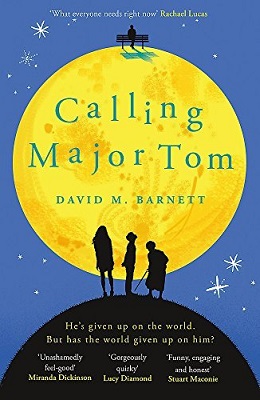
Calling Major Tom, David M Barnett (2017, UK). I know the author and had previously enjoyed his popCult! (see here), and Calling Major Tom sounded like it might appeal and was getting a big push from its publisher… And, okay, “feel-good” is not a term likely to draw me to a book, nor is “quirky” for that matter. But I trusted Barnett not to be horribly sentimental… and I’m glad I did. Major Tom is a British astronaut on his way to Mars. He wasn’t the original choice for the mission, he was actually a chemist working at the British Space Agency, who had been tasked with looking after the real astronaut. But the real astronaut keeled over and died of a heart attack – no one said this novel was especially plausible; it has a UK with a space programme instead of one on a headlong rush to economic catastrophe, after all – and Thomas Major, a complete misanthrope, took his place. But when his spacecraft’s communications gear goes offline after something strikes the antenna, he has to use a mobile phone to contact Earth. And he decides to use it to contact his ex-wife. Except the number now belongs to a dysfunctional family in Wigan, the Ormerods: Gladys (Nan), teenager Ellie and eight-year-old James. Their father is in prison, their mother died years before, Gladys is suffering from the onset of dementia, Ellie is holding down two jobs to bring money into the household after Nan was 419’d, and James is being bullied at school. And somehow, Major Tom, a complete curmudgeon, who wants nothing to do with people anymore, helps them turn their lives around. Calling Major Tom is, scarily, clearly “feel-good”. But it’s also funny… and I was surprised to find myself enjoying it. Frankly, I’m not surprised it’s doing so well because it ticks a lot of the boxes that successful commercial fiction – that isn’t thriller fiction with plots generated by a very small shell script – ticks. Worth reading. (And yes, the central premise of a lone astronaut travelling away from Earth did remind me a little of a short story which appeared in Postscripts, but never mind…)

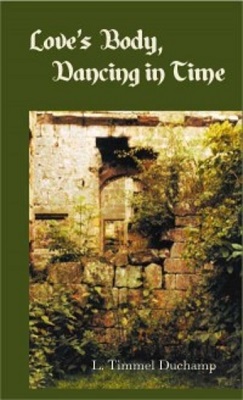
Love’s Body, Dancing in Time, L Timmel Duchamp (2004, USA). Duchamp is possibly best-known as the owner of Aqueduct Press, an excellent US small press which focuses on feminist genre fiction, but she is also an accomplished science fiction and fantasy writer in her own right. In fact, her ‘The Forbidden Words of Margaret A.’ I would count as one of the ten best science fiction stories ever written and her Marq’ssan Cycle one of the best sf series about first contact. Love’s Body, Dancing in Time is her first collection, and contains a short story, two novelettes and two novellas. ‘Dance at the Edge’ takes place on a world where some people – or so the narrator believes – can see a border into another world, but they lose the facility when they turn adult. In ‘The Gift’, a travel writer returns to a world famous for its culture, falls in love with a famous singer, but then discovers the price he paid for his voice (think The Alteration). ‘The Apprenticeship of Isabetta di Pietro Cavazzi’ is something Duchamp has done before – a well-researched, and convincing, historical story that slowly drifts into genre territory. In this case, the title character is a young woman confined to a convent to keep her away from a young man whose father wants him to marry well. This is very much a story which takes place in the world of women. The shortest peice in the collection is ‘Lord Enoch’s Revels’, which describes a party hosted by the eponymous peer, during some indefinable period, which may or may not be supernatural. The last story in Love’s Body, Dancing in Time is also the longest: ‘The Héloïse Archive’. It is worth the price of entry alone. A framing narrative describes the main text as a series of undiscovered letters between famous historical romance lovers Héloïse and Abelard, but as the letters progress so things begin to diverge from known history. It’s hardly an original idea, although showing the effects of time travellers’ interference in this secondary manner is quite original – the only other example I can think of is Mary Gentle’s Ash: A Secret History. And like that humungous novel, Duchamp’s novella displays an impressive amount of research. The story of Héloïse and Abelard is fascinating in its own right – the real story, that is, as it unfolds here, before gradually swerving off the rails. Every time I read something by Duchamp, I’m surprised she’s not better known. I suspect the fact that much of her output these days is published through Aqueduct Press, her own press – and that’s not a criticism, by any means – which is a proudly feminist genre press, and Duchamp herself is a very feminist writer… and I’m all too sadly aware how many Neanderthals there are in sf fandom who think “feminism” is a dirty word… Love’s Body, Dancing in Time is not an especially strong collection – although that last novella is a killer – but there are works I would demand be read in Duchamp’s oeuvre – both mentioned earlier (and I’m not the only one to think so about ‘The Forbidden Words of Margaret A.’ as it opens Sisters of the Revolution, an excellent anthology of feminist sf). Seek out her work – especially the Marq’ssan Cycle or a more recent collection, Never at Home (see here).

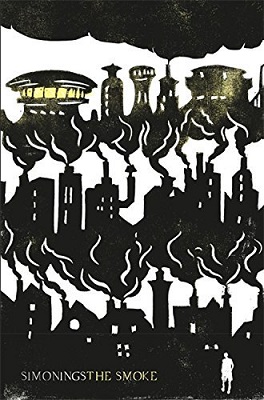
The Smoke, Simon Ings (2018, UK). I’m trying to get things back on track in 2018 that I’d let slide in 2016 and 2017. Such as SF Mistressworks, which now has two new reviews up after a nine-month hiatus – Emma Bull’s Falcon (see here) and Sydney J Van Scyoc’s Darkchild (see here). And reviewing books for Interzone. The last book I reviewed for the magazine was The Sand Men, which appeared in the Jan/Feb 2016 issue (and the author was extremely unhappy with the review, but so fucking what). Anyway, it had always been my intention to return to reviewing for the magazine, and when I saw Simon Ings’s latest, The Smoke, was available, I thought it the perfect book to get me back into it. I’m not going to say too much about the novel here – you’ll have to buy the copy of Interzone for that – but I’ll admit I’m not really sure what to make of it. It’s either bloody brilliant, or merely very good. It does so many things I’ve not seen a category sf novel do before, and it does them very effectively. I really liked Ings’s Wolves (see here) and it made my best of the year list. I suspect The Smoke will too.

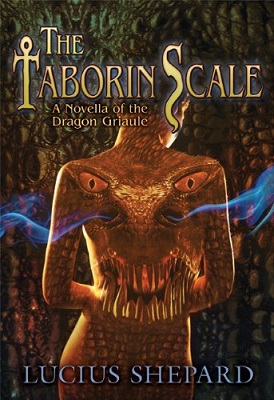
The Taborin Scale, Lucius Shepard (2010, USA). I probably have this novella in The Dragon Griaule collection, but since I bought Shepard novellas as they were published (mostly by Subterranean Press, who these days seem happier publishing limited editions of best-selling genre novels – like Andy Weir’s Artemis, WTF?), so I also have The Taborin Scale as a standalone. In fact, I might well have all of the contents of The Dragon Griaule as either standalone novellas or in other collections, unless there was a story original to the collection, of course. Anyway, The Taborin Scale… A numismatist, George Taborin, comes across a dragon scale in among a collection he bought, and travels to Teocinte, the town that has grown up beside the vast corpse of Griaule. There he consorts with a prostitute, to whom he gives the name Sylvia (not her real name). But something happens, and the two find themselves transported to another time, where Teocinte does not exist and Griaule is young and active and seems to have some purpose in drawing people to that time, although what it is remains unknowable. Taborin rescues a young girl from a group of transportees who had been abusing her, and the three eke out a precarious existence. But then Griaule dies – following the events of The Man Who Painted The Dragon Griaule – and Taborin and Sylvia and the girl find themselves abruptly back in Teocinte… And, to be honest, I’m not entirely sure where this novella was intended to go. It felt like a story in search of a plot, spiced up by the use of footnotes, and carried on the back of earlier Griaule stories. Shepard was a bloody good writer, but he was often sloppy and some of his work often felt half-baked. He was widely-admired, and notoriously cranky, which may be why publishers accepted his stuff when it really needed another go around. And yet, having said that, Shepard’s prose was usually top-notch. It was a bit magpie-like, with a tendency to borrow styles, but it was always put together well. Which is why The Taborin Scale feels so much like a curate’s egg: a well-established prose style, a milieu Shepard had explored in other works (all based around a humungous metaphor)… but then there are the footnotes… and the general vagueness of the story. The Taborin Scale reads like a cross between an experiment and a contractual obligation. I guess I shall have to read the collection to see how it all fits together…

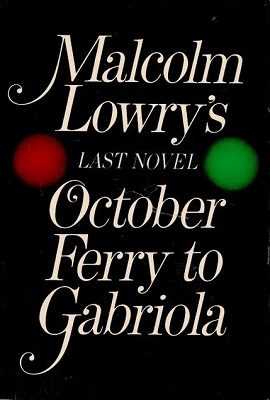
October Ferry to Gabriola, Malcolm Lowry (1970, Canada). I came to Lowry’s fiction sort of accidentally. I knew of him, of course, and of his most famous novel, Under the Volcano; but I’d never read him, nor had any real desire to do so. But after my father died, my mother was clearing out some stuff, including a collection of Penguin paperbacks my dad had bought in the late 1960s (the receipts were still in the books), and which included, among many other authors, three books by Lowry. I took about two dozen of the paperbacks, including the Lowrys, and the first of the Lowrys I read was his collection, Hear Us O Lord from Heaven Thy Dwelling Place. I was hugely impressed by the novella, ‘Through the Panama’. So I read the other two paperbacks, Ultramarine (see here) and Under the Volcano (see here). And then I wanted to read more… So I started collecting first editions of his books. And I have now read them all. October Ferry to Gabriola was his last, not published until thirteen years after his death. (In fact, only Ultramarine and Under the Volcano, and some of the contents of his collection, were published during his lifetime.) Ethan Llewellyn and his wife, Jacqueline, have been evicted from their shack on the Eridanus river and, after some time spent in Vancouver, have chosen to head for the small island of Gabriola to buy an advertised property. The novel opens on the bus to the seaside town where they will catch the ferry, but pretty much heads straight into flashback, beginning with their home in Niagara-on-the-lake. But their home there burns down in a freak lightning strike. Leading to their move to Eridanus. October Ferry to Gabriola is a hit of the pure Lowry – from the plot recycling parts of Lowry’s own life, never mind parts of his other works (their neighbours in Eridanus are Sigbjørn and Primrose Wilderness, Lowry analogues in Dark is the Grave Wherein My Friend is Laid, ‘Through the Panama’ and a handful of stories), the long discursive sentences, the detailed self-reflective and self-analytical prose, the self-deprecating humour, and, of course, the copious amount of alcohol. This is great stuff, it’s just so good. I went slightly mad when I decided to collect Lowry, but I’ve yet to read anything by him that has caused me to question that madness. I’m only sorry I’ve run out of novels by him to read. I guess I’ll just have to start re-reading them…

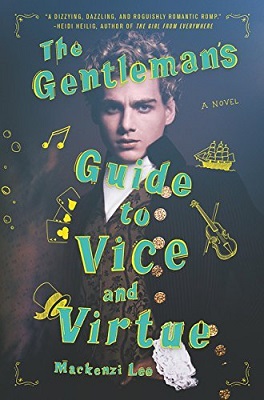
The Gentleman’s Guide to Vice and Virtue, Mackenzi Lee (2017, USA). At Sledge-Lit last year, I was talking to Jeannette Ng, author of Under the Pendulum Sun, and we were discussing the novels of Georgette Heyer, and Jeannette recommended The Gentleman’s Guide to Vice and Virtue (she was clearly a fan as she’d decorated her nails in homage to the book). When I got home that evening, sat watching telly and having a drink or two, as you do, I found myself visiting the website of a well-known online retailer and ordering myself a copy of the book, as you, er, do… And now I have read it. Well, I complained earlier in this post that “feel-good” and “quirky” are not descriptors that draw me to a book, and there’s a lot in The Gentleman’s Guide to Vice and Virtue that would normally mean I wouldn’t touch it with a bargepole. For one, it’s YA. The narrator, Monty, is a bisexual teenager, the son of an earl. In eighteenth century England. In a novel written by an American woman. His sister, Felicity, is a bluestocking who wants to study medicine, and Percy, his best friend (for whom he’s burning a torch), is the adopted mixed parentage son of a family of Quality. The two guys are off on a Grand Tour, delivering the sister to a finishing school en route in Marseilles. In Paris, they’re invited to a party at Versailles, where Monty, who is a complete rake, upsets the the king’s ex-PM, the Duke of Bourbon, steals something from him, and then makes a complete tool of himself by running around the famous garden stark bollock naked after being caught in flagrante delicto… Except the item he stole proves to be important, especially to the Duke of Bourbon. It’s a box with a combination lock, and it contains a key to a tomb in which can be found an alchemical pancea. So Monty, Percy and Felicity are forced to go undercover and travel incognito to Barcelona to find the original owner of the box… The novel is told entirely from Monty’s point of view and he’s not at all convincing as an eighteenth-century teenager – and did they allow children out of the schoolroom before the age of twenty-one in the 1700s? The prose tries for British, but a quarter of the way in gives up, then it’s all “goddamn” this  and “goddamn” that. But pretty much everything Monty does or says results in a lecture from the other characters. Percy lectures him on his white privilege; Felicity lectures him on his male privilege; yet’s he’s bisexual and there’s little discussion of that, other than a generic condemnation by society (the author says in an afterword she researched “mollies”, but Monty doesn’t feel like a person who would be part of molly culture). The Gentleman’s Guide to Vice and Virtue reads like contemporary characters in an historical setting. Lee is quite good at plotting, and she is generally good at setting the scene. But the characters do not convince. And the frequent lectures feel contemporary. When I compare a book like this to, say, William Golding’s Rites of Passage, then there’s no comparison. Golding’s novel does more, and more convincingly, in half the pages than The Gentleman’s Guide to Vice and Virtue. True, it doesn’t include the lectures on privilege, and there’s certainly a place for that, and I rue that fiction has to include such explicit lectures – but that says more about modern society and fandom than it does an individual novel. All told, The Gentleman’s Guide to Vice and Virtue was not for me. The lessons it was teaching, I have been taught elsewhere (not that it isn’t an ongoing process)… which meant I looked at other elements of the story. And there, it failed. I can’t fault its objectives, but I wasn’t impressed.

1001 Books You Must Read Before You Die count: 131

2 Comments

Reading diary 2018, #2

Okay, we’re just about a month into 2018 and it’s already proving a better reading year than 2017. Of course, the real test is keeping it going for 12 months… One of the other things I’d like to do, reading-wise, in 2018, beside read fiction from other countries, is to try and increase that 1001 Books You Must Read Before You Die count at the bottom of each of these posts. I’m not good on the classics, I need to read more of them. Would you believe I’ve only ever read one book by Charles Dickens? And while I’ve read all of Jane Austen’s novel (except Emma), I’ve never read anything by a Brontë.

Meanwhile, some recently-published and recently-read fiction…

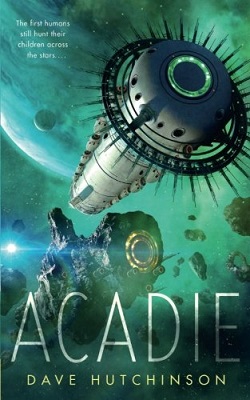
Acadie, Dave Hutchinson (2016, UK). I’m not entirely convinced by tor.com’s line of novellas if only because they like to suggest they either saved the novella or created the current market for them. Small presses have been publishing novellas for decades. Which is not to say tor.com are doing a bad thing. I like novellas so I can’t fault tor.com’s mission. True, many of the novellas they’ve published have not been to my taste – and one or two have, I feel, been lauded far more than they deserve – but … one or two of them have been entirely to my taste. Like this one. Dave Hutchinson is a friend but I also think his soon-to-be-more-than-a-trilogy of Europe books is excellent. Acadie, however, is much closer to heartland sf. The narrator is the president of the Writers, a group outlawed because of their experimentation on the human genome. He was a famous whistleblower and was recruited by them. When the Writers learn their hideout may have been discovered, they kick into action a plan to abandon the star system and settle elsewhere. The narrator is one of several people left behind to oversee the withdrawal and ensure the Writers are not tracked to their new home. But what he learns calls into question everything he knows. Okay, so the big twist isn’t that hard to spot, and while I’m no fan of first-person narratives, it’s hard to see how this story would work in third-person. If I have one complaint, it’s the depictions of the Writers’ society are both a little extreme, which undermines the point they’re trying to make. But otherwise, this is good stuff. It may well make the BSFA Award shortlist.

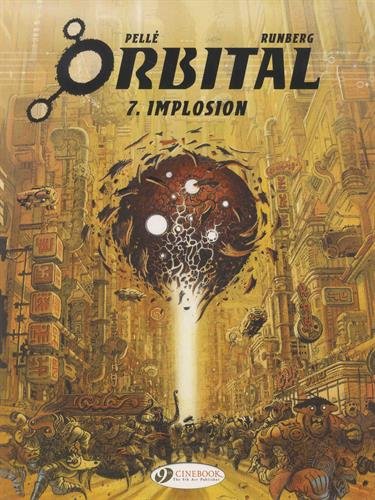
Orbital 7: Implosion, Pellé & Runberg (2017, France). Cinebook have been doing an excellent job introducing well-known bandes dessinées to the UK market, but my interest lies pretty much exclusively in the sf titles, such as Valerian and Laureline and this one, Orbital. The series follows the adventures of a human and Sandjarr, both mavericks, who were once members of their respective races’ diplomatic corps. Humanity lost a war to the Sandjarrs and hate them, so the first couple of volumes were chiefly concerned with normalising relations between the pair. But now they’re pretty much partners, and it’s a wider conspiracy seeking to undermine the human-Sandjarr alliance which provides the stories. Neuronomes, giant sentient ships which were instrumental in saving the galaxy in the previous two-volume story, have been mysteriously blowing themselves up, killing millions of people. Caleb and Mezoke are on the alien space station of Tetsuam, trying to track down a clue to what is affecting the Neuronomes. This may be the start of a new story, but it makes little or no sense without knowledge of the earlier six volumes. Which are worth reading anyway. Good stuff.

The Rift, Nina Allan (2016, UK). There’s no doubt that Allan is one of the more interesting genre writers the UK has produced in the past few years. She came out of slipstream and dark fantasy and has moved into science fiction, and her beginnings very much flavour her stories. The Rift is only her second try at novel-length, and even then her first, The Race, felt more like three novellas badly welded together than it did a novel… which sort of makes The Rift Allan’s first successful attempt at novel-length fiction. Because the one thing The Rift is… is a much more coherent narrative than The Race. (To be fair, the lack of coherence was a feature of The Race‘s narrative, it just didn’t quite work for me.) The problem I have with The Rift, and it’s fairly minor, is that I can’t decide if it’s stunningly clever, or just very clever with accidental elements of stunning cleverness. Obviously, I’d like to believe the former, but I’m also all too aware of how writers can unwittingly include more in their fiction than they realise. The plot in a nutshell: Selena’s sister, Julie, disappeared twenty years ago, assumed to have been a victim of a serial killer caught at that time, but now she has re-appeared and claims to have spent much of the two decades on an alien world she accidentally reached through a “rift”. The alien world feels like something which might have been invented for a 1970s science fiction novel, internally rigorous but also strangely familiar. It didn’t help, for me, that some of the invented names sounded like places in Denmark (Nooraspoor = Nørreport?). The big question is: did Julie really spend her time there, or has she made it up? And The Rift refuses to commit to one or the other. Is Julie perhaps an imposter? The final section of the novel seems to suggest as much, but Serena refuses to believe it, on more than sufficient evidence. The beauty of The Rift is that refusal to commit. It’s a lovely piece of writing – but that’s not unexpected for Allan – but it’s also a coherent straight-through narrative, enlivened with a few tricks such as changes of tense or person or POV, and it’s because the story is a neat contained whole, so to speak, that the narrative’s refusal to commit to a truth is so striking. It’s a novel that stays with you, not just because of the story it tells but because of the way it tells its story. It is, without a doubt, Allan’s best work yet.

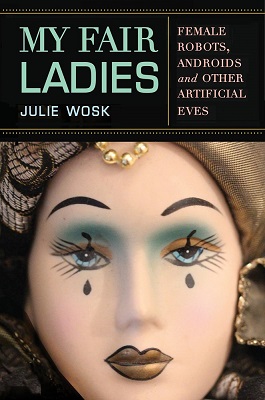
My Fair Ladies, Julie Wosk (2015, USA). I nominated this for a BSFA Award in 2016 based on a read of the first few chapters… but I never got around to finishing the book off. Which I have now done. And it deserved that nomination. Which, sadly, came to nothing anyway. Inspired by the sight of a mannequin’s head in a basket of tat at a flea market, Wosk began researching female automatons, both historical and fictional. But not just mechanical ones, or indeed magical ones from mythology. She discusses Eliza Doolittle, for example, as well as several early genre stories about mechanical women. The book then goes on to cover mechanical women in films of the 1920s and 1930s, then films and television of the decades following, before moving onto actual female robots. If you consider the robot trope in science fiction as a signifier for slavery, or for at the very least for “invisible” domestics, then it’s no great stretch to see artificial women as little more than a signifier for deep misogyny. Artificial women are, after all, above all biddable. They are the ultimate in male gaze, mirrors of the male gaze in fact; so it’s little wonder they’ve proven popular in genre. Of course, there are those examples which subvert the trope – at the end of Pygmalion, Eliza is her own woman and no longer Higgins’s toy; in Metropolis, the robot Maria is used to foment revolt among the workers; in Ernst Lubitsch’s Die Puppe, Ossi Oswalda’s impersonation of a doll sees her take control of the story… If there’s a weakness to My Fair Ladies, although it is a fascinating read, it’s that it doesn’t cover much written science fiction, covering only early genre stories and then films and television. When you consider the use of artificial women in written sf since WWII, and especially in the past couple of decades… the trope is even more pernicious, such as the title character of the awful The Windup Girl. There are no female Pinocchios. At least, there are none written by men. Madeline Ashby’s vN features a female robot as a protagonist, but she’s on the run after breaking free of her safety protocols. Jennifer Pelland’s Machine is a much more interesting work, although it is about a woman who has been decanted into a robot body while her human body is treated for a fatal condition. The treatment of artificial women in science fiction is, of course, a consequence of the treatment of women in science fiction – both in narratives and in the real world. And while women have always been writing science fiction, it’s a trope they’ve not typically made use of, and so it’s been developed almost exclusively by male writers. I would like to see that change.

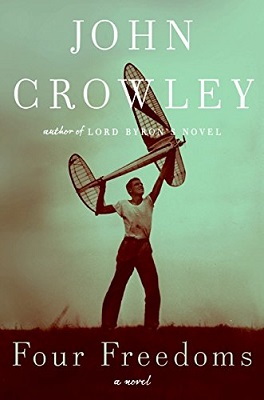
Four Freedoms, John Crowley (2009, USA). I bought this when it was first published, so it’s taken me nearly eight years to get around to reading it. And I’m a big fan of Crowley’s writing. Oops. Having said that, I’ve yet to read Endless Things, which I bought in 2007, chiefly because I want to reread Ægypt (AKA The Solitudes), Love & Sleep and Dæmonomania first… But: Four Freedoms, which is entirely unrelated and not even genre. The title refers to President Franklin D Roosevelt’s “four freedoms”: 1 freedom of speech, 2 freedom of worship, 3 freedom from want, and 4 freedom from fear. It is is set during WWII and chiefly concerns people who work at an aircraft factory in Ponca City, Oklahoma. The bomber these people are building is the B-30 Pax, but it’s clearly an analogue of the Convair B-36 Peacemaker, which did not see service during WWII (but from 1949 to 1959, to be precise) and was one of the great Cold War bombers of the US. Only 384 were built, but the novel claims 500 of its “B-30″s were built. Crowley mentions in an afterword that he didn’t intentionally model the B-30 on the B-36 and only later discovered the Pax / Peacemaker synchronicity and that the B-36 had been damaged by a cyclone at Fort Worth echoing events in his novel. I believe him – you don’t put “wow synchronicity!” notes in your afterword unless that’s what they were. The actual story of Four Freedoms is that of female and disabled members of the US workforce during WWII. The novel focuses on the factory which builds the B-30, but tells the story of several characters, introducing them and then telling their back-story through flashback. It’s a beautiful piece of writing – effortlessly readable, effortlessly convincing. I had forgotten how good Crowley is. I really ought to get started on my read of Endless Things

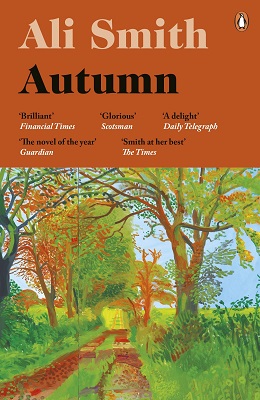
Autumn, Ali Smith (2016, UK). This was my first Ali Smith. I know her name, of course, although she has appeared on my radar more often recently as her fiction of the last few years seems to be borderline genre. Or rather, is genre but not published as such. And Autumn seems to be a case in point. Although to be fair, had it been published as genre, it would have generated no end of complaints and killed Smith’s career as a genre writer. Happily, it was published as lit fic, and those of us not so tied to space opera, mil sf, grimdark, etc. we can read nothing else, can enjoy it as genre. The novel opens with a man on a beach who appears to be in some sort of afterlife, and then abruptly shifts to the life of Elisabeth Demand, an art history lecturer. As a child she had made friends with her neighbour, an OAP called Daniel, who had been a songwriter. Years later, she discovers he is terminally ill and begins visiting him in his nursing home. At which point she realises that he is the only man she has ever loved, despite their great difference in ages, and that has affected all her relationships. The narrative bounces back and forth through time, telling each character’s story, and introducing Pauline Boty, a female British Pop artist, whose works and contributions have been criminally forgotten (in real life, that is). She was Daniel’s one great love, although she was married and did not return his feelings – but because of her, Daniel could not love Elisabeth. Much is made in reviews of the book’s post-Brexit setting, but to anyone who has lived in the North after a decade of the Tories’ criminal Austerity it seems pretty much what life in the UK is like now. I’m not sure about Smith’s prose. It seemed at first a little OTT, and some of the stream of consciousness sections seemed to serve little purpose. I’ll read more by Smith, I think, but I’m not about to dash out and read everything she has written.

1001 Books You Must Read Before You Die count: 131

1 Comment

Reading diary 2018, #1

I seem to be keeping up with my New Year Resolution to read more books. Monday to Thursday, when I get home from work, I spend an hour reading before making dinner or putting on a DVD. And I managed to polish off five books over the first weekend of the year – true, three were bandes dessinées and one was novella, but still…

The Book of Strange New Things, Michel Faber (2014, UK). I’d expected to dislike this – so why I took with me to read over Christmas, I’ve no idea. I read Faber’s Under the Skin many years ago, and hated it (but I thought Jonathan Glazer’s film adaptation was excellent). So I had expected something similar, even if the blurb sounded more like the BBC TV series Outcasts than anything else (although I may have been getting confused because there’s apparently a TV series in development based on The Book of Strange New Things; and, to be fair, I thought Outcasts a great deal better on rewatch). Anyway, expectations relatively low. So I was surprised to find that not only did I enjoy The Book of Strange New Things, but I also thought it pretty good. Peter Leigh has been selected by corporation USIC to serve as pastor at their exoplanet settlement. His wife, unfortunately, has to remain behind in the UK. On arrival at the exoplanet, called Oasis, he finds a small colony of apathetic engineers, all of whom live mostly on foodstuffs provided by a nearby town of the planet’s low-tech and enigmatic natives. It’s the natives, in fact, who have demanded a vicar’s presence, as some of them have taken up Christianity and the company doesn’t want to jeopardise the supply of foodstuffs. Leigh decides to build a church, with the help of his “Jesus Lovers”, the Oasisan Christians. Meanwhile, Leigh writes emails to his wife back in the UK. As he tend his flock on Oasis, and gradually understands what drives them, so she describes a UK falling apart bit by bit, testing both her faith and her love for her husband. Leigh is a bit pathetic as a protagonist, and the people with which he works are no better; but the aliens are really done quite well, and aspect of their nature which has driven some of them to human religion is tragic and provides a neat twist. The Book of Strange New Things was shortlisted for the Clarke Award in 2015, but lost out to Station Eleven (see here). I thought the Faber an odd choice at the time, but it deserved its place.

The Essex Serpent, Sarah Perry (2016, UK). I bought this after seeing many positive comments about it and, happily, it met my expectations. Cora Seaborne’s husband has just died and she, an amateur palaeontologist, decides to investigate stories she’s heard of the Essex Serpent. While in Chelmsford, she bumps into friends who tell her of their friend, William Ransome, a pastor, and his family in a coastal Essex village near where the Serpent has been spotted. So Cora and her autistic son go to visit them, and they all get on famously. Meanwhile, Luke Garrett, an ambitious surgeon, has his eye on Cora – he treated her late husband, and now that she’s widowed he is keen to deepen his friendship. And his friend, George Spencer, a rich dilettante playing half-heartedly at doctor, has fallen in love with Cora’s maid, Martha, a socialist activist. It sounds like it should be a mess, a story pulling in so many different directions – Cora and her desire to solve the mystery of the Essex Serpent, not to mention her own ambivalence toward her gender and role in society; Garrett’s ambitions; Martha’s activism in the London slums; Ransome’s rational approach to his Christianity; Spencer’s failed romance with Martha… There’s a Gothic feel to the story, a likeness that’s heightened by its use in places of letter exchanges, but the prose is anything but Gothic. It’s, well, breezy – hugely readable, often funny, and with some very nice descriptive passages. The cast are drawn well, as are their relationships. And there’s plenty going on – politics, religion, science, not to mention a commentary on Victorian society. I thought The Essex Serpent very good indeed, an early possible contender for my best of the year. Recommended.

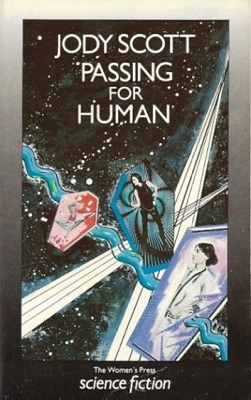
The Yellow Wallpaper & Other Writings, Charlotte Perkins Gilman (1989, USA). I knew Gilman’s name chiefly from Herland, an early novel about a feminist utopia, which I own in the Women’s Press SF edition but have yet to read. ‘The Yellow Wallpaper’ is perhaps her best known piece of short fiction. The narrator and her husband move into an old house, and the narrator becomes obsessed by the wallpaper in an attic room. She is convinced there is someone hidden inside the wallpaper who is desperate to escape and… well, it’s very atmospheric. The other stories, such as ‘If I Were a Man’ or ‘Turned’, are of their time, except for their overt feminist sensibilities. I’ve read early genre fiction by women writers, like Francis Stevens, Agatha Christie, Leslie F Stone, and, of course, CL Moore… but none them seemed to my mind to have as strong a female point of view as the stories in Gilman’s collection. The book also included an except from Herland, and a couple of excerpts from some of Gilman’s non-ficiton writing. I found the book in a charity shop a while ago, and bought it because I knew the name. But now I’m really glad I own a copy of it.

New Adventures in Sci-Fi, Sean Williams (1999, Australia). I’ve been a fan of Williams’s fiction since reading the space opera Evergence trilogy he wrote with Shane Dix back in 2003. And I’ve bought and read the sf novels written by the pair, and by Williams alone, ever since. And quite a few of Williams’s collections too. This was quite a hard one to find, I seem to remember. It’s relatively early stuff, but polished nonetheless, and even includes a favourite of mine, ‘A Map of the Mines of Barnath’ from 1995; although this time around it didn’t read quite as smoothly as I’d remembered. It’s still a bloody good sf story, though. The stories are mostly heartland sf, with a few dark fantasy. Of the sf, ‘The Soap Bubble’, in which a survey starship’s regular reports home are presented as episodes of a melodrama, at least until they meet an alien race, was quite cleverly done, and had a neat twist. ‘Reluctant Misty & the House on Burden Street’, a variation on the haunted house, was probably the best of the dark fantasy stories. The premises of some of the others felt a little secondhand and threadbare, although the stories were well told. I’m not sure what Williams is doing now – he started writing YA for a few years, and then went to Antarctica on some sort of writers’ programme. I really liked his space opera and hard sf novels, and it’s a shame he doesn’t seem to be writing them anymore.

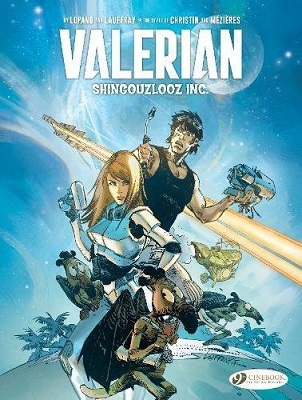
Valerian and Laureline 20: The Order of the Stones and 21: The Time Opener, Jean-Claude Mézières & Pierre Christin (2007/2010, France). These two volumes end the Valerian and Laureline story, begun back in 1967, although I’m sceptical the story-arc was fully plotted out at that time. Anyway, midway through the series, Galaxity, Valerian and Laureline’s employer disappeared after someone meddled with history, and the Earth was destroyed. After acting as free agents for several volumes, Valerian and Laureline ended up aboard an expedition to explore the Great Void. Where the Wolochs, mysterious stone beings, have appeared and are using the Triumvirate, three heads of criminal gangs, to attack humanity. In The Order of the Stones, the Wolochs go on the offensive, and the galactic civilisation is hard pressed to fend off their attacks. But there is one hope: the Time Opener. Which contains the Earth. But it can only be opened if enough people pure of heart are gathered together. And it’s the bringing together of these which forms the story of The Time Opener. Of course, they succeed. Interestingly, there were some bits and pieces from these two installments I sort of recognised from Luc Besson’s movie adaptation, demonstrating, I suppose, that his film was based on the entire series. Not that it was a good film. Overall, Valerian and Laureline have had a good run, and if the plot got somewhat convoluted somewhere around the middle – the final volume includes a timeline which does little to make sense of it all – and the ending was a bit weak, there were some excellent episodes along the way. It was a product of its time, but it didn’t hesitate to slip in contemporary digs at the real world in each of the volumes, which worked quite well because the two characters had travelled back in time and so the stories were partyl set on contemporary Earth. But there was plenty of space opera stuff too – so much so, the series is often mistaken taken to be an inspiration for Star Wars (there are similarities but they’re apparently coincidental). Perhaps the art never approached the gorgeousness of Frank Hampson’s Dan Dare, but the scripts were considerably better, albeit often somewhat compressed since each volume was no more than 48 pages. I first stumbled across these during the 1990s after Dargaud, their French publisher, made a half-hearted attempt to introduce them to the Anglophone market and published four random volumes in English. I started reading them in French, but happily Cinebook have been banging them out in English since 2010. They’re also now available in omnibus editions. Worth getting.

1001 Books You Must Read Before You Die count: 131

Leave a comment

Reading diary, #59

This is the last of 2017’s reading. I’m going to restart the numbering for 2018. I don’t remember why I didn’t for 2017, but never mind.

The Metabaron Book 1: The Techno-Admiral & the Anti-Baron, Alejandro Jodorowsky, Jerry Frissen & Valentin Secher and The Metabaron Book 2: The Techno-Cardinal and the Transhuman, Alejandro Jodorowsky, Jerry Frissen & Niko Henrichon (2016/2017, France). As far as I can work out, Jodorowsky’s name only appears on the covers of these two graphic novels because the Metabarons are his characters (they were originally spin-offs from The Incal). The actual story of this trilogy – the third book is due out this year, I think – is by Jerry Frissen. The Techno-Techno Empire has control of Marmola, the planet that is the only source of the Epiphyte, used to fuel all starships. When they learn the last Metabaron is on his way to the planet, they assume he is going to wrest it from them. So they assign the Techno-Admiral, their cruellest warlord to to stop him. In the second book, the Techno-pope’s closest advisor is promoted to Techno-cardinal and then sent to Marmola to take over production, as the Eipiphyte stocks are dwindling. With him, he takes the Transhuman, an engineered assassin who has all sorts of built-in weapons. But the Metabaron is still out there, causing problems… Frissen manages a good pastiche of Jodorowsky’s bonkers storytelling – not just the bizarre ideas; but also the male gaze and whiff of misogyny (something happily missing from The Incal, but sadly not from its spin-offs). The artwork in the first volume is very -CG-like and really quite gorgeous. In the second, however, it’s more sketchy, more like the penciller’s work has been coloured. I didn’t think it as effective. On the whole, I suspect it’s a series for fans only, as there’s little here to attract a new audience or those unfamiliar with the universe or Jodo’s work.

Ways of Worldmaking, Ben Rivers (2017, UK). A compilation of notes by Rivers on his films, and essays by critics, some of which are about Rivers’s art/films while others are about the man himself. The book is copiously illustrated with stills, photographs and strips of film. It’s also a handsomely put together volume, a solid hardback (and stitched, not glued!), of the sort you seldom see these days in bookshops. Obviously, it’s only going to appeal to someone who appreciates Rivers’s films. I’ve seen only a handful of them – his three feature-length pieces and a couple of short films (included as extras on the DVDs of the former) – but I’m definitely a fan. So Ways of Worldmaking certainly gave me an insight into the man and his works. The title, incidentally, is deliberately taken from Nelson Goodman’s 1978 book, which was a seminal influence on Rivers at college. Goodman argued that “art, philosophy, and the various sciences all make statements about the nature of reality through the creation of ‘worlds’,” as one of the essays in Rivers’s Ways of Worldmaking explains. As someone who reads and writes science fiction, that’s an idea which resonates for me, although in sf the act of worldmaking is not so much overt as it is a fundamental tenet of the genre.

Holidays in Soviet Sanatoriums, Maryam Omidi (2017, UK). Titles don’t get more descriptive of a book’s contents than this one. Apparently, back in the day, Soviet workers were encouraged to go on holidays to places that were a combination of holiday resort and health spa (and surely the plural is sanatoria?). Many were on the Caspian Sea, but there were also plenty in the mountains, particularly the Urals and Caucasians. With the fall of the USSR, most of them fell into disrepair and closed down. But some kept on going, and some have since been re-opened by private consortiums (or even consortia). Architectually, most of the sanatoriums were good examples of Early Soviet Modernist, and several of them are attractive buildings. The holidays offered varied by region and sanatorium, with many having specialist treatments, such as crude oil baths, mineral waters, or just sun, sea and sand. There are plenty of photographs in Holidays in Soviet Sanatoriums, but it’s not a deep study of its subject and the text is quite light. But I just wanted the pictures anyway.

Bodies of Summer, Martín Felipe Castagnet (2012, Argentina). I saw mention of this on someone’s blog, and the central premise sounded interesting so I picked up a copy. In the near-ish future of this short novel – it might even be a novella – the minds of dead people can be downloaded into reanimated corpses. But those who keep their own corpses for their life after death are shunned as pariahs. The narrator occupies the body of an old and overweight woman – he was male when alive – and lives with his grandson. The older the reanimated corpse when it died, the more power it needs to remain whole; otherwise, it starts to fall apart. The science in all this, incidentally, is complete bollocks, but never mind. Some people choose not be reanimated, but stay as virtual personalities on the Web. On the one hand, there’s a Catholic country (the author’s own) and a world in which there is demonstrably no afterlife. But the reanimation thing is also economic, and the quality of the body being occupied is dependent upon the price. The narrative mentions in passing rich people who deliberately kill themselves in order to inhabit better, or different, bodies; as well as those who indulge in dangerous pasttimes with no fear of really losing their lives. For the narrator, however, it’s more a case of reconnecting with his family, both alive and dead, and navigating a world that has changed considerably since he died. Much as I enjoyed Bodies of Summer, I didn’t find it an especially convincing story, but it was clearly not intended to be. I don’t mean that old thing about literary writers “slumming it” in genre, because that’s complete bollocks. It’s not just a matter of approach, or perspective, or even focus; but also how the writer chooses to use the tools available in genre. And there’s enough variation in those among writers who self-identify as genre, never mind among those who don’t. Worth reading.

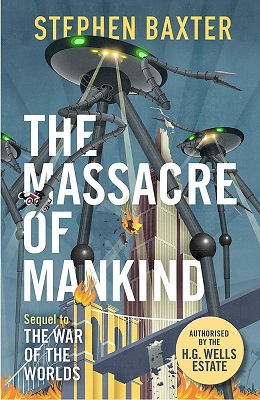
Emperor (Time’s Tapestry 1), Stephen Baxter (2006, UK). I’m not really sure what to make of Baxter’s novels. He’s frighteningly prolific, and keeping up with his books is almost a career in itself. Some of his novels I’ve enjoyed and thought quite good. And then the next one I pick up is weak and juvenile. And there doesn’t seem to be any pattern to it. For example, I liked the first book of the Destiny’s Children quartet, Coalescent, but was bitterly disappointed by the second, Exultant, and I really must read last two some day… Emperor I quite enjoyed, although it was ridiculously contrived. A woman in pre-Roman Britain begins speaking in tongues while in labour. Someone recognises it as Latin and writes it down. She dies in childbirth, but the son survives. And the Latin becomes the family prophecy… It is supposedly the words of the “Weaver”, a mysterious someone from the future. At least, this is the interpretation by several of the characters, as the prophecty is passed down, and mangled, through generations, and elements of it come true. The novel paints an interesting portrait of Roman Britain, mostly in the region around Hadrian’s Wall – the building of which comprises one section, and a visit to it a couple of centuries later forms another. The whole Weaver thing, however, feels too modern a conceit for the novel’s setting, but since it’s the link which ties the four novels of the quartet together – or so I’m guessing – then I suppose the novel is stuck with it. As Baxter novels go, this is a thin one, a mere 302 pages in hardback. I’m hoping I’ll find the second book as enjoyable a read, unlike the Destiny’s Children quartet.

Murder Take Three, Eric Brown (2017, UK). Despite the title, this is the fourth book in Brown’s Langham and Dupré series of crime novels. They’re set in the 1950s, Donald Langham is a midlist crime writer who works part-time for a private investigation agency with a wartime buddy, and French emigrée Maria Dupré is Langham’s agent and fiancée. A Hollywood starlet, filming at a country house, employs Langham to snoop around the set as she thinks there’s something fishy going on. Langham duly heads up there for the weekend, with Maria in tow, and they get to meet the cast (there is, curiously, not much of a crew on this film). It transpires that Langham knows the scriptwriter, a crime novelist like himself. The cast of the film are a mostly unpleasant lot, and there’s definitely an odd atmosphere to the place, but nothing especially peculiar seems to be going on… Until the starlet is found shot to death in the director’s trailer… They’re easy reads these books, and setting them in the 1950s means all the old murder-mystery tips and tricks and tools can still be used. The two leads are engaging characters, and if the supporting cast tend to drift into caricature territory, it’s no big deal. I think on balance I preferred the volume prior to this, Murder at the Loch, as its plot revolved around an interesting historical mystery. This one feels more like a pastiche of a 1940s Hollywood take on an English countryhouse murder, which gives it more of an air of unreality than it deserved.

The Chrysalids, John Wyndham (1955, UK). I may have read a Wyndham novel when I was at school, but I’m not entirely sure. I do remember reading one of his collections a few years later – if only because the cover art was a blurry photo of an Airfix model of a Colonial Viper from Battlestar Galactica. From what I recall, the stories were pretty bad. But Wyndham occupies a peculiar position in British sf – considered an important writer in the history of the genre by many, but also widely accepted by the mainstream. Some elements of his novels have even entered British culture, such as the Triffids. The Chrysalids, however, is set in Canada, although it might as well be set in Kent. The Earth has been depopulated by nuclear war, and much of it lies in ruins. In Labrador, in a small farming community, the narrator and seven other kids can all talk to each other telepathically. But they keep it secret, because mutations are ruthlessly culled (if animal) or exiled (if human), although the latter do sometimes have a tendency to turn up dead. Unfortunately, the secret gets out when the narrator is in his late teens/early twenties, Chiefly thanks to his very young sister, who is an extremely powerful telepath, so powerful in fact that she can just about hear the thoughts of people in New Zealand… which comes in useful as New Zealand is apparently a near-utopia for telepaths, and they’re sending a mission to Labrador to rescue the mutant teenagers. But not before the teenagers have been chased into the badlands and have witnessed a battle between the farmers and the mutants. Of course, radiation doesn’t cause hereditary mutation, we know that now, although perhaps they didn’t in the 1950s. The whole “keeping the genome pure” thing is also policed using religion, leading to some all too plausible – and sadly common, even now – Bible-backed bigotry. The narrator’s father is an especially big arsehole in that regard. And yet… it all feels very Home counties. For all the regard in which Wyndham is held, he’s never been an important figure in my map of science fiction, UK-only or Anglophone; and I’ve yet to be convinced he should be considered as important as he is.

1001 Books You Must Read Before You Die count: 131


Leave a comment

Reading diary, #58

This is the last but one Reading diary post before my 2017 reading is all written up. And then, of course, I’ll have to start documenting my 2018 reading… Which I hope to do more frequently and more diligently than I did in 2017.

The Thing Itself, Adam Roberts (2015, UK). I have not in the past got on especially well with Adam Roberts’s novels. He’s an enormously clever bloke and has excellent taste in fiction, but I think there’s something in his approach to the genre which rubs me up slightly the wrong way. Except. I really did like The Thing Itself and thought it very good indeed. The narrator is a radio astronomer, wintering in Antarctica with a creepy geek. This is during the 1980s. The geek is secretly experimenting with perception – the idea that our senses mediate the world, that there is something there, in reality, an idea based on Kant’s Ding an sich, which our senses edit out… but what if we could actually perceive it… “It” all turns out to be a bit Lovecraftian and eldritch, but the geek’s unsuccessful attempt to kill the narrator, and the brief glimpse the narrator has of unadulterated reality, were enough to fuck him up. And now, decades later, he’s a complete loser (although the geek is in Broadmoor). But then he’s contacted by a secret thinktank – and it’s pretty obvious they’ve built themselves an AI, but the narrator is too dumb to realise this – because they need him to approach the geek… And, of course, everything goes horribly wrong and the narrator ends up on the run, not entirely sure who he’s running from and increasingly convinced the mad geek has developed some sort of superpower. There are also a number of historical sections, which better explain, and illustrate, the book’s central Ding an sich premise. I do have a couple of minor niggles, however. The narrator uses a cane, which he loses while fleeing from hospital… but mysteriously has it back a chapter or two later. And a female character changes name over a couple of pages. But that’s minor, trivial even. I thought this a very good sf novel.

Crashing Heaven, Al Robertson (2015, UK). The trade paperback of this, among several others, was being given away free at Mancunicon, the 2016 Eastercon, so I grabbed myself a copy because, well, free. And, you know, it’s twenty-first century space opera and I still pretend to like that – although it does seem like increasingly fewer of them float my boat, as it were. Crashing Heaven is a case in point. It ticks all the boxes for 21st-century space opera, but that to me felt like more of a handicap than an advantage. Forster is an ex-soldier and POW, returning home to the Station after the cessation of hostilities with a collective of AIs who apparently dropped a rock on a lunar outpost that happened to be hosting a children’s schooltrip. (They denied doing it, of course.) Implanted inside Forster is an AI called Hugo Fist, which was designed to kill AIs (in that sort of handwavey computing cyber warfare bollocks that sf seems to love) and which manifests as an old-style music hall ventriloquist’s dummy. Unfortunately, due to some contract shenanigans, Fist is due to soon take-over Forster’s body, effectively killing him. Worse, Forster thinks the AIs are innocent of the lunar rock thing (I mean, come on, it’s obvious right from the start they didn’t do it). It’s all a plot, of course, by the “gods” of the Station  – who are apparently uploaded humans so sociopathic they refuse the same existence and abilities to every other human, which to me is just putting a sf spin on slavery. And that’s pretty much the world of the Station – slavery, genocide, megaviolence, the usual 21st century science fiction crap. Not interested. Crashing Heaven is apparently the first book in a series. I won’t be reading the sequels.

Glamour in Glass, Mary Robinette Kowal (2012, USA). I read the first book of this series a while ago, and a conversation on Twitter in late 2017 persuaded me to carry on with the series. So I bought book two. Which is Glamour in Glass. (Amusingly, according to the spine, it’s the second book in the “lamourist Histories”. Oops.) At the end of the first book, plain-but-talented Jane married estranged-earl David, and the two make their living as among the best glamourists in England. One of their clients is the Prince Regent,. He reveals to Jane that she will finally get her postponed honeymoon. In Belgium. Ostensibly there to study a new glamourist technique which can make things invisible, it turns out David is spying for the British Crown – since Napoleon has escaped and is expected to retake France… The end result is less Jane Austen and more Georgette Heyer, and I do love me some Heyer, but the Heyer of An Infamous Army rather than Cotillion. Which is no bad thing, although the change in tone between the first half of the book and the second did jar a little. And the final scene wasn’t quite as dramatic as the lead-up had suggested. (On the other hand, a modern eye does mean some of the more skeevy aspects of Heyer’s fiction are avoided.) But I did enjoy the book, and I’m glad I was persuaded to give them another go. I think I’ll carry on reading them.

Swastika Night, Murray Constantine (1937, UK). It says Murray Constantine on the cover but it’s sort of an open secret that Constantine was a pseudonym of Katherine Burdekin, so I have to wonder why Gollancz chose to use the pseudonym on the SF Masterwork edition. I mean, no one remembers either name these days, so it makes no fucking difference. Use her real name, make it obvious the writer was female. Anyway, the story is set 700 years after the Axis won WWII, and and Europe is all Greater Germany. People – well, men… as women are considered subhuman and treated like animals – are divided into Nazis, Germans and everyone else. A clever Englishman visits Germany on pilgrimage and hooks up with a German friend who had worked in the UK. Through him, he meets the local Nazi lord, who reveals a secret history. Hitler was not tall and blond and godlike, and women were once considered equal to men… There are perhaps a few people in the US, or members of UKIP, who may be surprised by these revelations, but to the human race it’s the sort of reveal which has almost no dramatic impact. It’s not helped by the fact the narrative consists mostly of characters lecturing each other. The misogyny is baked into the world but, despite suggesting homosexual relationships are both common and unremarkable, there’s a still a whiff of homophobia. Swastika Night is not a great book. Had its profile remained prominent in the decades since it was first published, it might have been considered an important book. Sadly, it was all but forgotten. It’s good that the SF Masterworks series has chosen to publish it – although it would have been better thad they used the author’s real name – and it is scarily more relevant now than it has been since the 1940s… It’s an historical document, it reads like an historical document… but it’s a sad reflection on our times that its premise is no longer historical…

Bluesong, Sydney J Van Scyoc (1983, USA). This is the second book of Van Scyoc’s Daughters of the Sunstone trilogy, which I have in the SFBC omnibus edition. I’ve been a fan of Van Scyoc’s fiction for a long time, and I’m not entirely sure why. Or rather, I hadn’t remembered why until I started reading this trilogy, beginning with Darkchild (see here), and now Bluesong. She was genuinely good. She built strange worlds and set stories in them that were predicated on that strangeness and yet had plots which explained the cause, and sometimes cure, of the strangeness. She was never especially popular, but I think I’d rate her one of the best female US sf writers of the 1980s. Sadly, her last novel appeared in 1991 (although she apparently had a couple of stories in F&SF about ten years ago). The Sunstone novels are set on the world of Brakrath which, although mostly low tech, was settled from another world centuries before and remains aware of them. The planet is a bit too cold to be comfortable for humans, so they hibernate during the winter. Even during the spring, the valleys would be too cold for agriculture… but for the barohnas, the female rulers of each valley, who have the power to focus and direct the sun’s rays… to defrost the land and provide sufficient warmth to grow things. In Bluesong, a young woman realises she is not one of the river people among whom she lives, runs away, and eventually ends up finding her father among the desert people… But she is actually a daughter of a barohna, and so will change into one herself. Van Scyoc draws her alien societies well, and this series is particularly good at dropping hints toward a story arc. I liked Bluesong more than Darkchild, but they’re both pretty good. Cherryh may have received more love during the 1980s, and, er, since, and was hugely more prolific, but Van Scyoc was just as good.

The Hidden Side of the Moon, Joanna Russ (1987, USA). I don’t think I ever doubted that Russ was an extremely clever writer, although it was more evident in some stories than others – some of her short fiction, in fact, was so much of its time, it was hard to see see past how emblematic of their period of writing they were. But it wasn’t until I read The Hidden Side of the Moon that I realised how consistently clever a writer was Russ. This is not a specially curated collection, but it’s so much more intelligent a collection than her The Zanzibar Cat. Perhaps it’s because not every story in it is genre, and it was not put together to showcase her genre credentials. Perhaps it’s because every story in it is fiercely feminist. I don’t know. I do know a collected works of Russ is long past overdue – not just the short fiction, but also the non-fiction, like the essays in Magic Mommas, Trembling Sisters, Puritans & Perverts, or her criticism. She is, like Samuel R Delany, one of the most important writers American science fiction has produced. And yet who is it who remains in print and has countless stories and novels adapted by Hollywood? Philip K Dick. A drug-addled hack. We are, I suppose, fortunate that Asimov, one of the most graceless prose stylists of his generation, has not been so enthusiastically adopted by Hollywood. And while I still have a soft spot for some of Heinlein’s works, he’s pretty much science fiction’s embarrassingly outspoken old uncle with all the offensive opinions at the family barbecue, who’s pretty harmless until he starts touching up his young nieces. It’s long past time science fiction stopped venerating skeevy old hacks like Asimov and Heinlein and Dick, and started lauding the real grand masters, like Delany, Russ, Tiptree and Le Guin.

1001 Books You Must Read Before You Die count: 131

3 Comments

Reading diary, #57

I’ve got a few of these posts to get out before I complete documenting my 2017 reading. The books below were all read two months ago, but I’ve been a bit crap at writing them up. I’ve been a bit crap at finishing books, in fact, and have got into the bad habit of picking up a new book before reaching the end of the current one… and then having to go back and finish it later. I’ve got piles of books scattered around the living-room which only need me to read the last twenty or so pages so I can put them back on the shelves (or send them off to the charity shop). I think I’ll make that a resolution for 2018: only pick up a new book when I’ve actually reached THE END in the one I’m reading. And if that means carrying two books on my daily commute, so be it.

Anyway, November 2017’s reading consisted of…

Nocilla Experience, Agustín Fernández Mallo (2008, Spain). This is the sequel to Nocilla Dream, which I read and thought very good last year – see here. There is a third book, Nocilla Lab, although I can find no information on when Fitzcarraldo Editions plans to publish it, or indeed Mallo’s most recent novel, Limbo. Like the first book, Nocilla Experience is split into numbered sections, 112 in total, some several pages long, others no more than a sentence or two. They are a mix of fiction and fact, or, such as in the case of the snippets of dialogue from Apocalypse Now, found documents. The main narratives all deal with obsession – a man who is trying to eat every box of corn flakes he can find with a sell-by date the same as his ex-wife’s birthday; another who turns bubblegum stuck to pavement into tiny paintings; a third man runs a restaurant that serves up found objects instead of food, although they’re presented as food… It’s a fascinating literary experiment, although I’m not entirely sure how it’s supposed to fit together – or if indeed it’s meant to. And, for some reason, much as I liked it, Nocilla Experience didn’t quite appeal to me as much as Nocilla Dream did. But I’m still looking forward to the third book… and I wonder if there are any Spanish writers inspired by Mallo – the “Nocilla generation” – who have also been translated into English…

The Silver Wind, Nina Allan (2011, UK). I’m still not sure if that’s “wind” as in what you do to a clock, or “wind” as in the movement of air. And I heard the author read one of the stories from this linked collection at a Fantasycon in Brighton several years ago. But there’s a fob watch prominent on the cover, and the six stories inside are all about time – so much so, watches and clocks are repeatedly called “time machines” – and there are definite hints that travel through time takes place in some of the stories. But each story also features variations on a small cast of characters, suggesting alternate universes more than time travel. It all makes for an unsettling read, a mosaic narrative which refuses to remain constant, which refuses to settle down. While the plots themselves are little different to those you might find in a series of literary fiction short stories, the fact the world in which they take place seems to rest on shifting sands gives them a fantastical atmosphere. It’s something Allan does in most of her fiction, but in The Silver Wind, because of the small cast and the interweaving of lives and stories, it’s much more obvious. Good stuff.

The Year of the Flood, Margaret Atwood (2009, Canada). This is the sequel to Oryx & Crake, and now apparently the second book of a trilogy, followed by MaddAddam, which I also own. I read Oryx & Crake a couple of years ago and, to be honest, I don’t recall much of the plot. I do remember finding it all very unconvincing and Atwood’s neologisms quite cringeworthy. That last is still true in The Year of the Flood, but the world it describes seems much better made. But brutal. Horribly, stupidly brutal, in fact. It’s cruel in a way that only science fiction and fantasy can manage, a scale of brutality that needs an invented world to achieve. Atwood seems to revel in the gore in parts of this novel, and I’m not interested in such fiction. I don’t want to read books that normalise psychopathic behaviour, and far too much science fiction does that. On the other hand, the “sermons” which introduce each section of The Year of the Flood are hilarious. It is, I think, a much better book than its predecessor, but it is also disappointingly violent. I don’t know when I’ll get to MaddAddam, but I suspect it’ll take me a while.

Prussian Blue, Philip Kerr (2017, UK). This is the twelfth novel in Kerr’s Bernie Gunther series, begun back in the early 1990s with his Berlin Noir trilogy. Since returning to the series in 2006, Kerr has been banging them out one a year, with no discernible loss in quality. And over the twelve books, we’ve seen Bernie survive WWII, bounce around South America, Cuba, Germany, and now it’s the mid-1950s and he’s a concierge at a small hotel on the Riviera. Each of the Gunther novels has followed the same template – what Bernie is doing now, and how he gets himself out of the bad situation he seems to have got himself into, and a narrative set at some point before, or during, the Second World War, when he worked for various iterations of the Berlin police. In Prussian Blue, a face from the past turns up and blackmails Bernie into murdering a woman in England, so he goes on the run. That face from the past was Bernie’s criminal assistant during an investigation into a murder in Obersalzberg, Hitler’s mountainside retreat in Bavaria, which he had to solve in a week before Hitler arrived to celebrate his fiftieth birthday. Unfortunately, Obersalzberg, administered by Hitler’s private secretary, Martin Borman, is rife with corruption, and there is no shortage of suspects. Just make matters worse, Borman doesn’t much care if the crime is solved, just as long as he has someone he can put in front of a firing squad. Which he soon finds. But Gunther also has a suspect. Unfortunately, the murder is linked to the millions Borman and his cronies are ripping off from the Third Reich. And while Borman’s brother, who hates him, is waiting in the wings to bring him low, he and Gunther have been out-manoeuvred.  Worth reading.

Dreams Before the Start of Time, Anne Charnock (2017, UK). I forget who originally recommended Charnock, but I read her Sleeping Embers of an Ordinary Mind (see here), and was impressed enough to want to read more. Which I now have done. Although it has taken me pretty much exactly twelve months. But it was worth the wait. Dreams Before the Start of Time is… an ensemble piece. There are a group of people, related by blood or marriage or just friends, and they’re living their lives in London and Shanghai over the next few decades, beginning several years from now. The story opens with a young woman deciding to become a single mother, but using a sperm donor. Her friend, on the other hand, has a one-night stand, and decides to keep the consequences. As the years unfold, attitudes to the means of conception, gestation and child-rearing change as technology progresses and sensibilities reflect new social mores. A sf novel like this in direct opposition to the Atwood above – the world has not ended, there are no sexual assaults, no mega-violence, no violence, in fact. There needs to be more science fiction like this. Of course, it helps that the writing is really good – good enough for me to pick the novel as one of my top five books of the year – see here. I was given Charnock’s A Calculated Life, her debut novel, for Christmas. I’m looking forward to reading it.

Final Incal, Alejandro Jodorowsky & Ladrönn (2017, France). Jodorowsky keeps on coming back to the Incal. This is hardly a surprise as it’s been his most successful title – although Incal spin-off the Metabarons has probably appeared in more media incarnations. In Final Incal, the multiverse is in danger when an evil machine intelligence creates a plague and the only defence is to convert everyone into a robot… Three iterations of John DiFool all meet up between universes, in the hunt for their lover, Luz, and the means to save the multiverse from destruction. But only one of them can complete the task. The artwork, by Ladrönn, is very good indeed. Apparently, Moebius did start work on the project, but only completed the first part, so Jodorowsky had Ladrönn redo it from the start. The story is the usual Jodorowsky weirdness, although it’s starting to feel a little recycled by now. This was an astonishing piece of sf in its day, and it continues to make for good reading decades later. But I have to wonder whether these returns and extensions to it are doing it any favours. I guess I’ll find out when I get around to reading Deconstructing the Incal

1001 Books You Must Read Before You Die count: 131

1 Comment

Reading diary, #56

After a run of male authors in my last Reading diary, it’s a run of female writers… including one novel I had never planned to read. These days, “Hugo Award winner” is more likely to make me put a book down than actually pick it up. Um, looking back over the history of the award, I can’t say I’ve ever really used it as a guide to my genre reading and have always felt it has picked far more duds than actual classics.

The Milkman, Michael Martineck (2014, USA). Michael is a friend of many years, around two decades in fact, although we only met for the first time in person at the Worldcon in Helsinki this August. And it’s just as well I know Michael as The Milkman posits a horrible corporatised world and does so with a completely straight face. But I know Michael does not believe the politics the book presents… because they really are quite nasty. The story is told from several viewpoints. A young woman is murdered outside a bar, but there are no clues to the crime. The corporate police officer tasked with solving the crime – assuming it can be done economically – finds himself hitting a brick wall. A film-maker is paid to make a documentary about the Milkman, a mysterious figure who analyses milk from corporate dairy farms and posts his results on an anonymous website. And then there’s the Milkman himself, who’s a low-level bureaucrat who, with his network of co-conspirators, tests milk as a hobby. The Milkman does a good job of presenting a world in which everything is owned by one of three corporations, and manages to use it effectively in a mystery/thriller plot. Personally, I’d have liked more commentary on the world – I mean, it’s a horrible place to be, and presenting arguments from the characters that it’s preferable to the “old world” made the novel sound approving. It’s a political novel, and when it comes to political novels the author needs to wear their politics on their sleeve. You can’t let the reader draw their own conclusions, because they might well draw the wrong ones. There’s enough right-wing sf out there – the entire genre is essentially right-wing – and commentary against it is sorely needed in science fiction. Much as I enjoyed The Milkman, it felt too ambivalent toward its world – despite the final scenes set among those who had opted out – and I’d liked it to have been a little more overt in its politics.

Lust, Elfriede Jelinek (1989, Austria). I’m a big fan of Michael Haneke’s films, and after seeing his The Piano Teacher, and learning that it was an adaptation of a novel by a Nobel laureate, I bought the book and read it and thought it very good. And then recently I thought it about time I read more Jelinek, so I picked up a copy of Lust, as it was quite short. It was perhaps not the wisest book to read on my daily commute, given the title. But never mind. The story is a brutal depiction of a marriage in wich the wife is treated as chattel by her husband. And when she eventually breaks free and finds herself a lover, he proves just as bad. What I had not remembered from The Piano Teacher, and perhaps that was down to the translator, but Lust was one long string of wordgames and puns and plays on words. It was relentless. Given its subject, it should come as no surprise the wordplay mostly focuses on sex, and especially on the male sex organ. I have no idea how this worked in German, or in the Austrian dialect in which Jelinek writes, but in English it felt to me like a dilution of the novel’s central point. The wife is entirely subject to the husband, she exists to satisfy his sexual desires, just as much as she is there to look after him and their spoilt son. Some of the expressions used, “shot his bolt”, for example, feel too… childish, schoolboyish, and while I get that the breadth and variety are what’s important, it does seem to detract from the brutality. This is an ugly book, about an ugly subject, so perhaps the wordplay is intended to add to that ugliness and it works much better in German. But this is definitely a book that provokes a reaction, and I’ll be reading more Jelinek.

Valerian & Laureline 19: At the Edge of the Great Void (2004, France). Cinebook are churning these out at a much faster rate after the Besson film, which is all to the good. At the Edge of the Great Void kicks off a new story-arc, which I think is the last for the duo. Valerian and Laureline are posing as itinerant traders on the edge of the Great Void because they feel the key to restoring Earth lies within it. But their plans are scuppered when Valerian is arrested. Fortunately, Laureline has made some friends, and with their help, she arranges an escape for Valerian, and the two of them join the crew of a ship heading into the Great Void. The story is mostly set-up – it introduces a new alien race, the Limboz, and drops hints about a plot by the Triumvirate, villains from an earlier story, and some sentient stones, the Woloch, who are clearly intended to provide the plot for the next few episodes. I’ve yet to see to Besson’s film, although I expect to be disappointed. The Valerian and Laureline series is massively inventive – there’s a good argument, although likely wrong, that it influenced Star Wars – and there’s a very dry wit in the interaction between the two main characters. But the stories are also very cut-down, so much so it often feels like bits of the plot have been left on the cutting-room floor. It’s like the opposite of decompression. Which, er, would be compression. I suspect it’s an artefact of the series’ original magazine appearances and limited page-count.

The Fifth Season, NK Jemisin (2015, USA). I had no plans to read this, for all that it won a raft of awards, and was shortlisted for many more (including, according to the back cover, the James Tiptree Jr Award, which, er, doesn’t have a shortlist – it has an honour list, and I should know as I’ve been on it). Anyway, there was no real buzz around The Fifth Season, as there had been for God’s War and Ancillary Justice, probably because The Fifth Season was Jemisin’s sixth novel – and, on top of that, it was fantasy, which is of zero interest to me. But some people said it was actually science fiction, not fantasy, and I heard some good things about it and, I admit it, the clincher was the fact it was going for £2 from a near-monopolitistic online retailer… So I bought it. And… It certainly smells like science fiction rather than fantasy; and if its sessapinae and orogeny is hand-wavy bullshit, it’s no more so than FTL, or indeed most of sf’s common tropes. It’s not worth summarising the plot, as much of it is linked to the world-building. The Fifth Season is set late in Earth’s history, when the planet is unstable, and “fifth seasons”, periods of intense seismic and/or volcanic activity, often bringing on nuclear winters, occur every few centuries. A new one has just kicked off as the book opens. There are three narratives, each following a female character – an orogene (ie, a person who can, among other things, control siesmic events) who has been in hiding for many years; a young girl with ability who is sold to an imperial order of trained orogenes; and a “four-ring” orogene of that order who is tasked with accompanying a “ten-ring” orogene to clear a town’s harbour of coral. The first narrative is written in the second person; the other two are more traditional. Initially, I thought the novel better than average – the prose was doing the job, but the world-building was interesting, if a little overdone (but we’ve all been there, nothing brings in the nerds like an excess of world-building detail). It was brutal in places – ho hum, it’s all that genre fiction does these days. So… enjoying it, but, on balance, unlikely to bother with the rest of the trilogy. And then I realised the book was using time-stacked narratives. Those three main characters were the same woman during different periods of her life. And things started to slot together like a piece of IKEA furniture. Now it was a much more interesting novel. Now, I might actually read the sequels. Did it deserve to win the Hugo? Given the shortlist… probably. I’ve read the Leckie, but the trilogy pretty much nose-dived after the first book. The other three shortlisted works do not appeal at all. If it hadn’t been for the £2 price point, I’d probably never have bothered reading The Fifth Season. Maybe if I’d stumbled across a copy in a charity shop, I might have given it a go. But I am glad I read it.

The Best of Leigh Brackett, Leigh Brackett (1986, USA). I’m no stranger to Brackett’s fiction, having been a fan for a number of years – ever since reading the collection, Sea-Kings of Mars, in the Fantasy Masterworks series, in fact. The stories in that collection are not fantasy, of course. But Sea-Kings of Mars was not the only book in the Fantasy Masterworks series that was actually science fiction. There are ten stories in The Best of Leigh Brackett, and they’re all, well, typical Brackett. Some I had read before. They’re set on planets and moons of the Solar System which share names with the planets and moons we know but otherwise bear no resemblance – Mars is a desert world, inhabited by ancient dying races; Venus is a jungle world, also, er, inhabited by dying ancient races; the moons of Jupiter are inhabited; as is Mercury… In fact, Brackett pretty much turned every planet and moon on the Solar System into the sort of exotic location used in a Humphrey Bogart movie. It’s always the same – a dying race, a dead culture, a degraded society, and a jaded hero from Earth – pretty much always the US – who overcomes local taboos and superstitions to win the prize. It’s pure Hollywood, so it’s no surprise Brackett worked extensively in movies, her best-known scripts being Rio Bravo (my favourite western) and The Empire Strikes Back. Leigh Brackett and CL Moore were female pioneers in sf – not the only ones, by any means, and it could be argued Gertrude Barrows Bennett was more of a pioneer – but Moore and Brackette were big names in the genre fiction back in the 1940s, and while their style of science fiction is no longer popular, there’s no doubt they were very good at what they did. Perhaps too good, in some respects – some of stories in The Best of Leigh Brackett are dismayingly misogynist. It’s nothing unusual when you compare it to, say, EE ‘Doc’ Smith (it continues to amuse me that ‘Doc’ is always presented in quotes), but I’d expected better of Bracket – and she has indeed done better in other stories. Despite the title, The Best of Leigh Brackett does not contain any of her more celebrated stories, except perhaps ‘The Jewel of Bas’ – but since those stories appear in plenty of other Brackett collections, that’s to its advantage. I’d also dispute the stories here were her best – I thought the aforementioned Sea-Kings of Mars a better selection. Nonetheless, Brackett is always worth reading.

1001 Books You Must Read Before You Die count: 131


2 Comments

Reading diary, #55

It might look I had a run of books by male authors, but in amongst these were several sf novels by female writers, which I plan to review on SF Mistressworks soon-ish. As it is, there are two books by a single writer, Eric Brown, who’s a friend of many years: a novella and a short collection.

Exalted on Bellatrix 1, Eric Brown (2017, UK). This is the final book in the Telemass Quartet, in which obsessive father Hendrick chases after the body of his young daughter, who has been put in stasis until a cure for her condition can be found, and who has been kidnapped by Hendrick’s ex-wife. And she is apparently just as warped as she’s been subjecting her daughter to increasingly desperate remedies, none of which have worked. But this is the fourth novella of a quartet, and Brown rarely fails to deliver some sort of uplifting closure to the agonies through which he puts his protagonists. In this one, Brown uses a setting he’s used many times in the past, an artists’ colony. Hendrick’s ex-wife has taken their daughter to the eponymous planet, where they’re hoping the reclusive, but advanced, alien inhabitants, the Vhey, will cure her. The end result is something in which the quartet’s story arc feels almost incidental. The novella focuses on the head of the colony, who is a nasty piece of work, and whose wife died in mysterious circumstances, and who plans to make use of the secret of the Vhey. Although not in the way Hendrick’s ex-wife is expecting, and not in a way that will save the daughter. Of the four novellas, this was probably the least satisfying, chiefly because it feels a bit warmed-over in places. Also, annoyingly, the previous three books used Roman numerals in their titles, but this one uses an Arabic number 1.

Revenger, Alastair Reynolds (2016, UK). This is, I think, supposed to be a YA novel – or at least YA-ish. The narrator is a teenage girl, in a planetary system populated by billions of space habitats, and which as been colonised in waves over billions of years. It is, it must be said, a pretty cool piece of world-building. Except… it’s all a bit steampunk. The spacecraft use light-sails to travel around the system, the technology is all brass and clockwork, except for magical tech artefacts left behind by aliens from earlier waves of colonisation… One of which are the skulls. Although the alien race whose skulls they were has long since vanished, and all that remains of them are bones, the technology inside their skulls remains active, and they’re all plugged into some sort of FTL comms network. Some teenagers can eavesdrop on this network, and send signals. Both Fura Ness and her sister Adrana have this knack. Adrana, the older of the two, persuades her sister to join her in running away from their financially-ruined father and making their fortune as skull readers. They join the crew of a ship that raids “baubles”, abandoned repositories of ancient alien tech (perhaps the baubles were habitats in the distant past, it’s never entirely clear). The baubles are usually secure behind impenetrable shields, but the shields occasionally drop for short periods, and some people are able to predict when these windows of opportunity will occur and how long they will last (again, it’s never made entirely clear why the shields should do this; because plot, I guess). Unfortunately, at their first bauble, the ship is attacked by a semi-legendary pirate, Bosa Sennen, who takes Adrana to be her skull-reader, and kills everyone else. But Fura hid, and survives. She vows revenge on the pirate, but her plans are derailed when her father has her brought back home and has a doctor halt her ageing so she will remain under-age and under his control. To me, that was the most horrifying part of the whole novel – Fura imprisoned by her age and society. Of course, Fura breaks free, joins the crew of a ship, engineers an encounter with Bosa Sennen and, well, there are no real surprises at the climax. As I said, the world-building is cool, but it’s never really convincing – and the baubles reminded me of something, A Deepness in the Sky perhaps? – and I didn’t really like the faux Victoriana. Fura makes for a good protagonist, but I thought the violence over-done. There is, I believe, a sequel called Revealer, due next year or the year after. I’ll buy it, of course.

The Paperchase, Marcel Theroux (2001, UK). I stumbled across this in a charity shop, and having been impressed by the last Theroux novel I read, Strange Bodies, I bought it. It’s not science fiction in the slightest, more of a family drama slash mystery. The narrator is a UK-based American, who is surprised to discover he’s been left his uncle’s house on a New England island in a will. The uncle was a celebrated writer, who faded away and became a recluse. The narrator leaves his job at the BBC and goes to live in the house – it’s a condition of the will: he only gets to keep it if he lives in it. And something about the papers left by his uncle, and the stories, and histories, of his neighbours, persuades the narrator there is a deeper story here – a mytsery about his uncle’s death, or his life. From a variety of unrelated facts, and assorted residents of the island, and friends of the late uncle, the narrator figures out the secret at the heart of the family. The problem is the prose, and the narrator, is so laid-back the revelation doesn’t really have the impact it should. True, it’s not especially earth-shattering, and very personal, but it’s the point of the novel so I’d expected something with more consequence. There’s a nicely digressive tone to the narrative, and the characters are well-drawn (and mostly likeable), but I polished this off about as quickly as I would a commericial crime novel and I had expected more of it.

Strange Visitors, Eric Brown (2014, UK). This is the eighth volume in NewCon Press’s Imaginings series of short collections. The contents in this one were originally published in a variety of venues, but, as is usually the case with collections, one story is original. It is not, to be brutally honest, Brown’s strongest collection. ‘Life Beyond…’, a piece of Simakiana, hews so closely to Simak’s patterns the plot is obvious from the first page. ‘Steps Along the Way’ is a post-human story about a twentieth-century human reincarnated thirty thousand years later… just to set up a surprise reveal ending (I suppose I should have liked this one, given its plot, but I thought it weak). ‘Myths of the Martian Future’ is one of those sf stories where every character in it is an alien of some form. It felt lighter than its tone suggested. ‘The Scribe of Betelgeuse V’ felt more like Dr Who story than an Eric Brown one. But without Dr Who. Its tone suited its lightness. ‘The Rest is Speculation’ is set during the last days of planet Earth, and reads more like a travelogue than a story (and the header in the book is incorrect as it gives the title of the following story). Which is ‘The Tragic Affair of the Martian Ambassador’, a HG Wells / Sherlock Holmes mash-up, and succeeds as that if not entirely as a Holmes mystery. ‘Bukowski on Mars, With Beer’ was written for “bizarro fiction” anthology Vivisepulture (which also contained my Nazi occult flying saucer story, ‘Wunderwaffe’). I don’t know enough about Bukowski to feel qualified to comment on this story. ‘People of Planet Earth’ is one of those stories based on one of those silly ideas that wants to be both shocking and humorous, but fails at both. Finally, I was prepared to be disappointed by the collection’s only original story, ‘P.O.O.C.H.’, if only because of its terrible title. And prepared to hate it when I read that P.O.O.C.H. was an acronym for “Personal Omni-Operational Correctional Hound”, but… The premise is daft – giving convicted felons robot dogs programmed for bad behaviour in order to make them better people – but Brown draws his protagonists well and does a good job navigating the emotional landscape of the story. And yes, I also got to feel smug about being a cat person. It’s easily the best story in the collection.

The Quarry, Iain Banks (2013, UK). This was Banks’s last novel and is about a man dying of cancer, so questions about art and life were inevitable after Banks announced he had terminal cancer. The novel is actually narrated from the point of view of the dying man’s son, who has, I think, Asperger’s Syndrome. It is, like most of Banks’s non-M novels, a story based around a family secret, but the secret in this case is actually pretty irrelevant. A group of people who shared a house during their student days have returned to the house, where the oldest of their number now lives, and is in the end stages of terminal cancer. There is mention of a videocassette – the group fancied themselves as avant garde film-makers at university – which none of them want to see the light of day, but neither dying Guy nor his son Kit, know what’s happened to the tape. Meanwhile, a few home truths are aired, a few minor secrets from the past are let out of the bag, and the mystery of the identity of Kit’s mother is occasionally floated past the reader, only for it to be dealt with in passing at the end. The scene where the group view the sought-after videocassette is also pretty much a damp squib. The novel is narrated by Kit, and I don’t know enough about Asperger’s or autism to just how accurately or effectively he is portrayed. Other than that, Banks always wore his politics on his sleeve, and they’re out in full force in The Quarry. It’s far from his best novel, mainstream, science fiction or both, although it does come across as an angrier novel than his earlier ones (except perhaps for Complicity) – but that’s hardly surprising given what the Tories have been doing to the UK since 2010. Banks’s death makes The Quarry a more uncomfortable read than it would have been otherwise – the politics were clearly intended to make for uncomfortable reading for some, but the cancer aspect of the plot, sadly, overshadows it. Still, it’s a Bank novel, so it’s a given that it’s worth reading.

Go, Went, Gone, Jenny Erpenbeck (2015, Germany). After reading The End of Days, I knew Erpenbeck was a name to watch. So I tracked down her previous books and read them, and they were good. And now we have her latest, actually published In Germany in 2015, but the English translation is new this year. A retired professor in Berlin, and who grew up in East Germany, one day stumbles across a camp of African refugees in Alexanderplatz. He follows their story in the press as they are moved to a tent city in another square, and then split up and placed in temporary accommodation – mothballed schools and sanatoria – while the Berlin senate makes a decision on their fate. The professor decides to document the plight of these refugee men – from Libya, Ghana, and Niger, chiefly. There is a group of them in an old nursing home near his house, and he is allowed to interview them. As he gets to know them and their stories, so he realises that the narrative written by European governments and press about the refugees is both inaccurate and incomplete, in much the same way the powerful in Germany fostered a desire for unity and imposed their own narrative on the union of East and West. There are contrasts also – the initial easy acceptance of East Germans by West Germans, which soon soured, not to mention the expectations of the East Germans based on myths of the West propagated through Western culture. This is a book that properly interrogates its topic, and it pulls no punches. Right wing press and governments have traded on people’s racism and xenophobia to whip up anti-immigrant and anti-refugee sentiment that has no basis in fact – because people scared of strangers are easier to control and are less likely to notice when their rights and property are taken from them just so some oligarch can earn more money than he could possibly spend in a thousand lifetimes. They’re the ones we should be scared of, the oligarchs; they’re the ones we should hate – not the poor sods driven out of their homes by wars created by inept US foreign policy and British arms sales, or the economic depredations of Western corporations chasing profits, and organising violent regime changes, in the developing world to offset their decreasing margins in the developed world…

1001 Books You Must Read Before You Die count: 131


1 Comment

Reading diary, #54

I’m slowly picking up on my reading, partly I think because I really enjoyed a recent reread of Gwyneth Jones’s Aleutian trilogy. I mean, I’d remembered the books as good, but I’d been starting to forget what reading good intelligent sf was like. Although not all of the sf I’ve read recently would qualify as that…

The Dancers of Noyo, Margaret St Clair (1973, USA). Okay, I admit it: I bought this because of the cover art. It was at the Eastercon, and it was like a quid. And I knew I could review it for SF Mistressworks (when I resurrect the blog, that is). I’d previously read a collection by St Clair, and some of her other stories in various women-only anthologies, but I think this was by first novel by her… And it wasn’t at all what I expected. In fact, it read more like Doris Piserchia than the St Clair I’d expected. The story is set after a plague – world-wide possibly, US-wide certainly; it’s hard to tell with US sf novels – in a California which has returned to a tribal agrarian culture. Sort of. The protagonist, Sam McGregor, is a bit of a rebel and doesn’t understand why the young men of the tribe must always dance under the instruction of the android Dancer. So he’s sent on a Grail Quest, which means driving down the coast in search of some sort of epiphany. Instead, he begins to relive the lives of people from earlier times, including a dead young woman being autopsied, and the inventor of the androids. To be honest, not a single bit of this novel made the slightest fucking sense. McGregor meets up with the daughter of the android inventor, who also appears to have something to do with “bone melt”, the disease which basically depopulated California, or the US, or the world. St Clair seems to have no clear idea of her story or what she wants to say. The result is a novel that doesn’t read so much as if St Clair made it up as she went along but more like a novel she couldn’t be bothered to turn into sense. It was her last.

Valerian and Laureline 18: In Uncertain Times, Jean-Claude Mézières & Pierre Christin (2001, France). Our two heroes are still wandering the galaxy after the loss of Galaxity and, well… When a graphic novel opens with a plot diagram that makes Primer look like a straightforward narrative… Because Galaxity’s disappearance was caused by God, who lives on Hypsis with His layabout son and Whose fortunes have been declining because humans no longer worship Him… But making Galaxity never exist means Earth will now be destroyed in the 27th Century, which is even worse. So God has to go back in time and sort of undo things, along the way preventing a multinational corporation from building for themselves a godlike creature. And this somehow involves Valerian and Laureline, because Laureline’s origin (revealed in the very first book in the series) is pivotal. Or something. One of these days I’m going to have read this series in one long binge – or at least the story arc that began with Galaxity’s disappearance in volume 11, The Ghosts of Inverloch. It’s good stuff, and fascinating sf, but I’m starting to lose track of the story-arc… And there’s no way Besson could have adapted these last few volumes.

Phoenix Café, Gwyneth Jones (1997, UK).. This is the final book of Jones’s Aleutian trilogy, after White Queen and North Wind (see here), and, as can be seen, just as well-served as those books by Gollancz’s art department. The story is set a century after the events of North Wind, and the Aleutians are preparing to return to the home world. They have the Buonarotti Device, and they’ve fitted it to their worldship. Unfortunately, it seems the Device doesn’t really work for humans – they can certainly travel somewhere else instantaneously, but their time at their destination has all the concreteness of a dream. Fortunately, it works perfectly well on Aleutians. (By the time of Spirit, Jones’s last published novel, and also set in the same universe, the problem seems to have been solved for humans.) The Gender Wars have pretty mcuh split humanity into two antoginstic blocs: Women (Reformers) and Traditionalists (Men). Men believe in traditional gender roles, and keep their women veiled. The Reformist agenda is less clear. The protagonist is Catherine, a “descendant” of Clavel (the Aleutians are serial reincarnators) engineered before birth to be human. Which presents a problem: because the serial reincarnation is partly learned and requires the total immersion in the Aleutian chemical communication medium, and Catherine obviously lacks the biology to read or generate such communication. In North Wind, Clavel was Bella a half-Aleutian/half-human hybrid, but as Catherine, who is fully human, Clavel can finally atone for the rape of Johnny Guglioli in White Queen, which kicked off three hundred years of Aleutian rule, and arguably led to the Gender Wars and the destruction of the environment. Like the other two books in the trilogy, Phoenix Café is a darker novel than I remembered it. There’s a hardness, almost a brutality, to the way the characters treat each other and themselves, and in places it makes the book a difficult read. And yet, there’s a fierce intelligence in the novel too, a sense that there’s far more going on than appears on the page. Gwyneth Jones is my favourite science fiction writer, and I consider her one of the best this country has produced, but it’s good to remind myself of that at times by rereading her books.

Party Going, Henry Green (1939, UK). The novel opens with a middle-aged woman entering a London railway station (I don’t think it’s named) and finding a dead pigeon. She picks up the corpse, takes it into the ladies’ toilets, washes it, and then wraps it in brown paper. She’s not entirely sure why. And after she bumps into the young woman she is there to meet (she was in service with her family as a nanny), she throws away the dead pigeon. But then she goes and retrieves it from the bin. The young woman is there to meet up with a bunch of friends who are all heading for the south of France on the boat-train. However, thick fog has closed down the station, and no trains are running. So after the party has gathered, they head into the station hotel to wait for the fog to lift. At which point, the ex-nanny is taken ill (it’s not clear if she’s just had too much to drink or is genuinely ill). Meanwhile, the party settles down in a suite, and the banter begins – mostly focusing on two women and their relationship with the young playboy who’s funding the trip to the Riviera. The fog still hasn’t lifted by five o’clock, and all the commuters have turned up to find their trains home aren’t running. So the management seal off the hotel while the station concourse fills up with angry workers. Green’s prose is beautifully done. There’s very little in the way of exposition, and what there is comes naturally from the characters. The prose is sparse and clear, and often dispenses with definite articles or pronouns in a Modernist style. The characterisation comes purely from the characters’ words and deeds. Green neither shows nor tells. It’s up to the reader to plot what’s going on, to figure out the relationships between the characters, to work out the story-arc (and, to be fair, there usually isn’t one), and to make sense of the situations Green documents. I stumbled across this omnibus of three of Green’s novels in a charity shop and was intrigued by the description of him as “the best English novelist alive” (by WH Auden, in 1952). His prose is indeed superb, and I greatly admire its clarity and its refusal to compromise. The Modernism reads a little quaint these days, and I’d sooner novelists experimented with structure rather than grammar, but every writer worth their salt should try a Green novel at least once.

The Amazing Adventures of Kavalier & Clay, Michael Chabon (2000, USA). According to my records, I received this book as a Christmas present back in 2008. I’d read Chabon’s multi-award-winning The Yiddish Policemen’s Union that year, and thought it good. So I’m a little surprised it’s taken me nearly nine years to get around to The Amazing Adventures of Kavalier & Clay. Maybe I was put off by its size – 643 pages in this paperback edition. And, to be honest, the history of comics, or fiction about early comics history, doesn’t really interest me. Which is a shame, because The Amazing Adventures of Kavalier & Clay is actually really good, much better in fact than The Yiddish Policemen’s Union. The eponymous duo are not comicbook superheroes but the creators of a comicbook superhero, The Escapist, who is as successful as Superman during the 1930s and 1940s. But The Amazing Adventures of Kavalier & Clay is also about Jews in New York – particularly when Europe was fighting WWII – and American Nazis, and Kavalier’s family back in Prague after the country was invaded by Germany… It’s also about stage magic – Kavalier is an amateur magician and escapologist – and real magic – the story opens with a plot to move the Golem from Prague – and broken dreams – Clay’s great love is the actor who plays The Escapist first on radio then in a film serial, but Clay chooses a “normal” life instead. I’m not entirely convinced by Chabon’s prose. There are occasions when it seems over-egged – actually, most of the time it seems over-egged. Although it’s always very readable. A prose stylist, he is not. But the story he tells is completely engrossing (okay, the whole Golem plot-thread was completely unnecessary). Such as Kavalier’s war service in Antarctica – a completely bizarre detour, but entertaining and interesting. I don’t get the comicbook history elements – or rather, while they come across as convincing, they don’t seem like plausible precursors of the comics I read as a child in the 1970s. But then, back then, I read US comics infrequently, and UK comics followed the anthology model – either WWII-set, or comical (as in Beano and Dandy). Do you know how weird it was for a British kid of the 1970s to read a comic that contained only a single strip and it wasn’t even complete? Which I guess seems like an odd aspect to notice, given the other elements in the novel. But I have no equivalent experience in those areas and am more than willing to accept the authority of Chabon’s narrative. Which all sounds a bit like cavilling, when I don’t mean it to. The Amazing Adventures of Kavalier & Clay was really very good indeed, and any infelicities in the prose style were offset by the novel’s breadth and depth. Recommended.

Solar, Ian McEwan (2010, UK). You know that old story about the bloke who buys some biscuits in a cafe, then sits at a table with a complete stranger. He eats one of his biscuits, and then is shocked when the other man takes one of the biscuits? McEwan turns that old chestnut into six-pages of over-baked prose in Solar. He later admits it’s a variation on an urban legend, the Unwitting Thief; but then so many parts of this books feel like variations on urban legends. McEwan also thinks airlines serve food on flights between London and Berlin – I didn’t think they bothered anymore for journeys of less than three or four hours, but perhaps I’m wrong. The protagonist is a womanising scientist who has been trading on his Nobel laureate for much of his career. He’s not so much a product of his time as a product of McEwan’s time, because he reads like a lecherous and sexist pig. His marriage is failing, his current job feels like a waste of time, and then he accidentally causes the death of his wife’s lover and frames his wife’s ex-lover for it, and uses it as a springboard to boost his own career. There’s some solid argument for anthropogenic global warming and against all the dumb climate change deniers, but everything esle in the novel is sadly quite bad. The protagonist is unlikeable, the female characters are badly drawn, elements of the plot seem to have been lifted from snopes.com, and there are assorted rants against “postmodernism” – which it is not: McEwan is just ranting against critics of male white privilege. I was much impressed by McEwan’s earlier novels when I read them back in the 1990s, but this century I’ve found them increasingly disappointing. Saturday, in fact, I thought awful. I only continued to read him out of a misplaced sense of loyalty. But after Solar, I purged my TBR of McEwan’s novels and I’ll no longer bother reading him. Life is too short.

1001 Books You Must Read Before You Die count: 131

3 Comments

Reading diary, #53

Apparently, I still read science fiction – or rather, most of my reading is still science fiction. Which is odd, given my opinion of the quality of much of it. But then two of the books below were rereads and by my favourite sf writer. Make of that what you will.

White Queen, Gwyneth Jones (1991, UK). I’ve been meaning to reread this book, and its two sequels, for a long time, but in the continual chase to main a positive TBR balance (ie, reading more books than I buy) I usually don’t find time for rereads. But then I agreed to write something about Jones’s aliens for a critical work, not just because I welcomed the opportunity to write about Jones but also because it would force me to do that long-put-off reread. And so it did. And… White Queen was not only better than I’d remembered it, but also a good deal nastier than I’d remembered. True, I’m a different reader now than I was twenty-five years ago – who isn’t? – when I last read the book. I can see how some of the characterisation was of that time… but it does read differently now. The word “whore”, for example, is thrown around a lot more than you’d find in a novel of the second decade of the twenty-first century. The characterisation also seems not as I remember it – the aliens are better drawn than the humans, basically. Some time hence, a decade or two, aliens land secretly on Earth. These are the Aleutians, so called because of their original landing place. They resemble humans, but have no noses, a single gender, and bio-technology based on “wandering cells” from their own individual bodies. Johnny Guglioni is an engineer/journalist, or eejay, (one of the novel’s less impressive neologisms), who has been infected with a virus which can degrade coralin, the “living clay” on which all modern electronics are based. He becomes involved with the Aleutians through Clavel, one of the three Aleutian “captains”, in an invented African country. Braemar Wilson is a tabloid television journalist who thinks Earth cannot survive an encounter with superior aliens, and who seduces Johnny as a means of gaining access to Clavel. Then the Aleutians reveal themselves to what they think is the world government, an international conference on women’s rights taking place in Thailand… The Aleutians are one of sf’s great alien races without a doubt, thoroughly convincing with the minimum of hand-waving. And the novel has plenty of the latter, as the plot soon congregates around a FTL drive, or instantaneous transportation method, invented by eccentric engineered genius Peenemunde Buonarotti, and which features in later stories and novels set in the same universe, notably Spirit and the stories in The Buonarotti Quartet. It seems an odd hook on which to hang the narrative up to that point, although it does handily lead into Johnny’s Christ-like redemption – and I have to wonder if that was the point of it all. It was Jones’s ‘Forward Echoes’, published in an issue of Interzone in late 1990 which made me sit up and take notice of Jones’s fiction (perversely, a revised edition of the story, ‘Identifying the Object’, in a chapbook collection of the same title, doesn’t give me that same jolt), and ‘Forward Echoes’ is about the first contact with the Aleutians in an African country. White Queen is an extension of it… and yet it’s not my favourite Jones novel, which is Kairos. But rereading White Queen after so long reinforced my admiration of Jones’s prose and made me realise how very very good she is at depicting the alien (and, on reflection, that ties in quite well to the fracturing of reality which is one of the strengths of Kairos). Jones is one of my favourite writers, and still, to my mind, one of the best science fiction writers this country has produced. And being at an age when rereading old favourites  usually ends up poisoning the well of my childhood, it’s heartening– no, it’s a delight… to discover my appreciation of Jones’s writing not only remains undimmed but has probably been strengthened.

Totalitopia, John Crowley (2017, USA). A new collection by John Crowley! Time for celebration. Except, well, this is a collection of essays and columns and a couple of stories, plus an unpublished piece of fiction… although, to be fair, I’ll pretty much take any Crowley I can get. (And I wonder when the Incunabula anniversary edition of Little, Big is going to appear, it’s been going on a decade since I paid for it). There’s a review of Paul Park’s fiction, focusing on his Princess of Romania quartet and his last “novel”, All Those Vanished Engines. Much as I admire Crowley’s fiction, for me Park is the best sf novelist the US has produced – although Crowley is more than qualified to write about him. The fiction is a little too Americana for my tastes – much as I love All That Heaven Allows, fiction that evokes a similar atmosphere leaves me cold. The columns are good, and while their subjects may not necessarily appeal, they certainly act as good inspiration for pieces I want to write myself – I really must write something about why All That Heaven Allows is my favourite film, for example; I mean, I listen to death metal, I write science fiction… and my favourite film is a 1950s melodrama. Go figure.

The Power, Naomi Alderman (2016, UK). This was the first of three books I took with me to Finland to read during the trip, and during whatever downtime I might have during Worldcon75. I pretty much finished the novel before the first day of the con was done. Which I suppose is a testament to its readability. I had high hopes for The Power. At one point, it seemed a serious contender for the Arthur C Clarke Award shortlist this year, and while the Shadow Clarke Jury ended up split on the book, and it never even got a look in with the actual jury, it did sound interesting enough to be worth a punt. But, oh dear. The central premise is brilliant: young girls develop the ability to generate electricity like electric eels, and the scaffolding to back it up is well-built (Alderman namechecks Peter Watts in her acknowledgements). But this is then used in service to a feeble cross between a transatantlic thriller and a BBC euro-thriller plot. There are three main narratives: a young woman in the East End of London, who witnesses her mother’s brutal murder, and ends up taking over her father’s gangster empire; the ex-athlete trophy wife of the Moldovan president, who desposes him and turns her country into women’s state; and an American orphan, who proves have the strongest power of all, and who starts up a religion with herself in the Christ role. The entire book is framed as a novelisation of “historical events” written a millennia or so later in a world in which women are the dominant gender. It’s not very subtle. I enjoyed the book, but I found it disappointing as the three narratives were such obvious ways of treating the concept, and made it all feel more like a techno-thriller than a commentary on its premise. I gave the book away after I’d finished. I hope the person I gave it to is more impressed than I was.

Retribution Falls, Chris Wooding (2009, UK). This was shortlisted for the Arthur C Clarke Award and was seen as an odd choice at the time. Having now read it, I’m even more mystified. It’s a steampunkish sf adventure story with 1970s sexual politics. And while one word in the preceding sentence qualifies it for the Clarke Award, the rest should have immediately disqualified it from the shortlist. The title refers to a semi-mythical town populated by pirates. Darian Frey is the captain of the Ketty Jay, a Millennium Falcon sort of equivalent in a world where there are powered aircraft who use an invented gas, aerium, to improve their lift. So they’re sort of a cross between zeppelins and aeroplanes, but are treated like steampunk spaceships. And it’s totally unconvincing. Then you have the crew, who are the usual bunch of RPG-session misfits (or Firefly-inspired character writing, which I guess is the same thing), who get inadvertently embroiled in a plot which reaches all the way up to the highest levels of society… Yawn. The book was, according to the author, written to be fun, which is fine in and of itself. But when the only two named female characters are a) undead and b) a ruthless pirate captain who turns out to be the jilted lover of the hero… Oh, and let’s not forget his current girlfriend, who’s been sent to a convent by her upper class father… All the other female characters are whores or nuns. Well, this is not a book that should have been published in the twenty-first century, never mind shortlisted for a major genre award. Seriously, what the fuck were they thinking? It’s not even like the plot is hugely original, as the way it unfolds is pretty much obvious from page one. Retribution Falls reads like a write-up of a dudebro session of a derivative RPG game. The genre is better than that, the Clarke is way better than that. Avoid.

Around the World in Eighty Days*, Jules Verne (1873, France). I have no idea if I’ve read this before – I don’t think so, but it’s hard to tell since I’ve seen versions of the films enough times over the decades to know the story. Except, well, they’re not the story. I don’t think any of the movies I’ve seen – I can think of two, off the top of my head, one starring David Niven and the other Steve Coogan – are at all faithful to the book. Yes, Phineas Fogg accepts a challenge to travel around the world in eighty days. Yes, he thinks he’s failed, only to discover that by travelling east he has gained a day. Yes, he has adventures along the way, and even rescues a young woman who becomes his wife at the end of the book. But in the novel, he meets her in India, when he rescues her from suttee. And I don’t recall a Scotland Yard detective on Fogg’s trail for much of his travels – he believes Fogg stole £50,000 shortly before leaving London. And the final section, in which a desperate Fogg, Passepartout, Fix and Aouda race across the USA to catch a ship to Liverpool… the big set-piece is driving a train over a damaged bridge at high speed so the bridge doesn’t collapse under it. Much of the prose is larded with geography lessons, and while Verne’s didactism is one of the more charming aspects of his novels, here it seems overdone. True, I’m coming at the book more than a century later, as a member of a society considerably better-informed about world geography, and a highly-educated member of that society with an interest in other countries… So much of the exposition was superfluous as far as I was concerned. Further, Fogg’s characterisation as unemotional and po-faced hardly made him a sympathetic protagonist. Perhaps Verne intended this so the reader would indeed think Fogg was the bank robber, but it only made him feel like he had zero depth. Unfortunately, I’m not convinced, from what I remember, that the film adaptations are especially superior. The book is, I suspect, the best version of the story. Which is a bit of a shame.

North Wind, Gwyneth Jones (1994, UK). I can’t remember if White Queen was initially presented as a standalone, I can’t remember when I first read White Queen if it was sold as the first book of a trilogy – although judging by the gap between it and North Wind, I suspect not. The story of North Wind opens a century later, long after all those mentioned in White Queen have died – although the Aleutians are, of course, serial reincarnators. Everyone now knows the Aleutians arrived in a generation ship – less of a hardship for serial reincarnators, obvs – and the events of White Queen have pretty much passed into legend, especially among the Aleutians, who remember it as a significant epic, The Grief of Clavel. The opening of North Wind turns the tables on White Queen, this time having a human rescue a naive Aleutian, rather than vice versa, when a backlash against the aliens takes place, and all but Bella, the “librarian”, among the Aleutians are killed in, again, Africa. Bella – “he” to himself and other Aleutians, but “she” to humans – is rescued by human Sidney Carton (the name explicitly taken from Dickens’ A Tale of Two Cities). Since White Queen, Earth has been embroiled in several Gender Wars – the Women are not all women, the Men are not all men; reformers and traditionalist are mentioned throughout as better labels – and this has made things more difficult for the Aleutians, and the halfcastes, who are humans who surgically alter themselves to resemble Aleutians, and consider themselves reincarnations (of, obviously, cultural icons of Jones’s own formative years, like Jimi Hendrix, who is of course also heavily referenced in Jones’s Bold As Love novels). In North Wind, Carton’s rescue of Bella, and her/his subsequent escape from his “care”, eventually leads into a hunt for Buonarotti’s mythical FTL drive… I couldn’t honestly tell you if North Wind is better than White Queen. I suspect the distinction is irrelevant. White Queen is a more memorable narrative, but it has the advantage of kicking off the series. North Wind has a more coherent narrative – but one of the strengths of the series, novels and short stories, is that a lack of narrative coherence is a side-effect of FTL travel, or rather, the narrative deliberately obfuscates in order to evoke the experience of FTL travel. I had forgotten how good this trilogy was, so I’m grateful for being prompted into rereading them. I should reread them more often, regularly perhaps. On the other hand, I had forgotten how badly Gollancz had served these books with cover art. Jones has recently rereleased the novels herself on Kindle, and she may well have updated them. Which is really annoying, as I’m not a fan of ebooks and would much sooner read hardcopy, paperback or hardback. Next up, Phoenix Café, the original 1997 Gollancz hardback…

1001 Books You Must Read Before You Die count: 131