It Doesn't Have To Be Right…

… it just has to sound plausible


Leave a comment

Moving pictures, #35

One of these days, I’ll put up one of these posts and it will not contain a single English-language film. But this time, I’m batting two from six for foreign-language films, which is an improvement on one from seven like my last Moving pictures post…

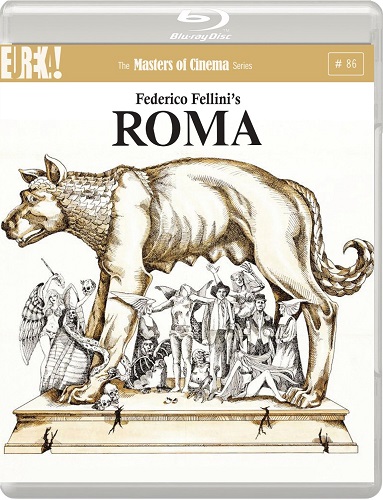
romaRoma, Federico Fellini (1972, Italy). When I picked up copies of Casanova and Satyricon, I decided to throw in Roma as well, even though I’d not seen it. I had thought, from the title and cover art (though, to be fair, I’d not looked especially closely at the latter), that Roma was set during, well, Roman times. Like Fellini Satyricon. I was, in fact, expecting something similar to that film, which is why I’d bought it – Fellini in all his 1970s indulgent colour. But it turns out Roma is about a young Fellini, who was actually from Rimini, arriving in Rome, and falling in love with the city. The end result is something which has the freedom and plotlessness of a New Wave film, but is in glorious colour and contains a strong thread of Fellini’s somewhat earthy humour. I had expected to like the film for the same reasons I’d like Fellini Satyricon – ie, because it was, basically, bonkers – but actually found myself liking it because it felt like a string of vaguely-related Nouvelle Vague scenarios shot with the sureness and control of a master director and in which the process of filming itself became one of the story’s narratives. One particular scene springs to mind: Fellini is filming something on Rome’s ringroad, and it begins to rain… Apparently, it was shot entirely on a soundstage, although it doesn’t look like it is. A featurette on the Blu-ray points out that a lot of the Roman locations were actually shot on soundstages – and that the same was true of many of the street scenes in Fellini’s . So there you go. I’d sort of added Roma to an order on a whim, but I liked it a lot and I’m glad I bought it.

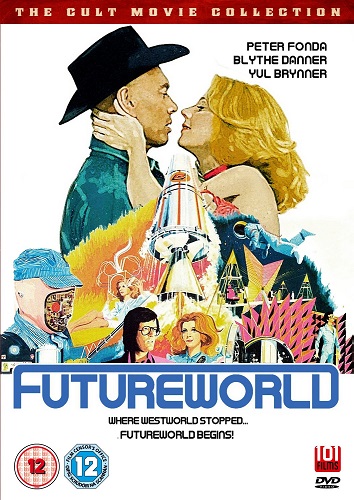
futureworldFutureworld, Richard T Heffron (1976, USA). I found this in a charity shop, and while I can remember seeing Westworld, I wasn’t so sure if I’d ever seen this sequel. And having now watched it, I’m still not sure. Some bits seemed familiar, other bits didn’t. I suspect I probably did see it – the scenes with “Clark”, the robot rebuilt by the janitor, seemed familiar, and they’re not scenes that would normally be excerpted or trailed where I might have otherwise seen them. Anyway… after the oops-we-appear-to-have-killed-a-lot-of-our-paying-guests of Westworld, Delos is determined to push ahead with its robot-serviced fantasylands, and so has another go with a big promotional splash. Included in said splash are old-school newspaper reporter Peter Fonda and up-and-coming TV reporter Blythe Danner. Of course, there’s more going on than Delos’s PR department want people to know… Well, no, not really: the robots are perfectly safe, and are unlikely to run amuck and slaughter guests. Instead, Delos is planning to replace state and industry world leaders with robot replicas, although how people would tell the difference is never explained. Or indeed why they should be any different. Robot replicas reporting to a corporate overlord versus our current generation of politicians… Nope. Same thing. Aside from a frankly bizarre dream sequence in which Blythe Danner has sex with rogue robot gunfighter Yul Brynner, Futureworld is a bog-standard 1970s sf film in which frankly rubbish sfx are married to a hackneyed plot that some sf author probably covered two decades before. It’s not like the production design is anything special either – and I really like 1970s production design. Meh.

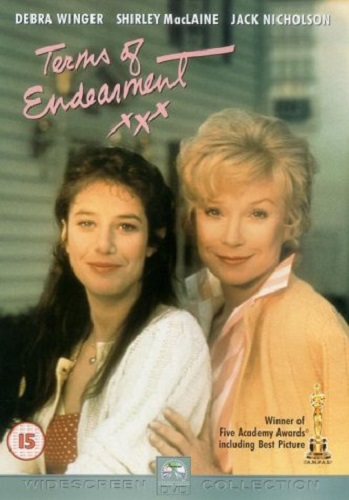
endearmentTerms of Endearment*, James L Brooks (1983, USA). Jack Nicholson is an ex-astronaut and a sad ageing womaniser. Shirley Maclaine, after being introduced via an entirely pointless prologue featuring her and her daughter, Debra Winger, and their relationship, is Nicholson’s neighbour. For reasons he does not appear to understand, he invites her out for a drink. The two are initially repelled by each other, for, it must be said, fairly good reasons. But they too fall in love, and Maclaine somehow succeeds in rehabilitating Nicholson, although her own snobbery survives more or less intact. As for Winger, who swoops into the story at various points, as if her life and relationships are germane to the central plot and not episodes that interfere in the central relationship between Maclaine and Nicholson. Terms of Endearment apparently won five Oscars – for Best Picture, Best Director, Best Actress, Best Supporting Actor and Best Adapted Screenplay – which no doubt explains its presence on the 1001 Movies You Must See  Before You Die list, but it is a pretty boring film. Maclaine is reasonably good, Nicholson does his usual gurning, Winger is good but her presence feels like an attempt to shoehorn a second plot in (perhaps it had more space in the original novel), and I totally forget who else was in the movie. I can at least now cross it off the list… but without any real sense of accomplishment.

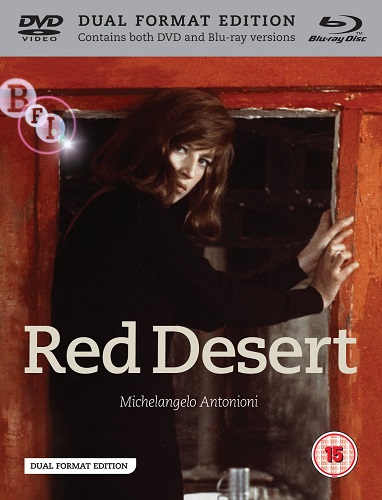
red_desertRed Desert*, Michelangelo Antonioni (1964, Italy). This was a rewatch, and I normally don’t bother mentioning them – especially when I’ve written about the film before on this blog, as I did here… But Red Desert is so good, it’s one of my top ten films, and I rewatched it because I finally got around to upgrading my DVD copy to the Blu-ray edition and… It’s a beautiful film, it’s a painterly film. And it shines on Blu-ray. The film is all about industrial landscapes and their effect on the environment – as translated through Monica Vitti’s damaged character – and never has pollution looked so pretty. The scene where the group of friends gather in a hut on the jetty, and a ship draws up alongside… The ship seems even more over-powering, so close and so huge… It completely overshadows the sexual games the couples had playing in the hut earlier. The white fog which covers everything when they leave seems like a fitting commentary. Red Desert is a favourite film – hence the purchase of it on Blu-ray and this additional review of it – and it not only survived a rewatch, but the rewatch only increased my admiration for the film. A genuine piece of cinematic genius.

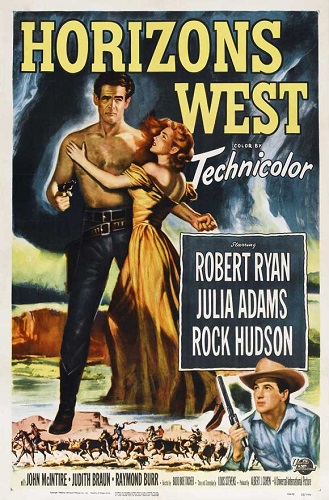
horizonswest11Horizons West, Budd Boetticher (1952, USA). When this dropped through the letter-box, I assumed I’d stuck it on my rental list because it was on the 1001 Movies You Must See Before You Die list. But it’s not. And it’s not a Howard Hawks western. So it must have been because it stars Rock Hudson. Except he’s not actually the star. Robert Ryan is the star. He and Hudson are brothers. After returning from the civil war (they were on the losinig side, you know, the side that thought it was okay to own slaves), they settle down to farm the family homestead. But Ryan has ambition. So he enlists the help of some local disaffected veterans, begins rustling cattle and selling them to the Mexicans, and so builds up a fortune. Raymond Burr plays the local grandee, who is a nasty piece of work, and provides additional motive to Ryan to earn his fortune – other, that is, than Burr’s wife, whom Ryan falls for, and who later proves the driver of his worse actions. Hudson meanwhile takes over as marshal and ends up attempting to bring his brother to justice. It’s an interesting situation, but it’s given the usual shallow Hollywood treatment. And there’s nothing else to recommend it. Missable.

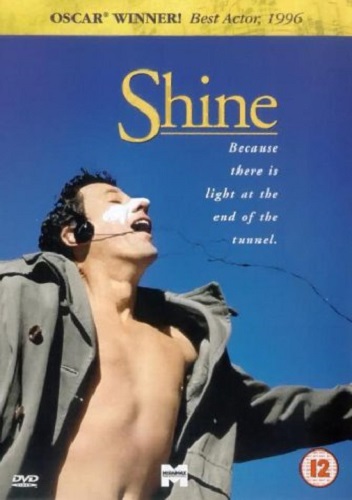
shineShine*, Scott Hicks (1996, Australia). A biopic, and you know how much I love them… The subject in this case is David Helfgott, an Australian concert pianist. The film opens with Helfgott (Geoffrey Rush in fine form) demanding entrance to a closed restaurant during a storm… and over the course of the film he gets to know its staff, one in particular, and becomes a regular there playing the piano. He is a psychiatric patient, and it is a friend of one of the waitresses – Lynn Redgarve – who eventually marries him and so rehabilitates him. Before that, we have his history: his teen years as a gifted pianist, driven by his tyrannical father, arguments over competitions, over whether he can study in the US, his move to London to study at the Royal College of Music, his eventual breakdown and admission to a psychiatric hospital… This is a polished piece of biopic-ery, but I can’t honestly see anything in it that lifts it above others of its ilk. How it made the 1001 Movies You Must See Before You Die list is a mystery. Which is hardly something I’ve no said before… I watched it, that’s enough. Meh.

1001 Movies You Must See Before You Die count: 786


4 Comments

Reading diary, #31

Been a while since the last one of these. I have been reading, of course, and I’ve even managed to get into the habit of polishing off a few pages when I get home from work. And now that Dayjob Horrible Project has moved into a slightly less frantic phase (but only slightly less), I can start getting some writing done… including those reviews I owe people… Meanwhile, here are some short paragraphs, that aren’t really reviews, about books I’ve read…

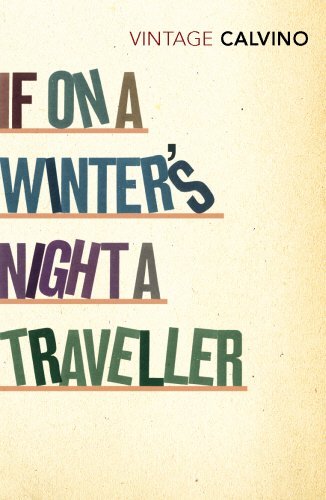
if_on_a_wintersIf on a winter’s night a traveller*, Italo Calvino (1979). You are reading a book which opens with the line, “You are about to begin reading Italo Calvino’s new novel, If on a winter’s night a traveller,” and you think, sigh, metafiction. But this is Italo Calvino, and so you take the advice Calvino offers: “Relax. Concentrate. Dispel every other thought”– Hang on, every other? How will you know which ones to dispel and which ones to keep? And yet, it is perhaps sound advice as you read about a reader who reads a book only for his reading to be cut short, and when he goes looking for a complete copy of the novel he was reading he discovers he had been reading an entirely different book altogether… And at the book shop he meets a young woman who is also interested in this literary mystery he has uncovered, and together they discover yet a third novel mixed in with the previous two. But then he meets the young woman’s sister and becomes involved in her schemes… and at some point both young women end up in one of the narratives you are reading about him reading… And yet despite this literary shell game, where the narrative peas seem to proliferate out of sight under the cups, the whole is intensely readable and not in the slightest bit confusing. In parts it reminded me of Nabokov’s Pale Fire, although without the prissiness. It certainly convinced me I should read more Calvino – If on a winter’s night a traveller may be one long literary trick, but it’s gloriously done. Bravo.

gorelGorel and the Pot-Bellied God, Lavie Tidhar (2011). And from the sublime to, er, Tidhar. This is the first of his “gunpowder fantasies”, which I take to mean generic heroic fantasies but with firearms. (Obviously the guns and bullets and gunpowder are all made by magic, as fantasy worlds rarely have an industrial base.) Gorel travels to Falang-Et, the home of a frog-like race, in order to steal their most sacred magical object (not that he knows exactly what it is). En route, he meets up with a bird-like man and a fish-like woman, and the three join together for the theft. Which doesn’t go quite as planned. Of course. That’s the nature of these sort of story. The setting hovers on the edge of strangeness and familiarity. I’m not that widely read in this type of fantasy, or New Weird, but I think there’s a bit of Lovecraft in there somewhere; and probably some Clark Ashton Smith and William Hope Hodgson, for all I know. Whatever it is, the combination is pretty effective. The book’s novella-length works in its favour too, although the prose is occasionally a little too light on detail. It’s still not my thing, but I did enjoy it.

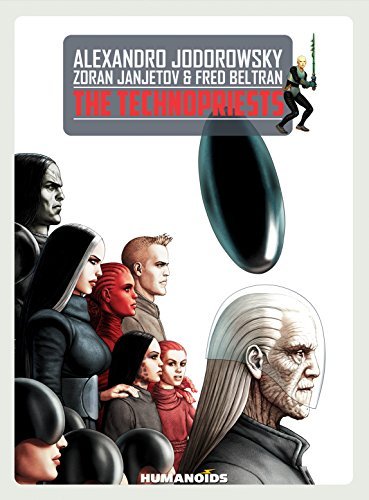
technopriestsThe Technopriests Supreme Collection, Alexandro Jodorowsky, Zoran Janjetov & Fred Beltran (2013). Originally published between 1998 and 2006, the eight-book bande dessinée series collected in this omnibus follow the fortunes of Supreme Technopriest Albino, and his two siblings, as he rises through the technopriest hierarchy while the other two track down the three pirates who raped their mother and so fathered them. The story is framed as Albino’s reminiscences during a journey to lead 50,000 technopriests to a new home in a distant galaxy. When the three were born, the mother rejected Albino and his four-armed red-skinned sister Onyx, and lavished all her affection on grey-skinned Almagro. She started up a business making “kamenvert” cheese, which became a galactic monopoly. But Albino wanted to be a videogame creator for the technopriests, only he proved to have much greater talent in that area than anyone had expected… This is not Moebius – the art is gorgeous, but all the characters are somewhat pumped up, so to speak. Happily, Jodorowsky’s off-kilter inventiveness is abundant. Although it takes a few twists and turns, it’s a more straightforward morality tale than The Incal or The Metabarons, and in parts it does feel a little like it’s retreading ground already covered in those earlier series. But if you like Jodorowsky’s bandes dessinées, you’ll like this one.

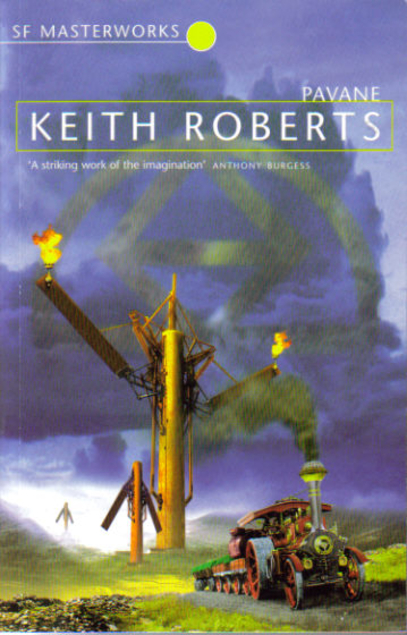
pavanePavane, Keith Roberts (1968). I’ve had this book for years – I collected the original SF Masterworks series as they were published – and was fairly sure I’d read it many years before. But having now read it (again?) I’m not so sure. I think I may have read a part of it as a short story – it’s a fix-up, after all. The central conceit has made it a touchstone work for an entire genre – alternate history or counterfactual stories. In Pavane, Queen Elizabeth I was assassinated and the Duke of Medina Sidonia successfully invaded England. The book is set at the time of writing in a Catholic Britain which is technologically far behind the real 1968 – obviously because of the Roman Catholic Church. It’s handled well – society seems to be stuck in the late 1600s, and some areas of science and technology not much past then. The first chapter, for example, is about a steam-powered road train. There is also a chain of great semaphore stations stretching the length and breadth of the country, as electricity has not been discovered nor radio invented. I’ve certainly heard it said that the Catholic Church set back science in Europe by about a thousand years, but I’ve never seen it argued with any degree of intellectual rigour. True, Hero of Alexandria had his aeolipile in the first century CE, and all the work done by Islamic medics, mathematicians and astronomers was completely ignored by the Church… But Roberts’s premise needs to be taken with a pinch of salt, since quite a few places – like the Holy Roman Empire – remained under Roman Catholic influence for a long period and progressed pretty much at the same pace as everywhere else. Still, Roberts was one of British sf’s better writers, and if Pavane isn’t his best book, it’s still a good one. ‘The White Boat’ is worth the price of entry alone. Worth reading.

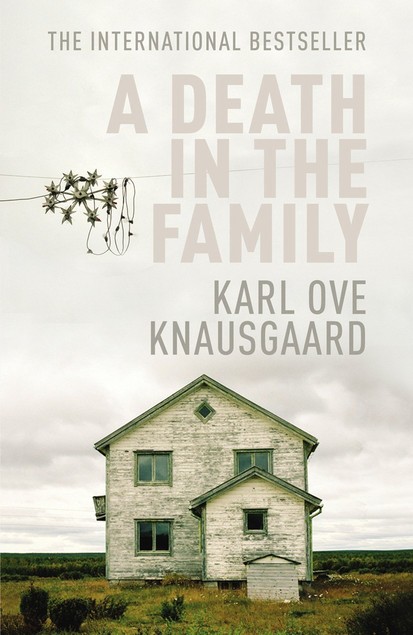
death_familyMy Struggle 1: A Death in the Family, Karl Ove Knausgård (2009). Yes, I know the cover the book spells it Knausgaard, but the proper Norwegian is Knausgård; and no, I don’t know why the publisher felt a need to “Anglicise” it, as it’s not exactly hard to write. But anyway. This is the first book in a six-volume autobiography – as I write this five volumes are currently available in English – although for some reason the series has been published as fiction. Knausgård, it seems, prefers the term “novel” because he wrote the books as if they were fiction, although they were based closely on his own life. Certainly it’s true the level of detail for something set thirty years ago suggests fiction more than reminiscence. A Death in the Family covers Knausgård’s teen years in Tromøya in southern Norway, his friends, the girls he fancies, his introduction to alcohol, and his difficult relationship with his parents. In the second half of the novel, Knausgård tries to come to terms with the death of his father, and the state his grandparents have fallen into since their son’s death. I’ll admit I found the level of detail fascinating, even though the story itself is mostly banal. And the weird distancing effect between adult Knausgård presenting his memories and the lack of self-awareness by the teen narrator made for an interesting juxtaposition. I think I’ll give the second one, A Man in Love, a go…

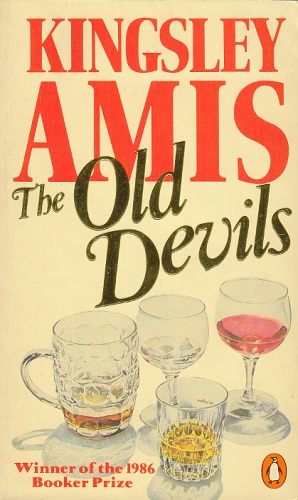
old_devilsThe Old Devils*, Kingsley Amis (1986). “Professional Welshman” Alun Weaver returns to his South Wales hometown after a career in London as a writer and poet and TV pundit. His old friends are in two minds about his re-appearance. And that of his wife, Rhiannon. Yet they welcome the pair pretty much with open arms, and some private bickering. And a lot of drinking. One of the good things about The Old Devils is that, on the one hand, the various characters are conflicted about the Weavers’ return; on the other, things quickly settle into what is clearly a well-established routine. A number of past events resurface and cause a few problems, but they seem to be resolved with a surprising lack of drama – in fact, the most dramatic scene is prompted by the pettiest of disagreements. There’s often some nastiness on display – and of all the characters, it’s the wives who are treated worst. One might almost suspect Amis was a misogynist – one wife is cruelly mocked by her friends, another has her character assassinated, and a third heartlessly abandons her husband. The men are old codgers and drunkards, and amusing at times, but The Old Devils‘ one-sidedness does get wearying as the novel progresses. I’ve no idea why The Old Devils is on the 1001 Books You Must Read Before You Die list.

1001 Books You Must Read Before You Die count: 126

1 Comment

Moving pictures, #34

Damn, more American films. Bit of a relapse here, although to be fair four of the US films are from the 1001 Movies You Must See Before You Die list.

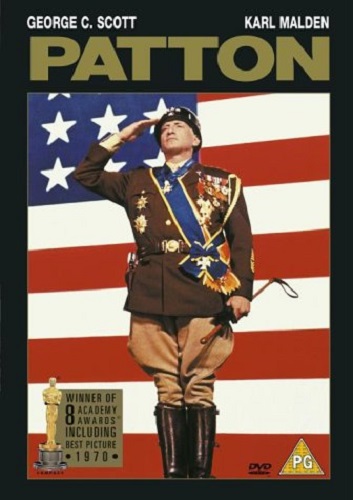
pattonPatton*, Franklin J Schaffner (1970, USA). George C Scott won an Oscar for his portrayal of the title character in this biopic, although he famously refused to accept it. But the rest of the cast and crew were happy to accept Oscars for Best Picture, Best Director, Best Original Screenplay, Best Film Editing, Best Sound and Best Art Direction. In Best Film, it was up against Airport, Five Easy Pieces, Love Story and M*A*S*H, so not an especially strong year (although the smart money would likely have been on M*A*S*H), because there’s not much in Patton that actually seems like Oscar-material. The script was written without the approval of the family and mostly from the memories of Patton’s friend and aide General Omar Bradley – and despite that still invented a number of incidents. It was filmed in Spain, and not in North Africa or Italy. The historical details are often inaccurate – it’s not just the use of tanks that weren’t built during WWII. but that the Luftwaffe only appears to possess two Heinkel bombers… and they weren’t capable of strafing the ground, which they do multiple times during Patton. Admittedly, the film was made before CGI – in the twenty-first century, they’d no doubt fill the skies with zillions of Luftwaffe bombers and fighters (which would, of course, be just as ridiculous). Patton was by all accounts an odd bloke, and Scott manages to get that across… but much of the film seems like little more than a spat between Patton and Montgomery as each chases after the glory of defeating the Axis. Hardly the most edifying motivations for waging war, but I guess it plays better than tactical and strategic opportunism. There are a vast number of WWII films, but there only a handful I’d rate, and this isn’t one of them. Watch Das Boot instead, or The Big Red One.

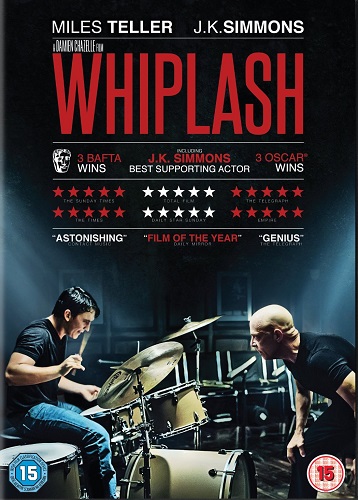
whiplashWhiplash, Damien Chazelle (2014, USA). Numerous positive reviews persuaded me to add to this my rental list, despite the subject not appealing. A student at a famous New York musical school is training to be a jazz drummer. He is talent-spotted by one of the lecturers, a well-regarded composer – and an abusive arsehole. And the film is all about how he abuses the student – and the other students in his jazz band. It’s one of those films where you can recognise how well it was played by its cast, and how well-written the story, but you still wonder why the fuck you watched it. JK Simmons – probably best-known in this country as Dr Skoda from Law & Order – plays the composer, who is a real nasty piece of work… and he thinks his methods are justified because only by driving people to breaking point are true muscial geniuses made. Which is, of course, complete bollocks. But, of course, the student initially responds to Simmons’s abuse, before eventually being pushed too far and cracking. And dropping out of music altogether. Only to later bump into Simmons, accept his flattering offer of drumming for his band at a jazz festival – but it’s all a trick to humilate the ex-student on stage, except he then turns the tables, which segues into one of the longest and most boring drum solos ever recorded (and I say that despite being a fan of prog). Whiplash was not a film I would normally have watched, and I can’t say I’m glad I watched it. Put it down as one of those films or books that you don’t like even though you recognise that they’re good (because, of course, how you respond to a work is an entirely different thing to its actual quality). Meh.

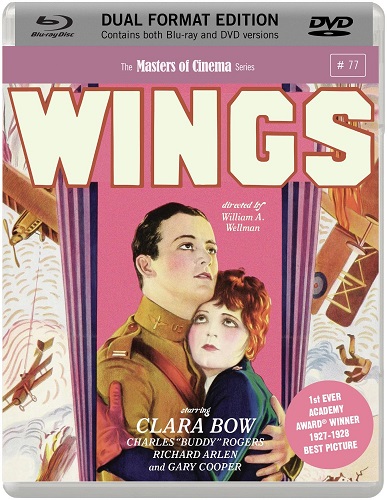
wingsWings*, William A Wellman (1927, USA). This was the first film to ever win an Oscar, which is of course about as much an indication of quality as winning the first ever Hugo. And yet… I believe Wings has a somewhat mixed critical legacy, but I admit rather enjoyed it. True, Clara Bow was somewhat clumsily inserted into the plot, and it showed. And, bizarrely, although it’s Gary Cooper’s first appearance on film, he looks pretty much the same as he did throughout his entire career. Basically, two rivals for the love of the same woman join up when the US finally decides to enter WWI (please don’t call it the 17-18 War, it erases the three years of fighting by all the other nations that were involved). During basic training as pilots, the two beat each other to a pulp and so become fast friends. They are shipped to Europe, where they begin flying sorties against the Germans. On one such sortie, one of them is shot down. But he manages to steal a German biplane to return to the allied line… only to be shot down and killed by his best mate. Wings is justifiably praised for its aerial sequences, which are pretty impressive for a 1927 silent movie – and, I suspect, would still have been impressive had the film been made fifty or sixty years later. Perhaps the romantic triangle – the two male leads and Jobyna Ralston; Clara Bow is the over-looked love interest – is hoary and clichéd, even for the 1920s, and perhaps the trench warfare doesn’t resemble depictions since put on celluloid or, er, televisual æther, but those are minor quibbles – the film is called Wings because it’s about a pair of aviators, and in that area it scores highly. Worth seeing.

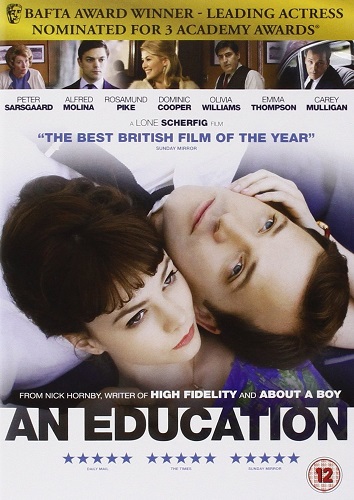
educationAn Education, Lone Scherfig (2009, UK). I stumbled across this on Amazon Prime, and since it’s on at least one edition of the 1001 Movies You Must See Before You Die list, I gave it a go. It’s based on a memoir by a British journalist, who, apparently, was seduced as a sixteen-year-old by a thirtysomething con man and so was introduced to a life she had only previously dreamt of – sort of. Teacher-pupil romances are nothing new, and have been a staple of literature and cinema for centuries (well, at least one century), but there is still something skeevy about a man in his late thirties in a relationship with a 16-year-old schoolgirl. An Education is set in the 1960s, when, we are supposed to believe, “things were different”, as if that’s supposed to excuse them… Although, of course, such relationships likely still happen today. I note that only recently – in 2016, for fuck’s sake! – has Virginia made it illegal for men to marry 12-year-old girls. Anyway, the heroine of An Education, Carey Mulligan, is clever and plans to go to Oxford – but after falling for the oleaginous charms of smooth talker Peter Sarsgaard (who does a pretty good British accent, it must be said), she drops out of school. After several adult adventures, including a dirty weekend in Paris, she learns he is already married – and tries to return her previous life, except it’s not that easy (but she succeeds anyway). An Education was slick and sixties and about as believable as an episode of Danger Man. It feels like a watered-down version of The Servant, without the menace, the suspense or the commentary on class and society. Meh.

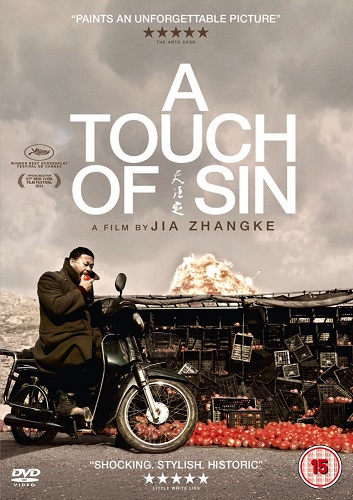
touch_sinA Touch of Sin, Jia Zhangke (2013, China). This is on later editions of the 1001 Movies You Must See Before You Die list (obviously it hadn’t been released when they put together the 2013 edition of the list), but it sounded like it was worth renting… And so it proved. It’s bloody good, easily the best film of the seven in this post. I’ve not seen anything by Zhangke before, but I’ll be adding his other films to my rental list. A Touch of Sin comprises four stories, all based on real events, and linked only by the similarity of their documented effects on those involved. In the first, a man in provincial town rebels against the rich man who has bought the village’s coal mine but not redistributed its riches as promised. The episode opens with a violent encounter and ends with one. The second episode is the slightest of the four and details one man’s murderous robbery spree. The third has a young woman travel to a provincial town, where she ends up working as a receptionist in a massage parlour. But when a local VIP demands she “service” him and tries to rape her, she responds violently. The final story is the most interesting. A young man leaves his job after inadvertently causing an industrial accident – the employer assigns his wages to the injured party as recompense – and ends up working as a host and waiter in a hotel catering to rich businessmen from Hong Kong. He then leaves that job and goes to work in a factory. Shortly afterwards, he commits suicide. China apparently has a very high rate of suicide, and the fourth story is based on one company where 18 employees attempted suicide (14 succeeded) within a year. This is the unadvertised cost of your cheap computers and and smartphones (not to mention the pollution). Western consumers are happy to accept the low prices resulting from company practices which lead to 18 staff suicides in one year, but then have the gall to moan about these products no longer being manufactured in Western countries. But don’t worry, people of the West! Soon, you will have a nation populated entirely by workers on zero-hour contracts with no rights, where only the air is free, and the environment, well, companies won’t have to siphon off funds from CAPEX to make sure the birds and bees don’t fall out of the sky. So you’ll still get your cheap smartphones and tablets, and on the back they’ll say “MADE IN ENGLAND”. Ahem. A Touch of Sin (a daft title, and the deliberate nod to A Touch of Zen does it no favours) is a beautifully-shot and altogether real study of the effects of capitalism on China. Recommended.
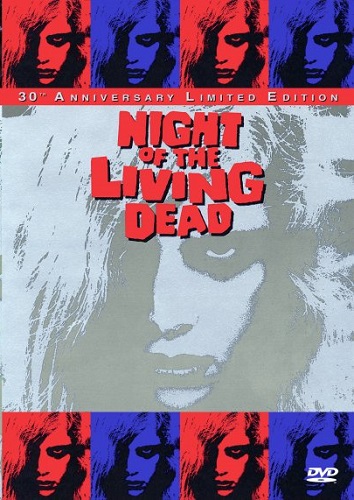
living_deadNight of the Living Dead*, George A Romero (1968, USA). I think I did this wrong – I watched Dawn of the Dead before watching Night of the Living Dead. Both are on the 1001 Movies You Must See Before You Die list, and I’ve no idea why I did it in that order. Okay, dawn comes before night, but Dawn of the Dead was released in 1978 but Night of the Living Dead was Romero’s first film and released a decade earlier. Also, I don’t get zombies. I don’t get the appeal, I don’t get the position they occupy in Anglophone 20th/21st-century culture. I didn’t, for example, even realise that the big thing about 28 Days Later is that the zombies run. So fucking what. In Night of the Living Dead, a couple visit the woman’s mother’s grave in a cemetery. A zombie attacks them and kills the man. The woman finds refuge in a house with a black man with a good head on his shoulders (a rarity in US cinema back in 1968). It transpires there are also people hiding in the cellar. Zombies attack the house. They fight them off. An escape attempt goes badly wrong. People die. Yawn. This is allegedly a classic of the genre, and for an independent film it has a couple of things to recommend it. But I suspect it’s one for fans of the director and/or zombie films; and not for me.

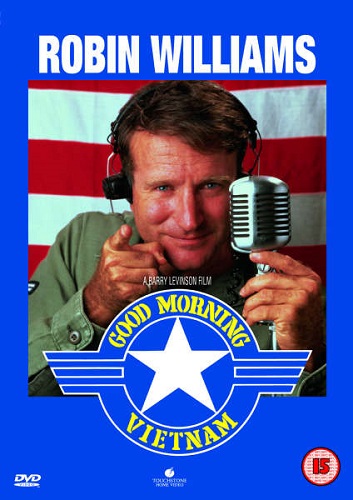
vietnamGood Morning, Vietnam*, Barry Levinson (1987, USA). Is there no phrase in cinema more likely to cause the heart to sink than “biopic”? Well, “directed by Chris Columbus”, perhaps. Or “from the producers of…”, as if the ability to bring in a film on time and on budget is any kind of artistic recommendation. Except, well, Good Morning, Vietnam, isn’t actually a biopic. Adrian Cronauer was a real person, and he really was a DJ in Saigon during the Vietnam War. He tried pitching a sitcom based on his experiences to TV networks, but tyey – conveniently forgetting that M*A*S*H was one of the most successful sitcoms of the time, and so proving that television executives have always been remarkably stupid – turned it down as they didn’t think war a fit subject for comedy. So Cronauer wrote a TV movie script, which passed across Robin Willams’s desk, and Williams liked it so much he turned it into a film project. The actual plot of the film, Cronauer has said, bears very little resemblance to his actual experiences; and all of Williams’s on-air performances were improvised during filming. Which does make you wonder why they bothered basing it on a real person. Or insisted it was true. After all, back in 1987 there was no social media, there was no “post-truth” politics; back then, words meant what the dictionary said, expertise was valued, and demagoguery had not been successful since 1930s Germany. Still, at least Williams got a shedload of award nominations out of Good Morning, Vietnam, so it wasn’t a total waste of time.

1001 Movies You Must See Before You Die count: 784


1 Comment

Moving pictures, #33

Again, more US films than I really would like to be watching. True, over half of the 1001 Movies You Must See Before You Die list is American, and when I’m looking for brainless entertainment to watch of a Saturday night with a bottle of wine in hand, then the US provides more suitable films than any other nation but… I’d seriously like my movie viewing to be more global, and though I’ve been making an effort in that direction, it sometimes feels like I’ve not been assiduous enough… Oh well. Most of my favourite films and directors are not from the US, and my DVD/Blu-ray collection now certainly comprises more world cinema than Hollywood…I’m getting there.

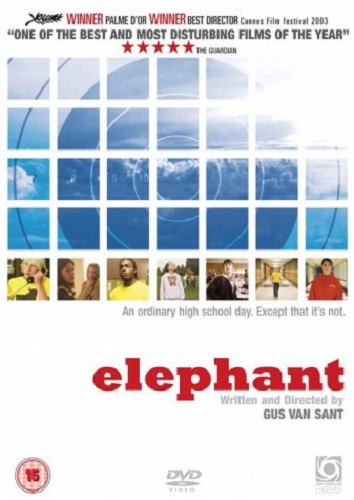
elephantElephant*, Gus Van Sant (2003, USA). You know that thing they have in the US, and that keeps on happening, where someone walks into a place and shoots everyone, because civilised nations banned guns the first time it happened but the US is happy to sell assault rifles to any lunatic with a dollar bill… Elephant apparently started life as a documentary about a real school shooting, but turned into a fictional representation of one. The film follows the victims, witnesses and perpetrators, often criss-crossing timelines, which is quite an effective technique. But the film itself offers no commentary on its subject, other than showing the shooters being bullied by jocks. Which is weak. I mean, it’s not hard to condemn either the shooters, the culture which persuaded them shooting their peers was a conceivable response, or the society which allowed them access to the weapons to do so. But Van Sant does none of these. He humanises the victims – which is the weakest argument of all against such atrocities. We know they’re human, we know they are just like us. We also know the perpetrators are little different to us. What we want to know is: why was this allowed to happen? And what is being done to prevent it? In the US, the answer to both appears to be: very little.

evangelion_3Evangelion 3.33: You Can (Not) Redo, Hideaki Anno (2012, Japan). The Evangelion films are re-workings of the Neon Genesis Evangelion OVA, but rather than distillations of that 26-episode series they feel more like isolated excerpts from it, ie random episodes from a much longer story. I like that the films make no concessions to their viewers, and that despite their basic plot of high-school kids piloting mecha in fights against giant aliens, there’s so much more going on that’s left for viewers to puzzle out: the world-building, the relationships between the characters, the technology, even the family dynamics for those characters who are related to each other… In this movie, the action takes place fourteen years after the explosive end of Evangelion 2.22 You Can (Not) Advance. Shinji and Evangelion Unit 01 have been drifting in orbit. He is rescued by WILLE and fitted with an explosive collar. Only it turns out WILLE is fighting NERV, and they have a, er, flying battleship. Which is now powered by Evangelion Unit 01 (there are around a dozen Evangelion units by this point). And then it sort of gets a confusing, with some cast members carried over from the earlier films, and entirely new ones to figure out as well. Not to mention a circuituous route, via the weird dynamics between the Evangelion pilots, to a final battle scene, which triggers another apocalypse… I’m going to have to watch this again – if not all three films – before I truly figure out what’s going on. It’s all made for an odd viewing experience. Although superficially the same, and sharing a design aesthetic, the three movies manage to present three episodes of one story-arc in three tonally different ways. The fourth and final film is due Any Day Now, having postponed several times since its original release date in 2013.

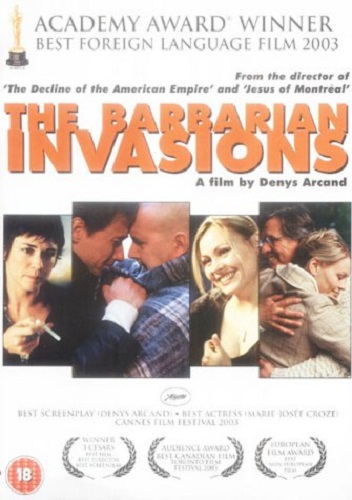
barbarianThe Barbarian Invasions, Denys Arcand (2003, Canada). Arcand’s The Decline of the American Empire was on the 1001 Movies You Must See Before You Die list I’ve been using, but this sequel is on a different one. I’d not been that impressed by the first film – it seemed almost a parody of an independent movie, a group of characters sitting around moaning about the state of the world – so I can’t say I was especially keen on seeing this sequel. But I must have stuck it on my rental list, and subsequently forgotten about it, because it arrived and I watched it and… It’s just as dull. It’s set seventeen years after The Decline of the American Empire, which was released in 1986, and features most of the same cast. Rémy has terminal cancer, and his family – especially his son, a financier living and working in London – and his friends (from the earlier film) come to visit him. There’s a lot about the Canadian national health system being over-stretched and ineffective, but I can’t decide if that’s done deliberately in order to enable the plot (rich son pays for expensive treatment in US), or some kind of commentary on public healthcare. There’s also a number of scenes of the friends sitting around and talking, a lot of which is reminiscences. I found it all a bit uninvolving, much as I did The Decline of the American Empire. Meh.

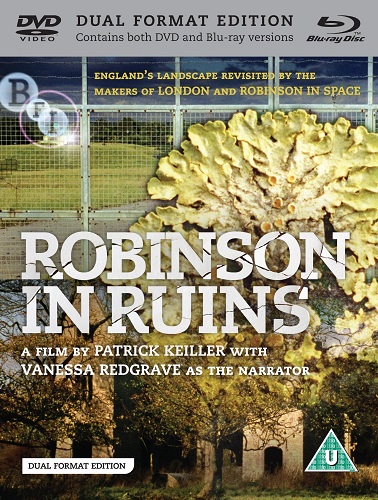
robinsonRobinson in Ruins, Patrick Keiller (2010, UK). I really liked Keiller’s earlier two films, London and Robinson in Space, and was expecting much the same of this one. But it was so much better. It has the cinematographic beauty that comes from well-placed static shots like in Benning’s films tied to a clever voice-over narrative like something out of an Adam Curtis documentary. This time Vanessa Redgrave narrates, as the lover of the narrator, and Robinson’s friend, in the earlier two films. Robinson in Ruins opens with Robinson’s release from prison, and then describes his journey through Oxfordshire and Berkshire, remarking on the things Robinson found and their history and how it all links in to the UK’s current economic malaise (current as of 2010, of course; we all know who exactly who – Osborne’s damaging and ineffective “austerity” aside – is responsible for the UK’s economic woes in 2016). I liked London and Robinson in Space a lot, but Robinson in Ruins is so much better. Perhaps its because it’s nearer in time than those two earlier times. True, I remember Tory Britain from 1979 to 1997 (although I was abroad for the last three years of it). Of course, 2010 saw the end of thirteen years under New Labour, although Robinson in Ruins is more about the damaging effects of big business and capitalism, and the corruption in which its naturally embedded, than it is economic policies. I suspect I will be watching this again before the end of the year, and it might well make my top five best of the year by December…

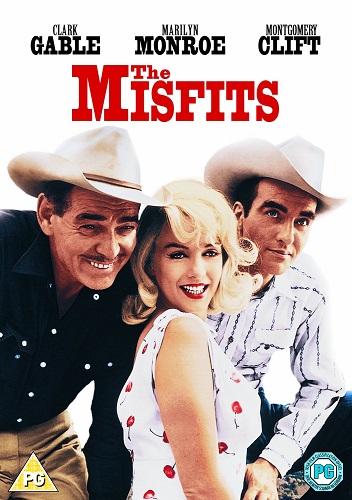
misfitsThe Misfits, John Huston (1961, USA). This was both Clark Gable’s and Marilyn Monroe’s last movie, and when it arrived from the rental service I assumed I’d stuck it on my list because it was on the 1001 Movies You Must See Before You Die list – except it isn’t, at least not the 2013 edition, which is the one I’m using. So I’m somewhat mystified as to why I stuck it on my rental list. Because it’s not that interesting. Monroe plays a somewhat flighty divorcee, Gable plays an ageing cowboy, the two fall in love. There’s Montgomery Clift as a rodeo cowboy who hooks up with them, and Eli Wallach as Gable’s friend, who’s a mechanic and flies a biplane. Gable and Monroe’s relationship falters when Gable decides to go capture some wild horses in the hills (to sell for dog food). He, Monroe and Wallach, plus Monroe’s friend Thelma Ritter, head off to a rodeo to find a third cowboy and so meet Clift. It all feels a bit like a cynical attempt to plug into some US myth or other, not to mention trading on its two marquee name stars. Gable is good, but Monroe looks like she’s sleepwalking half the time – and by all accounts, it was a difficult shoot as she often turned up late, and sometimes never at all. Clift isn’t too bad, although he doesn’t quite convince as a dim-witted cowboy. The final act, where the five – Wallach in a biplane, the rest in a pickup – try to round up half a dozen wild horse, and Gable gets dragged across the desert by a mare, feels somewhat over-stretched. Meh.

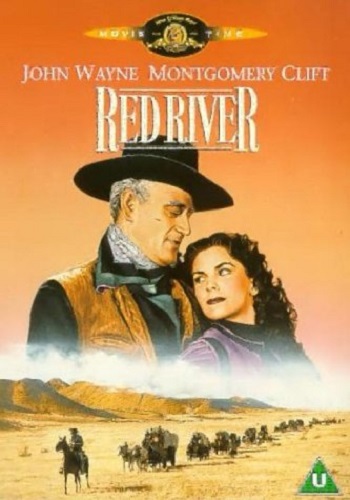
red_riverRed River*, Howard Hawks (1948, USA). I honestly thought I’d already seen this – I mean, I’d seen a several Hawks westerns starring John Wayne, and I was pretty sure this was one of them. But apparently not. Of course, it’s not that easy a call, given Hawks’s penchant for remaking his films under new titles… Wayne plays a typical Wayne character, who leaves a wagon-train, and his sweetheart, which is bound for California, to head south to claim land in Texas, accompanied only by a grizzled old man and a pair of steers (one male, one female, of course). Later that day, they see smoke on the horizon and dash back to discover the wagon-train destroyed by Native Americans and everyone killed. There is only one survivor, a traumatised boy called Matt. The three continue south, Wayne finds his land and claims it, killing a representative of a Mexican don who has title from the King of Spain (so much for international relations…). The film then jumps forward fourteen years, Matt has grown up into Montgomery Clift, and Wayne looks more like himself than Ronald Reagan (as he did earlier). Wayne’s ranch has proven successful and he has thousands of head of cattle. But no money. The just-ended civil war saw to that. So he needs to take his cattle to the nearest railhead in Missouri hundreds of miles away to sell them. There’s a nearer railhead in Kansas, but since no one has actually been there and see it, Wayne refuses to head that way. His high-handed tactics during the drive end up with Clift challenging him, taking over the drive and heading north along the Chisolm Trail to Kansas. Fortunately, the rumoured railhead exists, and Clift gets an excellent price for the cattle. Wayne then turns up. ready to kill him, they have a big fist-fight, and make up. It’s all very manly, and just like you’d expect the Wild West to be. Of course, having seen a number of Westerns, I’m aware of the way cattle barons like Wayne’s character treated homesteaders and settlers, and that’s not even mentioned – in fact, the only town in the film is the Kansas one at the end. Admittedly, the cattle drive is pretty impressive… although the use of sound-stages for the campfire scenes do spoil all that location shooting a bit. I’m not that much of a fan of Westerns (see my comments on the genre in previous Moving picture posts), and I understand that the Chisolm Trail was historically important, and that Red River makes a good story of it, but it’s all a bit too macho and one-sided for me.

1001 Movies You Must See Before YOu Die count: 780


3 Comments

Great wall o’ books

June was a negative month inasmuch as I ended up buying more books than I read, so the TBR increased in size. Oh well. Mostly this was due to Fantastika 2016, which had an excellent book room… but a few books I wanted also popped up during the month on eBay and so I bought them. Having recently discovered there are books I’d like to read but didn’t bother buying when they were published a few years ago, and copies are now £150+… Well, it makes sense to buy a book the moment a copy comes available at a decent price. That’s my excuse and I’m sticking to it.

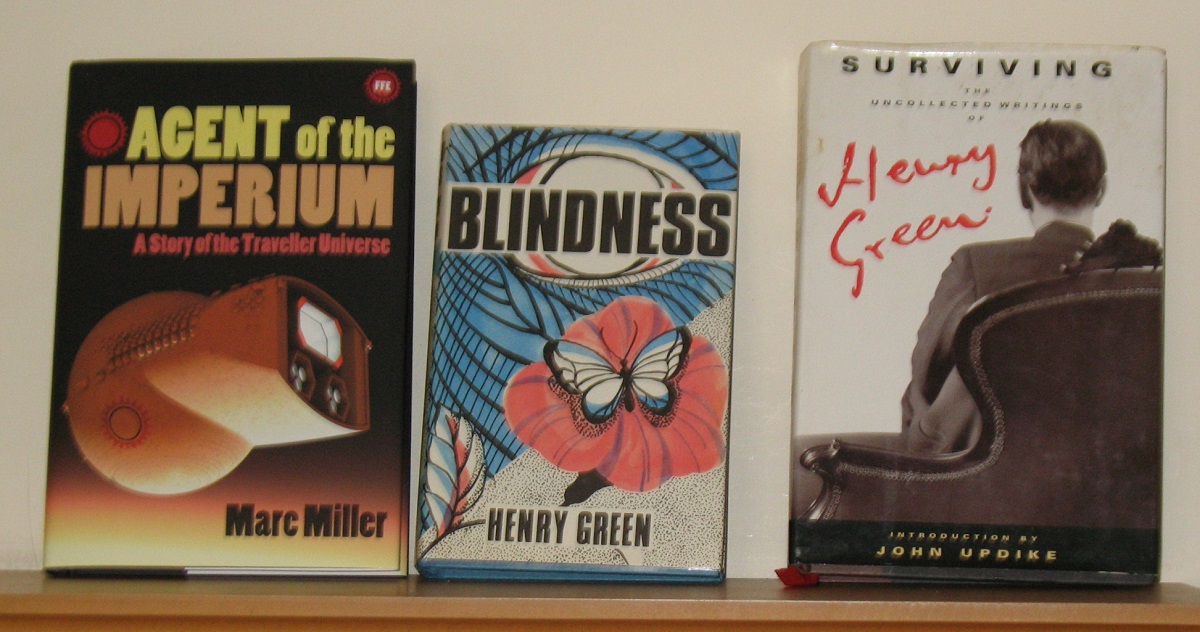
IMG_4160

Both Surviving and Blindness are first editions by Henry Green I found on eBay. Unfortunately, Surviving is a bit too tatty (well, it was very cheap) and Blindness was misrepresented as a first edition, but it’s a first edition of the 1977 reprint. Agent of the Imperium, on the other hand, is the first Traveller novel written by the game’s inventor, Marc Miller. I backed it on kickstarter and they’ve done a really nice job of it.

IMG_4161

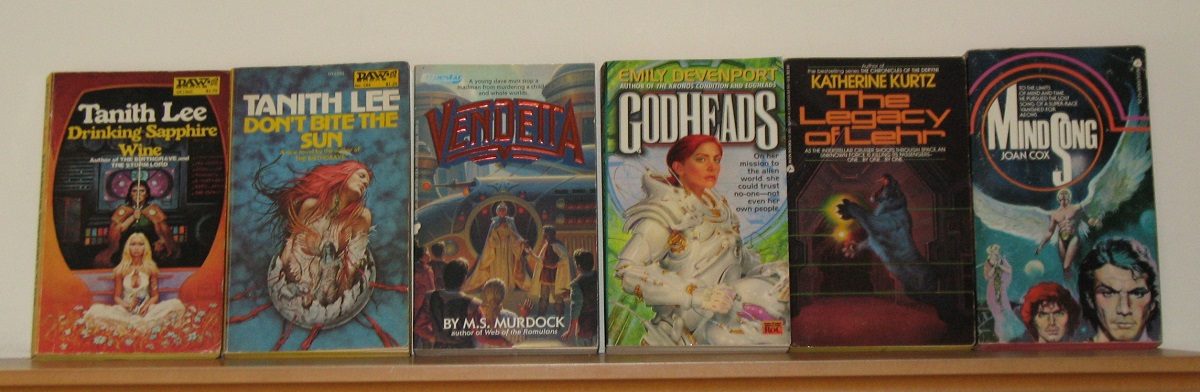
Mindsong, The Legacy of Lehr, GodheadsVendetta, Don’t Bite the Sun and Drinking Sapphire Wine I bought from the Alvarfonden at Fantastika 2016 to review on SF Mistressworks.

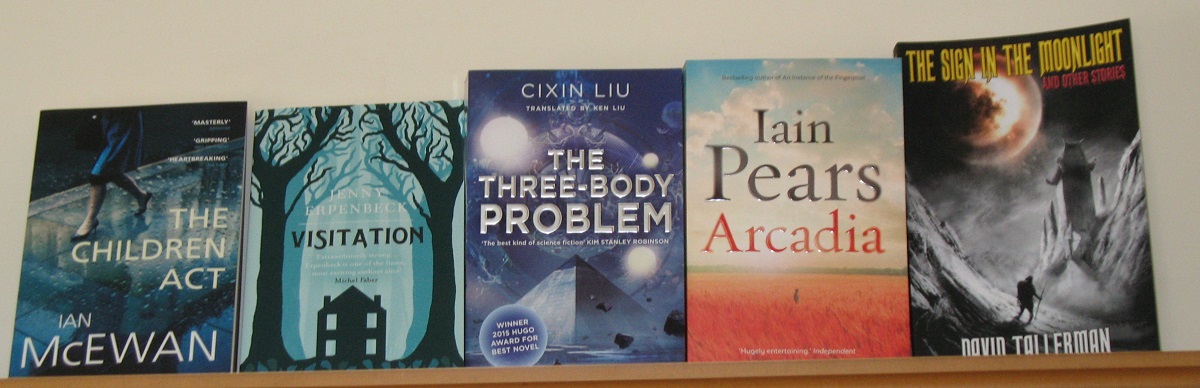
IMG_4162

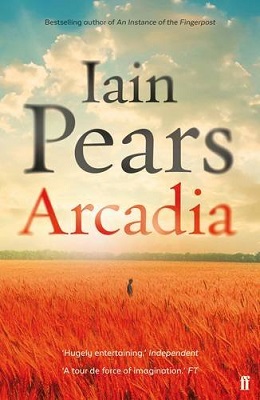
David Tallerman gave me a copy of his new collection The Sign in the Moonlight in a swap for a copy of my Dreams of the Space Age. Arcadia is the only novel on the Clarke Award shortlist I’ve not read – I was waiting for the paperback. The Three-Body Problem won the Hugo last year against all odds and I’ve wanted to read it since first hearing of it. I loved Jenny Erpenbeck’s The End of Days so I’m keen to explore of her fiction, hence Visitation. I’ve no idea why I still read McEwan, but after finding The Children Act in a charity shop I now have his last three on the TBR.

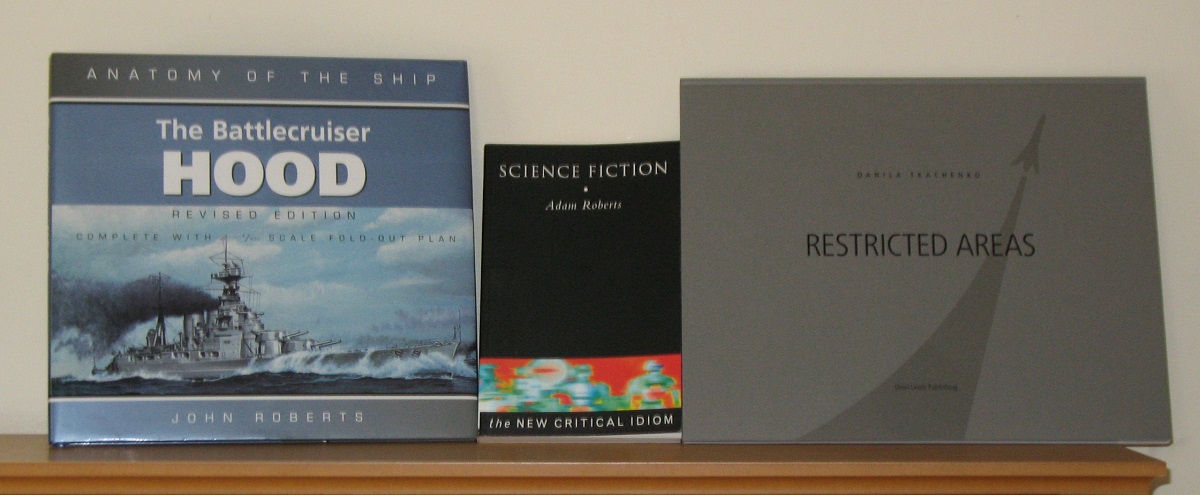
IMG_4163

I do like me some books of photos of abandoned Cold War equipment and places, hence Restricted Areas. And Adam Roberts’s Science Fiction I found cheap at the abovementioned Alvarfonden. The Battlecruiser Hood is one of the Anatomy of the Ship books I didn’t have – found this copy going for a good price on eBay.


Leave a comment

Moving pictures, #32

Definitely a mixed bag this time around. Perhaps a few too many from the US, but a couple from India as well. Plus Korea and Italy.

The-Good-The-Bad-The-Weird-2008-Front-Cover-1554The Good, the Bad, the Weird, Kim Jee-woon (2008, Korea). The title of this film pretty much clues you into its story – yes, it’s a Western, but a weird one, and very much Korean. And, perhaps surprisingly, a lot of fun and pretty good to boot. There’s a treasure map, which a Japanese official is carrying from China to Japan. But while crossing a Manchurian desert, his train is attacked by the Bad, who has been sent by the map’s owners to retrieve it. However, also attacking the train is the Weird, who manages to get the map first – although he doesn’t realise what it is or its value. Then the Good, a bounty hunter, turns up to kill the Bad, but instead gets caught up with the Weird as he escapes the Bad’s goons. And so it goes, as the Bad catches up, they have shoot-outs and fights, before the two manage to escape yet again… and eventually decide to make for the treasure. En route, the Good reveals that he’s after the Bad because he’s the “Finger Chopper”, a notorious criminal back in Korea. Eventually, the three of them arrive alone at the treasure… except the treasure is not what they’d expected. The fight choreography is done well – and there’s plenty of it – and the story has a somewhat off-kilter sensibility that plays entertainingly. I’d forgotten I’d put this on my rental list, and when it popped through the letter-box I was expecting it to be a bit meh, but I really enjoyed it. A better-than-average popcorn movie.

liberty_valanceThe Man Who Shot Liberty Valance*, John Ford (1962, USA). There are a lot of westerns on the 1001 Movies You Must See Before You Die list and I’m not an especially big fan of the genre. A few I’ve enjoyed, one or two I’ve even bought copies for myself. But most are, for me, Sunday afternoon viewing, enjoyable enough to watch but you’ve forgotten them ten minutes after the credits rolled. I get that they’re US mythology, that they’re predicated on tales of strong manly men being strong manly men and winning against all odds, but to be honest I find that Hollywood macho bullshit tiresome at best. I do, however, love the landscape in which these stories take place, and I value films which make a proper meal of it. The Man Who Shot Liberty Valance sadly does anything but – it was shot entirely on a soundstage. But it does offer an interesting spin on the whole idea of Wild West mythology… although it pretty much reduces it to a single line, and then spends the entire film justifying that line. Which is, “When the legend becomes fact, print the legend.” Jimmy Stewart plays a lawyer who travels west and settles in the rough town of Shinbone. En route he is waylaid by Liberty Valance (Lee Marvin), the local gunslinging hoodlum. Stewart vows justice – but legal justice. Tom Doniphon (John Wayne), the local stand-offish hard man, warns Stewart that law books are not going to do it. And so it proves. Marvin continues his reign of terror, Stewart teaches literacy to many of the towns folk (including love interest Vera Miles), and Wayne pines after Miles and gets angry with Stewart for stealing her heart. Then Stewart goes into politics, upsetting Marvin who engineers a shoot-out. But Stewart shoots and kills Marvin. Or does he? There’s little to admire in the story of this film, with its tale of rule by strength and politics corrupted by money. By all accounts, it was also a horrible shoot. Ford constantly belittled Wayne, and at one point even turned on Stewart. It sometimes astonishes me that little of the hardships of making some films comes through in the final product, which is, I guess, a testament to the professionalism of those involved. You can’t tell watching a film whether it was a happy shoot or an absolutely miserable one. And, to be honest, I think we viewers should know. The end does not justify the means. The fact that Ford made a bunch of people’s lives a misery so someone else could make pot loads of money is, when you think about it, pretty offensive. Film is a far more collaborative medium than writing… but the various media all take care to hide the tribulations of the creative process… because, of course, they’re selling product. Still, that’s capitalism for you…

19001900, Bernardo Bertolucci (1976, Italy). I think I saw this on one of the alternative 1001 Movies You Must See Before You Die lists – ie, not the 2013 edition – so it was either dropped before, or added later… and I’m not entirely sure why it was there in the first place (I seem to say that a lot about the films I’ve watched). It’s certainly epically long, 317 minutes in fact, and was originally released in two parts. It tells the story of two men, the son of a padrone and the son of one of his workers, from the late nineteenth century through to the end of the Second World War. The padrone, Robert De Niro, comes to an uneasy alliance with the fascists, but the worker’s son, Gerard Depardieu, becomes a communist and fights them. Donald Sutherland plays the foreman hired by De Niro who becomes a full-fledged fascist, black uniform and everything. The film mixes the historical with the personal, sometimes to good effect, but often the focus is too tight on unlikeable characters and the relationship of the scene to the grander sweep of the narrative seems lost. One example is a sequence in which Sutherland accidentally kills the young nephew of the padrone… and the death, subsequent hunt for the “missing” boy and discovery of his body is used to illustrate the ignorance, ruthlessness and expediency of the fascists without actually making them any more villanous than they already had appeared to be. Having said all that, I wasn’t especially convinced by the three leads’ performances, although Depardieu seemed the best of the trio. And there were far too many moments when it all seemed a bit overwrought, everything turned up to eleven… only for the narrative to move on and dial things down to something more appropriate. As far as I could determine, the point of the movie was the move from the old system of landed aristocracy – the padrones – to something more equitable, in which the people owned the land they worked – with a somewhat violent diversion via the fascists, who picked up on the general malaise and incorporated it into their rhetoric but actually did very little to address it (UKIP voters, take note: this is how fascism operates). As a result, the ending, in which De Niro is cast down, and Depardieu uplifted, doesn’t really feel like a consequence of the preceding five hours… This is not helped by the film opening with a scene from near the end, so that the movie is actually one long flashback sequence. Meh.

river_titasA River Called Titas, Ritwik Ghatak (1973, India). Ghatak’s The Cloud-Capped Star is on the 1001 Movies You Must See Before You Die list, and I watched it back in November 2014; and so too is his The Golden Thread, but that’s apparently – annoyingly – not available on DVD. Anyway, I’d thought The Cloud-Capped Star good enough to want to see more by Ghatak and, in the fullness of time, A River Called Titas was sent to me by one of my rental services. The film is one of those which comprises many interlocking stories (Wikipedia claims it was one of the first to do so – in 1973? Really?), all based around life in the villages on the banks of the eponymous river. One main narrative thread tells of a young woman kidnapped on her wedding night, but after she escapes from her captors she realises she has no idea who her husband is or where he lives. The movie takes a while to get started, and the quality of the original black and white stock was plainly quite poor – as is the audio quality – but the various weaving in and out of people’s stories soon proves captivating. I seem to rememember The Cloud-Capped Star being quite grim, and so is this in places, but the overall effect felt far more cheerful. There was also some excellent cinematography, especially of the river, as there was in the earlier film. I liked this so much, I’m considering getting copies of both of Ghatak’s films released by the BFI (except, WTF, copies of The Cloud-Capped Star are now £80…*); and I also fancy reading the source novel of the same title by Bengali writer Adwaita Mallabarman.

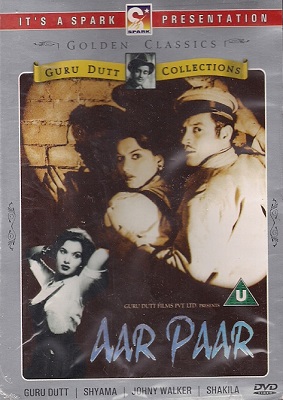
aar_paar_1Aar Paar, Shakti Samanta (1985, India). After being impressed by Guru Dutt’s Pyaasa (see here) and Kagaz Ke Phool (see here), I decided to buy a copy of his Aar Paar… but the seller screwed up and sent me this 1985 film of the same title instead. When I pointed out their mistake, they told me to keep the DVD sent in error and they also sent me the correct one. As for Samanta’s Aar Paar… it’s pretty much what you’d expect a not very good Bollywood film to be like. True, the Bollywood films I’ve seen so far have been considered good ones, and I’ve enjoyed them; but Aar Paar was definitely like a cheap version of them. I can’t even remember the story – in fact, I think there were several of them, I’m not sure. I remember a number of really badly choreographed fight scenes in which it sounded like they were fighting with exploding fists. There were, of course, several song and dance numbers, one of which I seem to recall took place on a boat. And there was a villain with greased-back hair. And the hero was not only fighting for the love interest but also for social justice – something to do with the fishing industry, in this case. This is one of those films that goes in one eye and out the other, and also goes reasonably well with popcorn and beer because it doesn’t much matter if you’re not following it. Miss ten minutes and you can pick up what’s going on within thirty seconds. It was fun, kinda, but if I hadn’t been sent it by mistake I’d never have bothered to seek it out to watch. [0]

rosemaryRosemary’s Baby*, Roman Polanski (1968, USA). Polanski’s actions leading to his current legal status in the US aside, I’ve never really understood why he’s held in such a high regard as a director. Okay, Repulsion was good, and Chinatown is a classic – but the latter at least is a result more of its script than its direction. And so to Rosemary’s Baby of which… I can remember very little and it’s only been a week or so since I watched it. Mia Farrow plays Rosemary, and John Cassavetes her husband (which is a little odd as I know him primarily as a director), and the two have this weird friendship with an older couple (Ruth Gordon and Sidney Blackmer) after they move to a new apartment… Rosemary gets pregnant, but it doesn’t go well, and her doctor is somewhat horrified to learn that the weird neighbours have been feeding her “tannis root” and… I must have fallen asleep or something because apparently there was all this Satanic stuff and I missed it. I suspect I’m going to have to watch this film again, but I really don’t want to. What I do remember hardly endeared it to me, or persuaded me it was worth greater study. Perhaps if I stumble across a copy for 99p in a charity shop, I might buy it and watch it again, but otherwise it’s Polanski and… Meh.

pickupPickup on South Street*, Samuel Fuller (1953, USA). A year or so ago, I’d never even heard of Samuel Fuller, and now I find myself something of a fan of his films – albeit only on the strength of having seen five of them. This one is noir, and pretty typical in its following of the forms, except… it’s all about secrets stolen to sell to the communists. Cold war noir. It’s a pretty typical Fuller film (and I say that despite my limited experience) inasmuch as he wrote and directed it, and it feels like he banged it out much as a pulp fiction writer would bang out simplistic moral tales which hooked onto the current Zeitgeist. There’s no denying Fuller’s technical proficiency (or indeed technical creativity – cf The Big Red One), amd his ability to craft taut and well-plotted noir stories certainly seems to deserve more credit than it gets – although, to be fair, this is the third film by Fuller to be given the Masters of Cinema treatment, so perhaps that last comment is unfair. But there is something impressively hermetic about Fuller’s plots, they’re not just ur-noir, they’re pretty much ur-cinema. They are without indulgence, just pure dialogue and tight visuals in service to a self-contained story. Truth to tell, the actual story feels almost incidental – in this particular movie, the microfilm of top-secret information is no more than a maguffin. But that matters not a jot. I mean, there’s solid entertainment, and then there’s a film which is so tightly-packed it’s like neutronium or something. I bought this, rather than rented it, and it was a fine purchase. [dual]

1001 Movies You Miust See Before You Die count: 779

* Not wanting to miss out on A River Called Titas, given the price now asked for The Cloud-Capped Star, I went and bought it. But then I did a bit of hunting and discovered copies of The Cloud-Capped Star were still available from the BFI shop for the RRP, so I ordered one. It’s annoying, but apparently my tastes are so fringe I need to buy stuff I want straight away, because once it’s deleted/out-of-print it’s going to cost ten or twenty times more. Gah.


1 Comment

Flying north

Recent events – the desire by our current government to commit political suicide, and half the population to commit economic suicide – have somewhat over-shadowed the past couple of weeks, but prior to the UK imploding very messily, I spent a weekend in Stockholm at Fantastika 2016, this year’s Swecon. It was my second Swecon, and my third Nordic con. My first had been Fantastika 2013, in the same venue as this year’s Fantastika – the Dieselverkstaden in Sickla, an area to the south of Stockholm’s city centre.

I flew to Sweden early on Friday 17 June. I’d been panicking a bit because I’d had trouble finding out where I was supposed to check-in online, but fortunately I got it sorted the evening before I flew. And when I boarded the aircraft – a Norwegian Boeing 737-800 – I discovered I had one of the seats by the emergency exit over the wing. In other words: leg room! After landing at Stockholm, I caught the Arlanda Express into the city-centre – SEK 280! – where I met up with Tobias Bodlund. We caught the Metro to Gamla stan, and had a burger and a couple of beers. The plan was to cross the bridge to Slussen and catch the Saltsjöbanan urban railway to Sickla… But it seemed the railway was closed as they were extending it or something, so we had to catch a replacement bus. The weather was hot and sunny, and the bus was like a sauna.

At Fantastika 2013, this area in front of the Dieselverkstaden had been a building site

At Fantastika 2013, this area in front of the Dieselverkstaden had been a building site

I checked into my hotel, showered and then headed over to the Dieselverkstaden to register… Early in the evening a group of us ate at the Italian restaurant just by the Diselverkstaden – although “restaurant” is perhaps a bit strong. You picked your food from a variety of bowls of saucers and pasta in a display counter, they dished it out onto a plate, and then stuck the plate in one of a dozen microwaves on a shelf behind the counter. Despite that, the food wasn’t that bad. Later, I caught one of the programme items, a conversation between GoH Caroline Mullan and Linnéa Anglemark.

Next was Jukka Halme’s infamous quiz, which I was told I had to go to… and where I was immediately volunteered to be one of the contestants. Jukka’s quiz is designed to be difficult, and the scoring can be a bit random, but it’s also intended to be entertaining. Which it certainly was. Our team was international, with GoH Jerry Määttä (Sweden), Thomas Recktenwald (Germany) and myself (UK). We also won. By a thumbs up. (The audience managed to score the same number of points – don’t ask – as us, but we’d managed a thumbs up for a close guess on one question.) Apparently, the score keeper – a volunteer from the audience – normally wins. I also managed to answer one of the “four fields” questions correctly and scored the full two points, which has apparently never been done before.

I had another beer or two after the quiz – unlike the last Fantastika, they’d set up a small bar in the concourse area outside the two auditoriums used for the programme.

The view from my hotel room on the Saturday morning

The view from my hotel room on the Saturday morning

The next morning when I woke up, it was chucking it down. And it rained most of the day. I wondered if I’d brought the weather with me from the UK. Breakfast was packed – there were at least four coach parties, one British, staying at the hotel. Fantastika 2013 had taken place in October, and the hotel had been a lot less busy. Back across to the Diselverkstaden to catch a few programme items and several wanders around the SAAM/Alvarfonden book room (a Swedish fan charity which sells secondhand books, mostly UK and US paperbacks, for SEK 10 to SEK 30). Tobias and I ate lunch at the Mexican taverna next to the Italian restaurant. Then it was an afternoon of programme items, visits to the book room, and the occasional beer. I ate in the hotel restaurant that night as I was on a panel at 6 pm, which was apparently when a lot of people went for dinner. The panel was titled “That’s why I killed him!” and was about character motivation. On the panel were GoH Maria Turtschaninoff, Anna Jakobsson Lund, Mats Strandberg, myself, and moderator Markku Soikkeli. I thought the panel went pretty well – and I was surprised when Markku asked me about the motivation behind the title character in my story ‘Barker’. (Easy: he’s based on a dog…).

After hanging around, drinking beer and chatting in the Diselverkstaden until around midnight, I headed back to the hotel.

Sunday was a quieter day. The con seemed to be winding down from around mid-morning. By mid-afternoon, when GoH Carolyn Ives Gilman had her signing, people were starting to leave. (I’d brought copies of her books for her to sign but, annoyingly, only realised I’d forgotten her debut, Halfway Human, when I landed in Sweden. Gah.) After the closing ceremony, led off by acapella singing by the Gléowine chair and closed with the spirit of Swecon being handed over to Kontur (Uppsala, 26 to 28 May next year), those of us that remained had the dead dog party in the Dieselverkstaden’s Bistro (last time, it had been in the Bishop’s Arms, a UK-style pub). The weather was nice and pleasant – bar the occasional shower – so we carried on until the bar closed. And when we moved across to the hotel, we managed to catch one more round before its bar closed.

Sergels torg, from the top of the Kulturhuset

Sergels torg, from the top of the Kulturhuset

My flight back to the UK was at 6 pm on the Monday, so I had plenty of time to kill. I woke up early, panicked a bit because I’d forgotten to check-in online the night before, but managed to do it on my phone (and discovered when I boarded the plane that evening that I’d once again got a seat by the emergency exit over the wing; result.) After checking out of the hotel, I took a taxi to the Centralstation, where I dumped my bag, and met up with Tobias. We went for lunch at the rooftop restaurant in the Kulturhuset, which overlooks Sergels torg. It was hot and sunny, just like it had been on the Friday (when I was also carrying a heavy bag around with me). After lunch, I said my goodbyes and caught the Arlanda Express to the airport, where I planned to kill the rest of the afternoon. The last time I’d flown from Stockholm had been on an early October morning, and the airport had been deserted. It wasn’t this time. It was heaving, and there weren’t many places left to sit.

My flight was delayed by 45 minutes, which meant I’d miss the train I’d planned to catch. Fortunately – for me, at least – the next train’s arrival had been delayed by 15 minutes, so I managed to catch it a couple of minutes before it left the station. But it was then delayed further – kids trespassing on the line between Manchester Airport and Manchester Piccadilly, apparently – and I didn’t get home until 10:30 that night. That final train ride is always the worst part of any journey home from abroad, because drives in just how shit our railway network is. Of course, we know who to thank for that…

Three years ago, I’d had an excellent time at Fantastika 2013, so it had always been my plan to attend another Swecon. When I learnt Fantastika, in the exact same venue, had been chosen as the Swecon for 2016, I knew I had no excuse not to go. And especially since I’d met a lot more people in Nordic fandom at Archipelacon last year… And yes, this Fantastika was a good as the earlier one, if not better. Not only are the Swedish (and Nordic) fans extremely friendly, but they’re also still focused on celebrating the books and stories that fandom is actually about. While there was a panel on the novels Robert Heinlein – which was actually very interesting – there were also lots of discussion of current science fiction and fantasy works. The experience reminded why I became a fan myself.

I really ought to shout out to all the people I spoke to over the weekend, but I’ll probably go and get a forget someone – but I’ll have a go anyway. Here, in no particular order, goes… Tobias, Johan, Luke, Fia, Kristin, Erik, Jukka, Jessica, John-Henri, Caroline, Brian, Chris, Barbara, Anders, Jukka, Carolina, Thomas, Patrik, Jerry, my fellow panellists, Tommy, Flemming, AR, Karin… and if I’ve missed anyone, I sincerely apologise.

As mentioned earlier, next year’s Swecon is in Uppsala. I’m hoping I’ll be able to go. And if not, there’s always Worldcon 75 in Helsinki in August next year.


2 Comments

Moving pictures, #31

Bit of an odd bunch, this. Nothing from the 1001 Movies You Must See Before You Die list. A few rentals, a couple from my own collection, a charity shop find, and one I found on Amazon Prime and initially thought was bloody awful but found myself enjoying by the end of it.

nebraskaNebraska, Alexander Payne (2013, USA). Bruce Dern is a crotchety old man, not entirely all there, who receives a letter telling him he’s been entered into a draw for $1 million and he thinks it means he’s won the prize. So he heads south to Lincoln, Nebraska, from his home in Billings, Montana… Or rather, he tries to, as he can’t drive. After several attempts to walk south to Lincoln, Dern’s youngest son reluctantly agrees to drive him to collect his “winnings”. The family all know there’s no prize money, but all they can do is humour Dern. En route, the pair stop off in Hawthorne, Nebraska, Dern’s home town. Once his family and old friends discover Dern is rich, they all want a piece of the money. Which doesn’t exist, of course. Dern is great in the lead role, and Will Forte – also responsible for the fucking awful MacGruber – puts in a good turn as his son. But it’s Dern’s film, and he’s more than up to the job. It’s filmed in black and white, which initially feels like an affectation, but soon seems to suit the material. Payne is not a director I especially rate – his previous movies I’ve seen have all been lightweight Hollywood comedies – but Nebraska is actually not bad. Like many films which show working-class white Americans, it demonstrates they can be not very nice people – while also suggesting they’re worse than depicted. The same might be said of working-class Brits, of course; or indeed those of any nation. But there is a particular mix of wilful ignorance and uncritical patriotism which seems characteristic of the white American working-class which is really unpalatable.

ship_of_foolsShip of Fools, Stanley Kramer (1965, USA). A group of assorted characters are crossing the Atlantic just prior to World War II, hoping for Oscars in what they hope might be, in 1965, an Oscar-bait movie. The star-studded cast says so, the weighty themes say so, filmed in black and white says so, the 149 minutes running time says so… In the event, Ship of Fools was nominated for Best Actor, Best Actress and Best Supporting Actor, but won only for Best Art Direction – Set Direction Black and White and Best Cinematography Black and White. Having now seen the film, I’m not surprised. It’s so full of itself, it’s astonishing the ship didn’t sink the second the director shouted “Action!”. As is the case in most ensemble films, there are a variety of interlocking plots being worked out. They’re supposed to have added weight because the voyage takes place just before the outbreak of WWII and José Ferrer’s character is a straight-up German Nazi. Then there’s the Jew, with the mordant sense of humour, whose misplaced optimism seems somewhat tasteless. And Vivien Leigh was apparently suffering full-blown paranoia, but managed to put in a passable performance. Oskar Werner plays the good German – on the one hand, he’s trying to improve the conditions of the passengers in steerage; on the other, he’s feeding La Condesa’s drug habit. The film was apparently adapted from a 1962 novel by Katharine Anne Porter, who based it on a journey she actually took across the Atlantic in 1931. It took her 22 years to write the book. Porter was apparently disappointed with the film. I’m tempted to try the novel, but I can’t recommend the movie.

faithWinter Light, Ingmar Bergman (1963, Sweden). A married couple live happily in a small Swedish village, and the local vicar is their very good friend. They consult him on all manner of things, and he sets their hearts at rest every time… Of course not. This is a Bergman film. It’s not cheerful. It’s as miserable as the most miserable-looking git caught without an umbrella in a cold and miserable thunderstorm. I don’t think cheerful was in Bergman’s cinematic vocabulary. What Winter Light is, is the study of a married couple who are suffering existential qualms due to China’s development of an atomic bomb, and who are not comforted by their local vicar’s words of reassurance. But then the vicar has his own problems, chief among which is an ex-lover he no longer loves… And then the husband of the couple shoots himself and… I’m reminded to some extent of Tarkovsky’s The Sacrifice, which also has a plot enabled by the threat of atomic bombs (the phrase “atomic bomb” sounds so much better than “nuclear bomb” – the former sounds like a wonder of science, the latter just another war toy). In The Sacrifice, the threat of nuclear war persuades Joseph Erlandsson – a member of Bergman’s stock conmpany at one point – to bargain with God: he will give up everything he owns if the holocaust is averted. It does, of course, somewhat depend on believing in a god. Winter Light plays the same existential game with the implied threat, but rather than apply it to a man’s possessions it makes play with his religious convictions instead. Of the three films in the The Faith Trilogy, I enjoyed The Silence the most, perhaps because it seemed most recognisably experimental in format; but on reflection, I wonder if Winter Light, being a much weightier story, is not the better one. [2]

black_goldBlack Gold, Jean-Jacques Annaud (2011, Qatar). Also known as Day of the Falcon, which is just as vague a title. It’s basically the life of ibn Saud, but with oil as the cause of the war between the two royal houses. The film was panned on release, chiefly because of its casting – Antonio Banderas plays one emir, Mark Strong the other; Frieda Pinto plays the love interest, and Liya Kebede the other major female character. The star, the young prince who becomes an ibn Saud-like leader, is played by Tahar Rahim (which was weird as I’d watched him in A Prophet only a week or so before). Banderas, the sultan of Hobeika, and Strong, the sultan of Salmaah, have just signed a peace treaty, and have agreed to keep the “Yellow Belt” as a buffer zone between their two sultanates (I assumed this is taking place somewhere in Nejd). Salmaah also has to hand over two of his young sons to Hobeika to ensure the peace. (I’m not sure whether Banderas or Strong are sultans or emirs, the two terms seemed to be used interchangably during the film – probably they were ra’ees, usually translated as “ruler”). Anyway, some years later Americans discover oil in the Yellow Belt. Salmaah rejects them, but Hobeika is happy to profit from the “black gold”. But then the elder of Salmaah’s two sons who is living with Hobeika tries to escape and is killed. The younger, Auda, played by Rahim, who is a bookish sort, is sent to his father as peace envoy. His father persuades Auda to help in his plan to conquer Hobeika and shut down the oil wells. Auda must lead a diversionary force into the Yellow Belt, while Salmaah himself leads another force right up to the gates of Hobeika. Except librarian Auda proves to have real tactical genius, and defeats Hobeika’s armoured cars with a force of prisoners on camels. And when he then attacks the Bani Sirri and frees their slaves, he earns the loyalty of all the other desert tribes… And so turns up to Hobeika with an enormous army at his back. There are a few elements here taken from the life of ibn Saud – such as his attack on Riyadh and defeat of the House of Rashid – but the Hijaz is ignored, Mecca is ignored, and the history of oil in Saudi didn’t start until later (see Abdelrahman Munif’s Cities of Salt and sequels). But despite its fancification of the real history of the interior of the Arabian peninsula (and did the Bedu tribes really dress that colourfully?), and the failure to cast appropriately (Strong at least manages an Arabic accent; Banderas doesn’t even try), I sort of found myself enjoying Black Gold. It was daft, but it was colourful and the references to ibn Saud’s life added an extra dimension.

szamankaSzamanka, Andrzej Żuławski (1996, Poland). Gosh, what to say. There is something about Żuławski’s films which… er, defies explanation. They are completely bonkers, but bonkers in such an emotionally intense and intensely watchable way that’s it’s hard not to feel something for them. The sight of Valérie Kaprisky burning up the screen in La femme publique had burned itself into my memory, and now Iwona Petry, as the (titular) heroine of Szamanka, who throws such an idiosyncratic performance at the screen it’s hard to forget it. She’s a student who rents a flat from an academic, but right from the moment they meet it’s l’amour fou. And it gets more fou as the film progresses. Meanwhile, the acadmic has discovered the well-preserved body of a two-thousand year-old shaman. The historical investigation and the affair become confused, so much so that the academic hallucinates the shaman telling him he was killed by his mistress. And so, as often happens in Żuławski films, the plot echoes the psychological dimension. Petry’s performance treads a fine line between plausible and outright weird, and the fact it works is more down to the tense atmosphere Żuławski manages to keep going for the length of the film – despite the lack of an obvious thriller plot. There are moments when it all feels like OTT posturing… but then something sort of clicks into place, and the film’s trajectory toward its tragic end is once again on course. As with La femme publique, I bought the Mondo Vision special edition DVD, which comes in a fancy box, with included OST CD, booklet and collectible bits and pieces. The presentation suits the material – I can think of many directors who deserve such releases, but Żuławski is certainly on that list. Worth buying. [1]

kingsmanKingsman: The Secret Service, Matthew Vaughn (2014, UK). A couple of weeks after watching this and I still haven’t decided if this is a clever satire of 007 and other British secret agent movies, or a horrible affirmation of their worst aspects. The title refers to a private intelligence service which cleaves to an image of stereotypical British upper class manhood from about sixty years ago. And then they meet a stereotype of 1990s British working class manhood… But, of course, the establishment eventually assimilates him. En route, we have a dumb plot to kill off 90% of the global population via free SIM cards in their phones (so, er, not really 90% then) as planned by squeamish lisping zillionnaire Samuel L Jackson. Tonally, Kinsgman is all over the place – it can’t decide what values it should be promoting, and as a result ends up saying very little that makes sense. The Bond-ish villain is presented as a spoof without actually being much of a commentary, which renders it toothless as satire. Firth is even stiffer than usual in the lead role, Taron Egerton is forgettable as the everyman bruv, and the supporting cast are more noticeable for who they actually are rather than the parts they’re playing. Kingsman will kill a Satruday evening if accompanied pizza and beer, but it’s never going to make any list celebrating the best of cinema.

1001 Movies You Must See Before You Die count: 776


Leave a comment

Best of the half-year, 2016

A lot of people do best of the year posts, but I also like doing these best of the half-year ones, as I find it interesting to see how they change as the year progresses. The two sets of lists are rarely the same, of course – new works make each top five that I hadn’t read, watched or listened to in the first half of the year. But sometimes, works from the honourable mentions get promoted to the top five as my opinion changes of them.

books
Every time I write one of these best of posts, I seem to start them with: it’s been an odd year for reading but I’m not sure why… Which I guess means they haven’t really been odd since they’ve pretty much been the same. It could mean, I suppose, that the last few years have felt like my reading lacks shape or direction because it’s not in step with the genre commentary I see online. After all, while science fiction still forms the bulk of my reading at forty percent, with mainstream fiction a distant second at 26%, I don’t generally read the genre books which are getting the buzz… And when I do, as I did with this year’s Clarke Award shortlist, then I have no idea why those books are receiving so much praise… Which is no doubt why only one category sf novel makes my top five – and only two genre titles appear in my honourable mentions… And yes, the one sf novel in my top five is on the Clarke Award shortlist (because it’s an exception to my earlier comments, of course).

end_days1 The End of Days, Jenny Erpenbeck (2012). I knew the moment I finished this book it would make my top five for the half-year, and I’ve not read anything since (I read it back in March) that has impressed me as much. I plan to read more by Erpenbeck – although not all of her books have been translated into English. Although not published as genre, either here or in Germany, its central conceit is certainly genre – a young woman, who is born in the latter days of the Austro-Hungarian empire, lives out her life during the turbulent years of the early twentieth century. Sometimes, she dies; other times, she survives. It’s a similar premise to Kate Atkinson’s Life After Life; it’s also beautifully written and feels like a much more substantial read. The historical side is handled with skill, and the view it gives on elements of European history during the period in question is fascinating. I wrote about it here.

vertigo2 Vertigo, WG Sebald (1990). Sebald is in a class of his own, so his presence in this list is probably no surprise. Vertigo is a collection of stories which have no overt link, but because of Sebald’s voice they read as a seamless whole. I’ve no idea how much of the novel is fact or fiction – it is, like Austerlitz, very autobiographical I suspect, but I’m not familiar enough with Sebald’s life and career to determine if parts of this novel – especially the section in which the narrator returns to his childhood village of W., notes the changes and reminisces about his time living in the village – although does not lessen my admiration of the book in the slightest (and learning the truth may well increase it). I’ve only read two Sebald books so far, and both made my best of the year lists. I still have one more, The Rings of Saturn, on the TBR. I think I should save it until next year. Anyway, I covered Vertigo in a blog post here.

europe3 Europe at Midnight, Dave Hutchinson (2015). It’s been a good year for this book, with appearances on various award shortlists. And rightly so. It’s not quite a sequel to the earlier Europe in Autumn, but it’s better for not being one. And thanks to the rank irresponsibility of our government in calling this stupid referendum, Europe at Midnight has become unfortunately topical. I say “unfortunately” because it’s obviously not the book’s fault, and although its creation of a pocket universe England might map onto the wishes of assorted Brexit fuckwits, I know the author’s sympathies don’t lie there and the novel’s Gedankenexperiment is in no way an endorsement of them. Of course, no one ever accused Le Carré of being pro-Soviet but then his novels presented the USSR as the enemy… And I’m digging myself into a bit of a hole here as Hutchinson’s Community is also presented as the enemy. But never mind. I wrote about this book here.

agodinruins4 A Gods in Ruins, Kate Atkinson (2015). Like the Hutchinson, this is a sequel of sorts to an earlier novel, Life After Life, although it neither continues the plot, nor uses the same cast, as its predecessor. I thought Life After Life good – an immensely readable novel – and even nominated for the Hugo (of course, it didn’t make the shortlist). A God in Ruins is, I think, slightly better. Its central conceit is dialled back more in the narrative, but it’s just as hugely readable as Life After Life. A God in Ruins is the story of the life of a man who fought during WWII and so tries to live a blameless live afterwards. It is, sort of, a variation on A Matter of Life and Death; but in a way that is neither obvious nor intrusive. For much of its length, it’s a lovely piece of historical writing, of personal history stretching much of the length of the twentieth century; but there’s an added dimension which is only hinted at. I wrote about it here.

abandoned5 Abandoned in Place, Roland Miller (2016). It’s all very well celebrating the achievements of past years, but often all we have as evidence are words in books. True, there is evidence aplenty on the surface of the Moon to prove that twelve men once walked there (assorted fuckwits who insist it was all faked aside), but in order to view that evidence we would have to, er, visit the surface of the Moon. There is, however, a lot of evidence remaining on Earth that something involving trips to the Moon took place – launch platforms, rocket test stands, etc – and it’s hard to imagine anything with such concrete (in both senses of the word) physicality being part of a great confidence trick. Is there a word which means the opposite of “paleo-archaeology”? Hunting through the abandoned remains of great engineering projects from last century, which either failed or have long since run their course? Neo-archaeology? This book celebrates one particular engineering project that ended over forty years ago – and it’s one that’s fascinated me for years. I wrote about Abandoned in Place in a post here.

Honourable mentions: Sisters of the Revolution, Ann & Jeff VanderMeer, eds. (2015), an excellent reprint anthology of feminist sf, containing a couple of old favourites, and much that was new to me – some of which became new favourites; Soviet Ghosts, Rebecca Litchfield (2014), another photographic essay, this time of abandoned buildings and plants in what was the USSR and its satellites; Wylding Hall, Elizabeth Hand (2015), strange goings-on when a 1970s UK folk band record at a haunted manor, handled with a lovely elegiac tone; Cockfosters, Helen Simpson (2015), a new collection by a favourite writer, so of course it gets a mention; In Ballast to the White Sea: A Scholarly Edition, Malcolm Lowry (2014), a “lost” novel and never before published, it’s certainly not among his best but the copious annotations make for a fascinating read; Women in Love, DH Lawrence (1920), his best-known novel after Lady Chatterley’s Lover and just as notorious back in the day for its rumpy-pumpy, but I love Lawrence’s prose… and if the philosophy and politics in this are somewhat dubious, I still have that; and The Robber Bride, Margaret Atwood (1993), not since Alias Grace have I read an Atwood novel I enjoyed so much on a prose level, so for me this is currently her “second-best” book.

films
My project to watch all the films in the 1001 Movies You Must See Before You Die list is now in its second year and has continued to introduce me to new directors I might otherwise never have discovered. Two films in my top five certainly qualify as such, and a third I’d long been aware of but would probably never bothered watching if it hadn’t been on the list. Of the remaining two, one was on the list but I’d seen at least one film by the director before; and the other movie was on a version of the list different to the one I’ve been using…

autumn_avo1 An Autumn Afternoon, Yasujiro Ozu (1962, Japan). My introduction to Ozu’s work was Tokyo Story which, at the time, I didn’t really take to. But he has been repeatedly recommended to me, and Floating Weeds was on the 1001 Movies You Must See Before You Die list, so I rented it… and liked it quite a lot. But the (I think) Criterion edition DVD cover art of An Autumn Afternoon reminded me a great deal of Michelangelo’s Antonioni’s Red Desert, a film I love, so I wanted to watch that. And after a false start, buying Late Autumn by mistake, but loving it all the same, I eventually got myself a copy of An Autumn Afternoon… And that convoluted route to it totally worked in its favour. Late Autumn I thought really good, but An Autumn Afternoon struck me as a somewhat satirical take on similar subject matter – and so perversely reminded me of my favourite Douglas Sirk movies – but it also seemed a distillation of all those elements of Ozu’s cinema I had noted in Tokyo Story and loved so much in Late Autumn. I have now added the rest of the BFI editions of Ozu’s films to my wants list.

entranced_earth2 Entranced Earth, Glauber Rocha (1967, Brazil). This wasn’t quite a “Benning moment”, where I loved a film so much I immediately went and bought everything I could find by the director… although I did indeed love this film and immediately went and bought everything I could find by Rocha. But, I must confess, wine was involved in the Rocha purchase, whereas it wasn’t in the Benning one. Not that I regret buying Black God White Devil, Entranced Earth or Antonio das Mortes, as all three are fascinating films – but Entranced Earth remains my favourite of the three. Not only is the Brazilian landscape unfamiliar enough I find it strangely compelling, but the film also features scene of political declamatory dialogue, which I love. The film is part of Brazil’s Cinema Novo movement, which seems to be like France’s Nouvelle Vague in parts but Italy’s Neorealism in others. There’s a crudity in production which, perversely, seems a consequence of, as well as an enabler for, a film closer to the director’s vision than might otherwise have been the case. And I really like that, I really like that movies like this are closer to the creative process than is typical in our commodified homogenised product-placement Hollywoodised cinema world. There are those directors who muster sufficient clout in their nation’s cinema industry they can make whatever they like, but there are also those who make great films because of their total lack of influence… and it’s the latter who often produce the more lasting work. Like this one.

qatsi3 Koyaanisqatsi, Godfrey Reggio (1982, USA). I’ve no idea how many years I’ve known about this film, but I’d never actually bothered watching it. Something about what I’d heard about it persuaded me I wouldn’t enjoy it – and while that may have been true twenty years ago, it could hardly be true now given my love of Benning’s work. But it was on the 1001 Movies You Must See Before You Die list, so I stuck it on the rental list, it duly arrived… and I was capitivated. The score and cinematography worked perfectly together – and while it’s a more obvious approach to its material than anything by Benning, that doesn’t mean it isn’t a beautifully-shot piece of work. I ended up buying the Criterion Blu-ray edition of all three Qatsi films, which, in hindsight, was a mistake, as the transfers of the first two don’t really do the format justice. The sequel, Powaqqatsi, is very good, although not as good as Koyyanisqatsi; but the third film, Naqoyqatsi, sadly suffers because its use of CGI (in 2002) makes it appear a little dated. All three are worth getting. But not on Blu-ray.

nostalgia4 Nostalgia for the Light, Patricio Guzmán (2010, Chile). The problem – if that’s the right word – with documentary films, is that no matter how beautifully-shot they might be, if the subject does not appeal then you’re not going to like the film. But then it’s not really fair to say the subject of Nostalgia for the Light “appeals”, because it’s an unpleasant subject and no one’s world is a better place for knowing about it. Nostalgia for the Light contrasts the hunt for stars by astronomers at an observatory in Chile’s Atacama Desert with the search for the remains of the Disappeared, the thousands of victims Pinochet’s brutal regime massacred for… whatever feeble-minded self-serving reasons such fascist regimes use. It’s a heart-breaking film, all the more so because it interviews those who survived the regime; but Guzmán’s intelligent commentary also gives context and commentary to the interviews. I now want to see more films by Guzmán – and oh look, there’s a boxed set of his documentaries available on…

pyaasa5 Pyaasa, Guru Dutt (1957, India). There are a couple of Bollywood films on the 1001 Movies You Must See Before You Die list, and so I rented them and enjoyed them; and while they may be superior examples of the genre (if “Bollywood” could be called a genre) and great fun to watch, to be honest they struck me as no more worthy of inclusion than a great many of the US films on the same list. But then I stumbled across a list of Bollywood classic films, and decided to try a few more than the two or three on the 1001 Movies You Must See Before You Die list… Which is how I discovered Guru Dutt. He’s been described as “India’s Orson Welles”, which I think is a somewhat unfair label as it suggests he’s an imitator; but while Dutt’s films certainly follow the forms of Bollywood movies, they’re also well-constructed, cleverly-written dramas. After seeing Pyaasa, I bought a copy of his Kagaaz Ke Phool, which I also thought very good; and I have his Aar Paar on the To Be Watched pile (as well as the 1985 film of the same title, because the seller buggered up my order). I think Dutt would be a perfect candidate for the BFI to release on DVD/Blu-ray.

Honourable mentions: Yeelen, Souleymane Cissé (1987, Mali), an old Malian fantasy tale told in a straightforward way that only highlights its strangeness; Come and See, Elem Klimov (1985, Russia), the banal title hides a quite brutal look at WWII in Russia; Shock Corridor, Samuel Fuller (1963, USA), a low budget thriller that rises above its production values, but then Fuller was good at that; Falstaff – Chimes at Midnight, Orson Welles (1966, Spain), a mishmash of Shakespeare’s various depictions of the title character, but it works really well and after watching it my admiration of Welles moved up a notch; Story of Women, Claude Chabrol (1988, France), a heart-breaking story of France’s mistreatment of its women during WWII, played strongly by the ever-excellent Isabelle Huppert; Osama, Siddiq Barmak (2003, Afghanistan), an even more heart-breaking film about the mistreatment of women by the Taliban; A Simple Death, Aleksandr Kaidanovsky (1985, Russia), a stark and beautifully-shot adaptation of Tolstoy’s ‘The Death of Ivan Ilyich’; Evangelion 1.11 and 2.22, Hideaki Anno (2007/2009, Japan), giant mecha piloted by high school kids battle giant alien “angels”, which as a précis does very little to describe these bonkers animes; Storm over Asia, Vsevelod Pudovkin (1928, Russia), a beautifully-shot silent film set in Mongolia; Fires Were Started, Humphrey Jennings (1943, UK), firemen during the Blitz by one of Britain’s best directors, but I probably need to rewatch his films to decide if this is his best; London, Patrick Keiller (1994, UK), it reminds me a little of Benning, but the arch commentary by Paul Scofield is hugely appealing; and Jeanne Dielman, 23 Quai de Commerce, 1080 Bruxelles, Chantal Akerman (1975, France), a mostly-silent, almost entirely unadorned depiction of three days in the life of the title character, which makes for fascinating viewing despite its lack of action or, er, plot.

albums
You’d think that given the amount of music I listen to that this would be the easiest category to fill in each year. But, perversely, it usually proves the hardest. Probably because I don’t document my music purchases and I rarely write about music. I also don’t purchase albums in anything like the number of films I watch or even books I read. Having said all that, I managed to pick five albums I first listened to in the first half of 2016, and they are…

no_summer 1 A Year With No Summer, Obsidian Kingdom (2016). I saw this band perform at Bloodstock in 2014 and thought them so good I bought their album as soon as I got home. And now, after four years, a second album finally appears. In some respects, Obsidian Kingdom remind me of fellow countrymates NahemaH and Apocynthion, although they’re not as heavy as those two bands. They’re progressive metal, of a sort, and they build up a wall of sound with guitars and drums, not to mention the odd electronic effect, that’s extremely effective. The songs are complex, often very melodic, and move from dreamy to aggressive and back again very cleverly.

afterglow 2 Afterglow, In Mourning (2016). I’ve been a fan of In Mourning since first hearing the monumental The Weight of Oceans, which remains one of the best progressive death metal albums of recent years. Afterglow doesn’t start as strongly as that earlier albums, but a couple of tracks in it turns more progessive and the melodic hooks which characterise the band begin to appear. By the time the last song fades away, you know it’s another excellent album.

rooms 3 Rooms, Todtgelichter (2016). The name of a band isn’t always a clue to its origin, but yes, Todtgelichter are German. And they play a sort of guitar-heavy post-black metal that works really well. Most post-black bands – I’m thinking of Solefald as much as I am Arcturus – tend to incorporate all sorts of musical influences; but Todtgelichter keep it simple and heavy and hard-hitting, and it works extremely well.

eidos 4 Eidos, Kingcrow (2015). It’s an entirely international line-up this top five, with Spain, Sweden, Germany, and now Italy. Kingcrow play progressive metal, although this is no Dream Theatre. They sound in parts very like Porcupine Tree – which is a perfectly good band to sound like – and on one track, ‘Adrift’, the main guitar part is almost pure Opeth. As influences go, you can’t really do better than that.

changing_tides 5 Changing Tides, Trauma Field (2016). I stumbled across Trauma Field a year or two ago when I found their 2013 album Harvest on bandcamp. It seem to me there were bits of fellow Finns Sentenced in there – although Sentenced never used a female vocalist that I can recall – but also a more progressive element than that band had ever incorporated. This new album feels a little lighter in tone, much more atmospheric, and is definitely less Sentenced-like… which is, of course, good.

Unfortunately, there are no honourable mentions so far this year. I’ve just not been listening to enough new music. I do most of my listening at work, and I’ve been so busy there I’ve not had a chance.


Leave a comment

Moving pictures, #30

Only one US film in this lot? I must be slipping. Lots of British films though – more, in fact, than it appears, since the two Jennings collections contain 14 and 8 films respectively. They were a damn sight more interesting than the one US movie, too.

faithThe Silence, Ingmar Bergman (1963, Sweden). This is the third film in Tartan DVD’s The Faith Trilogy by Bergman (the other two in the set are Through A Glass Darkly and Winter Light), but I’ve not been watching them in order. The Silence is set in an invented Central European country. Two sisters, one with her young son, are travelling by train through the country, and stop to spend some time in one of the towns. The older of the two sisters is a translator; she is also ill. They take an apartment in a run-down, but grandiose, hotel. While the son wanders around the hotel – at one point acting about with a troupe of dwarfs from a Spanish travelling show – his mother wanders about the town, visiting a theatre, sitting in a bar, before returning to the hotel with a man. In an introduction, Bergman explains that he’s always liked The Silence, but was convinced it would be a flop. In fact, it proved one of his more successful films internationally. It’s filmed in stark black and white, with very little dialogue (only 38 lines, claims Bergman), and the faded grandeur of hotel and town is evident in every film. I’ve said before that watching a Bergman film is like reading a literary fiction short story… and that’s especially true of this one – but one of those slightly-fabulist European stories where a deep reading is needed to figure out what’s going on. I liked this film much more than Through A Glass Darkly, although only the latter is on the 1001 Movies You Must See Before You Die list.

jennings_1The Humphrey Jennings Collection Volume 1: The First Days (2011, UK). After renting The Humphrey Jennings Collection Volume 2: Fires Were Started because the title film was on the 1001 Movies You Must See Before you Die list, I decided to buy all three of the BFI collections of Jennings’s short documentaries. There are fourteen films in this set, from 1934 to 1940. The early ones cover subjects such as the history of the post office, steam locomotives, chalk barges in Cornwall, fashion, a postcard’s journey and the GPO’s telephone link with the US via shortwave (the films were made by the GPO Film Unit). Later films show Britain during WWII – not just of the Blitz, but also showing how the government and farmers worked together to raise crops on land left fallow. Given that the later films are actual propaganda, it’s hardly surprising they’re all patriotic and jolly-old-Britain-look-how-wonderful-we-are, although as historical documents they’re quite fascinating. But even the pre-war ones hav ea certain terribly English quality about them, not just because of the BBC accents, but also thanks to their slightly patronising listen-with-mother air. Some were mucy more interesting than others – while the post office ones were a bit dull, and 1934 documentary on locomotives had its moments, I did find ‘Speaking from America’ (1938), with its description of shortwave translantic communications, fascinating. Worth seeing.

baby_janeWhat Ever Happened to Baby Jane?*, Robert Aldrich (1962, USA). It would seem the most notable thing about this movie is that its two stars – Joan Crawford and Bette Davis – loathed each other, and that hatred fed into their portrayals of washed-up acting sisters. Because there’s nothing else in the film to warrant its appearance on the 1001 Movies You Must See Before You Die list. Davis plays a successful child star (well, not her, obvs, a child plays her) who didn’t make the grade as an adult actress; while her sister, Crawford, proved a star as an adult. Until, that is, an attempt by one sister to run over the other – they didn’t get on, even back then – resulted in Crawford being paralysed from the waist down and so killed her career. Who actually ran over who is not revealed, and left to provide a twist at the end… and it’s a pretty feeble twist. The film quickly sets up the sisters’ back-history, and cleverly uses clips from early films by Crawford and Davis, before leaping ahead to the early 1960s. Crawford is bed-ridden, and cared for by Davis, who resents her sister’s fame and the fact she now has to care for her. And then, afraid Crawford is going to sell the house, Davis begins to mistreat her – and impersonates her over the phone to hide her mistreatment… It’s a hard film to take seriously. The plot telegraphs every twist and turn with all the subtlety of a brick in the face, Davis plays her role like a wild-eyed loon, and Crawford couldn’t play a convincing doe-eyed victim to save her life. The final twist in the tale is, as mentioned earlier, neither a surprise nor dramatic. Meh.

jeuxJeux interdits*, René Cléments (1952, France). During WWII, a young girl’s parents are killed in an attack by a German Stuka, and she seeks refuge at a nearby farm. The family take her in, especially since she is of an age with their youngest son. When one of the older sons dies of his illness, the two kids begin a “game” of their own – they create a cemetery for the dead animals they find, and steal crosses from, first, the older son’s hearse and later the graveyard, for the graves of their creatures. When the boy’s father finds out, he is furious… eventually leading to the young girl being taken away to a refugee camp by the Red Cross. I like the films of Jean Renoir – some more than others, it has to be said – and Jean Cocteau; but I can’t say I’ve ever really got on with other French films made before, say, the mid-1950s. Actually, I did like À nous la liberté (1931), and Dreyer’s The Passion of Joan of Arc (1928) doesn’t count as the film may be French but he’s Danish… I’ve no idea what it is, I just find them a little dull, and often longer than they need to be. And so it was with this one. Meh.

jennings_3The Humphrey Jennings Collection Volume 3: A Diary for Timothy (2013, UK). There are only eight films in this final set, but they’re mostly longer than those in the first volume. They’re from 1944 to 1950 (Jennings died in a fall from a cliff in Greece in 1950, while scouting locations), and are mostly work done by the Crown Film Unit (originally the GPO Film Unit) during WWII. The opener, for example, explains how British troops took the German song ‘Lili Marlene’ as their own after finding copies of it in over-run German positions. ‘A Defeated People’ (1946), on the other hand, shows the Germans trying to rebuild their shattered cities – and no film of London during the Blitz can ever compare with what Hamburg looked like by the end of the war. I don’t think you could accuse Jennings’s war films of being jingoistic, despite the fact they were propaganda. Most seem designed to bolster the spirits of the Brits – yes, there’s a note of “they deserved it” in ‘A Defeated People’, but the film is bluntly honest about the state the allies left the country in (and it does rightly point a finger at some of the plutocrats, the Krupp family in this case, whose industrial empire is still going… and you’d be surprised at the number of global brands still in existence which actively supported the Nazi regime…). Anyway, like the first and second volumes, this is worth seeing.

billBill, Richard Bracewell (2015, UK). I stumbled across this on Amazon Prime, and initial indications were not especially good… Bill Shakespeare is thrown out of his lute band after doing a blinding solo in a song during a gig. So he writes a play and decides to head to London to seek fame and fortune… Where he gets embroiled in a plot by the Earl of Croydon and King Philip II of Spain to kill Queen Elizabeth at a peace summit between the two. The story fits in Shakespeare’s “lost years”, between his departure from Stratford and appearance on the London stage. But I’m pretty sure it don’t go as this film claimed. I wasn’t that impressed initially – the humour was mostly based on anachronisms, and that’s a hard trick to pull off. But as it progressed, the jokes got funnier, the humour sharper, and the plot, er, thicker. The film was put together by the central cast from the Horrible Histories series, and is the second project they’ve worked together on (the first was Yonderland). They each play multiple roles, and they’re good in them (some, in fact, it took me a while to notice they were the same actors). There are some good lines and running gags, and it’s all a good deal funnier than Ben Elton’s lacklustre Upstart Crow.

trentTrent’s Last Case, Herbert Wilcox (1952, UK). I found this in a local charity shop and thought it worth a go. It wasn’t. It’s apparently the third film version of a 1913 novel by EC Bentley, which is considered by many to be the first send-up novel of the crime genre. Bentley also invented the clerihew (it is, in fact, his middle name). Despite the title, Trent’s Last Case was actually the first novel by Bentley featuring journalist/detective Philip Trent – and was intended as a standalone, but proved so popular Bentley wrote a sequel in 1936, Trent’s Own Case (and a short story collection, Trent Intervenes, in 1938). Wealthy businessman Sigsbee Manderson is found dead in the garden of his home, apparently a suicide. Trent, covering the death for his newspaper, investigates and decides it was murder. Initially, he believes the widow to be the guilty party, but then fastens on the tycoon’s personal assistant. But when he accuses the PA, and explains how the crime went down, he’s told he has some parts right – moving the body, impersonating the dead man, falsifying an alibi – but the tycoon did apparently kill himself. At which point, the widow’s uncle reveals that he actually killed the tycoon, accidentally, in a wrestle over a gun. Trent also falls in love with the widow, and asks her to marry him. Michael Wilding was awful as Trent, Orson Welles wore bizarre prosthetic eyebrows and a prosthetic nose which made him look like Parker from Thunderbirds, and Margaret Lockwood only reminded me of better actresses from the period. The film may have been a piss-take of crime novel conventions, but it came across as just a badly-plotted film. Oh well.

1001 Movies You Must See Before You Die count: 776