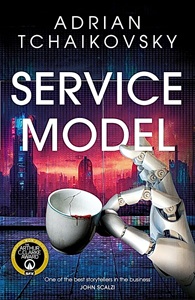
I bought Service Model (2024, UK) because it was nominated for both the Hugo and the Clarke Awards, and it was on offer. I finally got around to reading it because I was on a panel on robots in science fiction at Fantastika, the 2026 Swecon in Stockholm. It would be stating the absolutely fucking obvious to say that Tchaikovsky is massively prolific. I’d thought Stephen Baxter, who has been publishing pretty much a book a year since 1992, was prolific, but Tchaikovsky – on this side of the pond at least – has him well beat.
It’s generally accepted that the greater the quantity, the lower the quality. Surely Tchaikovsky can’t churn out so many books and they’re all excellent? If you look at shortlists for various Anglophone awards on either side of the Atlantic, you might believe he’s actually managed to do that. Except… Well, being nominated for an award is no actual indicator of quality – for the BSFA and Hugo, it only shows the author has a large fanbase among the voters. There’s much Tchaikovsky does well and I do wonder if perhaps he took the time he might write something really notable (as an example: in Children of Time (2015, UK), the novel which arguably kicked off his career, the spider stuff was excellent but the generation ship sections were trad and dull).
Service Model is fairly typical in this regard. Its central premise is nothing new – a robot accidentally kills its owner, goes looking for another job and discovers human civilisation has pretty much collapsed. There are some nice ideas, the sort that probably persuade an author the book is worth writing in the first place, but the world-building, the novel’s rigour, is slapdash and unconvincing.
Charles is a valet robot. He inadvertently slits the throat of his master, killing him. When a police inspector robot arrives at the manor, Charles tries to confess. Instead, his name is taken from him and he is ordered to report to Central Service and Diagnostics. Which Uncharles, as he is now called, discovers is backed up for years because there’s no human present to make decisions. He meets a young woman masquerading as a robot, the Wonk, who accompanies him to a hellish project where humans are forced to live in restrictive wage slavery as a “re-enactment project”. Uncharles and the Wonk escape and move onto the Central Archive, where robots are preserving all knowledge generated by humanity. That proves less than optimal. Uncharles worked briefly for a king robot who leads an army of robots who owe more to military jokes and clichés than actual military hardware, before ending up before God, a justice AI who was likely responsible for the collapse of human civilisation.
It’s a joke that wears thin after a handful of pages, and it doesn’t help that the timeline expands with each section – from two years to several generations – and I couldn’t work out if this was deliberate. There are some nice touches: each section is named for a famous author – Kafka, Orwell, Borges, Dante… – and the story relates to their most famous works. Some are more successful than others. The Librarian robots’ solution to digitising the data they’re saving is amusing. But the Re-enactment Farm relies on a single human acting like a complete psychopath and isn’t credible. The soldier robots are walking clichés and…
Uncharles isn’t a believable protagonist. He’s supposed to be a robot but he thinks and acts – despite mention of a “Protagonist Virus”, which comes across as feeble back-filling – pretty much like a human. He compares something to a gorilla handling a china cup, for example, but how would a robot know what either were and what the comparison means? Tchaikovsky throws in mentions of task lists and decision trees, but none of it really makes Uncharles read like a robot. While that’s no bad thing for the protagonist of a novel, it does undermine the presentation of that protagonist as a robot. As does the confusing timeline.
Also,
“What’s a vall-ay?” she asked. (p 289)
Er, in British English, it’s vall-ett. As Tchaikovsky should well know. (Having said that, I came across “she will be pissed” in a recent space opera by a UK author, and not meaning drunk. No, just no. If you’re British, write British English. Don’t pander to Americans. We’ve had to swallow their spellings for for near enough a century, it’s long past time they learnt their dialect is not the only one on the planet.)
Service Model could have been so much better than it was. On the other hand, it was nominated for two awards so perhaps it was precisely as good as it needed to be.
But I wasn’t convinced.

