
I forget why I bought A Death in the Family (2009, Norway) – and yes, I know his name his rendered as “Knausgaard” in the English translations. It was back in 2014, and I read it a couple of years later; and then picked up a copy of the second book, A Man in Love (2009, Norway). But then they went into storage when I moved north. And, also for reasons I forget, although perhaps because I’d thought A Death in the Family pretty good, five years ago I bought all seven of the “novels” which form the seven-book series, My Struggle. I write “novel” in quotes, because they’re allegedly autobiographies, but written in novel form, in much the same way popular histories are written these days (and it really annoys me when writers of popular histories report dialogue between historical figures, as if they had a time-machine and witnessed it).
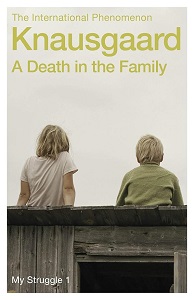
My Struggle caused something of a fuss when it was first published in Norway. Partly because its Norwegian title, Min Kamp, which means my struggle, is also the title under which Hitler’s book is published in Norway. For some reason, it has always been published in English under its German title. Huh. Knausgård’s series also upset people because, being autobiographical, the “characters” in it were and are real people, such as his wife, brother, father, etc. It also made Knausgård, who’d had two novels published previously, a household name in Norway; and famous outside Scandinavia when the books were translated into English and other languages.
A Death in the Family is a book of two parts. The first covers Knausgård’s teen years in Kristiansand; the second covers his return to Kristiansand, with his brother, to bury their father. There is some slippage, as in both parts the writer is looking back at events from the time of writing (which think is the first decade of this century). The narrative is detailed, both in the descriptions of the events which take place, and the thoughts Knausgård has, both as narrator and as historical self. Clearly there’s an element of invention to this, because there’s no way Knausgård could remember some of the events he writes about:
A few months before, I had seen the TV series The Mysterious Island, based on Jules Verne’s novel. (p 17)
I looked this up. Mysterious Island was broadcast in Norway in 1974/1975 on NRK, when Knausgård, born in 1968, was six or seven. I have a distinct memory myself of seeing the film Where Eagles Dare at an open-air cinema in Doha, and I think that happened in 1971 or 1972, when I was five or six, but how much of that is confabulation? The film was released in 1968, but a six-year-old at a cinema? We left Doha in 1972, so it had to be before that, and I’ve confirmed the family did see that film in an open-air cinema in Doha. But I’ve no way of knowing if what I remember was not confabulated from later viewings of the film. And so it is with much of the narrative of A Death in the Family, particularly when describing Knausgård’s early years.
Another element of the book is one I’ve come to recognise in novels translated into English from Scandinavian languages. The translator, Don Bartlett, has lived in Denmark, and while that certainly gives him the necessary language skills (Bokmål and Danish are very similar), I’ve noticed sometimes translators with knowledge only of Denmark miss some of the cultural, or everyday, elements of life in Sweden (or Norway). The most egregious example I can think of is the translator of Stieg Larssen’s Millennium trilogy, who also only had experience of Denmark, describing Myrorna, a chain of charity shops, as a “funky boutique”. I know little about Norway (for example, they eat sandwiches for lunch, as I do; which Swedes think weird, as they considered a sandwich something you eat between meals). Even so, I spotted a few strangenesses. Personnumer, person number, a unique identifying number used by all the Scandinavian countries, and in Norway and Sweden issued by the tax agency, is translated as National Insurance number. But I suspect that’s a translation choice.
Like Sweden and Finland, but not Denmark, Norway has a state liquor monopoly, known as Vinmonopolet. (I’ve joked in the past: Sweden – we shall call our state liquor shops the system company, Systembolaget! Norway – we shall call our state liquor shops the wine monopoly, Vinmonopolet! Finland – we shall call our state liquor shops… Alko!) So seeing the phrase “the cheapest Vinmomopol vodka” (p 319) looks a bit weird, especially since the definite article is more common in place names and such in Swedish, Norwegian and Danish.
Knausgård was living in Stockholm when he began writing Min Kamp, and while things have changed a lot in Sweden in the past twenty-five years, and my experience here is only post-Brexit, several times he describes himself making a cup of coffee at home. Using instant coffee. I’ve yet to meet a Swede who drinks instant coffee; and supermarkets carry far more brands and varieties of ground coffee than they do snabbkaffe. But perhaps that’s a Norwegian thing (see: sandwiches).
The chief appeal of A Death in the Family, however, is the annotations, the apercus, with which Knausgård peppers his memoir. Everything from teen friendships to his changing relationship with his father, is food for thought and, often clinically, examined. There’s a line around two-thirds of the way through the book, when Knausgård is describing his time as a university student in Bergen, which I think sums up both the experience of reading Min Kamp and the reason why it’s so good:
…and what enriched me while reading Adorno, for example, lay in not what I read but the perception of myself while I was reading. I was someone who read Adorno!” (p 367)

