
Chiang is the science fiction short story writer non-genre readers all praise (one of his stories was a question in this week’s University Challenge, for example). Which is not to say lots of genre readers don’t praise him too. And he’s won plenty of genre awards: eleven Hugo nominations, four of them wins; six Nebula nominations, four of them wins; and two BSFA Award wins. If he wrote novels, he’d probably have been nominated for the Clarke Award several times too. The only thing is… I find his fiction a bit, well, boring.
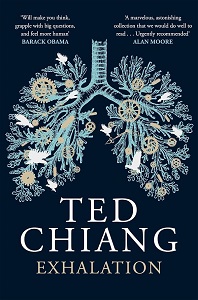
It’s not so obvious when you read his stories in isolation. They’re clearly well-crafted, and that’s what mostly comes across. But in a collection like Exhalation (2019, USA), read one after the other, it soon becomes clear that the way he constructs stories leads to a uniformity of approach which, in spite of the story’s plot or setting or trappings, quickly palls. Take the opening novella, ‘The Merchant and the Alchemist’s Gate’, which I’d previously read as a standalone book published by Subterranean Press. (Technically, it’s a “novelette”, but that’s a fake story-length, invented by genre publishers to justify paying less to writers, and only kept alive by genre awards because it means they can hand out yet more prizes.)
But, ‘The Merchant and the Alchemist’s Gate’. It’s explicitly a told story, narrated by the, er, narrator to the caliph of Baghdad, a story format famously used in 1001 Nights. The narrator explains how he met a man who had built a time-gate, which allows him to step into the future or the past, as long as it’s within the operating lifetime of the gate. The man explains this by telling stories – about other men who have used the gate. The narrator determines to use it himself in order to spend additional time with his wife, who died years before. The story’s time paradoxes are all carefully constructed, but it goes nowhere.
The title story is another case in point. In a world populated by mechanical beings whose metabolisms are powered by gas pressure, the gas being argon, a scientist investigates why clocks seem to be running fast. He more or less dissects his own brain – which is mechanical and pneumatic – and discovers the ambient pressure of argon is dropping, spelling the slow death of his race. The story is a blow-by-blow description of the narrator’s investigation, and completely lacking in drama.
‘The Lifecycle of Software Objects’, an actual novella, I also originally read as a standalone book published by Subterranean Press. It also takes a straightforward idea – the creation of artificial life in virtual environments – and then takes the idea past the point where there is anything interesting to say about it. The story follows a pair of “digient” creators who keep their creations “alive” long after the environment in which they existed has been shut down and the company which ran it has folded. There’s something quaint from today’s perspective – the story was originally published in 2010 – in hanging onto old version of software, and of course the tsunami of LLMs sold to the public as AI, has changed the nature of the debate around actual AI, leaving the novella even further behind.
‘The Truth of Fact, the Truth of Fiction’ is far too long for the story it tells. “Lifeblogging” allows people to record every instant of their day, and then later access those instants. It is the perfect defence against confabulation and misremembering. In the “novelette”, a journalist realises accurate instant access to moments in the past changes human dynamics, which feels somewhat banal given that LLMs now have achieved something similar. This narrative is interspersed with a story from a native village which finds life more difficult after moving from an oral tradition to a written one after a western nation occupies their country.
The novella ‘Anxiety is the Dizziness of Freedom’ was nominated for both the Nebula and the Hugo in 2019 and 2020. It has a simple premise: a company markets a device which forces the creation of a new reality according to the many worlds hypothesis, people can then message or speak to or video-call themselves in that other reality. Chiang then walks through a couple of scenarios showing where people’s lives are different in each reality. The overall plot is based around a scam run by a buyer and seller of the devices.
I’ll grant ‘The Merchant and the Alchemist’s Gate’ and ‘Exhalation’ are memorable – the premises if not the actual plots. The rest of the collection’s contents are forgettable. Even now, a fortnight after reading the collection, I can’t remember the stories. Chiang’s fiction reads like… code. They’re meticulous workings-out of some elements of a premise, to the point where all possible permutations and ramifications have been documented, by which point the reader no longer cares what the story is actually about.
I bought the signed limited editions of both The Merchant and the Alchemist’s Gate (2007, USA) and The Lifecycle of Software Objects (2010, USA) from Subterranean Press when they were published. They’re attractive books. (And it’s a shame Subterranean Press is closing down; it’s an excellent small press.) But the shine rubbed off Chiang’s fiction for me soon after, and there’s nothing in Exhalation which persuades me I was wrong to feel that way.

