
(A Facebook review)
This won the Arthur C Clarke Award in 2023, and throughout much of the award’s history that would be reason enough to read the book. But the shortlists in recent years have been… variable. Some of the judges’ choices have been absolutely baffling. The Last Astronaut (2019, USA)? Sea of Rust (2017, USA)? Never mind. Venomous Lumpsucker (2022, UK) sounded quite good – although having now read it, the marketing around the book didn’t sell it very well.
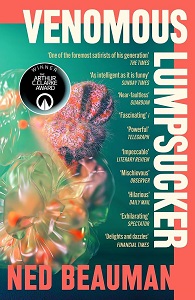
It’s set later this century, when nations and corporations trade “extinction credits” much as nations and corporations now trade carbon credits. Now, it’s to offset climate change (it’s not working); in the novel, thousands of species are being made extinct as corporations mine further afield for necessary elements and ores. The title refers to a fish which lives in the Baltic. It’s a cleaner fish, and cleaner fish are supposed to be the most intelligent types of fish. The venomous lumpsucker is even more intelligent than other species. It is also endangered.
An Indian corporation is mining the Baltic sea-floor, and has hired Resaint to assess the intelligence of the lumpsuckers, as that affects how many extinction credits they will have to pay for destroying their habitat and wiping them out. Unfortunately, Halyard, an executive with the firm, saw a way to make a quick buck, and sold the credits on the open market, expecting their value to drop so he could short them. The opposite happens: hackers wipe out all the digitised DNA of already-extinct species, which drives the price of credits sky-high. And then it turns out the company has already accidentally obliterated the lumpsuckers.
The novel is Resaint and Halyard chasing about the Baltic, trying to find a living colony of lumpsuckers, and being given a rude awakening into how the “extinction industry” works. Meanwhile, the UK has turned into a western North Korea, an isolated island nation ruled by a kleptocracy, but a powerful billionaire has bought up Cornwall and Devon and is seeding it with extinct species for his own reasons…
The targets of Beauman’s satire are pretty clear: not just the corporations putting profits above climate change, but also Brexit and Elon Musk. The novel is surprisingly funny, and the near-future stuff is inventive. Not everything works – the billionaire’s motives don’t add up, and the super AI reads more like a deus ex machina than actual near-future technology. But a good winner of the Clarke Award, nonetheless.

