
It Doesn't Have To Be Right…

… it just has to sound plausible


Leave a comment

Carry On, Jeeves, PG Wodehouse

The collection Carry On, Jeeves (1925, UK) is the third book in the second volume of the Jeeves Omnibuses, and contains stories published between 1916 and 1925. Some of the plots were later used in novels. I say “plots”, but there’s pretty much just the one Wodehouse uses.
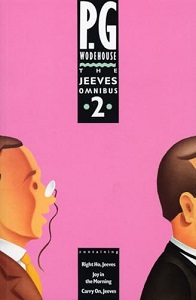
Interestingly, the opening story, ‘Jeeves Takes Charge’, describes Bertie hiring Jeeves. Around half of the stories take place in New York. They all follow the usual pattern: a friend approaches Bertie, or sometimes Jeeves directly, for help with a small problem, usually involving a fiancée or a relative, it all goes horribly wrong, but Jeeves has not only foreseen this, he has carefully engineered events to produce the desired ending. It’s all very clever, but it does wear a bit thin over the course of ten stories. There are some characters familiar from other stories, or novels, some here introduced for the first time.

The stories were mostly originally published in Strand in the UK and the Saturday Evening Post in the US. Some of the contents are rewritten versions of stories that appeared in an earlier collection, My Man Jeeves (1919, UK). So it’s not just plots Wodehouse re-uses, sometimes it’s the stories themselves. Still, they are amusing, and Wodehouse can throw a neat turn of phrase, even if it gets a little formulaic in places. The names here are not as absurd as in later stories, although I expect they would still seem absurd to any reader who is not, well, English. I should probably rephrase that: it’s not that the names do not seem absurd to English readers, they do; it’s just that they also seem entirely plausible for the upper classes.

Wodehouse’s depiction of the upper classes endures for the English. He’s not the only chronicler of the aristocracy’s inbred idiosyncrasies and depredations, and his stories only really hold true for a relatively short period in recent UK history; but then all the stories written about the English aristocracy only really hold true for the time during which the stories take place. In the twenty-first century, they’re an anachronism. Like, well, royalty.
1 Comment

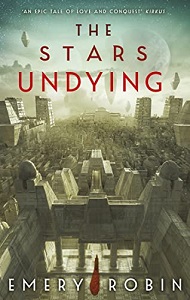
The Stars Undying, Emery Robin

(This is another review I posted to Facebook before I unshuttered this blog.)

The blurb and publicity for The Stars Undying (2022, USA) make a lot of the fact it’s Cleopatra in Spaaaace. Or rather, Julius Caesar and Cleopatra; followed by Mark Antony and Cleopatra. In a space opera setting. But subtly changed so it’s not obvious– No, of course it’s not subtle. The book makes a nine-course banquet of its inspiration. Which is no bad thing, and not uncommon in science fiction, from Asimov butchering Gibbon’s The History of the Decline and Fall of the Roman Empire (1776-1789, UK) and calling it Foundation (1951, USA), Blish doing the same to Spengler with his Cities in Flight (1955-1962, USA; see my review here) quartet, and, more recently and more pertinently, Kate Elliott space-operaficating Alexander the Great in Unconquerable Sun (2020, USA)…

In The Stars Undying, “Alexander the Great” dies but his memories are uploaded into an AI, and that becomes Alekso Undying, a god, and advisor to the rulers, of the people of Szayet, the latest queen of which is AltaGracia (Gracia). Gracia’s sister seized power after the death of their father, but Gracia won it back. With the help of Ceirran, the commander of the Ceiao military, and de facto ruler of the Ceiao empire. The two fall in love. Gracia follows Ceirran back to Ceiao (too many goddamn vowels), where she either charms or disgusts the locals. Because Ceiao is atheist, does not like the concept of Alekso Undying, and is a bit iffy with the idea of Ceirran, Gracia’s lover, controlling everything anyway. Gracia offers Ceirran immortality in the same form as Alekso – an AI running on uploaded memories in a “pearl” (a magical supercomputer substrate type thing), but this eventually proves Ceirran’s undoing. Et tu, Brute, and all that.

Unfortunately, Robin seems to have no sense of scale, and there’s no real sense the story is set in an interstellar empire. Cities are treated as if they’re worlds. Distances are farcical – 24,000 light years to fetch some cheese, as one memorable sentence mentions. Ceirran’s campaign, to conquer a distant world, doesn’t depart until the river that runs by the capital of the Ceiao, also called Ceiao, thaws. They’re going to another planet, what does the local weather matter?

It matters because this is a story told in a limited geographic area – southern Europe and North Africa – and all events and actions are predicated on that. It’s supposed to be a space opera, set in a galaxy, with thousands of planetary systems and worlds. And yet every place mentioned reads like it’s no further away from Rome than southern Spain or northern France.

It doesn’t help that Robin’s inspirations are so thinly-disguised, so it’s ridiculously easy to guess who is who, and what will happen. Admittedly, my knowledge of the period is limited to reading Robert Harris’s excellent trilogy about Cicero (yes, he’s there in The Stars Undying), but even so I had no problem identifying the people involved. From my reading, I also thought Robin’s characterisation of Caesar was far too kind. I know nothing about Cleopatra, and am more than willing to take her, er, take on Cleopatra. But, seriously, Caesar was not a nice guy, and Robin makes him into a romantic hero.

She also gender-flips Mark Antony, which arguably makes him more interesting than his inspiration. But does make her seem a little like, well, Starbuck from BSG (the reboot, of course).

The Stars Undying could have been an interesting space opera, but I think Robin made too many bad creative decisions. The sense of scale makes no sense, and actually detracts from the story. The worldbuilding is good in places, but poor in others (there’s no sense the book’s setting is interstellar). A big thing is made of Gracia lying about how she came to power, but when she reveals the truth it’s frankly hard to care.

An interesting idea, implemented in a way that undermines its source material and its purported setting. I won’t be reading the sequel.


2 Comments

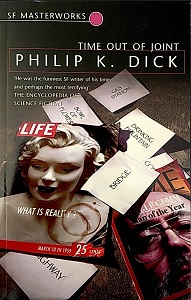
Time Out of Joint, Philip K Dick

I’ve never really understood why Dick’s novels are held in such high regard. He appears multiple times in the SF Masterworks series, more so than any other author. To me, his novels seem slapdash, written at speed and with very little idea of what they were supposed to be about. Some of his short fiction is excellent: ‘A Little Something for Us Tempunauts’ has been a favourite sf story for many years. But his novels – well, the only reason I’m reading them is because they’re in the SF Masterworks series, and once I’ve read those I’ll likely never go near a novel by him again.

Time Out of Joint (1959, USA) is a Wizard of Oz story, specifically the bit where Dorothy pulls away the curtain and reveals the truth about the Wizard. And, as in that situation, the truth behind the story of Time Out of Joint proves disappointing. Ragle Gumm is a WWII veteran in a small midwest town in the 1950s. Each day, he submits an answer to a newspaper competition, Where Will the Green Man Land Next. He spends the day researching, then fills in his answer on a map grid, and submits it by post. He always wins. He’s become something of a celebrity because of his winning streak.

But something weird is going on in the town. Gumm’s brother-in-law (he lives with his sister, her husband and their son) has a vivid memory of entering the bathroom and pulling a light-cord – but their bathroom has no light-cord. Gumm himself has memories of things that never happened. The son builds a crystal radio set, and they pick up weird conversations. In the Ruins, a derelict section of town, Gumm finds some magazines which feature celebrities such as Marilyn Monroe – they know she’s a film star, but on the other hand they’ve never heard of her.

Gumm’s world is beginning to unravel – a common Dickian trope. He plots an escape, but is brought back with his memory of his escape erased. So he tries a second time, this time with the help of his brother-in-law. They steal one of the trucks that delivers produce to the brother-in-law’s supermarket. And they make it out into the wider world…

It’s not the 1950s, it’s the 1990s. And Earth is at war with a small colony on the Moon. Gumm has a talent for predicting the targets of the nuclear missiles from the Moon. But he had a breakdown, so they created an artificial 1950s town, erased his memory, and use the competition as a cover for his predictions.

And, er, that’s it.

Gumm’s breakdown was triggered by a defection to the Moon’s side and a desire to emigrate. Once he uncovers the truth about himself and the competition, he contacts the “lunatics” in order to join them.

The first half of the book is the sort of stuff Dick does really well. All is not as it seems, but is it the protagonist or the world that is wrong? Dick keeps the details light, and focuses on a handful of characters and locales – which makes you wonder what’s happening in the rest of the town. His 1998 is less convincing. There is a world state called One Happy World, and people talk a particularly tin-eared creole. Time Out of Joint then jumps straight into exposition, and ends on a hopeful note.

Time Out of Joint was No 55 in the original SF Masterworks series, the tenth book of fourteen by Dick in the 73 books of the series. No other author appears as often. Personally, I’d keep No 20 A Scanner Darkly (1977, USA) and No 73 The Man in the High Castle (1962, USA), but ditch the rest. 

But then there are plenty of other books in the original SF Masterworks series I don’t think belong in it.