
As I was reading The Nano Flower (1995, UK), I kept on thinking it would have been better titled The Gammon Flower (to be honest, I couldn’t understand what “nano” had to do with it, anyway). In the early 1990s, Hamilton was known for being right-wing, back when “right-wing” meant he read the Daily Telegraph or the Daily Express or, like Neal Asher, who was even worse, the Daily Mail, voted Conservative, and revered Margaret Thatcher. And all of that is evident in this novel, the third book of the Mindstar trilogy.
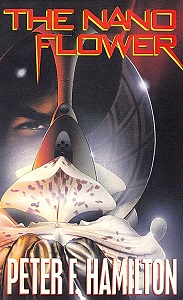
England is recovering from a decade or more of misrule by the “Marxist-Maoist” People’s Socialist Party, but the “New Conservatives” are back in power, and the country is booming. The irony here is that in the real world fourteen years of Conservative governments, and the Conservative-instigated Brexit, completely fucked over the UK. To be fair, even by 1995 it was clear to most people Thatcher had done irreparable damage to the country, although many refused to see it. On the other hand, Hamilton features climate change in The Nano Flower, which for a 1995 novel is a plus in its favour. Sadly, it is perhaps its only plus.
Julia Evans is CEO of Event Horizon, an extremely rich and powerful English – but never British – company, which has helped the country invigorate itself economically and geopolitically. Her husband, Royan, a gifted hacker, has disappeared, and all she has is a bizarre flower, which reached her by a roundabout route, and appears to contain alien DNA. This DNA is linked to a new technology, called “atomic structuring”, which promises to be a real game-changer.
One of Julia’s close friends is Greg Mandel, the protagonist of the earlier two books in the trilogy, an ex-member of the Mindstar Brigade, elite soldiers with mind powers, since turned fruit farmer. The hunt is on: first, for the escort who gave the flower to Julia (referred to throughout the novel as a “whore”, until that becomes too embarrassing for a major character, but the word “escort” is never used); then for missing hubby Royan, who seems to have been behind it all; and finally for the actual alien, which possesses the secret of atomic structuring. Julia is not the only one looking, and one of the others is leaving a trail of dead bodies behind them. In fact, this is a very violent novel, with a plot that’s little more than a string of brutal combat encounters.
I was amused that Peterborough, a town known for precisely nothing, is pretty much the economic centre of England. And that England includes Wales, but not Scotland or Northern Ireland – which would explain the use of England rather than Britain or United Kingdom, except Wales is not English, it’s, er, Welsh. Hamilton also seems to think Greenland is uninhabited, and parts of it are colonised by various nations, although not the US (perhaps that’s explained in earlier novels).
Time has not been kind to the novel’s technology. Everyone carries a “cybofax”, which appears to be pretty much a mobile phone. In fact, much of the tech, while not actually dated, uses out-of-date terms to describe itself. Plus brand names that have not survived, such as Amstrad and Lotus. It makes for a weird disconnect.
Hamilton, of course, went onto much greater success with a fat space opera trilogy, the Night’s Dawn trilogy, which certainly impressed by virtue of its girth if not its contents. Subsequent novels and series have all been space opera in a similar vein. Space opera is, of course, a genre well-suited to right-wing thought, and while I’ve no idea what Hamilton’s politics are these days I suspect they’re not the same as they were in 1995. I read The Nano Flower because it was nominated for the BSFA Award in 1996, but I’m unlikely to explore his oeuvre any further.

