
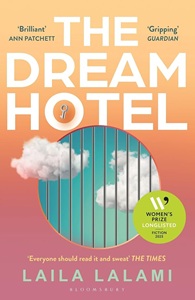
Another book from this year’s Clarke Award shortlist, and an improvement on the previous two I’ve read. In the world of The Dream Hotel (2025, USA), ie, the US a few years from now, US citizens are scored according to an algorithm managed by the Risk Assessment Agency (RAA). If their score reaches a certain level, they’re incarcerated for three weeks for “observation” to prevent them from committing a crime. So far, so humdrum. Philip K Dick was writing about “pre-crime” fifty years ago. As for being arrested without having actually committed a crime, or incarceration facilities run by private companies who manage things such that sentences are extended because it earns them more money… Well, that’s the US today under the presidency of the orange paedophile.
Where The Dream Hotel throws science fiction into the mix, and it explains the title, is the fact people can have a device fitted which manages their sleep… and records their dreams. And those dreams are fed into the RAA algorithm. People can be retained because their dreams increase their RAA score.
The novel treats it as perfectly normal, but it’s not really an idea that stands up to scrutiny. For a start, it fails any sort of evidential test, which means it could never be used in court. Except, of course, no crime has actually been committed. and if no crime is subsequently committed, then… well, it’s a self-fulfilling prophecy.
My other issue with The Dream Hotel’s premise, besides its banality, is that it’s not really novel material. It’s better suited to a short story. Which means the novel is surprisingly boring for much of its length.
Sara Hussein, an American of Moroccan extraction, is returning to her home in Pasadena when she is stopped at LAX, and finds herself sent to Madison, a retention centre, because an RAA agent at the airport recommended her for retention. She’s done nothing wrong; her score is not even especially high. But once caught up in the system, she can’t escape – her score rises, thanks to the whims of the un-regulated corporate staff.
What follows is a blow-by-blow account of the “observation” system, which is unnecessarily cruel – middle-class Americans caught up in this system, and subsequently released after the three weeks of observation, would surely never allow the system to continue. Sara’s twenty-one days becomes ten months, as her stay is extended for various trivial infractions, and events on the outside seem to conspire to prevent her assessment for release. In the end, she realises that by refusing to work she becomes a cost to the company running Madison, and is arbitrarily released.
There’s a brief section about another retainee, who proves to be an engineer at the company which makes the dream-recording device. She’s in Madison undercover, investigating whether the device can be used to influence buying habits by inserting adverts into dreams. Another section sees Madison evacuated when a fierce wildfire gets too close. Sara and the others are forced to live in even worse conditions at another retention facility. Neither section really adds much or convinces the novel’s premise is really suitable for novel-length.
The Dream Hotel was definitely better written than the other two books on the Clarke shortlist I’ve read, and its story certainly has relevance in present-day USA. But its premise is flimsy and not really strong enough to carry a novel. I’d place it somewhere between “not bad” and “meh”.

