
(Another review I originally posted on Facebook a couple of years ago.)
Flowers for Algernon (1966, USA) seems to be one of those science fiction novels most people know about, even if they haven’t actually read it. Perhaps because it was adapted into a movie in 1968, Charly. But I suspect it’s more because its central premise is one that resonates – although it hasn’t been used all that often, I think (another example that comes to mind is Thomas M Disch’s Camp Concentration (1968, USA)).
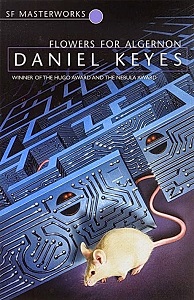
The Algernon of the title is a mouse whose intelligence has been artificially boosted through surgery and drugs. The experimenters get permission to use the same technique on a human being, a man called Charlie Gordon who has an IQ below 70. The experiment is a success and Charlie develops into a genius. Unfortunately, as Charlie soon discovers himself, the effect is not permanent.
The novel is told through Charlie’s journal entries, initially childish and misspelt and ungrammatical, but becoming analytical and introspective and dropping references to the genius-level things Charlie is now capable of doing. The novel is an expansion of a short story, initially published in 1959, but didn’t itself appear until 1966. It’s clearly set in the 1950s – lots of mentions of cafeterias, for example (thankfully no mention of hats) – and while it could at a stretch take place in the present day, at one point genius Charlie visits a home for the mentally impaired, where he also briefly lived before the experiment, and the home has thousands of patients, a number I found somewhat boggling.
I admit the basics of the story are affecting, but its setting, and its sensibilities, reminded me far too much of JD Salinger’s The Catcher in the Rye (1951, USA), a book I studied at school and hated. I can see why Flowers for Algernon has such a high profile – it’s one of a handful of US science fiction novels to have been taught in US schools – but it’s still an historical document and I suspect it’s better regarded as that and not as a science fiction novel.

