It Doesn't Have To Be Right…

… it just has to sound plausible


6 Comments

Forgotten Classic… or Just Forgotten?

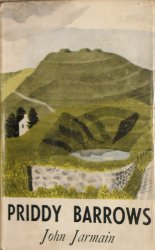
After reading some poems by John Jarmain in Return to Oasis: War Poems and Recollections from the Middle East 1940 – 1946 (see here), I wanted to read more. I hunted down a copy of his book of poems – titled, of course, Poems – on Advanced Book Exchange, and purchased it. I also learnt he had written a novel, Priddy Barrows, published the year before his death. This proved even rarer than Poems, with only two copies available on Advanced Book Exchange… and all the other hits on the Web leading back to one or the other of those two.

Anyway, I bought one of the copies.

And now I’ve read it.

The title, Priddy Barrows, refers to a school for handicapped boys located on the edge of the Mendips and run by a Napoleonesque headmaster called Captain Nelson Hayes. The novel recounts the events of a year in the lives of the people connected with, or living near, the school. Gerald Trested is one such. He sold his bookshop in London to come and teach at Priddy Barrows is set in the late 1930s – Nelson Hayes fought in the Great War – but there is something about the story which makes it feel as though it were set earlier. The novel is not a typical beginning – middle – end sort of story. Trested’s arrival at the school is not the start, nor is his eventual breaking of his engagement with Linda Ysaye the end. Having said that, nearly every character in the novel does undergo some form of story-arc, each of which intersects as the characters’ lives intersect. (The exceptions are the Turls, who end the book pretty much as they began it.)

I wanted to read Priddy Barrows after reading Jarmain’s poetry. So it was Jarmain’s use of language which had attracted me – was his prose as good as his poetry? And the answer is… yes and no. In parts, Priddy Barrows prose is very good indeed. Unfortunately, the whole book has been presented in a weirdly old-fashioned style, with paragraphs comprising single sentences, punctuated by semicolons and colons rather than full stops. It makes for an odd reading experience. Here’s a good example of the prose – it shows both the odd punctuation, and Jarmain’s strength as a descriptive writer:

They were the skaters who came up from Wells and the vale to this frozen pond in the old mine working: they played the headlights of their cars on the ice, white upon the black, and waltzed and laughed and cut patterns in their little ring in the saucer of the black frozen abandoned hills. Their lights cross-crossed closely over the circle of ice, and spreading beyond it were swallowed in the huge blackness which they could not penetrate; their cries and their gliding movement were to Luke, looking down on them from the distant barrow, like the brief hectic activity of human life as a god might see it: their fixed swift motion within the little lit compass of the ice was perfectly self-centred; nothing existed for them of the grave-strewn dark immensity of the hills beyond the beam of their lights.

Another aspect of the novel which impresses is the handling of the central relationship between Gerald Trested and Linda Ysaye. Linda dominates the relationship inasmuch as she is certain of what she wants. But the tentativeness Trested initially displays is later revealed to be apathy. He is handled sympathetically, although his story leaves him in an unsympathetic position of his own making. I suspect the journeys taken by the characters in Priddy Barrows may in themselves be classical allusions, but if so they were beyond me. The novel’s dénouement, however, throws all that has gone before on its head. Which sort of reminds me of Lawrence Durrell’s The Avignon Quintet.

Coincidentally, Durrell is a writer I very much admire for his descriptive prose and use of language. For example, the two images described below I find very striking:

A white sailing boat lay like a breathing butterfly against the white mole.
(from The Dark Labyrinth, Lawrence Durrell)

and

In that clear hard enamel air the human voice carried so far that it was possible to call and wave to her from the top while she walked the Plaka streets below.

(from Tunc, Lawrence Durrell)

So, is Priddy Barrows a forgotten classic? Sadly, no.

Even for its time, it’s written in a strangely old-fashioned style. And the plot, comprising as it does a knot of character stories – each of which seems to flit between Brontë, Austen and Dickens – only makes the novel feel more old-fashioned still. Jarmain has a fine eye for landscape, he draws his characters with skill and economy (although rendering Vowles’ Somerset accent phonetically is a bit annoying), and at times his prose displays a wonderful turn of phrase. But Priddy Barrows is a debut novel, and it promises more than, sadly, Jarmain ever had the chance to deliver.

Yes, I will read the book again one day. And I wouldn’t be surprised to discover that I like and appreciate it more after that reread.


9 Comments

As Good As I Remember It? – Frank Herbert’s Dune

Some people have The Lord of the Rings, some people have Dune. They reread one of the two books on a regular basis. While I don’t read Dune every year, it’s the sf novel I’ve probably read the most times (and I haven’t reread The Lord of the Rings since I was about nineteen). This year I read Dune once again as it’s one of the titles on my list of favourite sf novels.

dune_first

Frank Herbert’s Dune is generally considered a classic science fiction novel. It’s certainly a best-selling sf novel – and there aren’t that many of them. In fact, it’s still in print now, more than 40 years after its debut. Common wisdom has it that the Dune series falls in quality as it progresses, although there are those who consider the sequel to Dune, Dune Messiah, the best of the lot. Since Frank Herbert himself conceived of the original trilogy – Dune, Dune Messiah and Children of Dune – as a whole, it’s unfair to consider them sequels. The trilogy is a thematic whole – as FH himself wrote: “I conceived of a long novel, the whole trilogy as one book about the messianic convulsions that periodically overtake us … This grows from my theory that superheroes are disastrous for mankind, that even if we find a real hero (whatever that may be), eventually fallible mortals take over the power structure that comes into being around such a leader.”

As for the later Dune books – yes, God Emperor of Dune is less a novel than it is a manifesto, but once you accept that the book becomes a more interesting read. Both Heretics of Dune and Chapterhouse Dune are, I think, technically better-written than the original three. Admittedly, Miles Teg’s development of superhuman speed always struck me as pushing plausibility just a little too far out of the suspension of disbelief envelope. And back-fitting an underground Judaic society into the universe felt a bit like pandering and unnecessary.

The less said about the Brian Herbert and Kevin J Anderson prequels and sequels, the better.

For those few who’ve not read the book, Dune is the story of Paul Atreides. It is set some twenty thousand years in the future, in a feudal interstellar empire in which computers , “thinking machines”, have been banned for millennia. Interstellar travel is controlled by the Spacing Guild, who use the spice melange to see into the near-future and so safely pilot their starships via foldspace. Melange is only found on a single world, Arrakis, AKA Dune. Paul’s father, Duke Leto Atreides, is charged by the Emperor with taking over Arrakis from his mortal enemy, Baron Harkonnen. But this is just a ploy by Harkonnen, who intends to destroy House Atreides. He attacks, but Paul and his mother, Lady Jessica, escape into the vast deserts of Arrakis and join the native Fremen. These are a hard people, and superlative fighters. Paul proves to be prescient and the messiah their religion foretold, and he leads them in battle against the Harkonnens and the Emperor. And wins.

Dune, for all its popularity and success, is not a very well-written novel. Here’s a sample passage:

His mother had undergone this test. There must be terrible purpose in it… the pain and fear had been terrible. He understood terrible purposes. They drove against all odds. They were their own necessity. Paul felt he had been infected with terrible purpose. He did not know yet what the terrible purpose was.

FH’s prose rarely rises above serviceable. It often drops below it. His poetry – presented as the lyrics of Gurney Halleck’s ballads – is bad. It’s no better in his collection of poetry, Songs of Muad’Dib. But then he did write a lot of haiku, and I hate haiku. Further, the continuous “head-hopping” is often confusing. That’s not to say FH was a bad writer, just that Dune doesn’t showcase his best. His writing in The Green Brain is, I feel, much, much sharper; and he draws his setting and characters much more effectively and skilfully in The Santaroga Barrier.

What FH was, however, was perhaps the deepest-thinking sf writer of his generation. Even if his prose often got in the way of the story, his fiction always left the impression it was never based on, or built around, trivia. He didn’t write escapist adventure-stories. Even a fix-up such as The Godmakers, in which the joins are painfully obvious, had something intelligent to say about government and religion.

FH spent a lot of time on the background of Dune, and it shows a depth and richness matched by few novels in the genre. Its feudal, somewhat old-fashioned, nature has also meant it has stood the test of time well. Dune reads pretty much the same now as it did when I first read it thirty years ago. The protagonist, Paul, is a young man whose words and actions continually seem to chime with prophecy, suggesting he is heir to greatness. And so it proves. There’s plenty there for young male adolescents to identify with, especially those who read science fiction. I no longer identify with Paul to the extent I did as a callow youth. And Baron Harkonnen now seems more of a pantomime villain than a real antagonist. All he lacks is a moustache to twirl. However, the setting remains as fascinating as ever – it’s easy to feel that the background is the real achievement of Dune. Both it and The Lord of the Rings were notable first and foremost for their deep and detailed settings, and both of them perhaps led to the current privileging of immersion over everything else in genre novels and novel series.

Each time I reread Dune, I find its narrative message harder to swallow – i.e., the human race is slowly stagnating, and a jihad is needed to mix up the genes and inject some vitality back into it. Paul tries to prevent this – or rather, he tries to find a less violent solution. But he fails. For me, jihad is the wrong word. It means “struggle” – and what exactly is the jihad in Dune struggling against? Second, Herbert equates a stagnating civilisation with genetic stagnation, which is not necessarily true. And, finally, going out and killing lots of humans is a pretty peculiar way of injecting some vitality back into the gene pool.

Speaking of killing, Dune is full of it. I hadn’t realised until this reading quite how many people are slaughtered throughout the story. And often for the most trivial of reasons. In one scene, two guards are a little quick to obey Feyd-Rautha in the presence of Baron Harkonnen. Since those guards are clearly more loyal to Feyd-Rautha than the baron, Harkonnen has them killed. Feyd-Rautha’s harem is also murdered as punishment for something he did wrong. It’s not just the villains of the piece. Perhaps it’s not unexpected that the Harkonnens would place little value on life, but the Fremen view it equally as cheap. Duke Leto is the only character who values the lives of his men. On joining the Fremen, Paul adopts their view. It all makes for a somewhat callous read. And, of course, it’s stated that the jihad will slaughter billions more after Dune‘s story has finished…

Unfortunately, David Lynch’s 1985 film of Dune has also slightly spoiled the book for me. For much of the novel, Stilgar remains as described in the novel. But when Paul and Jessica join the Fremen and Paul chooses his Fremen name… I kept on hearing Stilgar’s dialogue in Everett McGill’s voice. After seeing the movie, it’s almost impossible to hear, “We call that one muad’dib,” any other way.

Even though I’ve read Dune at least half a dozen times in the last 30 years, I don’t doubt I’ll read it again. For years I’ve been promising myself I’ll read all six of the FH-penned Dune books in succession. Maybe I’ll set myself that as a challenge one year, and blog the results. If I can bring myself to do so, I might even continue onto the two “Dune 7” novels written by Brian Herbert and Kevin J Anderson… Which would sort of be the opposite of going from dreadful sf B-movies to Ingmar Bergman… but with just as explosive results (see below).

Yes, Dune remains a favourite – although for reasons I’m not sure I fully understand. It’s not FH’s best-written novel. It’s not even the best-written of the Dune series. It is also a somewhat heartless novel – its core ideas have never really convinced me. But its setting remains a work of genius, and – let’s be honest – every male sf reader secretly wants to be Paul Atreides…


4 Comments

August and September Favourites

I’ve still been reading a favourite book each month. But I was a bit too busy in August to write up something on that month’s book, Metrophage by Richard Kadrey. So I decided to roll it into the write-up of September’s book, Paul Park’s Coelestis. And here they both are…

Richard Kadrey’s Metrophage has been described as “one of the quintessential 1980s cyberpunk novels”, and yet it seems to have slipped below the radar of most sf readers. It has neither the profile of William Gibson’s Neuromancer, nor Neal Stephenson’s Snow Crash, and yet I believe it is better than both. Neuromancer was the seminal cyberpunk novel, and that can’t be taken away from it. But I’d argue that Metrophage did something just as important.

Jonny Qabbala is a drug pusher in Los Angeles. He is also an ex-member of the Committee for Public Safety. When Jonny’s connection, Raquin, is murdered, Jonny heads off to confront the killer, Easy Money… and promptly finds himself caught in the middle of a battle for Los Angeles – between the Committee for Public Safety, drug lord Conover, and the anarchist Croakers. In this future, the US went bankrupt and was bought up by the Japanese. Who are now at war with the New Palestine Federation (shades of The Centauri Device).

Jonny spends time with each of the three factions – not always by choice – but is entirely powerless to prevent events from unfolding. There are puzzles embedded in the plot – the mysterious leprosy-like disease raging through the city, the Alpha Rats on the Moon… Metrophage resolves these by putting Jonny in position to have the truth explained to him. It helps that he has contacts in each of the three factions – and even more so that he is seen as important to the plans of at least two of the factions. Kadrey takes the reader on a wild ride through his Los Angeles – alternately wasteland and near-future neon-soaked wonderland. Clues dropped here and there help explain the resolution. There are a couple of points I couldn’t quite figure out – the game Conover plays with Jonny using a copy (or original) of Gainsborough’s Blue Boy, for example. But plenty of other elements of the novel have been subsequently become well-known tropes in the language of science fiction.

Despite that, Metrophage reads as fresh today as it did twenty years ago. Few books – even cyberpunk ones – can claim to have avoided dating over two decades. But then, Metrophage is more than just a cyberpunk novel. If Neuromancer folded noir into science fiction, then Metrophage folded cyberpunk back into science fiction. I’ve always maintained that cyberpunk effectively ended with the publication of Metrophage, and after my recent reread I see no reason to change my mind. Metrophage is cyberpunk – although it features no cyberspace or hackers. Metrophage is science fiction.

I didn’t expect Metrophage to lose its place on my list of favourites, and my reread not only proved that but reminded me why it was a favourite. It’s a great book.

And after Kadrey, another book I didn’t expect to be dislodged from the list. However, its appeal is, perhaps, more personal. Paul Park first appeared with the Starbridge Chronicles – Soldiers of Paradise, Sugar Rain and The Cult of Loving Kindness – an ambitious science fiction trilogy set on a world with seasons which last centuries, much like Brian Aldiss’ Helliconia trilogy. From the first page of that trilogy, it was clear that Park was a distinctive voice. And his follow-up, Coelestis, more than proved it. In some respects, Coelestis remains unique in the genre. And that’s not an easy accomplishment.

Simon Mayaram is attached to the British Consulate on the only colony world on which an alien race was discovered, homo coelestis. These aliens were actually two races – Demons, and the Aboriginals, who the Demons had telepathically enslaved. The humans hunted the Demons to extinction, and freed the Aboriginals. Who now ape humanity – the rich members of the race undergo comprehensive surgery, and require a strict regimen of drugs, in order to appear and behave human. Katharine Styreme is one such Aboriginal. To all intents and appearances, she is a beautiful young human woman.

Simon is invited to a party given by a prominent member of the human community. Katharine – whom he has admired from afar – is also there, with her father Junius, a wealthy merchant. During the party, Aboriginal rebels attack, kill almost everyone and kidnap Simon and Katharine. Without her drugs, Katharine begins to revert to her alien nature – a process that is exacerbated by the presence among the rebels of the last surviving Demon. When human vigilantes attack the rebels, Simon and Katharine are forced to flee… and Katharine’s meagre grip on humanity begins to erode even further.

Coelestis is one of those science fiction novels which follows a logic all its own. It is, in a sense, post-rational. Although the story is set an indeterminate time in the future, the community to which Simon belongs bears an uncanny, and deliberate, resemblance to early Twentieth Century colonial British and American. Even the Aboriginals themselves – particularly the Styremes, who are made to appear human, and show no alien side – are hardly convincing in any scientific sense. Earth is described as a dying planet, and the colony planet has been cut off from its nearest neighbour. If there is an interstellar federation or empire, then it bears no resemblance to any other in the genre.

John Clute described Coelestis as a “Third World SF novel”. It’s sheer hubris on my part, but I think this is wrong. Coelestis is a post-colonial sf novel. It is clearly inspired by Park’s own years in India. And to call India a member of the Third World is to ignore its long and deep cultural heritage – and the Aboriginals (or rather, the Demons) are implied to have an equally long cultural heritage in Coelestis. The novel is not about living in a Third World analogue, it is about the gentle wind-down from colonialism and its often bloody consequences. Park makes as much clear in events described in the book. Mayaram is of Indian extraction (although born in the UK), and during his abduction by the Aboriginals, he rapes Katharine. It’s perhaps a somewhat  blunt metaphor for John Company and the Raj, but it makes the point. Even the Aboriginals’ attempt to ape human ways is a reflection of the Indian adoption of some elements of British culture – and especially the English language. The Aboriginals’ ersatz humanity is little more than surface – Katharine may resemble a young human woman, but whatever gender she possesses is what’s attached to her mimicry (the Aboriginals are actually one-sexed). She is not a viewpoint on the alien – Coelestis is a description of her fall from humanity, not of her imitation of it.

Having grown up in the Middle East, I find a particular appeal in novels such as Lawrence Durrell’s The Alexandria Quartet and Park’s Coelestis. To some extent, they remind me of my childhood. Both also have the added advantage of being novels which can be read many times – and there is always something new to find, or to think about, in them. I certainly plan to reread Coelestis again some time. Its place on my list of favourites is secure.


8 Comments

What I’m Pointing To…

Science fiction was born in 1926, when Hugo Gernsback published the first issue of Amazing Stories. The first attempt at defining science fiction occurred several days later. In more than eighty years, no one has satisfactorily defined the genre – the most often quoted “definition” is Damon Knight’s, science fiction “means what we point to when we say it”, from 1956. However, it often seems people chiefly define science fiction by its readers. So PD James, Maggie Gee, Margaret Atwood, Cormac McCarthy – for example – can all write novels that are not science fiction, despite featuring tropes common to the genre. Or so they would have you believe…

I’ve yet to see anyone claim Jed Mercurio’s Ascent as science fiction. And yet… It’s set in the past, true: the book ends in 1969. It is also chiefly a fictionalisation of real events. But the final third of the novel certainly never took place. Which arguably makes Ascent alternate history, which is often considered a sub-genre of science fiction – sf author Stephen Baxter did something similar with NASA and a trip to Mars in Voyage. But there’s more to Ascent‘s science-fictional credentials than just that.

Yefgenii Yeremin is orphaned during the Siege of Stalingrad. Each year, a boy from the orphanage to which he is sent is awarded a cadetship in the air force. Yeremin wins that cadetship – by partially blinding his chief rival. During the Korean War, he becomes Ace of Aces. Known as “Ivan the Terrible”, he kills more enemy pilots than anyone else – despite not “officially” being in Korea. Unfortunately, his masters back in Moscow are not happy with his final escapade, and he is assigned to an air base in Franz Josef Land (an archipelago in the Arctic Ocean, north of Novaya Zemlya). Most Soviet pilots spend a year or two in Franz Josef Land, but Yeremin and his family spend nearly a decade there. Yeremin is then recruited for the Soviet space programme… and the last third of Ascent describes his one-man mission to beat the Americans to the Moon in 1969.

The technology that Mercurio describes for this fictional mission is real. There really was a LK Lunar landing module and a LOK Lunar orbital craft. The project, however, was abandoned following the death of Chief Designer Korolev and a series of catastrophic failures of the N1 booster. As is clear from the attention to detail (and the bilbiography at the end of the novel), Mercurio has not stinted on his research.

Reviews of the book in the national press made much of its heavy use of unglossed aeronautical jargon and the near-obsessive attention to detail. This, some critics decided, was a reflection of the protagonist’s own self-absorption and aloofness. Yeremin was so driven, they argued, that he was defined by his immersion in the technology he used and the ways in which he used it. The fact that Yeremin’s wife is referred to throughout as “the widow”, they saw as indicative of a protagonist who was so focused on his own ambitions that he could not relate to people – especially those closest to him. But Yeremin’s fellow pilots in Korea are all named, as are the cosmonauts he joins in Star City (Yuri Gagarin, Alexei Leonov, Vladimir Komarov). The only US pilots named during the Korean War dogfights, however, are those who later become astronauts – Neil Armstrong, Gus Grissom, John Glenn, Wally Schirra

To my mind, Mercurio’s jargon-heavy prose, and lack of a glossary, has much in common with a science fiction narrative. To aeronautical and astronautical buffs, Mercurio’s prose is detailed and accurate… but not baffling. To a science fiction reader, a story which references androids, FTL, Dyson Spheres, AIs, etc., is not impenetrable. In fiction, settings are defined by what they contain – in mainstream fiction, those objects are shared with the real world. We all know what a television set is, a mobile phone (or cell phone), Kalashnikov AK-47 assault rifle, turnip, casserole, marmoset, etc… In science fiction, the objects within the setting are either unique to the story or to the genre. In the latter case, no glossing is usually necessary (and is, incidentally, where mainstream authors writing sf usually fall flat on their faces). In the former, the better writers allow meaning to come from context, and so avoid the dreaded info-dump. True, some sf novels do use glossaries – Frank Herbert’s Dune is perhaps the premier example. Mercurio does not gloss (the amount of jargon understood depends on the reader’s familiarity with the technology described), but he also makes terms comprehensible through context and through info-dumps.

Reviewers unfamiliar with the language of science fiction found the privileging of technology in Ascent worthy of comment. They interpreted this as an aspect of Mercurio’s characterisation of Yeremin. Narrow, or flat, characterisation is often perceived as a defining characteristic of science fiction. In a literature where the idea, often in the form of technology or science, is foregrounded, then characterisation is often going to appear subservient. Because Mercurio does this in Ascent, I started thinking about what it was that made the novel science fiction, and what it is that makes any sf novel science fiction…

Let’s say that science fiction can be distinguished by its settings, or by its readers. To many, if a story is set in the future or in outer space, then it is science fiction. But Apollo 13 is not considered to be sf. Any book labelled by the publisher as science fiction is sf. But not all sf books are marketed as sf – William Gibson’s Spook Country or Cormac McCarthy’s The Road, for instance. Any book written by an author who identifies themselves as a sf writer, or identifies themselves as a member of the community of sf writers and readers, is science fiction. Again, not all sf books are written by sf writers – Orwell’s 1984, or Anthony Burgess’ A Clockwork Orange. So neither of these characteristics are distinguishing or useful.

Science fiction, unlike fantasy, is a modernist form of literature because it takes as axiomatic that the human condition and/or the human environment can be controlled – from cybernetic implants to genetic engineering, from colonies on Mars to re-engineering whole galaxies. Even the “unknown” can be subjected to reasoning and control, although it may not produce answers. Science fiction differs from mainstream modernist literature in that the tools used for control of the human condition and/or environment are figments. They either do not exist, do not operate in the real world as described in the text, or rely on science and/or technology which does not exist. Or their use presupposes, or leads to, a condition or situation which cannot or does not currently exist – such as a landing on Mars, or the Germans winning World War II. Or, in the case of Ascent, the Soviets sending a cosmonaut to the Moon.

So science fiction is more than just an invented setting. It is more than just squids in space. It is the process by which the figments are used, and it is the intent of that process. Not the intent of the author – we can’t know that from the text alone. But if the figments are instrumental in the control of the human condition and/or environment, and that is the intent of the figments in the text, then the text must be science fiction.

It’s a theory, anyway…

After all that, I should probably point out that I did enjoy Ascent. I’ve been fascinated by the Space Race since I was a child – The Right Stuff is both a favourite book and a favourite film – and I’m enough of a geek to find the technology fascinating. However, I do think Mercurio missed one trick in his book. One of the Apollo missions allegedly reported strange lights on the Moon’s surface during one of their orbits. Perhaps Mercurio should have tied this in – so Yeremin’s landing becomes a UFO myth of the Apollo programme. It would have provided an amusing link to the real world.


6 Comments

I’m As Surprised As Anyone That I’ve Been Keeping Up With This…

I’ve been a bit random as to which title I choose to read next from my list of favourites. I wonder if this has affected my response to the various novels? I mean, going straight from the grim and political near-future of Gwyneth Jones’s Kairos to the slight but fun space opera of Iain M Banks’s Against A Dark Background… Of course, I read other books between those two – I read seven books, in fact… including Jed Mercurio’s Ascent (expect a post on this soon), Paul Park’s The White Tyger (the third book in the series begun with A Princess of Roumania; superior fantasy), and Text:UR (a small press anthology; a mixed bag, but on the whole recommended).

So, Against A Dark Background… This was the first of Banks’s non-Culture space operas. It’s actually set within the Golter planetary system, located millions of light-years from its nearest neighbouring star. It could be a Culture novel – there’s no reason why its story might not take place in some unexplored reach of the Culture’s universe – but unlike Inversions, there are no clues in the narrative suggesting as much.

The Lady Sharrow is a noble fallen on hard times. When she was little, her mother was assassinated, and her grandfather’s vast commercial empire was broken up by the World Court. She served in the military during the Five Per Cent War, but is now a retired hunter of Antiquities (relics of Golter’s seven thousand years of technological civilisation). As the novel opens, a religious cult, the Huhsz, has received permission from the World Court to hunt and assassinate Sharrow… in revenge for an incident generations ago. An ancestor of Sharrow’s had stolen several artefacts from the Huhsz – including a Lazy Gun. Only one Lazy Gun, of eight manufactured, remains. The last-but-one was found several years earlier by Sharrow, and handed over to a university. Who promptly tried to study its interior… only to trigger an explosion which killed half a million people. The Huhsz want the last Lazy Gun and will kill her if she does not give it to them. Except, she doesn’t know where it is.

Sharrow puts together the survivors of her Five Per Cent War squadron, and follows a series of clues about Golter’s planetary system, before finally finding the last Lazy Gun. It’s plotting by coupons, of course. Sharrow is on a Quest – although unlike in high fantasies, the consequences of failure are purely personal. Sharrow will die if she fails, it’s not the fate of the world at stake. Each step of the quest is a set-piece – from the theft of the Crownstar Addendum in Log-Jam to the assassination attempt on the last of the Useless Kings in Pharpech to the final assault on the Lazy Gun’s hiding-place. It’s all typically Banksian – but you guessed that much from the term “Useless Kings”. If there’s one thing that distinguishes Banks’s novels from those of a similar ilk it’s his mordant wit.

And that wit is firing on all cylinders in Against A Dark Background. Especially since every plan put together by Sharrow and her team during their quest goes horribly wrong. In fact, by any definition of “hero”, Sharrow is a failure – she is out-manoeuvred at every turn, and only manages to reach the next stage of her quest more by accident than by design. Or by being rescued by saviours from out of the blue. Against A Dark Background could have been titled The Perils of Sharrow.

Sharrow, however, is anything but passive. She’s a strong character. In fact, there’s a bit of the Perfect Girlfriend to both her and team-mate Zefla – both women are gorgeous, intelligent, independent, strong-willed, and more than willing to dress for display. By contrast, the male characters are mostly under-written. But perhaps this is a hang-over from the book’s origin. It was apparently first written in 1975 (when Banks was 21), but heavily rewritten before publication in 1993. The character of Feril, an android, I suspect was added in the rewrite; or at least altered a great deal. Feril joins Sharrow’s team some two-thirds of the way through the novel. It is C3-PO in all but name and irritating mannerisms. Star Wars had yet to be released in 1975, of course.

Against A Dark Background is by no means Banks’s best sf novel. It’s a space opera quest, with plotting by coupons. However, it is slightly subversive in as much as Sharrow loses each coupon to other forces as soon as she has found it. And yet still the quest progresses towards its foreseen end. To have a character fail all the time would not make for an entertaining read, and so Banks livens up the story with wit and an approach to genre furniture and tropes that knows, or allows, no shame. He had fun writing Against A Dark Background, and he wants the reader to know it. Against A Dark Background is a fun book.

Against A Dark Background was one of the books on my list of favourites I’d read several times. And each time I’ve enjoyed it – perhaps because it’s hard to take seriously. That’s the book’s strength. Repeated rereads don’t spoil it, because there’s as much enjoyment in encountering remembered characters and events as there is in meeting new ones. Like AE van Vogt’s Undercover Aliens and John Varley’s The Ophiuchi Hotline, familiarity is comfortable. It doesn’t breed contempt. Against A Dark Background is a favourite novel first and foremost because I enjoy it every time I revisit it. It will stay a favourite; it stays on the list.


6 Comments

Rereading Favourites – June Update, Part 2

Kairos I did not expect to disappoint. If anything, I imagined I would get more from the book on this reread – it’s been over a decade since I read it last and I hope I’m a more discerning reader now than I was then. Which also means, I suppose, that I had higher expectations of this favourite novel than I’d had of the others I’ve reread so far…

And right from the first page, the prose was as good as I’d remembered it. By the end of the first chapter, something else about the novel had occurred to me – what had been near-future science fiction was now alternate history. Kairos was first published in 1988, and it posits a future extrapolated from Thatcher’s Britain. The ever-widening equity gap, the increasingly ham-fisted attempts to enforce law and order, the slow realisation that the decisions made by government were not for the benefit of the people it represented… It wasn’t hard to imagine a dystopic future back then. If anything, it seemed almost inevitable.

I was going to write that we’re better off now than we had expected to be – both politically and economically. But a couple of days after finishing Kairos, I happened to watch Red Road, a film set in a far-from-salubrious area of Glasgow (it’s a very good film, incidentally). If Red Road is a true reflection of life in the present day for some, then for them the future of Kairos has come true…

Jane “Otto” Murray is a lesbian ex-political activist, and the owner of a small secondhand book shop. One of her closest friends, James, a gay soap opera actor of Nigerian extraction, asks her to look after a small film container given to him by his sister. Both James’ sister and brother are involved with BREAKTHRU, a pharmaceutical company turned cult religion – there is, incidentally, no commentary here on cults or religions. BREAKTHRU have managed to obtain a sample of a drug, which they call Kairos. This drug allows users to directly affect the real world. There is mention of quantum theory, used to “scientifically explain” how the drug operates, but it is its effects not its mechanism which is important.

After dabbling with BREAKTHRU, Otto’s lover, Sandy Brize, leaves her. Shortly afterwards, Otto’s son, Candide, runs away. Someone has kidnapped his dog and demanded the film canister as ransom. But Candide runs to Sandy, taking the film canister with him, and enlists her help in rescuing the dog. Together, they head north, meet up with a posse of animal liberationists, and raid the BREAKTHRU laboratory where Candide believes the dog is being experimented upon. Throughout this period, the drug in the film canister has been affecting Sandy, who has in turn been affecting the real world…

There’s no denying that Kairos is a very good book, and rereading it I can understand why it became a favourite. I’ve admired Jones’ writing a great deal since first encountering it, and Kairos is neither the somewhat clumsy science fiction of her earlier Escape Plans nor the near-fantasy of her debut, Divine Endurance. It is a novel that feels important – less so now , of course, than it did when I first read it (which would be a couple of years after it was published). Even so, it’s nice to read a sf novel that actually had relevance, even though that relevance no longer holds true. Perhaps that’s one of the definitions of a favourite novel – it recaptures what you felt when you first read the book. And a definition of a well-written book must be one in which you sympathise with the protagonists no matter how little you have in common with them – and I certainly have very little in common with Otto.

I’m glad I reread Kairos. I will almost certainly reread it again. It’s by no means a cheerful or fun book, although it is liberating and hopeful in its resolution. I’m going to keep it on my favourites books list.

Incidentally, my copy of Kairos is inscribed by Gwyneth Jones, To Ian, In memory of the strange sausages. She never did tell me what that means…


1 Comment

Rereading Favourites – June Update, Part 1

After Soldier, Ask Not, I decided to expand the challenge to include an “also-ran” each month… just in case the favourite failed to make the grade. For June, the favourite was Gwyneth Jones’ Kairos, and the also-ran was Time and Again by Clifford Simak.

Time and Again was first published in 1951 under the title First He Died. It’s also one of the earliest sf novels I ever read. I can distinctly remember reading it when I lived in Dubai – likely borrowed from Dubai Country Club‘s subscription library. That would be sometime between 1976 and 1979. Thirty years ago! And yet I could recall some of the details of the plot – there was a time war; and a man who landed a wrecked spaceship despite it having no drives, nor even being airtight. One image from the novel which had stayed with me was of a car that had crashed into a tree, and which contained a book from the future.

I suppose disappointment was inevitable – I certainly hope I’m a more discerning reader now than I was when I was eleven years old. The novel opens with a typically Simakian scene: a man is sitting on his porch, the crickets are chirping, the brook is burbling, night is falling… Another man walks up, tells the seated man he is from the future, and that Asher Sutton is returning to Earth tomorrow and must be killed. It’s a great set-up for a story. And it gets better. Twenty years ago, Sutton was sent to 61 Cygni in an attempt to break through the mysterious barrier guarding the system’s seventh planet. He is the first and only person to have done so. And now he is back – travelling in a spaceship that has no spacedrive and isn’t even airtight. Sutton will write a book about something he learned on 61 Cygni. This book will be used as a rallying cry for a movement to emancipate androids (vat-grown humans, slaves in all but name). Others, however, will interpret Sutton’s revelations to refer to humans only. And so there will be a war.

Time and Again is set some 6,000 years from now, in a future when humanity has a galactic empire – which appears to be ruled by a bureacracy. Time travel has only just been discovered when Sutton returns to Earth, but factions from the future representing both sides have travelled back in time in an effort to influence events.

The great ideas promised by the novel’s opening, however, never really appear. Simak is more concerned with the character of Sutton, and the nature of his revelation, than he is with the ramifications of the situation Sutton creates. The world-building is poor – the Earth of the 81st Century comes across as no different to 1950s America, but with silly clothes and a code duello. The time travel, and any paradoxes it might create, never really kicks into gear. Early in the story, Sutton finds a letter written by an ancestor in 1987, and which has remained unopened since then. Ignoring the fact that paper would never last 6,000 years, the letter itself is written in a style of English which seems more 1900s than 1980s. It all adds up to a novel which is a great deal less than the sum of its parts. Perhaps it’s for good reason it’s not as well-known as some of Simak’s other works, like Way Station or City.

So, cross off one also-ran. It drops off that list, never mind being promoted to the favourites list. And on we go with the rereads…

Incidentally, you’ll notice that my editions of Time and Again and the Dorsai trilogy – see here – all feature cover art by Tony Roberts (who was recently famous for being “sampled” by Glenn Brown in his Turner Prize nominee, The Love of Shepherds 2000). I wonder if it’s the art that made me believe the books were favourites – because I really do like those covers. Perhaps it’s because I began to identify myself as a sf fan around that time, but I find the cover art of the late 1970s more appealing than that of sf books today. Tony Roberts, Angus McKie, Tim White, Bruce Pennington and, of course, Chris Foss… Stewart Cowley’s Terran Trade Authority books: Spacecraft 2000 – 2100 AD and Starliners… Spaceships. Cool spaceships. Book covers then always seemed to exude an air of mystery – something sadly lacking from today’s cover art. It seems almost irrelevant that those wonderful covers rarely had any link to the contents of the book. But they made you pick it up.


3 Comments

It’s in the Memes, er, Genes

When I resolved to read one of my favourite science fiction novels during each month of this year, I hadn’t realised quite how prevalent in the blogosphere was the idea of a themed year-long reading list. Admittedly, I saw it as more of a “resolution” than a “challenge”. After all, where’s the challenge in rereading your favourite books? Having said that, part of my intention was to determine if my list of favourites actually needed updating…

And the first update I made was to expand the list to twelve – so I could read a book for each month of the year. One of the two titles I added was Gordon R Dickson’s Soldier, Ask Not, the second book of the Dorsai trilogy. I remember the trilogy being a favourite during my teens, and I vaguely recalled that Soldier, Ask Not was the most interesting of the three. However, in a spirit of fairness, I decided to reread the entire trilogy…

Tactics of Mistake was the clearest of the three books in memory. Why this should be the case, I don’t know. It’s not as if I’d read the book more often than the other two in the trilogy. Perhaps it’s because it’s the most straightforward of the three; or perhaps it’s because, like Dune (another favourite), it features an ordinary young man who subsequently proves to be anything but. This young man is Cletus Grahame, a military officer and scholar. In the future of Tactics of Mistake, the Earth has settled into two mutually antagonistic blocs, the Western Alliance and the Eastern Coalition. These blocs manoeuvre for position and power, and occasionally fight, on the fourteen worlds so far settled by humanity. One such world is Kultis, where the settlement of Neuland is waging a guerrilla war against Bakhalla. The Western Alliance is supporting Bakhalla – a colony of Exotics, sort of Buddhist-like philosophers with arcane psychological skills; while the Eastern Coalition supports Neuland. (It’s odd how so many US sf novels of the mid-twentieth century attributed almost superhuman powers to psychologists – e.g., Isaac Asimov’s Foundation trilogy, Frank Herbert’s The Dragon in the Sea, or Algis Budrys’ Rogue Moon.) Grahame has had himself posted to Bakhalla in order to try out his tactical theories against the Neuland guerillas. He also makes an enemy of Dow deCastries, a rising star in the Eastern Coalition’s upper echelons. DeCastries intends to have the Eastern Coalition rule both Earth and the off-world colonies. Under himself, of course. Grahame plans to prevent him. And he does this, in part, by turning the Dorsai, a world of interstellar mercenaries, into the most effective fighting force ever seen.

Sadly, Tactics of Mistake did not match up to memory. Grahame is a little too competent to be entirely plausible – and his dodgy knee has a touch of characterisation-by-quirks to it. His love-interest, Melissa, acts like a teenager throughout the novel. And the chief hook on which the narrative hangs – Grahame’s genius at tactics – is, well, is unconvincing. His battle plans seem to rely on the enemy screwing up – in fact, they succeed because the enemy screws up exactly as Grahame had predicted. So much for “no battle plan survives contact with the enemy”… Ah well. Fond though my memories of the Dorsai trilogy may be, Tactics of Mistake is definitely not a contender for the favourites list…

But then it was Soldier, Ask Not that I actually added to the list. This is the second book in the trilogy. Unlike the other two, I’d actually reread it back in 1995 – after I’d found a copy in a remaindered book shop in Abu Dhabi I used to visit often when I lived in the UAE (the trilogy itself was in storage in the UK at the time). This may be why I remembered the book as the most interesting of the three – although the fact that it focused on the Friendlies, a pair of worlds settled by Christian fundamentalists, also contributed. What I’d forgotten, however, was that the novel is a first-person narrative. And that the narrator, Tam Olyn, is an Earth-born newsman (and we can tell this is science fiction: newsmen such as Olyn are renowned for their objectivity). He proves to be one of the very few people able to influence historical forces (Cletus Grahame, of course, was another). Olyn is a far from sympathetic character: selfishness and arrogant. When his one selfless act results in the death of his brother-in-law in a massacre of prisoners by a Friendly mercenary, Olyn sets out to destroy the Friendlies and their way of life.

Dickson appears to have tried for a more literary tone in Soldier, Ask Not than he had used in Tactics of Mistake. Unfortunately, it doesn’t work. I suppose in some respects this is the book showing its age – many of the various turns of phrase have become cliched, or are used with a clumsiness modern readers will no longer accept. Dickson also appears to confuse himself with his astrography – if not flatly contradicting his earlier self. The uninhabited world of Oriente, for example, is described as orbiting both Procyon and Sirius. There is something curiously one-dimensional about Dickson’s future setting too. There are few, if any, mentions of cultures other than West European/American; and the Friendlies are, of course, Christian fundamentalists. Yet Dickson takes great care to describe his characters as having mixed ethnicity (Jamethon Black in Soldier, Ask Not, for instance, is partly of Berber ancestry). The novel’s resolution is entirely expected – in fact, Olyn’s rehabilitation is pretty much obvious from the first page. Given that it was the presence of the Friendlies that I remembered as most interesting about this book, I was disappointed to see how they were treated. At times there’s a clear envy of their faith in the prose; and yet they’re completely monstered when required by the plot. The aforementioned massacre, for example, doesn’t seem plausible for a culture with a rigorously-defined moral framework.

The final book in the trilogy, Dorsai!, was the first book published (as The Genetic General), but was then heavily rewritten. It’s set at the same time as Soldier, Ask Not – in fact, the events of Dorsai! are mentioned in Soldier, Ask Not. Like Tactics of Mistake, its protagonist is a tactical genius, Donal Graeme, although he is not recognised as such by his peers. At least not initially. They just think he’s “strange”. Also like Cletus Grahame, Graeme sets himself in opposition to a powerful politician, William of Ceta, who also intends to control all the colonised worlds. In fact, the plot of Dorsai! bears many resemblances to that of Tactics of Mistake (or vice versa, given that Dorsai! was written and published first). In a nutshell, Graeme, a Dorsai, heads out among the colonised worlds to make a name for himself. He proposes unorthodox battle plans to his masters, which subsequently prove to be exactly what’s needed for victory, and so is promoted to ever higher positions. All of which is necessary for him to effectively block William’s plans. There’s not much in the way of jeopardy in Dorsai! – at no point do we doubt Graeme’s eventual success. But then the novel, and by extension the trilogy, always seemed more of a platform for Dickson’s theories regarding the sweep of history and splintering of humanity into specialised cultures than it was a serious attempt at well-plotted fiction.

Sadly, Dorsai! is on a par with the preceding two books in the trilogy. There are some interesting ideas in there but the books read as little more than adventure stories with a side-helping of pie-in-the-sky historical and psychological theorising. But even that doesn’t work plausibly. We have historical forces at work… and yet they can be controlled by Great Men. I always thought the two concepts were mutually exclusive. The setting of the Dorsai trilogy, contradictions aside, is lightly sketched in, which sometimes works against it. The structure of the books, however, are heavily dependent on military tactics and strategy, and their use on the battlefield, and these are not at all convincing.

So, after all that, Soldier, Ask Not becomes the first book to be dropped from the favourites list. I can see why I liked the books in my teens but, well, I’m older now and they no longer hold the same appeal. Dickson’s central premise is mildly interesting, but the implementation is disappointing. Ah well. I suppose I’ll have to turn to the almost-rans list to find a novel to take Soldier, Ask Not‘s place. Um, I seem to recall really liking Time And Again by Clifford Simak when I was younger. I suppose I’ll have to reread it…

Incidentally, here’s something Dorsai-related that is really scary


7 Comments

Favourites

Whenever people asked me what were my favorite science fiction novels, I always had a list of ten titles ready to trot out. Some of the books are novels I’ve returned to again and again; others I’ve read only once – but that was enough to deem it a “favourite”. It occurred to me several months ago that this list hasn’t changed in over a decade. It seemed odd that there hasn’t been one novel published in the last ten years I didn’t think good enough to be on the list. So, among the health- and finance-related New Year’s Resolutions for 2007, I decided to reread one of those favourite books each month. And, wonder of wonders, so far I’ve managed to stick to it…

Here’s the list (in order of year of publication):

(Annoyingly, most of these titles are currently out of print. Oh, and the more observant among you will have noticed that there are twelve titles in the list above – that’s so I can read one a month for the entire year.)

So far, I have read…
The Undercover Aliens – I actually read The Mating Cry (see here) – remains a favourite. It’s by no means van Vogt’s best-written novel. Nor does it have the most coherent plot of any of his books. But the mix and match of Otto Preminger-style California noir and Planet Stories-type science fiction appeals immensely. The protagonist is a classic hero; the female lead is an archetypal femme fatale. It has immortals, an alien robot spaceship, Mexican cultists, and masks in it. It is a great deal of fun.

John Varley’s debut novel, The Ophiuchi Hotline, is also fun. In a Solar System in which humanity has been booted off the Earth by gas-giant-dwelling Invaders in order to save the dolphins and whales, Lilo has been sentenced to death for illegal genetic experiments. She is rescued by Boss Tweed, mayor of Luna and head of a secret organisation dedicated to wrestling Earth from the Invaders. Lilo isn’t happy about being indentured to Boss Tweed – she’s a prisoner at a facility aboard an asteroid in the Saturn system – so she decides to escape. Well, a clone of Lilo is. And she’s not the only clone of Lilo loose in the plot. Oh, and she’s also figured out that the eponymous, er, “hotline”, a radio signal narrowcasting scientific and technological knowledge used by humanity to survive off-Earth… Well, the unknown senders have just presented their “bill”…

The plot is little more than an excuse to travel about the Eight Worlds, marvelling at its many strangenesses. And in later novels Varley flatly contradicts some of the background given here. But that’s minor. On this reread, I found the book a much lighter read than I’d remembered – Varley throws out ideas every other sentence, but there’s not much meat to the prose on which he hangs them. Lilo is a bit flat as a character (er, characters); but so are the rest of the cast. The ending had slipped from memory – which was odd, given that it involves probably the most interesting idea of the whole novel. The rest of The Ophiuchi Hotline is mere window-dressing compared to it. Despite all that, the book will remain on the list.

Next up was Stations of the Tide. The previous two novels I’d read and reread many times. This one I’d last read over ten years ago. However, I’d forgotten very little of the plot – so the twist ending wasn’t much of a twist. A bureacrat visits the world of Miranda, shortly before its sole continent is inundated by the Jubilee Tides. He’s hunting Gregorian, allegedly a magician, who has smuggled something proscribed, something apparently given to him by the avatar of post-human Earth, onto the planet’s surface. The quest plot is interspersed with sections set in the Puzzle Palace, a Palace-of-Memory-like virtual reality in which the administrators of a galactic federation live and work. Swanwick never quite categorically presents Gregorian as a “magician” – it’s not plausible in the universe Miranda inhabits; and various characters try and explain Gregorian’s tricks, albeit never entirely convincingly.

One of the remarkable things about Stations of the Tide – and a great deal moreso when it was published – is its referentiality. Its narrative riffs off a host of science fiction works – not all of the references I claim to have spotted. In 1992, this was fresh and exciting. Fifteen years later, it’s been done so often it’s almost humdrum. One thing I hadn’t noticed on previous reads was that the novel is a thinly-disguised Southern Gothic. Even down to the fat bed-ridden matriarch. The sections set in the Puzzle Palace also didn’t work as well as I’d remembered them – I seem to recall the Palace of Memory idea was popular at the time, but Swanwick’s use of it as a metaphor for a VR sensorium is mostly just confusing. For the time-being, the jury’s still out on this book. I have a handful of “also-rans”, and I suspect one of them may take Stations of the Tide place in the top ten.

Where Time Winds Blow was, like Stations of the Tide, a favourite I’d not read for many years. Something about its central premise had struck me powerfully when I’d first read it all those years ago. This one was going to be an interesting reread… And so it proved. It is, like many British science fiction novels of its time, literate, slightly mannered, and very considered in its treatment of its characters. Its central idea is the framework on which the entire plot is hung (compare this with Stations of the Tide above). On the world of Kamelios, winds blow in and out of time, picking up and depositing artefacts, and people, in different eras. Leo Faulcon is a member of team which investigates artefacts left by the time winds. When Kris Dojaan joins the team, it provokes a crisis in Faulcon. Dojaan is hoping to find his brother, who was picked up by a time wind several months before. Faulcon and Dojaan’s brother were close, but he doesn’t admit it to Kris. Faulcon is also in a relationship with the team’s leader, Lena Tanoway.

Where Time Winds Blow is a great novel… for about three-quarters of its length. The central premise is a superb idea – the time winds are strongest along along Kriakta Rift, where mysterious and unfathomable artefacts magically appear and disappear. Holdstock imbues his characters with a depth and breadth not often seen these days in science fiction (or indeed, throughout much of the genre’s history). He also carefully dissects his central cast – with an almost Graham-Greene-like callousness. The writing, however, is occasionally clumsy. And I noticed when reading Eye Among the Blind last year that his characters tend to flip between emotional states with implausible speed. But this is forgivable. What isn’t is… Prior to setting up the novel’s climax, Holdstock explains the mystery of the time winds. It’s a concept he explores in greater depth in Mythago Wood and its sequels. It’s also a disappointment, given what’s been before. Right up to the point where Faulcon discovers the “truth” about Kamelios, Where Time Winds Blow was secure in its position on the top ten. Now, I’m not so sure. It’ll need another read, I think. Perhaps next year.

To be continued when I’ve finished the next four books…


4 Comments

Super Sexed Up Sci-Fi

One of my favourite science fiction novels is AE van Vogt’s The Undercover Aliens, first published in 1950. There’s something about its mix of Californian noir and Thrilling Wonder Stories science fiction I find strangely appealing. The writing is no better and no worse than much of van Vogt’s output – and this is a writer who built his career on the advice given by a how-to-write book. The plot is much the same.

Allison Stephens, ex-GI, is the lawyer managing the Tannahill estate in Almirante, California, sometime shortly after World War II. The Tannahills are the richest and most powerful family in the town, but their family home, the Grand House, is currently empty. The previous occupant has just died, and Almirante is waiting for nephew Arthur Tannahill to arrive. He had apparently been in an accident back east, and is now suffering from amnesia. The story begins when Stephens rescues a woman from a group of Mexican cultists. She gives her name as Mistra Lanett, tells Stephens not to get involved, and disappears. Later that night, she appears at his house, having been shot by a “needle-beam”…

The Grand House is apparently thousands of years old and, as Stephens later learns, was built atop a crashed alien spaceship by early inhabitants of the region. They subsequently became immortal – and have controlled Almirante ever since, while hiding their true nature. Mistra Lanett is one of this group; as is Arthur Tannahill. A nuclear war is brewing between the US and Lorillia. Some of the immortals, led by Lanett, want to secretly attack Lorillia and scare it into backing down – the immortals have the technology to do this (where they get it from is never explained). The rest of the group want to move the Grand House to Mars, and sit out the holocaust. Lanett had caused Tannahill’s amnesia as a delaying tactic, and she uses Stephens to force a compromise solution.

There are clearly no aliens in The Undercover Aliens, undercover or otherwise. The novel was first published under the title The House That Stood Still, which may not be as catchy but is at least relevant to the plot. Recently, however, I discovered a third title for this book – The Mating Cry. Not only a different title, but apparently a “revised” version.

Compiling a bibliography for van Vogt is not an easy task. Many of his novels were fix-ups of short stories, some were republished under different titles, and revised versions of stories sometimes ended up as entirely new novels. Nevertheless, I did a little research on van Vogt and discovered that…

From 1950 to 1959, Galaxy magazine published a series of digest-sized reprint science fiction novels, offered as companions to the magazine. In 1959, they sold the series to Beacon Books, a company known for publishing novels with “mild sexual content”. Beacon subsequently published eleven sf novels, each accordingly “sexed up” and retitled. The Mating Cry is Beacon Book’s revised version of The Undercover Aliens.

I chanced across a copy of The Mating Cry on eBay a few months ago, and bought it. I wanted to see how it differed from the original. And, having read it, it’s… an odd experience. You wouldn’t have thought the addition of a couple of sex scenes could change a novel so much. And yet the character of Mistra Lanett changes completely. In The Undercover Aliens, she comes across as a maiden-in-distress, despite being clearly manipulative and determined to have her own way. But in The Mating Cry… The incident mentioned earlier where she turns up at Stephens’ house: after having her wound treated, she climbs into bed with the lawyer. In fact, every time they meet after that, they have sex. Yet she remains the Hitchcockian blonde of The Undercover Aliens. There’s nothing overly shocking about her behaviour in today’s climate, but the fact that these sex scenes have been slotted into the narrative makes Lanett appear callous and quick to use her body to twist Stephens into doing her bidding.

I’ve always thought The Undercover Aliens would make an excellent film. Perhaps you’d have to drop some of the sillier science-fictional aspects (the move to Mars, for example), but the house-of-immortals central premise would work really well. Allison Stephens is a good solid hero. And Mistra Lanett makes a classic femme fatale. You’d have to keep the story set in the years immediately following World War II, of course. That’s a big part of the story’s charm. But…

In The Undercover Aliens, you want the hero to get the girl. In The Mating Cry, you don’t.