It Doesn't Have To Be Right…

… it just has to sound plausible


1 Comment

Reading diary 2019, #7

I was never much of a fan of ebooks, but circumstances forced me to use them. Because of my move, I got a Kindle and, since it took a while for me to find somewhere reasonably permanent to live, I was reluctant to buy hardbacks or paperbacks due to the hassle of shifting them from one address to another. So the Kindle has proved extremely useful. In the last three months, my reading has been around 80% ebook. There are some books I would like to keep as physical copies, which means I’m not going to buy them as ebooks. I have some catching up to do there, however.

Meanwhile, below are: a paperback I brought with me to Sweden, and five ebooks I bought once I was here, two of which I actually have as physical copies, but in storage back in the UK.

Lord of the Flies*, William Golding (1954, UK). This was Golding’s debut novel, and probably the only book for which he is known by most people. Which must have rankled. I have a feeling I read this at school, perhaps when I was eleven or twelve, although the only novels I remember reading at that time as part of my schooling are Cider with Rosie and The Cruel Sea. But I did read a lot then. In fact, it was around that time I was introduced to science fiction when a lad in my class lent me a copy of Starman Jones. Another boy in the year below me then lent me some EE ‘Doc’ Smith Lensman novels… and the rest, as they say, is history. Lord of the Flies has sort of entered British culture and its central conceit is part of the country’s popular consciousness. That conceit is, of course, schoolboys marooned on a desert island who start behaving like, well, children. Everyone remembers Piggy and his glasses, but he’s not the focus of the story. (I’ve not seen the film adaptation, from 1963 or 1990, so I don’t know if either made changes.) There is Ralph, mysterious and charismatic (and reads like Golding recalling a school boycrush), who is more or less dragooned into leadership. And there is Jack, leader of a choir, who fancies himself a leader (so is the Boris Johnson of the group). Ralph rightly insists on a signal fire to attract the attention of any passing ship. But Jack is more interested in hunting wild pigs. The conflict splits the group of schoolboys, and Piggy is accidentally killed. It has been said that Lord of the Flies is not as universal as it’s proclaimed to be, because its cast consists entirely of white British schoolboys (mostly) from the middle classes and above. This is only a problem if you think Lord of the Flies was intended to be, well, universal. I don’t think it is. It’s about public schoolboys (well, mostly; I think a few are not). If Golding was making a point that might be applicable to a much wider group then he wouldn’t have been so careful about the make-up of the marooned boys and their group dynamics. I know very little, I admit, about Golding’s life, or his thoughts on writing, so I may be projecting. But Lord of the Flies strikes me as too carefully staged and cast to be chiefly allegorical – an assumption based on a reading of only third of his oeuvre, I admit. But careful writers are careful writers, and careful writing is a good indicator of a habit of carefulness, much as a history of stupid decisions is a good indicator of stupidity (hello, Boris Johnson). I finished Lord of the Flies surprised it was Golding’s best-known work as it felt too slight. And this after reading The Pyramid (see here) and The Paper Men (see here). Perversely, though they felt too much like what they were, they also felt more… considered than Lord of the Flies. This is not to say it’s a bad book, but it is more of an historical document than its reputation would suggest. Read it by all means, but Golding wrote more interesting novels and they would be better reads.
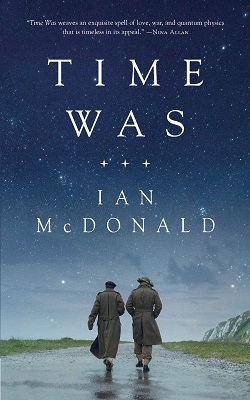
Time Was, Ian McDonald (2018, UK). I’d heard a number of good things about this novella, and while I’m usually sceptical about recommendations, and, to be honest, I’ve bounced out of McDonald’s novels on a number of occasions, but… it’s a novella, and it was on offer on Kindle. So I went for it. And I’m glad I did. The purported Nazi invasion of Shingle Street, Suffolk, has pretty much entered WWII mythology. McDonald posits it as a Project Rainbow-like experiment (AKA The Philadelphia Experiment), which actually results in sending two men careering independently through time. Unfortunately, they happen to be in a relationship. Fortunately – and this provides the entry to the story – they communicate using a collection by an obscure poet, left in antiquarian bookshops scattered throughout Europe. (Reading this novella, I was reminded of the Italian publisher who published a pirate edition of DH Lawrence’s Lady Chatterley’s Lover, banned in the UK at the time, and was so embarrassed at how it successful it was he sent royalties to Lawrence.) So Time Was is sort of a literary detective novel because the obscure collection is really obscure. But it also hints at a relationship between two men that leaves evidence scattered throughout the twentieth century. It’s cleverly done. And, I must admit, it did remind me of something, or perhaps several somethings – but I couldn’t think what. Which is not presented as a criticism. If anything, those echoes of other half-remembered stories added to Time Was. I liked this novella a lot, and I’m surprised it didn’t make more award shortlists. It won the BSFA Award, and was shortlisted for the Campbell and Dick, but didn’t even warrant mention for the Hugo or Nebula. A shame. This is an excellent novella.

Dune Messiah, Frank Herbert (1969, USA). The Dune series reread continues, although perhaps not as quickly as I’d hoped. It’s all down to me, of course; there’s nothing stopping me reading the books one after the other. Except I have a habit choosing something different to my last read for my next one. Probably not a great strategy when reading a series – but given this year I also decided to have a go at rereading the Wheel of Time series, and I’m pretty sure I wouldn’t survive reading those books in quick succession… Anyway, Dune Messiah. Popular wisdom would have it that Dune Messiah is the best of the original Dune trilogy – or, as some would day it, the best of the Dune sequels. Which tells you how wrong popular wisdom is. Dune Messiah is not a sequel – Herbert conceived of the trilogy as a whole, although perhaps not in detail. It’s also not the best of the three. Neither, to be honest, is the first book, Dune. Which means it must be the third one… but I’ve yet to reread it. Dune Messiah is set some years after the end of Dune. Paul Atreides is now emperor and has become increasingly disenchanted with the institution he has created. Meanwhile, there is a plot to kill him, led by some Fremen who fought with him and are unhappy with the changes to Arrakis. There are also a series of sub-plots. Princess Irulan, Paul’s wife, is angling for an heir, and has joined a conspiracy with a Guild navigator, a Tleilaxu Face-Dancer and a Bene Gesserit. It’s clear they all have different objectives, and it’s a marriage of convenience, so to speak (marriages of convenience pop up a lot in the Dune books). Meanwhile, Chani is pregnant and Paul knows she will die in childbirth. Which she does. She has twins, which Paul had not foreseen. And it turns out the Tleilaxu are more interested in finding a trigger for the ghola Hayt, a clone of Duncan Idaho, to recover Idaho’s memories. While rooting out the plot to kill him, Paul was permanently blinded by a “stoneburner”, a type of nuclear weapon. It’s Fremen tradition to abandon blind people in the desert, and eventually that’s what Paul does: walks out into the desert. Some years later, a blind Fremen called the Preacher appears in Arrakeen, the capital city of Arrakis, and rants against the regency that has taken over from Paul. Is Dune Messiah better than Dune? Yes. The prose is much better-written. But then it improves as the series progresses, so that’s no surprise. But where Dune had the fifteen-year-old Paul Atriedes as its focus, a character readers, especially male teen ones, can glom onto, Dune Messiah has no one. Which means it reads as a more distanced narrative. Paul is presented as a tragic figure – in fact, no one in the book is all that sympathetic, except perhaps, perversely, Princess Irulan. (Since first reading the book in my teens, I’ve always been fascinated the most by Skytale, the Tleilaxu Face-Dancer.) Dune was definitely a book of two halves: ‘Dune World’ and ‘The Prophet of Dune’. But Dune Messiah also feels like a book of parts, perhaps because its sub-plots don’t gel especially well. To some extent, that’s down to Herbert’s decision to have a cabal of four plotters all pursuing different aims, and a plot to kill Paul on top of that. It makes for a busy narrative, and yet Dune Messiah is only 256 pages. So the plot jumps around and Herbert skimps on some of the detail. Dune Messiah reads like Herbert stringing together his favourite scenes from the story he had planned. It works – better than Dune does, to be honest – but it does feel more like a best-of than a coherent narrative. The Dune series is a science fiction institution, and is likely to be even more so in the future. After decades of trying to raise the profile of the Dune series, leading to the questionable decision to publish a series of shit novels by Kevin J Anderson, Herbert Limited Partnership have finally got their wish, with a two-movie adaptation of the Dune directed by Denis Villeneuve and a supporting TV series. Dune is going to be up there with Lord of the Rings and Game of Thrones. The good news is the books are just as capable of supporting the cross-platform media giant Dune will become as Tolkien and GRRM. This is not necessarily a compliment. However, the Dune series reread continues and perhaps I will surprise myself with my re-evaluation of the following books…
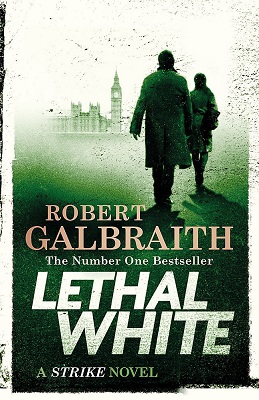
Lethal White, Robert Galbraith (2018, UK). Speaking of series, my mother lent me the first Cormoran Strike novel, The Cuckoo’s Calling, and, while I wasn’t overly impressed, it did strike me as interesting enough to continue with the series. Not because Galbraith was really JK Rowling (to be honest, I’ve only read Harry Potter and the Philosopher’s Stone) but because The Cuckoo’s Calling sort of fell between the stools of crime fiction and literary fiction without actually being good examples of either, and yet still managed to present a pair of sympathetic characters more than capable of carrying a number of novels. And so I read The Silkworm and Career of Evil… and now Lethal White. The continuity between novels is good, even if the individual novels continue to suffer from that unfortunate fall between two stools. However, Galbraith does at least choose interesting subjects around which to base her novels (okay, so yes, Career of Evil was structured around the songs of Blue Oyster Cult, and I’ve been a fan of the band since my schooldays). Lethal White is, to be honest, more of the same. A politician somewhere between Boris Johnson and Jacob Rees-Mogg (AKA between arsehole and scumbag; or vice versa), is murdered. He had been the subject of a Strike investigation, which proves embarrassing. And so Cormoran and sidekick Robin Ellacott (Robin, get it?) have to solve the murder – initially thought to be suicide under weird circumstances (a time-honoured Tory tradition) – and clear the wife and estranged son of blame. But everyone seems to have an alibi. As mentioned previously, Lethal White does well as a follow-on from the previous book, and its central crime is sufficiently puzzling to drive the plot. But there’s a strange whiff of approval for the central Tory character, and I’m not sure if I misread the novel because this is JK Rowling and even vast riches wouldn’t turn her into a fan of Boris Johnson. Although, to be fair, Michael Heseltine might be a better model, and the extremism of the current Conservative Party has helped rehabilitate him and he’s now seen as almost moderate. I’m not saying the Galbraith novels are good – either as novels qua novels or as crime novels. But they’re certainly very readable and they do seem to have a somewhat sideways approach to crime… and this is in a genre which doesn’t necessarily prize originality.

Araminta Station, Jack Vance (1987, USA). I first read this many years ago, probably soon after it was published in 1989 (the edition pictured, the NEL A-format paperback, is the one I own), which was a few years before I started recording the books I read. For some reason, I never got around to picking up copies of the two sequels, Ecce and Old Earth and Throy, until many, many years later… Then I never got around to actually reading them. And now, of course, they’re in storage. Happily, all three books of the trilogy are available as ebooks from the SF Gateway, so I picked up the first as a reread. The planet of Cadwal has been declared off-limits to development and is ostensibly policed by a group based at the eponymous station. Which has existed so long its workings have come to define its society. Glawen Clattuc is a teenager likely to take a middling position in the Araminta bureaucracy. But enemies of his father arrange for him to be given a much lower ranking than he deserves. He goes to work for the station’s police force. At a festival, Glawen’s girlfriend disappears, believed murdered and her body shipped off-world in a wine cask. There’s a suspect, but no evidence to charge him. There’s also a plot brewing in Yipton, an offshore community composed entirely of Yips, a human subspecies used as temporary labour at Araminta Station. All of which results in Glawen being sent on a mission to another world, where he ends up imprisoned in a monastery. And that, and the plot in Yipton, seems to link into mutterings about opening up Cadwal for development… I remember reading Vance’s last couple of sf novels in the late 1990s and early 2000s, and being disappointed by them. And the Cadwal Chronicles trilogy were the novels published prior to those. So my expectations weren’t especially high. Happily, Araminta Station proved to be Vance on fine form. It’s busier than most of his other novels, but it’s also better plotted. The characterisation also seemed less arbitrary than I recalled in other novels. And the comic lines were good too.

The Battle to the Weak, Hilda Vaughan (1925, UK). A few years ago, I put together a list of postwar British women writers. Some of them were already known to me – Olivia Manning, Naomi Mitchison, Elizabeth Taylor – and not all of them began their careers after WWII, but there were undoubtedly some particularly big names from the period I chose to ignore… Not, I hasten to add, that I considered my list in any way complete. It was a selection. And I did indeed track down books by some of the names on the list – Katherine Burdekin, Susan Ertz, Pamela Frankau, Storm Jameson, E Arnot Robertson, GB Stern… and Hilda Vaughan. Who, it turns out, probably didn’t really fit on the list, although her last novel was published in 1954, as she was chiefly active between the wars and is probably better considered a contemporary of DH Lawrence than a postwar writer. And, in fact, The Battle to the Weak, her first novel, has much in common with Lawrence’s novels. A young woman from a poor farming family in mid-Wales is sent to stay with an aunt at a seaside town. There she meets a young man, and the two fall in love. Unfortunately, it turns out he’s the son of her father’s mortal enemy, a neighbouring farmer he’s been violently clashing with for years. The son was given to his aunt at a very young age and more or less adopted, so he’s not at all involved in the feud. When the young woman’s father learns the identity of her fiancé, he forbids the wedding. As does the fiancé’s father. So the fiancé goes off to Canada to make his fortune. The young woman prepares to join him, but her father fights with her sister, who falls down the stairs and is paralysed from the waist down. The woman puts her plans on hold to look after her sister. Years pass. The sister dies. The young woman prepares to move to Canada. Then the father dies, so the young woman stays on to help her mother. The man in Canada writes and tells the young woman he couldn’t wait and has married. Years pass. The man returns to Wales, and the two eventually reconnect. In its depiction of rural life in the 1920s, The Battle to the Weak is very Lawrentian. There’s also a cross-generational aspect. But Vaughan’s novel is much more grim than anything Lawrence wrote. The lives she documents are hard, and the men – bar a couple of exceptions, one of which is the fiancé – are monsters. Especially the father. The prose is typical of the period, but it’s good. If you like fiction from the early part of the twentieth century, then Vaughan is definitely worth a go.

1001 Books You Must Read Before You Die count: 135

6 Comments

Reading diary 2019, #6

My reading seems to be all over the place of late. Mostly it’s because I’ve been limiting myself to buying ebooks, and only when they’re cheap. I did bring some books with me, and I bought a few at the recent Swecon, but I put a lot of unread books into storage. So with less to choose from, my reading has proven less planned. Ah well.

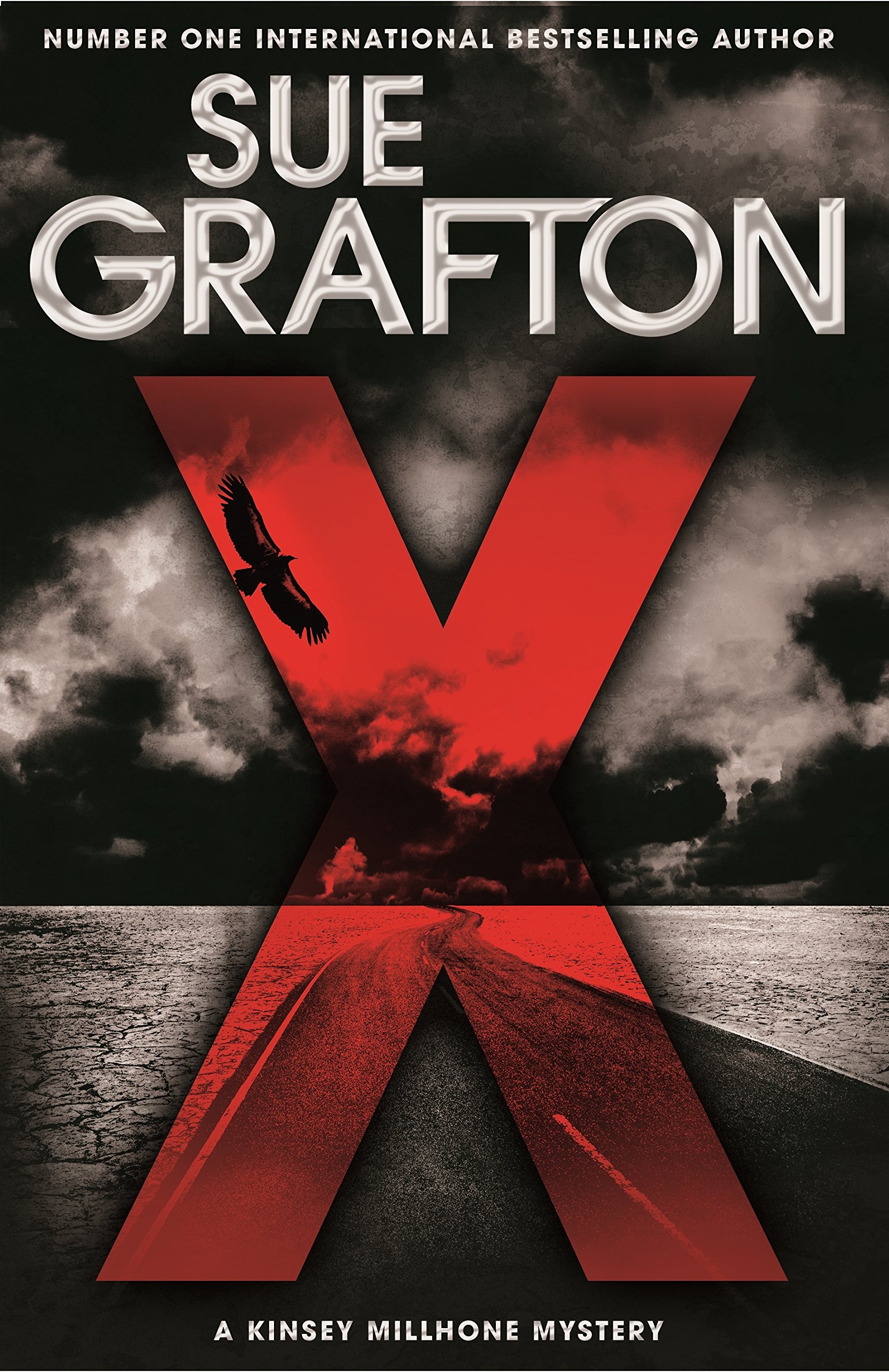
X, Sue Grafton (2015, USA). I’ve been a fan of Grafton’s Kinsey Millhone novels since discovering them back in the mid-nineties. As well as being good crime novels with an engaging narrator, Grafton’s decision to keep the internal chronology consistent irrespective of how long it took her to produce a novel has meant each book has slipped further and further back into the past. Even now, thirty-seven years after the series began – or rather, thirty-three years from A to X – and X is still set in the 1980s, albeit towards the end of the decade. Millhone is hired by a local rich woman to check up on the son she gave up for adoption decades before, and who has just been released from prison after committing a string of burglaries. She does as asked but then discovers the man was no relation… and that the rich woman is the estranged wife of millionaire, and the two are trying to screw as much money out of each other as possible. Throw in a string of missing women and the man responsible for their deaths, identified by Milhone, and who then begins stalk her. Plus an elderly couple who have moved into Milhone’s neighbourhood but do not prove to be who they claim… It’s a bit busier than most of the Milhone novels, and the millionaire man and wife plot actually has a happy end; but these are good books and definitely worth reading.

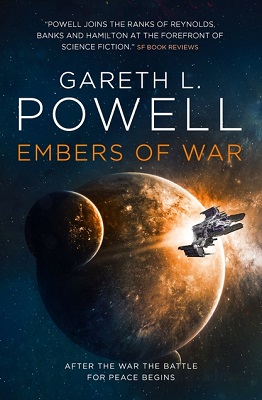
Embers of War, Gareth L Powell (2018, UK). This won the BSFA Award earlier this year, although I don’t chose the books I read because they won awards (ha!). I’d sort of gone off space opera in recent years as none of the stuff being published really appealed – and, to be honest, most of it seems to resemble military sf more than it does space opera. But UK space opera is a different beast to US space opera, and closer to my sensibilities. I’d also heard a few good things about Embers of War… But, well, having now read it, I’m not entirely convinced. Powell’s decision to tell his story using a number of different points of view in short chapters, I think, worked against it. It didn’t help that so many of the voices were similar, including that of the ship’s AI whose story the novel ostensibly is (in fact, Embers of War is the first in a series about the ship; the sequel is Fleet of Knives). Anyway, the ship Trouble Dog used to be a warship but is now a de-armed rescue ship with your typical space opera crew of misfits. A spaceliner is attacked by a mysterious enemy while visiting a planetary system whose planets were all reshaped into giant sculptures by a powerful and long-dead alien race. Trouble Dog goes to the rescue. Meanwhile, the target of the spaceliner attack – and why do sf novels think it’s acceptable to murder thousands in pursuit of just one person? It needs to stop – has managed to survive and finds herself on the surface of the planet known as the Brain (because, er, it looks like one). She discovers a labyrinth inside the planet – this part of the novel reminded me a great deal of a favourite sf short story, ‘A Map of the Mines of Barnath’ by Sean Williams – and so discovers its secret. The real identity of the woman was not hard to figure out, and it’s the reason why people want her dead – although given she was following orders at the time, it did seem a bit like they were going after the wrong person. The last Powell novel I read was The Recollection back in 2011 (see here), and I thought that started well but then turned boringly generic. Embers of War suffers from the latter as well. The world-building is all a bit too identikit and the ideas feel somewhat second-hand (cf my mention of the Williams story earlier). The characterisation is either bland or relies on quirks, and the prose is readable without being memorable. Readers who like BDOs and alien puzzles will find something to their taste here, but for me this is just Extruded Space Opera Product, with little or nothing that makes it stand out.

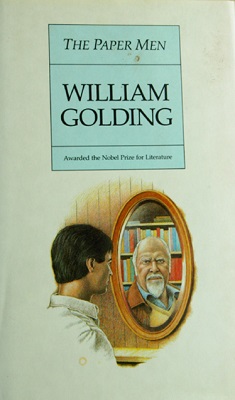
The Paper Men, William Golding (1984, UK). I’m having trouble making up my mind about Golding. Until a couple of years ago, I knew him only as the author of Lord of the Flies – his debut novel and his most famous, which must have really hurt – but then I read Rites of Passage and was very impressed. I picked up several of his books in a charity shop, so I had more to read. But… I’m reminded of John Fowles’s oeuvre: he wrote a couple of novels that were stunning pieces of work, but also a number that were almost emblematic of the output of a British white middle-class middle-brow male writer and so not so good. I think Golding was a better writer than Fowles, although none of his books, other than his debut, were as successful as either The Magus or The French Lieutenant’s Woman (and while the latter is an excellent piece of work, the former is very much the sort of book that’s admired only by people in their early twenties). So too with Golding: a handful of beautifully-written but quite strange novels, and then some that are pretty much emblematic of the output of a British white middle class male writer, although perhaps never middle-brow. And The Paper Men falls into the latter category. It’s a first-person narrative by a famous writer who has managed to build a successful career out of a critically-acclaimed and commercially-successful novel and a series of much less successful follow-on works. But he’s seen as an important man of letters, and a US academic turns up on his doorstep asking to be his official biographer. The writer refuses. Shortly afterwards, the writer’s marriage breaks up and he heads off to foreign parts. There’s then a sort of hallucinatory chase around the world, with the biographer trying, and failing, to gain permission to access the writer’s papers. There’s something more going on there, or at least it feels like there should be, but if it’s a reference to anything it pass me by. There’s some very male-gazey – well, pretty lecherous – depictions of the biographer’s young wife, and a number of situations with border on farce. In fact, at times The Paper Men feels like it’s supposed to be a comic novel, even though it’s not at all humorous for most of its length. I’ll certainly read more Golding, but the last two books by him I’ve read have been somewhat disappointing.

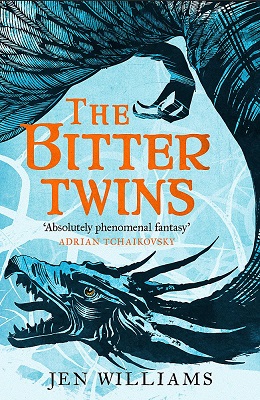
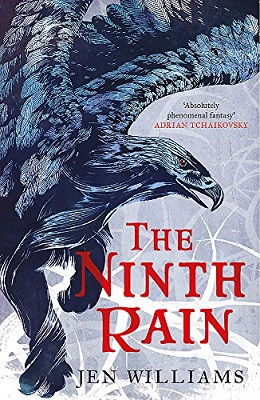
The Bitter Twins, Jen Williams (2018, UK). I read the first book in this trilogy earlier this year (see here), and only did so because some friends were extremely effusive with their praise of it… I mean, I’m not a fan of heroic fantasy, although I’ve read a lot of it in the past, and I’m pretty sure there’s very little overlap between my taste in genre fiction and that of the one friend who praised these books the most… But I’m happy to read outside my comfort zone because how else would I discover new authors to like and admire? While bits of the first book, The Ninth Rain, didn’t entirely work for me, I do like fantasy worlds that are couched as science-fictional – and vice versa, of course – so there were definitely things to appreciate there. Enough, at least, to read the second book. Which is, I think, better than the first. And middle books of trilogies generally are not that. It’s better because it introduces a mystery in one of its narratives, gives it a satisfying conclusion, and also uses it to reveal some deeper background about the world. On the other hand… there was something about the writing style which didn’t quite click with me. It wasn’t until a chat at a con with the aforementioned friend where she mentioned “cock-blocking” and quoted a particular line from The Bitter Twins that I figured out what it was about the prose that was giving me trouble: it was written like fan fiction. The author was having far too much fun with their characters, to the extent that “having fun with characters” was driving the story rather than the plot. I’m not saying this is a bad thing. That friend? She’s a big fan of fan fiction, so it’s an approach and style of narrative that appeals to her. I don’t have that background – she had to explain what “cock-blocking” was to me – and I prefer my narrative voice distanced (see pretty much every Reading diary post on this blog). Despite that, the world-building in this trilogy remains very good – in many respects, it reminds me of Jemisin’s award-winning Broken Earth trilogy – and while the good guys tend to be a bit too good to be true at times, the villains of the piece are interesting. Worth a go.

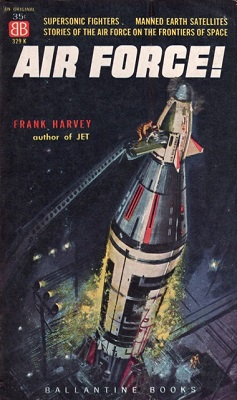
Air Force!, Frank Harvey (1959, USA). I think it was the cover art which prompted me to buy this. I do like books about the Space Race, and while a cherry-picker was never used to deliver astronauts to their space capsule – whatever capsule that’s supposed to be on the cover – it all looked close enough to reality to appeal. If you know what I mean. The contents turned out to be somewhat different to what I’d expected. For a start, I’d thought it was non-fiction, a series of essays written for the popular press about the Space Race, or extrapolations of its future. It turned out to be entirely fictional, albeit based on extrapolations of the state of aviation and space technology in the US at the time.  There are eight stories, originally published chiefly in the Saturday Evening Post. One story is about the first X-15 flight to achieve orbit (the X-15 never did), another is about a pilot whose wife is pressurising him to leave USAF and go into business but his successful prevention of a disaster on a flight persuades him to say. Another story has a fighter pilot “demoted” to transport planes but he manages to prevent a fatal crash during a catastrophic failure of his plane’s systems and that persuades his superiors he should be back flying fighters. It’s all very gung-ho and USAF rah rah rah, and while the technical details are spot-on, the extrapolations are closer to the military’s wishful thinking than what actually happened. This is Man In Space Soonest rather than Skylab, if you know what I mean. The prose is not even serviceable, it’s “journalese” and presents each story as a cross between fiction and a personal account. It’s fun, if you’re into mid-twentieth century US aviation fiction, but its appeal these days, ie sixty years later, is going to be limited pretty much to fans of that. Like, er, me.
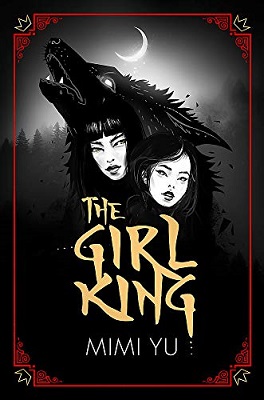
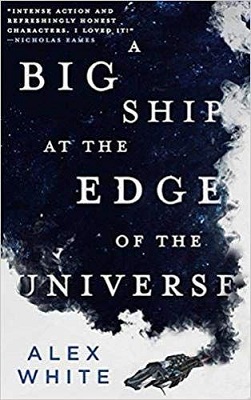
A Big Ship at the End of the Universe, Alex White (2018, USA). I should have known from the title… and its sequels’ titles (currently A Bad Deal for the Whole Galaxy and The Worst of All Possible Worlds). This is the Becky Chambers school of titling books, and I’m not a fan of Becky Chambers’s novels. Although to be fair, I was unimpressed with A Big Ship at the End of the Universe for a number of reasons, of which its terrible title was probably the least objectionable. The bad news starts pretty much on the first page. This is a far-future space opera universe… and it has magic. There’s no sense to it, clearly it was added because the author it was a cool idea. Half the stuff magic does in the book is also done by technology. Why would they do that, build a technological solution to a problem already solved by magic? It’s like that throughout the story. But, you know, some people like tech and magic; the fact it makes no sense, that it destroys any rigour the universe might claim to possess, is not a deal-breaker for them. It’s certainly a hurdle more easily scaled by some readers than others. Had that been my only issue with A Big Ship at the End of the Universe, then I’d have simply written it off as “not for me”. But… The novel opens with car race on a space station and it’s clear this is a sport all worlds enjoy and follow, and there’s a lot of money and prestige invested in it, much like Formula 1 in the real world. During the race, one of the drivers, the favourite to win the championship, witnesses the murder of her rival by a strange masked magical figure who seems to have EVEN MOAR magical powers than is known to be possible. The driver is charged with the murder, fears for her life, and does a runner (despite belonging to one of the richest families in the galaxy). Meanwhile, a woman who makes a living selling fake treasure maps to gullible treasure hunters finds herself being hunted by unknown assailants. And she is one of those rare people who have no magical ability whatsoever. Both end up being kidnapped by, and then dragooned into, the crew of the Capricious, an ex-warship from the losing side of an earlier war. The map-seller was once a member of the crew but walked away when the war ended. Bad feelings remain. The plot is all about a super-warship that disappeared during the war, and somehow the super-magic assassin is associated with it. After some internal tensions, the crew of the Capricious track down the ship with authorially imposed ease, but then find themselves the targets of a group of super-powerful magicians, including the aforementioned assassin, who seem to have no trouble razing rich and powerful galactic institutions to the ground. And that is this novel’s biggest problem. The villains are super-powerful, and their strategy of slash and burn is at complete odds with the conspiracy’s previous actions, and it all seems EVEN MOAR implausible than having random magic powers in a technological space opera universe. And if that weren’t enough, the hardy band of adventures otherwise known as the crew of the Capricious still manage to win the day. They are massively outgunned, hugely outgunned… But they win. A battle, not the war – as indicated by the presence of sequels. I mean, there’s suspension of disbelief and there’s suspension of disbelief. The presence of magic is stretching it, but I’m willing to go with it. The rest? No! Dial it back, FFS. It’s nonsense. Super-villains taken down by hardy adventurers with no special powers? There’s no rigour here, no attempt at it. It’s like the author just threw “cool” ideas at the page with no regard for what fitted. It’s not like the plot is super original, because it’s not, in fact it’s a pretty standard one for RPGs (and “ordinary” player-characters overcoming super-powered NPCs is also pretty common in RPGs). Anyway, A Big Ship at the End of the Universe is not a good book. I will not be continuing with the series.


12 Comments

The Hugos 2019, novellas

I attended the Worldcon in Helsinki in 2017 – and had a great time – which meant I was eligible to nominate and vote for the Hugos that year and the year following. I did neither. In either year. I’ll be attending the Worldcon this year in Dublin. Which means I’m once again eligible to nominate and vote for the Hugo Awards. Again, I’ll be doing neither. The Hugos have never really aligned with my tastes, and I refuse to vote for people on shortlists that comprise works. However, as an eligible voter, I have access to the Hugo Voter Pack. Which is pretty much everything on the various shortlists. This year, I decided to actually have a go at reading the shortlisted works. I doubt I’ll finish the novels before the con itself – and, to be honest, I’ve not even started them – but the novellas, novelettes and short stories… those I can do. The other categories I don’t care about.

First up are the novellas. Because it’s a length of fiction I like, both to read and to write. Of the six works on the shortlist, four were by authors whose names I’d heard of before and, in some cases, even read previously. One was vaguely familiar and one was completely unknown to me. In the order in which I read them…

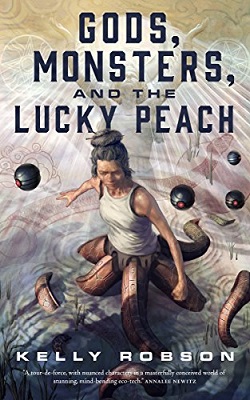
Gods, Monsters, and the Lucky Peach, Kelly Robson. I don’t think I’ve read anything by Robson previously, but her name sounded vaguely familiar– Ah, she won a Nebula for Best Novelette last year, and is another of the Clarkesworld/Tor.com stable, members of which have appeared on many shortlists in the last couple of years. Gods, Monsters, and the Lucky Peach was published by Tor.com. In fact, five of the six novellas on this year’s shortlist were published by Tor.com. Which is a problem. Anyway, Gods, Monsters, and the Lucky Peach is set on a post-climate crash Earth, in which a much-reduced population live in small high-tech communities. There are people who work on fixing the damage caused by the climate crash, in an effort to create a world that can be repopulated to former levels. The protagonist of this story is one of them. She also has eight prosthetic legs, like an octopus. And she is part of a team, if not its leader, which submits a proposal for an environmental impact study which involves time travel back to Sumeria. It sounds messy as fuck, but Robson manages to make it all hang together. There are problems: it’s not entirely clear what the team from the future are trying to achieve, the personal politics are confused with the wider political situation, and the POV is peculiarly narrow given the world-building. It actually reads like part of a series where much of the world-building was handled in earlier works, but I’m not sure that’s the case. It’s a reasonably well-handled piece, and the prose itself neither stands out nor is an obstacle – and the latter is certainly something that could be said of other nominees. I’m not sure if it deserves to be on the shortlist… but on balance, I’d say its presence is not embarrassing.

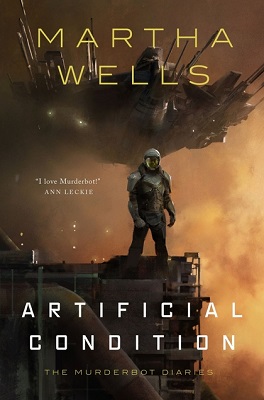
Artificial Condition, Martha Wells. Another problem with the novella category – indeed, with the Hugo Awards over the last few years as a whole – is the preponderance of sequels. Martha Wells, previously better-known for mid-list fantasy series, published three of her Murderbot novellas in 2018. (The first was published in 2017.) That’s a series. Artificial Condition is the second instalment. None of them stand alone. There are indeed cases where the second instalment in a series is better than the first, but in this case the first instalment, All Systems Red… won the Hugo Award for Best Novella last year. Come on, people, read a little more fucking widely. It would be understandable if the Murderbot series were astounding, the best sf published for many years… But they’re not. They’re entertaining, and even a little bit clever in places. But fun as they may be, they’re not award-worthy. And if you’re nominating fiction because it was “fun”, you appear to have misunderstood the meaning of the word “best”. The thing about “best” is that you have to recognise something as being of high quality, higher quality in fact than pretty much everything else you read, you don’t necessarily have to have enjoyed it or thought it was fun. The two are quite different. Any old wine will get you pissed, but the good ones won’t have you gagging every time you take a sip. At least not for the first half-dozen glasses. What we have here is a novella that gets you pissed without you actually noticing the flavour of the vintage – and I’d submit that’s not what awards are about, at least not awards that have the word “best” in their title. I enjoyed Artificial Condition. I might even read the rest of the series. But I really can’t see this as award-worthy and its nomination says more about the award than it does the genre.

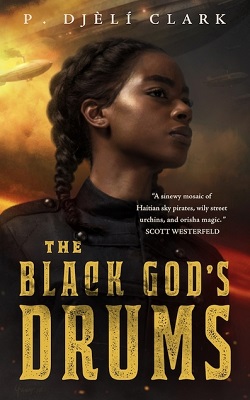
The Black God’s Drums, P Djèli Clark. Clark won the Nebula Award for Best Short Story this year (the story is also nominated for the Hugo), but appears to have come pretty much from nowhere. True, The Black God’s Drums was published by Tor.com, but his short story was published in a magazine I’ve not come across before. Also true, there seems to be a great love for debuts in recent years’ popular vote genre awards (seriously? why?), but that doesn’t mean the nominated works are necessarily bad. The Black God’s Drums is a bit busy, but it’s an interesting melding of ideas – alternate history, steampunk, voodoo magic and gods – and if it suffers it’s because its ideas makes its plot all a bit too obvious. Streetwise urchin protagonist has connection to powerful goddess; said goddess makes unexpected appearance at story climax to save the day. It’s not quite that simplistic, but the telegraphing here is as blatant as it comes. Obvious foreshadowing is better than none, but a little subtlety goes a long way. The plot is pretty much a staple of, well, fiction in general: nutter steals superweapon to wreak vengeance on city, random people come together to foil the plot (because there’s no organised government response to these sorts of things, ever). Does The Black God’s Drums belong on the shortlist? About as much as the Robson, I think. Its presence is hardly embarrassing, but if this and the Robson are the best the genre can produce in a given year then there’s still a long way to go…

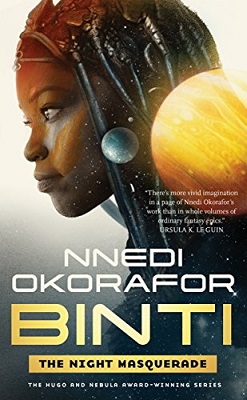
Binti: The Night Masquerade, Nnedi Okorafor. Like Clark, Okorafor also appears twice in this year’s Hugo nominations – for this novella and for the Black Panther comic she scripted. I have to admit I don’t understand the acclaim her fiction receives. She’s a fascinating person and is an excellent role model, but what little fiction by her I’ve read has struck me as simplistic and badly-written. It doesn’t help that Binti: The Night Masquerade is the third and, I think, final part in the Binti series. I read the first, and thought it interesting, if not particularly well put-together. But it was much better than this one, in which this happens and then that happens and then something else happens and then Binti is killed and then she comes back to life and then it all abruptly ends. It doesn’t help that the title refers to a nightmarish figure who appears to Binti, and yet the name of it – the Night Masquerade – clearly indicates it’s a fucking fake but everyone is too fucking stupid to realise. Anyway, Binti returns home but her family are dead, except they’re not really, and there are two races at war with each other but it’s almost impossible to keep straight because Okrafor is more interested in Binti’s feels than she is setting the scene. I’m no fan of exposition, and I disagree entirely with Kim Stanley Robinson’s statement “it’s just another form of narrative”, and “streamlining exposition into the narrative” is another piece of writing advice that gets my back up… Which is not to say there’s zero info-dumping in Binti: the Night Masquerade. There’s plenty. But it’s all about Binti and her culture, or that of her male companion. The rest of the world is so sketchy it might as well have been made-up on the spot by Binti herself. I really do not rate these novellas, and I’m mystified by the love shown to them.

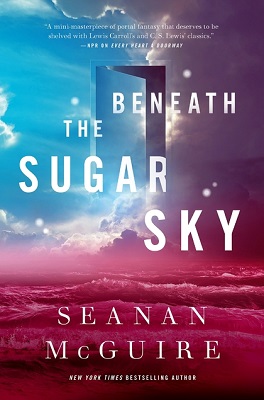
Beneath the Sugar Sky, Seanan McGuire. Yet another sequel. This is the third instalment in the Wayward Children series, about which I know nothing… but can pretty much guess what it’s about from this novella alone. Think Miss Peregrine’s Home for Peculiar Children. Sort of. But less clever. McGuire’s prose is so bland it rivals Gaiman’s. Except, that is, for the occasional flight of fancy, none of which actually work. The story is all “poor fat girl who is actually a princess in another reality” tagging along with some friends who try to help a fellow “wayward child” at a school for children who have spent time in other worlds and can’t cope in the real one. The central conceit is, I admit, quite neat, and McGuire clearly has a great deal of fun with it. But it all reads like poor-me fiction and a single idea stretched well past breaking point. The first volume in the series, Every Heart a Doorway, won the Hugo and Nebula awards in 2017, and I’m told it’s better than this one. And the second instalment, Down Among the Sticks and Bones, was nominated last year. But Beneath the Sugar Sky‘s presence on the shortlist says more about the power of McGuire’s fanbase than it does the quality of her fiction.

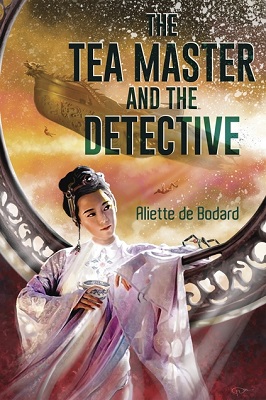
The Tea Master and the Detective, Aliette de Bodard. I’ve been and on-and-off fan of de Bodard’s fiction since first reading one of her stories in an issue of Interzone just over ten years ago. I say “on-and-off” because her science fiction appeals to me much more than her fantasy. And while I remember a number of sf stories set in an Aztec-dominated world, she is best-known these days for her Xuya universe stories, a Vietnam-based far future. (The universe itself is shortlisted for the Best Series Hugo Award, which is not how I thought the Best Series Hugo Award worked, and I’m surprised there’s more than 250,000 words in the short stories and novellas, but no novels, set in the Xuya universe.) Anyway, the “tea master” is a ship mind (more McCaffrey than Banks, if I’ve interpreted the text correctly) and the detective is a woman with a chequered past who hires the ship mind for a simple task. During which they discover a body that clearly did not die of natural causes. The mystery of the victim’s death is intertwined with the mystery of the detective’s past, although one is not a consequence of, or reflects on, the other. But both have satisfying conclusions, and the novella makes good use of its setting. The Tea Master and the Detective is not, as a friend said to me, the best Xuya story de Bodard has written, but it’s a good one. and to my mind, it’s easily the best on this year’s Hugo shortlist.

So there you have it. I’m not going to vote on any of the above, but if I had to choose a winner it would be The Tea Master and the Detective. If I were in a good mood, I’d vote de Bodard, then Robson, then Clark, and everything else below no award. If I were in a bad mood – which is more likely, I suppose – then it’d be de Bodard and everything else below no award.

I had thought this might prove a fun exercise. In fact, I’m discovering why I no longer follow the Hugo Awards. Ah well. Next up, the novelettes…


1 Comment

Reading diary 2019, #5

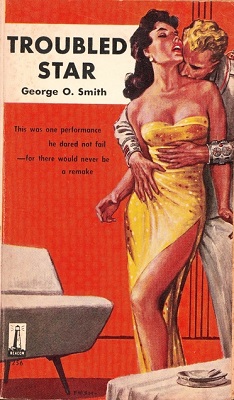
I’m sort of getting into this ebook thing. Four of the books below are ebooks; the other two are paperbacks I brought with me. And no, I don’t know why I brought Troubled Star. It’s a duplicate copy, and I have much cleaner copy in storage, so I probably just threw it in the suitcase rather than bin it.

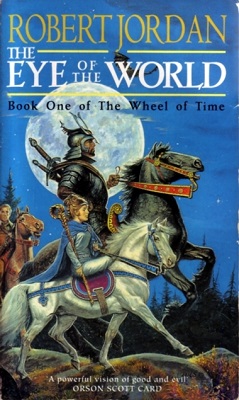
The Eye of the World, Robert Jordan (1990, USA). Members of the 2017 Worldcon in Helsinki, which I attended, were given an ebook copy of all fourteen volumes of Robert Jordan’s Wheel of Time series as it had been shortlisted for the Best Series Hugo Award. I’d previously read up to book ten or eleven, I forget which, and had the next volume in the series sitting unread on the bookshelves. I distinctly remember reading the first six or so books. I’d seen them in Books Gallery in the Liwa Centre in Abu Dhabi, and bought them because I wanted to know what it was that had made them such massive sellers. I read them in quick succession. And to this day, I’ve no idea why they sold so many copies. They were badly-written, bloated and derivative. But now that I have my Kindle, I thought it might be time to time finish off the series. Which meant starting from the beginning. So I reread The Eye of the World. I thought it might prove an interesting exercise, seeing what I thought to it now, twenty-five years or so after my previous read. And, well, my opinion of the book has not substantially changed. The writing still struck me as poor, the characterisation is simplistic at best, and a lot of the world-building consists of over-used tropes and borrowings. What I hadn’t noticed previously was how badly-structured the novel is, with the entire story pretty much wrapped up in the final chapter, after long chapters of travelogue that barely advanced the plot. On the other hand, knowing how the story pans out (well, most of it) and seeing the story hooks here (even if many of them weren’t actually planted) was just enough to keep me from throwing the book (well, Kindle) at the wall or gouging my eyes out. And in the series’ favour, it’s not grimdark, so it’s not gratuitously violent, rapist or sexist. Which is not to say it doesn’t feature all three – but not to grimdark’s offensive levels, nor, like grimdark, does it try to make a virtue of their inclusion. The reread wasn’t entirely painless, and I think it might take me longer to work my way through all fourteen books that I had initially expected… but I’m still going to try and do it.

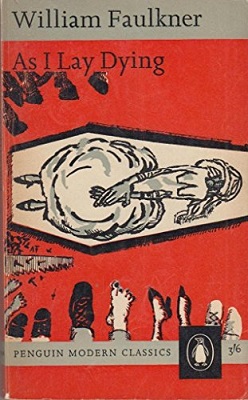
As I Lay Dying, William Faulkner (1930, USA). Although Faulkner was a name known to me, I’d read none of his books and knew nothing about him or his works. But my father had two novels by him, which I took, and I read one, The Sound and the Fury, last year and was hugely impressed. So I picked up a couple more on eBay. And I brought them with me to Sweden. The first of these was As I Lay Dying, arguably Faulkner’s best-known and most highly-regarded novel. There’s even a commercially successful metal band named after it. The story is told from several viewpoints, each in their own voice, and it concerns the death of Addie Bundren, and her husband’s attempt, with family and friends, to take her body to a neighbouring town to bury her among her kin. But all that is either incidental, or merely the trigger, for what happens in each narrative. It all takes place in Faulkner’s native American South – Mississippi, I think, for the most part – and the language reflects the setting. Despite As I Lay Dying‘s reputation, I didn’t find it as impressive a work of literature as The Sound and the Fury, possibly because the latter had the more adventurous structure, and I’m big on novels that experiment with narrative structure. But that’s really damning it with faint praise as this is full-on classic American Literature, and though not all works and writers described as that appeal to me, I do admire Faulkner’s prose a great deal. Definitely worth reading.

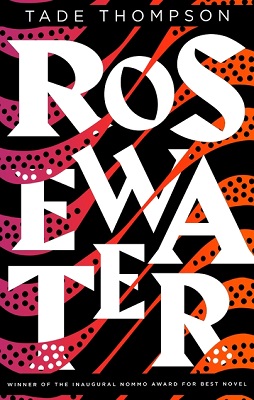
Rosewater, Tade Thompson (2016, UK). I’d heard so much about this, and it was shortlisted for the BSFA Award this year (despite being originally published in 2016, but never mind), and it was 99p on Kindle… so I bought it. And I read it. And… There’s a good story in Rosewater, but it throws too much in, like a writer not sure which of their ideas have real merit so they chuck them all in hoping that at least one makes the grade… And because there’s so much going on, the story doesn’t seem to have much of a clue where it’s heading for much of its length. Is it about the titular city and the alien entity around which it has grown, and the regular frenzies of miracle healing it creates? Or perhaps it’s about Kaaro, who works for the Nigerian intelligence service (or a side-branch of it) and has telepathic powers – as do many others – also created by the alien entity? Or maybe it’s about Bicycle Girl, a semi-mythical figure who seems to be associated with a village that disappeared and now exists in an alternate dimension or pocket universe, created by entirely human tech? There is currently something of a feeding frenzy in sf about African genre fiction, which is all a bit white man’s tears as the various African nations – Africa is not a country – have literary traditions going back centuries or longer and many of them have had their best writers and works translated into English for decades. They just don’t happen to be category genre. So sf from a Nigerian writer – as Thompson is – should, were the genre not so overwhelmingly white- and Americo-centric, not really be cause for celebration. But sf is as it is, and Thompson’s origin and the setting of Rosewater play a major part in reviews of the book. That’s just as racist as ignoring the book because of the author’s race. There’s no doubt Thompson could be a major voice in UK sf – he’s based in London – and Rosewater amply demonstrates that. This is a strong debut, but it’s a messy piece of work to make an award shortlist. A few years from now, Thompson will be churning out award-worthy books. But that’s more a criticism of awards than it is the author.

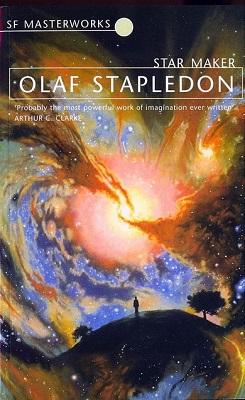
Star Maker, Olaf Stapledon (1937, UK). I have the SF Masterwork edition of this book – that’s the one from the original numbered series – but that’s in storage now. I bought a 99p copy on my Kindle so I could read it. I’ve no idea if the two editions are the same – they can’t be that different, I’d have thought, since this isn’t a work that needed translating. But the copy I read certainly had more than its fair share of OCR errors and typos. There’s not much of a plot to review: the narrator is an Englishman of the 1930s who falls asleep on a hillside and becomes a disembodied galactic traveller, as you do. He visits various worlds, learns to cohabit the minds of certain of their inhabitants, and they too join him on his travels, until he is more of a gestalt intelligence than the man he once was. Stapledon describes the various types of civilisation his observer visits, and while they’re initially based on extrapolations of Earth biology – even the symbiotic races, which play such a great part in the book – but soon it transpires the stars are sentient, and then the galaxies too. This is sf on the grandest scale, and it’s unlikely it would wash these days because it only really works with a style that’s no longer commercially acceptable. It’s not that genre fiction of the past fifty years has been stunted in any way, or has held off from Stapledonian scales because he did it first – Stephen Baxter’s entire career is ample rebuttal to that – but more that the style which allowed Stapledon to what he did is no longer considered commercially viable. Is that a bad thing? Not really. We still have Stapledon. He’s in the SF Masterworks series, and his books are readily available in a variety of editions as ebooks. Obviously, these are, paradoxically, historical documents, but for those who know what they’re getting into, they’re definitely worth a go.

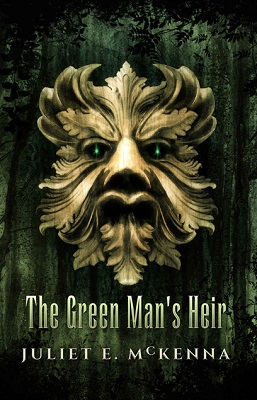
The Green Man’s Heir, Juliet McKenna (2016, UK). Another Kindle book that was 99p, but this time as a promotion. The author tweeted the book was reduced, and since I’d never read anything by her – she mostly writes fantasy, which, er, Wheel of Time reread above aside, I don’t normally read – and The Green Man’s Heir is urban fantasy, which I definitely don’t read… But the plot sounded interesting so I thought it worth a go. And I’m glad I did give it a punt. The narrator is Daniel Mackmain, a jobbing carpenter who happens to be the son of a dryad. Which means he is plugged into the mythological world based on landscape. So when a woman is brutally murdered near where Mackmain lives, and a dryad gives him enough to clues so he thinks he might be able to solve the case… The Green Man’s Heir is a mashup of mystery novel and fantasy novel but it works because it’s centred on its hero and not focused on its central crime. The story moves on from the murders and pulls in romance, but it all ends in a place that feels entirely a consequence of what has gone before. This is clearly a book by someone who knows what they’re doing. And if their earlier fantasy series have not made the big time, I hope this one does – there’s a sequel – because it’s good stuff. It may be a bit Mythago Wood meets Midsomer Murders, but it does it well and it certainly does it a great deal better than the last of those two.

Troubled Star, George O Smith (1957, USA). Back in the day, Galaxy magazine provided a free paperback with every issue. For some reason, after several issues they handed this over to Beacon Books, better known for publishing hospital romances, and they decided the books should be a little more, well, suggestive. So they rewrote a bunch of sf novels and published them. I’ve managed to collect them all, and most of their original editions, or author-preferred editions, chiefly so I can compare the two. Because, to be honest, they didn’t exactly choose good novels. Much as I love AE van Vogt’s The House That Stood Still, the Beacon Book version of it, The Mating Cry, adds little, and in fact only makes the female lead less sympathetic. I don’t have a copy of the book on which Troubled Star is based – originally published under the same title in February 1953 – but I think I can guess what’s been changed. It’s not very subtle. Anyway, three scouts for a galactic transportation company are on Mercury in the Solar System (note to sf writers: only capitalise when it refers to the Sol system, and the planets of any other star are a planetary system not a solar system). Anyway, Earth is in the way of a new hyperspatial route or something, and no, I’ve no idea if Douglas Adams had read this although he may have done. There’s a sex scene – that’s the Beacon touch – but this is otherwise true to its origins: pulp sf. I can claim a legitimate interest, although that’s wearing thin, but I suspect no other reader can. Avoid.

1001 Books You Must Read Before You Die count: 134


1 Comment

Reading diary 2019, #4

The first book in this post I read before leaving the UK, but I’m not sure why I didn’t include it in an earlier Reading diary. Two of the books I read on my Kindle (well, one was a reread), and the remaining three I brought with me in my 26 kg suitcase.

I’ve been avoiding the English Bookshop here because I don’t want to buy new books just yet. Once I’ve read most of the two dozen I brought with me, then I’ll start buying some more. Although there are a couple of new books I want in hardback… like the last Bernie Gunther novel… and the new one from Nina Allan…

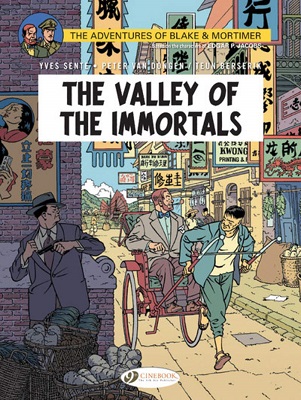
The Adventures of Blake & Mortimer 25: The Valley of the Immortals, Part 1, Yves Sente, Peter Van Dongen & Teun Berserik (2018, Belgium). Unlike the Adventures of Tintin, with which the Adventures of Blake and Mortimer are closely linked, Blake and Mortimer survived the death of their creator. Edgar P Jacobs set up a studio to continue the series, and it’s been churning them out ever since. And, to be honest, the studio’s stories have been better than Jacobs’s ever were. Until, it seems, this one. Sort of. The Adventures of Blake & Mortimer 25: The Valley of the Immortals is a sequel to one of Jacobs’s most famous stories, The Secret of the Swordfish, which was pretty much a Yellow Peril narrative. To be fair, The Adventures of Blake & Mortimer 25: The Valley of the Immortals soon leaves Jacobs’s invented Asian evil empire – actually called the Yellow Empire – behind, and focuses on real Chinese history, specifically the Communists and Kuomintang, both of which are after a recently discovered artefact from third-century BCE China. As is a warlord who plans to use it to declare himself emperor. Mostly, this is all good stuff, but while dragging in the Yellow Empire slots the story into the Blake and Mortimer universe, and gives continuity to the characters, it leaves a bad taste and the book would have been better for ignoring it. One of the good things about the series has been that it has changed with the times. Tintin’s earlier adventures are racist as shit, and because The Adventures of Tintin ended with Hergé’s death, there are no new stories to offset those early works. Because Jacobs founded a studio to continue the Adventures of Blake and Mortimer, we have new stories – more, I think, than Jacobs actually wrote – which have kept pace with sensibilities (and have also become increasingly sophisticated in their stories). If you like Tintin, then you should be reading the Adventures of Blake and Mortimer. There are twenty-five of them, so you’ve got some catching up to do.

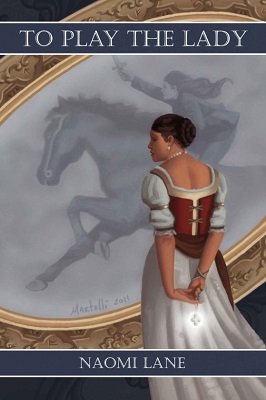
To Play the Lady, Naomi Lane (2011, USA). Someone recommended this to me a long time ago, but it was only available on Kindle and at that time I didn’t own one. But now I have one. And To Play the Lady was cheap. So I bought it and, er, read it. And I wish I could remember who recommended it. Because it wasn’t very good. The background is a bit identikit, and there’s doesn’t seem to have been much thought put into it. The protagonist is a complete Mary Sue, and accrues powers as the story progresses. Which is not to say the story doesn’t have its good points. Provincial aristocrat’s daughter is sent to the palace to be a maid of the queen, but she’s a bit of a tomboy and has been taught all sorts of unfeminine things. Her origin brings her into conflict with the other maids – all the daughters of peers of the realm – and her abilities at riding and archery cause problems because they’re not exactly ladylike. And it also turns out she has a rare magical talent and has to be individually tutored by the royal sorcerer… Sigh. There’s a breezy tone to the narrative, which is fun, and having a queen’s maid as the focus of a story gives an interesting perspective, but… Jenna Mallory, the protagonist, is so Mary Sue-ish it gets annoying quite quickly. The book is the first in a series, and the second book, To Serve the King, appeared in 2016. So if this is a trilogy, the final book is not likely to appear until 2021. I may well give the second book a  go, but I’m in no great rush to do so.

Dune, Frank Herbert (1965, USA). It probably doesn’t need to be said that this was a reread. I last read Dune in 2007 and blogged about it here. But I didn’t bother with the sequels on that reread, and since the Gateway ebook collection of all six Dune books was only 99p, I decided to buy it and work my way through all of them. Starting with, er Dune. It’s a book I know well, so I was more interested on this reread in how it compared to what I remembered. And yes, the writing is still pretty terrible for much of its length – especially in sentences that contain the phrase “terrible purpose” – but the worldbuilding is still among the best the genre has produced. However, my reading was focused on the scenes. And… the ones I remember liking rang a bit false, such as the time Duke Leto and Paul fly out to see a spice harvester in action. But other scenes I hadn’t liked, like the banquet scene, I much preferred this time around. What I hadn’t forgotten was the casual misogyny and homophobia, which very much made the book a product of the 1960s. I’d also forgotten how slipshod was Herbert’s worldbuilding: some things he’d made an effort to disguise, but in other places he’d simply slotted the Arabic word straight in. There didn’t seem to be much logic to it. Fifty-five years after it was published, Dune remains popular – Denis Villeneuve, movie flavour of the month in some genre circles – is currently filming an adaptation. In two parts, if rumour is to be believed. And there may well be a television series following on from the movies. But while there is a certain timelessness to the universe of Dune, Dune the novel is very much a book of its time. Had it been re-invented each decade, perhaps it would be an even bigger property that it is. Although I suppose the awful Brian Herbert and Kevin J Anderson sequels and prequels could be considered “re-inventions” but they’re pretty shite. If I had a Swedish crown for every time I’ve heard someone say they’d read Dune but not its sequels, or that Dune is the best of the series and the rest are not worth reading, well, I’d be living in a Swedish palace. A small one. And yet it’s completely untrue. Frank Herbert conceived the first three books as a single story, so all three really need to be read in order to understand the point Herbert was trying to make. And I’ve always maintained the writing improved, at the sentence level, as the series progressed. This is hardly controversial – the more Herbert wrote, the better he got at it. I’m hoping that particular conviction will survive my reread. We shall see. But the take-away from this reread: the best-loved scenes disappointed, but the scenes I’d not liked as much previously read much better than I’d expected.

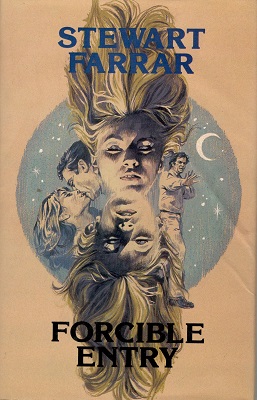
Forcible Entry, Stewart Farrar (1986, UK). I’d been after this books for years, although I forget why, when a copy popped up on eBay. The book was only ever published in hardback, and the hardback was published by Robert Hale, which no doubt explains why it had proven so hard to find. Unfortunately, I lost the auction on eBay for the book… but found a copy for less on abebooks.co.uk from a seller in Australia. (I see there’s now a copy on Amazon going for £590. I paid nowhere near that.) And, after all that, was it worth it? I understand most of Farrar’s fiction revolves around witchcraft and Wicca – I believe he practiced it himself – and certainly a coven of witches makes an appearance in Forcible Entry. But the story is mostly about parapsychology research, particularly telepathy and astral projection. Matthew is a professional photographer and dying of cancer. He also volunteers as a test subject at a parapsychology study run by the university. Which is where Sheila, an attractive young woman, works as an office manager. The two prove to be gifted at astral projection. On one such trip Matthew, knowing he is dying, steals Sheila’s body. So while his real body dies of cancer in hospital, Matthew takes over Sheila’s body and feigns amnesia to cover any mistakes he might make in his impersonation (he had been studying her for weeks beforehand). However, Sheila had been an unwitting agent of the CIA investigating an organisation that wants to use people with parapsychological abilities for nefarious reasons. But not everyone is convinced by Matthew’s impersonation of Sheila – especially her American boyfriend, who involves a coven of witches to undo the possession – and when Matthew is forced to kill to defend his secret… It’a an interesting premise, and Farrar’s prose is readable and unremarkable. I’m surprised the book is not better-known – or rather, surprised it never made it to paperback, because there’s certainly a market for it. But then, I don’t think many of Farrar’s novels made it to paperback, so it seems his chief readership was library borrowings. There were a couple of other Farrar novels offered by the seller on eBay who was selling Forcible Entry, and one or two of them looked interesting. But I’m not going to go out of my way to track down his books, although if I see one going cheap I might give it a go.

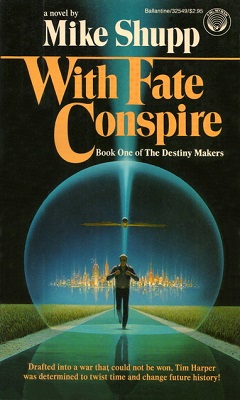
With Fate Conspire, Mike Shupp (1985, USA). Back in the 1990s, I corresponded online with Mike Shupp. We were members of an online sf novel writing group, although both of us were using the group chiefly as motivation. Anyway, Shupp had published a five-book series, The Destiny Makers, between 1985 and 1991, but nothing else. And nothing since that online sf novel writing group – he was working on something new, and it looked good, but it hasn’t appeared in the years since. To be honest, I suspect With Fate Conspire is not a book that would see publication today. Not because it’s bad – it isn’t, it’s actually quite good. But it makes zero concessions to its readers, and it’s often a struggle to figure out what’s going on. Partly that’s because the plot is about time travel, and partly because it’s set on an Earth 90,000 years from now which is very different. But Shupp further complicates matters by fracturing his narrative. Tim Harper is a Vietnam vet physics student who gets caught in the field of a time machine sent from the future. He figures out how to use it, and travels back to the time it was sent, 90,000 years from the present-day. It’s a world in which some ten percent of the population are telepaths and they are strictly apolitical after two world wars caused by their interference in national affairs. But where Harper ends up is in the last stand-out against a world-state, and they decide to use the time travel technology to change the past and maintain their independence. With Fate Conspire does not make this easy. The narrative jumps about, and does not even mention some of the more important plot elements, and reading the book is a struggle to figure out what’s going on. I don’t have a problem with this, but I suspect present-day editors would. With Fate Conspire is definitely a book a written by an engineer. Happily, I have all five of the series and I brought them with me to Sweden. The next book is titled Morning of Creation. Expect it to appear in a blog post sometime in the next month or so.

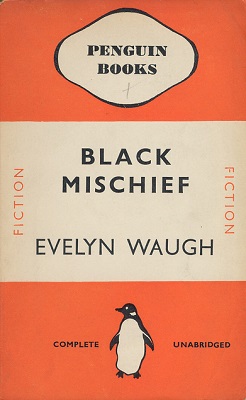
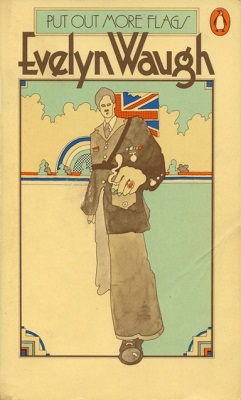
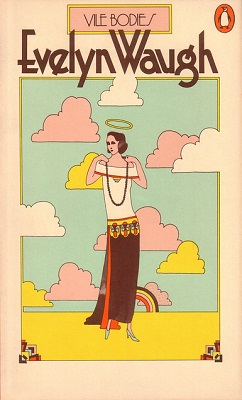
Black Mischief, Evelyn Waugh (1932, UK). This was one of a bunch of Evelyn Waugh novels my mother found me in charity shops. In Harrogate. Where they obviously have a somewhat different class of customer to Sheffield. Although, to be fair, it’s a rare charity shop that will keep 1950s Penguin paperbacks on their shelves. And they were pretty tatty copies too. Black Mischief is set in the invented African island-nation of Azania. There are two African language-groups, one native to the island, the other invaders several centuries earlier. Plus Arabs, legations from assorted European nations, churches from the major religions, and a variety of hangers-on and chancers. The current ruler dies and his son, only just down from Oxford, takes the throne. And is determined to drag his country into the twentieth century (the fourth decade of it, at least). Waugh lays out the history of his invented country with impressive clarity. The story then shifts to London and Basil Seal, a character from Waugh’s earlier novels, a dissolute upper class wastrel, who happens to know the new emperor of Azania and fancies getting out of London. So he travels to Azania, hooks up with emperor, and is made Minister of Modernization. He’s in it for what he can get, of course, but he’s out-matched by pretty much everyone else in the country. Had Black Mischief been written a few decades later, it might have aged better. Because it’s horribly racist. It’s not just the language, it’s the treatment of races other than English. Waugh mocks the English quite heavily; and the French too. Especially their legations. But his treatment of the Sakuyu and Wanda relies on racial caricatures, as does his characterisation of Youkoumian, an Armenian Jew. Perversely, the one non-English character who isn’t treated racistly is the new emperor, who comes across as woefully naive, if well-intentioned, and the sort of over-educated naif so beloved of Oxbridge comedies. Not one of Waugh’s best.

1001 Books You Must Read Before You Die count: 134


4 Comments

Reading diary 2019, #3

After years of resistance, I have finally succumbed – although it was, of course, more a matter of practicality than choice. I have started reading ebooks. I bought two dozen books (a mix of paperback and hardback) with me to Sweden, but the vast bulk of my collection went into storage (85 boxes!). And I’m not really sure when I’ll see them again. There’s an English Bookshop here in Uppsala – it’s well-known across Scandinavia – but books in Sweden are expensive. And until I get my ID card and a permanent address, I can’t buy books online… So: a Kindle. I’ve ended up buying ebook versions of books I already own – such as Shadow Captain and Crimes Against Humanity below – because my copy has gone into storage, but there are also books I’ve wanted to read for a while which are only available on Kindle. So it’s all working out quite well.

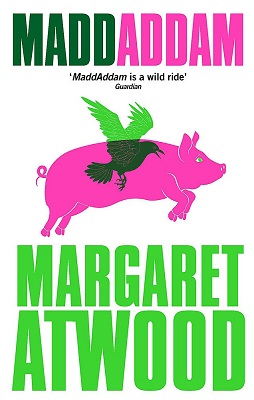
MaddAddam, Margaret Atwood (2013, Canada). I bought this with me in my carry-on luggage and I started it on the plane. To be honest, I’m not sure why I bothered reading it. It’s the third book of a trilogy and I didn’t much like the preceding two books, Oryx and Crake and The Year of the Flood. Which is not to say that I don’t like Atwood’s fiction – Alias Grace is an excellent novel, and I’ve thought other books by her were very good indeed. But not the MaddAddam trilogy, which reads like really badly-done sf that’s striving for satire but misses every time. The surviving Gardeners from The Year of the Flood have more or less settled down, with the Crakers (a race of genetically-engineered pacifist and dimwitted herbivorous humans created by Crake) and Snowman, who was also part of the project with Oryx and Crake. The two Painballers from the previous book are still at large, and the Gardeners have no desire to fall into their clutches. But MaddAddam is mostly about Toby – and her lover, Zeb, half-brother of Adam, founder of the Gardeners, and his various adventures in the US prior to the release of the virus which killed off most of humanity. And it’s all so very, well, obvious – a dystopian neoliberal US that has been a mainstay of science fiction since cyberpunk. Atwood enlivens it with some jokey branding, but half the time the brands are embarrassingly bad, as if any marketing department on the planet would come up with such crass brands as AnooYoo, and so on. On the other hand, the sections where Toby tells the Crakers slightly mythologised stories about Zeb are quite funny. Which is another reason why I’m not especially keen humorous science fiction for a start, and yet the MaddAddam trilogy doesn’t seem to know whether it’s humorous or serious. It’s impossible to take seriously, which suggests the latter intent; but it’s not comic enough to qualify as the former. Ah well.

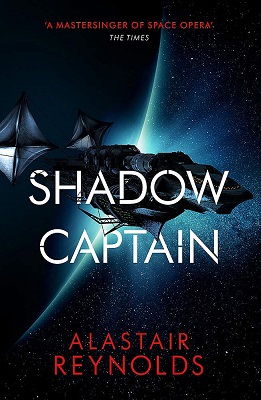
Shadow Captain, Alastair Reynolds (2019, UK). This is the sequel to last year’s Revenger, Reynolds’s first attempt at YA fiction. And, to be honest, other than the fact the two protagonists – one of which is the narrator – are teenage girls, it doesn’t much read like YA. The story is set in, I think, the Solar system many many millennia hence. The planets have been broken up into hundreds of thousands of worldlets, many of which have black holes at their cores to provide gravity. There have been successive waves of civilisation in the system, although no one knows what causes them to die off or be re-ignited. There are aliens present, semi-integrated into society, but apparently no FTL, so no real explanation of where they come from. And there are lots of alien artefacts – it is, in fact, the hunt for alien artefacts on uninhabited worldlets, some of which are protected by forcefields which periodically turn off, and which are know as “baubles”, which drives the plot of the trilogy. In Revenger, teenage sisters Adrana and Fura Ness joined the crew of a spaceship hunting for artefacts. They are “bone readers”, which means they can connect telepathically to hardware, still functioning, in giant alien skulls, and which are used by spaceships as a form of FTL communications. By the end of Revenger, Adrana and Fura have beaten dread pirate Bosa Sennen and taken her ships. In Shadow Captain, they need to find a way to let everyone know that Sennen is dead and the two sisters have no plans to follow in her footsteps. Unfortunately, they get involved with a gangster on a minor “wheelworld” while trying to resupply, and end up in no better a situation than when the book began. Along the way, Reynolds introduces a pair of mysteries which are likely to form the plot of the final book of the trilogy – the aforementioned waves of civilisation, and the possibility there may have been many more abortive waves; and the likely existence of some planetary object which swings into occupied space at intervals and wreaks havoc. There’s a distinctive flavour to Revenger and Shadow Captain, a sort of Dickensian steampunk aesthetic, which is appealing – although it does slip in a few places, where some technology exists without anything seemingly underpinning it. And the baubles are pretty damn cool. Reynolds has used something similar before, in Diamond Dogs, and it’s an idea that has always appealed to me (see John Morressy’s Under a Calculating Star and the movie Galaxy of Terror). The third book, currently titled Bone Silence, is due in January next year. I plan to buy a copy.

The Pyramid, William Golding (1967, UK). I’m not sure what to make of Golding. Here’s a writer who’s chiefly known for his debut novel, but went on to write a further fourteen or so books, all of which are generally highly-regarded but nowhere near as popular or well-known as his first novel, Lord of the Flies. Which, to be honest, I read at school, as probably did many UK schoolchildren. But I stumbled across three of his books in a charity shop a couple of years ago and decided to give him a go. And I was extremely impressed by the first one I read, Rites of Passage. And the second (well, third) novel by him I read was The Inheritors, which was odd, and an odd choice of subject, but very good. So I asked my mother to keep an eye open for his books in charity shops, and she found me three more, of which The Pyramid was one. And… it’s not at all what I expected, based on what I’d previously read by him. It’s set in the 1920s in a small town near “Barchester”, although if there are any other references of links to Trollope’s series they’d be lost on me as I’ve never read Trollope. The protagonist of The Pyramid, Oliver, is a young man due shortly to study chemistry at Oxford. Before he leaves, he wants to make out with the nubile receptionist from the doctor’s surgery next-door, who, it is implied, has a “reputation” (it is later revealed she is fifteen). Oliver succeeds – and it’s quite clearly rape, and described as such later, although the narrative seems to brush it off. Oliver returns home a few years later during his time at Oxford, and ends up involved in a local play, where he plays a gypsy violinist (as he plays the piano and violin) and a spear-carrier. But it all goes comically wrong. The final section is set decades later, when Oliver returns home as an old man, and learns the truth about some of inhabitants of the town he knew as a child. I’m not entirely sure what Golding is trying to say with The Pyramid. The various sections are linked by Oliver and place, and some shared characters, but otherwise seem not at all connected. The protagonist is not at all likeable, and his treatment of the teenage girl – and the narrative’s – has not aged well at all. The preoccupation with social class – the title refers to “the crystal pyramid” of social class – reads oddly to a twenty-first century reader, even a British one. To be honest, Waugh writes about class much much better than Golding does here – perhaps because the only intelligent way to write about class is as satire. In all, The Pyramid feels like a minor work, but I’ve more of his books on the TBR and I plan to read them.

The Loved One, Evelyn Waugh (1948, UK). I also asked my mother to keep an eye open for books by Evelyn Waugh – I forget why; I think I’d just watched the TV adaptation of Brideshead Revisited, fancied reading some of his novels and found a couple in charity shops myself… Anyway, I asked her to look out for them, and the next time we met up, she gave me a carrier bag containing a dozen of them. Which was considerably more than I’d expected. Quite a few of them were tatty Penguin paperbacks from the 1950s, which I didn’t mind as these were books I planned to read and pass on. I bought four of them with me to Sweden, including The Loved One. Which is a thin novel, of no great consequence. It’s set in Hollywood during the 1940s, immediately post-war, I think. The protagonist, Dennis Barlow, is a Brit, who worked for a major studio but was let go. He now works for a pet burial service. Which is a career the rest of the British expat community think is diminishes their standing among the Angelinos. This is especially the opinion of Sir Ambrose, who works at the studio which once employed Barlow. And also lets Sir Ambrose go, by simply giving his job to a relative of a manager (this is why employment laws are a good thing). Meanwhile, Barlow has met Aimee, a beautician at Whispering Glades, an upmarket cemetery that could only ever exist in California. And maybe in Florida. Barlow woos Aimee using poetry by assorted great poets which he claims to be his own verse. But then Aimee learns where Barlow works, and she has as low an opinion of the pet burial service as Sir Ambrose. The Loved One is mildly amusing, and Whispering Glades is certainly a good satirical creation, but the Barlow and Aimee are too much the naifs and the rest of the cast are all pretty much caricatures. Still, even second-tier Waugh is pretty damn good prose.

Crimes Against Humanity, Susan R Matthews (2019, USA). I’ve been a fan of Matthews’s Under Jurisdiction series since reading the first book back in the late 1990s (I reread it and reviewed it for SF Mistressworks a few years ago; see here). There’s been quite a gap in the novels’ publication history. The books were originally published by Avon, who dropped Matthews after the opening trilogy and two standalone novels. She was then picked up by Roc, who published a further two Under Jurisdiction novels before dropping her. The next novel in the series came out from Meisha Merlin, who went bust shortly afterwards. That was in 2006. And it wasn’t until 2016, when Baen started publishing her, starting with two omnibus editions containing the six Under Jurisdiction novels, that we started to see new entries in the series: Blood Enemies (see here), Fleet Insurgent (a collection; see here), and now Crimes Against Humanity. This novel follows on from the preceding ones – and it’s get to be quite a  complicated story arc by this point – with Kosciusko settled in Gonebeyond space, and the nine Benches deciding torture is a Bad Thing so they no longer need their military torturers. One of whom hates Kosciusko – for being slapped down in the past after abusing bond involuntaries, because Kosciusko is so much more skilled than him, and because Kosciusko’s actions have pretty much resulted in him, in all torturers, losing his job… So a wealthy capitalist, with lots of fingers in illegal pies, including in Gonebeyond space, and especially including slavery, uses the torturer in a plot to kidnap Kosciusko. It all comes to a head during a raid against the slavers and the rescue of the unsold slaves they abandoned. The plot involves infecting Kosciusko with a tailored virus. Unfortunately, it spreads to all the Dolgorukij (Kosciusko’s race). The story is told from multiple viewpoints, and Matthews does her usual where she throws the reader straight in at the deep end. The narrative has to bend itself over backwards considerably more these days to make Kosciusko a sympathetic protagonist – I mean, even back in the 1990s a torturer as a lead character was a hard sell, but these days, post-Gitmo, post-rendition, post-Bush, it would be almost impossible… Except maybe not, as there’s a shit ton of crap science fiction out there which normalises shitty US tactics like torture. Crimes Against Humanity plays it heavy on taking responsibility and the inappropriateness of forgiveness for such crimes; but it also comes down hard on slavery. Which makes the novel feel more contemporary in sensibilities and not a novel that should have seen print 20 years ago. I do like these books, and the story’s by no means finished, but I’m not sure if there any new books in the pipeline.

You Must Remember Us…, Leonard Daventry (1980, UK). I latched onto Daventry years ago when trying to put together a list of forgotten British sf authors, and found a copy of his best-known novel, A Man of Double Deed (see here), the first book of the Keyman trilogy, the second and third books of which don’t appear to have been published in paperback in the UK, only in the US, and the hardback editions were published by Robert Hale, copies of whose books are as rare as rocking-horse shit these days (apparently because most of their sales were to libraries). My copy of You Must Remember Us…, Daventry’s last novel, was published by Robert Hale, and I was extremely lucky to find a near-mint condition copy on eBay for around £20 a year or two ago. It was one of the books I brought with me to Sweden. And… it’s not very good. The earth has managed to destroy itself, and a last starship has escaped from the UK. The carefully-selected crew, however, didn’t make it to the launch site in Wales in time, so those aboard are whoever was available at the time. And they’re sort of muddling along, managing to keep everything running, for the ten-year journey to Alpha Centauri (the means propulsion is left vague). En route, they come across a deserted alien spacecraft, and four of them explore it but find nothing except a line of enigmatic symbols. The ship then vanishes. Some time later, members of the crew begin to develop extremely fast-growing, and fatal, tumours. There is only one cure: they have to transplant their brains into robot bodies. This doesn’t go down too well, and only fifteen of the crew make the change. They then sleep for twenty years. And when they wake up, they’re orbiting an Earth-like planet inhabited by a Neolithic humanoid people… who see the robot crew as gods. It’s all very British, and surprisingly old-fashioned for 1980. A Man of Double Deed had a flavour all its own, but You Must Remember Us… feels very ordinary. Brains transplanted into robot bodies is a relatively common sf trope, and has been around for a long time – ‘Helen ‘O’Loy’ from 1938, for example – and even made appearance in the execrable Legends of Dune series by Brian Herbert and Kevin J Anderson. These days, of course, it’s not an actual transplant that’s used, more a downloading of the consciousness – the mind as software – such as in Jennifer Pelland’s very good Machine. Daventry’s novel doesn’t add anything to the trope, and I’m not really surprised it never made it into paperback and has been pretty much forgotten. I’d still like to read the rest of the Keyman trilogy, however.

1001 Book You Must Read Before You Die count: 134


Leave a comment

Reading diary 2019, #2

I should do another book haul post but, well, the new books are all in boxes. And who knows when I’ll see them again… Meanwhile I’ve bought myself a Kindle and I’ve loaded it up with ebook versions of some of my recent purchases so I can actually get to read them even though they’re going straight into storage. The following half dozen books, however, were read old school, ie, paper. I’ll be taking a few paperbacks with me, of course, but space and weight is limited.

The Beekeeper of Sinjar, Dunya Mikhail (2018, Iraq). My mother lent me this and I think it was one of her friends who either recommended it or lent it to her. It is, to be honest, not usual reading material for either of us. I don’t think anyone needs to be told that ISIS, AKA Daesh, are nasty pieces of work – especially with Shemima Begum all over the UK news last month. (For the record, she’s a British citizen and has every right to return to the UK, and revoking her citizenship is disgusting, never mind illegal; but that’s the scumbag Tories for you.) The Beekeeper of Sinjar is specifically about the Daesh genocide of the Yazidis, an ethno-religious group from the region, whose monotheistic religion is distinct from the Abrahamic religions. Daesh would slaughter the men and elderly, and sell off the women at slave markets to Daesh members. A number of the Daesh described in the book were either American or Russian. The title refers to a man who still lives in the area, and helps Yazidi women escape their Daesh captors. Sometimes it’s just a matter of paying off the Daesh man holding a woman captive, other times the women have to be spirited away and smuggled across the border. The book is structured as a series of telephone conversations between US-based Mikhail and the beekeeper, during which the beekeeper often tells the stories of the women, and occasionally, men he has rescued. It’s harrowing stuff. And let’s not forget, Daesh is Blair’s and Bush’s legacy. Unfortunately, The Beekeeper of Sinjar suffers by being quite badly written. Partly it’s the nature of conversations – although the poetry excerpts add little – and the book never really gives a clear idea of what the Yazidi are (I had to look them up on Wikipedia to learn they have their own religion, for example). Certainly, the story in The Beekeeper of Sinjar needs to be told, but I think I would have preferred something more like reportage than Mikhail’s attempt to humanise events.

The Final Solution, Michael Chabon (2003, USA). I’m not entirely sure why I continue to read Chabon. I find his particular style of over-egged prose not to my taste, and as it’s as evident in The Final Solution‘s 127 pages as it is his longer works. The story is relatively simple, although it tries for cleverness – as Chabon often does – and while it doesn’t rely on an explanatory essay, like Gentleman of the Road (which, I must admit, I did enjoy; see here), the point of The Final Solution hinges on the reader realising something that’s not in the text – although the book’s title is a bloody great huge signpost. In 1944, a retired detective, who is clearly Sherlock Holmes, although he’s never named as such, is dragged into one last case to find the missing parrot belonging a mute German Jewish boy staying at a nearby vicarage. The bird’s disappearance coincides with the murder of another of the vicarage’s lodgers, and it’s surmised he was trying to steal the parrot – which has a habit of reeling off long strings of numbers in German, which many think are code – but was  himself robbed of the bird. Chabon handle his Holmes quite well, although Holmes’s irascibility often makes him more annoying than sympathetic, and his approach to the mystery make the plot anything but straightforward. Not a bad light read, but Gentleman of the Road was better.

Boneland, Alan Garner (2012, UK). This is third book in a trilogy begun with The Weirdstone of Brisingamen, a book I remember from my childhood as a quintessential English fantasy, completed nearly half a century after the second book, The Moon of Gomrath, was published, because Garner had grown to dislike his characters. Boneland is also not a children’s book. The protagonist is Colin, the boy from The Weirdstone of Brisingamen, but he has forgotten all the events of that book – in fact, he can’t remember anything that happened to him before the age of thirteen. He’s now a radio astronomer, working at Jodrell Bank, and living in a hut in a nearby wood. He’s hugely intelligent, but has problems socialising. He visits a psychotherapist, and she more or less teases him into being sociable with him. It’s a relationship that feels like to belongs in a genre novel from fifty years ago – and not a genre novel like The Weirdstone of Brisingamen. There’s something of the fell of a mouthpiece character to her – certainly, she seems to carry more weight in the story than her role would indicate. Colin’s story is crosscut with that of a shaman living in the same area  thousands of years previously. Both are protecting something, although neither seem entirely sure what. Boneland is not an easy read. Even by the end, it’s not entirely clear what role each of the main trio of characters play. But the writing is really good – Garner is a master at writing about landscape – (but it’s also very talky) and though it’s only a thin novel of 149 pages, there’s a great deal in it. It probably needs a reread.

Without a Summer, Mary Robinette Kowal (2013, USA). This is the third book in Kowal’s Regency fantasy series, and while – being a huge fan of Georgette Heyer and having read a number of US Regency romances – I had thought it’d take some convincing for me to accept a US-written Regency-set novel, and a genre one to boot, but I have to admit Kowal has done an excellent job on these. She has the dialogue down to a tee, and the prose is not far behind. She manages the sensibilities well enough that a British reader can find no cause to complain, and she incorporates real world history in such a way it adds to the plot. (Although I read a couple by US writer Fiona Hall, a pseudonym of Ellen Pall, back in the 1990s that did something similar and weren’t bad.) Anyway, 1816 – not 1916, as the backcover blurb claims – did indeed suffer climate abnormalities, due to the eruption of Mount Tambora in 1815 (not to be confused with Krakatoa, East of Java, which is actually west of Java, and happened in 1883). The extended winter has meant the coldmongers – who use magic to chill things, and are all children, much like sweeps, because of the perils of their occupation – can find no work, and are being blamed for the unseasonal weather. It turns out the coldmongers are planning a march to protest their poor lot, but an unscrupulous peer intends to escalate it into a full-blown rebellion so he can unseat the current prime minister (I think; I can’t check as the book has gone into storage). Protagonist Jane, and her husband David, get dragged into the plot due to a family connection and their sympathies for the coldmongers. It ends with the pair of them held in the Tower of London for treason but, of course, they can hardly be hanged as there are two books following this one. That’s probably Without a Summer‘s chief fault – the jeopardy is meaningless, because the two leads are sure to be found innocent and restored to their former position. Still, a fun read, and I plan to get the sequels.

Mission Child, Maureen F McHugh (1998, USA). I’m not entirely sure what to make of this novel. It had neither a plot nor did it need to be science fiction. And yet it was good. Janna is a teenage girl at an “appropriate technology mission” in the far north. Although the local culture resembles Inuit, the people of the region seem to be descended from northern Europeans. A local tribe wipes out the mission, and only a handful of people escape, including Janna and her husband. They trek to to another tribe, with whom they share kinship, but are never made entirely welcome. Then the tribe that attacked the mission attacks this other tribe, and again Janna and her husband escape. But he dies during the escape, and Janna makes it alone to a coastal city, where she is put in a refugee camp. She is mistaken for a man and chooses to impersonate that gender for reasons of safety, although later she decides she is transgender. Janna, now Jan, moves to another city and links up with another tribal person who’s a bit of wideboy, full of semi-legal schemes and deals. Jan gets a job as a technician, brings over a shaman from the refugee camp, and ends up as his helper when the wideboy is murdered after dealing in something high tech he stumbled across. Jan eventually falls out with the shaman and sets off travelling. He ends up on a tropical islands, whose inhabitants are descended from a mix of Indian and Chinese settlers, where he hires out as a bodyguard. But his employer is killed in a raid (this part of the book was originally published as a short story, I believe), and so Jan takes his employer’s daughter to her grandmother on another island, and ends up settling down there. He ends up helping offworlder medics when a plague strikes the islands as he is immune to the disease thanks to a medical implant he was  given back in the first chapter. For all that the novel is about the impact of high tech offworlders on the cultures of Jan’s world, there’s no good reason I could see why the novel needed to be set on another world, or even sf. Certainly it gave McHugh free rein in envisaging cultures to make her various points, but it does all feel a bit, well, arbitrary. Which is not to say Mission Child is a bad novel. Far from it. McHugh was definitely one of US science  fiction’s more interesting writers during the 1990s (she has not published anything in long-form since 2001), and I should probably give her short fiction ago (there are two collections to date, both published this century). Mission Child is a bit of a puzzler: a book that is clearly genre, but doesn’t really need to be, but works so well as genre it seems churlish to complain it didn’t have to be genre.

Brideshead Revisited*, Evelyn Waugh (1945, UK). There are many who consider this the finest novel written in English literature. I can’t agree, although it is very good. But I’m not even sure it’s Waugh’s best novel. I thought Sword of Honour better, to be honest. But then, Brideshead Revisited is not a satire, and even Waugh admits he over-wrote it in places. Which is not to say the prose is not good, because even over-written Waugh is fucking classy prose, and way more impressive and readable than, say, Chabon, who I also find over-writes. But Brideshead Revisited suffers from an odd structure, which the television series simplified (and I saw the TV series long before I read the novel), and an extended chronology that covers far more time than there are chapters. It opens with Charles Ryder in uniform during WW2 finding himself back at Brideshead, the seat of the Flyte family, old Catholic aristocracy. Back in his university days, Ryder had made friends with Sebastian Flyte, the youngest son. He had become a friend of the family, but fell out with them when they tried to control Sebastian’s drinking with a strategy he felt would make things worse. (It did.) Years later, married and with children, he bumps into Sebastian’s sister, Julia, and begins an affair with her. The two decide to marry once their individual divorces go through, but the estranged father returns to the family seat to die and everything changes. The framing narrative – Ryder in WW2 – provides only a prologue and an epilogue, and the title too, of course – but the way Ryder lives his life throughout the 1920s and 1930s but the narrative only deals with his interactions with the Flyte family… not to mention the faint smell of fawnication over the aristocracy that pervades the novel, and the fascination with Catholicism (which does, to be fair, result in one of the novels’s best comic scenes), makes it all a less likeable read than it should be. That it succeeds is totally down to Waugh’s prose, even if it is more florid than usual (although I read the later edition, in which Waugh toned it down somewhat). Some of the characters are close to caricatures – especially Ryder’s father, Anthony Blanche and Kurt – but Waugh handles his female characters surprisingly well. Brideshead Revisited is a definitely a book worth reading, but if you had to read a single Waugh novel I wouldn’t recommend it as the one to read. Having said that, I now want to watch the TV series all over again. And I’d like to see the 2008 film adaptation too.

1001 Books you Must Read Before You Die count: 134


1 Comment

Reading diary 2019, #1

I seem to be slacking on the reading from this year. My excuse is sorting all my shit out – that’s a few thousand books, for a start – before I move to Sweden… This will be the third time I’ve moved to another country, and it never gets any easier.

The Ways of the World, The Corners of the Globe and The Ends of the Earth, Robert Goddard (2013 – 2015, UK). I’ve been reading Goddard’s novels for years – I think I first came across them when I was living in the UAE – and found them to be light undemanding thrillers, sometimes a little formulaic, sometimes a little too implausible – but quick and easy reads. The Ways of the World, The Corners of the Globe and The Ends of the Earth, collectively known as the James Maxted trilogy, or the Wide World trilogy, are historical thrillers, not contemporary like his usual fare, and take place just before, during and after the peace talks in Paris which resulted in the Treaty of Versaille in 1919. The story opens when the father of James ‘Max’ Maxted, who is part of the British delegation in Paris, is found dead, seemingly by suicide after jumping from a high roof. Max smells foul play, and heads off to France to uncover the truth… which drags him into a mystery stretched over three books, and which initially seems to be about catching the ex-head of Kaiser Wilhelm’s intelligence bureau, now on the loose and with an extensive network of spies for sale to the highest bidder, before abruptly swerving halfway through the trilogy toward a family secret, located in Japan. So it all reads a bit like two stories welded together into a single trilogy. It doesn’t help that the hero is apparently killed off in book two – he isn’t really; I mean, no one writing commercial fiction would do something like that. But the two main plots sit uneasily together, and The Ways of the World has to tie itself in knots to kick off the first plot without hinting at the second. Goddard’s prose is easy to read, and his research is generally pretty good. The characters are perhaps somewhat broad-brush, but that’s hardly unexpected. But at least in this trilogy he’s managed to avoid his usual tendency to wrap up his story a bit too quickly. But if you want to read a book set in Japan in the early twentieth century, read Yukio Mishima. One for Goddard fans.

The Ninth Rain, Jen Williams (2017, UK). I’ve never been a big fan of fantasy (of the secondary world variety), and what few fantasy novels I read after the turn of the century did little to change my opinion. Grimdark is fucking horrible, and while the recent trend toward more inclusive fantasies is an excellent move, and long overdue, many of the resulting novels seem very derivative. But friends of mine are big fans of Jen Williams, so I  thought I might at least give her a go. And the good news is, there’s an interesting world on display here, and a plot that moves from start to finish without excess flab. On the other hand, the characters are all a bit stereotypical: the prettyboy playboy who’s also excellent at combat (and a super-strong vampire to boot); the slightly absent-minded curious one who’s also massively wealthy; and the underdog with special powers, which increase as the novel progresses. Eight times in the past, nasty aliens, sort of a cross between Giger’s xenomorphs and giant insects, have invaded the world, and been beaten off by the Eborans – really long-lived and good-looking and a bit decadent, so sort of like elves, but their tree-god, whose sap they lived off, died after the last invasion, so now they drink blood, so sort of like elf vampires… Anyway, said tree-god would provide a host of magical feasts to fight the invaders – these are the “rains”. It looks like the aliens might be gearing up for another invasion, but there are no Eborans to fight them, and no tree-god to provide magical warbeasts. Which the reader gradually learns as the plot takes the central trio all over the world researching the whys and wherefores of the aliens. To be honest, I really didn’t like the start of the fell-witch character’s narrative, in which women, often young girls, who exhibit the power are abducted and treated worse than slaves by an organisation that forces them to use their power to develop a popular drug. But the rest of the story made up for it. I’m not a fan of fantasy as a genre, as stated above, but I do sort of like ones that feel like science fiction, such as The Fifth Season. And The Ninth Rain. (The ordinal numbers in the titles are obviously just coincidence.) I enjoyed this book, I’ll probably even read the rest of the trilogy.

Put Out More Flags, Evelyn Waugh (1942, UK). This was the first of Waugh’s WWII satires, published in 1942, so during the war, but, unlike Sword of Honour (see here), it’s a sequel of sorts to Decline and Fall and Vile Bodies, and follows some of the characters introduced in those novels. Basil Seal, something of a reprobate, discovers a way to make money by dumping an incorrigible trio of East End kids on rural aristos as part of the evacuation programme. Another character joins the military and finds himself engaged in work of little or no use to the war effort – which, to be fair, Sword of Honour covered much better (admittedly, that book was written post-war). A week or two after finishing Put Out More Flags and I can’t honestly say I remember much of the plot. The characters are very much the same as in the earlier books, the only difference is the war, the run-up to it, and its early years. For all his faults as a human being – he was apparently a nasty piece of work – Waugh can bloody write. His characters are unsympathetic for a number of reasons: they’re the epitome of entitled British upper classes, usually incredibly stupid and thoughtless, and amazingly selfish. It’s only the fact Waugh’s prose is so enjoyable, and his eye for comedy, that make the books enjoyable.

The Girl King, Mimi Yu (2019, USA). This was a review book for Interzone. It’s hardly my first choice of reading material – see above – but the pickings were slim and the plot summary sounded like it might be worth a go. In a fantasy world clearly inspired by Chinese history, the oldest daughter of the emperor, who is very much a martial tomboy type, is passed over for the throne and instead married off to a cousin she hates. Before the ceremony takes place, she tries to change things so she’ll be seen as a better heir than her cousin – but they plan to kill her. She escapes. And hooks up with the last of a race of werewolves, except he’s not sure about his powers. And it’s all to do with a magical city hidden in the magical “Inbetween”, because the cousin wants the city’s powers for himself. And… the two protagonists, the tomboy and her sister, who turns out be a villain, are both teenage, so is this supposed to be YA? I can no longer tell the difference between YA fantasy and fantasy. I am not, I admit, well-read in the former, but those YA fantasies I have read seemed little different to the fantasies I used to read back in the 1980s and 1990s. I mean, while I never bothered with David Eddings’s novels – at least not until trying Pawn of Prophecy this century (see here), and being hugely unimpressed – I could’t help noticing that they’d been rebadged as YA not so long ago. But that may have just been a cynical marketing ploy to reach a bigger audience. The Girl King is published by Gollancz, an imprint with a lot of history in science fiction, but that means nothing as these days it seems to be mostly buying YA-friendly fantasy properties. Anyway, see the next Interzone for the full review.

1001 Books You Must Read Before You Die count: 133


1 Comment

Reading diary 2018, #21

Another eclectic bunch of books read. Only one recent genre novel (and one old one). The rest are mainstream.

A Winter Book, Tove Jansson (1971, Finland). Jansson apparently came to adult fiction late. She was in her fifties before she wrote her first novel that wasn’t children’s fiction. She also wrote a number of short stories. A Winter Book is cobbled together from a previous collection – not translated into English, IIRC – and a number of uncollected stories. They’re grouped thematically, and many deal with childhood in some way. Except for the ones that are about old age. Those who have read other fiction by Jansson will know what to expect. She’s very good at describing  the world she knew – pretty much every story she wrote drew on her own life. So we have stories set in Finnish winters, and stories that take place among the islands during the summer. It’s all very smooth and effortless storytelling, although some stories are more interesting than others. And yet, the collection itself doesn’t exactly linger. I read it more than a month ago and I’d be hard-pressed to describe any of the stories in it. Perhaps it’s that smoothness. Worth reading, though I suspect fans will get more out of it than I did.

Marune: Alastor 993, Jack Vance (1975, USA). I’m not sure why I picked this one off the shelves for a reread, given that previous Vance rereads haven’t gone so well. But I had fond memories of his Alastor Cluster series, and if the books were going to go back into storage I might as well remind myself of those fond memories. And… Marune: Alastor 993 was a much better book than I’d remembered it. Or rather: I’d remembered it as middling Vance, but it was a better put-together narrative than Star King, which I’d remembered as good Vance. The plot is one Vance has used several times: the amnesiac who has to research his origin and background, and discovers that his amnesia was deliberately induced in order to improve his rivals’, or enemies’, lot. Of course, the book’s real charm lies in the bizarre society the amnesiac belongs to. And, of course, his experiences away from his people have given him a broader outlook, which allows him to think past his family’s customs and traditions, and so he takes his rightful place as head of the family and overcomes his rivals and the family’s enemies. Although his amnesia does get in the way at times… Vance wrote two other Alastor Clusters books: Trullion: Alastor 2262 and Wyst: Alastor 1716. I might give them a reread before they go into storage.

The Waterdancer’s World, L Timmel Duchamp (2016, USA). I’m a big fan of Duchamp’s Marq’ssan Cycle, which is easily one of the best first contact sf series ever written – and certainly contains one of the genre’s best-written villains in Elizabeth Weatherall – not to mention thinking Duchamp’s short story ‘The Forbidden Words of Margaret A.’ is a bona fide genre classic… So any new work by her is a cause for celebration. Except, she’s not always an easy read, and not because her prose is especially hard. There are lots of things in The Waterdancer’s World to like, but I still struggled to read it. It doesn’t help that its narrative is formed from multiple journals, all from different times during the history of the world Frogmore, because some of the narratives were way more engaging than others. There are also excerpts from a “galactic encyclopedia”, which is never a good way to info dump, and in many cases the info wasn’t actually necessary. But I’m a big fan of bending and twisting forms of narrative, so I can’t begrudge Duchamp’s experimentation. Of the various narratives, the journal of Inez Gauthier, the privileged daughter of the head of Frogmore’s occupation forces, is the most interesting; but the eponymous character, who doesn’t actually appear all that often, is the most fascinating person in the novel. There’s a fierce intelligence to Duchamp’s fiction – which is surprisingly rare in science fiction, the only other examples that spring to mind are Gwyneth Jones and Samuel R Delany – but Duchamp’s fiction seems much more, well, researched than those two. In the case of The Waterdancer’s World that has the unfortunate effect of making the sf feel a bit old-fashioned – not in sensibilities, they’re thoroughly twenty-first century; but in the whole look and feel… At times, I was almost visualising sets and costumes from Out of the Unknown, a British sf TV anthology series from the 1960s. Still, it’s all good stuff. I still have Duchamp’s latest to read on the TBR.

Vile Bodies, Evelyn Waugh (1930, UK). My first Waugh. I hadn’t realised when I decided to work my way through Waugh’s books quite how old they were. I’d known he was writing during the 1940s and 1950s, but it seems much of his fame rests on the novels he wrote in earlier decades satirising the “bright young things” of 1930s London. I do enjoy fiction from that period, although I prefer post-war, but I have at least something to which I can compare Waugh… And the obvious candidate is Henry Green, whose fiction I like a great deal. And who Waugh himself takes a few potshots at in his novels (perhaps not in this one but certainly the one below). Waugh is generally considered one of the best novelists the UK has produced but on the strength of Vile Bodies I’d say Green was better. Vile Bodies, which is apparently a sequel to Decline and Fall (which I also have), opens with the characters crossing the Channel from France, and then getting into various upper-crust scrapes in London. One long-running joke involves the dim-witted father of the female lead, whose less-than-illustrious fiancé wants to marry her, doesn’t have enough money, so he approaches the future father-in-law several times for help. There’s also a trip to a motor race to support a race driver friend, in which an air-head aristocrat socialite finds herself taking the race driver’s place and disappearing off into the wild blue yonder out of control. It’s all very obvious and yet all very cleverly done. And well-written, if not up to Green’s standards. I’ve got most of Waugh’s oeuvre to read, thanks to my mother, and I shall work my way through them. But it’s not looking like he’ll ever become a favourite.

Sword of Honour, Evelyn Waugh (1965, UK). My second (old) Waugh – and it’s also about the Second World War (did you see what I did there?). I’d been hoping to sneak this onto my Goodreads challenge as three books, as Sword of Honour is an omnibus of Men at Arms, Officers and Gentlemen and Unconditional Surrender. Except it isn’t, as Waugh rewrote the trilogy as a single novel shortly before his death. So it goes down on the challenge as a single book. Anyway… The novel charts the war experience of Guy Crouchback, scion of an old Catholic aristocratic family now fallen on hard times. He has spent the between-war years in Italy and speaks the language fluently. But he’s a bit of a wet, and the British are so thoroughly incompetent they’re incapable of taking advantage of his language skills. The nearest he gets is serving in Croatia near the end of the war. In fact, if there’s one thing that comes across in Sword of Honour it’s how useless the British were. We like to pretend we won WWII, but we didn’t. Not really. The Soviets did. And the Americans. Initially, we just fucked up big time. That’s what Dunkirk was. A major fuck-up. And even after all that, we still had a country run by upper-class twits and it took a while for the competent middle-class to get control. Reading Sword of Honour makes Brexit seem a lot more understandable – or rather, the fucking hash our government has made of Brexit. And yet Sword of Honour was meant to be a satire. It’s based partly on Waugh’s own war experiences, although he makes a Crouchback a much more likeable protagonist than Waugh himself apparently was. Because was by all accounts he was a nasty piece of work – a total snob and arrogant and a good candidate for being shot by his own men. Waugh gives Crouchback a better, if more ironic, future in his rewrite of the trilogy, but it’s still an essentially cheerful novel for all that it takes the piss mercilessly out of the British armed forces during wartime. I thought it a great deal better than Vile Bodies, not just because its subject matter I found more interesting but because it didn’t feel so overdone. Recommended.

How to be Both, Ali Smith (2014, UK). It’s probably time to accept I just don’t get on with Smith’s novels. Admittedly, I’ve only read two, but I can’t say I enjoyed either. Which is odd, because you would think her style would appeal to me. It’s copiously-researched, often turns on little known history, is written present-tense and without speech marks for dialogue… but it’s also often – at least in those books I’ve read – pretty close to stream-of-consciousness and that’s never a style I could deal with at length. It doesn’t help that the actual plot of How to be Both is wilfully obscure. I mean, yes, I grew up on genre fiction, and it privileges plot, but I like literary fiction, and that privileges, well, any number of things but plot is rarely one of them. I’ve not had the training to be fully appreciative of Smith’s fiction, even though I’ve read any number of literary authors and appreciated what they’ve tried to achieve. I suspect this will be the last novel by Smith I’ll read. She’s just not for me.

1001 Books You Must Read Before You Die count: 133


Leave a comment

Reading diary 2018, #20

I won’t be able to squeeze in one more of these posts before the end of the year, which is, er, today, although I’ve read enough books for one. But that post can wait for 2019. I’ll have enough trouble trying to pick the best five books I read in 2018 – not to mention the best five films I watched…

Inside Moebius, Part 3, Moebius (2008 – 2010, France). This is the final two volumes, in a single volume, of Moebius’s exploration of his inability to give up marijuana. I’ve no idea why Dark Horse chose to double up the original French editions, but they’ve done an excellent job in presenting them – with a useful glossary which attempts to explain some of the more obscure reference Moebius makes, not to mention some of his impenetrable-to-non-Francophones puns (although many have been deliberately transliterated to be equally punnish in English). But, in essence, it’s more of the same. As in the first two volumes, Moebius explores Desert B, encountering younger versions of himself and versions of his best-known characters. On balance, I think the first volume was the best as more things seemed to happen in it. Part 3 contains more references to Moebius’s contemporaries, but that’s entirely lost on me as my knowledge of the field is pretty much limited to science fiction bandes dessinées and what’s been translated into English… Worth it if you’re a Moebius fan.

Matryoshka, Ricardo Pinto (2018, UK). This is the third of NewCon Press’s fourth quartet of novellas – and I believe there’s another quartet due out next year, also containing, as this quartet does, a novella by Adam Roberts (is there no end to his productivity?). But this novella is by Ricardo Pinto, who is best known for his Stone Dance of the Chameleon fantasy trilogy. I have all three books, but have only read the first two. They are excellent. The third book, The Third God, I’ve been reluctant to pick up because, well, because it’s too bloody big to pick up. I bought the hardback when it was launched at an Eastercon in Bradford, it is humongous. And yet I loved the first two books. I really ought to get round to reading it. Maybe I’ll get a chance during those dark Scandinavian winter nights… Anyway, Matryoshka is completely unrelated to the Stone Dance of the Chameleon, and is perhaps best described as either science fiction masquerading as fantasy or fantasy masquerading as science fiction. The protagonist, a young man drifting about Europe after WWI, meets an enigmatic young woman in Venice and accepts her invitation to… another dimension. Where time runs faster the further you are from the portal. She persuades him to accompany her on a sailing trip to rescue her brother from a distant island where he was lost years before. When they get there, the brother is no more than a few months older. And when they return to the city, everyone else has aged decades. The concept is handled well, but this is a story which privileges the imagery and, fortunately, Pinto has the writing chops to pull it off. It feels a little like an excerpt from a longer work, or at least the world certainly deserves further exploration. This quartet is shaping up to be quite a good one, it has to be said.

The Woman Who Loved The Moon, Elizabeth A Lynn (1981, USA). I bought this at Fantasticon in Copenhagen. Someone was selling a whole bunch of UK and US sf and fantasy paperbacks. These days, I seem to have more luck finding secondhand books at Nordic cons than I do at UK cons. Good job I’m moving there, then. Or maybe not – given I have a shitload of books to sort out before I flee the country… Lynn is not a well-known name on this side of the Atlantic – she doesn’t appear to have been published in the UK since the late 1970s. Not that she appears to have written much since then – pretty much nothing between 1990 and a new fantasy novel in 2004, and nothing since. Which is a shame, as there are worst writers with much healthier careers. But then fantasy has never been about the writing, which is why so many bad writers have proven so successful in the genre. As fnatasy collections go, this is a perfectly respectable one, with, as is typical, a couple of sf stories, such as ‘The Man Who Was Pregnant’. Each story has a brief introduction, and I admit I like author’s notes in collections. Lynn never made the big time, which seems unfair given how polished the stories in this collection are. But perhaps the fact I can remember little of them a few weeks after reading the book explains why she never made it a big. A good writer, but not, it seems, of especially memorable stories.

The Books of Earthsea, Ursula K Le Guin (1968 – 2001, USA). I’d been meaning to reread the Earthsea books for years, chiefly because I suspected I would get more out of Tehanu now than I had when I first read it back in the early 1990s. I’d been considering buying a copy of the Earthsea Quartet, as it’s normally sold here in the UK, but when I saw this new omnibus, containing all six Earthsea books – A Wizard of Earthsea, The Tombs of Atuan, The Farthest Shore, Tehanu, Tales From Earthsea and The Other Wind – plus some additional material, and illustrated as well, I decided to get myself a copy. The problem with ominbuses – omnibi? omnibodes? – however, for those of us who track our reading – and this is a vitally important question – is: does it count as a single book, or do you count the individual volumes it contains? So, is The Books of Earthsea one book read, or is it six books read? The Books of Earthsea makes it a little awkward as it contains material not previously collected, but the point is still valid. I chose to record each of the six volumes on my Goodreads reading challenge, if only so I could make my 140 books read target, which I have well overshot, but I’ve marked it as a single book in my own personal record of books read. As for the contents… do I really need to describe them? The first three books were more male-centric than I’d remembered – an issue Le Guin herself was aware of, and addressed in later books and stories, although the world-building required some retconning and twisting out of shape to make it work. The Tombs of Atuan was better than I had remembered and The Farthest Shore a bit duller. Tehanu I really liked this time around. Its plot felt a little uneven, with everything seemingly wrapped up in the last few pages of the book, but that seemed like a fault with all five of the novels in the series. Tales from Earthsea was entirely new to me, and the stories were good. The Other Wind was a little too obvious in places – I mean, who thought the king and princess would not end up together? And again, the plot seemed wrapped up a little too quickly and a little easily. But these are germinal works (not seminal, obvs), and read in sequence form an important dialogue with the fantasy genre. The individual books should certainly never be read in seclusion. Just reading A Wizard of Earthsea would be completely missing the point of Earthsea. On the other hand, this is a book for people with strong arms, as it’s not a comfortable weight to read easily. And the illustrations didn’t work at all for me. I’d sooner they hadn’t been there. But it’s definitely worth getting hold of a copy of this book.

Spring Snow*, Yukio Mishima (1968, Japan). After watching Paul Schrader’s Mishima: A Life in Four Chapters (see here), I decided to give some of Mishima’s fiction a go, and since the Sea of Fertility was his most famous work, I bought the first book of it: Spring Snow. It’s… good. Very good. The story is set in the second decade of the twentieth century, and concerns the relationship between the son of a wealthy family and the daughter of an impoverished aristocratic family. They grew up together and their eventual pairing was considered inevitable. But he, for whatever reasons, pretends he has no feelings for her. And so she ends up affianced to a prince of the Imperial family. As a result, the two conduct an illicit affair in the weeks leading up to her marriage. Also in the story are a Thai prince and his companion, who attend the son’s school and live in his family’s guest-house. I knew nothing about Mishima’s fiction – I was aware of how he had died, however – when I started this book, and I still know little other than what I read in Spring Snow. But it’s an excellent piece of writing, and the period, and lives, it depicts are fascinating. I’m almost certain I’ll read the rest of the quartet. Recommended.

Scienceville & Other Lost Worlds, Gary Gibson (2017, UK). Gary is a friend of many years, although I see him only rarely as he lives on the other side of the planet. But I’ve bought each of his his books in hardback as they were published – except for one, I think, which was a freebie at a Fantasycon; sorry, Gary – and enjoyed those I’ve read (complaints about excessive bodycount notwithstanding). Scienceville & Other Lost Worlds is a short self-published collection, containing six stories, some of which are close to novella length. The title story refers to an invented utopia that seems to exist for many people. The other stories are mostly light science fiction – a story about prisoners in some future dystopian UK who have one of their senses removed, a story about travellers to alternate universes and a mission that nearly comes a cropper, a story about a rock star who agrees to a deal with a steep price in order to revitalise his career… It’s all polished stuff, although none stand out as much as Gary’s recent novella for NewCon Press. Having said that, there are few stories which hang around so much you remember them months later… which does sort of make it difficult to pick the best of the year. Or it would if awards were actually about the stories and not the writers, who helpfully provide “eligible works” posts and so bend everything totally out of shape. True, the field is now so big it’s impossible for a reader to make an informed decision on the “best” story of a particular year. But, FFS, voting for your pals and favourites only makes it more of a mockery. Are there no truly memorable stories during any one year? Gibson does not provide exact publication details for the stories in Scienceville & Other Lost Worlds – which he ought to have done – and not all of the contents are eligible for awards in 2019 and, much as I like Gary, I don’t think they’re especially deserving either. Good solid sf, yes; but when “good solid sf” wins awards then awards are even more broken than they are now…

1001 Books You Must Read Before You Die count: 133