It Doesn't Have To Be Right…

… it just has to sound plausible


4 Comments

I love the smell of old paper in the morning

Inspired by Pornokitsch’s book porn post earlier today, I have decided to share some of the older, and perhaps less obviously the sort of books I would buy, books in my collection. And here they are…
20121214bookpornh

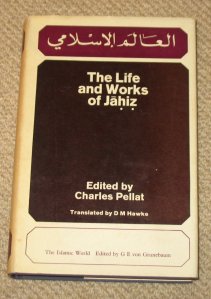
I bought The Life and Works of Jahiz on abebooks after reading and enjoying Robert Irwin’s The Penguin Anthology of Classical Arabic Literature, but I’ve, er, never got around to reading it. It was published in 1969, so it’s not especially old – in fact, it’s younger than me. But I suspect very few people I know also possess a copy. (I see there’s a single copy for sale on Amazon… for £129.99.)

20121214bookporna

I’ve tried my hand at poetry, and a few of my attempts have been published, but I’ve found the poetry that appeals to me most is that of the 1930s and 1940s, such as by the Cairo poets. Here I have three collections by Terence Tiller: Reading a Medal (1957), Poems (1941) and The Inward Animal (1943); Richard Spender’s Collected Poems (1944); and John Jarmain’s Poems (1945). They were bought at antique fairs, on eBay, or from Abebooks.
20121214bookpornb

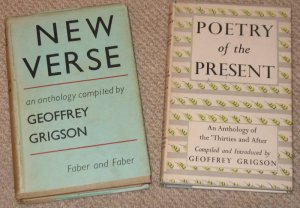
And here are two poetry anthologies from that period. New Verse (1939) features photographs of the contributors at the end and appears to have been annotated in pencil by a previous owner. Poetry of the Present (1949) has a review slip in it, giving the exact publication date as April 28th 1949 and price as 10/6.

20121214bookpornc

My favourite poet is probably Bernard Spencer, and here are a couple of hard-to-find chapbooks: The Twist in the Plotting (1960) and With Luck Lasting (1963).
20121214bookpornd

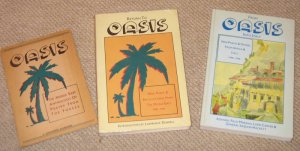
I first came across the Cairo poets via the Lawrence Durrell connection. During WWII, there were two groups of poets and writers in Egypt – both serving in the armed forces and civilians. Durrell and Spencer were in the Personal Landscape group, centred around a journal with that title. The other group was called Salamander after its magazine, and later published three collections of poetry by armed forces personnel: Oasis (1943), Return to Oasis (1980) and From Oasis into Italy (1983). (I can’t find any copies of Oasis online to link to, unfortunately.)
20121214bookporne

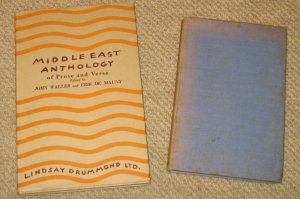
Middle East Anthology of Prose and Verse (1946) is, er, exactly that. It includes Lawrence Durrell, John Jarmain, Bernard Spencer, Keith Douglas and Olivia Manning, among others. The book lacking a dustjacket is Personal Landscape (1945), like Oasis above, an anthology drawn from the pages of the magazine of the same name, which includes, er, Lawrence Durrell, John Jarmain, Bernard Spencer, Keith Douglas and Olivia Manning, among others.
20121214bookpornf

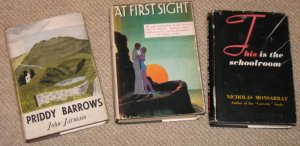
From verse to prose – three novels from the 1930s and 1940s. Priddy Barrows (1944) is Jarmain’s only novel – he was killed in WWII. I wrote about it here. Copies of both Priddy Barrows and his poetry collection are, it seems, now impossible to find. At First Sight (1935) is Nicholas Monsarrat’s second novel, and This Is The Schoolroom (1939) is his fourth (but my copy is a 1947 reprint).

20121214bookporng

Finally, a couple of books about bathyscaphes. Seven Miles Down (1961) is the only book written specifically about the voyage of the Trieste to the floor of Challenger Deep in 1960. I wrote about it here. 2000 Fathoms Down covers descents in a bathyscaphe by the two authors during the 1940s and 1950s.
9 Comments

Prometheus stole fire, not stupidity

A few nights ago, I watched the DVD of Ridley Scott’s Prometheus. I’d seen the film at the cinema earlier in the year, and been most unimpressed. It looked gorgeous, but there wasn’t a single functioning brain cell in it. Anyway, here are some notes I took as I watched the DVD…

  • When DNA breaks up, it does not form magical chemicals that can reform as DNA.
  • Noomi Rapace’s character is fond of saying, “it’s what I choose to believe”, which does not mean “it is true”, and any scientist with half an IQ would know as much.
  • The Prometheus starship appears to be somewhat bigger on the inside than the outside – I mean, if the crew are going to spend the journey in cryostasis, why would you put a huge gym in the ship?
  • The Prometheus takes two years to travel approximately 34.5 light years to LV-223, so the moon could be orbiting either Pollux, Gliese 649, Gliese 86… or some completely made-up star.
  • Why does David the android (Michael Fassbender) eat?
  • The lifeboat in which Charlize Theron’s character lives has everything she might need… including a grand piano?
  • On arrival at LV-223, they discover the Engineer facility because “God does not build in straight lines”. Er, what? Nature certainly does, physics certainly does.
  • Why does everyone aboard have a seat on the bridge of the Prometheus? Shouldn’t only the crew?
  • The ancient paintings depicted a “galactic system”. This means absolutely nothing.
  • The civilisations which made the ancient paintings apparently never had contact with each other. Unlikely. Even if centuries apart, there would still be historical artefacts – like, er, the ancient paintings which prompt the mission to LV-223…
  • The cave painting on Skye was dated as 35,000 years old. Northern Europe was still experiencing the last ice age at that point (the Flandrian interglacial didn’t start until 10,000 years ago).
  • Why does David the android dye his hair? Can’t he just swap it?
  • The Engineer facility is a sugar-loaf type rock hill inside a circular rock wall, and it has an undercut entrance supported by carved pillars – so yes, it would be easy to say it is not natural.
  • Speaking of entrances, the scientists have to duck to get inside – yet the Engineers are enormous. What a silly way to enter a building.
  • Speaking of the Engineers, their spaceships are famously boomerang-shaped… Except for the one which opens the film, which is saucer-shaped. Why?
  • The scientists are inside an alien facility, their sensors have told them the chemical composition of the air, but there’s no mention of biological contaminants… so let’s all take our helmets off. Right…
  • Several of the scientists make jokes about Martians – eh?
  • The man responsible for mapping the Engineer facility… gets lost. Fail.
  • Why is there a xenomorph in the mural?
  • Two scientists are in charge of the expedition– no wait, one scientist and his “zealot girlfriend”. So no gender equality in the 22nd century, then.
  • How do you trick a severed head that’s been dead for 2000 years into thinking it’s alive?
  • And, what do you know, a perfect match between human and Engineer DNA. So much for evolution.
  • David the android does not need to drink, or indeed breathe, but he still eats food – eh?
  • The two lost scientists don’t know where they are… but they can give their coordinates to the ship.
  • It’s the twenty-first century, haven’t we moved on from infertility as the sole motivation for a female character?
  • Or indeed, when a woman is asked if she is a robot, offering sex is not the first or most efficient means of proving your humanity.
  • Some of the scientists and crew smoke cigarettes. Aboard a spaceship. Fail.
  • What generates the holograms of the Engineers running through the facility? Where is the machinery? You can see it in the engineer spaceship.
  • And how come it still works after 2,000 years? The Antikythera Mechanism didn’t.
  • When Noomi Rapace takes off her clothes, she is apparently wearing a bandage around her chest rather than a bra.
  • When Weyland makes an appearance, where did his nurse come from?
  • Why do all the Engineers look identical?

… And at this point I gave up making notes because it was all getting too silly. Why bother mentioning that Rapace has to abseil out of the Engineer spaceship… so how did she get into it? Or that running away from a rolling spaceship along the line it is rolling is pretty bloody stupid.

I was also informed that the DVD version featured a different start and end, and a number of additional scenes in the middle – as if it were, you know, a different and less stupid film. I didn’t notice any difference. Perhaps the version I bought is the theatrical release – it doesn’t say it is, but it also doesn’t say it’s not. That’s annoying.

I’m all for science fiction cinema, and I would like to see more of it. But this is shoddy writing, this is a failure of writing craft. It’s indicative of the contempt in which Hollywood holds the audiences of its films. It’s no wonder I’ve found myself increasingly watching world cinema, art house cinema and classic movies…


6 Comments

Whoops, my finger slipped…

There you are, browsing your favourite online purveyor of books and, oh dear, you seem to have bought a bunch of them. That’s what happens to me. Well, that, and being unable to pass a charity shop without popping in to see if they have any decent books on sale. The end result is a book collection which continues to grow and mutate and evolve like some bookish monster out of Quatermass. Or something.

Anyway, here’s the latest additions…

201212096_bookhaula

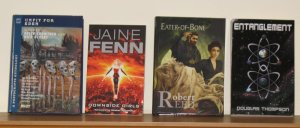
Some small press goodies: both Downside Girls, a collection by Jaine Fenn, and Entanglement, Douglas Thompson, I bought at Novacon. Unfit for Eden and Eater-of-Bone are both from PS Publishing.

201212096_bookhaulb

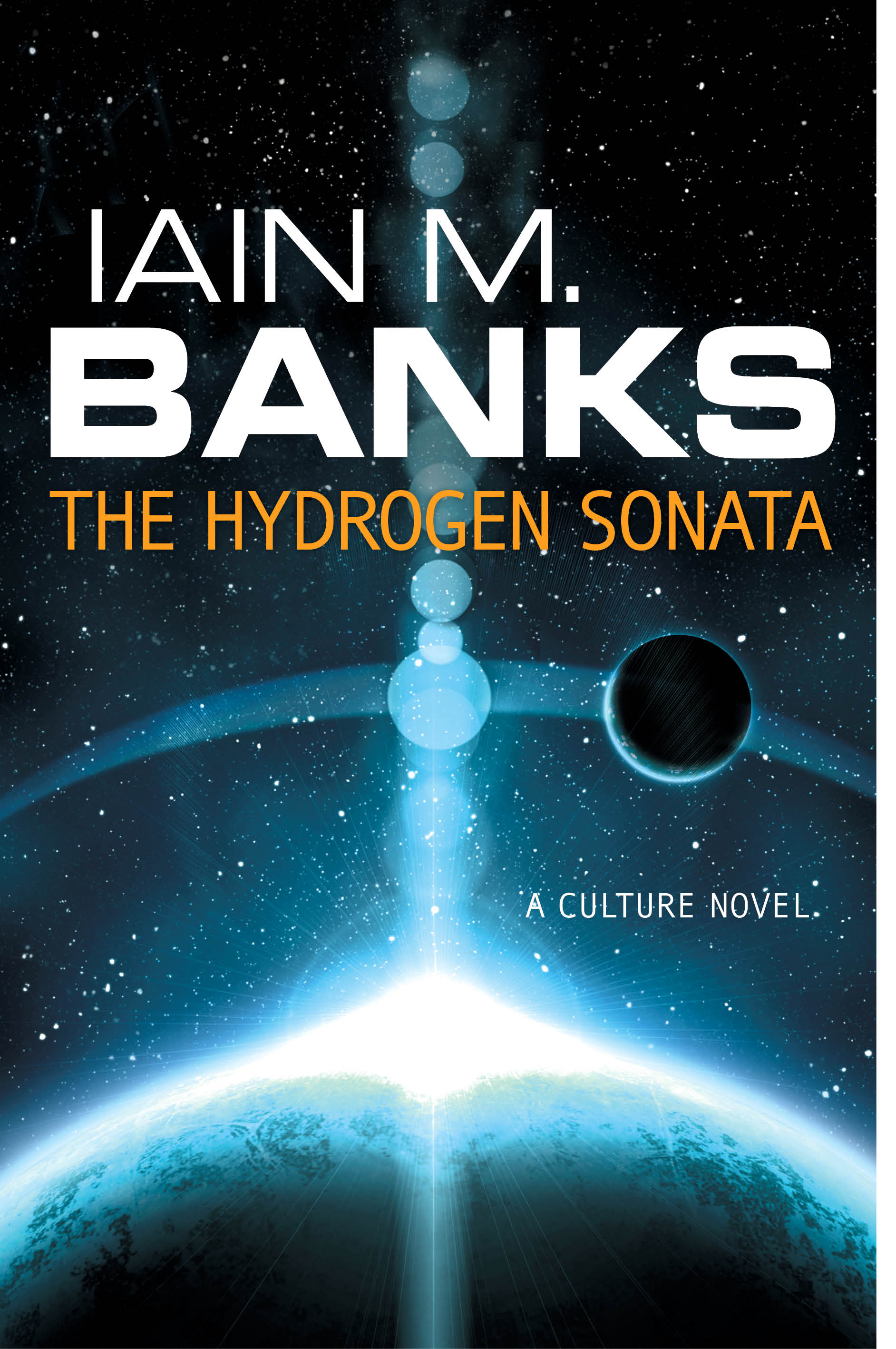
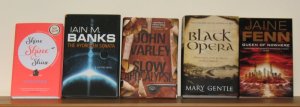
A few recent first editions – Lydia Netzer’s Shine Shine Shine I’ve already written about (see here); likewise Banks’ The Hydrogen Sonata (see here). I suspect John Varley is long past his best, but I’ll give Slow Apocalypse a go anyway. Mary Gentle’s Black Opera has been getting some positive notices. I only have the first of Jaine’s Hidden Empire novels, and Queen of Nowhere is the fifth – so it’ll be a while before I read it.

201212096_bookhaulc

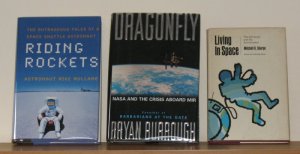
Some books for the space collection. Riding Rockets and Dragonfly are both signed. I’m told Mullane’s autobiography is a really good one. The Burrough is about the Mir space station. Living in Space was dirt cheap on eBay.

201212096_bookhauld

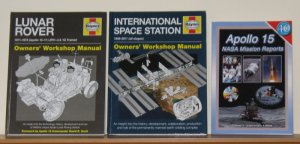
I love how Haynes have started producing these Owners’ Workshop Manuals for all sorts of things – not just the Lunar Rover and International Space Station here, but also the Millennium Falcon, Avro Vulcan, Thunderbirds, RMS Titanic, USS Enterprise, and even Dan Dare’s Spacefleet Operations. Not, of course, that anyone will ever get to own one of those. Apollo 15 NASA Mission Reports is exactly what it says on the cover. I have quite a few of the books.

201212096_bookhaule

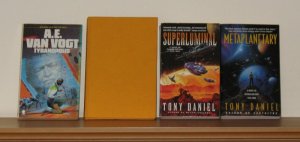
Some books bought at Novacon: Tyranopolis, AE van Vogt; The Quy Effect, Arthur Sellings; and Metaplanetary and Superluminal, Tony Daniel.

201212096_bookhaulf

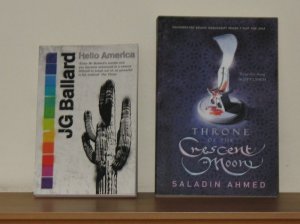
As I’ve got older I’ve found myself appreciating Ballard’s fiction more and more. So I’ve been buying the nicely-packaged 4th Estate paperbacks. Only three more after Hello America and I’ll have the lot. Throne of the Crescent Moon is an ARC, which I’m reviewing for Interzone. I’ve also interviewed the author.

201212096_bookhaulg

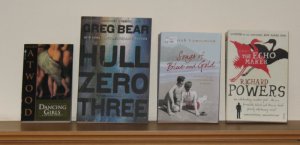
Charity shop finds: Dancing Girls, a Margaret Atwood collection; Greg Bear’s Hull Zero Three was, apparently, mystifyingly shortlisted for the Arthur C Clarke Award; Deborah Lawrenson’s Songs of Blue and Gold may not look like my usual reading fare, but it’s based on Lawrence Durrell and his relationship with his wife when they lived on Corfu; Richard Powers is an author I’ve fancied trying for a while now and The Echo Maker was a fortunate find.

201212096_bookhaulh

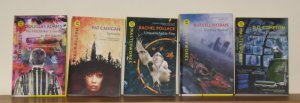
I recently won a competition on the Gollancz blog, and this was the prize: a package of SF Masterworks – The Hitchhiker’s Guide To The Galaxy, Synners, Unquenchable Fire, Riddley Walker and The Continuous Katherine Mortenhoe. Many thanks.

201212096_bookhauli

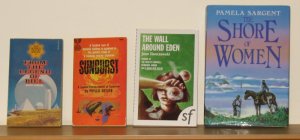
These are for SF Mistressworks and were bought at Novacon. I’ve already reviewed Phyllis Gotlieb’s Sunburst (see here). I had a copy of Mary Staton’s From the Legend of Biel and read it many years ago, but gave it away. I fancied rereading it. The Wall Around Eden is from The Women’s Press. I’ve already reviewed a Pamela Sargent anthology and collection, so The Shore of Women will be her first novel to be reviewed on SF Mistressworks.

201212096_bookhaulj

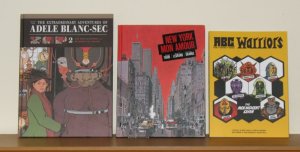
Jacques Tardi’s bandes dessinée are really very good. The Extraordinary Adventures of Adèle Blanc-Sec volume 2 is completely bonkers. I suspect there won’t be a volume 3. New York Mon Amour is a collection of noir stories set in the titular city and despite the setting there’s something distinctly non-American about them. The Fantagraphic editions are nicely put-together, but annoyingly the books are all different sizes. Argh. ABC Warriors: The Meknificent Seven I bought on the strength of fond memories of the strip in 2000AD. I shouldn’t have bothered: it’s cobbled together from war movie clichés, often with dialogue which doesn’t even reach those heights. Ah well.

201212096_bookhaulk

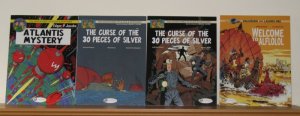
These bandes dessinée are much better. Atlantis Mystery is an original Edgar P Jacob’s story, and very text-heavy. The story is complete tosh too. The Curse of the 30 pieces of Silver, part 1 and part 2, is of much more recent vintage, and is a mish-mash of Tintin-esque mystery-adventure and Dan Brown Biblical conspiracy, with a secret Nazi cabal thrown in as the villains. (Incidentally, Amazon’s database looks completely buggered on the Blake and Mortimer books – it has Atlantis Mystery and The Curse of the 30 pieces of Silver, part 2 down only by volume number, not title; so title searches won’t work.) Welcome to Alflolol is the fourth of the Valérian and Laureline series to be published in English by Cinebook.


Leave a comment

Locus poll adden-doh

So, a day or two after I filled in my selections for the Locus Poll of Polls (see here), I stumbled across this Mind Meld I did back in October 2010 on my perfect short fiction anthology. While most of the TOC made it into my categories for the polls, some didn’t and I wish I’d managed to remember them. The missing ones were:

‘That Only a Mother’, Judith Merrill (short story, 1948)
I went for ‘No Woman Born’ by CL Moore instead. I’d have to reread both to decide which of the two I should have chosen. It might have been both.

‘The Sword of Rhiannon’, Leigh Brackett (novel, 1949)
This is apparently a novel, so it doesn’t even belong in a short fiction anthology. Whoops. I picked Brackett’s ‘The Last Days of Shandrakor’ for my 20th Century SF/F Novelette category.

‘A Woman Naked’, Christopher Priest (short story, 1974)
I did think about including this one, but I had more than ten choices for my 20th Century SF/F Short Story category. Even though some turned out to be novelettes, I still had to say no to a couple of titles. Incidentally, I wrote a guest post on this story on Gav Reads – see here.

‘The View from Venus: A Case Study’, Karen Joy Fowler (novelette, 1986)
I considered this one too, but I thought it was a short story and I was over-subscribed in that category. But I’ve just looked on isfdb.org and it’s down as a novelette. So I should have included it in that category, probably in place of the Sterling or the Dowling.

‘In Saturn Time’, William Barton (short story, 1995)
Like the Priest, I considered this, but had no free space in the category.

‘Beside the Sea’, Keith Brooke (short story, 1995)
I’d forgotten about this one, but I suspect it wouldn’t have made the cut anyway. Though it is an excellent short story.

‘The Avatar of Background Noise’, Toiya Kristen Finley (short story, 2006)
I wish I’d remembered this one. I left my 21st Century SF/F Short Story category blank, but I’d have included this one if I’d remembered it. Argh.

I only managed nine in the 20th Century SF/F Novella category, two in the 21st Century SF/F Novelette, and none in 21st Century SF/F Short Story. I think I need to read more short fiction from the first decade of this century. It’s not like I’m prevented from doing so – I have a huge pile of Interzones, a shelf full of Postscripts, and a whole bunch of other magazines and anthologies…

So, I think, as a resolution for 2013, I shall work towards putting together a short fiction best of the year, as I do every year for books, films and albums. That should encourage me to read more short stories. I’ll not differentiate between short story, novelette or novella – they’ll all be munged together into one list. Nor will I work overly hard at reading as much as possible. If a story doesn’t grab me within the first 500 to 1,000 words, I’ll not bother finishing it. I’ll stick to the venues I usually frequent, though if someone recommends a story published elsewhere I’ll give it a go. Hopefully, by the end of the year I’ll have enough to choose from to list the five best. I’ll even be able to pick stories to nominate for the BSFA Award. (hint, hint.)


9 Comments

Fly me to the Moon

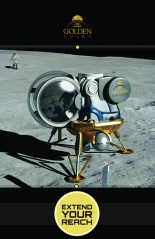
This week saw the announcement by the Golden Spike Company of a plan to sell commercial passenger flights to the Moon. For a mere $1.5 billion each. This is your libertarian future, as so fondly imagined by various right-wing US science fiction authors: poverty endemic in all nations, while the One Percent get to fulfill their dreams in outer space. Of course, few of the ultra-rich can actually afford $1.5 billion, but don’t worry, there’s plenty of cash floating around in the public sector they can sequester. All they have to do is buy a couple of governments, and then persuade said governments to sell off their national assets: utilities, infrastructure, national healthcare…

This is the twenty-first century we can look forward to. All our dreams, the future of our race, we will have to experience vicariously. But that’s okay, because those dreams are about the only thing that can’t be taken away from us. Manipulation of the financial market means you will lose your house, selling off healthcare means injury or illness will beggar you, cost-cutting (AKA profit-maximising) and outsourcing means you will lose your job, tax avoidance by corporations and the ultra-rich means there’ll be no money for benefits to feed you or house you or keep you warm in the winter once you’re unemployed…

But at least someone will be having fun. Visiting the Moon.

goldenspike

It cost US taxpayers around $10 per person per year for a decade to put twelve men on the Moon with the Apollo programme. They did it for science, to beat the Soviets in the Space Race, and for humankind. There are a huge number of scientific and technological advances which spun out of Apollo. Computers and mobile phones as we know them likely would not exist but for the huge orders for integrated circuits – in their infancy at the time – placed by NASA for the spacecrafts’ guidance systems.

If we leave space travel in the hands of the ultra-rich – and that seems to be the way we’re going with all these dumb outer space tourist-jaunt proposals – then we are doomed to die when this planet can no longer support us. We will have no future as a race. And the way things are heading right now, we’ll be lucky to survive into the twenty-second century.

Remember all those space exploration sf novels of the 1940s and 1950s? NASA and the USSR demonstrated the reality was considerably more hazardous than had been imagined. So sf completely mythologised the whole endeavour – magical antigrav spaceships travelling light-years in days or hours using magical FTL drives. Those tropes are now so embedded in the genre, they’ve become part of the setting. I put together Rocket Science partly to question those tropes, to inject some realism back into space travel and outer space, to kickstart a new science fiction tradition based on the reality of space travel.

But what had never occurred to me – or to the genre as a whole, I suspect – is that space would become just another playground for the ultra-rich, just like one of those private Caribbean islands with beaches of golden sand and clear blue seas.

They have taken away our future. It’s time we stopped ignoring that fact in our fictions.


1 Comment

The humungous Locus poll and my picks for it

I hate polls; polls are stupid things. Picking the best fiction with a popularity contest? Fail. But I had a bash at it anyway. Not that my choices are likely to appear in the final top ten in any category, or cause anything but the tiniest amount of skew in the results. But it was sort of fun as an intellectual exercise.

Picking out the novels was easy enough, but the short fiction categories were hard, especially the 21st century ones. Some stories stay with you for years afterwards, but they’re few and far between. And numbers alone – plus the fact I don’t read every piece of short fiction as it’s published – means I probably encountered few memorable stories during the first decade of this century.

Anyway, for what it’s worth here are my picks:

20th Century SF Novel
1 Coelestis, Paul Park (1993)
2 Dhalgren, Samuel R Delany (1975)
3 The Dispossessed, Ursula K Le Guin (1974)
4 Kairos, Gwyneth Jones (1988)
5 Synthajoy, DG Compton (1968)
6 Ash: A Secret History, Mary Gentle (2000)
7 Where Time Winds Blow, Robert Holdstock (1981)
8 Red Mars, Kim Stanley Robinson (1992)
9 Take Back Plenty, Colin Greenland (1990)
10 The Female Man, Joanna Russ (1975)

20th Century Fantasy Novel
1 Aegypt, John Crowley (1987)
2 In Viriconium, M John Harrison (1982)
3 Rats & Gargoyles, Mary Gentle (1990)
4 Mythago Wood, Robert Holdstock (1984)
5 Lens of the World, RA McAvoy (1990)
6 Watership Down, Richard Adams (1972)
7 The Golden Compass, Philip Pullman (1995)
8 Tehanu, Ursula K Le Guin (1990)
9 The Book Of The New Sun, Gene Wolfe (1983)
10 The Grail of Hearts, Susan Shwartz (1992)

20th Century SF/F Novella
1 ‘Great Work of Time’, John Crowley (1989)
2 ‘The Fifth Head of Cerberus’, Gene Wolfe (1972)
3 ‘Forgiveness Day’, Ursula K Le Guin (1994)
4 ‘Equator’, Brian W Aldiss (1958)
5 ‘Green Mars’, Kim Stanley Robinson (1985)
6 ‘Marrow’, Robert Reed (1997)
7 ‘Secrets’, Ian Watson (1997)
8 ‘Story of Your Life’, Ted Chiang (1998)
9 ‘Piper at the Gates of Dawn’, Richard Cowper (1976)
10

20th Century SF/F Novelette
1 ‘The Barbie Murders’, John Varley (1978)
2 ‘Beauty and the Opéra or the Phantom Beast’, Suzy McKee Charnas (1996)
3 ‘The Time-Tombs’, JG Ballard (1963)
4 ‘A Little Something For Us Tempunauts’, Philip K Dick (1974)
5 ‘Black Air’, Kim Stanley Robinson (1983)
6 ‘The Last Days of Shandakor’, Leigh Brackett (1952)
7 ‘No Woman Born’, CL Moore (1944)
8 ‘FOAM’, Brian W Aldiss (1991)
9 ‘Swarm’, Bruce Sterling (1982)
10 ‘Housecall’, Terry Dowling (1986)

20th Century SF/F Short Story
1 ‘And I Awoke And Found Me Here On The Cold Hill Side’, James Tiptree Jr. (1972)
2 ‘Air Raid’, John Varley (1977)
3 ‘Forward Echoes (AKA Identifying the Object)’, Gwyneth Jones (1990)
4 ‘The Lake of Tuonela’, Keith Roberts (1973)
5 ‘The Road To Jerusalem’, Mary Gentle (1991)
6 ‘A Map of the Mines of Barnath’, Sean Williams (1995)
7 ‘The Brains Of Rats’, Michael Blumlein (1986)
8 ‘Aye, And Gomorrah’, Samuel R Delany (1967)
9 ‘A Gift From The Culture’, Iain M Banks (1987)
10 ‘The Gernsback Continuum’, William Gibson (1981)

21st Century SF Novel
1 Light, M John Harrison (2002)
2 Life, Gwyneth Jones (2004)
3 Ascent, Jed Mercurio (2007)
4 Alanya to Alanya, L Timmel Duchamp (2005)
5 The Caryatids, Bruce Sterling (2009)

21st Century Fantasy Novel
1 Evening’s Empire, David Herter (2002)
2 A Princess of Roumania, Paul Park (2005)
3 Lord Byron’s Novel: The Evening Land, John Crowley (2005)
4 Hav, Jan Morris (2006)
5 Lord of Stone, Keith Brooke (2001)

21st Century SF/F Novella
1 ‘Arkfall’, Carolyn Ives Gilman (2008)
2 ‘My Death’, Lisa Tuttle (2004)
3 ‘Diamond Dogs’, Alastair Reynolds (2001)
4 ‘Dangerous Space’, Kelley Eskridge (2007)
5 ‘A Writer’s Life’, Eric Brown (2001)

21st Century SF/F Novelette
1 ‘The Merchant and the Alchemist’s Gate’, Ted Chiang (2007)
2 ‘Divining Light’, Ted Kosmatka (2008)
3
4
5

21st Century SF/F Short Story
1
2
3
4
5

Well, the same names crop up in most lists, but that’s because I think those writers are amongst the most interesting in genre fiction. I did trawl through the lists of suggested titles provided by Locus, but there were few novels or stories I liked or thought especially good – in fact, many of choices above don’t appear on any of their lists. I’ve not read enough 21st century short fiction to pick the five best. I managed it with a handful of novellas and novelettes, but short stories?

(No doubt I’ll think of possible titles the moment I hit the “Publish” button on this post…)

And let me once more ask what on earth is the use of the novelette? It’s an entirely arbitrary and useless category. Anything bigger than a short story but smaller than a novel is a novella. The only places where novelette is used as a category is in the Big Three genre magazines and US genre awards. And it seems to me it only exists so the big friendly and incestuous club of US genre writers have an excuse to give each other yet another award. Get rid of it, please.


8 Comments

From the Sublime to the ridiculous

The Gzilt are unusual among all galactic civilisations in that the holy book of their religion has proven to be demonstrably true. It predicted scientific advances long before they were made. There was other stuff in the Book of Truth, of course – the typical moralistic posturing, the usual self-serving self-importance around which religions accrete, all that sort of stuff. But people took it seriously because parts of it actually became true.

Now, the Gzilt are about to Sublime. This means they are about to leave this universe en masse for another where everyone lives in– Well, no one really knows because those few who have returned have been mysterious and enigmatic to the point of uselessness. But Subliming is good. And the universe to which races Sublime is apparently infinitely large and infinitely wonderful and everyone there feels infinitely uplifted.

Subliming calls for celebration, so various other races are descending on the Gzilt worlds to wish the Gzilt well and to, hopefully, if given permission, loot what’s left for themselves. A representative of the remnants of the Zihdren, the Gzilt’s original mentors, who Sublimed thousands years before, turns up with some unwelcome news. But before it can be revealed the Zihdren-Remnanter ship is callously destroyed by a Gzilt battleship. This could upset things. As could the news the destroyed ship was carrying.

Also, the Gzilt were one of the original races – they’re humanoid; very much so, in fact – who agreed to band together to form the Culture ten thousand years earlier. But, for whatever reason, they chose to go their own way. There is a person in the Culture who was there at those original negotiations, and he’s still alive and it seems he might know something about the news the destroyed Zihdren-Remnanter ship was carrying. So the Culture ships hanging around to see the Gzilt Sublime are keen to find out what it was…

It doesn’t take long – less than a third of the way into the book, in fact – before Banks reveals the secret carried by the destroyed ship. The Book of Truth, it transpires, was a put-up job. By a group of Zihdren academics. For reasons of their own – which are alien, no doubt – they decided to plant a holy text which could be proven true on the primitive Gzilt. And for more than ten thousand years, that the Book of Truth might not be precisely what it claims to be has never occurred to those who take it as their creed. Even though they are allegedly civilised enough to Sublime.

But, well, they’re not really civilised at all. And Subliming doesn’t appear to be a reward for being a good bunch of highly civilised people either. Because the Gzilt response to news of the Book of Truth’s, er, true origin becoming known is to go on a berserk murdering spree. The politician in charge during the last days of the Gzilt sends one of the Gzilt Regiments to massacre another who had got wind of the destruction of Zihdren-Remnanter ship. Said politician had also promised scavenger rights to one alien race, the Liseiden, but when the Ronte win the rights instead, he causes a situation in which the Liseiden destroy the Ronte fleet.

And the final action-piece of the novel is an all-out high-bodycount attack on a blimp full of partygoers by a single-minded special forces colonel and his band of lethal attack robots.

Somewhere threading her way amongst all this is Vyr Cossont. Who has four arms. Which she needs to play a piece of music on a preposterous instrument called an Antagonistic Undecagonstring. The piece of music, which was written thousands of years before and is allegedly unplayable, is called…

‘The Hydrogen Sonata‘.

This is the tenth Culture novel and even before it appeared The Hydrogen Sonata was being heralded as a “return to form” (which is quite a good trick) after the disappointing Matter and Surface Detail. Unfortunately, I don’t think it is. In fact, I think Matter was a much more interesting novel.

The Hydrogen Sonata is pacey, Vyr Cossont is an engaging protagonist (though she’s somewhat at the beck and call of events), there are one or two nice bits of invention, and there are a number of conversations between Ship Minds which are fun. But. The secret of the Book of Truth is revealed early, which robs the rest of the novel of all tension. You keep on reading expecting the other shoe to drop – but there is no other shoe. The way the violence mounts is stupidly cartoonish, particularly for a people who are days away from Subliming. In fact, the second half of The Hydrogen Sonata reads more like an Arnold Schwarzenegger film adaption of a Culture novel than an actual Culture novel.

And that title? What relevance exactly does that have to the story? I know Banks’ Culture novels usually boast titles peripheral to the point of irrelevance, but Cossont’s attempt to play a piece of unplayable music has no impact on the plot whatsoever. Perhaps the title is a joke, perhaps it needs to be decoded… and since hydrogen’s symbol is H and a sonata is a word for a type of musical piece, it could read as…

The H(ot) Air.

Because as Culture novels go, The Hydrogen Sonata contains far more bluster than the other books in the series.

(Sorry, could not resist the title to this piece.)


1 Comment

Did we get there?

Peter Tennant has reviewed Where Are We Going?, edited by Allen Ashley and published by Eibonvale Press, in Black Static #31. The anthology contains my bathypunk story, ‘The Way The World Works’, and Tennant says of it:

“… the story beguiling with its elaborate build up and the mythic resonances attendant upon its final revelation, but having arrived at his destination Sales doesn’t seem to know what to do and so the story fizzles out with the literary equivalent of an actor knowingly winking at the audience. It felt anti-climatic.”

It’s always fascinating to see what other people make of your fiction. To me, the last line was the story’s payload. Nor do I believe in neatly-tied up endings – see Adrift on the Sea of Rains, for example. But I can’t control how people read my fiction; and a story’s success lies as much in how people read it as it does in how well I’ve written it; if not more so.


9 Comments

Five genre novels that do something interesting with narrative structure

I like stories that play around with the structure of their narrative. I like reading them, I like writing them. I particularly like the way they allow you to hide things, so you can drop them all on the reader at the end and blow their mind. I call that the B-52 Effect – not after the bomber but after the drink, which you knock back and it sort of goes whoommppfff when it hits your stomach. If I can do that in my fiction, then job done.

While I was thinking about interesting narrative structures, it occurred to me it’s not something genre fiction does often, but when it does it generally does it quite well. And I tried to think of ten excellent novels that boasted interesting narrative structures. But I could only think of five:

Lord Byron’s Novel: The Evening Land, John Crowley (2005), has perhaps the most common form of non-linear structure used in genre fiction, comprising two separate narratives – one of Byron’s fictional novel, which is also glossed with historical notes; and the second narrative is an email exchange set in the present about Byron’s life and his novel. One narrative informs the other and is in turn informed by it. I like that.

Ash: A Secret History, Mary Gentle (2000), shares a similar structure to Crowley’s novel, in that the main narrative is – perhaps – a fictional work about the title character, and this is wrapped within another narrative which comments on Ash’s narrative and is in turn changed by her narrative.

Use Of Weapons, Iain M Banks (1991), famously has two narratives intertwined and chronologically opposed – one moves forward in time, like your average normal linear plot; but the other alternates with it and moves backwards in time. It makes for a mind-blowing climax, but sadly it’s a single shot: once you know the ending, you’re not going to get that B-52 Effect again.

The Dispossessed, Ursula K Le Guin (1974), equally famously has a non-linear structure narrative, with alternating chapters set on each of the story’s two worlds, Anarres and Uras, but not in chronological order. According to the Wikipedia article on the book, the chapters if re-ordered chronologically would go: 2, 4, 6, 8, 10, 12, 1, 3, 5, 7, 9, 11, 13.

Synthajoy, DG Compton (1968) is, given that I’ve only read eight of Compton’s seventeen sf novels, the only one I’ve read so far that isn’t a two-hander. Most have a pair of protagonists, typically one male and one female, and the viewpoint alternates between them. Interestingly, in The Steel Crocodile the sections overlap so the reader sees events from both viewpoints. Synthajoy, however, has a single POV. At the start of the book, the protagonist is in an institution being “cured” after committing a crime. The narrative then starts to seamlessly slide into the past and describes the events that led up to the crime, and throughout the novel drifts back and forth between the two narratives. It is very cleverly done.

There are surely other genre novels with narrative structures other than the bog-standard linear beginning-to-end plot, but I’m having trouble thinking of good ones. There are fix-up novels, of course, though there’s nothing especially interesting in that as a structure. And both The Fifth Head of Cerberus and Icehenge comprise three loosely-linked novellas, and are both very good and cleverly done. Literary fiction is much more adventurous in this regard and two examples leap immediately to mind: Cloud Atlas and Girl Reading. Anyone else have any examples worth mentioning?


4 Comments

Readings of recentness

And there’s me thinking I’d given up commenting on the books I’d read here on my blog…

Sunburst, Phyllis Gotlieb (1964). A review of this will be going up on SF Mistressworks this week (need MOAR REVIEWS, btw. Volunteer. Please.) Garish cover art, a strapline that reads, “A fiendish race of demonic children is spawned in the genetic chaos of a runaway nuclear explosion”, a thirteen-year-old girl as a protagonist, and a prose style that feels two decades earlier that its publication date… It’s actually not bad.

Shine Shine Shine, Lydia Netzer (2012). About which I wrote some words here.

The Maltese Falcon, Dashiell Hammett (1930). This is allegedly the best crime noir novel ever written, which doesn’t say much for the genre. I knew the story from the Bogart film, and was surprised at how faithful an adaptation it proved to be. There’s a feeling throughout the story that Hammett was blithely making shit up… and then there’s this section on the history of the eponymous bird which names various mediaeval texts and it all seems very convincing. I liked Gutman, and Hammett did a good job with his dialogue. Spade was a cypher, and I was soon sick to death of reading about his “wooden features”. Couldn’t get a handle on the femme fatale or Joe Cairo. The functional prose was, at best, functional. The film is better.

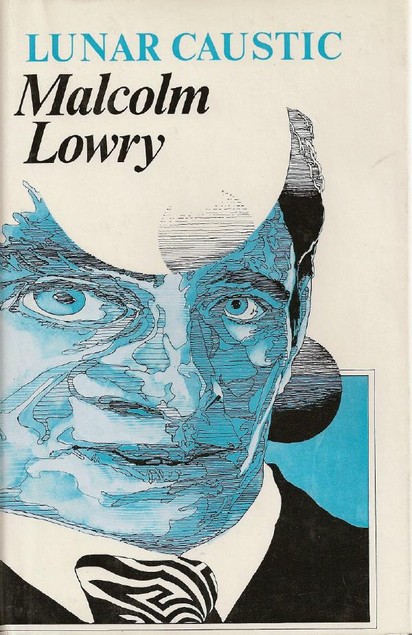
Lunar Caustic, Malcolm Lowry (1968). Which is perhaps chiefly interesting because of its publishing history. An early version of this novella was accepted for publication in Story magazine in the 1930s, but Lowry called it back. And continued to work on it. I can sort of understand the impulse. When Lowry died in 1957, he left behind several manuscript versions, and his wife and Earle Birney, a neighbour and university professor of English, spliced together this 1968 edition out of them. It’s set in a psychiatric hospital in New York and is, like much of Lowry’s fiction, partly autobiographical. There are moments of genius in it, though it does feel somewhat slight compared to some of his other novella-length fiction, especially ‘Through the Panama’. Also, its publication history has disguised the fact that it’s set in 1936, when Lowry checked himself into Bellevue Psychiatric Hospital (though he started work on it in 1934, on his arrival in New York). As a result, it feels weirdly old-fashioned for its time – given its publication year it’s tempting, for example, to read it as a contemporary of One Flew Over the Cuckoo’s Nest, which suggests that psychiatric hospitals changed very little in the intervening three decades. Lunar Caustic was intended to be a part of a seven-novel sequence, The Voyage That Never Ends, which would I suspect have been a major work of English literature. As it is, we can only treasure what little we have.

The Watcher, Jane Palmer (1986). And this one I did review for SF Mistressworks and you can see my review here.

Girl Reading, Katie Ward (2011). A very impressive debut, and almost certain to end up on my top five books of the year. I wrote about it here.

Sion, Philip Boast (1999). Boast’s weird alternate secret biblical histories are something of a guilty pleasure, but I think this one pushed the weirdness factor a bit too far. It’s set in Biblical Judea, and told from the point of view of Mary Magdalene. Except she’s not really Mary Magdalene. Whoever she is, she has lived before, and remembers historical events dating back to Moses and Abraham, and even much, much earlier. In Sion, Joseph and Mary belong to a sect, but Jesus also has brothers and sisters. And it was Jesus’ brother James who is considered the messiah of prophecy. But Jesus truly is the Son of God, although his message of love is anathema to the sect and to their conception of a messiah. Jesus marries Mary Magdalene, and after the crucifixion, Mary and child escape to France. The story is then narrated by their son, Jude, who travels and eventually discovers the Ark of the covenant and its secret. He dies and then becomes a disembodied intelligence who leaps from body to body, occasionally meeting up with his mother, who is apparently doing the same. The final section explains that Mary was a passenger aboard an asteroid starship crossing through this universe, but which crashed and stranded a group of them on prehistoric Earth. Or something. It’s not entirely clear. It’s a shame the book is so unbalanced, with far too much of the narrative spent on too detailed a description of Mary’s time in Judea. It’s only when Jude appears that it picks up pace, but even then it throws away the entire point of the plot in a hurried final section. Disappointing.

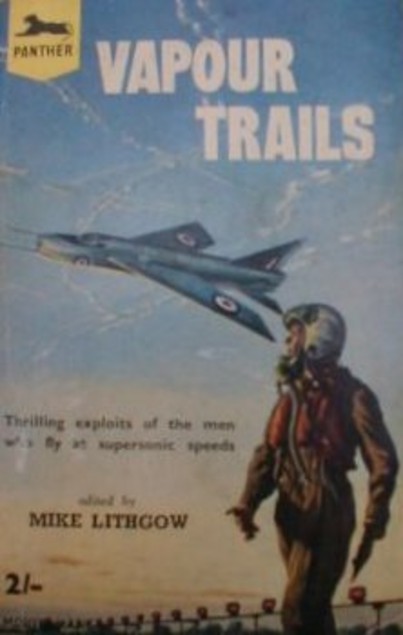
Vapour Trails, Mike Lithgow, ed. (1958). Funniest book I’ve read all year. It’s a series of essays about test piloting by British pilots of the day. You get the impression that a number of the anecdotes they recount have seen plentiful use in after-dinner speeches. The more astonishing incidents are those set during the really early days of aviation, where anyone with sufficient money could buy a plane and learn to fly it themselves. One test pilot, for example, tells of an incident in the 1920s at an airfield where he worked. A wealthy German had bought himself a Blériot plane and was learning how to fly it. Blériots, apparently, could manage an altitude of 200 feet on warms days, but only 20 feet on cold days. The German set off across the airfield in his plane, and eventually took off. Just as he was about to clear the hangars, he turned off his engine… and the plane promptly crashed. When asked why he’d turned off the engine, he explained he’d picked up a tail wind and thought that was enough to keep him flying… Recommended, even if you’re not an aviation buff.

The Ascendant Stars, Michael Cobley (2011). Is the third and final book of Cobley’s Humanity’s Fire space opera trilogy, and notable among such types of books in that it actually resolves the plot and leaves pretty much everything neat and tidy. In the previous two books – Seeds Of Earth and The Orphaned Worlds – Cobley went slightly berserk and set so many balls spinning, it was hard to keep track of them all. There was the invasion of Darien by an imperialistic alien race, there were the cyborg Legion of Avatars imprisoned in hyperspace and about to break free, the lost human colony who have been operating as mercenaries for the bad guys but have now schismed, the planned terrorist attack which turns out to be much more than it seems, and I forget what else. And it appears it’s all a feint or something because the Godhead, a vast machine intelligence resident in hyperspace, wants to transcend and needs to blow up fifty suns to do so. Cobley handles his large cast with deftness, there are some nicely-written set pieces, and his universe contains plenty of variety and diversity. However, and perhaps it’s just me, but it all feels a bit tired. The Humanity’s Fire trilogy is an accomplished space opera trilogy, but I’ve lost faith in the subgenre, in its “anything goes” ethos, its “chuck everything in” world-building… I think we’re seeing the end of new space opera, British or otherwise. It’ll either settle into a rut, much as high fantasy has done for the past twenty years, or it will slowly fade away. It already feels a bit like the twentieth century, ie a progressive experiment that people are inexplicably turning their back on – cf Leviathan Wakes. Regression is not the next step. We need something new to come along, and I think, and hope, we may be seeing New Hard Science Fiction poised to take its place…