It Doesn't Have To Be Right…

… it just has to sound plausible


2 Comments

British sf masterwork: The Uncensored Man, Arthur Sellings

When I put together my list of British SF Masterworks last year (see here), a number of eligible authors were suggested to me that I’d never heard of before. One such was Arthur Sellings who, I discovered, had written six novels and numerous short stories (many of which were collected in two collections) between 1953 and 1970. He died suddenly in 1968 of a heart attack, “just as he was gaining more and more notice” according to his entry in the SF Encyclopedia here.

Although I actually put Sellings’ 1970 novel, Junk Day, on my British SF Masterworks list, I have so far only managed to acquire The Silent Speakers (1962), his debut novel, and The Uncensored Man (1964), his second novel. It was the latter I read.

Dr Mark Anders is a physicist at Jarwood, a secret British weapons laboratory. He is married to Ruth, who also works there, but their marriage is faltering. Ruth is too perfect, and too much a perfectionist, and whatever spark their relationship had possessed has long since dissipated. In an effort to cheer himself up, Anders goes visits an old friend who is a doctor in a distant town. While there, he witnesses a teenage patient of the doctor’s have an epileptic fit, wake up and talk for a minute in German, and then fall into a light coma. But the boy has learning difficulties and has never been taught a foreign language. Intrigued, Anders investigates further, but draws a blank. Then his brand-new computer spits out a page of Greek writing instead of the expected experimental results. He gets this translated, and it proves to be a quote from the Book of Revelations.

Mystified, and suspecting he may be suffering from some psychological condition, Anders visits Dr Nowatski, A Polish psychiatrist he met briefly at a party years before. Nowatski gives Anders a shot of LSD – it was legal, in those days. Under the influence of the drug, Anders… visits a parallel world and meets its human inhabitants. The remainder of the novel describes Anders attempts to learn the truth of this alternate Earth, his run-ins with Jarwood’s security stemming from his association with Nowatski, and his subsequent development of mental powers.

The Uncensored Man is tosh, but it’s quite well-written tosh. The central premise – the origin and reason for existence of the alternate Earth – is neither plausible nor convincing. While Anders is a nuclear physicist working on neutron bombs, Sellings gives no information on his actual work. And though the reason why his computer spouts Greek is explained, how it actually does so is ignored. The book lacks authenticity.

However, Anders is a well-drawn character. Likewise Nowatski. The two women – Ruth, and Nowatski’s wife, Anna – are less rounded, though their treatment is sympathetic. In fact, they are repeatedly shown to be better persons than their menfolk. The prose is also good – in other words, it is typical of British sf of the 1960s, and so much better than US sf of the same period. US authors of the time may have had the ideas, but British sf authors had the writing chops.

The Uncensored Man is a very British novel, and very much a novel of its time. These days, it’s little more than a curiosity. It’s no masterwork, and it remains to be seen which of Sellings’ novels belongs on my list. It’s an interesting read, but not one, I think, that would have set the genre alight.

As mentioned earlier, I also have a copy of Selling’s debut, The Silent Speakers (published as Telepath in the US), and if I see other novels by him I’ll no doubt pick them up. But he was neither as good as Compton, nor as prolific as other British sf authors of the time, such as Tubb, Brunner or Cooper. Like Rex Gordon and Leonard Daventry, the fact he’s now forgotten does not seem entirely surprising. But it would not have done the genre a disservice to have had the likes of Sellings and his peers representing it rather than some of the sf novels we now consider to be classics.


1 Comment

Getting there

On 8 November, Phobos-Grunt, a Roscosmos mission to a moon of Mars, launched. Unfortunately, soon after achieving orbit the rocket engine designed to boost the space probe out of Earth orbit and on its journey to the Red Planet failed to fire. Engineers are working hard to fix the problem. They have until 12 November. After that, the space probe will not have enough fuel to make the trip.

Phobos-Grunt is an interesting mission. Yes, it’s a robot, and a crewed mission would have been much more exciting. But. It is a sample-return mission. Phobos-Grunt will land on Phobos, scoop up some of the regolith, and then a small section of the space probe will return the sample to Earth. The trip to Mars will take almost a year. And the same back again. In order to return some 200 gm of soil from a moon only 26.8 by 22.4 by 18.4 kilometres in size. It will be the first space probe to return an extraterrestial sample to Earth since Luna 24 in 1976.

Phobos

Mars at its closest approach to Earth is 56 million km, when Earth is at aphelion and Mars at perihelion. John Carter might be able to travel there in the blink of an eye – and lose all his clothes in the process – but Phobos-Grunt is having to make the journey the non-magical way using a Hohmann Transfer orbit. That puts the distance it needs to travel closer to 200 million kilometres. Phobos-Grunt will leave most of itself behind on Phobos and only a small capsule will return to the surface of the Earth.

Perhaps a detail or two there need to be stressed. 200 million kilometres. That’s roughly the same as travelling from London to New York about 36,000 times. If you did that continuously, refueling in the air, you’d be flying constantly for around 30 years. And then, once you’d completed your journey, you’d present scientists with a handful of dust. This is not to stress the inefficiency of the Phobos-Grunt mission, but its difficulty. Or rather, the near-impossibility of space travel to other planets. Which is something science fiction has traditionally ignored. Unless, of course, you count arriving stark naked at your destination a “difficulty”…

Looking closer to home, there are places which present real challenges to explorers. Such as, er, Challenger Deep. It’s considerably closer than Phobos, but it’s still 10,900 metres beneath the surface of the Pacific Ocean. That’s more than the height of Everest (which is 8,848 m). Challenger Deep has only been visited three times, and only once by human beings (see here). Two subsequent visits by robotic vehicles, in 1995 and 2009, took samples from the ocean floor. But Challenger Deep presents its own difficulties. The trip there might be relatively trivial. You just sink. But the pressure down there is something else. It’s over 1000 atmospheres, or 1250 kilograms per square centimetre. For Phobos-Grunt, the reverse is true: though extreme heat and cold, and radiation may cause problems, the vacuum of space is almost benign by comparison. On the other hand, whatever you send to Phobos has to survive a year-long trip…

It sometimes seems to me that the point of science fiction is to show how science and/or technology could overcome such problems. Not render them trivial, or even completely ignore them. But overcome them. Solve them. When Hugo Gernsback started Amazing Stories in 1926, he saw the genre as chiefly didactic. I don’t think it needs to be that – or rather, it doesn’t need to be overtly didactic. When Anthony Burgess wrote A Clockwork Orange, he intended for the novel to “brainwash” its reader into understanding Nadsat. That’s what sf should do. And while I don’t subscribe to Kim Stanley Robinson’s “the infodump is just another narrative technique”, I do think a reader should put down a sf text knowing more about something than they did when they picked it up. But as long as the genre continues to ignore the issues which science and technology can address, as long as it turns a blind eye to the obstacles which actually prevent its plots from occurring, then readers will not learn anything new from a sf text.

Does that mean science fiction should comprise only “improving” texts? Yes, why not? It’s not as if learning is a bad thing, after all.


Leave a comment

Going with the flow

So that’s the first week of Nanowrimo over. Seven days of trying to write 1,667 words – at least – a day. Of a novel about which I had nothing but the title and a vague idea on which to base it. By the end of Day 7, I had managed 11,666 words, which is pretty much on target.

But are they 11,666 good words? Well, no; not really. So far, Into the Dark, as it’s titled, is not very coherent. It’s not quite automatic writing, but it’s not far from it. But then it’s not as if I decided to do Nanowrimo expecting there to be a complete polished novel at the end. I’m doing it more to discipline myself into writing on a daily basis more than anything else. Though I do hope there will be something salvageable come the end of November.

The idea for the novel was simple. It would recount the first stage in humanity’s first mission to another star. Initially, this was going to be the preparations for the launch of the rocket which would take the crew of six up to their spacecraft waiting in orbit. The style would be very literary, but also hard sf.

Then I decided to move it back a bit. To before the launch. Instead, the crew would be coming to the end of a simulated mission in a copy of the spacecraft on the ocean bed. A bit like NASA’s NEEMO, but much deeper. The protagonist is a project director sent down to tell the crew that for reasons of politics they need to get them up into orbit as quickly, and covertly, as possible. But what this project director finds in the underwater habitat is not at all what he expected…

It’s nothing Deep Star Six or anything like that. No monsters, or psychopaths. Instead, all of the crew have converted to Fedorovism. And the project director, Beeney (yes, I named him after my cat), is convinced this is not good for the years-long mission. He finds it troubling and possibly dangerous.

At which point, Into the Dark has sort of gone all Heart of Darkness on me. Which may be a good thing.

Some things about the novel have proven happy accidents. I only have a cast of seven, and the story is told from only one point of view. It’s set entirely in the underwater habitat, which is small and limited. The plot has allowed me to throw in research I did for other stories – yes, the descent of the Trieste (see here) is in there; also stuff about the Mercury, Gemini and Apollo programmes. Nothing about Spitfires yet (see here), but give me time…

But mostly I’ve been completely winging it, and I suspect the chapters written so far are riddled with repetitions, inconsistencies, complete nonsense, and wild improbable swings in story-logic. But perhaps there are also one or two gems buried in the midden heap.

As for what I plan to do with manuscript once it’s finished… well, that remains to be seen. For now, it’s teetering on the edge of rescue.


Leave a comment

Prolificity

Well, not really. However, Alt Hist #3 was published yesterday and is currently available on Kindle here and from Smashwords here. I mention this because it is a good magazine, and because it contains my story ‘A Light in the Darkness’ about Wilfred Owen and Nikola Tesla. It’s alternate history, of course. One of these days I’ll have to have a go at a straight historical story. But for now, go out and buy Alt Hist #3. It’s a good thing.


23 Comments

Bookjoy: more Compton

Synthajoy was DG Compton’s fourth science fiction novel. Previously, he had written half a dozen crime novels under the name Guy Compton. So it should come as no surprise that Synthajoy is as much a crime novel as it is a science fiction novel.

Thea Cadence has been incarcerated in the Kingston, a clinic designed to rehabilitate criminals using the Sensitape process. Thea’s husband, Dr Teddy Cadence invented Sensitape – or rather, he invented the concept. The device itself was invented by Tony Stech, his business partner. Sensitape is, as the name suggests, recorded emotional states which can be played into a person’s mind, and thus directly affect it. At the Kingston, Thea is undergoing Sensitape treatment in contrition as her sentence for a crime.

Cadence had been inspired to invent Sensitape while attempting to cure Stech’s father of an increasingly common condition called UDW, Uncompensated Death Wish. He failed to prevent the man’s death, but Sensitape did subsequently make UDW extremely rare. In fact, Sensitape was a great success. But the recording made of a couple making love, Sexitape, was an even bigger success. Cadence, however, always dreamed of artificially creating the emotions on a Sensitape, i.e., deliberately programming the effect required. He called this process Synthajoy.

Thea drifts in and out of her memories as she is being treated. Though she did not defend herself during her trial, she does not consider herself guilty of the crime. She resists her rehabilitation treatment. And in between periods of introspection and rebellion, she relives – or explains to her nurse – the history of Sensitape and her involvement with it. In this way, facts pertinent to the crime of which she has been charged are revealed.

Thea murdered her husband.

An early Sensitape session in which she was the guinea pig gave her a revulsion for her husband’s body. He found sexual companionship in the arms of another woman – the one from the Sexitape, in fact. Thea meanwhile had an affair with Tony. Who later committed suicide under suspicious circumstances. During her trial, the prosecution claimed it was jealousy that had led to the murder. They did not know of Thea’s relationship with Tony, nor did she tell anyone of it.

Synthajoy is a carefully-plotted ramble through Thea’s consciousness and history. She is hiding the truth from herself as much as she is from her prosecutors and rehabilitators. And it is only as she reveals her past that the truth about Tony’s suicide and the murder of Dr Cadence are uncovered. Unlike later novels, Synthajoy is a single-hander, and told entirely from Thea’s point of view. She is intelligent, educated, middle-class, and beautifully real. Unsurprisingly, the writing is a joy to read:

It is extraordinary to watch my hands. They smooth and fold, now so neat and expert, so accomplished now that they act without mind, without my volition … Hope is like a fever, a heat engendered by battle, and it leaves a deadly chill behind it. My arms ache. My hands tingle and creak. (p 50)

Also, unsurprisingly, the book is very firmly British, and very firmly a novel of the late 1960s / early 1970s. (It was first published in 1968). Those characteristics, as much as the writing, are the essence of Compton’s appeal. His novels are fiercely intelligent and beautifully crafted, but it is their finely-tuned sense of time and place, the way the central ideas are so well integrated into the real world, that makes them stand out.

There are ideas that Compton returns to again and again. The abuse of technology is an obvious marker – and one that demands a story set in as close an analogue of the real world as is possible. And yet… It seems odd that Compton should begin his writing career in crime, writing novels in which the purpose of the story is to explain a death. Yet his science fiction novels typically feature epidemics of unexplainable deaths – UDW in Synthajoy, Gordon’s Syndrome in The Continuous Katherine Mortenhoe (see here), and the Disappearances in Ascendancies (see here).

In his three decades of writing science fiction, Compton never won an award, despite being published regularly in both the UK and the US. The Steel Crocodile was shortlisted for the Nebula in 1971, but lost out to Ringworld (an extremely popular book, but nowhere near as well-written). He appeared on the Locus Award shortlist three times, and in 2007 the SFWA made him an Author Emeritus. Yet he was possibly the best British sf writer of the 1970s. At a time when US authors of the 1950s dominated the field on both sides of the Atlantic – Asimov, Smith, Herbert, Heinlein – Compton was one of a handful of British sf writers writing sf novels so much more intelligent and well-crafted than those of their contemporaries. It’s a shame they appear to be mostly forgotten, and it’s the likes of Foundation and Stranger in a Strange Land which dominate lists of so-called genre classics. Perhaps the re-issue of Compton’s back-catalogue as ebooks through the SF Gateway (Compton’s entry is here), and The Continuous Katherine Mortenhoe‘s appearance in the SF Masterwork series in October 2012, will see Compton receive the recognition he deserves.

The following novels by Compton are currently available on Kindle via the SF Gateway. If you own such a device, you should buy them immediately: Farewell, Earth’s Bliss (1966), The Silent Multitude (1966), The Quality of Mercy (1967), Synthajoy (1968), The Steel Crocodile (1968), Chronocules (1970), A Usual Lunacy (1978), Windows (1979), Ascendancies (1980), Scudder’s Game (1988), Nomansland (1993), Justice City (1995) and Back of Town Blues (1997).


2 Comments

Oh no what have I done?

I appear to have done something very foolish. I was sort of toying with the idea, but I didn’t really intend to do it. I mean, it’s not like I haven’t got enough on my plate already. So I’ve no idea what possessed me to sign up for Nanowrimo this year.

But I did.

Well, I had this idea for a series of novels, a sort of literary treatment of a hard science fiction staple: the first interstellar mission. This was inspired – structurally, that is – by the likes of CP Snow’s Strangers & Brothers, Anthony Powell’s A Dance to the Music of Time and Simon Raven’s Alms for Oblivion. The individual novels would be short – in fact, Nanowrimo’s 50,000-word target is pretty much the perfect size. Anyway, I wanted to see if the idea worked, if I could write something of that sort of literary hard sf. And Nanowrimo seemed like a good way to motivate myself.

I could have chosen a better time, however. It’s not like I’d have spent November twiddling my thumbs. There’s Rocket Science to get sorted out – once I’ve decided on a final TOC, I need to start line-editing the contributions. Then there’s the fiction in various degrees of completion I have knocking about on my computer. Some just need a quick buff and polish; others need need me to work what the hell is going on in them. Plus, there’s the many reviews I need to get done…

Anyway, Nanowrimo. Write 50,000 words by the end of the month. That’s 1,667 words a day. That’s all I have to do. Yeah right. You can find me on the Nanowrimo website here. It should be… interesting.


Leave a comment

The future we used to have, part 6

Time for yet another in my ongoing series on retro-futures. The past, they say, is another country and they do things differently there. But the future we’ve come to inhabit is every bit as different as the one the past imagined into existence. And not necessarily for the better. We never had utopia within our reach, but neither should we have turned our back on the struggle towards it.

There is something that strives towards utopia in Brutalist architecture – which no doubt explains why so many Brutalist projects did not ultimately survive. The car designs of Nuccio Bertone seem to me the closest automobile equivalent. And I still think the Lamborghini Marzal is one of the nicest-looking cars ever designed. According to Wikipedia, the Marzal was a one-off concept car, but I have a very clear memory of seeing one in lime green in Doha, Qatar, during the early 1970s. It belonged to a sheikh, and my father even got to drive it.

buildings

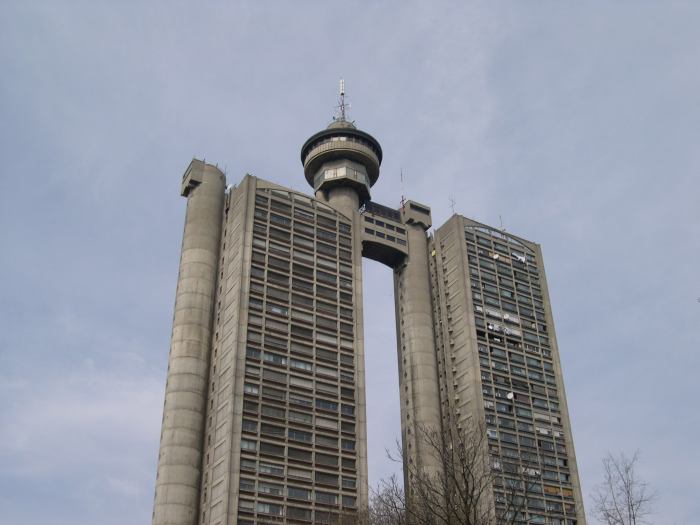
Genex, Tower, Belgrade

Habitat 67, Montreal

Torres Blancas, Madrid

Geisel Library, University of California, San Diego

Tricorn Centre, Portsmouth (demolished 2004)

Alexandra Road Estate, London

cars

Lamborghini Marzal, 1967 (Bertone)

Inside the Lamborgini Marzal (Bertone)

Alfa Romeo Navajo, 1976 (Bertone)

In the future, all drivers will wear crash helmets and skintight clothing: Alfa Romeo Carabo, 1968 (Bertone)

In the future, all drivers will wear bikinis: Ferrari 512 S Modulo, 1970 (Pininfarina)

planes

Boeing 733 SST

Myasishchev M-50 Bounder supersonic bomber

Rockwell XFV-12 supersonic VTOL fighter

McDonnell XF-88B hybrid supersonic jet-turboprop fighter

space

Hyperion Single Stage To Orbit (Philip Bono)

ROMBUS, Pegasus and Ithacus SSTOs (Philip Bono)

Boeing LEO SSTO

Soviet SPIRAL Project: GSR and OS (source: http://www.buran-energia.com)


2 Comments

Reading snapshot meme

David Hebblethwaite has just done this on his blog, and I read his blog, so I guess I’ll have a go at it. Again. Because we’ve all done this before. But so what: it’s about books. Books are good, and reading them is even better. The only thing better than reading that you can do with books is, er building a fallout shelter with them and pretending World War III has happened. Or maybe a zombie apocalypse. And while the rest of the world succumbs to anarchy and chaos and radiation / undeadedness, you read the books you built your shelter from. Win.

Anyway, the meme: it goes like this:

1. the book I’m currently reading
Synthajoy, DG Compton – the best British science fiction writer of the 1970s, and his novels continue to be superb and very, er, 1970s. And that’s why I think they’re brilliant.

2. the last book I finished
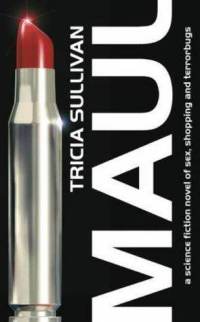
Maul, Tricia Sullivan – this was October’s book for my reading challenge (see here), and I was expecting to like this a lot more than I did. Proper full write-up to follow soon-ish. For the present, I will say it has a slightly American Psycho vibe to it which, like that book, struggles to convince, and a near-future in which men are exceedingly rare, and correspondingly prized, due to a plague, which feels like an entirely different type of society.

3. the next book I want to read
The Unit, Ninni Holmqvist – the TBR actually numbers in the hundreds, but I have a sort of mini-TBR, a half-dozen books which will be my next immediate reads. And top of this list is The Unit, which Michaela Staton gave me ages ago and keeps on asking me what it’s like. It does look very interesting, in fact.

4. the last book I bought
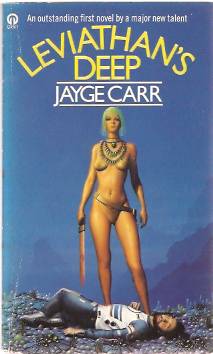
Leviathan’s Deep, Jayge Carr – when I say “bought”, I didn’t pay any money for this. It was priced 50p but since we’d just given the Harewood House second-hand bookshop two carriers bags full of books, they let us have the handful we wanted for nothing. Which was pretty cool, as Leviathan’s Deep had been on the wants list since reading Carr’s story in Women of Wonder: the Contemporary Years (see here). It’s a shame about the slightly dodgy cover art, though.

5. the last book I was given
Blood Count, Robert Goddard – I have no excuse for this one. Goddard writes formulaic potboilers, but I’ve read every one of his books to date. My mother got this from the above-mentioned second-hand bookshop, and has passed it on to me. In their defence, they are very quick reads.


13 Comments

Why there’s nothing fantastic about science fiction

We all like our genre labels, even if we argue over their provenance – literary genre, marketing category, or whatever it is we are pointing at. But people have a natural tendency to categorise things, to seek out patterns, in order to make things more manageable. It helps no one to insist that there is no such thing as genre, that all literature is one big amorphous field in which authors play with a selection of tools. Not only does this fail to recognise the nature of those tools, the author’s intent, or the reader’s response, it hampers discussion and confuses matters.

Genre exists. Deal with it.

There are also those who like to lump science fiction and fantasy together as a single genre. Certainly, they can both be found in the same part of a book shop. They call this “speculative fiction”. But sf and fantasy have as much in common as… sf and mainstream fiction, say, or fantasy and crime fiction; than they have in common with each other. Sf and fantasy and crime, for example, share a reliance on plot; or, sf and fantasy can be as mimetic as literary fiction.

In fact, other than the (not obligatory) use of invented worlds, sf and fantasy have very little in common. And there are mainstream novels which use invented locales – such as South Riding, Barchester, Wetherton or Kings Markham. But then, all literature is speculative, all literature is imaginative – but that doesn’t make all literature the same.

Even distinctions between “science fiction” and “category science fiction” are facile. The latter is what some people use to describe books sold as science fiction – the difference, in other words, between an Iain M Banks’ Surface Detail and Cormac McCarthy’s The Road. The former has “SF” on its spine, and is shelved in the sf and fantasy section of the book shop.

As for science fiction and fantasy belonging to an all-encompassing “speculative fiction” genre… That too is a failure of taxonomy. They are entirely different modes. Science fiction is, at heart, modernist. It may be plot-dependent, which much modernist literature is not, but its modern form was certainly created as a means of explaining an ever-changing industrialised world. It even began in an electronics magazine! Sf’s self-reflective nature – i.e., “a genre in conversation with itself” – is also a characteristic of modernist fiction. As is the gradual shift from a chiefly utopian mode to a dystopian one.

Fantasy displays none of these characteristics. It is not always plot-dependent, though epic/high fantasy (i.e., secondary world fantasies) tends to rely heavily on either the quest or hero’s journey templates. It does not seek to explain the world, but to lend it further mystery; its worlds are not open to explanation. It is neither utopian nor dystopian, but always returns to the status quo. It is not self-reflective, though over the decades it has built up a large toolbox of conventions and tropes.

Without genres, we cannot discuss literature intelligently. Without taxonomy, we cannot know what we are talking about. As marketing categories, sf and fantasy serve a purpose for readers and purchases and fans. But sf and fantasy as definable (however nebulously) modes of fiction provides the context we need to engage and comment on fictions displaying genre characteristics.


3 Comments

World book meme!

Book meme! Here are the 25 titles chosen for 2012’s World Book Night. Do the usual: bold for read, italics for owned by unread. And, given the multimedia nature of our cultural landscape, asterisk those with film or television adaptations you have seen.

*Pride and Prejudice by Jane Austen
The Player of Games by Iain M Banks
Sleepyhead by Mark Billingham
Notes from a Small Island by Bill Bryson
The Alchemist by Paulo Coelho
The Take by Martina Cole
Harlequin by Bernard Cornwell
Someone Like You by Roald Dahl
A Tale of Two Cities by Charles Dickens
Room by Emma Donoghue
*Rebecca by Daphne Du Maurier
*The Remains of the Day by Kazuo Ishiguro
Misery by Stephen King
The Secret Dreamworld of a Shopaholic by Sophie Kinsella
Small Island by Andrea Levy
*Let the Right One In by John Ajvde Lindqvist
The Road by Cormac McCarthy
*The Time Traveler’s Wife by Audrey Niffenegger
The Vanishing Act of Esme Lennox by Maggie O’Farrell
*The Damned Utd by David Peace
Good Omens by Terry Pratchett & Neil Gaiman
How I Live Now by Meg Rosoff
Touching the Void by Joe Simpson
I Capture the Castle by Dodie Smith
The Book Thief by Markus Zuzak

Not so good a score: six read, six seen. None on the TBR. Oh well.