Well, I didn’t see that coming. I was expecting a more literary shortlist, but this one is definitely more core genre. So much so, in fact, that at least half of the books harken back to much older sf. Hull Zero Three is a generation starship story (with, apparently, a resemblance to Pandorum), and The Waters Rising is a sequel to a book published in 1993. Embassytown I’ve read (my review here), and thought it somewhat 1970s in story and style.
The remaining three at least appear to be more relevant. I’ve read The Testament of Jessie Lamb and thought it very good – well, I thought the first half excellent, and the second half less good. Rule 34 I may try reading, but The End Specialist doesn’t appeal at all.
Anyway, once again the Clarke Award has confounded expectation, something it has done since it was first inaugurated. I am, perhaps, a little disappointed in the shortlist – there were, I thought, better books than some of the ones chosen. Interestingly, Nicholas Whyte guessed four of the six, and could have guessed five of them, simply from their popularity on Goodreads.com and LibraryThing.com. Does this mean the Clarke was looking for “readability”, just as the Booker judges foolishly claimed to be last year? I’m pretty sure that’s not the case, but I do think there was an attempt at narrowing the definition of science fiction after previous years’ occasionallly bizarre flexibility over the term.
And no, I’m not going to predict the winner. I just hope it’s not Miéville.
Early Monday 26 March 2012 local time, film director James Cameron became the third person to visit Challenger Deep, the deepest part of the ocean. It was last visited in 1960, by Jacques Piccard and Don Walsh in the bathyscaphe Trieste – see here. Challenger Deep is a slot-shaped depression in the floor of the Marianas Trench, is 10,898.4 metres beneath the surface of the sea, where the water pressure is 114,000 kPa (about seven tons per square inch).
Cameron made the trip in a submersible called Deepsea Challenger, which was developed in secret. Unlike the Trieste, it did not use gasoline for buoyancy, but syntactic foam. The trip took Cameron over two hours, less than half the time it took Piccard and Walsh to make the same journey. He remained on the ocean floor for three hours – and not the planned six due to a hydraulic fluid leak. The Trieste spent less than twenty minutes in Challenger Deep.
There is an X-Prize associated with Challenger Deep: $10 million to the first organisation to make two crewed descents. This does suggest Deepsea Challenger will make another trip soon.
The fact that a private individual has achieved this – and he wasn’t the only one planning to do so: Richard Branson has a submersible of his own – does make you wonder if the first trip to Mars will be funded by some starry-eyed multi-billionaire. In Terry Bisson’s Voyage to the Red Planet (1990), the first Mars mission was partly funded by a film studio, who wanted to make a movie there. The novel was intended as a satire, but it could be sadly prophetic.
This is not to belittle Cameron’s achievement – though, to be fair, it hardly presented any insurmountable engineering challenges. The Trieste made the trip more than half a century ago, and consisted of a hollow steel ball attached to a float filled with petrol. Its designer, Auguste Piccard (incidentally, Hergé’s inspiration for Professor Calculus), had started work on his first bathyscaphe in 1937, and the Trieste‘s keel was actually laid in 1953. Deepsea Challenger is a far more sophisticated vessel, but a descent to Challenger Deep could have been made any time during the past fifty years.
All the same, it’s pretty cool. Though I doubt we’ll ever see people living and working in Challenger Deep.
Well, I used to do readings and watchings posts, and since I did 30 words on 30 books, I should do the same for the movies I’ve watched. It’s the usual eclectic mix, of course.
Bunny Lake Is Missing, Otto Preminger (1965)
American expats newly arrived in London misplace young daughter, but then it seems daughter might never have even existed. Police very confused. But all a cunning plot. Curiously low-key thriller.
Limitless, Neil Burger (2011)
Just think what you could if you had total mental focus. Why, you could make movies like this one. Smart drug leads to smarter than expected film. Actually worth seeing.
The Girl with the Dragon Tattoo, Niels Arden Oplev (2009)
Swedish TV series original. Swedish Nazi back during WWII proves to be psycho killer. Big surprise. Journo and hacker chick investigate. Interesting thriller with good characters and sense of history.
The Girl Who Played With Fire, Daniel Alfredson (2009)
Lisbeth Salander tracks down her evil dad, ex-KGB bigwig. He tries to kill her but she won’t be put down. Thriller series turns silly as Salander develops superpowers. Or something.
The Girl Who Kicked the Hornets’ Nest, Daniel Alfredson (2009)
Salander’s evil dad was protected by secret group within Swedish spy services as Millennium trilogy jumps shark. Drawn-out courtroom drama stretches credulity way past breaking-point. Makes 007 look eminently plausible.
Red Psalm, Miklós Janscó (1972)
Hippie paean to 19th century Hungarian peasant revolts, with much socialist declaiming, folk songs, striding about and a complete lack of coherent plot. Brilliant. Loved it. More please. Review here.
Mr Deeds Goes To Town, Frank Capra (1936)
Simple but honest man inherits fortune and elects to do good with it. Establishment aren’t having it and try to have him declared mentally unfit. Heart worn blatantly on sleeve.
Grave of the Fireflies, Isao Takahata (1988)
During WWII, kids run away from mean aunt and hide out in abandoned air-raid shelter. Of course, they’ve no idea how to cope on own. Sad story spoiled by mawkishness.
Claire’s Knee, Éric Rohmer (1970)
Fifth of Rohmer’s Six Moral Tales. Educated French middle-class people pontificate on love while one of them fantasises about a teenage girl’s knee. Too many words, not enough insight. Meh.
Red Desert, Michelangelo Antonioni (1964)
A dubbed Richard Harris visiting Ravenna gets friendly with his friend’s wife, mentally-fragile Monica Vitti, in beautifully-shot industrial landscape. Incredibly painterly film. Slow but involving. Brilliant. Loved it. Review here.
Ivan’s Childhood, Andrei Tarkovsky (1962)
Tarkovsky’s first feature film. Orphaned boy acts as scout behind enemy lines for Red Army in WWII. Many touches of Tarkovsky genius but much more straightforward than his other films.
Torment, Alf Sjöberg (1944)
Bergmans’ first film, though he only provided script. Moody student carries on with corner-shop girl, but she is murdered – and nasty teacher did it. Hitchcockian thriller seen through distorting mirror.
8½, Frederico Fellini (1962)
Saw La Dolce Vita years ago and not impressed, so surprised to discover I loved this. Marcello Mastroianni meditates on life and art while making sf film. Huge ending. Glorious.
Heaven Can Wait, Ernst Lubitsch (1943)
Technicolor New York in 19th century as dead self-effacing millionaire Don Ameche is sent to Hell and is forced to reveal he was actually a nice bloke. Not a classic.
Melancholia, Lars von Trier (2011)
Planet on collision course with Earth. Everyone panic. Except people with clinical depression, that is. Lovely photography, good acting, bollocks physics. Can’t honestly see why people rate this so highly.
My Night at Maud’s, Éric Rohmer (1969)
Third of Rohmer’s Six Moral Tales. Catholic stalks young woman, then talks about religion, fidelity and love with friend and his girlfriend all night. Lessons to be learned. I think.
Gentlemen Prefer Blondes, Howard Hawks (1953)
Marilyn Monroe and Jane Russell whoop it up among dirty old men on liner to Europe. It’s a cunning plot to force Monroe’s beau to declare. Goes wrong. Technicolor fun.
Summer With Monika, Ingmar Bergman (1953)
Young working-class lovers run away to Swedish islands. Monika gets pregnant, they return to the real world. But Monika’s not the home-making type. See, it was grim in Sweden too.
Santa Sangre, Alejandro Jodorowsky (1989)
Boy grows up in circus, witnesses mother have her arms cut off by mad knife-thrower. Years later, she uses him to commit crimes. It’s by Jodorowsky. So it’s completely bonkers.
Les Enfants Du Paradis, Marcel Carne (1945)
The lives and loves of assorted theatre types in early 19th century Paris. Three hours long, and feels like it. A classic to many, I found it slow and dull.
Pocketful Of Miracles, Frank Capra (1961)
Homeless lady is lucky charm for gangster in 1920s New York in cross between Cinderella and Pygmalion. Played for laughs but not much is a laughing matter. Capra’s last film.
The Magician, Ingmar Bergman (1958)
Max von Sydow gurns in title role as three town worthies take the piss out him in 19th century Sweden. Science vs magic and the fight is fixed from start.
Sucker Punch, Zack Snyder (2011)
They’re mental patients. No, they’re prostitutes. No, they’re super agents in steampunkish fantasy world. In corsets and stockings. Kick-ass women as exceptional – and hot – tools of patriarchy. Wrong message.
Captain America, Joe Johnston (2011)
Possibly the best of the recent rash of superhero films. Retro-action during WWII as Cap sells war bonds across US and then tackles Red Skull in his lair. Almost fun.
Black Swan, Darren Aronofsky (2010)
Ballet dancer driven to dance perfectly driven to madness. Well-played, though not the most original story ever. At least her shoes weren’t red. Have yet to figure out Aronofsky’s career.
Highlander 5: The Source, Brett Leonard (2007)
Worst film in a bad franchise, and possibly worst film ever made. Even the covers of Queen songs were terrible. There can only be one. Nope. Fear for your sanity.
Transformers 3: Dark of the Moon, Michael Bay (2011)
More coherent than earlier Transformers films, but just as offensive. Irritating, stupid, and wrong, wrong, wrong. It’s not big and it’s not clever – someone should tattoo that on Bay’s forehead.
The Imaginarium of Doctor Parnassus, Terry Gilliam (2009)
Carnival-type caravan wanders London and there are wonders within. Famously whimsical director produces another piece of whimsy. Yawn. Heath Ledger died during film, but story was rescued. Still dull, though.
Szindbád, Zoltán Huszárik (1971)
A classic of the Hungarian New Wave, just like Red Psalm. Just shows how individual are responses to such films. Loved Red Psalm, but found this one a bit dull.
In Shakespeare’s As You Like It, Rosalind runs away to the Forest of Arden with her friend Celia. In order to prevent discovery, Rosalind disguises herself as a boy and takes the name Ganymede. In the forest, she meets Orlando, who pines for Rosalind. He does not recognise Ganymede as her, and she offers to pretend to be Rosalind so that Orlando can practice his love poetry. Meanwhile, the shepherdess Phebe has fallen in love with Ganymede (who is really Rosalind).
In Shakespeare’s day, the female roles would have been played by boys.
So we have a boy playing a girl who disguises herself as a boy who then pretends to be a girl so another man can practice his wooing. And another boy playing a girl becomes besotted with the boy playing a girl disguised as a boy.
Now some Tory MP thinks that allowing gays to get married might result in Shakespeare, among others, being rewritten in order not to offend members of same-sex marriages? What an idiot.
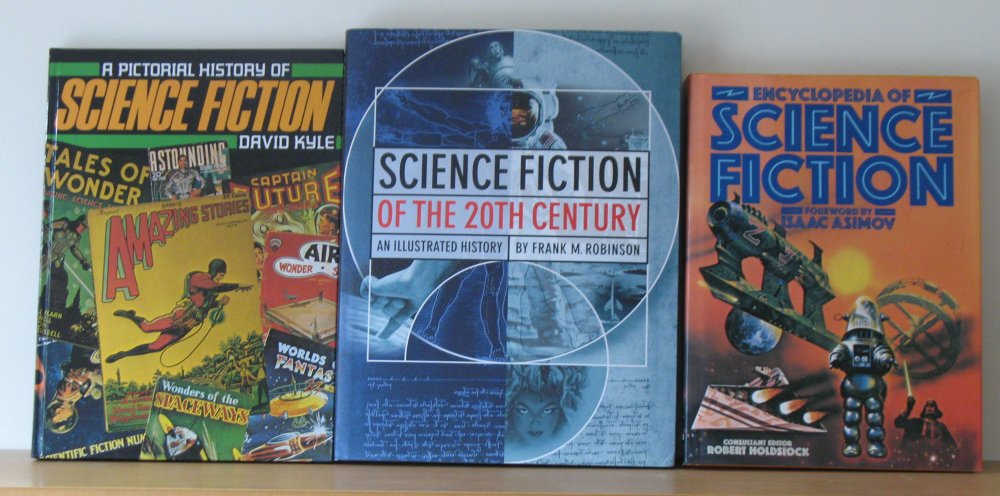
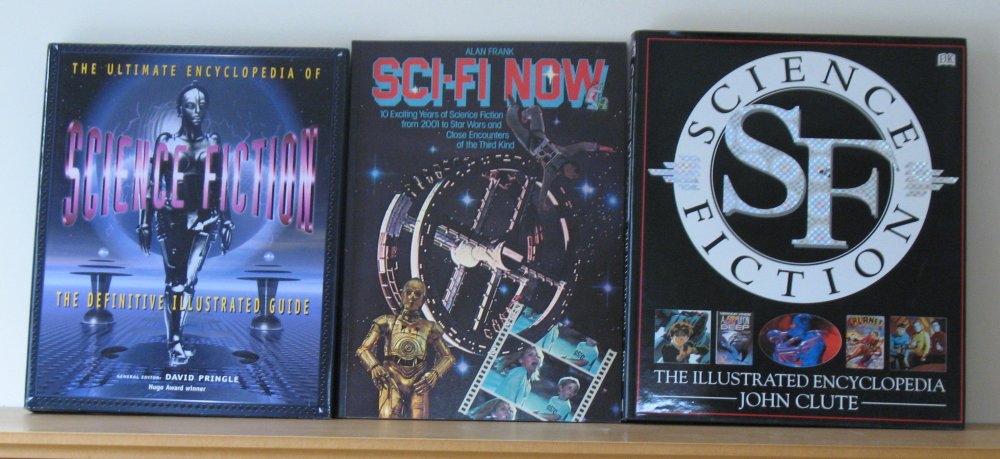
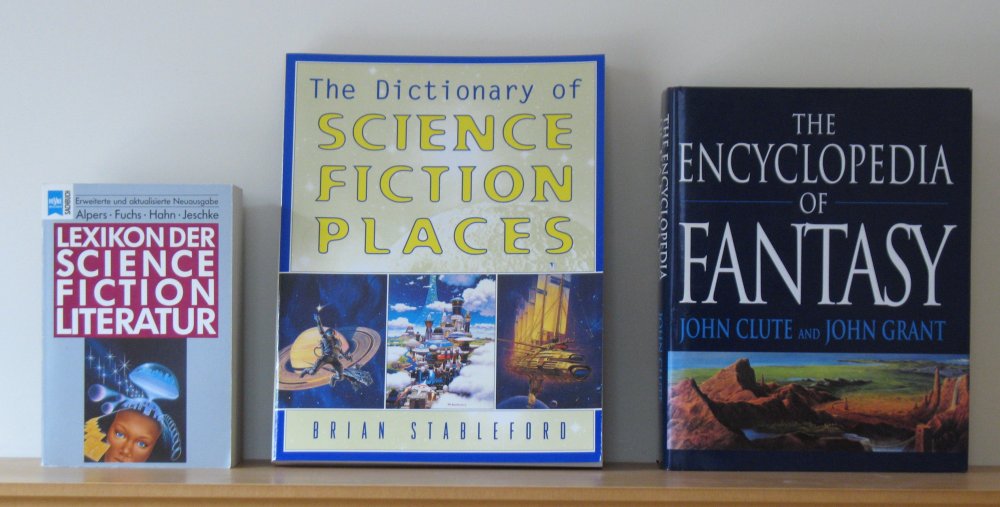
According to Damon Knight, “science fiction is whatever I’m pointing at when I say ‘science fiction'”, which is about the most useless and yet most accurate definition of the genre to date. Which has not stopped countless people trying to come up with definitions of their own. They’ve even written entire encyclopaedias on the subject. These are some of the ones I have on my book-shelves…
Peter Nicholls’ 1979 The Encyclopedia of Science Fiction was the first such. I bought a paperback copy for £1 at an antiques fair back in the late 1980s, but later picked up a hardback copy for a fiver on eBay several years ago. I have two copies of the next version, Clute & Nicholl’s The Encyclopedia of Science Fiction, because I bought the hardback edition when it was published – RRP £45!; but I got it for £27 from an acquaintance who claimed to have contacts in the book distribution trade. Anyway, when I moved to the Middle East after graduation, the book went into storage. But I stumbled across a paperback copy of the US second edition in Abu Dhabi. I don’t remember where I got the James Gunn The New Encyclopedia Of Science Fiction from. The latest version of The Encyclopedia of Science Fiction is, of course, online at sf-encyclopedia.com.
A trio of coffee-table books on science fiction. The Kyle and the Holdstock I’ve had for a couple of decades. Science Fiction of the 20th Century by Frank M Robinson I found cheap on eBay a few years ago.
No collection of science fiction encyclopedias would be, er, complete without Clute & Grant’s The Encyclopedia of Fantasy. Lexicon der Science Fiction Literatur I bought while studying in Aachen in 1990. According to my records, I bought The Dictionary of Science Fiction Places for £2 in a discount book shop in Harrogate in 2004.
Edit: for reference, my post on critical works on science fiction is here.
I shamelessly stole this idea from Pornokitsch, who did the same yesterday. Since I’m not doing my readings & watching posts this year, I thought thirty words on the last thirty novels I’ve read might be a good way of mentioning my recent reading. But 30 words is actually harder to do than it looks…
Final Days, Gary Gibson (2011)
Discovery on planet orbiting distant star reached by wormhole suggests future is fixed and immutable. World starts to fall apart. Nice Apollo re-enactment but otherwise not that much stands out.
The Member of the Wedding, Carson McCullers (1946)
Tom Sawyer-ish Frankie daydreams of brother’s wedding. A GI mistakes her age, wants to get frisky. Lovely writing, though it’s hard not to suspect Frankie is wrong in the head.
Like A Sniper Lining Up His Shot, Jacques Tardi (2010)
Graphic novel adaption of French thriller set in the UK. Assassin like father like son. With guns. And gore. Not much more to be said. Tardi is definitely worth reading.
Bodies, Jed Mercurio (2002)
Incompetent doctors get away with murder on the NHS. New houseman is horrified. He learns to work with the system. A favourite writer but it will scare you off hospitals.
City of Pearl, Karen Traviss (2004)
First human colony disappears, rescue mission discovers aliens protecting them. Mix of hard sf and space opera. Nice heroine, not so interesting aliens. Oozes competence without suggesting more. Review here.
The Bender, Paul Scott (1963)
Should have been a film with Dirk Bogarde. 1960s wastrel goes begging for cash and sparks family crisis. Great wit, great writing, and an astonishing postmodern interlude. Recommended. Review here.
Leviathan’s Deep, Jayge Carr (1979)
Freak alien resembles humans. They want to conquer her planet and fall in love with her. She scuppers their plans. Somewhat old-fashioned sf, though protagonist well-drawn. Review on SF Mistressworks.
The Bookman, Lavie Tidhar (2010)
Literary and pulp potage which stripmines steampunk tropes. Orphan adventures, starts cleverly in Victorian Lizard London but loses steam about halfway through before Bond-esque Vernian finish. The first of three.
Omega, Christopher Evans (2008)
Man recovering from terrorist bomb explosion dreams himself into alternate self in a world where WWII never ended. Very cleverly done, alternate world very real, great writing. Recommended. Review here.
Angel At Apogee, SN Lewitt (1987)
Princess pilot, a hot-shot of course, proves to be catalyst which rejoins three sundered races on three separate planets. Interesting debut, though perhaps a little over-egged. Review on SF Mistressworks.
The Fat Years, Chan Koonchung (2009)
China prospers while rest of world in financial crisis. Interesting window on Chinese society, though unsatisfactory as a novel – the plot is explained in a final chapter info-dump. Review here.
The Fall, Albert Camus (1957)
Pompous ex-lawyer monologues at stranger in Amsterdam bar and over several days tells him of his somewhat boring fall from grace. Mercifully short, though there’s some insightful writing in it.
Selected Poems, Lawrence Durrell (1956)
It’s a book of poems. And they were selected. By Lawrence Durrell. He did this several times. Except when he wasn’t collecting his poems for his Collected Poems. More here.
Betrayals, Charles Palliser (1994)
A story told through several stories – including a superb pisstake of Taggart, and a righteous skewering of Jeffrey Archer. Superbly done, though perhaps needed the stories tying together more. Recommended.
Leviathan Wakes, James SA Corey (2011)
Solar system shenanigans as alien virus wreaks havoc for corporate profit. Who needs New Space Opera? Regressive: no diversity, old school sexism, implausible villainy. Mostly right physics. Avoid. Review here.
Native Tongue, Suzette Haden Elgin (1984)
Men repeal rights of women, so they secretly develop women’s language. Interesting linguistics, good female characters, though characterisation of men not so convincing and world-building weak. Review on SF Mistressworks.
This Island Earth, Raymond F Jones (1952)
Manly engineer saves the galaxy by demonstrating good old US engineering know-how. Womanly PhD does his ironing and cooking. Happily they don’t write them like this any more. More here.
The Lady in the Lake, Raymond Chandler (1944)
Mixed-up femme fatales don’t fool Marlowe in hunt for rich man’s missing wife. Not the cunningest murder-mystery plot and Marlowe often gets away with murder. Strong on place and time.
The Door, Magda Szabó (1987)
In Hungary, writer hires housekeeper, who proves to be old school peasant and a right character. Fascinating portrait of housekeeper, thoroughly enjoyed it. Soon to be major film. Review here.
The Unorthodox Engineers, Colin Kapp (1979)
Collection of sf shorts in which lateral thinking engineers solve seemingly intractable problems. Dated, problems not especially unsolvable, nor especially original. Entirely forgettable, in fact. Hard book to find, though.
Journey to the Centre of the Earth, Jules Verne (1864)
Story not as good as Nemo’s though text is more pleasingly detailed. Science horribly dated, of course, and often wrong. Characters bizarrely emphatic – except for phlegmatic Icelandic guide. Historical document.
Arkfall, Carolyn Ives Gilman (2008)
Novella set on human-colonised Europa-like planet with interesting socialist society. Woman and male tourist find themselves on unintended journey after seaquake. Promises more than it delivers but still worth reading.
Kamikaze l’Amour, Richard Kadrey (1995)
Kadrey channels Ballard and Shepard in rock star epiphany in California overrun by Amazonian jungle. Not sure how original was 17 years ago but is not now. After Metrophage, disappointing.
Smart-Aleck Kill, Raymond Chandler (1958)
Collection of four shorts. Simple direct prose, strong on place and time, though plotting something of a direct line and characterisation sketchy. More for noir fans than normal readers, possibly.
Embassytown, China Miéville (2011)
Truthful aliens get hooked on impossible Ambassador’s speech. World falls apart. Narrator teaches aliens to lie and saves planet. Interesting ideas but old-fashioned science fiction. Likely award-winner. Sigh. Review here.
Dr No, Ian Fleming (1958)
Bond in Jamica. Again. Racial stereotype has evil plan to do evil. Bond foils, with help of trusty local. He nearly dies in the process, but he gets girl. Again.
The Incal, Alejandro Jodorowsky & Moebius (1981)
Seminal bande dessinée allegedly cobbled together from failed Dune film project. Light and dark Incal combine to save galaxy from evil Darkness. Completely bonkers. Lovely art. Everyone should own copy.
Alias Grace, Margaret Atwood (1997)
Character study of true life murderess from 1840s. Clevery done – never quite determines innocence or guilt, though very detailed on life and crime. Lovely writing. Possibly Atwood’s best novel. Recommended.
The Planet Dweller, Jane Palmer (1985)
Hot flushes and giant aliens that live inside planets. Cartoon aliens that want to conquer galaxy. Hit and miss comedy, but too fantastical for sf. Review soon on SF Mistressworks.
The Ginger Star, Leigh Brackett (1974)
By-the-numbers swords and planets. Manly hero brought up by animals battles way across barbarian planet to save mentor. Been there, done that. Yawn. Review soon on SF Mistressworks.
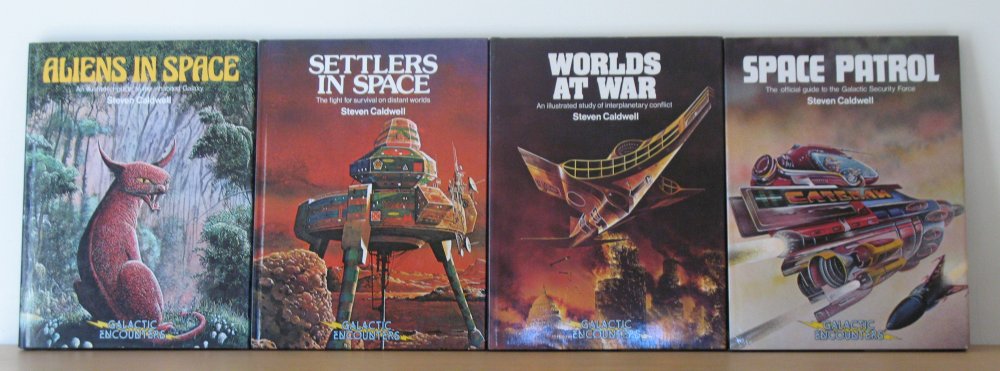
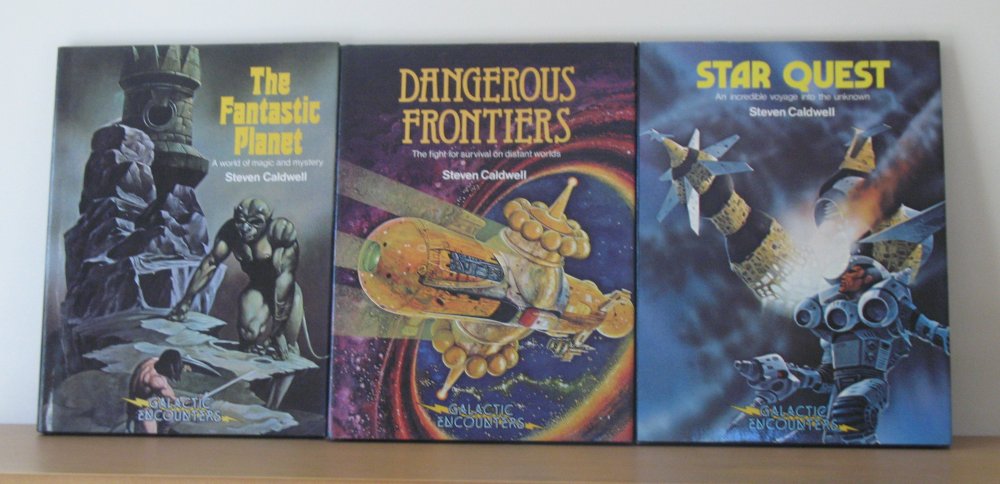
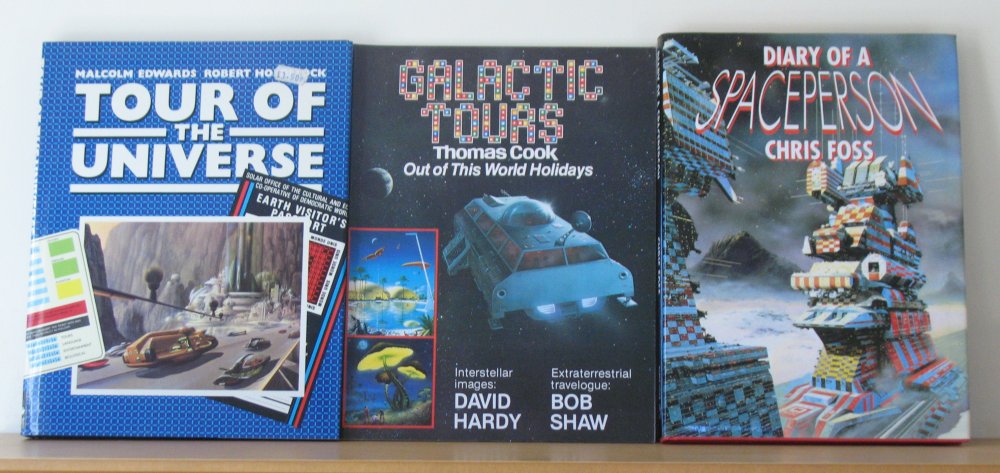
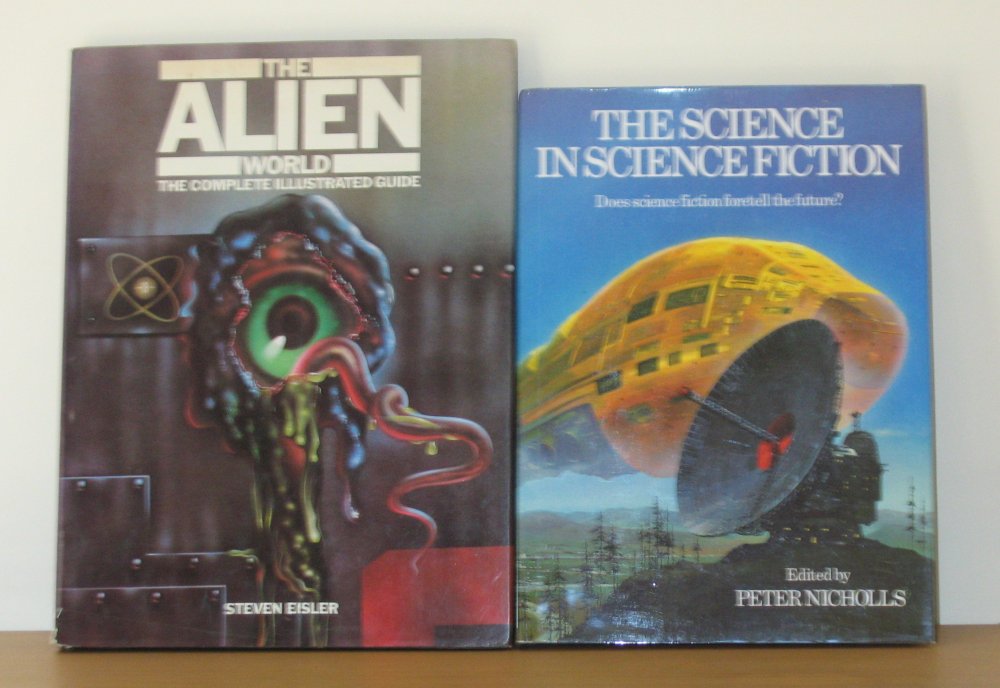
Back in the late 1970s and early 1980s, several publishers brought out colourful coffee-table sf books. Usually, they were filled with cover-art from sf novels, around which someone had written some text to tie the pictures together. Stewart Cowley’s Terran Trade Authority is probably the best-remembered example. I used to buy them whenever I saw them – often from book discount shops.
Finally, a few years ago Morrigan Press produced a RPG based on the Terran Trade Authority. Morrigan Press seem to be now defunct, and the books are out of print.
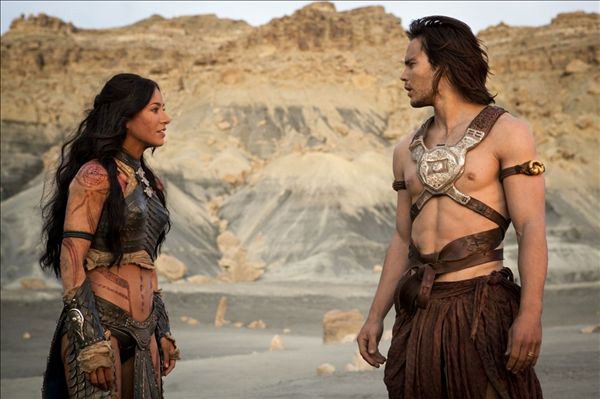
There’s always been something more appealing about the idea of John Carter than about the books in which he features. It’s pure wish-fulfillment, of course – being magically transported to an alien world, becoming a fearsome warrior, falling in love with a beautiful princess… John Carter was always the manliest of men, and deeply honourable to boot, and so formed the sort of ur-hero it was easy for impressionable boys to worship and wish to emulate.
And, it has to be said, there something exciting in the mix of savagery and sophistication which pertained on Edgar Rice Burroughs’ Mars. Ancient cultures with flying ships and radium pistols, who still fought with swords from the backs of riding animals. The Barsoomian cultures had all the trappings of decadent cultures, yet were still vigorous and thrusting and more than able to put up a good fight. Which they did. Frequently.
But Edgar Rice Burroughs wrote his eleven Barsoomian novels between 1912 and 1964, and they were never more than pulp fiction. Adapting them faithfully for the screen in the twenty-first century was always going to be problematical. Attitudes and sensibilities have changed – for the better, of course – and it’s no good pretending fidelity to the source material excuses sexism or racism (though Michael Bay has no such excuse for his Transformers films).
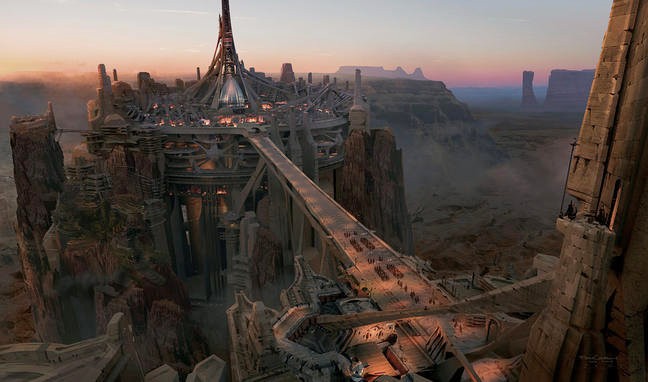
Harder, of course, to realise would be the world of Barsoom itself. Not just the landscapes of Mars, the vast canyon that is Valles Marineris, or the 21-kilometre high Mons Olympus; but also the various races and fauna, the flying ships, the cities… The Tharks are 4.5 metres tall, with four arms. Prosthetics and make-up are not going to produce convincing copies of that. But CGI can. Especially 2012 state-of-the-art CGI. After 2009’s Avatar, we know such things are possible.
As a result, the Barsoom in Andrew Stanton’s John Carter looks fantastic. Some of the long shots are breath-taking. Perhaps they didn’t get in a shot of Mons Olympus, but there was a canyon which could have been Valles Marineris. And perhaps in places the Martian landscape did resemble the Arizona desert a little too closely. But there’s no denying John Carter is a great-looking film. And that applies to the production design too. It feels as though it melds elements of all the various cover-arts that have graced Burroughs’ books through the decades.
It is in the story, however, that the film has suffered the majority of its attacks. I’m not sure I understand quite why John Carter has come under so much fire. It resembles a typical sf tentpole release inasmuch as it’s a spectacle film, full of awesome visuals and frantic action. No other film of this type seems to have been criticised so much – and mostly for not being what its detractors wanted it to be. True, the white man leads natives to victory is a problematical story, though John Carter is nothing like as offensive as Avatar in that regard. What Carter brings to Helium is an alliance with the Tharks, and that is solely because the Tharks were first to discover him on his arrival on Mars. Yes, he can jump higher and strike harder than any Barsoomian, but it’s his facility with a sword – learnt as a member of the US Cavalry – which makes him a good warrior. The jumping is useful, and moves the plot along in various places; but it doesn’t make Carter better than everyone else.
Perhaps the biggest change between the books – or rather, between peoples’ memories of the books – and the film is Dejah Thoris. In the film, she is a scientist – Helium’s chief scientist, in fact, and close to discovering the “ninth ray”. She is also an excellent swordswoman, as is amply demonstrated throughout John Carter. And Carter himself has no problem with this. It’s a welcome change.
The film does suffer from a couple of narrative longeurs. A long trip down the River Iss seems to serve little purpose, though it does give John Carter the magical phrase he needs to travel between worlds. When the chief Thern explains the presence of his race on Barsoom to Carter, it does seem a somewhat blunt way of getting the information across. There are long journeys across the Barsoomian desert in which little happens. Despite this, the film’s 132 minutes pass surprisingly quickly.
There are elements of the film worthy of praise. There is wit in the script. The cast – many of whom are British – are uniformly excellent; though Tardos Mors, the ruler of Helium, seemed a bit useless. The Tharks are especially good. The story wrapped within a story wrapped within a story structure I thought worked well, and primed the film for two endings, both emotional – the first heart-breaking, and then a proper upbeat one after. Initially, the decision to hold off on revealing that Carter had lost his wife and child years before seemed odd, but when it did appear, intercut with a battle scene, it had a great deal of impact.
It’s been too easy for people to criticise John Carter. “It’s not like the books.” Well, no. I should hope not. “If they were going to bring Barsoom to the cinema, why did they do it that way?” Because that’s the way the film-makers chose to do it. Since when has it become a valid criticism to complain that a film wasn’t made the way the critic wanted it to be made? The fact of that matter is that Hollywood has been praised for creating tentpole sf extravaganza films which are sexist, racist, and insultingly stupid. John Carter is none of those. It’s a surprisingly modern spin on an old-fashioned sf adventure film. And happily it’s been done with intelligence. So yes, I would pay to see a sequel.
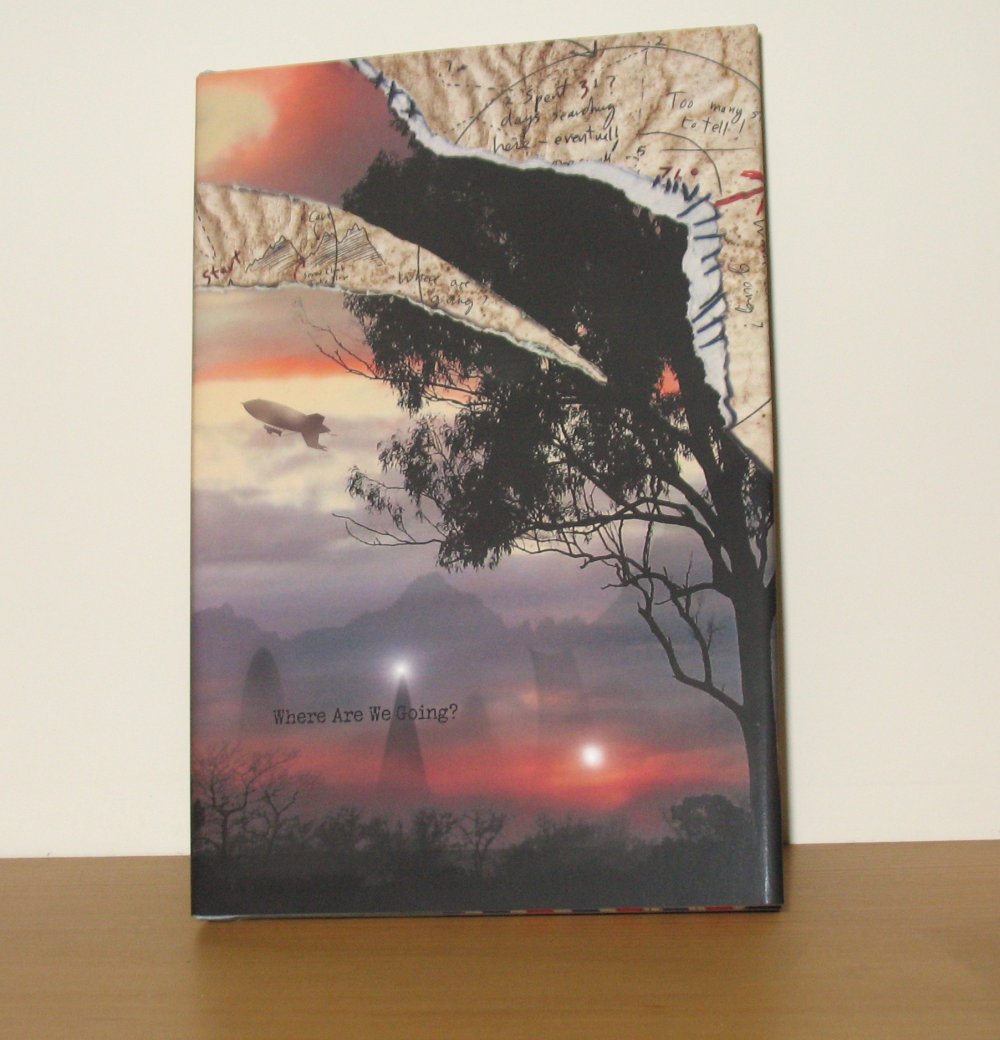
Look what arrived in the post yesterday: my contributor copy of Where Are We Going?, an anthology edited by Allen Ashley and published by Eibonvale Press. It looks very nice indeed. And it has an excellent line-up too.
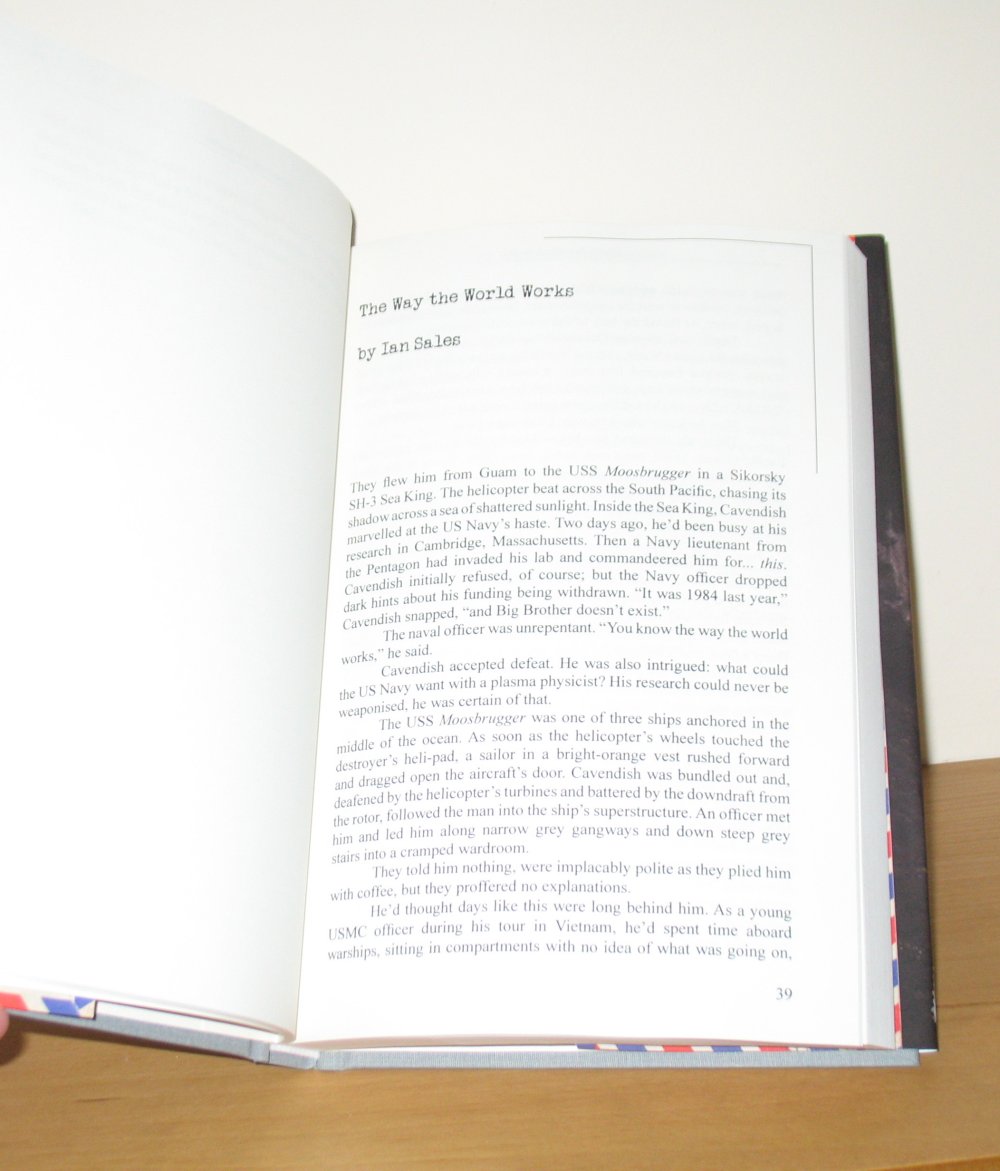
And here’s my story, ‘The Way The World Works’. It’s my bathypunk one – see here. It’s good to finally see it in print.
The anthology was launched in London on 2 March. Unfortunately, I couldn’t make it, but judging by the write-up and photos here, it went very well indeed.
A couple of days ago on Twitter, Requires Hate tweeted that she would no longer read science fiction with male protagonists. Not a problem, you would have thought – there must be plenty of sf with female protagonists. And so there is. But not as much as you’d expect. The majority of science fiction novels are told from a male point of view. Some might have female POV characters – Gareth L Powell’s The Recollection, for example – but the story is shared with a male character. Sf novels, whether by women or men writers, with a single female protagonist are not that common.
I may have got some of these slightly wrong as I’m going on my memory of the books – they might not be as exclusively female POV as I remember them. It’s unsurprising that I can think of more women writers who use female protagonists than men writers. I suspect this would be true for most people. Second, most of the books I could think of were relatively recent. Back in the Golden Age even the likes of Leigh Brackett and CL Moore wrote books with male protagonists.