It Doesn't Have To Be Right…

… it just has to sound plausible


7 Comments

2014, best of the half-year

We’re halfway through 2014, which is a year, I believe, of no prior literary, cinematic or even science-fictional significance. No matter, I have certainly consumed some significant literature, cinema and music for the first time during 2014, or at least during this first half of the twelve-month. As usual, there’s a top five and a paragraph of honourable mentions for each.

Et voilà!

BOOKS
1 Life After Life, Kate Atkinson (2013) I nominated this for the Hugo, but since it features no spaceships or dragons it was always going to be a long shot. And, what a surprise, it didn’t get a look-in. I’d never read Atkinson before – my only exposure to her work was the BBC Jackson Brody adaptations with Jason Isaacs – so I was surprised at just how effortlessly good this book was.

2 Ghosts Doing the Orange Dance, Paul Park (2013) I also put this novella on my ballot, and it too never made the shortlist. The title refers to a painting, painted by one of Park’s relatives, which may or may not show an encounter with extraterrestrials. This is an astonishingly clever piece of meta-fiction, in which Park explores his own family tree and fiction, and creates something strange and interesting. And beautifully written too.
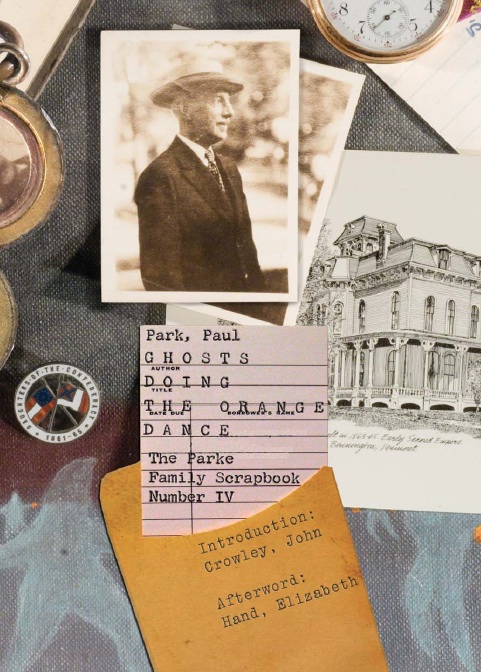
ghosts-doing-the-orange-dance-hc-by-paul-park-1622-p

3 The Machine, James Smythe (2013) And a third book I read for the Hugo. And also nominated. And – yup, you guessed it – it didn’t appear on the shortlist either. Ah well, my first – and last – attempt at involving myself in the Hugo awards… I won’t make that mistake again. The Machine, however, did make it onto the Clarke Award shortlist, and was even considered by many the favourite to win. A Ballardian near-future with some sharp prose.

4 Busy About the Tree of Life, Pamela Zoline (1988) I read this for SF Mistressworks, but my review has yet to appear there. Zoline is best-known for her 1967 short story ‘The Heat Death of the Universe’, and she didn’t write much else – a further four stories, in fact. All are collected here. Unsurprisingly, this is one of the strongest sf collections around. It really should be back in print.

Zoline-Tree

5 Europe in Autumn, Dave Hutchinson (2014) This is a surprise – a book in my best of the year in its actual year of publication. I’m pretty sure that’s a first for me. Europe in Autumn is a pleasingly cosmopolitan near-future thriller that takes an interesting twist reminiscent of Ken MacLeod’s novels… but very different all the same. Sure to be on some shortlists next year.

Honourable mentions: Two books from my Hugo reading made it onto my top five – even if they didn’t make the award shortlist (as if) – and I’m going to give another one a mention here: Anne Carson’s Red Doc> (2013), a narrative poem which managed more art in its 176pp than all fourteen volumes of The Wheel of Time; also very good was Olivia Manning’s last novel, The Rain Forest (1974), a somewhat Lowry-esque farce set on a small island in the Indian Ocean; from reading for SF Mistressworks, Joanna Russ’s collection Extra(ordinary) People (1984, my review here), her novel We Who are About To… (1977, my review here) and Josephine Saxton’s Queen of the States (1986, my review here); and finally Laurent Binet’s HHhH (2013), which offers a fascinating perspective on literature, history and writing about history as fiction.

Two women and three men in the top five, and five women and one man in the honourable mentions. I have made an effort in 2014 so far to maintain gender parity in my fiction reading – and, as can be seen, it does make a difference. On the other hand, there seems to be more genre fiction in my picks this year than is normally the case – over half were published explicitly as genre, and a further three published as mainstream but make use of genre conceits. Which makes a top five that is entirely genre – which I think is a first for me for a good many years.

FILMS
1 Beau Travail, Claire Denis (1999, France) Beautifully photographed – and if that seems common to my choices, cinema is a visual medium – but also sharply observed. However, what knocks this film from merely good to excellent is the final scene – and if you’ve seen it, you’ll know what I mean.

beau-travail

2 Under The Skin, Jonathan Glazer (2014, UK) Scarlett Johansson guerilla-filming in Glasgow, playing the part of an alien harvesting men for some unexplained reason (in the film, that is; in the book it’s for meat). It’s the film’s refusal to annotate or explain that makes it.

3 Blow-Up, Michelangelo Antonioni (1966, UK) After you’ve finished marvelling how young both David Hemmings and Vanessa Redgrave look in this film, you begin to realise how beautifully each shot is framed. It’s perhaps not as painterly a film as Antonioni’s stunning Red Desert, and perhaps its plot boasts too many echoes of that of L’Avventura… but this is excellent stuff.

4 Call Girl, Mikael Marcimain (2012, Sweden) A political thriller based on a real scandal during the 1970s, known as the Bordelhärvan scandal, involving senior politicians and under-age prostitutes. Filmed with that sort of stark Scandinavian realism that is its own commentary.

5 The Burmese Harp, Kon Ichikawa (1956, Japan) A Japanese soldier in Burma just after WWII chooses to stay in the country as a travelling Buddhist monk, with the intention of providing a proper burial for all the soldiers killed during the fighting and whose bodies have been left to rot. What really makes this film, however, is that the rest of his company use choral singing to maintain their morale, and throughout the film they put on impromptu performances.

burmese-harp-blu-ray-cover

Honourable mentions: Upstream Colour Shane Carruth (2013, USA), is an elliptical, often beautiful, film and the complete antithesis to Hollywood mind-candy; Kin-Dza-Dza!, Georgiy Daneliya (1986, Russia), is completely bonkers but somehow manages to make its more ludicrous aspects seem completely normal in its world; Head-on Fatih Akın (2004, Germany), an intense drama about a Turkish-German couple and a marriage of convenience; Man of Iron, Andrzej Wajda (1981, Poland), is based on the strikes in the Gdańsk Shipyard during the 1970s, and mixes real fact and fiction – Lech Wałęsa appears himself and is also played by an actor; The Best of Everything, Jean Negulesco (1959, USA), its first half is the sort of well-photographed 1950s melodrama that really appeals to me, but it’s a shame about the film’s second half; Like Someone in Love Abbas Kiarostami (2012, France), displays Kiarostami’s typically elliptical approach to story-telling which, coupled with its realness, makes for beautiful cinema; and finally, a pair of films by Piotr Szulkin: Ga, Ga. Chwała Bohaterom (1986, Poland), the blackest of comedies, takes a hero astronaut and subjects him to a litany of inexplicable indignities; and Wojna Swiatów – Następne Stulecie (1981, Poland), even blacker and more cynical, in which a popular TV presenter becomes first a tool of the oppressors, then a rebel, but will be remembered ever after as a collaborator.

And once again I have failed to pick a single Hollywood film – well, okay, the Negulesco is a Hollywood film, but it’s also 55 years old. So perhaps I should have said a recent Hollywood film. This doesn’t mean I haven’t watched any, just that none of them were any good.

ALBUMS
1 Shadows Of The Dying Sun, Insomnium (2014) A new album by Insomnium on this list is hardly a surprise, but this band really is bloody good. As I’ve said before, if you look up “Finnish death/doom metal” in the dictionary, all it says is “Insomnium”.

2 Valonielu, Oranssi Pazuzu (2013) I actually purchased this in 2013, but too late to make that year’s best of. It’s… well, it’s a recipe that doesn’t deserve to work, but actually does so brilliantly – space rock plus black metal. Weird and intense and very very strange. It should come as no surprise to learn the band are from Finland.

Oranssi_Pazuzu-Valonielu

3 From a Whisper, Oak Pantheon (2012) A US band that plays a similar black/folk/atmospheric metal as Agalloch, but seems a little more… metal in places. This is their first full-length album after a debut EP, and I’m looking forward to whatever they produce next.

4 The Frail Tide, Be’lakor (2007) This Australian band’s latest album made last year’s Top 5, so why not their debut this year? Their complex melodic death is enlivened with some nice acoustic passages in this. Excellent stuff.

5 Earth Diver, Cormorant (2014) Another self-release by a band that refuses to be pigeon-holed and quite happily shifts through a number of metal genres during each epic track. And they do write epic tracks.

Cormorant-Earth-Diver

Honourable mentions: 25th Anniversary of Emptiness, Demilich (2014) is a compilation of unreleased and rerecorded material from classic Finnish vocal fry register death metal band, an important document; Stone’s Reach, Be’lakor (2007), the band’s sophomore release and every bit as good as their other two, but their debut’s acoustic sections gave it the edge; The Void, Oak Pantheon (2011), is the band’s debut EP and an excellent harbinger of their later material; Restoration, Amiensus (2013), any band that manages to mix Agalloch and Woods of Ypres gets my vote; Older than History, Master of Persia (2011), Iranian death metal which makes good use of Iranian music traditions to produce something excellent.


Leave a comment

The future we used to have, part 24

Here’s some twentieth-century somewhat scary techno-porn in lieu of real content, while I (supposedly) work on some new fiction – including Apollo Quartet 4 All That Outer Space Allows – some book reviews, and some non-fiction articles on various science fiction tropes.

air

1024px-Lockheed_XF-104

Lockheed XF-104 Starfighter

1280px-Su-15_Flagon

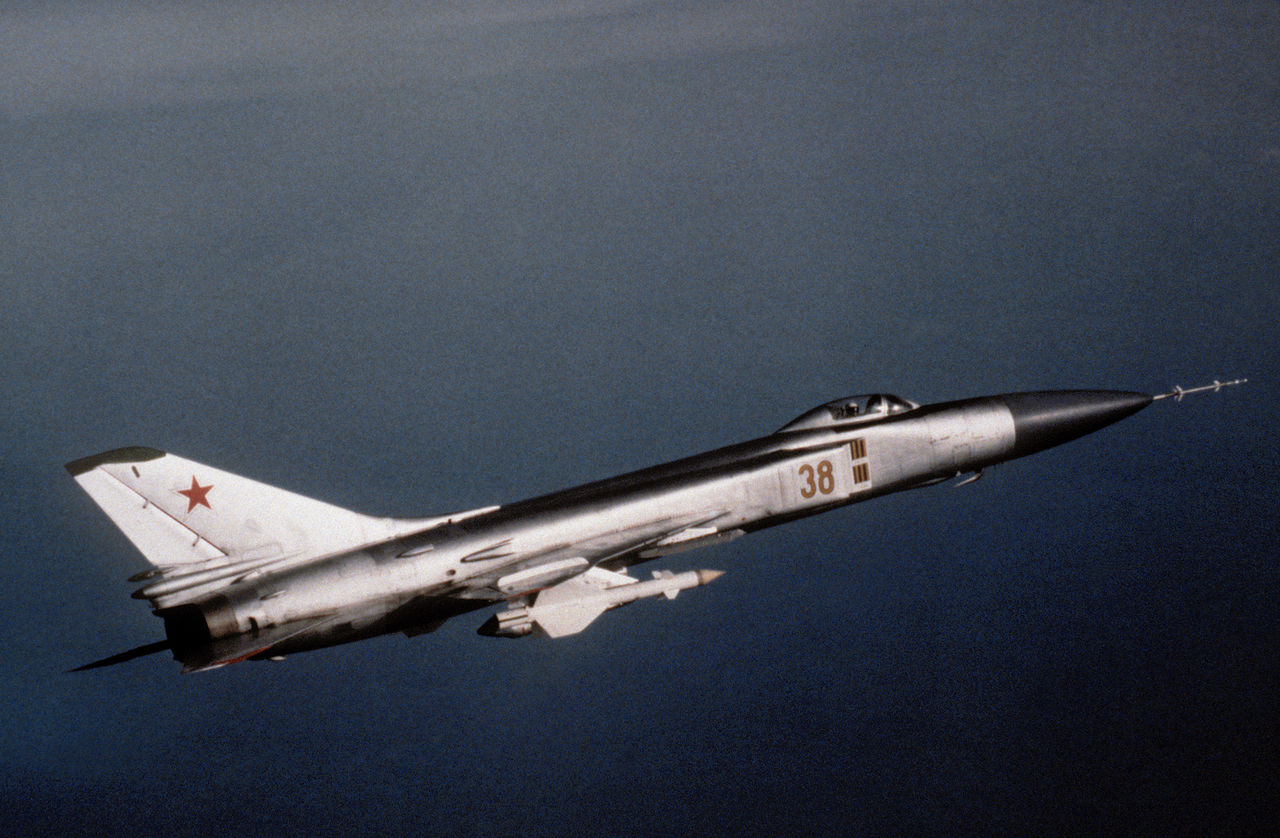
Sukhoi Su-15 ‘Flagon’

mig2113

Mikoyan MiG-21 ‘Fishbed’

sea

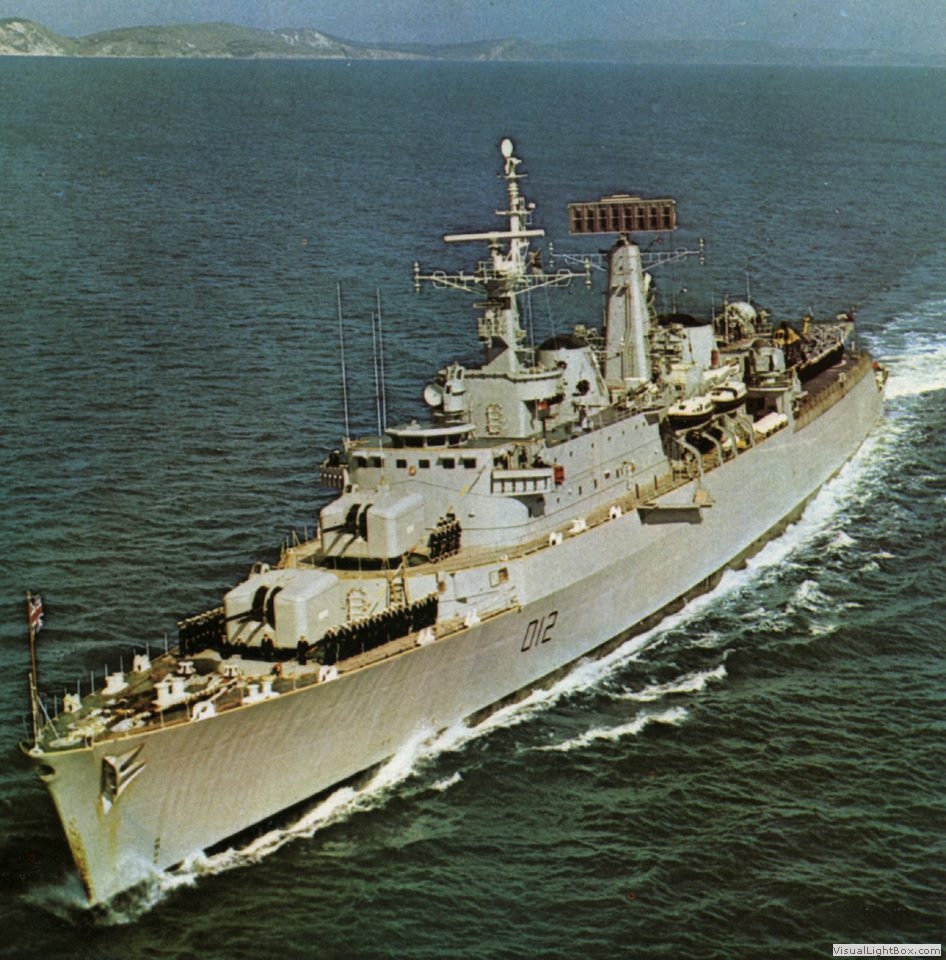
hms_kent_at_sea_2

HMS Kent, a County class destroyer, Royal Navy

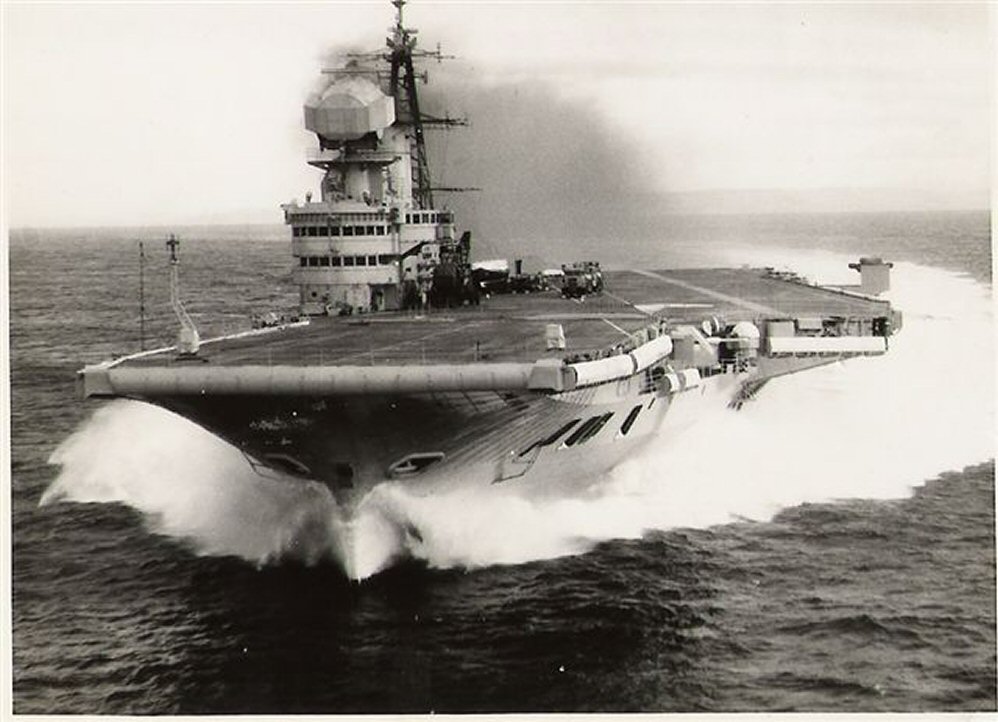
workup_speed_trials_aran

HMS Victorious, Royal Navy

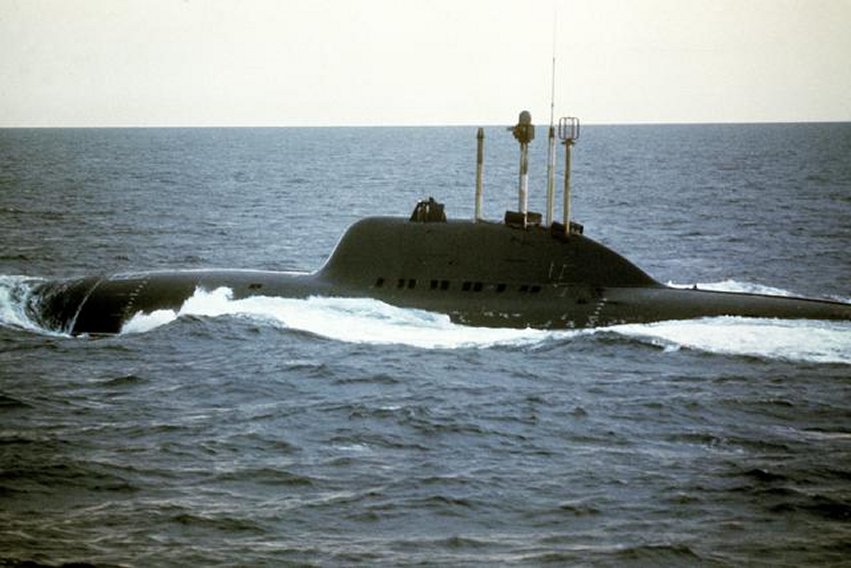
Alfa-class-submarine-2

Alfa class hunter/killer submarine, Red Navy

land

atomproofcity

Atom Proof City, from Look Magazine, 26 October 1948

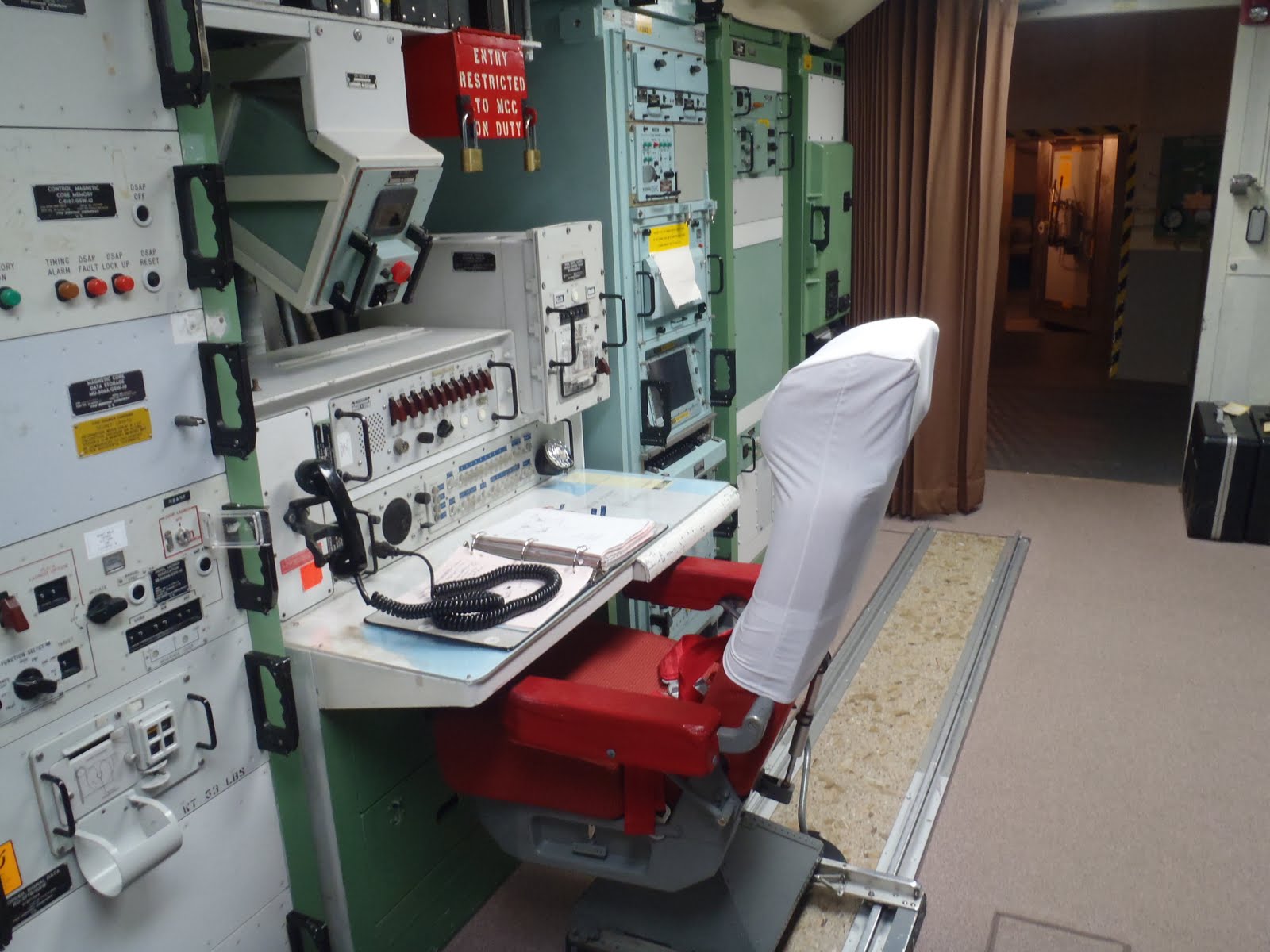
missilecontrolroom

Missile Control Centre in a Minuteman II silo

NORADBlast-Doors

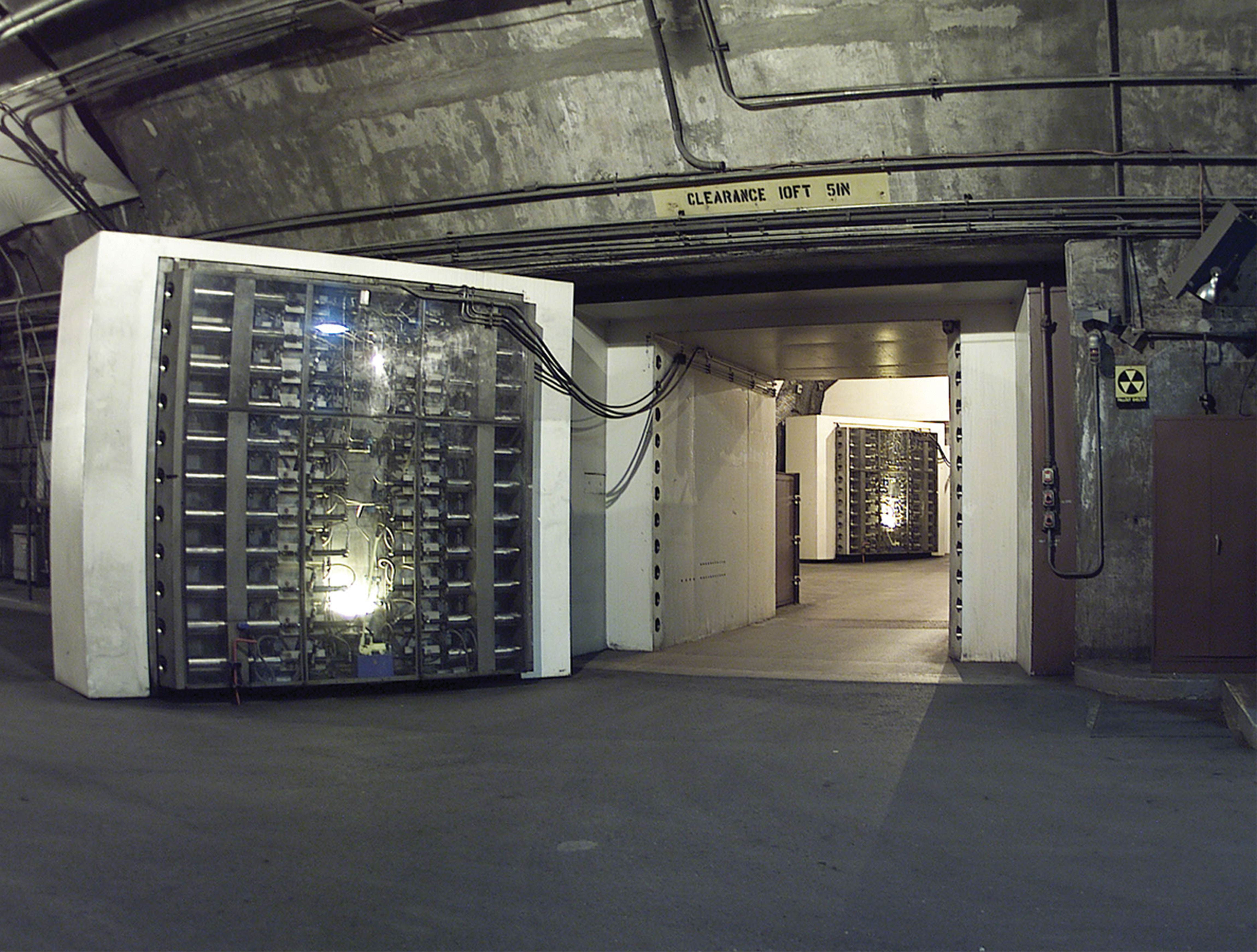
Blast door, NORAD, Cheyenne Mountain


5 Comments

More on women-only science fiction anthologies

Back in April, I posted a list of women-only science fiction anthologies – see here – but since then I’ve discovered two more that should have been on my list:

futureevesFuture Eves, Jean Marie Stine, ed. (2002) Subtitled “Classic sf by women about women”, this anthology is split into two sections: From the 1920s – ’30s and From the 1940s – ’50s. It contains stories by Leslie F Stone, Margaretta W Rea, Hazel Heald, Evelyn Goldstein, Marcia Kamien, Joy Leache, Betsy Curtis, Beth Elliott and Helen Clarkson. There’s a couple of names there new to me – Rea’s story is apparently the only one she ever had published (in Amazing, Jan 1933), Goldstein had eight stories published between 1954 and 1960, Kamien three in the mid-1950s, Leache three from 1959 to 1961, and Elliott only one in 1959. Clarkson is also known for a single story, which was reprinted in New Eves – see my review here.

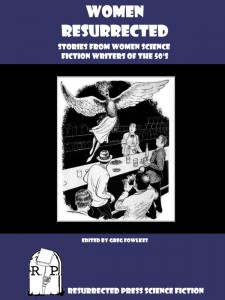
rotator_women-225x300Women Resurrected: Stories from Women Science Fiction Writers of the 50’s, Greg Fowlkes, ed. (2011) This is from a small press which seems to specialise in “resurrecting” old and forgotten genre works – not just science fiction, but also mystery and adventure. Women Resurrected contains stories by Pauline Ashwell, Marion Zimmer Bradley, Florence Verbell Brown, Barbara Constant, Betsy Curtis, Dorothy de Courcy, Miriam Allen deFord, Helen Huber, Jean M Janis, Elisabeth R Lewis, Katherine MacLean, Judith Merril, Evelyn E Smith, Lyn Venable, Ann Walker, Elaine Wilber, Therese Windser and Mari Wolf. Yet more unfamiliar names – Brown (1 story only published), Constant (2 stories), de Courcy (20 stories), Huber (1 story), Janis (2 stories), Lewis (1 story), Venable (7 stories), Walker (1 story), Wilber (1 story), Windser (1 story) and Wolf (7 stories).

None of these “unknown” writers had careers that lasted beyond the early 1960s. It’s tempting to wonder why – marriage? children? no longer welcome by editors? It also seems odd that de Courcy, with twenty stories published between 1946 and 1954, should prove so obscure, especially given that a woman sf writer – Pamela Zoline – is still known today for a single story published in 1967 (and she only published 5 in total throughout her career). Perhaps the fact de Courcy co-wrote with – husband? brother? – John de Courcy explains it. The same might also be said of Mari Wolf, who wrote alone – I mean, how can you forget a writer whose first story was titled ‘Robots of the World! Arise!’.

So that’s a pair of anthologies which focus on the early decades of science fiction and women’s contribution to it. According to Partners in Wonder by Eric Leif Davin, there were 65 women writers published in science fiction magazines between 1926 and 1949, and a further 138 who debuted between 1950 and 1960. In total, those 203 women sf writers produce 922 stories during those 34 years, averaging between 5% and 16% by title of the total contents for genre magazines throughout the period.

After 1960, of course, and the appearance of massmarket paperbacks in supermarkets, there was a huge influx of female sf readers and writers… and yet common perception still has it that women writers are a small minority – as if the situation prior to 1960 has held true for the last 50 years. Even worse, little or none of those pre-1960 women sf writers are ever collected, or appear on lists of “classic” sf… further feeding into the myth that women did not write sf during those decades. Happily, the above two anthologies prove this untrue . More like them, please.


1 Comment

SF Mistressworks in Sci-Fi Romance Quarterly

Starting this month, Sci-Fi Romance Quarterly will reprint a review from SF Mistressworks. You can download #3 Apr-Jun 2014 of the magazine here. For this first appearance, they’ve chosen my review of Vonda N McIntyre’s Fireflood and Other Stories. I’m very happy with Sci-Fi Romance Quarterly’s offer to host a SF Mistressworks review each issue as it will bring some excellent science fiction by women writers to a wider – and appreciative – audience.

Issue3-Cover


11 Comments

Memory jog

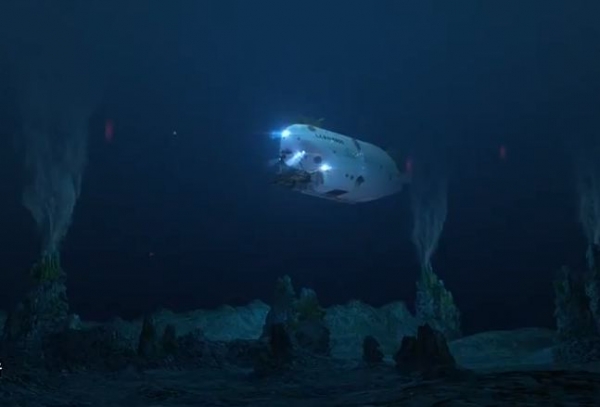
The latest issue of Perihelion Online Science Fiction Magazine has appeared, and among its many fine stories is one of mine – ‘Waters of Lethe’. It’s about a bathyscaphe journey to the bottom of Europa’s world-ocean. Sort of. You can read it here.

shinkai-6500

I’ve now written stories which feature Wilfred Owen, Spitfires, the Bell, Apollo astronauts, flying boats, rocket sleds, bathyscaphes… What to do next?


2 Comments

Moving pictures, #4

Another dash through across the silver screen. Here are some of the more notable films I’ve watched recently.

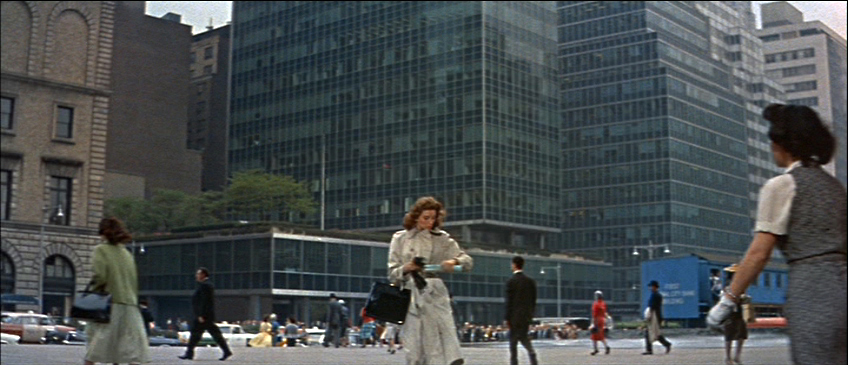
The Best of Everything, Jean Negulesco (1959, USA) Three women are employed at a New York publishing house. One makes the jump from secretary to reader to editor. The first half of the film is one of those beautifully-photographed 1950s melodramas, with some lovely shots of the New York of the time. Disappointingly, the second half trades that in for soap opera office politics.

best-of-everything-02

Elysium, Neill Blomkamp (2013, USA) Rich people live in the lap of luxury in the eponymous space habitat, while everyone else suffers in abject poverty on Earth – but that’s as far as the social commentary goes. This is really just another implausible actioner with a nice line in visuals and a bad handle on the laws of physics.

Ga, Ga – Chwała Bohaterom, Piotr Szulkin (1986, Poland) Barking mad sf film, in which an astronaut lands on another world… which proves to be just like this one, except they treat their heroes somewhat differently. Not so much black comedy as fulginous.

Head-on, Fatih Akin (2004, Germany) Marriage of convenience between young Turkish-German woman and older Turkish-German man, so she can live the life she wants away from her traditional family, turns sour when the pair fall in love and he accidentally kills an ex-lover of hers. Not the most sympathetic of lead characters, but the actors playing them carry the film. Excellent.
Argo, Ben Affleck (2012, USA) You know when Canada rescued those US hostages from Iran back in 1980? Well, it wasn’t Canada that did it, it was the CIA. Yes, Americans. The whole film feels like a petulant grab to correct misplaced credit decades after the fact. And we’ll not mention the stupid race-against-time at the end to get the hostages out of the country…

The Killers, Robert Siodmak (1946, USA) Classic noir told through flashback, which explains why a pair of killers drove into town and killed garage mechanic Burt Lancaster. Turns out Burt used to be involved with a bad crowd, who pulled off a payroll robbery which turned nasty. Ava Gardner vamps it up, but I thought Rita Hayworth was better in Gilda (also released in 1946).

Villa Amalia, Benoît Jacquot (2009, France) Pianist Isabelle Huppert walks away from her life and settles down in the eponymous run-down villa in Italy. Beautifully shot, elegantly told. There something about the feel of the film which reminds me of François Ozon’s Under the Sand.

VILLA AMALIA un film de Benoit Jacquot

The Bank Dick, Edward Cline (1940, USA) WC Fields inadvertently catches a bank robber, is employed as the bank’s security guard as reward, and promptly cocks that up – much as he does everything. Mildly amusing, though not a patch on Laurel & Hardy.

Follow The Boys, Eddie Sutherland (1944, USA) Hollywood stars entertain the troops at training camps throughout the US during WWII, plus back-story showing how it all came about (entertaining the troops, that is, not WWII). Lots of cameos by big names. WC Fields is genuinely funny, Orson Welles puts on a magic act that clearly relies on camera trickery, and there’s a good tap dance in the rain from star of the film George Raft.

The Ugliest Woman In The World, Miguel Bardem (1999, Spain) Near-future thriller about a female killer which seems to have been inspired by so many other films it makes it difficult to remember what you’re watching. The premise is iffy – ugly young woman undergoes experimental gene therapy, which turns her beautiful… so she murders a contestant in the Miss Spain beauty pageant, takes her place, and proceeds to kill the other contestants. But the film is so odd, it sort of hangs together.

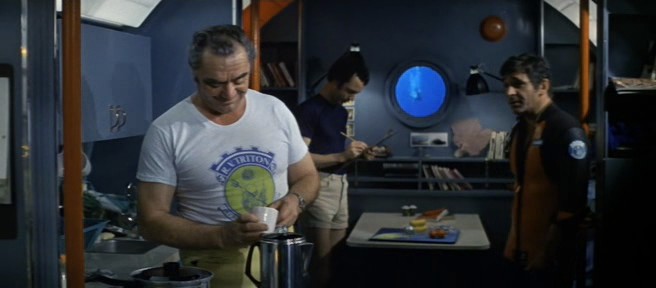
The Neptune Factor, Daniel Petrie (1973, Canada) Stone-faced grump Ben Gazzara is captain of a model submersible which is menaced by magnified tropical fish while searching for an underwater habitat lost during a seaquake. Oh, and there’s a giant crab too. They manage to find a pair of survivors, although how they didn’t get squished by the pressure is never explained. Jacques Cousteau it’s not.

bscap0001pk


15 Comments

Fables of the Deconstruction

I’ve recently been reading a new science fiction anthology for review for Interzone and this, coupled with David Hebblethwaite’s remarks on science fiction awards here and Nina Allan’s comments here, has brought into focus some elements of my increasing dissatisfaction with the genre and its resistance to progress. Especially hard science fiction.

David complains about the lack of experimentation in form in sf, but I think there’s also a lack of experimentation in settings and narratives in hard sf. It’s all very well using cutting-edge science, the latest descriptions of exoplanets or the moons of Jupiter… But it always remains outside, outside the reader’s viewpoint on the plot, outside the characters’ psychology, their motivations or perceptions or worldview. While it’s true human beings need a specific environment to survive, and will take their society and transplant it wherever they may find themselves, irrespective of that external environment… their new surroundings will affect them, will change them. Not only must they make accommodations with their location, but their society will likely change as a result. But it rarely seems to in science fiction stories. Writers simply transplant a society little different to the writer’s present to their new environment, and add some technological bells and whistles to justify its presence. Even worse, they often model their society on an older one, such as the Wild West, with all its lawlessness and amorality, and stick it on, say, Io. How progressive is that? It’s not, of course. For all the story’s gimmickry and ideas, it still posits the sort of individualistic and brutal human (male, usually) that hasn’t characterised human society for centuries and is certainly unlikely to do so in the future.

To me, hard science fiction’s inability to reflect its settings in the psychology of its protagonists is a failure of the imagination. A good non-genre example would be Paul Scott’s Raj Quartet, comprising The Jewel In The Crown, The Day Of The Scorpion, The Towers Of Silence and A Division Of The Spoils. It covers the years leading up to, and during, the independence of India, but much of the story is set among British expatriates in the country. While the British in India built communities that were models of those back home in the UK, they could not help but evolve into something different through contact with the country’s population. And the people living in those countries changed too – so much so that they often suffered culture-shock on their return to Britain.

SF3-dang_L

If you look further afield in sf, particularly in the short fiction market, there’s plainly a twenty-first century strain of the genre, one which freely borrows imagery and tropes from fantasy and New Weird. It also displays a greater spread of settings, societies and protagonists. Personally, I think the focus on imagery is mostly surface and usually hides a lack of sfnal progress – that’s progress in terms of how science fiction works, of course; the elements which go together to create science fictions and so differentiate them from other works of literature. The other areas in which sf is progressing – diversity, non-binary gender, etc – I think are excellent and long past due.

All this makes hard sf’s insistence on sticking to old story patterns all the more puzzling. I once defended hard sf from an accusation of being inherently right-wing. I still think it’s not right-wing, though I recognise many of its proponents write from a right-wing perspective. But certainly the subgenre is reactionary and conservative (with a small “c”, note). It doesn’t have to be. The laws of physics may be immutable, but there’s nothing that says human societies always tend to the Competent Man (usually a white Westerner) lording it over others by virtue of his competence, wits and willingness to commit violence. In fact, that’s a pretty offensive characterisation of human society. It’s sadly also widely prevalent in hard sf (and in sf too, in a wider sense).

Nina Allan, in her post, writes that sf no longer seems to comment on political and social issues, nor displays “evocative and original use of language”. She also makes a very useful distinction – between authors who write from within science fiction and authors who “draw their influences from science fiction”. Both her and David’s comments are addressed to the former – as are mine.

I think Nina makes some interesting points, but her comment about language seems to me to forget that science fiction is chiefly a genre of commercial fiction, with much of its DNA provided by pulp fiction. The current economic climate (well, actually, the global economy the neoliberals and neocons have gifted us over the past thirty years) means publishers prize commercial science fiction more than they do literary science fiction. The small presses – and self-published authors, to some extent – have picked up the latter baton, but they are still small fry in a large profit-driven ocean. When writing commercial fiction in any genre, there’s a tendency to stick to tried and tested – and familiar and lucrative – patterns. So it doesn’t really surprise me that prose in sf novels is blanding out, or even that ideas and the presentation of those ideas is tending to more… comfortable forms. I can rue this, I can compare it unfavourably with the situation thirty or forty years ago… but there are too many things that need to change, many of which the publishing industry has no control over, before it can be resolved. Plus, there are other issues which need to be addressed first – notably the lack of diversity, and the preponderance of sexism and racism – and it’s good that the sf conversation keeps on talking about these topics and is making progress at combatting them.

But. Science fiction. The stuff that makes these stories what they are. Nina uses this year’s Clarke Award shortlist as a barometer of the state of the genre. Which is not necessarily a fair argument. It has never been part of the award’s remit, and the jury are, as she acknowledges, all too human – in fact, I suspected one of the judges of championing the Mann but when I asked they said they hadn’t… which only shows the danger of making such assumptions. And speaking of Phillip Mann’s The Disestablishment of Paradise, for all the book’s faults, it can’t be accused of not being experimental in form. True, its structure is hardly original – a story-within-a-story, with “author” interpolations, plus ancillary material presented as appendices – but neither is it the far more common straightforward linear narrative, or indeed the relatively common dual narrative, past versus present, of the eventual winner, Ancillary Justice.

The point I’m trying to make, which unfortunately I keep on ruining by drifting from the point, is that the science-fictionalness, to coin a phrase, of a text, particularly hard sf, has not appreciably progressed for decades. I don’t doubt that the bulk of sf authors in years past never really bothered to interrogate or deconstruct the tropes they used – although some did, Samuel R Delany certainly did – and likewise very little present-day science fiction makes a serious attempt at examining the science-fictional assumptions, the tropes and genre furniture, of which it makes use. Nor do they explore the psychology of their protagonists. These, I think, are not only a missed opportunities, but also make sf, for me, a less interesting genre than it could be in the twenty-first century.

So let’s add these things together – from David, the lack of experimentation in form; from Nina, the lack of contemporary commentary; and from myself, the failure to examine what science fiction actually does and why it does it… Surely there’s something in among that lot worth exploring? Which is why the hard sf anthology I mentioned in the opening paragraph of this post proved so disappointing a read – and also seemed to be so emblematic of much that I feel in sf isn’t working for me. The anthology’s contents certainly met its theme, and they definitely qualified as “hard science fiction”… but there were so many unaddressed assumptions implicit in the stories, and so little examination of what makes a story hard sf rather than simply sf, that I couldn’t understand why the editors had even bothered to put it together.

Science fiction is by definition fecund terrain for stories. Hard sf may add some restrictions, but that should in no way limit how it tells its stories. Why can’t sf writers dig a little deeper into the tropes they use so blithely? Why can’t they take science fiction apart, examine it from all angles, and then put it back together in interesting ways? I’d not only like to see that happen to a much greater extent than it does presently, I’d like to see it as the default mode for writing science fiction – especially hard science fiction.


1 Comment

May book haul

Not too many this month, so I appear to be getting my habit a little under control. More work still needed, however. On the plus-side, it’s getting harder to find irresistible bargains on eBay; on the other hand, it’s getting easier to find obscure books that look interesting…

2014-05-26 09.14.55

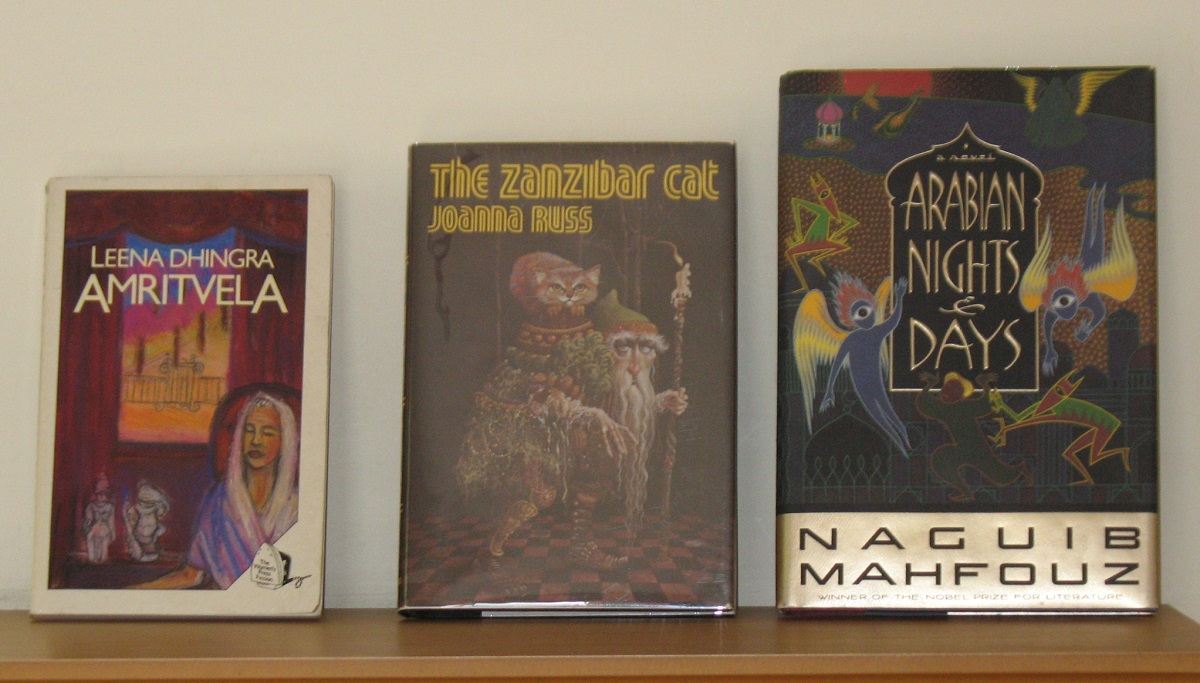
Three first editions. Amritvela is actually signed and was a couple of quid on eBay. It’s not sf, but I need to read more world fiction anyway. The Zanzibar Cat is Russ’s first collection. Arabian Nights and Days was given me by my mother. I’ve read several books by Mahfouz, and I have a couple more on the TBR. But I’ve yet to read his Cairo trilogy, as the only copies I have of it are in Arabic. That’s a project for one year – get my Arabic up to scratch so I can read them…

2014-05-26 09.15.31

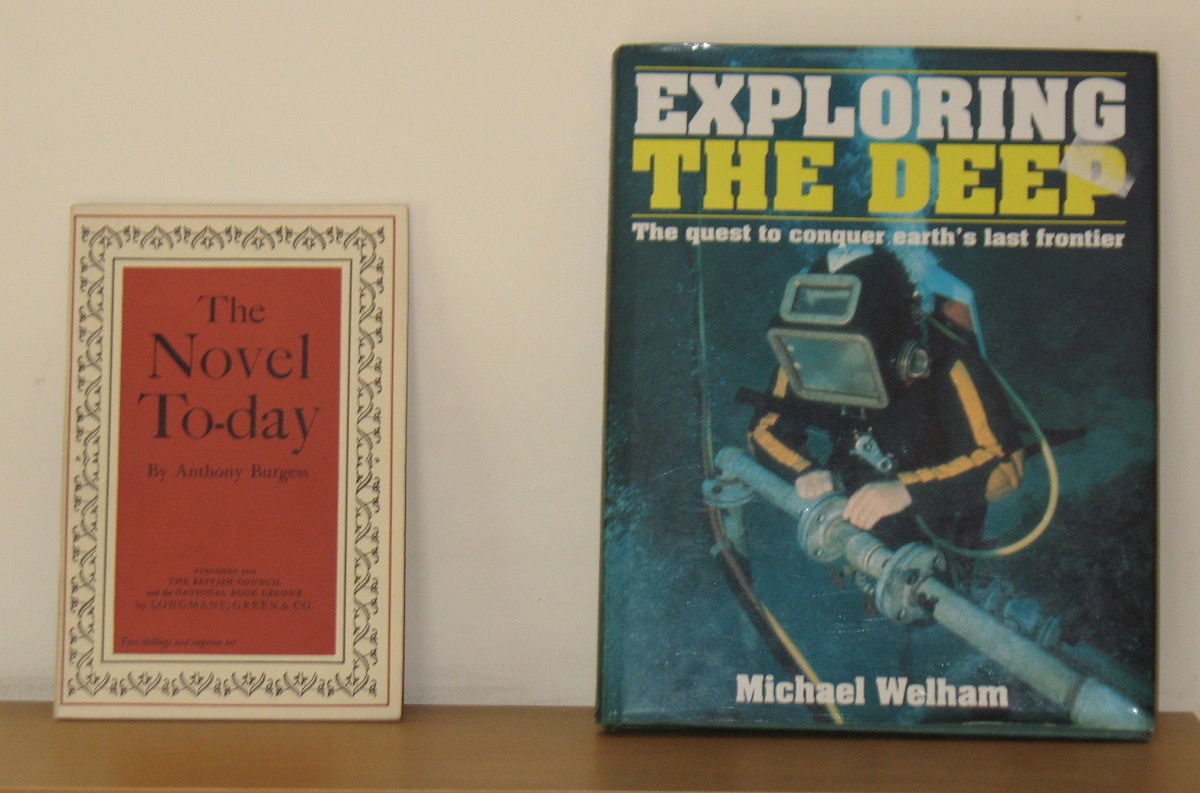
The Novel To-day was a lucky (and cheap) find on eBay. It goes in the Anthony Burgess collection. Exploring the Deep was also from eBay (and also cheap), and is a pretty good overview of its topic. Useful research material, should I ever decide to write some hyperbaric sf…

2014-05-26 09.16.11

A pair of Tor doubles – No 12 He Who Shapes/The Infinity Box by Roger Zelazny and Kate Wilhelm, and No 15 The Last Castle/Nightwings by Jack Vance and Robert Silverberg. I started collecting these after a bunch of them appeared in a remainder book shop in Abu Dhabi, and over the years I’ve managed to find 28 of the 36 Tor published. Some of them are quite good, but many are rubbish. The Invincible is more Lem. The Leopard and My Struggle 1: A Death in the Family were bought as a birthday present.

2014-05-26 09.16.51

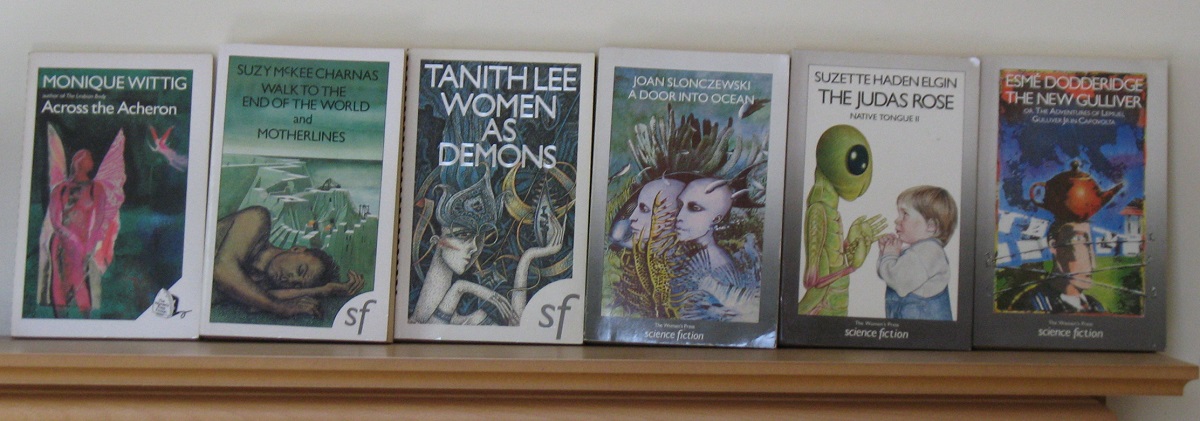
For The Women’s Press sf collection – Across The Acheron I found on eBay, but Walk to the End of the World and Motherlines, Women as Demons, A Door into Ocean, The Judas Rose and The New Gulliver were all from Brian Ameringen at Porcupine Books.  I recently updated the list of The Women’s Press sf titles on the SF Mistressworks site – see here.


1 Comment

2014 reading diary, #6

Despite the number of books I read, I don’t think I’m putting much of a dent in the TBR. I must stop buying books for a month or two. Of course, that means publishers must instantly stop publishing books I want, and booksellers must remove all the books I might desire from their shelves… Then I should be able to do it.

ride-with-the-devilRide with the Devil, Daniel Woodrell (1987) Originally published as Woe to Live on but retitled when a film adaptation was made, this is Woodrell doing McCarthy. The narrator is a German immigrant (referred to, of course, as ‘Dutch’ or ‘Dutchy’) and a member of Confederate band of irregulars. They’re bandits in all but name, displaying little or no military discipline, wearing patchwork uniforms (and often masquerading as Union soldiers in stolen uniforms). They are brutal, not particularly smart, callous, and appear to be motivated chiefly by revenge against the depredations of the Jayhawkers. One of their number is black, but he’s not a slave – he and the narrator, Roeder, become good friends, in fact – which does sort of confuse the whole issue of the war. After an attack by Union cavalry, the troop scatter and Roeder, the black guy, and two others hide out on the land of a sympathetic Southern gentleman landowner. One of the other two, Roeder’s best friend, enters into a relationship with the landowner’s widowed daughter-in-law. Soon after, the troop reconvenes and stages a raid on the home town of the Jayhawkers. By this point, Roeder has lost his taste for violence, and has belatedly recognised that his fellows are far from noble freedom fighters but violent psychopaths. I really liked Woodrell’s Winter’s Bone, but this felt too much like McCarthy-lite. I’ll keep an eye open for more books by Woodrell, but if I’d read this one first I probably wouldn’t have bothered.

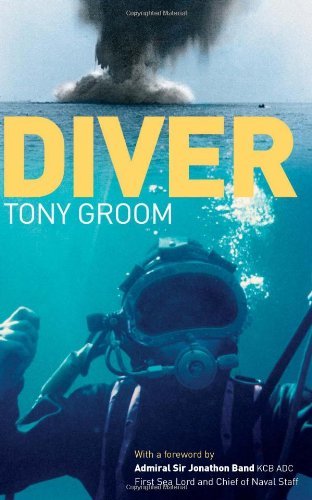
diverDiver, Tony Groom (2007) I think I was a little hungover – or rather, I was feeling insufficiently motivated to do much of anything – when I picked this book off the shelf for a bit of light reading. It proved a good choice, at least initially. The first few chapters, describing Groom’s training and early years with the Royal Navy, are very funny. He signed up determined to become a diver, made it through all the courses, got into a bit of trouble on his first posting to a minesweeper, was then sent to Tuvalu to help clear WWII mines from the waters around the atoll… before flying out to the Falklands as part of the UK task-force. The chapters on the Falklands War are quite harrowing. The Fleet Clearance Diving Team was in the thick of it, defusing bombs that had fallen on British ships but not exploded (pretty much all of the bombs were British-made, incidentally). After leaving the Royal Navy, Groom became a commercial diver in the oil industry, saturation diving in the North Sea. He makes it clear quite how dangerous an occupation it is – not just because of explosive decompression, but also because the divers are dependent on so many other people. They’re trapped inside their decompression chambers, and should the ship or barge suffer some sort of calamity there’s no escape for them. And on the sea floor, they’re totally dependent on their umbilical – though they carry ten minutes of emergency “bail-out” heliox, the umbilical also pumps hot water into their suit and should that fail they’d soon develop hypothermia. Groom has a readable chatty style, and cheerfully admits at times he may have got some of the details wrong – especially when discussing the Falklands War, as he bases his narrative on his diaries. Interesting stuff.

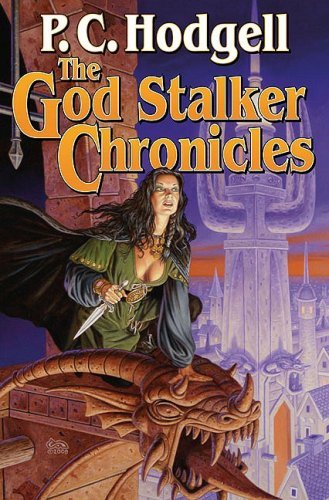
godstalkerGod Stalk, PC Hodgell (1982) I picked up a copy of the Baen reprint omnibus edition, The God Stalker Chronicles, containing both God Stalk and its sequel Dark of the Moon, at the World Fantasy Con last October. I’d sooner have bought them as individual paperbacks, rather than one humungous hardback, but it was all I could find. God Stalk is in almost all respects an ordinary epic fantasy, set in an epic fantasy world with a complex history and pantheon, and featuring a special snowflake protagonist. It’s a very likeable book, as indeed are a number of books of this type; and there are some nice touches in Hodgell’s world-building. I’d been expecting it to be a tad literary, but it’s not – it’s written in precisely the sort of prose common among books of its ilk, although it is somewhat smoother to read than most. However, where I think it fails – and this may account for its apparent obscurity – is that the learning-curve is among the steepest I’ve come across in fantasy. It doesn’t help that protagonist Jame is apparently unaware of her own history – it’s never stated that she’s amnesiac, but she was banished from her home keep by her family, spent several decades wandering, and has no memory of that time. There’s an extensive back-story to God Stalk, but Hodgell is parsimonious with the details – until they’re needed… which often results in a wodge of exposition thick with the names of gods and lords and races. The plot takes a good third of the book to get going, so it’s a bit of a slog for the first few chapters. Eventually, things start to come together – some of the foreshadowing is a little too obvious, however – and you need to refer less and less to the dramatis personae at the front of the novel. I’ve still got the second half of this omnibus to read, and I’ll decide after that whether I can be bothered to continue with the series (the seventh book is published next month). Incidentally, Jame is mistaken for a boy on several occasions – with that cleavage she has on the cover? Baen. Sigh.

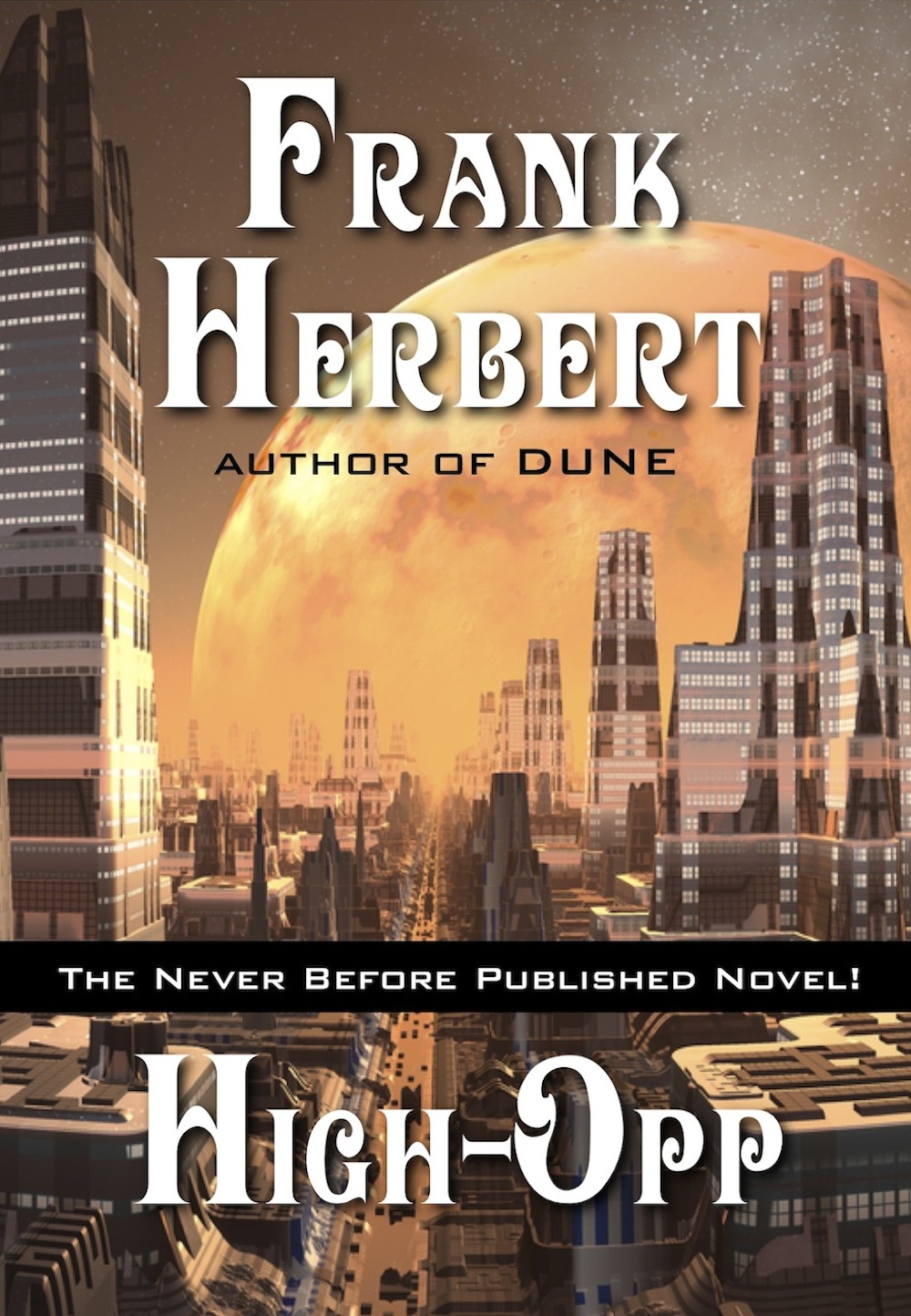
high-oppHigh-Opp, Frank Herbert (2012) Despite his success with The Dragon in the Sea, Frank Herbert had trouble selling another novel, and it wasn’t until Dune, published by Chilton, a publisher best-known for car repair manuals, that he had another book in print. During that period, he wrote a number of novels, all of which were eventually trunked. High-Opp is one of them. And, to be honest, it’s easy to see why no publisher back then would go for it. It’s also the book which contains the “fap gun” – Herbert should probably have considering renaming his future firearm. The world of High-Opp is run by opinion polls, although they’re presented pretty much as global referendums. Of course, the entire system is fixed, with a political class (all related to each other) holding all the top spots. A fast-rising star is brought low as part of a plot to overthrow those in charge, since he’s been identified as an ideal candidate to lead a rebellion by the head of BuPsych, who wants to effect a change of leadership. But he’s no tool to be used, and decides to actually smash the system. He wins the day and they make him emperor. This book is a curiosity and little more. I’m not surprised it’s taken more than half a century to see print.

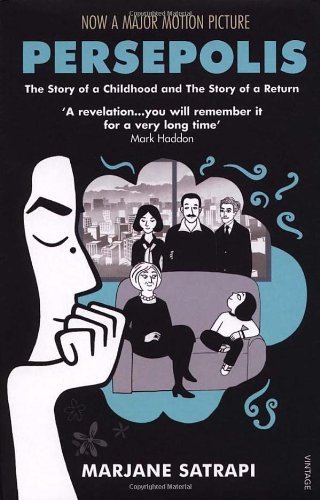
persepolisPersepolis, Marjane Satrapi (2003) This was made into an animated film in 2007, which I’ve not seen. That must be an odd experience, pretty much as if the graphic novel itself had suddenly come to life. Satrapi was royalty, her great-great-grandfather was the shah of Iran overthrown by Reza Pahlavi in 1921, but she grew up during the Iranian Revolution in 1979, and its her childhood during those turbulent years, and her family’s coming to terms with the new regime, which forms the first third of Persepolis. The Satrapis were Westernised, secular, well-off and political – and lost a lot of friends and relatives, first to Pahlavi’s secret police, then to the Ayatollah’s regime, and to the war with Iraq. Marjane Satrapi rebels, which puts her at risk from the authorities, so her parents send her to a French-speaking school in Vienna. There she experiences both friendship and racism, and at one point ends up living on the streets. She returns to Iran several years later, and once again has to learn to live in a fundamentalist Islamic state. There’s a telling scene when her friends ask her if she ever had sex while in Vienna, of course she replies, after all she’s nineteen and it’s not unusual in the West… but her friends, for all their secular views, are horrified. Persepolis is, of course, autobiographical, and while the art may be deceptively simple the story is not. Recommended.


4 Comments

Science fiction under pressure

As a species, we have little experience with naturally hostile environments, a century’s worth perhaps. By “hostile”, I don’t mean environments such as the Arctic, which are uncomfortable, or could prove fatal without basic survival tools. I mean environments which are pretty much instantly lethal without complex technological assistance. Human beings have to date visited two: space (including the lunar surface) and the sea deeper than 200 metres below the surface (it’s actually shallower than that, but the depth record for free diving currently stands at 214 m).

A scene from Luc Besson's The Big Blue

A scene from Luc Besson’s The Big Blue

Science fiction has covered the first of these in countless stories and novels, with varying degrees of accuracy. But no reader of sf doubts the hazardous nature of outer space. While all too many science fictions present magical technology allowing human beings to live and work and make war in space, there’s still a background of ever-present danger. In fact, it’s almost become a cliché.

But what of the opposite extreme? High atmospheric pressure rather than vacuum? Certainly the former have been covered in science fictions, though the genre tends to treat it as much the same as the latter – ie, both are survivable when wearing a spacesuit. But spacesuits are actually just personal spacecraft, designed for the same environment as spacecraft – ie, space. (If that’s not belabouring the point a bit much.) They provide a self-contained atmosphere and protection from radiation. A spacesuit wouldn’t work on a planetary surface with a datum pressure of, say, 50 atmospheres. It would be unwearable, constricted by the gas pressing against every square centimetre, its joints locked since they are designed to maintain a constant internal volume. When submarines get squished when they sink too deep in the sea? That’s what would happen to a spacesuit… and the person inside it.

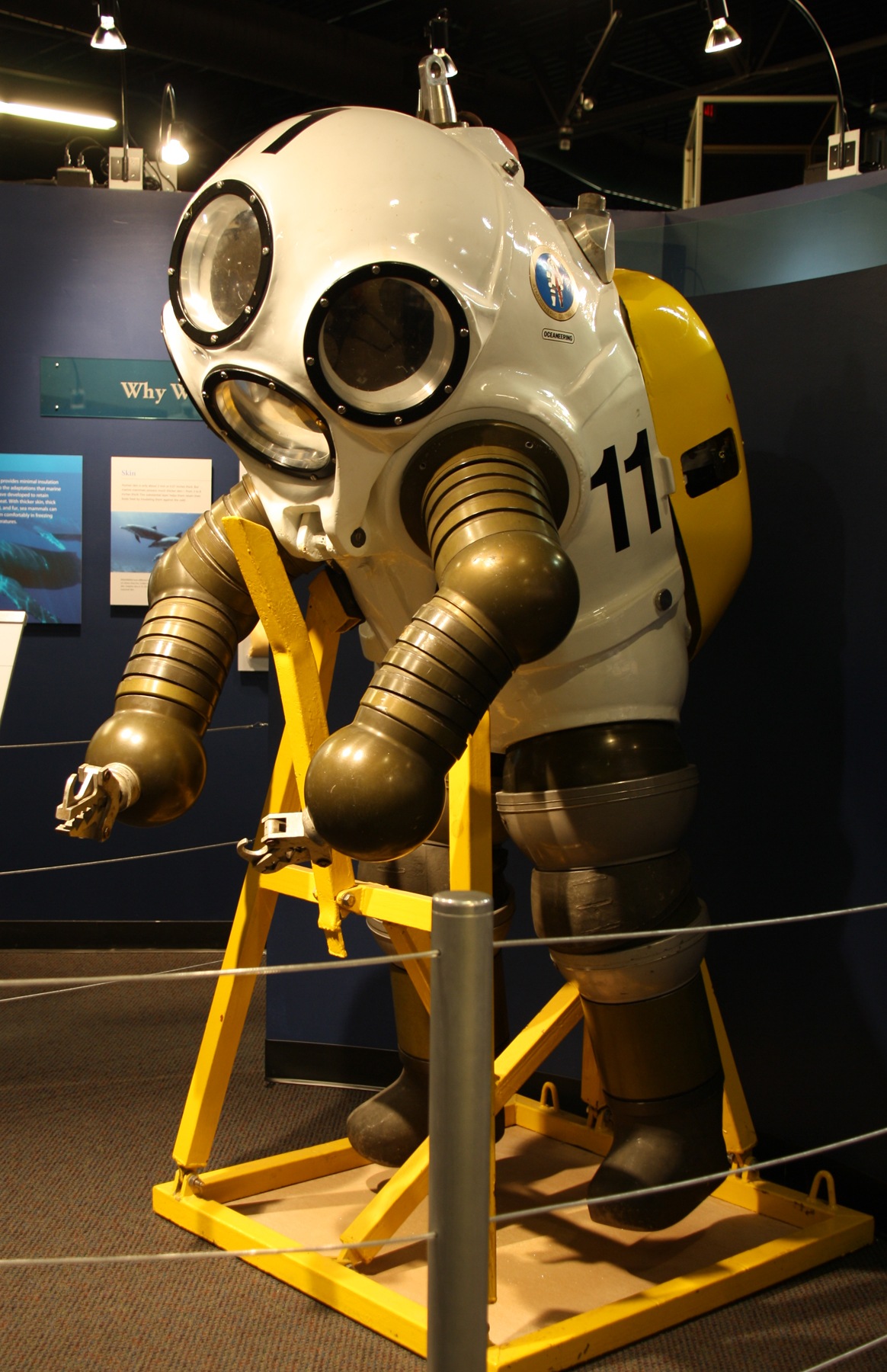
A JIM suit

A JIM suit

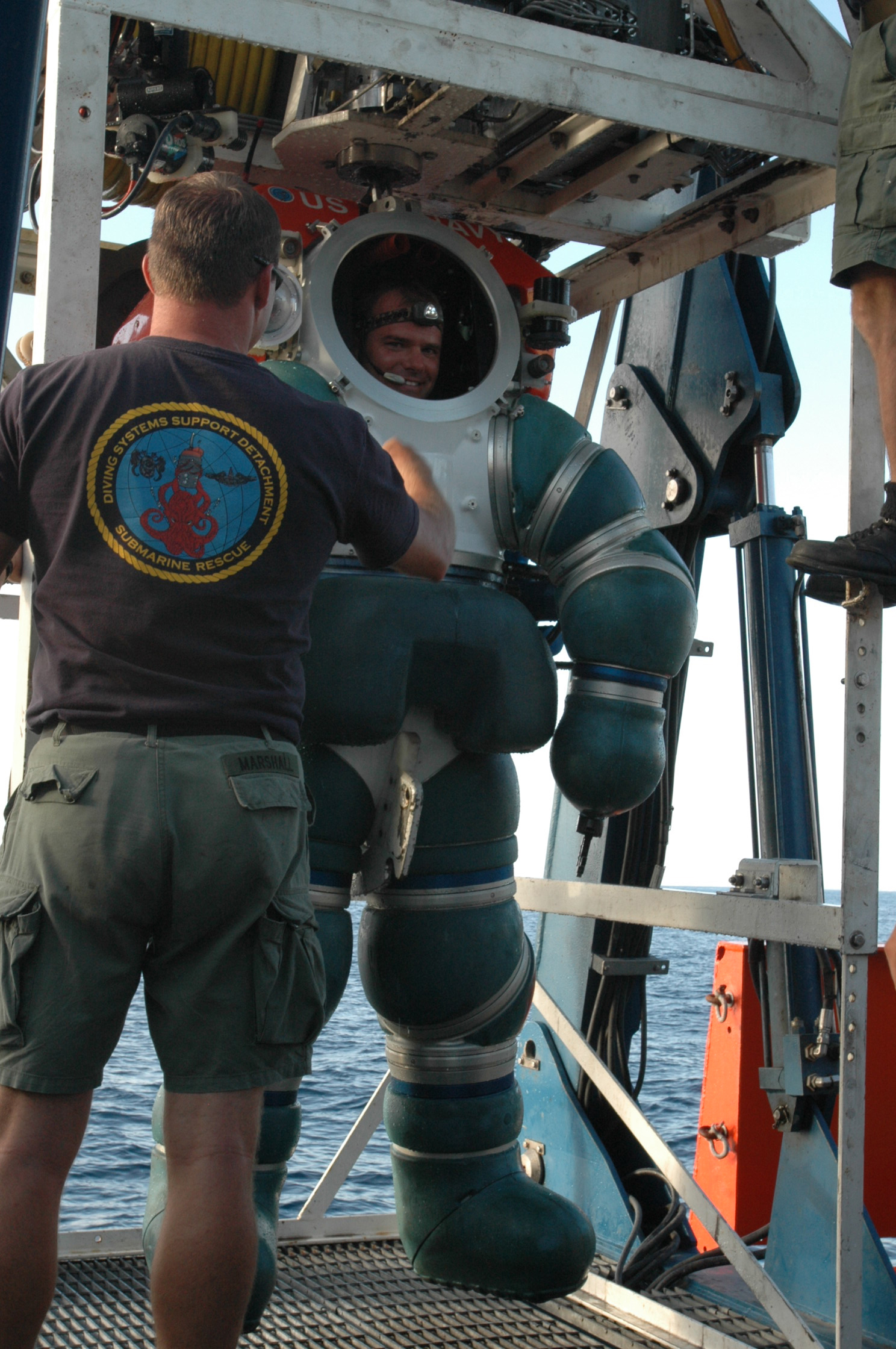
Which doesn’t mean hyperbaric environments would necessarily be out of reach. One solution would be to use an Atmospheric Diving Suit, which is much like a spacesuit but designed to keep pressure out rather than in. The current depth record in an ADS is 610 m (2000 ft), which is 61 atmospheres. Perhaps with the advent of new and stronger materials, or some sort of force-field, environments with much higher pressures would be accessible to someone in an ADS.

Chief Navy Diver Daniel P Jackson in the Hardsuit 2000

Record holder Chief Navy Diver Daniel P Jackson in the Hardsuit 2000

The only recent example that comes to mind of a sf novel set (partly) on a world with a hyperbaric environment is Alastair Reynolds’ On the Steel Breeze (2013), the second book of his Poseidon’s Children trilogy. Several chapters take place on the surface of Venus, which, as well as a mean surface temperature of 462° C, has a surface pressure of 92 to 95 atmospheres. In the novel, some of the characters go EVA on the surface, an apparently not uncommon pasttime, in “surface suits”:

The suits were essentially ambulatory tanks. They were glossy white, like lobsters dipped in milk. They had no faceplates, just camera apertures. Instead of hands, they had claws. Their cooling systems were multiply redundant. That was the critical safety measure, Chiku learned in the briefing. Death by pressure was so rare that it had only happened a few times in the entire history of Venus exploration. (p 128)

Clearly – refrigeration aside – Reynolds’ surface suit is much like a beefed-up ADS, and in no way resembles a spacesuit. Which is as it should be.

But what if a closer interaction with the environment is required? Perhaps there’s a need for something more dextrous than “claws”? Or human beings must be as unencumbered as possible in order to live and work in this hyperbaric environment. Obviously not the surface of Venus, but perhaps somewhere less extreme…

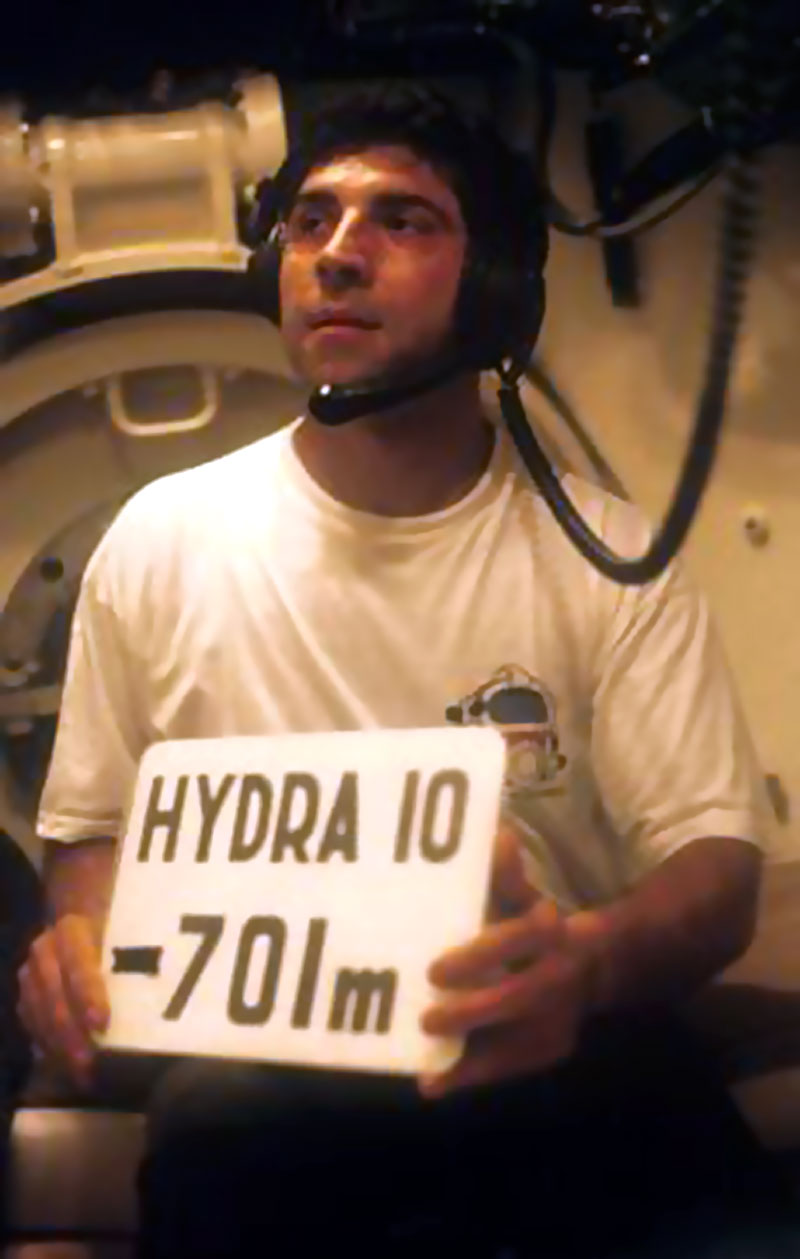
Theo Mavrostomos at a simulated depth of 701 m

Theo Mavrostomos at a simulated depth of 701 m

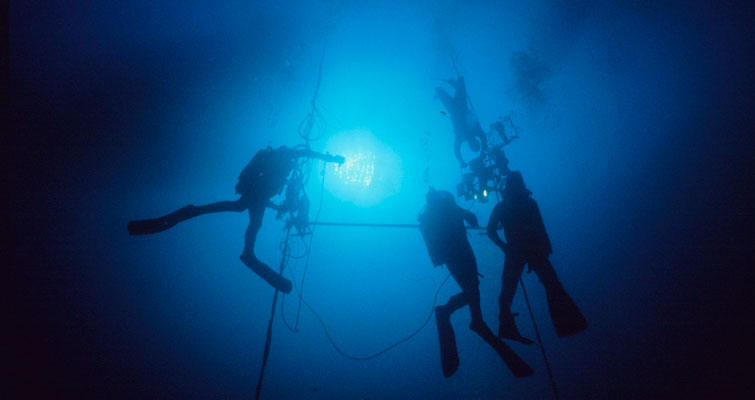
You can saturate a human body up to pressures around 70 atmospheres – that’s the current record, set during a simulated saturation dive by Theo Mavrostomos in 1992. He spent two hours at a depth equivalent to 701 metres (2300 feet). The term “saturation” means the person’s tissues have absorbed the maximum possible partial pressure of gas. A sudden return to normal atmospheric pressure would result in explosive decompression. A too-quick return would cause the absorbed gas to bubble out of the person’s tissues – the “bends”, or decompression sickness, which can be fatal. There are other hazards associated with hyperbaric environments. At pressures above 5 atmospheres, nitrogen causes nitrogen narcosis, or “the rapture of the deep”; and at pressures higher than 15 atmospheres High Pressure Nervous Syndrome can affect people breathing helium-oxygen mixtures.

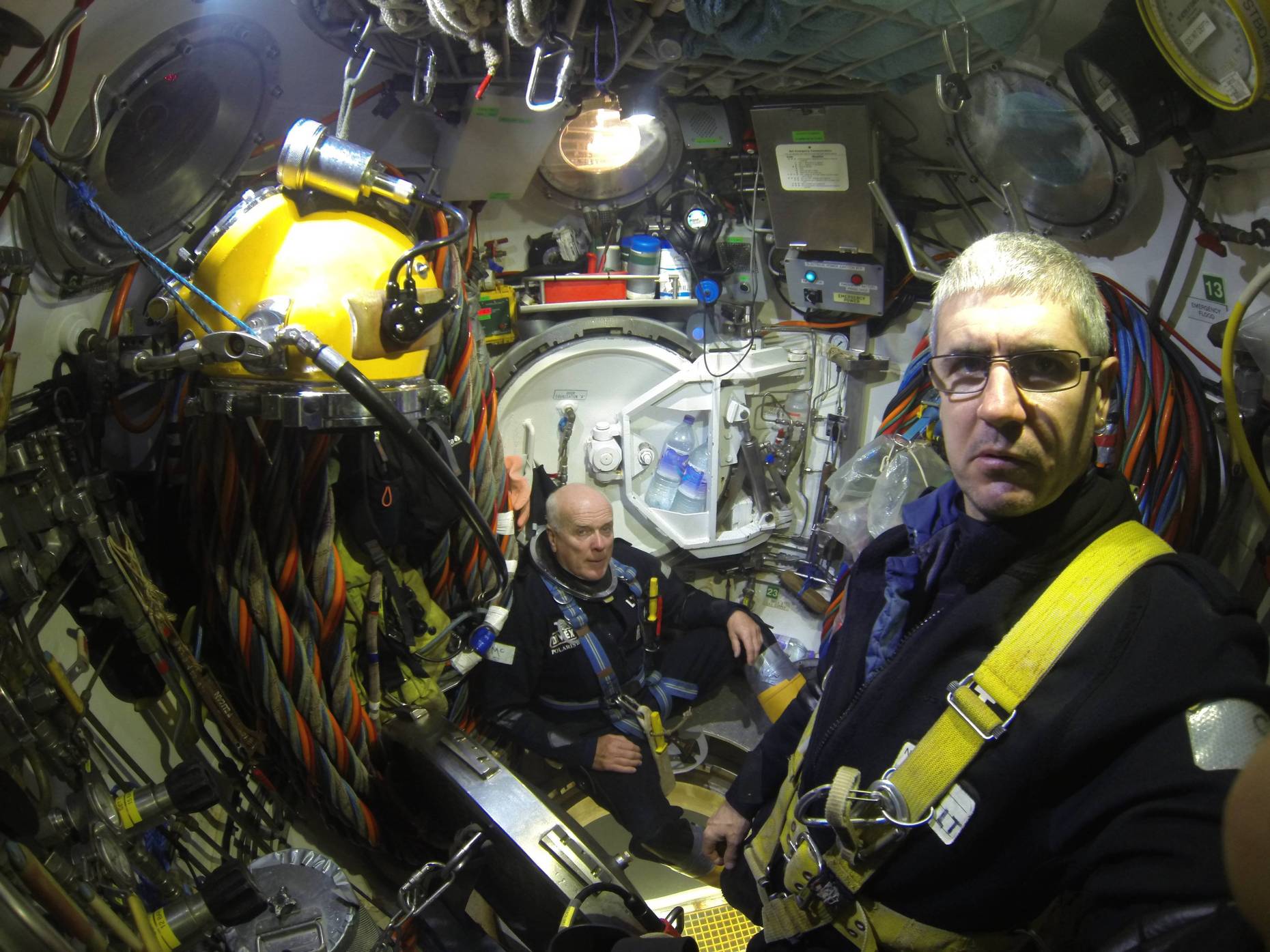
A pair of North Sea saturation divers

A pair of North Sea saturation divers

High pressure air is extremely difficult to breathe – not just the physical act of drawing it into the lungs, but also the lungs diffusing it into the blood. By using a less dense gas, such as helium, to maintain the correct partial pressure of oxygen (too much oxygen is poisonous), the human body can handle greater pressures. But this also presents its own set of problems – there’s HPNS, but also helium’s excellent conductivity of heat, not to mention the shortening of sound wavelengths resulting in the infamous “Donald Duck” voice (at the limit of saturation diving, this can make divers pretty much unintelligible). HPNS can be mitigated by adding some nitrogen back into the mix, and “unscramblers” are used on the radio links to divers but these are not wholly effective. There is no solution to helium’s conductivity other than bloody great heaters scattered throughout the saturation system.

At present, we’ve about reached the limit possible with saturation diving. In the oil industry, working at depths of 100 to 250 metres (320 to 820 ft) is routine. Deeper than 450 metres (1500 ft), ROVs are used. Greater pressures than 70 atmospheres may be possible – perhaps by using hydrogen, which has half the atomic weight of helium. Unfortunately, hydrogen is extremely flammable, although some helium could be added to render it safe. French diving company Comex consider it possible to reach depths of 1000 metres (3281 ft), or 100 atmospheres, using a hydrogen mix, but no one has tried and there’s currently no impetus to do so.

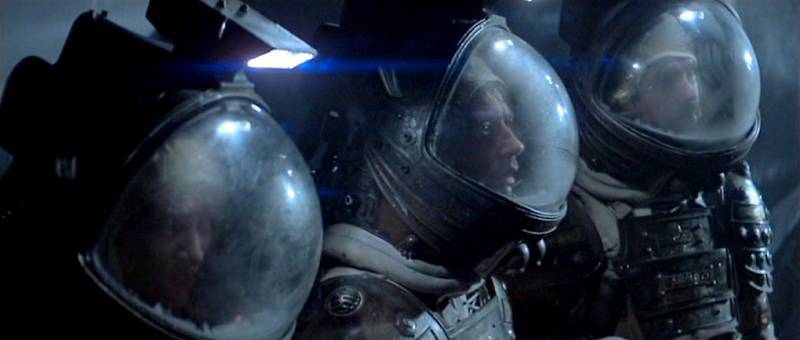
A still from Ridley Scott's Alien

A still from Ridley Scott’s Alien

Where this gets interesting is that, as far as I know, no one has used this in science fiction. While hyperbaric environments, or dense atmospheres on high-gravity planets, perhaps even gas giants, have undoubtedly been used, it’s either been with some science-fictional equivalent of a ROV, or magical spacesuits which operate as well in 100 atmospheres as they do in a vacuum, or perhaps even a kind of armoured suit capable of withstanding great pressure like a souped-up ADS. Dense atmospheres seem mostly to appear in science fiction only as settings for winged aliens or humans, such as in Vonda N McIntyre’s ‘Fireflood’ (1979) or Wings’ (1973; see here). Gas giants are quite common in sf, though mostly the action takes place in their upper atmosphere. One that doesn’t is Poul Anderson ‘Call Me Joe’ (1957), in which a disabled operator “drives” a ROV on Jupiter’s surface – James Cameron used a similar idea in Avatar (2009).

But sf typically treats alien worlds – what we now call exoplanets – as either extensions of space, or Earth-like, or near enough Earth-like not to make any difference. Those hardy explorers of countless science fictions often have little more to deal with than inclement weather, although perhaps one or two might need a breathing mask… No one has ever thought of the Earth’s surface as remotely like space – it’s an environment entirely distinct, and although it covers a wide range of conditions they’re all survivable. So why no variety in alien worlds? Ignorance initially, almost certainly; but then it becomes about the story, about some “alien” aspect of the exoplanet which drives the plot, as in Marion Zimmer Bradley’s Endless Voyage (1975; see here). Yet, allegedly, science fiction is about science and technology, and how we use it…

Mars Arctic Research Station

Mars Arctic Research Station

Surely it would be more interesting to explore the techniques and technology that might be used to explore, or perhaps even colonise, an environment that is neither Earth-like nor vacuum? A saturation system strikes me as a perfectly suitable method to use in a hyperbaric environment; and one that is filled with dramatic possibilities. Just think, you could murder someone by knocking them out and them putting them in a balloon’s gondola… Too much science fiction, to my mind, fails to get across the true experience of the strange environments in which it takes place. It’s passed off as “setting” using a few incidental details, but in all other respects treated as if it were, say, middle America, or the Wild West. A more rigorous approach to such things would be far more interesting.

Of course, it’s not just exoplanetary environments. There’s certainly science fiction set underwater at great depth (see my earlier blog post on the topic here), but most such sf imagines that human beings have been physiologically engineered to survive in that environment. But, as far as I’m aware, no one in sf has made the mental leap from deep sea to hyperbaric planetary surface.