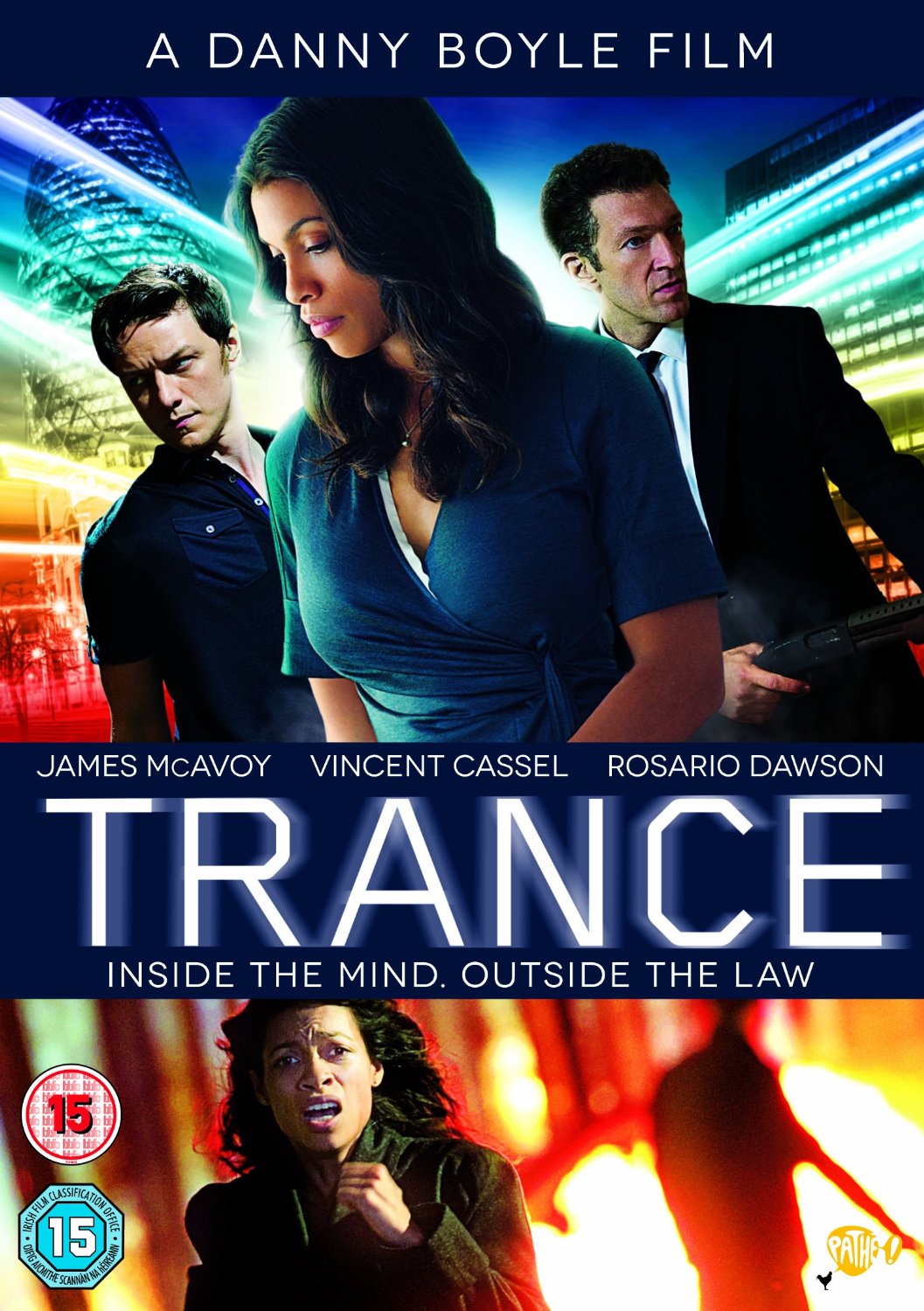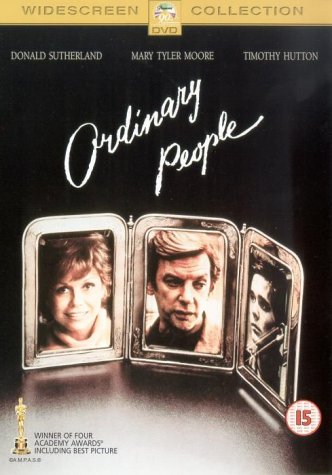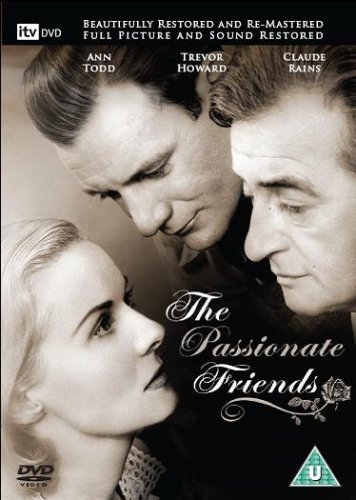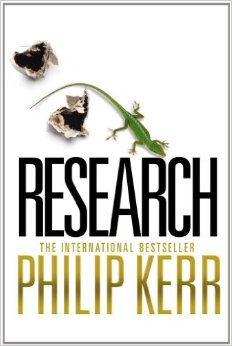
It Doesn't Have To Be Right…

… it just has to sound plausible


Leave a comment

Books everywhere

At least these book haul posts are now less frequent, and feature fewer books, than they did in previous years. Even so, I really need another big clearout – I can even reach some of my bookshelves because of all the books stacked in front of them. Buying new bookcases won’t help as I already have bookcases on every wall – most of which are double-stacked. If I could read faster, I could probably get rid of quite a few books…

2015-07-10 11.25.00

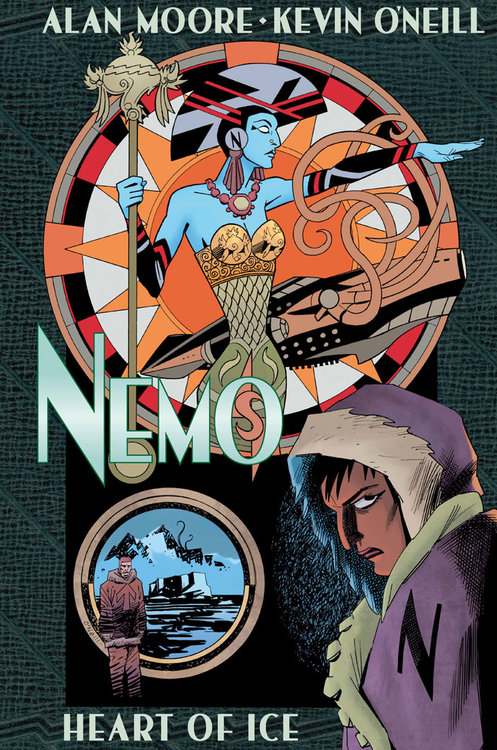
Some graphic novels. Run Like Crazy Run Like Hell is the latest Tardi, a slick and quite sick thriller. The Nemo trilogy – Heart of Ice, The Roses of Berlin and River of Ghosts – is a spin-off from The League of Extraordinary Gentlemen, and the Nemo here is the daughter of Verne’s original. I wrote about the trilogy here.

2015-07-10 11.25.33

A mixed bag. Soviet Ghosts is lovely photographs of abandoned buildings in what was the USSR. Notes for a Myth is a 1968 poetry collectionm by Terence Tiller. I now have all of his books. And Home, Marilynne Robinson’s third novel, is a signed first edition.

2015-07-10 11.26.12

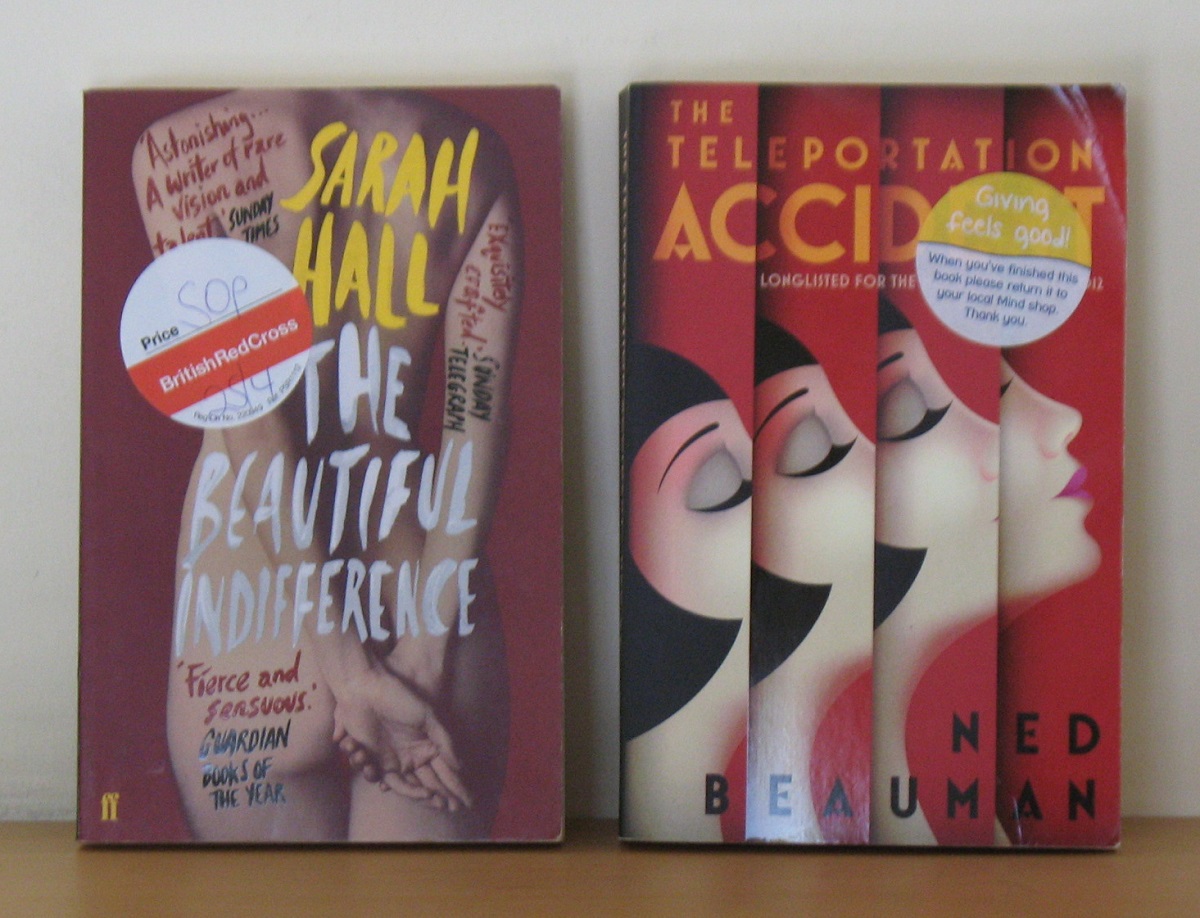
A pair of charity shop finds: a collection by Sarah Hall, The Beautiful Indifference; and The Teleportation Accident, a book Lavie Tidhar has raved about for a while now.

2015-07-10 11.26.30

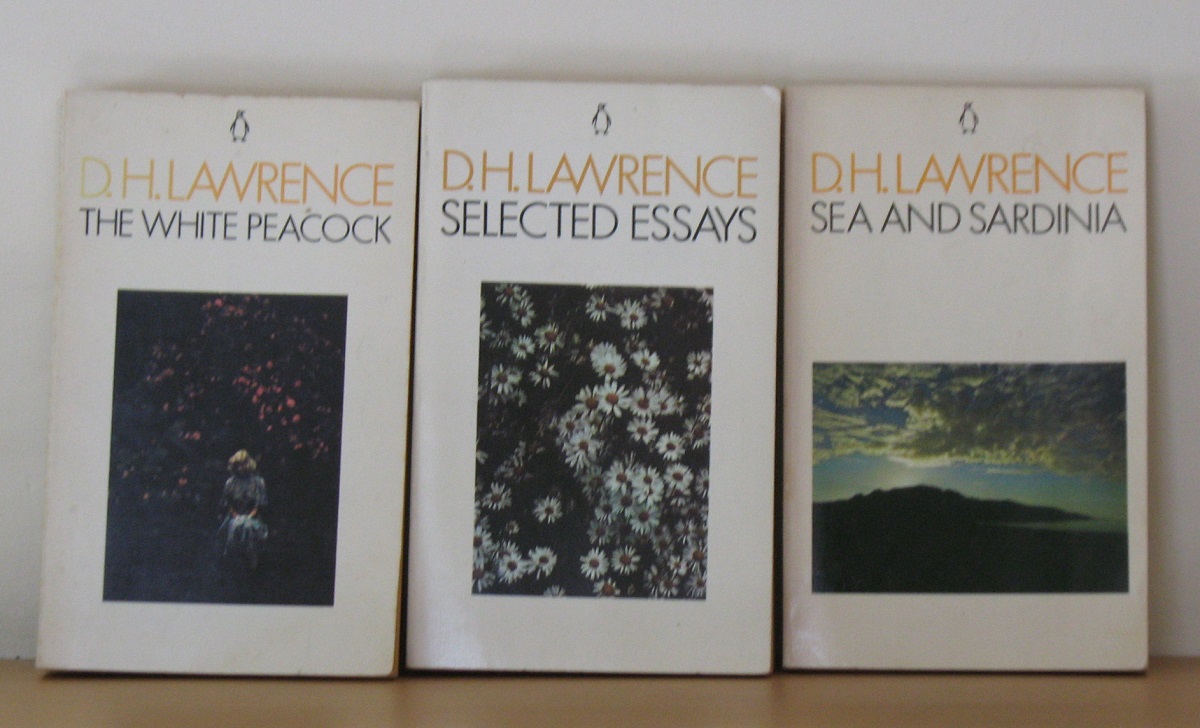
Three more Penguins for the DH Lawrence collection: The White Peacock, his first novel; Selected Essays; and a travel book, Sea and Sardinia. I now have 21 of these white Penguin paperbacks, from a total of, I think, 27.

2015-07-10 11.26.47

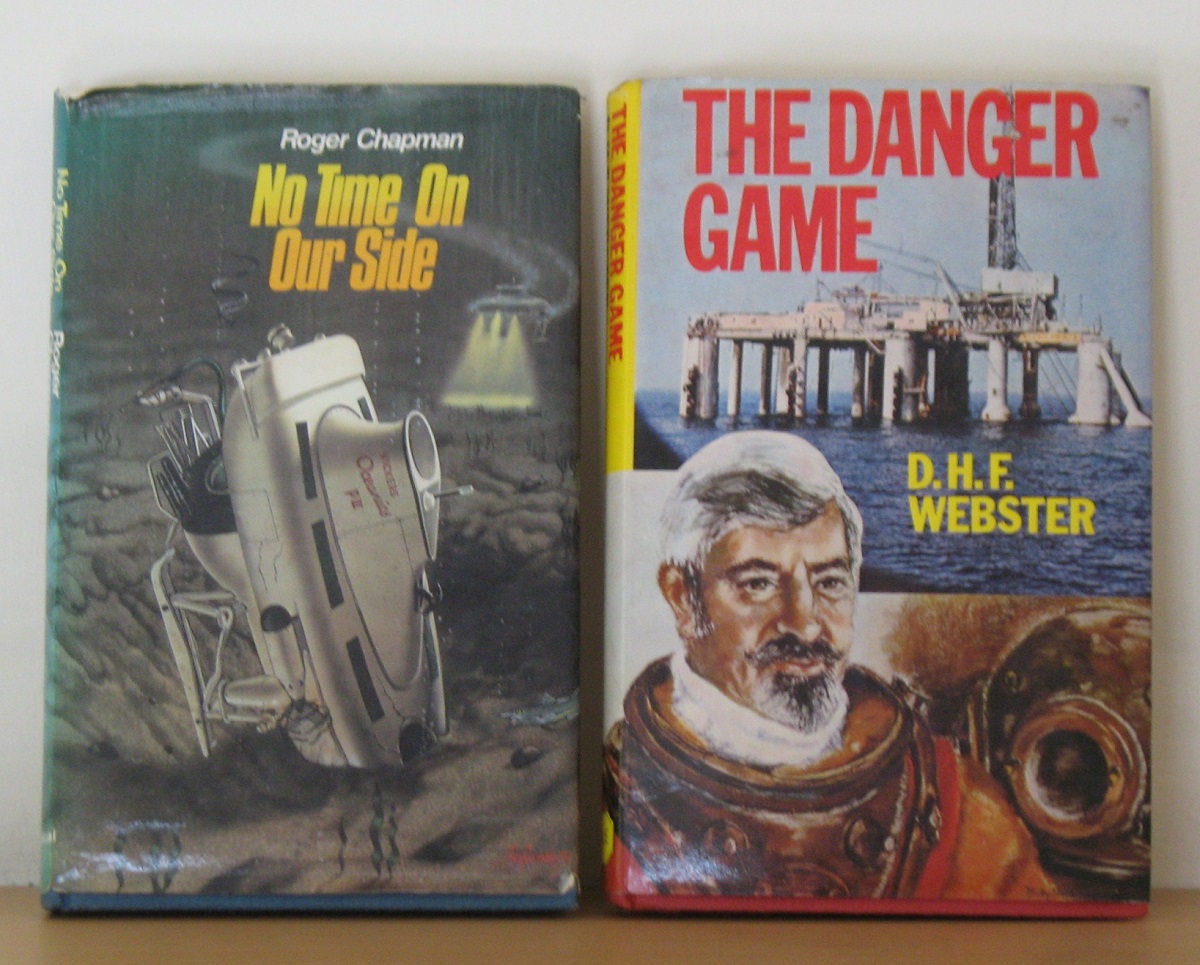
And finally, another two books for the deep sea collection. No Time on Our Side details the three-day rescue of the two crew – the author was one – of the submersible Pisces III, which sank in 500 m of water 250 km south of the Irish coast. The Danger Game is the autobiography of a diver for the North Sea oil industry.


1 Comment

Moving pictures, #17

Six months into the year and I’m on my seventeenth film post already. And it’s not like I include every film I watch here – I don’t, for instance, bother writing about films I’ve seen before, or crappy ones on Movies24 that I find myself watching on a Sunday afternoon after my brain has given up the ghost… Anyway, as usual asterisked films are from the 1001 Movies You Must See Before You Die list (or at least the version of the list I’m using).

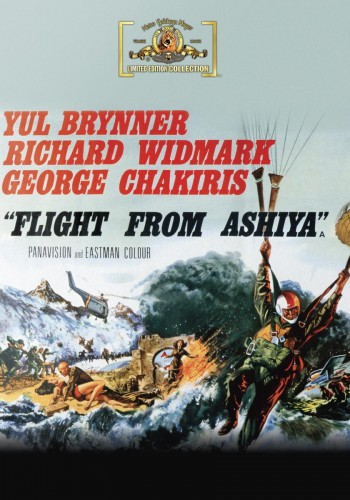
flight_from_ashiyaFlight from Ashiya, Michael Anderson (1964, USA). Richard Widmark is a tough-talking USAF Rescue Service pilot stationed in Japan. Yul Brynner is his Japanese sergeant and medic, and George Chakiris is a pilot lieutenant with confidence issues. A Japanese ship goes down in a fierce storm, and two Rescue Service Grumman HU-16 Albatross seaplanes are sent to rescue them. As they fly to the site of the sinking, and begin searching for survivors, flashbacks cover important events in the past of each of the three main characters. It’s melodramatic, but surprisingly dull, stuff. Suzy Parker has a not-much-more-than-walk-on part as Brynner’s latest flame, and the aerial sequences aren’t too bad; but other than that, this isn’t even the sort of film you’d stop to watch if you were channel-hopping on a lazy Sunday afternoon. Disappointing.

royalspaceforceRoyal Space Force: Wings of Honnêamise, Hiroyuki Yamaga (1987, Japan). I know only a little about anime, and have seen only a dozen or so of the best-known ones and, of course, pretty much all of the Studio Ghibli movies… but I’m open to learning more. So when David Tallerman recommended a handful of titles I should add to my rental list, I picked two of them and this was the first that arrived. And… while the world-building in Wings of Honnêamise was cleverly done it wasn’t enough to offset that style of overly-broad humour and the characters mugging all the time common to much anime that I find really hard to take. The launch sequence at the end, however, where Honnêamise’s first crewed rocket makes it into space while an air and ground battles rages around the launch pad is actually really good. I’m not sure if it’s worth sitting through near enough 100 minutes of the film to get to that point, but even now, weeks after watching the movie, that sequence sticks in my memory. Perversely, thinking about it for this post is sort of making me want to have another go at watching the film. Apparently, a sequel titled Aoki Uru (Uru in Blue) is finally in preproduction, after a number of aborted previous attempts, with a proposed launch date of 2018.

continuumContinuum, Richie Mehta (2013, Canada). AKA I’ll Follow You Down. Physics professor Rufus Sewell says goodbye to wife Gillian Anderson and son (who, twelve years later, grows up to be Haley Joel Osment) and heads for a scientific conference in Princeton, but never returns. It turns out he’s actually invented a time machine, and he uses it to travel back to the 1940s in order to meet Albert Einstein. But he is mugged and killed before he can return. Fortunately, Osment is a genius and he manages to figure out his dad’s arcane physics and so build a replica of his time machine. Which he then uses to go back in time to save Sewell. It’s hardly the most original plot in media science fiction – at least half a dozen sf television series have used it more than once throughout their runs – and it’s all played very low-key… But Osment is too much a genius to be really plausible – and that’s after you’ve swallowed Sewell inventing a time machine. Meh.

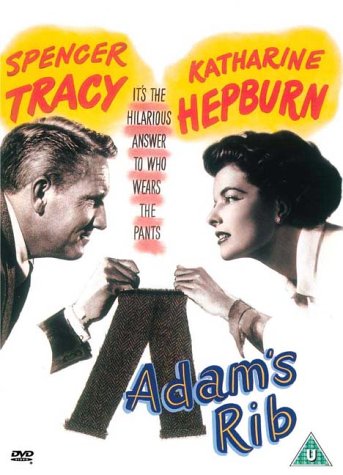
adams_ribAdam’s Rib*, George Cukor (1949, USA). Much as I enjoy screwball comedies, I’ve never really seen Spencer Tracy as a screwball romantic lead. He never quite seemed light enough on his feet, if you know what I mean. But here he is with Katherine Hepburn, as a married couple who are also lawyers who end up opposing each other in court. She’s defending a woman who took a potshot at her philandering husband, he’s the prosecuting attorney. The result is a battle of legal wits and domestic rivalry in the court room. To be fair, I thought Tracy and Hepburn were better in Desk Set – while the film was not especially witty, it was in Technicolor – Technicolor! – and there was a giant 1950s computer in it. It was also a bit, well, sweeter. (And Tracy played a good curmudgeon.) Anyway, I’ve seen Adam’s Rib, so meh.

theislandThe Island, Pavel Lungin (2006, Russia). Amazon insisted on recommending this film to me – repeatedly – because I’d bought, or searched for, films by Aleksandr Sokurov. I checked it out on Wikipedia, and it looked like it might appeal… so I bought a copy. And it did appeal. During WWII, Germans board a Russian coal barge and force the crewman to shoot his captain. The Germans then mine the barge. The crewman survives and is wracked with remorse for killing his captain. The film jumps ahead thirty years. The crewman, Anatoly, is a monk on the tiny island on which he washed ashore. He is also something of a Holy Fool, and tells people things which then come true. He looks after the monastery’s boiler, is perpetually filthy, and talks back to the monastery’s abbot. But one day an admiral brings his daughter to be exorcised by Brother Anatoly… Some films take you by surprise not simply because of the way they’ve been shot – and The Island is indeed beautifully shot – but because of their story and what they say. And The Island certainly did that. I was initially expecting something like one of Béla Tarr’s movies – I seem to recall the phrase “slow cinema” being used in reference to Lungin – but The Island soon became something very different. I now want to watch more films by Lungin. But, since he’s Russian, very few of them have been released in the UK – only this one, in fact. Gah.

paddngtonPaddington, Paul King (2014, UK). This was pretty successful last year, so I thought it might be worth a go. I should have known better. Yes, I remember the Paddington Bear cartoon from my childhood, but this was some bizarre story that didn’t seem to know in which decade it was set. An explorer in “deepest, darkest Peru” finds some talking bears, and years later the child bear heads to London to find the family of the hunter. Though the film was sent in the present day, it only made sense – talking bears notwithstanding – if it was sent in the 1940s. And everything in the plot was structured as if the story were set in the 1940s. It made for a weird disconnect between plot and visuals, and even the modicum of wit couldn’t rescue the movie from total crapness. And comedy cross-dressing? When was the last time a movie featured that? Whatever happened to the British film industry? All it seems capable of turning out these days are mockney gangster movies, execrable upper middle class rom coms, and appalling comedies. Those “quota quickies” they banged out during WWII? Most of those are better than this shit.

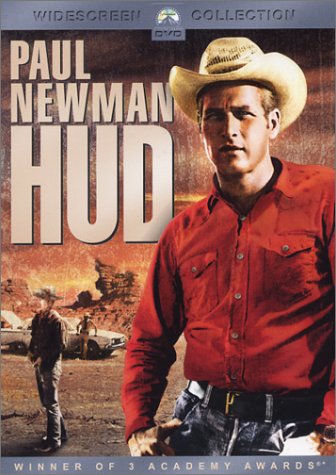
hudHud*, Martin Ritt (1963, USA). Paul Newman plays the ruthless and self-centred son of a rancher, and he’s more concerned with making money than anything as profit-jeoparding as principles (such as, for example, not drilling for oil on the land). So Hud sleeps around, gets into fights, argues with his dad, patronises his younger brother, and generally presents as one of those arsehole characters Hollywood likes to build films around because they’re good for winning awards. (Hud, incidentally, was nominated for seven Oscars, but only won for best actress, best supporting actor and best cinematography.) Working my way through the 1001 Movies You Must See Before You Die list has introduced me to films, and directors, I might not otherwise have seen and which I have greatly appreciated and admired. But it has also resulted in me watching a great deal of middle-brow Hollywood output that I would otherwise have quite happily not bothered seeing. Hud is one such movie. Oh, the scene where they massacre the cattle because it has foot and mouth disease is affecting, but centring the film on an unlikeable prick doesn’t to me feel like it adds anything useful or interesting. I’m sixty percent of the way through the list now, and I suspect of those I’ve seen I’d only consider around a quarter truly belonged there.

1001 Movies You Must See Before You Die count: 601


4 Comments

Åwesome

When I learned the 2015 Eastercon would be in Heathrow, I knew I’d be giving it a miss. And when I discovered its guests of honour were urban fantasy writers, then I had even less reason to attend. At Fantastika, Swecon 2013, in Stockholm, I’d heard about Åcon, a small con which takes place in Mariehamn in the Åland Islands, an archipelago between Finland and Sweden (it’s a self-governing part of Finland, although the natives speak Swedish). I quite fancied attending Åcon – I’d found Nordic fandom hugely friendly at Fantastika, and Mariehamn looked like a nice place to visit – but plans to do so in 2015 came to nothing… But that was okay because then Archipelacon was announced. An Eastercon-sized convention. In Mariehamn.

So that would be my alternative to the Heathrow Eastercon.

konopas

As the  date of the convention approached, I started to worry about travelling to Åland – the Finnish fans catch a ferry from Turku, and the Swedish fans from Stockholm. I didn’t fancy finding my way from Helsinki to Turku and onto the ferry in a country I’d never visited before. But then I found out Mariehamn had an airport… and I could fly there from Helsinki Airport. Sorted. I booked my flights, my hotel room, and my days off from work.

As journeys go, it wasn’t too bad. I had to spend five hours in Helsinki Airport waiting for my connection, but it’s a nice airport so it was no real hardship. And at the gate to the flight to Mariehamn I ran into some friendly faces, Icelandic writer Emil Hjörvar Petersen and his girlfriend Kristin. We were staying in the same hotel too, the Park Alandia. So on reaching Mariehamn, we shared a taxi from the airport. And met up later for food and drinks in the hotel bar… where I discovered all food in Finland is either gluten-free, lactose-free or both. (I was told a lot of Finns are lactose-intolerant, but most food is actually only “low lactose”. However, I had no problem finding lactose-free food during my stay – and even in Helsinki Airport half of the sandwiches in the café were labelled lactose-free.)

IMAG0304

The following morning, I went for a wander in the centre of Mariehamn. Which didn’t take long. It may be small, but it’s very pleasant. I found the convention venue, the Alandica conference centre, quite easily, but when I turned up they were still getting things ready. I returned later, bumped into some friends, and so Archipelacon began in earnest…

IMAG0300

Much as I’d like to mention everyone I spoke to during the con, I’m likely to miss someone off so if I have done, apologies. But here goes anyway: Tobias, Ian, Cristina, Edward, Farah, Johan, Linnéa, Johan, Kimmo, Rollo, Kristina, Alexander, Emil, Kristin, Jukka, Juha, Elio, Linda, Gary, Niall, Liz, Nic, Jukka, Polar bear, Loponen, Jerry, Juha, Christina, Doug, Dave, Gaie, Minnow, Alexander, Eugene, Cheryl, Karin, Mia… and no doubt there’s someone I’ve forgotten. I met people from a dozen nations, and hung out with people I knew from Fantastika, UK fandom, online fandom, not to mention lots of very friendly people I’d never met before. Archipelacon is also the only time I’ve had a convention-goer introduce themselves to me in a non-convention venue. I’d nipped back to the Park Alandia Hotel bar for some food on the Thursday night, and the person next to me spotted my membership badge and introduced himself and his wife – they were, of course, also members. We were then joined by a fourth person who had spotted our badges. I don’t recall anything like that ever happening at a UK con.

IMAG0310

The programme was very good, although I didn’t attend as much as I’d planned (but certainly more than I typically do). I was on only one programme item, “Why SF Writers Should Rule the World — or Should They?”, with Kristina Hård, Kimmo Lehtonen and Farah Mendlesohn. Obviously, we all said they shouldn’t. Then we sort of talked around the subject, prompted at intervals by Kristina. The audience seemed to enjoy it.

There was also a strong academic track – and a lot more academics present than is the case at Eastercons. In fact, sitting outside on the Alandica deck at one point I found I was the only non-academic in the group at the table. On the Friday night, there was a big party around the pool of the Hotel Arkipelag (the main con hotel). The Arkipelag also has the only nightclub in Mariehamn – so when we moved indoors later, it was very busy. The nightlife in Mariehamn is… odd. It all felt a bit nineties. At the Saturday night pool party, I left around midnight, and took a wrong turn leaving the hotel… and found myself at the nightclub entrance, where bouncers held back Mariehamn twentysomethings queuing behind a rope. And when I got to the Park Alandia Hotel and entered through the bar, I noticed that everyone there was over the age of forty-five. I was later told the nightlife in the town revolves around the hotels, but wandering about town on the Sunday I found a couple of small bars. Outside one were three men who looked like they’d just stepped out of an Aki Kaurismäki film. Except they were speaking Swedish, of course.

IMAG0306

The Alandica was a superb venue. The central space was big and airy, with plenty of seating. The two auditoriums were excellent. There was food available throughout the day – much of which was lactose-free. And the bar sold bottles of the local beer, Stallhagen – which is what I drank for most of the weekend. It’s very nice. Sunset each day was around 11:30 to midnight. Which meant it was always later than you thought. The weather was sunny and hot – you don’t expect to get suburned in Finland, but I did.

IMAG0319

I’d promised myself I wouldn’t buy any books at the con, but I’d said the same at Fantastika and still left with a dozen or so. Thanks to Alvarfonden. This is a fan-run fund which sells secondhand US and UK paperbacks cheap – at Archiepelacon for between €1 and €2. So I ended up coming back with half a dozen or so, mostly for SF Mistressworks: The Clewiston Test, Kate Wilhelm; Outer Space Stories, AL Furman; Strange Bedfellows, Thomas N Scortia; The Tomorrow People, Judith Merril; Galactic Sibyl Sue Blue, Rosel George Brown; Godsfire, Cynthia Felice; A Woman A Day, Philip José Farmer; and A Voice Out of Ramah, Lee Killough. I read the last during my flight home, so a review of it will be going up on SF Mistressworks this coming Wednesday.

2015-07-03 10.41.34

2015-07-03 10.41.54

The only bad thing to happen during the weekend was entirely my own fault. On the Sunday afternoon, I received a telephone call from my hotel. “You must check out now.” “I’m booked through until tomorrow.” “No, you’re not.” I wasn’t. Gah. I’d booked a room from Wednesday to Sunday, meaning including Sunday night. But the hotel took that to mean checking out on Sunday. And I never noticed I’d only booked four nights instead of five (possibly because Archipelacon started on a Thursday rather than a Friday, and that threw me). Tobias offered the spare bed in his room – he was in the same hotel – but the hotel managed to find me a free room. Except it had no shower. Which meant using the one down in the saunas. I took that room because I’d be up at seven am to catch my flight, and thought it unfair to Tobias. But skulking naked around the hotel sauna was not an experience to be repeated.

It seems likely Archipelacon was a one-off, but I think pretty much everyone who attended would like it to be repeated. The Alandica was an excellent venue, Mariehamn (nightlife notwithstanding) was a lovely little town, and everyone seemed to have a really good time. I know I did. It was the best con, in fact, I’ve been to for a long time. I certainly plan to visit Finland again – perhaps an Åcon, or maybe a Finncon (next year it’s in Tampere, I believe). And, of course, there’s always Sweden – Fantastika is back at the Dieselverkstaden in Stockholm in 2016. There was even talk of running small con in Reykjavik. I’d definitely go to that.

ETA: Archipelacon has posted all the photos by official con photographer Henry Söderlund. You can find them here.


2 Comments

Reading diary, #8

Time once again to catch up on my recent reading. Which seems to have been all over the shop recently. I try to plan my reading but it never works. I mean, I sometimes decide not to read a book as planned just because it’s a hardback and would be a faff carrying in my bag to and from work. So I end up choosing a paperback I hadn’t planned to read instead. Other times, I fancy something a bit fluffier and less worthy than my original choice… Which does make me wonder why I bother to plan my reading in the first place.

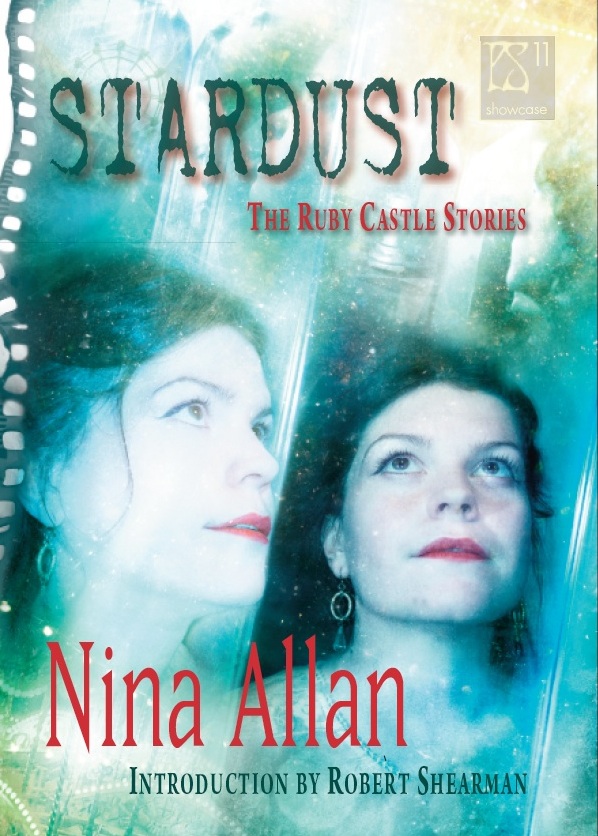
ps-showcase-11-stardust-hc-by-nina-allan-1749-pStardust: The Ruby Castle Stories, Nina Allan (2013). This collection of short stories are linked by mention of the eponymous, well, not character, she’s an element in the background of each, a cult actress who appeared in films the protagonists of the stories remember watching. And, to be honest, not every mention feels like it’s original to the story, or an organic part of it. Indeed, ‘The Lammas Worm’ was originally published in Tartarus Press’s Strange Tales, Volume III, the only story in the collection to see prior publication, and I have to wonder if the mention of Ruby Castle in it wasn’t added so it would fit in Stardust. None of which is to say that hese are bad stories. Allan is a good writer, and if she doesn’t always play to her strengths, the end result is at least interesting in some fashion. The six stories and single poem in Stardust are mostly slipstream, and are set in contemporary Britain, Victorian Germany and Russia. But it’s not quite the Britain, Germany or Russia we know. In some respects, Allan’s slight twisting of the real world works well, but it’s a technique that seems to fail as often as it succeeds – the Russia of the title story, for example, is not at all convincing. Where Allan succeeds best is in dropping some small detail or plot-point which signals this is a reality at an angle to our own. Sometimes it’s in the first line: “In my country July the tenth 2029 is remembered by everyone as the date of the Anastasia space disaster”. In other stories, it’s a slow accumulation of tiny details. Add to this a tendency for her stories to shoot off in unexpected directions, and it’s clear Allan is creating an interesting body of work. Her prose is never less than polished and if, often as not, the story seems to leak around the edges… sometimes that adds to the general effect of the piece. I still have Allan’s The Silver Wind and A Thread of Truth to read – I bought three of her collections at the last Fantasycon – and I’m looking forward to tackling them.

lastbastleThe Last Castle / Nightwings, Jack Vance / Robert Silverberg (1966 / 1968). This is #15 in the Tor double series from 1988 to 1991, although both novellas originally saw print in the late 1960s. I’m pretty sure I’ve read them many years before, either in a collection or Ace double (which is how the Vance was originally published). Silverberg also expanded ‘Nightwings’ to novel-length, and I may have read that too. I can’t remember – and, to be honest, I can’t recall much of ‘Nightwings’ only a couple of weeks after reading it. Vance’s ‘The Last Castle’ is at least more memorable. It’s set during the twilight years of Earth, after humans from another world decide to recolonise it, and they now live a life of ease in castles, waited upon by alien creatures called ”. Who promptly decide to kill all the humans. Only one man takes the threat seriously enough to attempt to fight back. It’s typical Vance in all respects, and as fair an introduction to his oeuvre as any. There are, sadly, only two female characters named in the entire novella, and they’re wives and sex partners. Even for 1966, that’s piss-poor. Silverberg’s novella actually features a female protagonist – she’s the “nightwings” of the title, a member of a race adapted from human stock for flying. She travels to Rome in some distant future in the company of the narrator, a Watcher, and a mysterious man who seems somewhat too well-educated to be the non-guild itinerant he claims. A Watcher, incidentally, is a member of a guild dedicated to scanning the galaxy with some sort of equipment built into a small cart – it’s all very vague and handwavey – in order to spot the first signs of a long-threatened invasion. Which, of course, happens during the story – well, there’d be even less of a plot if it hadn’t occurred. ‘Nightwings’ won the Hugo, and was nominated for the Nebula, in 1969, but I thought it pretty slight. It trades entirely on atmosphere, despite the fact little of the background makes sense, and the ending is visible from several kilometres away. Meh.

manycolouredThe Many-Coloured Land, Julian May (1981). I first read this shortly after it first appeared in the UK, back in the early 1980s. I remember liking it a great deal – and I know a number of people count the Saga of the Exiles among their favourites… But it’s never wise to reread books you remember fondly from your teens, they almost never survive unscathed. As this one didn’t. I may reread the other books in the series at some point, but it’ll only be to review them for SF Mistressworks – as I did with this one here.

adam-robotsAdam Robots, Adam Roberts (2013). Or is it the other way round? Never mind. As it says quite prominently on the cover, this is a collection of short stories, a number of which are original to the book (although the page which gives original publication details seems to be missing a couple). I’d thought I’d read quite a few of Roberts’s stories, but many of the ones in here were new to me. Except, I have read at least three of the anthologies in which a story in this collection originally appeared… One of these I liked, despite the thump-worthy pun in the last line. Another struck me as a neat idea stretched just a tad too far. And the third… seems as memorable after this second read as it was after the first. The stories in Adam Robots are never less than very readable, and Roberts can indeed turn a lovely phrase, and often does, but there’s also a sense that some of the pieces are lacking in… thickening. Perhaps it’s the sf story as Gedankenexperiment, an exploration of premise but not necessarily a thoroughly rigorous examination of it – which, on occasion, does make the story feel as though it exists only as a vessel to hold a premise rather than as an armature for a narrative. In the shorter pieces, of course, this is not an issue – the space is limited. Having said that, the saving grace of many of these stories is that Roberts carefully positions them as stories – it’s literary device deployment rather than immersion. The end result is a collection that is both enjoyable and impressive – and definitely good value for money as it contains twenty-four stories. I do have one peeve, however: the title ‘Review: Thomas Hodgkin, Denis Bayle: a Life (Red Rocket Books 2003), 321pp, £20. ISBN: 724381129524′. That ISBN is 12-digit. There are only 10-digit and 13-digit ISBNs. And if missing a digit was done to prevent accidentally giving the ISBN of a real book… well, the last number is a checksum. Just make it fail the checksum and it can’t be a real book.

snailSnail, Richard Miller (1984). The word to describe this novel is, I believe, ‘Vonnegutian”. The writer was clearly trying to be Vonnegutian – so much so Kilgore Trout appears several times as a character, although for reasons never explained he’s named Kilgore Traut, and that spelling is claimed to be correct. The narrator of Snail is a senior Wehrmacht officer, who falls foul of Hitler because he marries a call girl, and so promptly sits out most of the war. Back in WWI in the German trenches, he met and fought alongside the Wandering Jew. Who later gave him an immortality elixir to give to Hitler. Which the narrator does, turning Hitler into an immortal nine-year-old. He also takes some himself, and becomes an immortal sixteen-year-old. The rest of the novel follows him through the twentieth century, although it’s mostly concerned with his encounters with Pallas Athena, the Wandering Jew, and an organisation called Macho-Burger Incorporated, which seems to be using fastfood to chemically induce gender essentialism. I don’t honestly know why I bought this book, or why I read it. Although published in the 1980s, it feels like it belongs to an earlier decade, and its wit is far from sharp – I mean, Pussy-Cola and Cocka-Cola? There’s all sorts of stuff in here, most of it pretty juvenile and played more for comic effort without actually interrogating it. Best avoided.

nemo1Nemo 1: Heart of Ice, 2: The Roses of Berlin, 3: River of Ghosts, Alan Moore & Kevin O’Neill (2013 – 2015). Although set in the world of the League of Extraordinary Gentlemen, these are a spin-off, and feature not the original Nemo, but his daughter, Janni Dakkar, who is now the captain of the Nautilus. In Heart of Ice, she makes an enemy of Ayesha, who is determined to get her revenge and so, bankrolled by Charles Foster Kane, sends a trio of penny dreadful inventor-heroes after Nemo… Who is following a trail left by her father to Antactica, where she finds a city straight out of Lovecraft. It all comes to a bad end for the villains. The second book takes place in a Berlin transformed by the science of Rotwang – including an army of Maria robots. But when Nemo’s daughter, and her boyfriend Robur, are killed when their airship is destroyed by Berlin’s forces, Nemo attacks Berlin’s “Moloch Machine”. And in the third book, Nemo chases after Ayesha to South America and Maple White Land, a mesa where dinosaurs roam, only to find an army of bikini-clad fembots guarding a cadre of young Hitler clones… And that’s pretty much the appeal of this trilogy: you’re playing spot the references all the time. While some are blindingly obscure – those penny dreadful characters, for example – others are all too obvious. I know Moore has played around in the Cthulhu mythos before, but seriously, who still thinks a Lovecraft mashup is clever?

schoolforloveSchool For Love, Olivia Manning (1951). Felix Lattimer is left orphaned in Baghdad when his mother dies of typhoid, and since it’s during WWII he can’t be sent back to Britain and the care of relatives. There is, however, a relative much closer – in Jerusalem. Mrs Bohun. So Felix is sent there. Mrs Bohun really is a piece of work – the blurb describes her as “one of the most reoubtable (and ridiculous) of comic horrors in English fiction”, and it’s true. The actual plot – Felix interacts with the other residents of Mrs Bohun’s house, is too immature to see what is really going on, and, well, things happen – is more or less incidental. The old working class man in the attice ends up in hospital, and his room is let to a young and pregnant widow. Mrs Bohun’s attitude changes to the first, and then the other, but it’s all in character. Manning is a good writer and worth reading, but this is a slight piece. Its setting is interesting, and that setting is handled reasonably sensitively, albeit with the patrician sensibilities of a British expat from the first half of the twentieth century. While Mrs Bohun appears quite horrific in some respects to modern sensibilities, I suspect time has sharpened that edge. Manning doesn’t deserve to be forgotten – she was an excellent writer during her day and her books are still worth reading today.


Leave a comment

Best of the half year, 2015

It’s that time of the year again, time to look back at the books I’ve read, the films I’ve watched, and the albums I’ve listened to, and decide which five earn a place on the much-coveted best of the half-year lists. To put these lists into perspective, I have – by 20 June – bought twelve albums (all from bandcamp), watched 234 films (which does include a number of rewatches), and read 74 books (which includes half a dozen previously read books). I’ve also been documenting my reading in a series of Reading diary posts (currently at #7, with #8 to be posted shortly), and my film-watching in a series of Moving pictures posts (fifteen so far this year).

So far, 2014 has felt like quite a good year. To date I’ve read 74 books, which is a slight dip from this time last year but up on the year before. And in both years I comfortably managed to read 150 books (which is just as well as I’ve entered 150 books for my GoodReads 2015 Book Challenge). On the film front, I have as usual failed to make it to the cinema even once, so most of my movie-watching has been on DVD – and I’ve started buying Blu-rays more often now too. Most of those DVDs were rentals, which has helped so far knock sixty titles of the 1001 Movies You Must See Before You Die list, not all of which, incidentally, I’m convinced belonged on the list. I’ve also spent the year so far tracking down copies of films on DVD by my favourite directors, especially Aleksandr Sokurov. I now own all but one of his DVDs, but since the only copies of it I’ve found are priced around £200 to £250 I might have to use – kof kof – “alternative” sources. Anyway, I’ve been watching a lot of films – 238 to date. Some of them I’ve watched more than once. Finally, music… which has not been as successful this year as books or films. I’ve spent most of my time listening to groups on bandcamp, and have consequently discovered a number of excellent bands – in fact, all of the ones mentioned in this post were purchased there. I’ve only been to two gigs this year – one was Sólstafir, who were excellent; the second was half a dozen bands at a gig sponsored by Femetalism. None of my favourite bands have released new albums so far this year, although one or two have releases planned later in the year.

Anyway, here are the lists, with the usual honourable mentions as well.

books
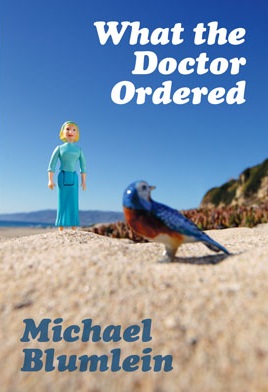
whatdoctororderedspread0What the Doctor Ordered, Michael Blumlein (2013). Blumlein has been a favourite writer for many years, but his short fiction has always been more impressive than his novels. And this new collection – only his second since 1990’s The Brains of Rats – amply demonstrates why Blumlein is such a brilliant short story writer. A much undersung writer who deserves to be better known. Incidentally, Centipede Press have done a lovely job with the book.

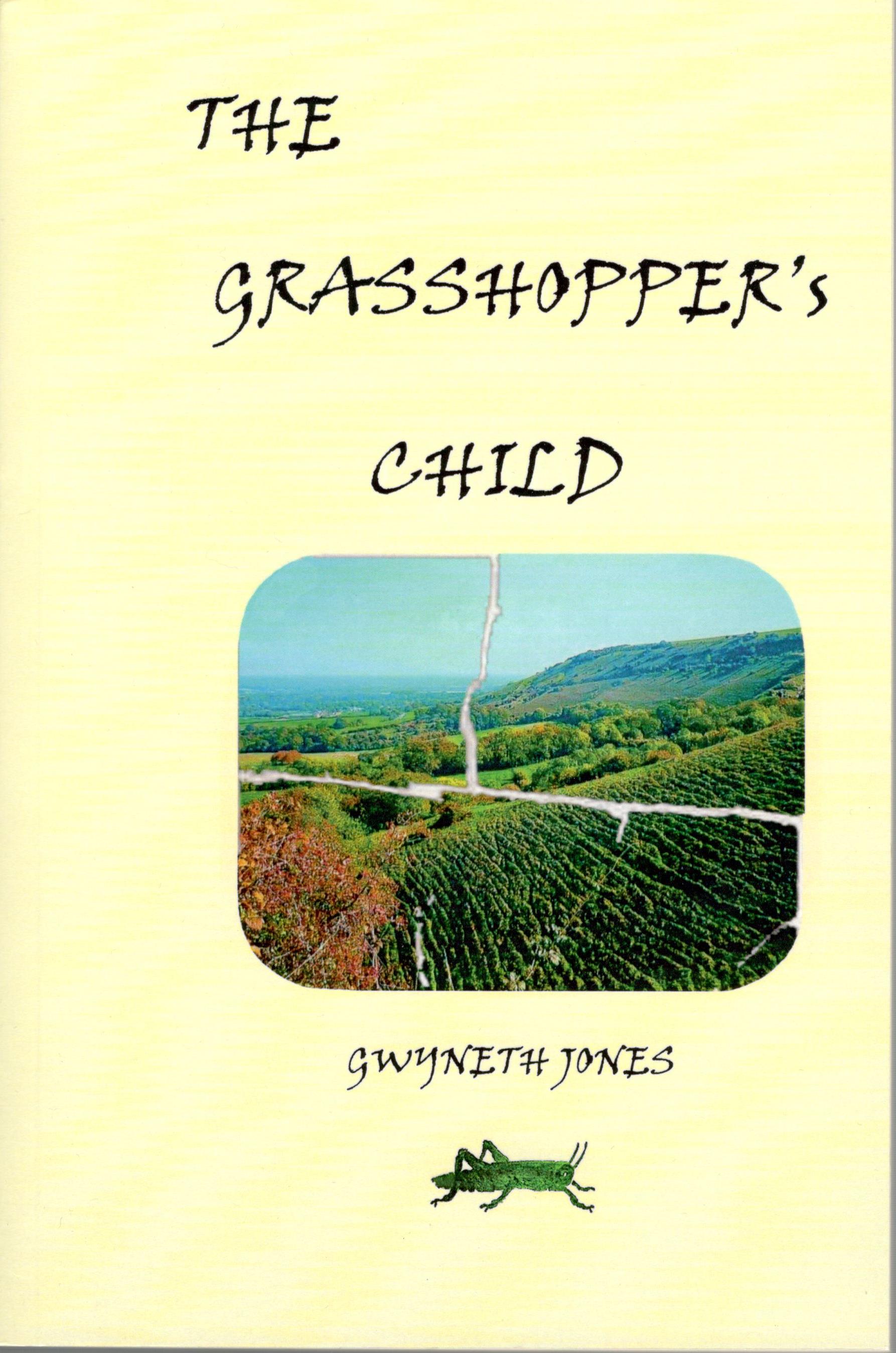
grasshopperschildThe Grasshopper’s Child, Gwyneth Jones (2014). A new novel from a favourite author. It’s actually a YA novel set in the universe of the not-YA Bold as Love quintet. There is a fierce intelligence to Jones’s books which shines through her prose, and it’s one of the reasons I consider her the UK’s best science fiction writer currently being published – except she isn’t these days, as The Grasshopper’s Child was self-published. Seriously, that shouldn’t be happening.

raj4A Division Of The Spoils, Paul Scott (1975). The final book of the Raj Quartet, and what a piece of work the quartet is. Scott is superb at handling voices, and in Barbie Batchelor has created one of fiction’s great characters – although this book belongs more to Guy Perron, a gentleman NCO keen to return to the UK now the war is over, but who comes into the orbit of the Layton family (who have been a constant presence running through all four books). I’m already looking forward to rereading the quartet.

the_leopardgThe Leopard, Giuseppe Tomasi di Lampedusa (1958). I watched the film of this and that persuaded me to read the book. And I’m glad I did. There are Lawrentian elements to it, although a story which valorises the aristocracy and (mostly) presents the lower classes as venal in order to demonstrate the coming of a new world order… would not be my first choice of reading. But Tomasi di Lampedusa manages to give his fading nobles an air of tragedy as their time passes, even if the Salina family’s paternalism feels like a relic of a much earlier age.

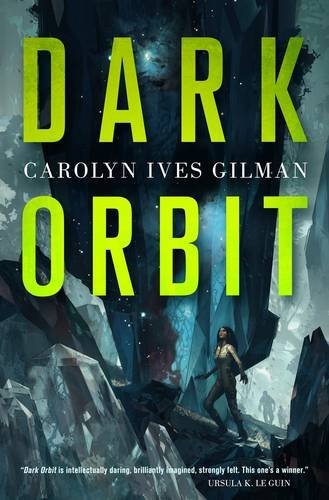
darkoribtDark Orbit, Carolyn Ives Gilman (2015). Another favourite author. This novel is set in the same universe as Gilman’s excellent novellas ‘The Ice Owl’ and ‘Arkfall’, and while some elements of the novel are not entirely successful, it does make use of some heavy concepts and it handles them really well. A science fiction novel that makes you think – and we really could do with more of them these days.

Honourable mentions. A pair of polished collections – The Lady of Situations, Stephen Dedman (1999), and Adam Robots, Adam Roberts (2013), not every story in them worked, but the good ones were very good indeed. Strange Bodies, Marcel Theroux (2013), which surprisingly seems to have been missed by much of sf fandom, which is a shame. A Man Lies Dreaming, Lavie Tidhar (2014), a pulp detective tale with a failed Hitler as the hero shouldn’t work, but this blackly comic take on it definitely does. Touch, Claire North (2015), is perhaps not as successful as last year’s The First Fifteen Lives of Harry August, as its fascinating premise is married to a weak plot; but never mind.

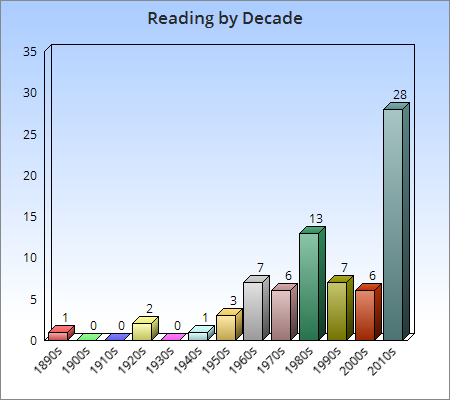
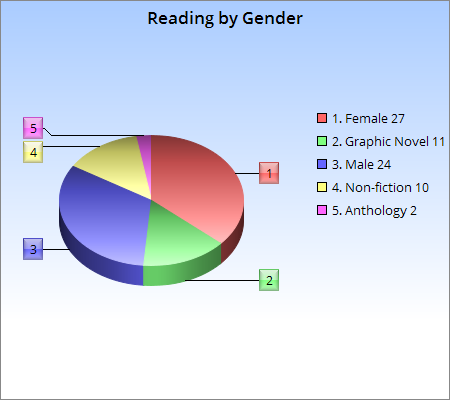
As usual, I’ve been collecting stats on my reading. And it breaks down as follows…

decade2015

I hadn’t realised I’d read so many recent books, and I’ve no idea why the 1980s is the next most popular decade – perhaps it’s due to the books I picked to review for SF Mistressworks. The one nineteenth century book was HG Wells, the two 1920s ones were DH Lawrence.

gender2015

I alternate genders when choosing fiction books to read, but I seem to have slipped up somewhere, and women writers currently outnumber men in my reading.

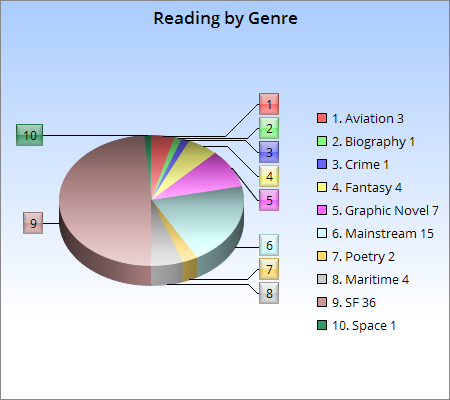
genre2015

It never feels like I read a lot of science fiction, but at almost half of my reading I guess I must be doing so. Mainstream is the next highest genre, but only twenty percent. To be fair, it seems the mainstream books are often more memorable than the genre ones. But at least the numbers explain the good showing by genre in my top five and honourable mentions.

films
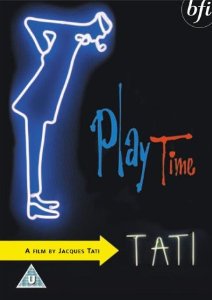
playtimePlaytime, Jacques Tati (1967, France). I’d never actually seen a Tati film until I rented Les Vacances de M Hulot last August. I enjoyed it, but something I read somewhere persuaded me to add his Playtime to my rental list. And I watched it for the first time early this year. And loved it so much, I bought a Blu-ray of it. And then I spotted that a Tati Blu-ray collection was on offer on Amazon, so I bought that too. But none of Tati’s other films blew me away as much as Playtime, although Mon Oncle comes a close second (and so makes my honourable mentions below).

elegy_voyageElegy of a Voyage, Aleksandr Sokurov (2001, Russia). I’ve watched this three times since I bought it, as part of my 2015 love affair with Sokurov’s films. As the title suggests, the film is a meditation on travel, and art, with Sokurov in voiceover describing a journey he takes which ends up at a museum in, I think, a German city. Elegy of a Voyage is everything that Sokurov does so well, that makes a film a Sokurov film. Not to mention the somewhat idiosyncratic artistic choices Sokurov makes, such as using a 4:3 aspect ratio, distorting the image so it almost resembles a painting, and the use of colour filters to further distance the viewer from the picture. The beauty of Sokurov’s films is not that they bear repeated viewings, but that they require it.

dayofwrathDay Of Wrath, Carl Theodor Dreyer (1943, Denmark). This year I also became a fan of Dreyer’s films – his Gertrud had been a favourite for a couple of years – but in 2015 I bought DVDs of all his available movies. And worked my way through them. The silent films are astonishingly modern – especially The Passion of Joan of Arc – but I do prefer the later films, and after Gertrud, Day Of Wrath is I think his next best – and like Gertrud, it’s about women and women’s roles in society, but this time set in 1623 and describing how a young woman saves her mother from a charge of witchcraft by marrying the local pastor. And then it all goes horribly wrong.

jodosduneJodorowsky’s Dune, Frank Pavich (2013, USA). One of the reasons I bought a Blu-ray player capable of playing multi-region Blu-rays was because I wanted to see this film – to date it has not been released in the UK. Jodorowsky’s Dune is a documentary about the unmade film adaptation of Frank Herbert’s novel, which only exists in concept art by Chris Foss, Moebius and HR Giger… and a complete storyboard “bible” which Jodorowsky’s producers sent to a number of US studios. A fascinating look at what could have been a fascinating film.

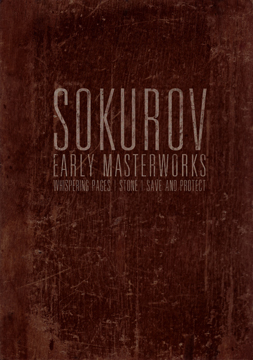
sokurov_earlyStone, Aleksandr Sokurov (1992, Russia). A young man looks after the house Chekhov once lived in, and then one night a man who might be Chekhov mysteriously appears… Filmed in black and white, elliptical and, in the second half, featuring Sokurov’s trademark timelapse photography of a snowy landscape. While Elegy of a Voyage is a documentary, this is fiction, but deeply allusive fiction – which is why I woke up the morning after watching this and discovered I’d gone and ordered a pair of Chekhov books from Amazon…

Honourable mentions. Fear Eats The Soul, Effi Briest and The Marriage of Maria Braun, all by Rainer Werner Fassbinder (1974, 1974 and 1979, Germany), and all from a DVD box set I received for Christmas, these were I felt the best three. The Big Red One, Samuel Fuller (1980, USA), I’m not a big fan of WWII films but this is a good one, and even manages to rise above what is obviously a smaller budget than most such films get. Mon Oncle, Jacques Tati (1958, France), more modernist low-key humour, which may not be as cinematically beautiful as Playtime, but comes a close second. James Cameron’s Deepsea Challenge, John Bruno, Ray Quint & Andrew White (2014, USA), another Blu-ray not available in the UK which motivated my purchase of a multi-region Blu-ray player, this documentary covers Cameron’s descent to Challenger Deep in 2012. Two or Three Things I Know About Her, Jean-Luc Godard (1967, France), although not a Godard fan I do love some of his films, such as this one, a study of a bored housewife who works on the side as a prostitute; I’ve already bunged the Criterion DVD on my wishlist. Whispering Pages and Spiritual Voices, Aleksandr Sokurov (1994 and 1995, Russia), a completely opaque drama and a deeply philosophical documentary (about Russian soldiers), yet more evidence of my admiration for Sokurov’s works. Moscow does not Believe in Tears, Vladimir Menshov (1980, USSR), an odd drama about three women in Moscow in the 1950s and the 1970s, which makes a pleasing antidote to US “evil empire” propaganda. Dilwale Dulhania Le Jayenge, Aditya Chopra (1995, India), a superior Bollywood film about UK-based NRIs and arranged marriages, with amusingly broad comedy, well-staged musical numbers and a pair of likeable leads. The Man from London, Béla Tarr (2007, Hungary), my first Tarr and probably the most plot-full of his films, and while I’m still not quite plugged into his brand of slow cinema, it’s definitely the sort of cinema that appeals to me.

As with books, I’ve been collecting stats on the films I’ve watched…

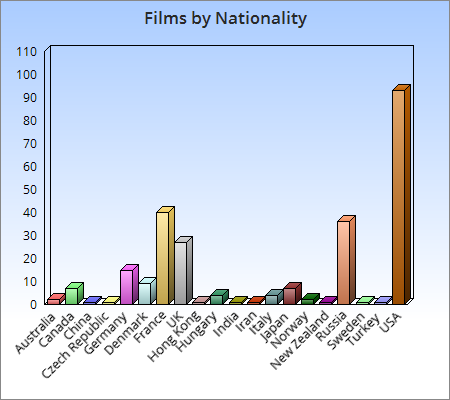
filmnation

I still seem to be watching mostly American films, but that’s likely because so many on 1001 Movies You Must See Before You Die list are American – or, at the very least, the US ones are easier to find (ie, readily available for rental). The good showing for Russia is, of course, Sokurov – several of his films I’ve watched two or three times already this year.

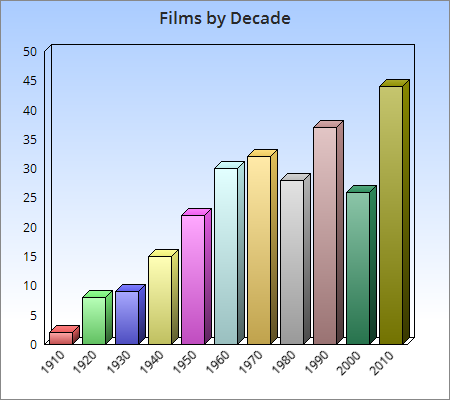
films decade

A reasonable spread across the decades, although I would have expected the fifties and sixties to do better than the seventies, as I much prefer films from those earlier two decades. The first decade of this millennium doesn’t seem to have done very well either, which is odd.

albums
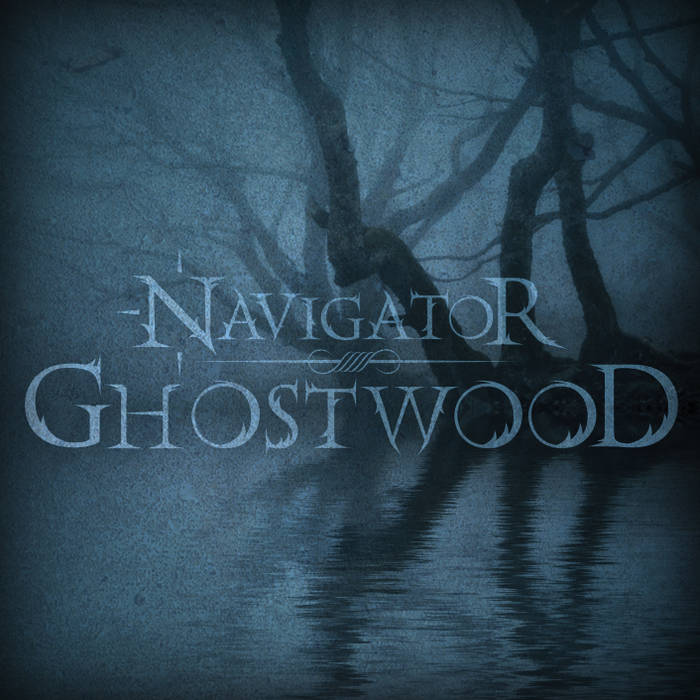
ghostwoodGhostwood, Navigator (2013). A US prog rock band I stumbled across on Bandcamp, and then began listening to repeatedly. In parts they remind me of Australia’s Chaos Divine, and though they describe themselves as “for fans of: Porcupine Tree”, I think I prefer this album to those by Steven Wilson’s band. There are a few bits of electronica in there somewhere, but also plenty of heavy riffing- the title tracks boasts especially good riffage. And very catchy melodies. Good stuff.

sidereusSidereus Nuncius, Apocynthion (2013). A Spanish death metal band with a death metal / post-metal sound not unlike NahemaH’s – who were also from Spain, but have sadly disbanded after only three albums. I hope Apocynthion stay together and produce many more albums. The opening track with its insistent drumbeat is especially good.

secretyouthSecret Youth, Callisto (2015). I bought a Callisto album several years ago, and though I enjoyed their brand of heavy post-metal I never bothered with any of their subsequent albums. But then Zero Tolerance magazine streamed this, their latest, I gave it a listen, discovered it was very different to their earlier album… and liked it so much I bought it. It’s still post-metal, but the growls have been mostly replaced by clean vocals, and in places there’s almost an early Anathema-ish sound to it.

worstcaseWorst Case Scenario, Synesthesia (2015). This was very much a lucky discovery and while at first they reminded me quite heavily of The Old Dead Tree – who, like Synesthesia, are also from France – repeated listens proved they definitely had their own thing going. Like The Old Dead Tree, they drift between death and goth metal, but they also throw quite a bit of prog into it, and it’s a mix that works well, even if in places they sound a bit Muse-ish.

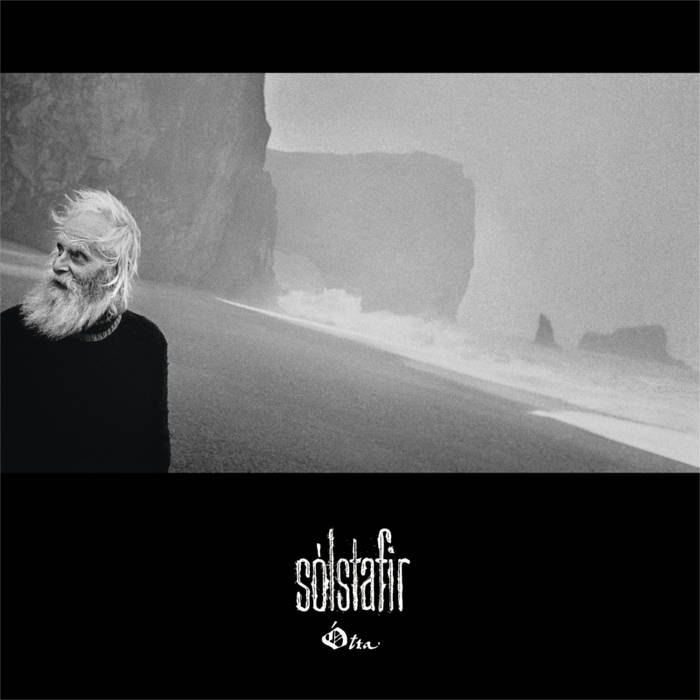
ottaÓtta, Sólstafir (2014). These Icelanders were excellent live, so I bought their last two albums (the only ones available on Bandcamp), and it’s hard to say which is the better of the two. There are a couple of cracking tracks on 2011’s Svartir Sandar, but I decided Ótta was just a little bit the better of the two, if only for the banjo-accompanied title track.

Honourable mentions. Doliu, Clouds (2014), a UK doom band, and the track ‘if these walls could speak’ is absolutely brilliant. Entransient, Entransient (2015), a US prog metal band with a bit of post-rock thrown in for good measure. Good stuff. The Malkuth Grimoire, Alkaloid (2015), a German progressive death metal supergroup, containing (ex-)members of Necrophagist, Obscura, Spawn of Possession, Aborted, Dark Fortress, God Dethroned, Blotted Science and Noneuclid, this is quality stuff, in the same area as Barren Earth but a very Germanic version. Svartir Sandar, Sólstafir (2011), see above. Half Blood, Horseback (2012), as the album’s Bandcamp page puts it, “shifts from Americana twang to fiercely evil buzzing guitars to hypnotically meditative kraut-drone”, which is as good a description as any; file alongside Ultraphallus.


4 Comments

Moving pictures, #16

It seemed like a good idea to document the films I watched throughout the year, especially since I was working my way through a 1001 Movies You Must See Before You Die list. What I hadn’t considered was how many movies I’d watch. And so have to document. Ah well. Here are more. Ones from the list indicated with an asterisk as usual.

mansfaveMan’s Favorite Sport?, Howard Hawks (1964, USA). I like Rock Hudson films, I like Technicolor films, I like screwball comedies. Throw in Howard Hawks as director, and Man’s Favorite Sport? ought to be a sure-fire winner. Sadly, it isn’t. Chiefly because it was written as a Cary Grant / Katherine Hepburn vehicle, but ended up with Rock Hudson and Paula Prentiss. While both are very good in their roles, Hudson isn’t Grant and has always performed better in Hudson roles. But, by god, the Technicolor certainly makes a picture of this moving, er, picture. The comedy has its moments, the chemistry on screen does create sparks, and Hudson does his best delivering the Grant one liners… but Man’s Favorite Sport? is mostly a lovely-looking film. Hudson plays a fishing expert at Abercrombie & Fitch, who has secretly never fished in his life. And then a fishing resort – represented by Prentiss – persuades his boss to enter him in a competition for publicity purposes. When Hudson comes clean, Prentiss and resort owner’s daughter Maria Perschy have to, er, teach a man to fish. A good piece of early sixties rom com, starring a master of the form and a rising comedic actress. For all its flaws, it’s still bags of fun.

banquetThe Banquet, Xiaogang Feng (2006, China). This was apparently based on Hamlet, although you’d have to be pretty forgiving to acknowledge it. Set in China during the tenth century, a crown prince has exiled himself to a remote theatre after his father married the noblewoman the prince was in love with. But then the emperor is killed by his brother, and assassins are sent to kill the prince. They fail, but he makes his way to the imperial court anyway, where things all get a bit complicated. Like a lot of wu xia movies, The Banquet is a pretty lush production, and the story covers pretty much all the bases – there are epic sword fights, gruesome deaths, love-making with lots of gauzy veils, complicated court politics, sumptuous sets and costumes… and an ending that comes completely out of left-field. One of the better wu xia films I’ve seen recently.

the_man_in_grey_uk_dvdThe Man In Grey*, Leslie Arliss (1943, UK). Stewart Grainger and Phyllis Calvert meet up at an auction room during WWII (he’s a RAF officer, she’s a WREN), and in the process of chatting her up inadvertently bids on a box of trinkets that are all that’s left of the Rohan aristocratic family. He admits to a connection to the Rohans and is far from complimentary; she admits the last male Rohan was her brother. The film then flashes back to the Regency period, and now Phyllis Calvert is an heiress at a posh school in Bath. After leaving school, she’s introduced to the ton, where the eponymous noble, James Mason, asks for her hand in marriage – mostly for appearance’s sake. Later, she bumps into an incorrigible rake, Grainger again, and is smitten by his charms. Grainger is an actor in a company with a woman Calvert was friendly with back in her school at Bath, and she invites the woman, Margaret Lockwood, now down on her luck, into her household. So you have a situation where Mason is having an affair with Lockwood, while Calvert is secretly in love with Grainger. It’s all a bit ploddingly predictable, if you know the form, and Mason’s presence, and the year of release, suggest it’s a “quota quickie” (Mason was a Quaker and refused to fight during WWII), none of which stands against it as some of those quota quickies were actually pretty good. This one is clearly held in such high regard it made the 1001 Movies You Must See Before You Die list, although to be honest I couldn’t see why. A watchable bit of Regency hokum, with an unneccessary contemporary (as of 1943) framing narrative, and a good turn by its leads… But it’s hard to see it as a classic.

networkNetwork*, Sidney Lumet (1976, USA). I’d assumed I’d seen this at some point in the past – the film is near enough forty years old, and it seems reasonable to assume it was on television several times during the 1980s – but if so, I’d completely forgotten everything about it… as I discovered when I started watching it. The other thing that readily became apparent was that its satire had completely lost its teeth. A corrupt and manipulative media? Driven by profit? That’s not satire, that’s reality. Turning Peter “I’m mad as hell and I’m not going to take it anymore” Finch’s nervous-breakdown news anchor into a prophet of the modern age is a bit, well, that horse has long bolted. And it was probably leaping a fence near the horizon when this film was released. Even casting Faye Dunaway as the ratings-hungry TV executive willing to do anything for the network just plays into your standard sexist arguments about women in the workplace. Some films belong on the 1001 Movies You Must See Before You Die list; some don’t. This is one of the latter. Um, maybe I should put together my own list…

2or3things2 or 3 Things I Know About Her*, Jean-Luc Godard (1967, France). I have mixed feelings about Godard’s films. Most I’ve found a bit dull, but I absolutely adored Le Mépris. And while he’s never been afraid to experiment with the form – something I admire in directors – he was also hugely prolific. So after the disappointing Masculin Féminin (see here), I wasn’t expecting much of 2 or 3 Things I Know About Her. But I actually thought it really good. My second favourite Godard, so far. And I liked it enough to want to watch more of his films. 2 or 3 Things I Know About Her is basically a film study of Marina Vlady, who plays a bourgeois mother who also has sex for money. It follows her as she does housewife things interspersed with meetings with clients. Occasionally, she, and other members of the cast, break the fourth wall. There are also shots of building works in Paris, and some nice concrete architecture. Apparently, this was one of three films Godard made in 1967 – he’d shoot 2 or 3 Things I Know About Her in the morning and Made in USA in the afternoon. Like I said, some films belong on the 1001 Movies You Must See Before You Die list, some don’t. This is one of  the former. I think I’ll get myself a copy of this film, on Blu-ray if I can.

joanofarcThe Passion of Joan of Arc*, Carl Theodor Dreyer (1928, France). Another director I seem to have fastened on to it is Carl Theodor Dreyer, and it’s certainly true Gertrud is a favourite film and I hold Day Of Wrath in high regard… It could be argued that The Passion of Joan of Arc is his most famous film, despite being silent and originally released in 1928. But even though nearly ninety years old it’s an astonishingly… modern film, with its reliance on close-ups and the quite brutal way it depicts Joan of Arc’s burning at the stake. In fact, even the look and feel of the film is weirdly modern. Watching the movie, it’s hard to believe it was made in 1928. Happily, eureka! have done a bang-up job on releasing it on DVD (and Blu-ray). The slipcase not only includes the disc but also a thick booklet on the film. And so it should: The Passion of Joan of Arc is an important film, and should be treated as such. It’s just a shame many other important films are not treated as well.

fatherlandFatherland, Christopher Menaul (1994, USA). Apparently Mike Nichols spent $1 million on the film rights for Robert Harris’s novel but couldn’t interest any studios in the project. So HBO made it as a TV movie instead. And although it netted Miranda Richardson a Golden Globe, it’s actually not very good. Hitler victorious is likely the most popular form of alternate history, but Harris gave his version an interesting spin – setting his story twenty years later, as celebrations for Hitler’s 75th birthday are ramping up throughout Germania, and which will culminate in an historic meeting between the Führer and US President Joe Kennedy Senior. Unfortunately, the death of a party figure starts SS Major March on an investigation which threatens to uncover the Reich’s biggest secret (hint: it’s not a secret in the real world). Rutger Hauer, a Dutchman, plays March, a German; while Miranda Richardson, a Brit, plays Charlie McGuire, an American reporter in Berlin for the festivities who gets dragged into the affair. The film was apparently made in Prague, which doesn’t stand in for Berlin especially well, and the production can’t seem to decide if it should present Germania as a German-speaking nation or, as is often the case in English-language productions, have everyone speak English so subtitles are not needed. So it does a bit of both. The plot is also thuddingly predictable, whether you know the source text or not; and Hauer is a bit too laconic to convince as a SS officer. Disappointing.

1001 Movies You Must See Before You Die count: 599


1 Comment

Retail therapy

There are many different forms of retail therapy. Some people buy shoes, some people buy clothes they wear once and then abandon in their wardrobe. I buy books, often hard-to-find secondhand books – and, yes, it may well take me years before I get around to reading them, but never mind. Here is the latest batch…

2015-06-12 15.53.00

Two books about aircraft. I pick up copies of Wings of Fame when good condition ones appear on eBay. I now have all but four of its twenty-issue run. The Handley Page Victor was one of the most iconic-looking of the Cold War bombers, and there were quite a few that looked pretty iconic. I remember seeing a simulator at some RAF exhibition many years ago. Urban Structures for the Future, on the other hand, is architecture – futurist architecture from 1971, in fact. I saw it on eBay and couldn’t resist.

2015-06-12 15.53.27

And from the air to beneath the sea. Project SEALAB is a 1966 junior book about the US Navy project to study living at the bottom of the sea, which ended in tragedy with SEALAB III. I wrote about it here. Diving for Science is, as the cover states, a history of deep submersibles, and Farming the Sea is about living, and farming of course, underwater.

2015-06-12 15.54.02

Two more installments in a pair of Cinebook series, both translated from the French. The Septimus Wave follows on from an earlier book, The Yellow “M”. Châtelet Station, Destination Cassiopeia, however, is the first of a two-parter. They are volumes twenty and nine in their series respectively. I wrote about both of them here.

2015-06-12 15.54.27

Sisters of The Revolution I backed on kickstarter, and though it took a while to appear it looks like it was worth the wait. It’s an anthology of femininst sf by women writers, and it contains a few favourites. Hearing Voices is an anthology of fiction reprinted from Litro magazine and includes my story of Space Age fashion and Apollo astronauts, ‘The Spaceman and the Moon Girl’. The Language of Power is the fourth – but not the last, one hopes – in Kirstein’s Steerswoman series. I noticed copies were getting a bit scarce so I thought it time to pick one up.

2015-06-12 15.54.50

Despite the fancy cover design, Poseidon’s Wake is the final book of the Poseidon’s Children trilogy. The Lady from Zagreb is the tenth Bernie Gunther book from Philip Kerr, who’s now churning out novels like a machine. Gilead is a signed first edtion.

2015-06-12 15.55.29

And while I’m at it – this, Gollancz, is not how you do a trilogy. Two books that match and then… seriously?


Leave a comment

Moving pictures, #15

And it’s back to movies, with the usual somewhat eclectic collection of viewing. As usual, films on the 1001 Movies You Must See Before You Die list are asteriskificated.

mapstothestarsMaps to the Stars, David Cronenberg (2014, Canada). Ah, movies about people who make movies, people who make millions for very little work, who live lives of wealth and privilege and think people actually give a shit about them. And that’s pretty much Maps to the Stars, which focuses on a Hollywood family – there’s a famous TV shrink, the son is the child star of a very profitable franchise, the mother manages the son, and the daughter… Well, the story is really about the daughter, who was institutionalised elsewhere after a past arson attempt… but now she’s back in town. And being drove around by Robert Pattinson. There’s also a fading actress, who’s trying to land the lead role in a remake of her mother’s most famous film, and is having a somewhat unemotional affair with the TV shrink. Oh, and the son is trying hang onto his role after a stint in rehab and a co-star who gets all the best lines. I like metafiction because it’s about the mechanics of fiction, but films about film-making mostly seem to focus on the frankly unlikable personalities who profit from the successes of the movie industry. It’s a bit like the US equivalent of Downton Abbey. Admittedly, this is Cronenberg – and you expect something more from him than just another inward-looking Hollywood-movie-about-Hollywood, populated with a cast where it’s impossible to tell who is the more self-involved – the characters or the actors playing them. And true, Cronenberg throws in some minor weirdness to leaven the unremitting rich-people-problems, but it’s not really enough. Even claims that the film recapitulates in allegorical form the decline of Western civilisation seems like one of those feeble excuses five-year-olds are prone to come out with when found in the presence of an expensive broken vase.

jodosduneJodorowsky’s Dune, Frank Pavich (2013, USA/France). Top of the list of films that were never made is Alejandro Jodorowsky’s adaptation of Frank Herbert’s Dune. It only survives in numerous pieces of concept art – although given the artists, Moebius, Chris Foss, Giger, it’s no wonder it survives – and six “bibles” produced by the French production company in order to sell the project to Hollywood studios while drumming up finance. Jodorowsky still has a copy, but it’s not known what happened to the others. Jodorowsky’s Dune is the story of the film, which reached a much further point in preproduction than I’d thought, and was only scuppered because Hollywood was unwilling to entrust it to Jodorowsky. But I’ve always believed it would have been a magnificent piece of cinema, and this documentary only reinforces that belief. Perhpas the most fascinating part of the film – and it’s a close call as the damn thing is fascinating throughout – is where it shows the impact Jodorowsky’s project had on subsequent science fiction films. It’s not just that his “team” – O’Bannon, Foss, Giger, Moebius, etc – went on to work on other films, but also that elements of his storyboard ended up in completely unrelated sf movies. Sadly, Jodorowsky’s Dune is only available as Region A Blu-ray, but it does include a Region 1 DVD – so you might as well get it anyway. Because it’s totally worth it.

ossessioneOssessione*, Luchino Visconti (1943, Italy). An early piece of Italian neorealist cinema, if not the first film labelled as such. I am not a huge fan of Italian neorealist films, although I love a number of Italian movies (especially those by Antonioni); nor is Visconti among my front rank of directors. I suspect Ossessione is on the 1001 Movies You Must See Before You Die list because of its position as the first Italian neorealist film, because in most other respects it’s relatively ordinary. A tramp finds work at a provincial restaurant, has an affair with the owner’s wife, and the two of them plot to kill her husband. But he dies accidentally… but the boyfriend still ends up going down for it. It’s apparently based on Cain’s The Postman Always Rings Twice. Which I know I’ve not read, but I might have seen one of the film adaptations…

nowyouseemeNow You See Me, Louis Leterrier (2013, USA/France). The charity shop were doing a buy-one-get-one-free offer, so I went for this one although I really don’t like glossy Hollywood thrillers at all. Admittedly, the elevator pitch did sound intriguing: a group of illusionists pull off a series of bank robberies. Having now seen Now You See Me, I dislike glossy Hollywood thrillers even more. Jesse Eisenberg proves once again he has as much onscreen charisma as a dead badger, not to mention a talent for playing characters you’d swerve to run over if you saw them crossing the street. The remainder of the cast are pretty much standard for the type of film, the elevator pitch – illusionists! making the crimes! – is spoiled by the illusions clearly being the result of CGI trickery (except, of course, for those that are “explained”), and it’s all as slick and unmemorable as a cheap supermarket kagool. Avoid.

keeperThe Keeper Of Lost Causes, Mikkel Nørgaard (2013, Denmark). My mother is a fan of Alder-Olsen’s novels, and when I spotted this film adaptation of his debut in a charity shop, I decided to give it a go. It’s a Nordic crime thriller, which pretty much hits all the clichés, opening with a police raid that goes badly wrong and in which only our brooding Nordic detective escapes uninjured. But not unscathed. After a medical leave of absence, he’s given a makework job, closing cold cases in Department Q. But not apparently closing cases – he’s not supposed to solve them, just mark them as unsolved and archive them. Or something. But the first one he picks, he decides to solve. A woman disappeared on a ferry, and the death was marked down as suicide, even though the woman had shown no suicidal tendencies. Nordic detective, however, with the help of faithful sidekick of Arab extraction, is made of sufficiently stern stuff to ignore any complaints or threats from his boss, and proves the woman is still alive! In a saturation system! Built in a barn by a nutter! Apparently, checking off every Nordic crime trope wasn’t enough, the makers of this film also had to get the hyperbaric element completely wrong. I can’t speak for the books, but this film adaptation is distinctly unimpressive.

fireworksFireworks Wednesday, Asghar Farhadi (2006, Iran). Some of the best films I’ve seen over the past few years have been from Iran, and Asghar Farhadi’s About Elly is one of the best of those. So I made an effort to seek out some of his earlier films. The title of this one refers to New Year’s Day, when fireworks are let off as part of the celebrations; but it could also be seen as a reference to the internal dynamics of the family at the centre of the story. A young woman about to be wed gets a temporary job cleaning the flat of a family who had have just had it repainted but are now apparently off to Dubai for a short holiday. Except relations between husband and wife are not at their best… because she suspects him of having an affair with a divorcee who runs a beauty salon in their block of apartments. Both husband and wife enlist the young woman in their attempts to prove their suspicions – but that’s all beside the point as Fireworks Wednesday is more of a character protrait of the wife than anything else, and it’s superbly done. Farhadi may be a less formally experimental director than Kiarostami, but he is nonetheless a world-class talent. Seek out all his films and watch them.

orientalelegyOriental Elegy, Aleksandr Sokurov (1996, Russia/Japan). Unfortunately, I have yet to source a copy of this DVD (which actually comprises three films), but I did find a copy of ‘Oriental Elegy’ on Youtube with subtitles. So I downloaded it to a USB drive and watched it on my telly. The quality was… not the best. Although given that this is one of Sokurov’s “elegies”, and his propensity for post-production visual effects, that’s perhaps not so much of an issue. I would seriously like to see  – and own – a decent copy of this. It’s fairly typical for Sokurov, a meditation on life and death prompted by a traveller’s visit to a strange Japanese town, where he listens to the testimonies of various people, amd where distorted cinematography helps illustrate the words spoken by the traveller in voice over. Like most Sokurov films, I’m going to have to watch this a number of times to figure it out. Now that’s value for money…

1001 Movies You Must See Before You Die count: 595


2 Comments

The Great Big Apollo Giveaway

Well, okay, perhaps “great big” is something of an exaggeration. But the giveaway bit isn’t! Anyway, because the Apollo Quartet is at last completed, I have decided to give away five copies of the entire quartet in either mobi or epub ebook format. That’s Adrift on the Sea of Rains, The Eye With Which The Universe Beholds Itself, Then Will The Great Ocean Wash Deep Above and All That Outer Space Allows.

KSC-visitors-view-apollo

For those of you now going: Apollo, eh? Quartet, eh? What’s that, then? The three novellas and short novel are as follows:

AQ1_2nd_edn_coverAdrift on the Sea of Rains
In an alternate 1980s in which the Apollo programme was taken over by the military, a group of astronauts are left stranded at the USA’s only moon base when nuclear war destroys the earth. However, they have with them a Nazi Wunderwaffe, the Bell, which might help them find a home before the supplies run out. Winner of the British Science Fiction Award in 2013. Available for purchase in paperback and on Kindle (UK | US).

AQ2_2nd_edn_coverThe Eye With Which The Universe Beholds Itself
The US has had a research station on an exoplanet since the mid-1990s, but at the turn of the millennium it mysteriously vanishes. Bradley Elliott, the first – and only – man to walk on the surface of Mars is sent to find out what happened… because the solution to the mystery may be linked to what he found at Cydonia back in the 1980. Available for purchase in limited hardback, paperback and on Kindle (UK | US).

AQ3_2nd_edn_coverThen Will The Great Ocean Wash Deep Above
The Korean War has heated up and the US needs all its soldiers and pilots to fight the Sino-Soviet forces. So NASA decides to use the Mercury 13, a group of women pilots who passed the same medical tests as the Mercury 7, for their space programme. Meanwhile, the bathyscaphe Trieste II must descend 20,000 feet into the Puerto Rico Trench to recover a spy satellite film canister that went off-course. The crew find something a good deal stranger down there. Available for purchase in limited hardback, paperback and on Kindle (UK | US).

Screen Shot 2014-10-08 at 3.46.35 PMAll That Outer Space Allows
A science fiction writer’s husband is selected by NASA for the Apollo programme, and she finds herself on the periphery of the most science-fictional endeavour of the twentieth century. But is she a science fiction writer first, or an astronaut’s wife? Because her husband’s career depends on her being the latter – even though she is determined to use her access to the Apollo programme as inspiration for her stories. Available for purchase in limited hardback, paperback and on Kindle (UK | US).

How to win a copy of this amazing quartet? Easy. Just send an email to editor (at) whippleshieldbooks (dot) com, with the subject line APOLLO GIVEAWAY. Closing date is noon GMT on 11 June 2015. I’ll then do some randomising magic and pick five lucky winners. Please specify in your email whether you’d prefer epub or mobi format.


6 Comments

A prospect of space opera, part two

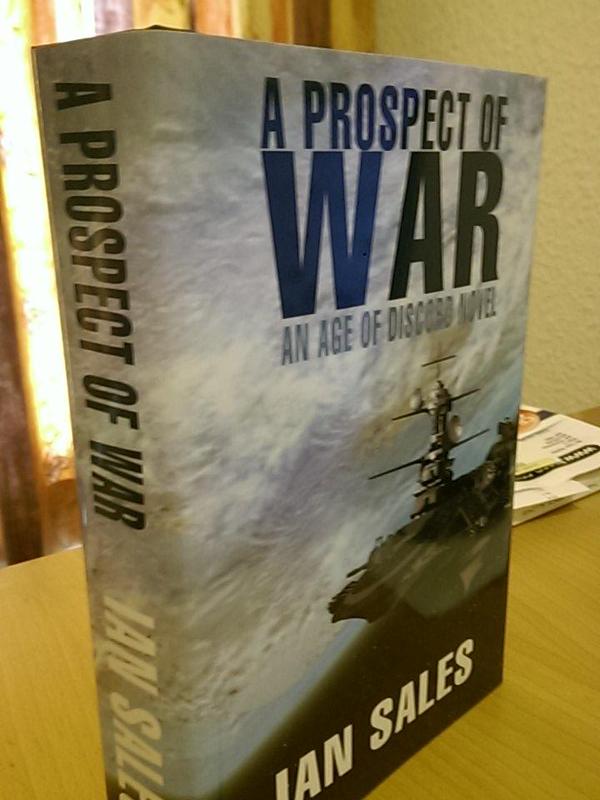
If you want a book to sell, you have to be pretty relentless in pushing it all the time, but I can’t say it’s something I enjoy doing. I’ve always believed you judge a person by their deeds, not their words. Except in this case, the deeds, er, are the words. Or something. So consider this blog post, a discussion of some aspects of the universe of my space opera, A Prospect of War, and space opera in general, as in the nature of a a discreet poke to remind you that HEY, I JUST HAD A SPACE OPERA PUBLISHED BY TICKETY BOO PRESS AND IT’S AVAILABLE FOR PURCHASE ON KINDLE (a hardback edition will be launched in July).

Serfs up, dude
The interstellar empire in which A Prospect of War takes place is feudal. It’s not the only political system you might find in a space opera novel, although it’s a relatively common one. But when the speed of communication is limited to the speed of travel – and travel itself is slow and often uncertain – local government needs a high degree of autonomy. However, if the throne is going to maintain control, it needs to know those running things locally have its interests at heart, and what better remote rulers than a group of people tied to the throne by chains of privilege, self-interest and obligation. They owe their position to the throne, and they’re well-rewarded for enacting the throne’s wishes. And, of course, should one get out of line, there’s always the threat of the throne organising the others to gang up on them.

Having said all that, such a political structure only works if everyone has clearly defined roles and responsibilities. And that includes the people at the bottom. They’re going to be the most numerous, so they need to be the most tightly-controlled. Such as, not letting them travel. Pretty much like serfs back in the Middle Ages. The serfs would be the economic resources in a fief, and in return are protected, and to some degree succoured, by the noble who owns their bond. But you can’t just have serfs and nobles, since the latter have enough on their plate without also managing the serfs. So you need a freeman or franklin class between the two…

One point to bear in mind is that these social classes are real to the people in them. Serfs – or, as I called them in A Prospect of War, proles – can’t just go gallivanting off on adventures just because some interesting stranger passes through their village. A franklin – or yeoman – arguably might, but they have their own responsibilities and obligations. As for the nobility… Well, the genre has enough stories about over-privileged oafs trampling all over the rank and file in defence of another group of over-privileged oafs – oh wait, that’s what my space opera is about… Or is it?

Reeve_and_Serfs

But back to the government side of things… When it comes to an interstellar empire, there’s another factor to take into account: anyone who rules the space between planets automatically has the high ground. No world is safe from orbit. This is where the navy comes in. They don’t so much enforce the throne’s rule as rattle sabres menacingly from orbit. Needless to say, space is big. Really big. Vastly, hugely, mindboggingly big. To borrow a phrase. Things can get lost, really lost, in space. So I cheated. In A Prospect of War, interstellar travel takes place using a sort of hyperspace, an alternate dimension, called the toposphere. This means there’s effectively no actual space between planetary systems, it’s completely out of the equation. It’s as if the countryside between city-states didn’t exist – though a journey still takes a certain amount of time. This makes the concept of an imperial navy much more plausible.

The Imperial Navy in A Prospect of War is one of three institutions which effectively rule the empire, alongside the civil government and the regnal government. In Dune, Frank Herbert writes “In politics, the tripod is he most unstable of all structures”, but since I can’t find any other reference to that sentiment I suspect he just made it up. Certainly for my space opera universe, I decided a tripod was no more and no less unstable than any other form of government. Besides, the nature of an interstellar empire and the history of that empire naturally inclined to a three-way balance of power – the navy to safeguard the space between worlds, the nobility to rule the individual worlds, and the throne as the ultimate recipient of fealty. However, in my universe past events had seen enfranchisement develop among the nobility, leading to a legislative forum, an electorate, and also an administration to support it – the civil government. And this despite the fact the throne already had an administration in place to enact its will – the regnal government. So, there’s some duplication of government institutions – like the Imperial Exchequer (regnal) and the Imperial Treasury (civil). Some of the plot of the trilogy is driven by the politics between these two governments, just as much as it is by the conspiracy which intends to overthrow either, or both, of them.

What, no guns? At all?
One thing I knew people would notice about A Prospect of War is that it’s a space opera, set in space, with spaceships… but everyone has swords. Just swords. No guns. I liked the idea of swords as personal weapons, because they made violence intimate. And they also made handy signifiers of social class – because swords need skill to use, which means training, which means spending money. And the more money a person spends, the better their teacher, and so the better a swordfighter they become. Unlike a gun, a sword is not a democratic weapon. The empire of A Prospect of War is not a democracy.

koppen-treatise-1619

If people carry swords, what’s to prevent someone else from, well, just shooting them? We all know that scene in Raiders Of The Lost Ark (this one). My solution was to, er, pretend guns don’t exist. No projectile weapons. No gunpowder. Just never got invented. It requires a leap of faith, but I’ve been told it works. True, there are “directed-energy” plasma cannons, but they need lots of power, so a lack of handheld versions isn’t implausible. (It’s implied in the novels that the five space opera technologies, which includes directed-energy, are used without any real theoretical understanding – a consequence of them having been reverse-engineered from a derelict spaceship millennia before.) Besides, space opera blasters – guns of any description – aren’t very dramatic. Swordfights are much more exciting. Just as long they’re not those interminable Hollywood swashbuckles, of course.

But if swords are badges of social rank, then not everyone can have them. Especially not proles. Contrary to the belief of one particular nation state, an armed populace is not necessarily the best defence against… well, anything. And although the empire has an emperor and dukes and earls, etc, it’s not precisely a tyranny. So, no swords for proles. They only get to use knives and non-edged weapons. Even the soldiers. Well, except for the marines, who use boarding-axes, as much because they’re useful tools in boarding actions as because they’re lethal close-order weapons.

All this makes for interesting battles, a sort of Age of Reason-type mass combat but without the firearms. There’s hugely lethal artillery – the directed-energy cannons – and a much higher degree of mobility than was historically the case… but otherwise it’s pretty much two lines of soldiers charging forward and lamping each other with maces. Which also makes the violence in a battle very much more intimate than if guns existed. And making violence intimate makes it that much more dramatic. Especially when the reader is emotionally invested in the characters… As I would hope they are.